Only xxx Can Save the Crypto World? Let 'Lobster' Play Prediction Markets

比推Опубліковано о 2026-03-17Востаннє оновлено о 2026-03-17

Анотація

This article discusses recent hot topics in the crypto community, as shared by influencers on X (formerly Twitter). Key points include: - Debate around an AI arbitrage bot allegedly earning $98K on Polymarket using Claude. Skeptics point to potential survivorship bias, liquidity constraints, and the rapid decay of alpha once strategies are public. - A resource sharing over 11,000 high-quality image generation prompts for Nano Banana Pro. - Commentary on Venus Protocol, highlighting its vulnerability to repeated exploits, with a linked analysis of how to profit from a recent attack. - A controversial opinion piece by influencer @BTCdayu arguing that only Sam Bankman-Fried (SBF) can "save crypto." The author claims that despite SBF's crimes and 25-year sentence, his genius is needed to address current industry crises: VC-backed altcoins scamming users, Bitcoin miners pivoting to AI, broken tokenomics, and a lack of new narratives. SBF's background at Jane Street, his innovative FTX trading system, and his early bets on AI (like Anthropic) are cited as reasons he could drive integration between AI and crypto, potentially pushing BTC to $1 million. This sparked heated discussion, with replies noting the improbability of a pardon, SBF's likely shift to AI, and that this nostalgia reflects a bygone era of "capital, narrative, and runaway imagination." The article concludes with links to the news outlet's social channels. All content is presented as personal opinion and not invest...

Dear readers, hello~

What were the crypto KOLs talking about in the past 24 hours?

Note: The following content is compiled from the X platform and represents personal opinions, not the stance of this platform, and does not constitute investment advice.

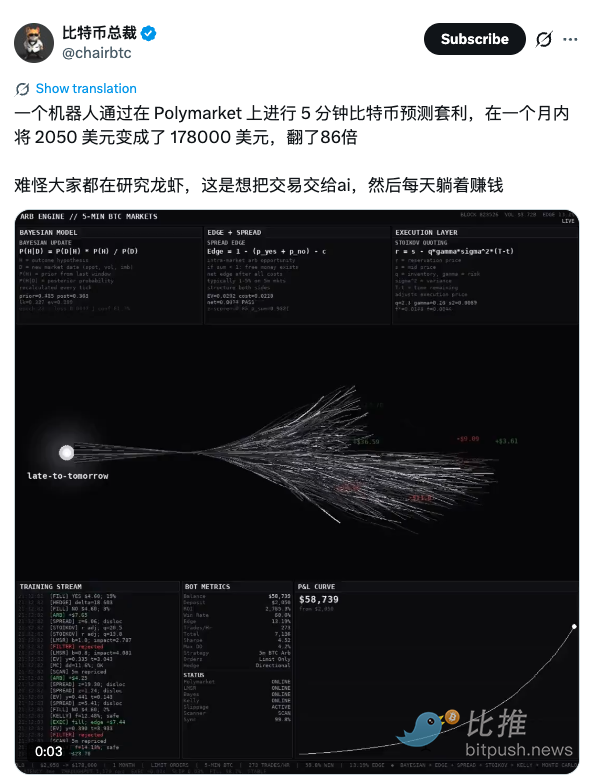
AI Arbitrage Bot: Real or Fake?
Popular Replies:

  • Someone claimed to have made $98K using Claude on Polymarket. I verified: the money is real, the story is fabricated.

  • If the little lobster wants to do 5-minute market detection, the detection frequency should be at least at the ms level, right? Then the consumption of tokens could make someone a "millionaire in debt."

  • 86 times sounds scary, but there are a few issues: 1) Sample bias? Losing bots don't tweet. 2) How much scale can Polymarket's liquidity support? 3) Once the strategy is public, the Alpha disappears. To truly verify sustainability, at least 3 months of backtesting + maximum drawdown is needed;

  • Is this AI just survivor bias? Most losing AIs are too ashamed to show up;

Over 11,000 High-Quality Image Generation Prompts for Nano Banana Pro

Resource self-service: https://github.com/YouMind-OpenLab/awesome-nano-banana-pro-prompts


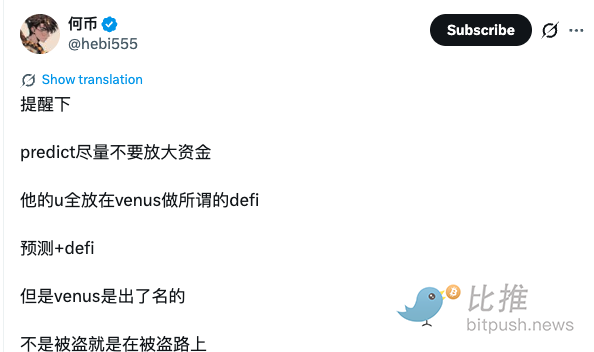
Venus is Either Being Hacked or on the Way to Being Hacked

Recap on how to profit from the Venus THE attack: https://x.com/hklst4r/status/2033182792029294736
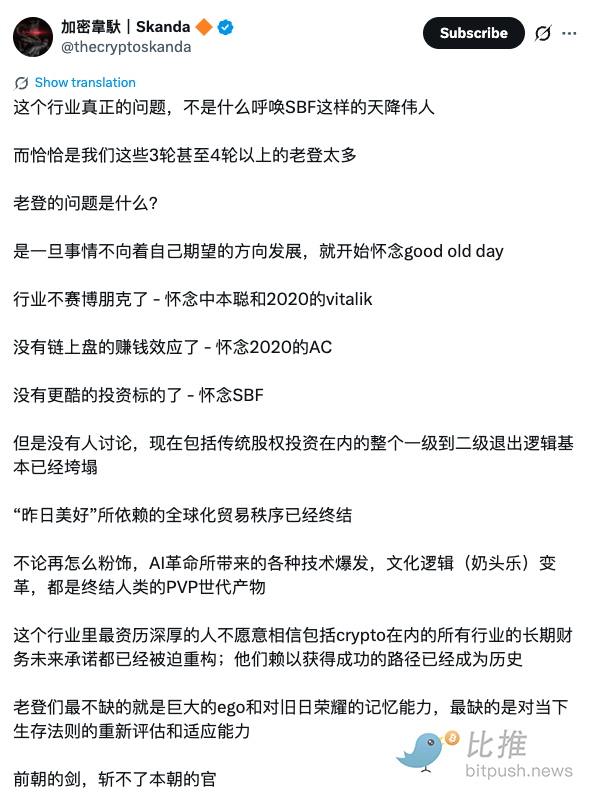
Who Can Save the Crypto World?

Crypto KOL @BTCdayu wrote: Only SBF Can Save the Crypto World.

The author believes that although SBF's misappropriation of funds is a serious crime deserving of a 25-year sentence, the crypto world urgently needs his genius mind to save it from the current crisis: VC altcoins scamming retail, BTC mining farms transitioning to AI, token economics becoming a joke, and a lack of new narratives. SBF, from Jane Street, innovated the FTX trading system, heavily invested in AI projects like Anthropic (potential trillion-dollar returns), and understands the integration of AI and Crypto. If pardoned, he could reconstruct computing power, build an AI Agent settlement layer, inject new capital energy, and push BTC to $1 million. His core view: Forgiveness is not forgetting, but allowing genius to create value under regulation and rules.

The article sparked heated discussion:
Popular Replies:

  • Even if SBF is pardoned, he might not work in crypto anymore, as his business acumen in AI is even higher.

  • He cannot be pardoned. First, he backed the wrong side back then. Second, if you're going the political donation route, you绝对不能中途跳船 (absolutely cannot jump ship midway).

  • Remembering SBF is actually remembering the crypto era of "capital, narrative, and imagination expanding uncontrollably." In that cycle, VC money flooded in like liquidity, "effective altruism" could coexist with high leverage, and big fools holding onto a belief coin could see hundred or thousand-fold gains... So it's about time to wash up and sleep.

  • Staying sober in a bear market is more precious than幻想暴富 (fantasizing about getting rich quick).

  • Surviving > Making money


Twitter: https://twitter.com/BitpushNewsCN

Bitpush TG Discussion Group: https://t.me/BitPushCommunity

Bitpush TG Subscription: https://t.me/bitpush

Original link: https://www.bitpush.news/articles/7620287

Пов'язані питання

QWhat is the main argument presented in the article regarding who can save the crypto circle?

AThe article presents the argument that only SBF (Sam Bankman-Fried), despite his criminal conviction, can save the crypto circle with his genius mind, innovative capabilities from his Jane Street background, and his foresight in AI and crypto fusion.

QWhat are the key criticisms or concerns raised about the AI arbitrage bot story mentioned in the article?

AThe key criticisms include potential survivorship bias (only profitable bots are publicized), questions about the scalability given Polymarket's liquidity, and the concern that the trading alpha would disappear once the strategy is made public.

QAccording to the article, what was the Venus protocol incident about?

AThe Venus protocol was reportedly exploited, and the article includes a link to a复盘 (post-mortem analysis) on how to profit from the Venus THE attack, indicating it was a security incident or hack.

QWhat is the Nano Banana Pro mentioned in the article, and what resource is provided for it?

ANano Banana Pro appears to be an AI image generation tool or model. The article provides a link to a GitHub repository containing over 11,000 high-quality image generation prompts for it.

QWhat is the general sentiment among commentators regarding the 'Only SBF can save crypto' proposal?

AThe sentiment is largely skeptical and critical. Commentators point out that SBF is unlikely to be pardoned, that he might not return to crypto even if he was, and that the piece is more a nostalgic reflection on a past era of crypto excess rather than a practical solution.

Пов'язані матеріали

Why Pricing Social Interactions is Doomed to Fail?

Titled "Why Putting a Price on Social Interaction Is Doomed to Fail," this article critiques attempts to monetize social networks directly through SocialFi models, arguing their inevitable failure stems from a fundamental misunderstanding of media dynamics. Using Marshall McLuhan's theory of "hot" and "cold" media, the author posits that social networks are inherently "cold" media. Their value isn't contained in individual posts but is co-created through user participation, interpretation, and fragmented, ongoing interaction (e.g., replies, shares). This ambiguity and need for user involvement are core to their function. The article asserts that SocialFi projects like Friend.tech failed because introducing real-time, tradable financial pricing (a definitive "hot" signal) into this "cold" environment doesn't add a layer—it replaces the medium's essence. The unambiguous price signal overshadows and nullifies the nuanced, participatory social signal. Users become traders, not participants, and when speculative profits vanish, the underlying social ecosystem—never genuinely cultivated—collapses entirely. This principle extends beyond crypto. The author argues platforms like Twitter have gradually "heated up" through metrics (likes, retweets counts, algorithmically defined value), shifting users from participants to performers and eroding organic engagement. The solution isn't to abandon capital but to manage its entry point. Successful models like Substack, Patreon, or Bandcamp allow capital to "condense" at specific, isolated nodes (e.g., subscriptions, one-time payments) without permeating and "heating" every social interaction. They preserve the core "cold," participatory medium while enabling monetization at designated boundaries. The NFT boom and bust serves as a stark parallel: the ancient "cold" medium of collecting (valued for story, community, gradual accumulation) was rapidly destroyed by platforms that introduced real-time floor prices, rarity scores, and trading dashboards, transforming collectors into speculators and vaporizing cultural value when prices fell. The core lesson: "Liquidity equals heat." Injecting high liquidity and definitive pricing into a "cold" participatory medium doesn't optimize it; it fundamentally alters and destroys its value-creating mechanism. The future lies not in pricing every social gesture but in finding precise, non-invasive points for capital to condense without overheating the entire ecosystem.

marsbit2 хв тому

Why Pricing Social Interactions is Doomed to Fail?

marsbit2 хв тому

Jensen Huang's CMU Speech: In the AI Era, Don't Just Watch, Build

Jensen Huang, CEO of NVIDIA and a first-generation immigrant, delivered the commencement address to Carnegie Mellon University's class of 2026. He shared his personal journey from a humble background to founding NVIDIA, emphasizing resilience, learning from failure, and the responsibility that comes with leadership. Huang framed the present moment as the dawn of the AI revolution, a shift he believes is more profound than previous computing waves. He described AI as fundamentally resetting computing—moving from human-written software to machines that understand, reason, and use tools. This will create a new industry for generating intelligence and transform every sector. While acknowledging AI's potential to automate tasks and displace some jobs, Huang distinguished between the *tasks* of a job and its core *purpose*. He argued AI will augment human capability, not replace humans. The real risk, he stated, is not AI itself, but people being left behind by those who effectively use AI. He presented AI as a generational opportunity for massive infrastructure investment—in chip factories, data centers, energy grids, and advanced manufacturing—that could re-industrialize nations like the U.S. and bridge the digital divide by making computing and intelligent tools accessible to all. Huang called for a balanced approach: advancing AI safely and responsibly, establishing prudent policies, ensuring broad access, and encouraging universal participation. He urged the graduates not to fear the future but to engage with optimism and ambition, reminding them of CMU's motto, "My heart is in the work." His core message was clear: this is their moment to actively build and shape the AI-powered future, not merely observe it.

marsbit59 хв тому

Jensen Huang's CMU Speech: In the AI Era, Don't Just Watch, Build

marsbit59 хв тому

The Era Has Arrived Where Human Writers Must Prove They Are Not Machines

The article describes an era where AI-generated content is flooding the market, forcing human authors to prove they are not machines. It begins with the example of dozens of AI-written, error-ridden biographies of Henry Kissinger appearing on Amazon within hours of his death, a pattern repeated for other deceased celebrities and even living experts who find fraudulent books under their names. This spam content has exploded, with monthly new book releases on platforms like Amazon reaching 300,000 by late 2025. The issue spans genres, from suspiciously high proportions of AI-written teen romance and self-help books to dangerous, AI-generated foraging guides containing lethal advice. The platforms' automated review systems, designed to catch plagiarism and banned words, are ill-equipped to detect AI-generated text that avoids these pitfalls while being nonsensical or fraudulent. The problem has infiltrated traditional publishing. A major publisher, Hachette, had to recall a bestselling horror novel after AI detection tools suggested 78% of its content was machine-generated. An acclaimed European philosophy book was later revealed to be entirely written by AI under a fake author persona. In response, authors are fighting back. At the 2026 London Book Fair, 10,000 writers published a blank book titled "Don't Steal This Book" containing only their signatures—using emptiness as a protest weapon in an age of AI overproduction. Initiatives like the "Human Author Certification" program have emerged, ironically placing the burden on humans to prove their work is not machine-made. The article warns of a vicious cycle: AI-generated low-quality books pollute the data used to train future AI models, leading to "model collapse" and an ever-worsening flood of digital waste, eroding trust in publishing and devaluing human creativity.

marsbit1 год тому

The Era Has Arrived Where Human Writers Must Prove They Are Not Machines

marsbit1 год тому

Торгівля

Спот
Ф'ючерси
活动图片