One Year After the Crash of Crypto Treasury Companies, Copycats Are Already Making a Comeback

marsbitОпубліковано о 2026-06-29Востаннє оновлено о 2026-06-29

Анотація

One year after the collapse of digital asset treasury (DAT) companies, which wiped out up to 99% for early investors, the scheme has returned in a new guise. Recently, Triller Group announced it would become a "SpaceX treasury company," causing its market cap to surge. This follows the rebranding of another firm, LGHL, now targeting a token called HYPE. The original model, popularized by MicroStrategy (MSTR) and its "Bitcoin yield" narrative, saw companies trading at massive premiums to their underlying crypto holdings. However, most followers like TwentyOne, Metaplanet, and Nakamoto have crashed 80-95%+ from their peaks, erasing nearly all value for late investors. The author argues these structures have no fundamental reason to trade at premiums when low-fee Bitcoin ETFs or direct ownership exist. The cycle persists due to speculative demand driven by FOMO, gamification, and a belief the system is rigged, met by insiders and promoters who profit from the pump-and-dump dynamics. Drawing a parallel to the 1637 Tulip Mania, the piece concludes that such frenzies are not a bug but a recurring product of markets, where greater fools provide demand and insiders supply the schemes. Despite holding Bitcoin personally, the author condemns this specific packaging of assets into leveraged corporate vehicles marketed as innovation, a cycle seemingly unstoppable until a major crash.

Author: Rasheed Saleuddin

Compiled by: Deep Tide TechFlow

Deep Tide Guide: Last summer, the frenzy for Digital Asset Treasury (DAT) companies ended in a spectacular crash, with early investors losing up to 99%. One year later, the same scam is back under a new guise—this time packaged with SpaceX stock and the HYPE token. The cycle of greed and fear never ends, as retail investors continue to foot the bill for insiders' feasts.

Last Tuesday, the Triller Group (who?) announced it would become the world's first SpaceX treasury company. That is, it will use newly raised funds to buy and hold SpaceX stock. That's its business model: holding SpaceX. This news sent Triller's market cap soaring from $15 million to $63 million.

Matt Levine noticed this, and it caught my attention too. This announcement closely followed the rebranding of an "established" treasury company, LGHL—they previously bought crypto assets like SOL and SUI, and now they're buying the HYPE token. Because, well, hype.

We've seen this movie before. Just last summer. The ending was so bad you'd think it would never happen again. Worse, it was blatantly one of the most obvious scams, one I could see coming from a mile away.

The sequel is already showing. Because global speculators need their "spiritual opium," and pump-and-dump insiders are happy to supply it. Supply meets demand. When will they ever learn?

The Pioneer Made the Wrong Headlines

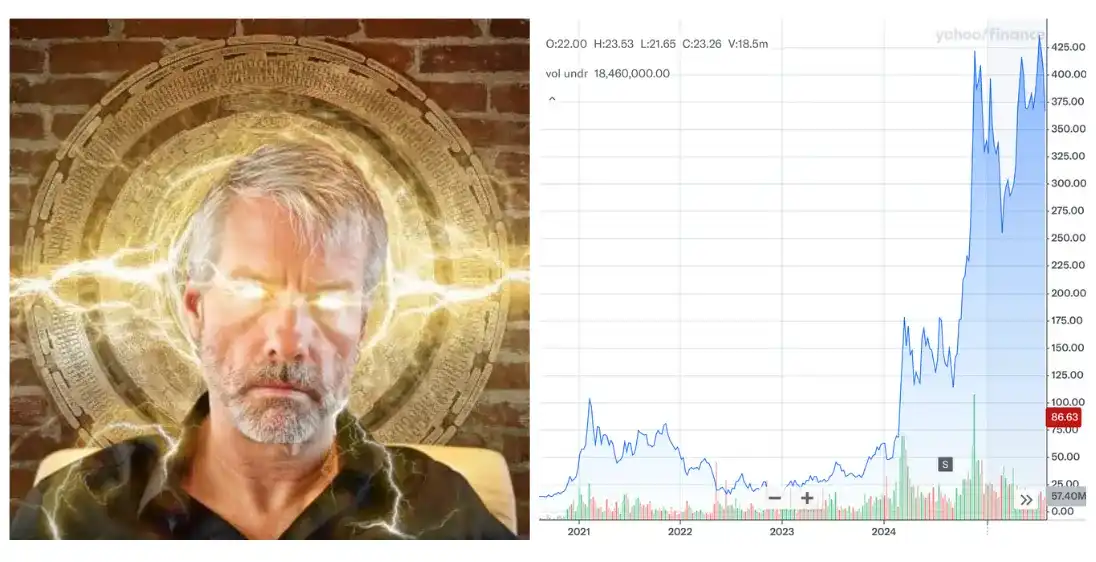
MicroStrategy/Strategy (MSTR) CEO Michael Saylor pioneered the concept of "Bitcoin yield." Through alchemy, a bitcoin held by a corporation somehow became worth more than a bitcoin held by someone not named Michael Saylor.

For a long and awkward period, the market agreed with him.

Not long ago, MSTR traded at 200% of the value of the Bitcoin on its balance sheet (Net Asset Value, NAV). You paid two dollars for one dollar's worth of Bitcoin. The sage Saylor, hailed as Satoshi Nakamoto reincarnated, frantically bought up all the Bitcoin he could, issuing expensive stock and even more complex financial instruments to new believers. The stock price looked like it would rise to infinity.
The Copycats

The premium on Strategy's stock attracted competitors, just as premiums always do. I documented this last May:

SPACs became Bitcoin buyers. Unprofitable operating companies ditched their original businesses to raise funds and buy BTC, ETH, or even more obscure crypto assets.

Spoiler alert: None performed as well as MSTR. And MSTR itself wasn't exactly a success story.

One year later, here's the situation:

Strategy (MSTR): Down 79% from its peak. This is the combined result of BTC falling 45% over the same period and the NAV premium compressing from 2x to 1x. Leverage magnifies gains and losses—that's how leverage works.

TwentyOne (XXI): Reached 5x NAV at its peak. Credit where it's due, it still trades above 1x NAV, though it's down 85% from its peak. Even some insiders got caught.

Metaplanet: Down 87% from a year ago, and down another 50% since the crash.

Nakamoto (NAKA) (formerly KindlyMD): Down 87% since October, after already falling 95% from its all-time high. If you put $100,000 into this stock a year ago, you'd have $650 left.
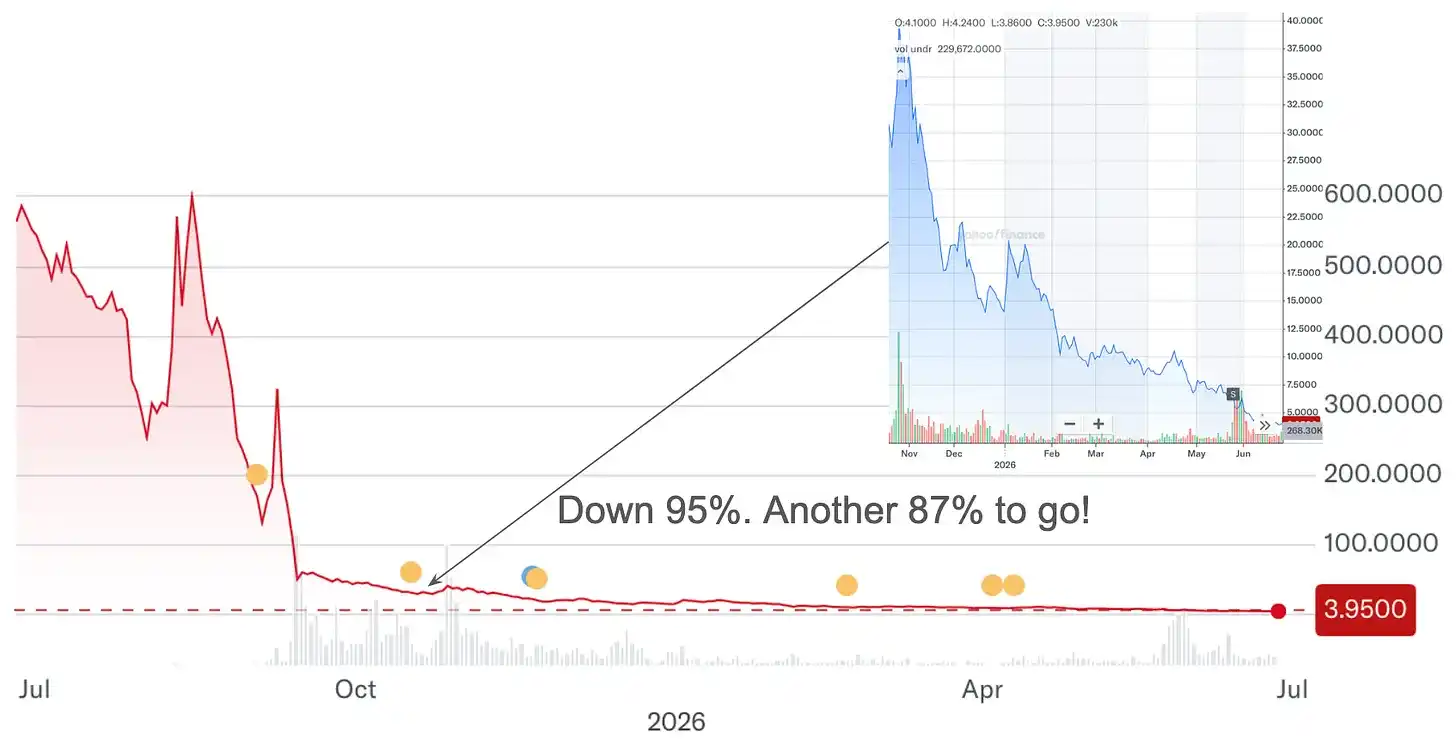
From $100,000 to $650. Enough for a (very) nice dinner. Speculators who "bought the dip," thinking "how much lower can it go," didn't fare much better than the original believers. The answer to "how much lower can it go" is often "quite a bit."

Why This Was Bound to Happen

Bitcoin ETFs exist. They charge only 9 basis points. Bitcoin itself exists. You can hold it yourself. There is no structural reason for DATs to trade at a premium—only greater fool theory, momentum trading, and a particular brand of financial nihilism where retail speculators, convinced the system is rigged, conclude they might as well play the rigged game with maximum aggression.

If you believe the traditional investment system doesn't work for you, the expected value of speculation looks different. FOMO plus dopamine plus gamification plus GameStop: Each alone is a manageable psychological condition. Together, they become a significant part of today's market structure.

Needless to say, insiders are always incentivized to meet the demand. They profit no matter which way the stock moves—another thing worth remembering.

About Tulips

The sad conclusion here is that no one cares when the market is irrational. This is a shame because the DAT crash is a perfect fable for the consequences of fear and greed. It should be a central case study for all bubble reporting. This is the Tulip Mania, only real and recent.

The 1637 dialogue "Waermondt and Gaergoedt" depicts two fictional Dutch weavers watching tulip prices collapse in real-time. One passage, spanning nearly four centuries, reads as if it were written last month:

"Things had gotten to the point that what used to be thrown into the dung heap to kill weeds in baskets was now selling for high prices. I thought I was rich enough. I thought I'd never have to weave again."

Polishing turds didn't work back then either. A flower that sold for 22 ducats in 1637 was trading at 400 ducats at its peak the year before. Then the liquidation came:

"I wish this country had never had flowers!"

I wonder how many retail investors, like those who turned an initial $100,000 into $650, wish they had never heard of Metaplanet, Nakamoto, or the phrase "Bitcoin yield."

One More Thing

I hold some Bitcoin. My venture fund holds crypto investments. I'm not against digital assets. I'm against this specific frenzy of packaging digital assets into companies, charging privileged fees, issuing debt for leverage, and then marketing the result as financial innovation.

I thought this frenzy was killed by the 2025 DAT crash. But the Golden Age of scams continues (with thanks to Shrubstack).

History repeats itself. Always. The pump-and-dump isn't a bug in the system; for those operating it, it's the product. Speculators provide the demand, insiders provide the product. Until we get the mother of all tulip crashes.

The pump-and-dump is the end in itself.

Трендові криптовалюти

Пов'язані питання

QWhat is a 'vault company' in the context of this article, and how did the first wave of such companies end?

AA 'vault company' in this article refers to a firm whose business model is to raise funds and use them primarily to buy and hold a specific asset, like Bitcoin (e.g., MicroStrategy) or other cryptocurrencies. The first wave of such companies, following the model of MicroStrategy's 'Bitcoin yield,' saw their stocks trade at huge premiums over the net asset value (NAV) of the crypto they held. This ended in a 'catastrophic crash' in the summer of 2025, where early investors in many Digital Asset Treasury (DAT) companies lost up to 99% of their money.

QAccording to the author, why did DAT companies trade at a large premium over the value of their underlying assets, and what eventually happened to that premium?

AThe author argues that DAT companies traded at a large premium to their Net Asset Value (NAV) not for any structural reason, but due to 'greater fool theory, momentum trading,' and a form of financial nihilism where retail speculators, believing the system is rigged, try to play the 'rigged game' aggressively. This premium eventually collapsed as the bubble burst, with stocks like MSTR seeing their premium compress from 200% to around 100%, contributing to their massive decline from peak prices.

QWhat are the two new examples of 'vault company' schemes mentioned in the article, and what assets do they plan to hold?

AThe article mentions two new 'vault company' schemes: 1) Triller Group announced it would become the world's first 'SpaceX vault company,' using newly raised funds to buy and hold SpaceX stock. 2) LGHL (a previously established vault company) rebranded to focus on buying HYPE tokens instead of its previous crypto assets (SOL and SUI).

QWhat historical event does the author compare the DAT crash to, and what is the key similarity?

AThe author compares the DAT crash to the 17th-century Dutch Tulip Mania. The key similarity is the extreme and irrational speculation on an asset (tulip bulbs then, shares of companies holding crypto now), where prices soared based on hype and greed before collapsing catastrophically, leaving investors with massive losses. The author cites a 1637 dialogue about the tulip crash that sounds 'like it was written last month.'

QWhat is the author's main argument about the relationship between retail speculators and insiders in these schemes?

AThe author's main argument is that a symbiotic cycle exists between retail speculators and insiders/promoters. Retail speculators, driven by FOMO and a belief the system is unfair, provide the demand for highly speculative products. Insiders and 'pump-and-dump' traders then meet this demand by creating and promoting these schemes (like vault companies), from which they profit regardless of the outcome for retail investors. The author concludes that for those running it, 'the pump-and-dump is the product itself.'

Пов'язані матеріали

Bitcoin Soars Over 24% in a Week, Best Weekly K in Recent Years, $2.7B Short Squeeze Sets Record, Policy Tailwinds Ignite Rally

Bitcoin surged over 24% this week, breaking above $78,000 and marking its best weekly performance since March 2024. The rally accelerated following a series of crypto-friendly signals from Washington and was further amplified by a record wave of forced short liquidations. Data from CoinGlass shows approximately $27.4 billion in crypto short positions were liquidated within 24 hours, the largest such event since the platform's records began in 2021. Total liquidations neared $30 billion, with shorts accounting for about 92%. Key drivers included a new SEC proposal ("Regulation Crypto Assets") to simplify token offerings, progress on the stalled CLARITY法案, comments from CFTC Chairman Michael Selig about moving forward independently if Congress delays, and former President Trump's remarks regarding bringing the Hyperliquid exchange into the US compliantly. Macroscopically, the US Treasury's announcement to double its long-term bond buyback program helped lower yields, improving liquidity expectations for risk assets. The market, previously stagnant near $60,000 with high short positioning, saw a violent squeeze. This created a self-reinforcing cycle where rising prices triggered further short liquidations. The interplay between shifting policy expectations and this massive deleveraging event fueled the historic weekly gain.

marsbit5 хв тому

Bitcoin Soars Over 24% in a Week, Best Weekly K in Recent Years, $2.7B Short Squeeze Sets Record, Policy Tailwinds Ignite Rally

marsbit5 хв тому

19 New Decacorns in Half a Year: Why is the Primary Market Chasing 'Certainty'?

In the first half of 2026, China’s primary market saw a notable increase in unicorns, adding 19 new companies each valued over 100 billion RMB, particularly in sectors like embodied AI and large language models (LLMs). Firms such as Galaxy General, Zibian, and ZhiPingFang even surpassed 200 billion RMB valuations within months. Moonshot AI's valuation surged from around $10 billion to $35 billion by July 2026, with a pre-IPO target of $50 billion. This concentration of capital into a few "certain" sectors highlights a market shift. The driving force is not a general abundance of capital but a chase for "certainty"—primarily clearer exit pathways like imminent IPOs. Companies with defined public listing timelines attract intense investment despite higher valuations, as they reduce exit uncertainty for investors. Secondary market valuations of listed peers also serve as new anchors, boosting the perceived value of private companies in similar fields, though this creates dependency on public market sentiment. Another form of certainty comes from the expectation of rising valuations in subsequent funding rounds. The investment logic has shifted in some cases from assessing long-term fundamental value to betting on the next round attracting higher prices. This dynamic is also seen in deep-tech areas like nuclear fusion, where firms like NeoFusion secured a 10.6 billion RMB valuation despite early commercial stages, driven by scarcity and strategic bets. However, this trend signals a risk transfer: technical uncertainties remain but are temporarily masked by valuation inflation. As valuations climb—50 billion to 200 billion or 500 billion RMB—companies face increasing pressure to demonstrate real revenue, profit, and sustainable business models. The danger lies not in the rise of unicorns itself, but if valuations become detached from value creation and rely merely on the expectation of future funding or exits. Ultimately, the surge reflects investors seeking perceived safety in shorter-term exit certainty and transactional momentum, rather than a renewed appetite for risk. The true test will come when the market inevitably refocuses on fundamentals, questioning how many of today’s high valuations are backed by genuine economic value.

marsbit35 хв тому

19 New Decacorns in Half a Year: Why is the Primary Market Chasing 'Certainty'?

marsbit35 хв тому

Just Now, Sam Altman Blasts Dario Amodei as 'Anti-Human', Secret Model Exposed the Same Day

Just now, Sam Altman strongly criticized Dario (Amodei, co-founder of Anthropic), denouncing his "doomsday marketing" as "anti-human dictator rhetoric." This came alongside the accidental exposure of OpenAI's next-generation model, codenamed "gpt-nathree," hinting at the imminent release of GPT-6 Astra. The leak occurred when an OpenAI employee's public GitHub commit mentioned the codename. Combined with previous leaks of "gpt-mewfour," it suggests these are iterative checkpoints for OpenAI's upcoming agent model, Astra. Astra is known for multi-agent collaboration and long-duration task handling, having reportedly solved previously unsolved mathematical problems. Meanwhile, two new Anthropic model codenames, "claude-marshmallow-eap" and "claude-melon-eap," were also exposed but are believed to be iterations of the Claude 5 series, not a new flagship. In a wide-ranging podcast interview, Altman admitted he was wrong about the speed of AI-driven disruption, acknowledging societal inertia slows adoption. He fiercely criticized rivals' marketing that simultaneously promises immense benefits (like curing cancer) and warns of existential risk, calling it a dangerous "benevolent dictator" narrative that seeks to concentrate power. He emphasized that people are the ultimate purpose of AI. Altman also revealed OpenAI's unconventional, consensus-defying path: spending four and a half years in the "dark" without a public product before ChatGPT's breakthrough, driven by scaling laws rather than early customer feedback. He concluded that even with superintelligent AI, genuine human connection will remain irreplaceably valuable.

marsbit1 год тому

Just Now, Sam Altman Blasts Dario Amodei as 'Anti-Human', Secret Model Exposed the Same Day

marsbit1 год тому

Торгівля

Спот

Популярні статті

Як купити ONE

Ласкаво просимо до HTX.com! Ми зробили покупку Harmony (ONE) простою та зручною. Дотримуйтесь нашої покрокової інструкції, щоб розпочати свою криптовалютну подорож.Крок 1: Створіть обліковий запис на HTXВикористовуйте свою електронну пошту або номер телефону, щоб зареєструвати обліковий запис на HTX безплатно. Пройдіть безпроблемну реєстрацію й отримайте доступ до всіх функцій.ЗареєструватисьКрок 2: Перейдіть до розділу Купити крипту і виберіть спосіб оплатиКредитна/дебетова картка: використовуйте вашу картку Visa або Mastercard, щоб миттєво купити Harmony (ONE).Баланс: використовуйте кошти з балансу вашого рахунку HTX для безперешкодної торгівлі.Треті особи: ми додали популярні способи оплати, такі як Google Pay та Apple Pay, щоб підвищити зручність.P2P: Торгуйте безпосередньо з іншими користувачами на HTX.Позабіржова торгівля (OTC): ми пропонуємо індивідуальні послуги та конкурентні обмінні курси для трейдерів.Крок 3: Зберігайте свої Harmony (ONE)Після придбання Harmony (ONE) збережіть його у своєму обліковому записі на HTX. Крім того, ви можете відправити його в інше місце за допомогою блокчейн-переказу або використовувати його для торгівлі іншими криптовалютами.Крок 4: Торгівля Harmony (ONE)Легко торгуйте Harmony (ONE) на спотовому ринку HTX. Просто увійдіть до свого облікового запису, виберіть торгову пару, укладайте угоди та спостерігайте за ними в режимі реального часу. Ми пропонуємо зручний досвід як для початківців, так і для досвідчених трейдерів.

623 переглядів усьогоОпубліковано 2024.12.12Оновлено 2026.06.02

Як купити ONE

Обговорення

Ласкаво просимо до спільноти HTX. Тут ви можете бути в курсі останніх подій розвитку платформи та отримати доступ до професійної ринкової інформації. Нижче представлені думки користувачів щодо ціни ONE (ONE).

活动图片