One Article to Understand the Profit Pools and Industry Landscape of the AI Storage Hierarchy

marsbitОпубліковано о 2026-05-14Востаннє оновлено о 2026-05-14

Анотація

**Deciphering the Profit Pools and Industry Landscape of the AI Storage Hierarchy** AI storage architecture can be divided into six distinct layers based on proximity to computing units: 1) On-chip SRAM, 2) HBM, 3) Motherboard DRAM, 4) CXL pooling layer, 5) Enterprise SSD, and 6) NAS & Cloud Object Storage. In 2025, the total market for these layers (excluding embedded SRAM value) was approximately $229 billion, with DRAM constituting half, HBM 15%, and SSD 11%. The profit landscape is highly concentrated, with over 90% market share in the top three layers for key players. These profit pools are categorized into three types: 1) High-margin, oligopolistic silicon layers (HBM, embedded SRAM, QLC SSD), 2) High-margin, emerging interconnect layers (CXL), and 3) Scalable, recurring-revenue service layers (NAS, Cloud Object Storage). **Key Layers Analysis:** * **On-chip SRAM:** Profits accrue primarily to TSMC via advanced wafer sales for AI chips. * **HBM:** The largest AI-era profit pool, driven by AI accelerator demand. SK Hynix (57-62% share), Samsung, and Micron dominate. HBM boasts exceptionally high margins (e.g., SK Hynix's 72% operating margin in Q1 2026) and is projected to grow at a ~40% CAGR to $100 billion by 2028. * **Motherboard DRAM:** The largest market by revenue ($121.8B in 2025), controlled by Samsung, SK Hynix, and Micron. High profitability is sustained as capacity shifts to HBM. * **CXL Pooling Layer:** Enables rack-level memory sharing for AI work...

Author: Godot

AI storage can be broken down into six layers,

1) On-chip SRAM

2) HBM

3) Motherboard DRAM

4) CXL Pooling Layer

5) Enterprise SSD

6) NAS and Cloud Object Storage

This hierarchy is based on the location of storage; the further down, the farther from the computing unit, and the larger the storage capacity.
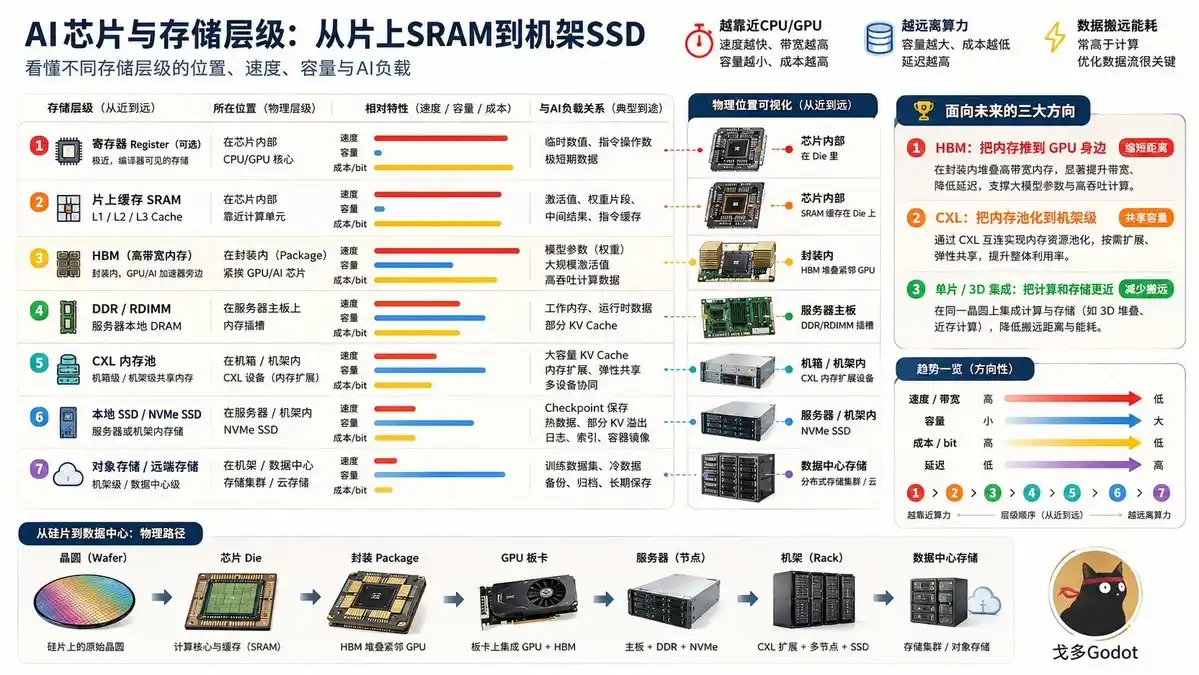
In 2025, the total market for these six layers (SRAM is on compute chips, its embedded value needs to be excluded) was about $229 billion, with DRAM accounting for half, HBM for 15%, and SSD for 11%.

In terms of profit, each layer is highly concentrated among oligopolies, with the top three typically holding over 90% market share.

These profit pools can be divided into three categories,

1) High-margin oligopolistic pools at the silicon layer (HBM, embedded SRAM, QLC SSD)

2) High-margin emerging pools at the interconnect layer (CXL)

3) Scale-compounding pools at the service layer (NAS, Cloud Object Storage)

The three types of pools differ in nature, growth rate, and moats.

Why is Storage Layered?

Because the CPU responsible for control and the GPU responsible for computing only have temporary cache on the chip, namely on-chip SRAM cache. This cache space is too small, only enough to hold temporary parameters, and cannot accommodate large models.

Outside these two chips, larger external memory is needed to store the large models and the context for inference.

Computation is fast. The latency and energy consumption of moving data between different storage layers are the biggest issues.

Therefore, there are currently three main directions,

1) Stack HBM, placing memory next to the GPU to shorten the data transfer distance.

2) Use CXL to pool memory to the rack level, sharing capacity.

3) Integrate computing and storage on the same wafer, achieving compute-in-memory.

These three directions will shape the profit pool of each layer over the next five years.

The specific layers are detailed below,

L0 On-chip SRAM: A Profit Pool Exclusive to TSMC

SRAM (Static Random-access Memory) is the cache inside CPUs/GPUs, embedded in each chip and not traded separately.

The standalone SRAM chip market is only about $1–1.7 billion. Leaders are Infineon (~15%), Renesas (~13%), and ISSI (~10%)—a small market.

The profit pool for this part lies with TSMC. To fit more SRAM into each generation of AI chips, more wafers must be purchased.

Over 70% of the world's advanced process wafers are in TSMC's hands. The SRAM area of every H100, B200, TPU v5, etc., ultimately translates into TSMC's revenue.

L1 HBM: The Largest Profit Pool of the AI Era

HBM (High Bandwidth Memory) is high-bandwidth memory where DRAM (Dynamic Random-access Memory) dies are vertically stacked using TSV (Through-Silicon Via) technology and then attached next to the GPU via CoWoS packaging.

HBM almost single-handedly determines how large a model an AI accelerator can run. SK hynix, Micron, and Samsung have a near 100% market share.

As of Q1 2026, the latest market share breakdown is: SK hynix 57% to 62%, Samsung 22%, Micron 21%. SK hynix has secured significant procurement shares from companies like NVIDIA and is the dominant supplier.

Micron's Q1 FY2026 earnings call mentioned that the HBM TAM (Total Addressable Market) is expected to grow at a CAGR of ~40%, from about $35 billion in 2025 to $100 billion in 2028, reaching the $100 billion mark two years earlier than previous forecasts.

The core advantage of HBM lies in its extremely high profit margins. In Q1 2026, SK hynix's operating profit margin reached a record 72%.

Reasons for high profitability,

1) The TSV manufacturing process sacrifices some traditional DRAM capacity, keeping HBM in a state of supply shortage.

2) Improving advanced packaging yield is difficult; Samsung's previous market share drop from 40% to 22% was also affected by this.

3) Major suppliers have been relatively cautious in capacity expansion, and achieved a DRAM ASP (Average Selling Price) increase of over 60% QoQ in Q1 2026, demonstrating a clear seller's market.

Among the three giants, SK hynix, driven by strong HBM demand, achieved annual operating profit of 47.21 trillion KRW in 2025, surpassing Samsung Electronics for the first time in history. In Q1 2026, with a 72% operating margin, it even exceeded the profitability levels of TSMC (58.1%) and NVIDIA (65%).

Micron has high growth expectations, with Bank of America raising its target price to $950 in May 2026. Samsung, with the continuous progress of HBM4 mass production, has the largest room for market share recovery.

L2 Motherboard DRAM

This layer refers to what we commonly call memory modules (DIMMs).

Motherboard DRAM includes conventional memory products like DDR5, LPDDR, GDDR, MR-DIMM, etc. It is currently the part with the highest market sales share in the AI storage system. The global DRAM market reached approximately $121.83 billion in 2025.

Samsung, SK hynix, and Micron still dominate the vast majority of the market. According to the latest data from Q4 2025, Samsung ranked first with a 36.6% market share, SK hynix second with 32.9%, and Micron third with 22.9%.

The shift in production capacity towards higher-margin HBM has helped maintain high profitability and pricing power for memory. Although the single-product margin of conventional motherboard DRAM is not as high as HBM's, its overall market size is the largest.

L3 CXL Pooling Layer

CXL (Compute Express Link) allows DRAM to be "pooled" from a single server motherboard to the entire rack level.

With CXL 3.x and beyond, all memory in a rack can be shared and scheduled by multiple GPUs in the future, allocated on-demand. This solves the problem of KV cache, vector databases, and RAG indexes not fitting or being too cumbersome to move during AI inference.

The CXL memory module market was only $1.6 billion in 2024, projected to reach $23.7 billion by 2033. It appears the oligopoly of Samsung, SK hynix, and Micron will continue.

In this layer, Astera Labs focuses on Retimers and intelligent memory controllers between CXL and PCIe, holding about 55% share of this sub-market. Latest quarter revenue was $308 million, up 93% YoY; non-GAAP gross margin 76.4%; net profit up 85% YoY. It can be said to be quite lucrative.

L4 Enterprise SSD: The Biggest Beneficiary of the Inference Era

Enterprise NVMe SSDs are the main battleground for AI training checkpoints, RAG indexes, KV cache offloading, and model weight caching. High-capacity QLC SSDs have completely pushed HDDs out of AI data lakes.

The enterprise SSD market was about $26.1 billion in 2025, with a CAGR of 24%, projected to reach $76 billion by 2030.

As for the competitive landscape? Correct, still dominated by the three giants.

Market share by revenue in Q4 2025: Samsung 36.9%, SK hynix (including Solidigm) 32.9%, Micron 14.0%, Kioxia 11.7%, SanDisk 4.4%. The top five account for about 90%.

The biggest change in this layer is the explosion of QLC SSDs in AI inference scenarios. SK hynix's subsidiary Solidigm and Kioxia have already produced single-disk products with 122 TB capacity. AI inference KV cache and RAG indexes are spilling over from HBM to SSDs.

From a profit pool perspective, enterprise SSDs don't have the extreme gross margins of HBM but enjoy dual tailwinds of capacity-driven growth and inference expansion.

SK hynix (via Solidigm) and Kioxia are relatively pure plays. Samsung and SK hynix enjoy triple-layer benefits from HBM + DRAM + NAND, making them more comprehensive AI storage platform companies.

L5 NAS and Cloud Object Storage: The Compounding Pool of Data Gravity

NAS and Cloud Object Storage are the outermost layers for AI data lakes, training corpora, backup/archiving, and cross-team collaboration. In 2025, NAS was about $39.6 billion (CAGR 17%), and Cloud Object Storage about $9.1 billion (CAGR 16%).

Major vendors for enterprise file storage are NetApp, Dell, HPE, Huawei; for SMBs, Synology and QNAP. For Cloud Object Storage, using IaaS share estimates, AWS ~31–32%, Azure ~23–24%, Google Cloud ~11–12%, the three combined ~65–70%.

Profits in this layer mainly come from long-term hosting, data egress fees, and ecosystem lock-in.

To summarize,

1) DRAM has the largest market but the lowest gross margins (30–40%); HBM's market is only one-third of DRAM's, but its gross margin is double (60%+); CXL Retimers have the smallest market but the highest gross margin (76%+). The closer the layer is to computing, the scarcer and more lucrative it is.

2) Incremental profit pool growth primarily comes from three areas: HBM (CAGR 28%), Enterprise SSD (CAGR 24%), and CXL Pooling (CAGR 37%).

3) Each layer has different business barriers: HBM relies on technical barriers (TSV, CoWoS, yield ramp); CXL-type relies on IP and certification (single supply chain for Retimers); service-type relies on switching costs.


Пов'язані питання

QHow is the AI storage hierarchy structured, and what are the six layers mentioned in the article?

AThe AI storage hierarchy is divided into six layers based on proximity to the compute unit, with capacity increasing as distance increases. The layers are: 1) On-chip SRAM, 2) HBM, 3) Motherboard DRAM, 4) CXL Pooling Layer, 5) Enterprise SSD, and 6) NAS & Cloud Object Storage.

QWhich layer in the AI storage stack is described as the most lucrative profit pool in the AI era, and what are the market share dynamics among its key players?

AHBM is described as the largest profit pool in the AI era. As of Q1 2026, the market is dominated by SK Hynix (57-62%), Samsung (22%), and Micron (21%). SK Hynix leads, driven by strong demand from customers like NVIDIA.

QWhat are the three primary strategic directions mentioned for optimizing data movement between storage layers, and how do they impact future profit pools?

AThe three primary directions are: 1) Stacking HBM to shorten data transfer distances, 2) Using CXL for rack-level memory pooling and capacity sharing, and 3) Developing in-memory computing (e.g., on the same wafer). These trends will shape the profit pools across the storage hierarchy over the next five years.

QAccording to the article, what are the three distinct categories of profit pools in the AI storage landscape, and what are their key characteristics?

AThe three categories are: 1) High-margin Oligopoly Pools (e.g., HBM, embedded SRAM, QLC SSD) characterized by technological dominance and high margins; 2) High-margin Emerging Pools (e.g., CXL) driven by new interconnects; and 3) Scale & Recurring Revenue Pools (e.g., NAS, Cloud Object Storage) based on data gravity, long-term hosting, and ecosystem lock-in.

QWhich company is highlighted as capturing the profit pool for on-chip SRAM (L0), and what is the underlying reason?

ATSMC captures the profit pool for on-chip SRAM. This is because the need to integrate more SRAM into each new generation of AI chips (like NVIDIA's H100/B200, Google's TPU v5) requires more advanced semiconductor wafers, over 70% of which are supplied by TSMC. The SRAM area directly translates into TSMC's revenue.

Пов'язані матеріали

It Took Me a Year to See the Bitter Truth About Agent Payments

After a year building infrastructure for the Agent economy, engaging with major players like Stripe, Visa, and Coinbase, the author shares a sobering analysis of the current state of Agent payments. The core finding is a stark lack of genuine, immediate demand across most envisioned use cases. The article breaks down four key market segments: 1. **Agent-to-Merchant (Consumer Shopping):** For most product categories (e.g., clothing, electronics), conversational AI shopping is a step backwards from visual e-commerce interfaces. While agents excel at understanding needs, they can't replace side-by-side product comparison. Real merchant interest is defensive "Agent Engine Optimization," not driven by current customer demand. Potential exists for high-frequency, low-decision purchases (like food delivery) or navigating complex store UIs, but these require massive B2C distribution channels dominated by giants like Amazon. 2. **Agent-to-API (Developer Services):** Developers already have subscriptions and billing relationships for APIs (compute, data). Prepaid balances solve micro-payment issues for low transaction volumes. A deeper structural problem is that major SaaS vendors' business models rely on enterprise contracts, resisting granular pay-per-call pricing. While protocols like MPP and x402 serve the long tail of niche services, this market is small and developers are historically low-willingness-to-pay. 3. **Agent-to-Agent:** This remains largely theoretical with minimal transaction volume. While it represents a long-term bet on a fundamentally new transaction infrastructure (sub-second, micro-penny to million-dollar, multi-party settlements), it does not constitute a present market. 4. **Agent-to-Finance:** This is the only category with existing, paying demand. Integrating AI into financial workflows (trading, portfolio management) is a natural evolution and enables new capabilities like autonomous rebalancing. However, competition favors established, regulated institutions. The "real problem" is not moving money between agents, but the broader challenge of **coordination**—orchestrating work between agents and humans, verifying outcomes, and settling results. Payment is just one component of settlement, which is itself part of coordination. Companies that solve the coordination layer will subsume payment, not the other way around. While well-funded incumbents build defensively for a long-term future, startups must find where the market is today—which, for the author's team, lies outside these four categories in an area of real, growing, and underserved activity.

marsbit2 хв тому

It Took Me a Year to See the Bitter Truth About Agent Payments

marsbit2 хв тому

It Took Me a Year to See the Hard Truth About Agent Payments

**Title: It Took Me a Year to See the Hard Truth About Agent Payments** Over the past year, I've worked on infrastructure for the Agent economy, engaging with major players like Stripe, Visa, Coinbase, and numerous startups. The findings reveal a stark reality: genuine, widespread demand for Agent-based payments does not yet exist. **Key Observations:** * **Agent-to-Merchant (Shopping):** The user experience for AI shopping often falls short, especially for visual product discovery. While AI excels at understanding needs, conversational interfaces can't yet replace browsing and comparing multiple products visually. Current merchant interest is largely defensive ("Agent Engine Optimization") for a future that hasn't arrived. High-frequency, low-friction purchases (like food delivery) are potential fits, but lack open APIs and face high AI inference costs. Simpler, more affordable, or cross-language interactions for complex UIs are a niche opportunity but require massive consumer distribution to scale. * **Agent-to-API (Developer Tools):** Developer payment needs for APIs (computing, data, models) are already met through subscriptions and prepaid credits. The core challenge is not payment friction but supplier economics: most large SaaS providers prefer enterprise contracts over micropayments for API calls. Protocols like MPP and x402 suit the long-tail of smaller services but cater to a developer market historically reluctant to pay for these tools. Major infrastructure needs at the top of the stack are already being addressed. * **Agent-to-Agent (Machine Commerce):** This is a long-term vision with almost no current transaction volume. While a future with high-speed, high-frequency, multi-party machine-to-machine transactions would require novel infrastructure, it remains theoretical. The market is not here yet. * **Agent-to-Finance:** This is the only category with clear, present demand. Financial professionals and DeFi users already pay for tools, and AI augmentation is a natural evolution. Autonomous AI agents can enable entirely new financial strategies. However, competition is fierce from established, regulated incumbents who can more easily layer AI onto their existing products. **The Core Insight:** Companies, especially giants with long time horizons, are building defensively for a potential future of mass machine commerce. For them, early investment is a low-cost hedge. For startups, the current market reality is different. The primary challenge isn't just moving money between agents (payments). The larger, unsolved problem is **orchestration** – coordinating work between agents and humans, verifying outcomes, and then settling. Payment is just a part of settlement, which is just a part of orchestration. Companies that solve the orchestration problem will subsume payments, not the other way around. After a year of building, we see the real, growing, and underserved market opportunity lies in this broader domain of orchestration.

链捕手26 хв тому

It Took Me a Year to See the Hard Truth About Agent Payments

链捕手26 хв тому

Claude Opus 4.8 Finds a $4.5 Billion Bug: The AI Era is Mass-Producing Hackers

A researcher discovered a critical "infinite mint" vulnerability in the Zcash cryptocurrency's Orchard protocol using Claude Opus 4.8, leading to a swift fix but also a 50% market drop, erasing billions in value. This incident highlights a new era where powerful, accessible AI models are dramatically lowering the barrier to finding software vulnerabilities. Previously, the security community feared specialized models like Claude Mythos Preview, capable of finding decades-old zero-day exploits. The Zcash case, however, involved a publicly available, general-purpose model. This shift makes advanced security auditing—and attack capabilities—accessible to far more people, not just experts. The mass democratization of vulnerability discovery brings a dual challenge: a flood of low-quality, AI-generated false reports that overwhelm maintainers, and the real, rapid uncovering of deep, dangerous bugs. Open-source projects, often understaffed and unfunded, are particularly vulnerable to this "attention DDoS." The article cites examples like curl shutting down its bug bounty program due to the unsustainable workload. Our perceived digital safety has often been luck, relying on the high cost and effort required to find deeply hidden flaws in complex systems, as seen with historical vulnerabilities like Heartbleed or Baron Samedit. AI changes this cost structure, effectively "mass-producing flashlights" to illuminate every corner of our codebase. While large companies operate extensive security chains involving external white-hat hackers and massive defensive operations, the global cybersecurity workforce faces a severe shortage, especially of experienced personnel capable of analyzing complex threats and coordinating fixes. The core dilemma emerges: AI makes *finding* bugs cheap and scalable, but *fixing* them remains a slow, expensive, and human-intensive process. The article concludes that AI won't destroy the internet but acts as a bright light, revealing that our digital existence is not inherently secure but is precariously maintained by ongoing human effort. The true cost in the AI era may not be discovery, but whether there will be enough people left willing and able to do the hard work of repair.

marsbit59 хв тому

Claude Opus 4.8 Finds a $4.5 Billion Bug: The AI Era is Mass-Producing Hackers

marsbit59 хв тому

Codex Goal Mode Usage Guide: How to Make AI Continuously Pursue a Specific Objective

"Codex Goal Mode: How to Make AI Work Continuously Toward a Specific Goal" OpenAI's Codex "goal mode" (/goal) transforms the AI from a reactive code assistant into a proactive execution agent capable of working autonomously for hours or even days to achieve a defined objective. To maximize its effectiveness, follow these key principles: 1. **Define Clear, Verifiable Exit Criteria:** The goal prompt should be a concise, measurable success condition, not a lengthy specification. Use quantifiable metrics like "reduce build time by 30%" or "achieve 100% test parity." 2. **Provide Initial Guidance and Tools:** Direct Codex toward likely problem areas and specify available tools (e.g., browsers, testing environments) to prevent it from exploring unproductive paths. 3. **Enable Progress Measurement:** Equip Codex with ways to track advancement, such as creating comparison tools for visual tasks or evaluation sets, ensuring it can gauge its own progress. 4. **Use a Realistic Execution Environment:** For tasks like performance optimization, provide access to environments that closely mimic production (e.g., similar configs, databases) to yield valid results. 5. **Be Cautious with Visual Goals:** Avoid vague "pixel-perfect" instructions. Instead, supplement visual references with functional checklists or design system specifications to prevent Codex from obsessing over minor details. 6. **Implement Progress Tracking:** For long-running tasks, have Codex commit code to draft PRs, update progress documents, or send Slack updates to maintain visibility into its work. 7. **Review and Consolidate Results:** Once the goal is met, instruct Codex to review its work, clean up ineffective experimental code, and reflect on what strategies succeeded or failed. Ultimately, using goal mode shifts the developer's role from writing prompts to managing a persistent engineering agent—defining objectives, establishing metrics, configuring environments, and conducting final reviews.

marsbit2 год тому

Codex Goal Mode Usage Guide: How to Make AI Continuously Pursue a Specific Objective

marsbit2 год тому

Торгівля

Спот
Ф'ючерси

Популярні статті

Як купити ONE

Ласкаво просимо до HTX.com! Ми зробили покупку Harmony (ONE) простою та зручною. Дотримуйтесь нашої покрокової інструкції, щоб розпочати свою криптовалютну подорож.Крок 1: Створіть обліковий запис на HTXВикористовуйте свою електронну пошту або номер телефону, щоб зареєструвати обліковий запис на HTX безплатно. Пройдіть безпроблемну реєстрацію й отримайте доступ до всіх функцій.ЗареєструватисьКрок 2: Перейдіть до розділу Купити крипту і виберіть спосіб оплатиКредитна/дебетова картка: використовуйте вашу картку Visa або Mastercard, щоб миттєво купити Harmony (ONE).Баланс: використовуйте кошти з балансу вашого рахунку HTX для безперешкодної торгівлі.Треті особи: ми додали популярні способи оплати, такі як Google Pay та Apple Pay, щоб підвищити зручність.P2P: Торгуйте безпосередньо з іншими користувачами на HTX.Позабіржова торгівля (OTC): ми пропонуємо індивідуальні послуги та конкурентні обмінні курси для трейдерів.Крок 3: Зберігайте свої Harmony (ONE)Після придбання Harmony (ONE) збережіть його у своєму обліковому записі на HTX. Крім того, ви можете відправити його в інше місце за допомогою блокчейн-переказу або використовувати його для торгівлі іншими криптовалютами.Крок 4: Торгівля Harmony (ONE)Легко торгуйте Harmony (ONE) на спотовому ринку HTX. Просто увійдіть до свого облікового запису, виберіть торгову пару, укладайте угоди та спостерігайте за ними в режимі реального часу. Ми пропонуємо зручний досвід як для початківців, так і для досвідчених трейдерів.

347 переглядів усьогоОпубліковано 2024.12.12Оновлено 2026.06.02

Як купити ONE

Обговорення

Ласкаво просимо до спільноти HTX. Тут ви можете бути в курсі останніх подій розвитку платформи та отримати доступ до професійної ринкової інформації. Нижче представлені думки користувачів щодо ціни ONE (ONE).

活动图片












