On the Eve of the Tech IPO Boom, Polymarket Joins Forces with NASDAQ to Seize 'Valuation Authority'

marsbitОпубліковано о 2026-05-20Востаннє оновлено о 2026-05-20

Анотація

At the dawn of a major tech IPO wave, prediction market platform Polymarket is forming an exclusive partnership with Nasdaq Private Market (NPM) to launch contracts predicting the valuations of pre-IPO giants like OpenAI, Anthropic, and SpaceX. This move aims to capture the "valuation adjudication right" in the booming but opaque private market, where accurate valuation data is scarce for retail investors. Facing stiff competition from rival Kalshi, which holds an 89% US market share and full regulatory approval, Polymarket's deal with NPM is a strategic counterattack. NPM provides crucial, real-time secondary market transaction data from employee stock sales to settle the new prediction contracts. In return, Polymarket's market-generated probability data becomes a valuable "institutional signal" for NPM's clients. This follows Polymarket's broader strategy of monetizing its prediction data through partnerships with giants like ICE (Intercontinental Exchange) and Dow Jones, integrating its signals into mainstream financial data feeds and media. The Nasdaq deal specifically targets the lucrative and high-profile arena of pre-IPO tech valuations, potentially raising the entry barrier for competitors in this niche.

In this wave of tech IPO frenzy, everyone wants to 'get on board,' including Polymarket.

The soonest SpaceX could list on Nasdaq is in 23 days, an IPO poised to break all records in human IPO history.

OpenAI's last round valuation was $5 trillion, Anthropic is rumored to be worth $4 trillion, and SpaceX $17.5 trillion. Globally, there are 1,600 unicorn companies with a cumulative valuation of $5 trillion. The returns from this sector have historically been available only to institutions and accredited investors. Directly buying shares in these companies requires a six-figure minimum, a one-year lock-up period, accredited investor certification, and a network of connections. Ordinary people have no access.

Furthermore, private companies are not obligated to disclose their valuations. Funding round valuations are lagging, secondary market quotes are scattered, and the actual transaction prices of employee stock are highly sensitive internal information. This, precisely, is the perfect entry point for prediction markets.

On May 19th, just before this critical timing, Polymarket announced an exclusive partnership with NASDAQ, launching a batch of prediction contracts targeting the market valuations of pre-IPO companies. Users can bet on whether OpenAI's valuation will break through $10 trillion by year-end, whether Anthropic will reach $11 trillion by December 31st, and if SpaceX can touch $15 trillion before June 30th. NASDAQ, as the data source, is responsible for the final settlement of the contracts.

Polymarket previously had a market on OpenAI's closing market cap on its first day. Bloomberg reported that it accumulated $1.6 million in trading volume since last September. On Kalshi, existing IPO contracts are even more concentrated: Cerebras Systems' probability of an IPO before 2027 is priced at 95%, Kraken at 83%, Databricks at 70%, Discord at 70%. OpenAI and Anthropic also have contracts.
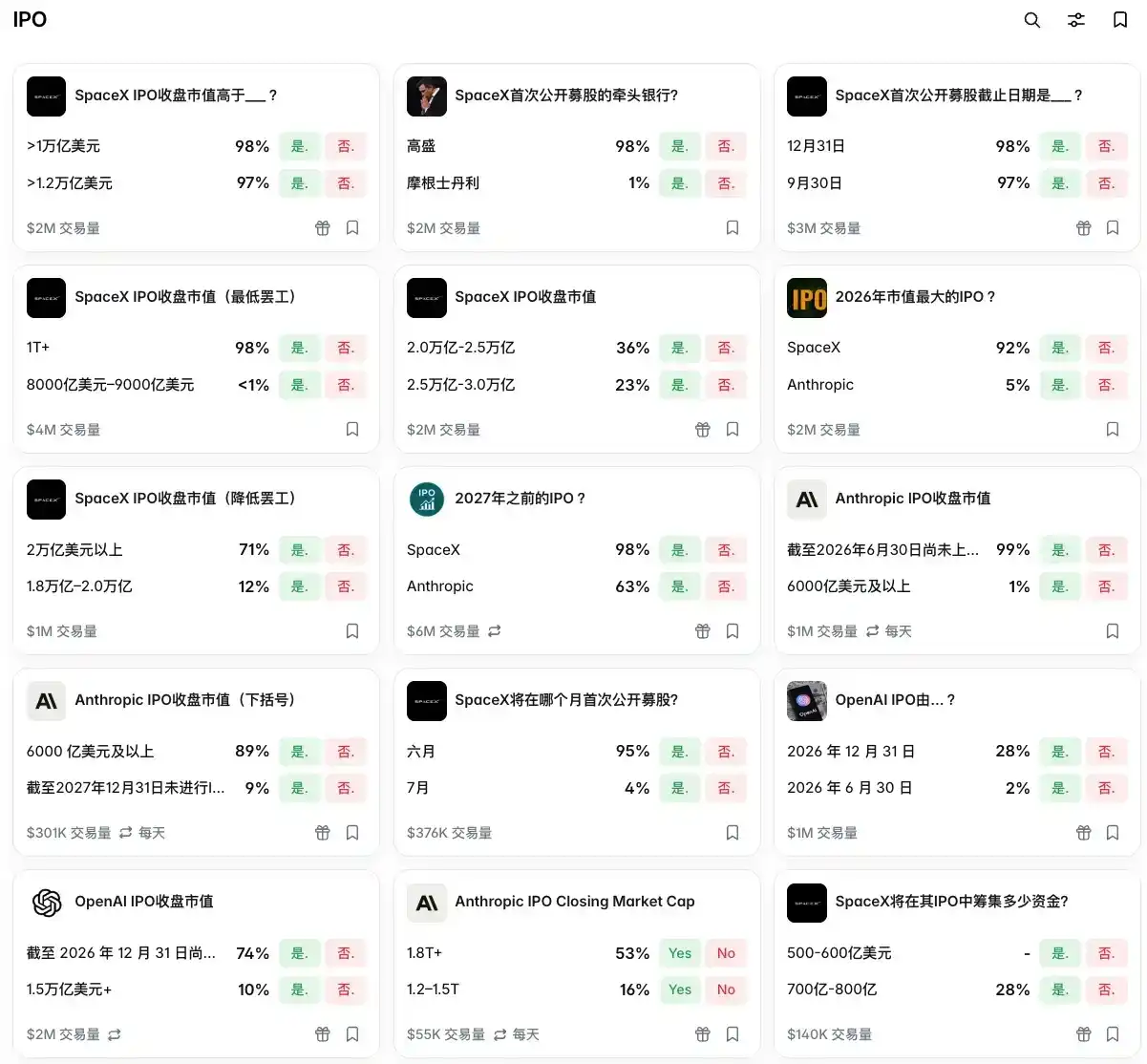
Both competing platforms are placing significant emphasis on this wave of pre-IPO frenzy.

Polymarket's Comeback Fight

Over the past eight months, Polymarket has been surpassed by Kalshi on nearly every visible metric.

In April, Kalshi's monthly trading volume was $14.8 billion, a 13% increase month-over-month. Polymarket's global volume plus the US App volume totaled $10.2 billion, a month-over-month decline of 8.9%. Active traders dropped from 733,000 in March to 643,000 in April, a 12% decrease. In valuation, Kalshi's latest round is $22 billion, while Polymarket is reportedly in talks for $15 billion.

A Bank of America report in April noted that among US-based prediction markets, Kalshi has captured approximately 89% of the market share.

Kalshi's journey over the past few years has been smoother than Polymarket's. In 2020, the CFTC granted it a Designated Contract Market (DCM) license, the first in the US and still the only one specifically issued to an event contract platform. This means Kalshi can accept USD, issue 1099 tax forms, integrate SDKs with platforms like Robinhood, and have its probability data cited by CNN and CNBC. In February of this year, Kalshi was selected by TIME for its TIME100 Most Influential Companies list, and its App Store ranking once approached that of ChatGPT.

Polymarket, fined $1.4 million by the CFTC in 2022, withdrew from the US market. It wasn't until July 2025 that the CFTC and the Department of Justice concluded a new round of investigations against it, allowing it to acquire a compliant trading license through the acquisition of QCEX.

However, Polymarket's partnership with NASDAQ this time is likely a signal of a counteroffensive.

The specific partner for Polymarket is Nasdaq Private Market (referred to as NPM), a company incubated by NASDAQ that specializes in serving private companies. Its main businesses are two-fold:

First, organizing secondary market liquidity programs for employee stock. Employees of companies like OpenAI, SpaceX, and Anthropic hold a large number of options or restricted stock units. Since the companies are not public, they cannot sell on the open market. NPM helps companies organize tender offers, allowing employees to sell their shares to approved external investors. NPM itself has disclosed facilitating nearly $80 billion in such transactions, covering over 1,000 company-sponsored liquidity programs and serving more than 200,000 employee shareholders.

Second, building a valuation database for private companies. NPM daily sees the transaction prices of employee stock for companies like OpenAI, Anthropic, and SpaceX on the secondary market. This data was previously sold only to institutional clients for a hefty annual fee.

The key step in this partnership is NPM's agreement to, for the first time, provide these valuation data to Polymarket for use.

Rodolfo Sanchez, NPM's Data Vice President, made a crucial statement in the press release: "The data flows in both directions." NPM provides data to Polymarket for contract settlement, while Polymarket's contract price curves become, in turn, "institutional signals" available to NPM's clients. Institutional clients buying NPM data also receive a probability curve priced in real-time by hundreds of thousands of retail traders.

Selling Data, Seizing Authority, Capturing Retail

This is not Polymarket's first time selling its data.

In October 2025, ICE announced an investment of up to $2 billion at an $8 billion pre-money valuation. The significance of this deal wasn't just the valuation, but the terms. ICE secured global exclusive distribution rights for Polymarket's data. The sales channels of the parent company of NYSE began selling Polymarket's probability data to global institutional clients.

In January 2026, an exclusive partnership with Dow Jones. Polymarket's prediction data was integrated into The Wall Street Journal, Barron's, MarketWatch, and Investor's Business Daily. The financial media matrix under News Corp began embedding Polymarket's probability signals as standard modules in their layouts, similar to the Dow Jones Index or VIX.

In February 2026, ICE formally launched the 'Polymarket Signals and Sentiment' product. Real-time quotes from thousands of contracts on Polymarket were standardized into structured data streams and distributed to institutional clients via the ICE Consolidated Feed, flowing through the same pipeline as NYSE stock data, bond prices, and corporate announcements. ICE President Ben Jackson mentioned this product alongside Reddit and Dow Jones in the Q1 earnings call, calling it one of the three pillars of ICE's alternative data services.

And this new partnership is about seizing the authority to determine valuations in this year's hottest private market.

We speculate Kalshi won't sit idle; its next move will likely involve partnering with a private market data provider to implement a similar structure. However, mainstream private data providers like Forge and PitchBook have smaller scales and cover fewer companies compared to NPM. NPM has already been exclusively secured by Polymarket. The cost for Kalshi to enter this track will be higher.


Пов'язані питання

QWhat is the key collaboration between Polymarket and Nasdaq, and what specific data is being shared?

APolymarket has launched an exclusive collaboration with Nasdaq, specifically its incubated company Nasdaq Private Market (NPM). The key aspect of this partnership is that NPM is providing its private company valuation database to Polymarket for use in settling prediction contracts. This database contains real-time transaction data on employee stock sales from pre-IPO companies like OpenAI, Anthropic, and SpaceX. In return, Polymarket's prediction market price curves serve as a 'crowd-sourced signal' for NPM's institutional clients.

QAccording to the article, how does Polymarket's current position compare to its competitor Kalshi in the US prediction market?

AAccording to the article, Kalshi currently holds a dominant position in the US prediction market. A Bank of America report cited in the article states that Kalshi has captured approximately 89% of the US market share. Key metrics for April show Kalshi with a monthly trading volume of $14.8 billion, compared to Polymarket's combined global and US app volume of $10.2 billion. Furthermore, Kalshi is reported to have a higher valuation and possesses a crucial regulatory advantage with its CFTC-issued Designated Contract Market (DCM) license.

QWhat are the two main business functions of Nasdaq Private Market (NPM) mentioned in the article?

ANasdaq Private Market (NPM) primarily serves two key functions for private companies: 1) Facilitating secondary market liquidity programs for employee shares. It organizes tender offers that allow employees of companies like OpenAI and SpaceX to sell their stock options or restricted shares to approved external investors. 2) Building a valuation database for private companies. NPM collects data on the transaction prices of employee stock sales, creating a valuable proprietary dataset on private company valuations.

QWhat previous steps has Polymarket taken to commercialize its prediction market data prior to the Nasdaq deal?

APrior to the Nasdaq collaboration, Polymarket had already taken significant steps to commercialize its data. In October 2025, Intercontinental Exchange (ICE) invested in Polymarket and secured the global exclusive distribution rights for its data. In January 2026, Polymarket entered an exclusive partnership with Dow Jones, integrating its prediction data into major financial publications like The Wall Street Journal. In February 2026, ICE formally launched the 'Polymarket Signals and Sentiment' product, streaming structured prediction data to institutional clients alongside traditional market data feeds.

QWhy is the pre-IPO company valuation market considered a significant opportunity for prediction markets like Polymarket?

AThe pre-IPO valuation market is a significant opportunity because it addresses a major information gap. Private companies are not obligated to disclose their valuations, and data from funding rounds is often lagging or incomplete. Secondary market quotes are fragmented, and internal transaction prices for employee stock are highly sensitive. This lack of transparent, real-time valuation data creates an ideal environment for prediction markets to aggregate crowd-sourced beliefs about a company's worth, providing an alternative signal that is otherwise inaccessible to the general public.

Пов'язані матеріали

Xiaohongshu's Second Great Voyage, This Time Sailing Towards AI

Xiaohongshu's Second Voyage: Navigating Towards AI Since ChatGPT's emergence, Xiaohongshu's founder Mao Wenchao has been acutely aware of AI's potential threat, recognizing that the life advice people seek from chatbots overlaps directly with his platform's core business. Founded in 2013 as a PDF shopping guide for Chinese tourists, Xiaohongshu evolved into a massive community where millions share authentic, personal experiences—from product reviews to travel tips. This vast repository of "I've tried this" human judgment became its most valuable asset. However, the rise of AI, which delivers instant answers, challenges the very need for users to sift through numerous personal notes. Fearing its treasure trove of lived experience could become mere training data for others, Xiaohongshu is proactively adapting. In 2026, it established a dedicated AI division (Dots), launched RED Skill to turn user experiences into usable AI tools, and acquired the AI search product "Diandian." Its investments now extend to AI firms like MiniMax and hardware startups, moving upstream to address needs before they even become search queries. The platform's commercialization strategy is also evolving. With a newly acquired payment license and tools like the AIPS model to track consumer decision journeys, Xiaohongshu aims to seamlessly integrate recommendations with transactions, embedding commerce within AI-generated answers. Yet, a critical tension remains. While building smarter machines to organize and leverage its human experiences, Xiaohongshu must prevent AI from drowning out the authentic, flawed, and trustworthy "I've tried this" voices that built its community. Its core challenge is to harness AI's power without letting the map—the machine's perfect, synthesized answer—replace the territory of genuine human experience. This balance between technological advancement and preserving human trust defines its current journey and its future.

marsbit5 хв тому

Xiaohongshu's Second Great Voyage, This Time Sailing Towards AI

marsbit5 хв тому

SharpLink CEO: How to Understand Ethereum Developers Just Exceeded 1 Million?

SharpLink CEO reflects on the milestone of Ethereum surpassing 1 million historical developers, emphasizing that this figure represents the largest pool of technical talent ever assembled around an open, permissionless blockchain network. While approximately 232,000 developers remain active, the key question for the crypto industry is not which chain is fastest, but where the best builders choose to build long-term. Ethereum's advantage lies in a decade-long accumulation of infrastructure, standards, tools, liquidity, and a cohesive culture, making it the default operating system for programmable finance. This developer base is tackling complex challenges: the Glamsterdam upgrade aims to enhance scalability while preserving core principles; synchronous composability seeks to unify Rollup ecosystems; and significant efforts are underway for post-quantum security. Ethereum's deeper network effects stem from composability and shared standards (like the EVM and Solidity), creating a flywheel of more developers, tools, and liquidity. Three reinforcing strengths cement Ethereum's lead: credible neutrality (secured by ~900k validators), a modular architecture with interconnected Rollups, and a culture that attracts top researchers. The ecosystem is consolidating as the trusted coordination layer for internet-native finance, favored by large institutions valuing security and liquidity. The future of Ethereum is being built by this global community of founders and architects.

链捕手19 хв тому

SharpLink CEO: How to Understand Ethereum Developers Just Exceeded 1 Million?

链捕手19 хв тому

A Clod of Chinese Soil Chokes Two Japanese Giants

"Chinese Soil Chokes Japanese Giants" The production of a key electronic specialty gas, tungsten hexafluoride (WF6), vital for manufacturing AI chips, was halted by two leading Japanese producers—Kanto Denka and Central Glass. Their shutdown was not due to a technological failure but a sudden, critical shortage of a raw material they had long taken for granted: ultra-high-purity (6N-grade) tungsten powder, which is almost entirely sourced from China. Following a quiet Chinese export announcement in January 2026, tungsten powder shipments to Japan dropped to zero for months. Despite frantic efforts, Japanese companies found no viable alternative; imported powder was three times more expensive and lacked the required purity. Their existing stockpiles were exhausted by mid-2026. WF6 is essential for depositing tungsten into the microscopic contact holes of High Bandwidth Memory (HBM) chips, which are crucial for advanced processors like those from Nvidia. While Japanese firms had mastered producing ultra-pure WF6 gas, their entire supply chain relied on China's 6N tungsten powder—a dependency now revealed as a fatal vulnerability. China's dominance in this "soil" results from decades of painstaking R&D by companies like Xiamen Tungsten and China Tungsten & Hightech. They overcame immense technical hurdles, such as separating chemically similar molybdenum from tungsten, to achieve mass production of the world's purest tungsten powder. With their primary suppliers gone, Kanto Denka and Central Glass announced a permanent halt to WF6 production starting July 1, 2026. This immediately created a supply crisis for major semiconductor manufacturers like Samsung and SK Hynix, forcing them to urgently seek and certify new Chinese suppliers for WF6 itself. The reversal marks a dramatic shift: China has moved from exporting low-value raw materials to controlling the high-purity foundation of a critical global tech supply chain, upending a long-established industrial hierarchy.

marsbit50 хв тому

A Clod of Chinese Soil Chokes Two Japanese Giants

marsbit50 хв тому

Торгівля

Спот
Ф'ючерси

Популярні статті

Як купити POL

Ласкаво просимо до HTX.com! Ми зробили покупку Polygon Ecosystem Token (POL) простою та зручною. Дотримуйтесь нашої покрокової інструкції, щоб розпочати свою криптовалютну подорож.Крок 1: Створіть обліковий запис на HTXВикористовуйте свою електронну пошту або номер телефону, щоб зареєструвати обліковий запис на HTX безплатно. Пройдіть безпроблемну реєстрацію й отримайте доступ до всіх функцій.ЗареєструватисьКрок 2: Перейдіть до розділу Купити крипту і виберіть спосіб оплатиКредитна/дебетова картка: використовуйте вашу картку Visa або Mastercard, щоб миттєво купити Polygon Ecosystem Token (POL).Баланс: використовуйте кошти з балансу вашого рахунку HTX для безперешкодної торгівлі.Треті особи: ми додали популярні способи оплати, такі як Google Pay та Apple Pay, щоб підвищити зручність.P2P: Торгуйте безпосередньо з іншими користувачами на HTX.Позабіржова торгівля (OTC): ми пропонуємо індивідуальні послуги та конкурентні обмінні курси для трейдерів.Крок 3: Зберігайте свої Polygon Ecosystem Token (POL)Після придбання Polygon Ecosystem Token (POL) збережіть його у своєму обліковому записі на HTX. Крім того, ви можете відправити його в інше місце за допомогою блокчейн-переказу або використовувати його для торгівлі іншими криптовалютами.Крок 4: Торгівля Polygon Ecosystem Token (POL)Легко торгуйте Polygon Ecosystem Token (POL) на спотовому ринку HTX. Просто увійдіть до свого облікового запису, виберіть торгову пару, укладайте угоди та спостерігайте за ними в режимі реального часу. Ми пропонуємо зручний досвід як для початківців, так і для досвідчених трейдерів.

233 переглядів усьогоОпубліковано 2024.12.11Оновлено 2026.06.02

Як купити POL

Обговорення

Ласкаво просимо до спільноти HTX. Тут ви можете бути в курсі останніх подій розвитку платформи та отримати доступ до професійної ринкової інформації. Нижче представлені думки користувачів щодо ціни POL (POL).

活动图片