On the Eve of the Quantum Computing Wave: Why Nvidia Might Emerge as the Biggest Winner?

比推Опубліковано о 2026-02-09Востаннє оновлено о 2026-02-09

Анотація

Amidst the prevailing market perception that quantum computing remains a distant, sci-fi concept, Barclays' latest research challenges this view, arguing that the technology is on the verge of transitioning from a "lab toy" to a commercial tool. The report highlights several key misconceptions: First, quantum computing is not "too early"; the industry is approaching a watershed moment around 2026–2027 when "quantum advantage" is expected to be demonstrated, requiring stable operation of 100 logical qubits. Second, quantum computers will not replace classical systems like GPUs but instead complement them. Each logical qubit may require a GPU for error correction and control, potentially driving significant demand for chips from companies like NVIDIA and AMD, with projected incremental value exceeding $100 billion by 2040. Third, hardware approaches are not equal. Trapped ions currently lead in precision, silicon spin offers scalability potential, and neutral atoms excel in qubit count. Fourth, quantum computers are not yet powerful enough to break modern encryption, requiring thousands of logical qubits—far beyond current capabilities. Finally, the investment landscape is broader than often assumed, with opportunities across quantum processors, supply chains, semiconductor manufacturing, and enabling infrastructure, spanning both public and private companies.

Author: Long Yue

Original Title: The Biggest Misconception About "Quantum Computing": It's Still "Too Early"


Investors generally believe that quantum computing is still in the realm of science fiction, but Barclays' latest research note points out that this "too early" illusion might cause you to miss the most critical trend in the next 12 months.

According to news from the trading desk, Barclays' analyst team has recently released a research report titled "Quantum Computing: Correcting Investors' Biggest Misconception".

The core logic is very straightforward: Wall Street is underestimating the speed of the technology explosion and completely misunderstanding the relationship between quantum and classical computing power (like Nvidia's). Barclays believes we are on the eve of transitioning from a "lab toy" to a "commercial tool".

Misconception 1: Quantum Computing is "Too Early"

Barclays' first correction is: Don't treat quantum computing as a purely long-term theme that "won't yield results for another decade".

The current market consensus is that perfectly functioning "Fault-Tolerant Quantum Computing" (FTQC) won't arrive until after 2030. This is correct, but Barclays reminds investors not to ignore the intermediate "tipping point".

Barclays points out that 2026 to 2027 will be the industry's watershed moment, achieving "Quantum Advantage".

More importantly is "how to define advantage". Barclays believes that "advantage is only proven when a system targets 100 logical qubits". It also cautions that any "claim of advantage" needs to be backed by "strong technical data"; otherwise, it's more like marketing than an inflection point.

"We expect major announcements within the next 12 months...... Quantum advantage will be proven when a system can stably run 100 logical qubits."

This is like the Wright brothers' first flight; although it couldn't carry passengers (commercialization), it proved that airplanes were better than horse-drawn carriages (quantum advantage). Once this signal appears, the valuation logic of the capital market will be instantly reshaped.
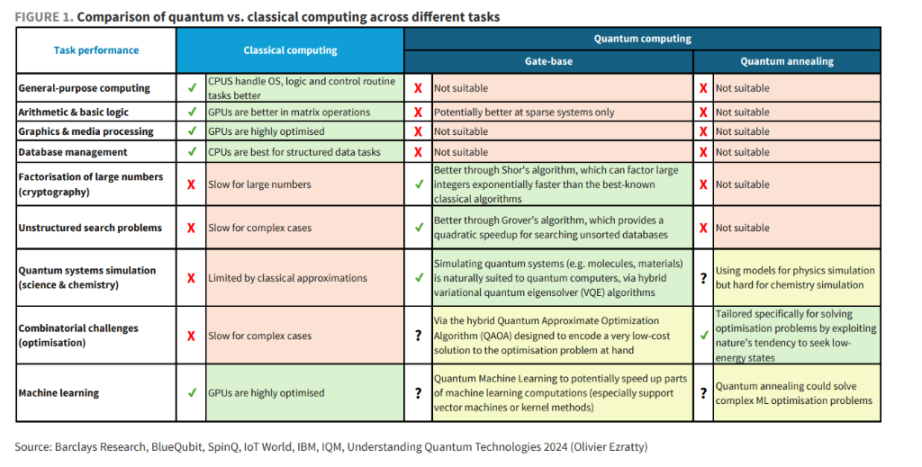
Misconception 2: Quantum is coming, it will replace classical computing, so Nvidia is finished?

This is the market's biggest cognitive bias. The report points out that many people think quantum computers are so powerful they will replace current CPUs and GPUs. Barclays refutes this: it's not a replacement relationship, but a "strongest assistant" relationship.

"Quantum computers will not replace classical computers as general-purpose machines but will complement them."

The core logic behind this is "error correction": Qubits are very fragile and unstable (prone to errors). To make them work properly, an extremely powerful classical computing system is needed to monitor and correct them in real-time.

Barclays' research reveals a startling data relationship:

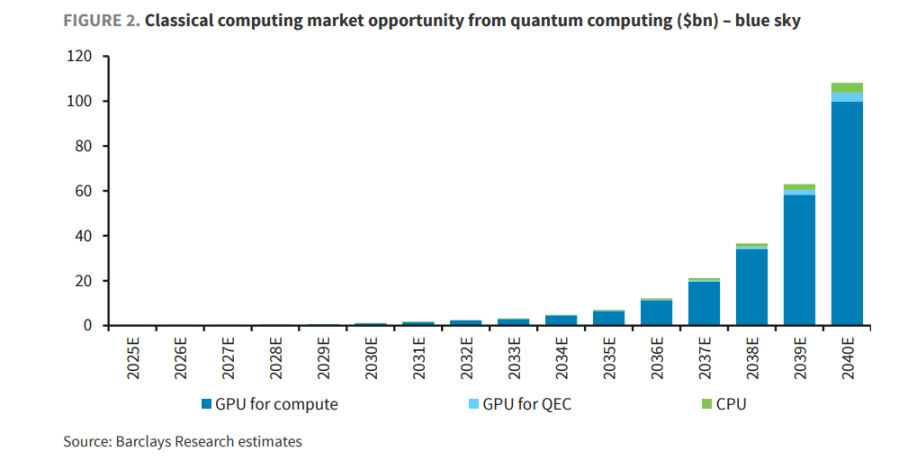
"Each logical qubit might require one GPU for error correction and control."

What does this mean? If you build a quantum computer with 1000 logical qubits, you would need to purchase 500 to 2000 GPUs to support it.

This is no longer competition; it's symbiosis. The stronger the quantum computer, the more explosive the demand for chips from Nvidia and AMD. Barclays calculates that this "derived demand" could bring over $100 billion in incremental value to the classical computing market by 2040 in a blue-sky scenario.
Misconception 3: Quantum hardware is all similar, like buying a lottery ticket?

The truth about this misconception is that the field has already diverged, with clear leaders and laggards.

Quantum hardware paths are not singular. Barclays categorizes mainstream physical qubit paths into electronic (superconducting, electron spin), atomic (trapped ions, neutral atoms), and photonic, among others, noting that their pros and cons stem from trade-offs between speed, accuracy, coherence time, external infrastructure (cryogenics, lasers, vacuum), and scalability.

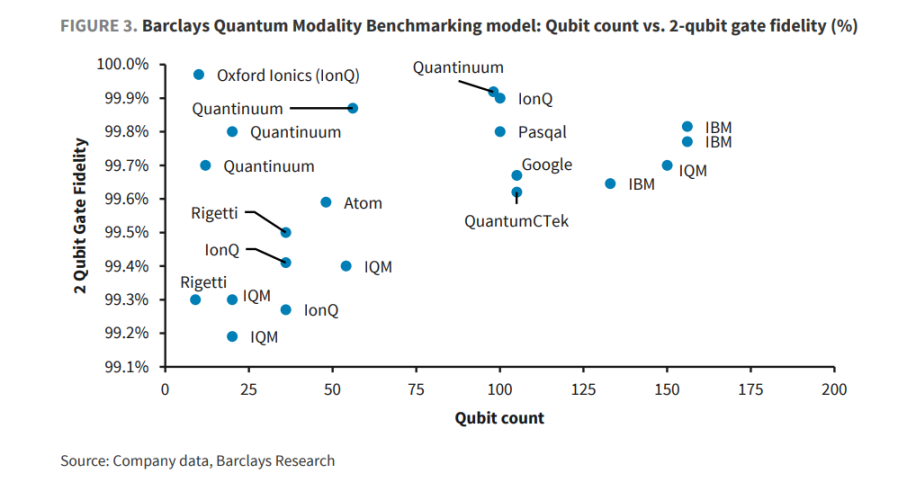
Using a "quantum benchmarking model," Barclays highlights the key points in the currently chaotic hardware landscape:

  • Current "Accuracy King" — Trapped Ions: Represented by companies like Quantinuum and IonQ. Their advantage is accuracy, low error rates, and relatively mature technology.

  • Future "Mass Production Dark Horse" — Silicon Spin: The direction Intel is pursuing. Although performance is currently average, it can leverage existing semiconductor fabs for manufacturing. Once it breaks through, it's the easiest to mass-produce.

  • Winning by Numbers — Neutral Atoms: Have a natural advantage in stacking large numbers of qubits.

Barclays concludes:

"Our testing indicates that trapped ions are currently in the lead...... but the scalability of silicon spin deserves long-term attention."
Misconception 4: Passwords are about to be cracked?

Regarding the panic that "quantum computers will crack bank passwords tomorrow," Barclays pours cold water on it: Think again, the computing power isn't there yet.

Cracking current RSA encryption requires thousands of perfect logical qubits, while humanity's top equipment currently only has a few dozen. Barclays states bluntly:

"Quantum computers are not yet powerful enough...... modern encryption standards are not yet under threat."

Misconception 5: The quantum theme has "only two or three companies worth investing in"

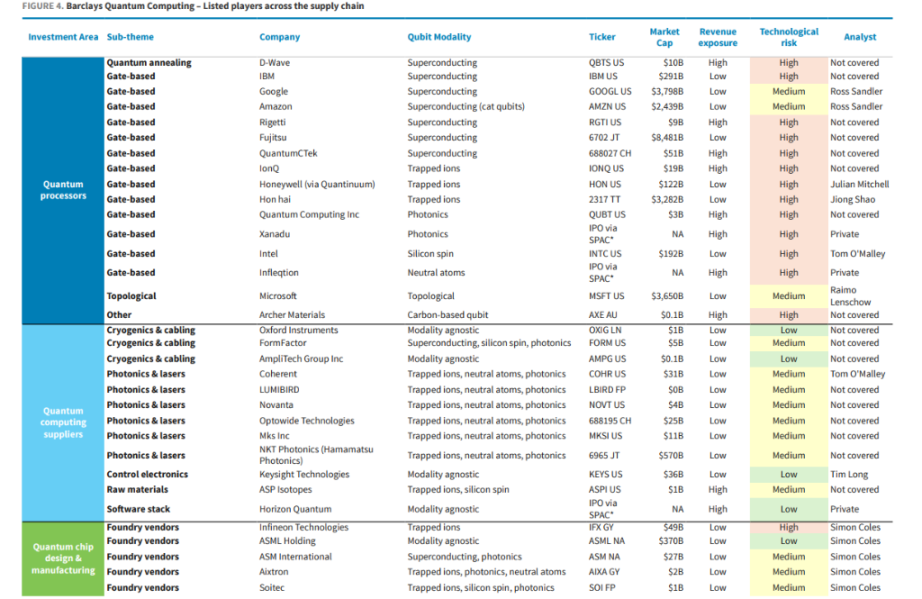
The market often believes investment targets in this field are scarce, limited to a few well-known companies. But Barclays梳理ed the entire industry chain, identifying 45 listed companies and over 80 private companies. They are mainly distributed across four areas:

1) Quantum Processors (system sales or QCaaS cloud access)

2) Quantum Supply Chain (cryogenics, lasers/optics, control electronics, materials, etc.)

3) Quantum Chip Design and Manufacturing (overlap with traditional semiconductor manufacturing)

4) Ecosystem Enablers (cloud, data center infrastructure, quantum simulators, quantum-classical integration: GPU/CPU/servers, etc.)

The framework provided by the report leans more towards "risk pricing": short-term often means "higher revenue exposure" corresponds to "higher technical risk". It roughly categorizes technical risk as high (single path), medium (few paths), low (path agnostic) based on whether the business model is tied to a single path.

This also explains why the quantum narrative easily "focuses solely on pure quantum hardware stocks": their revenue exposure is most direct, but their path uncertainty is also greatest; whereas the supply chain, semiconductor equipment & EDA, cloud & data centers, and hybrid integration segments might better capture the transmission of "quantum progress → capital expenditure and supporting demand".

Twitter:https://twitter.com/BitpushNewsCN

Bitpush TG Discussion Group:https://t.me/BitPushCommunity

Bitpush TG Subscription: https://t.me/bitpush

Original link:https://www.bitpush.news/articles/7610362

Пов'язані питання

QWhat is the core argument of Barclays' report regarding the timeline for quantum computing?

ABarclays argues that the market underestimates the speed of quantum computing's development, with the 'quantum advantage' expected to be demonstrated between 2026 and 2027 when systems can stably run 100 logical qubits, a critical inflection point that is not a distant future event.

QAccording to Barclays, what is the relationship between quantum computers and classical computing hardware like GPUs?

AIt is a symbiotic, not competitive, relationship. Quantum computers require powerful classical systems for error correction and control, with each logical qubit potentially needing one GPU. This creates massive demand for GPUs from companies like NVIDIA and AMD as quantum computing scales.

QWhich quantum hardware technology is currently leading in terms of 'precision' according to the Barclays benchmark model?

ATrapped ions, represented by companies like Quantinuum and IonQ, are currently the 'precision king' due to their low error rates and relative technological maturity.

QDoes Barclays report suggest that current encryption standards are immediately threatened by quantum computers?

ANo, it states that quantum computers are not yet powerful enough to threaten modern encryption standards like RSA, as this would require thousands of perfect logical qubits, far beyond current capabilities of a few dozen.

QHow does Barclays categorize the investment landscape for quantum computing beyond just hardware companies?

ABarclays identifies a broad ecosystem of over 45 public and 80 private companies across four main areas: quantum processors, the quantum supply chain (cryogenics, lasers, etc.), quantum chip design/manufacturing, and ecosystem enablers (cloud, data centers, integration hardware like GPUs).

Пов'язані матеріали

Analyzing the Impact of AI on Economic Growth and Productivity

**Title: Analyzing AI's Impact on Economic Growth and Productivity** This article examines three contrasting views on AI's influence on economic growth and productivity. **The Optimistic View** posits that AI, especially through automating R&D ("recursive self-improvement"), could dramatically accelerate growth, even triggering a technological "singularity" with explosive, potentially infinite, economic expansion. **The Moderate/Mainstream View** acknowledges AI's productivity benefits but emphasizes significant real-world constraints that could limit its impact. These include: limited cost savings per task, structural ceilings on which jobs and industries are "exposed" to AI, adoption bottlenecks (e.g., compute, energy, regulatory hurdles), and the "weak link" effect where non-automatable tasks cap overall gains. Consequently, the realized AI dividend may be far lower than optimistic projections, with estimates typically ranging from 0.1% to 1.3% annual productivity growth. **The Pessimistic View** stems from two strands. The first aligns with the moderate view but applies extremely conservative assumptions about task exposure and efficiency gains, yielding minimal projected impact. The second introduces a demand-side critique: if AI primarily replaces rather than augments labor, it could depress labor's share of income, weaken consumer demand, and create a "demand trap" that ultimately stifles growth, unless offset by redistribution policies. **The authors' assessment** is nuanced: * **Short-term (1-2 years):** AI will support growth primarily through investment spending, not significant productivity gains. * **Medium-term (3-5 years):** Three potential paths emerge based on AI demand and bottleneck severity: 1. **"Optimistic Path":** High demand, few bottlenecks. Rapid productivity gains but risk of major job displacement and social conflict without redistribution. 2. **"Moderate Path" (most likely):** High demand but significant, surmountable bottlenecks. Leads to moderate productivity gains, financial market volatility (K-shaped returns), and sectoral job losses. 3. **"Pessimistic Path":** Low demand or severe bottlenecks. Minimal productivity and growth impact, triggering financial market corrections but allowing a smoother societal transition with less labor disruption. * **Long-term:** AI holds potential for a major productivity revolution and prosperity. The conclusion stresses that no path is smooth. Technologically "optimistic" outcomes could be socially detrimental, while "pessimistic" technological diffusion might be more socially stable. Policymakers must monitor developments and prepare balanced responses to manage economic, financial, and social sustainability.

marsbit6 хв тому

Analyzing the Impact of AI on Economic Growth and Productivity

marsbit6 хв тому

The New Cold War is a Tech Stock War

The New Cold War is a Tech Stock War The article argues that the contemporary geopolitical and economic rivalry between the US and China represents a "New Cold War," but one fundamentally fought through technology and financial markets, not physical barriers or conventional trade. Historically, US dominance was secured through financial systems. The Soviet Union, reliant on the rigid "Transferable Ruble," was ultimately undermined by its dependency on the US dollar for oil trade. Later, Japan's semiconductor challenge was countered not just by tariffs (e.g., Plaza Accord, 301 investigations) but by binding it to US Treasury bonds. China presents a more complex, "embedded" challenger. While it holds vast dollar reserves and US debt like Japan, its industrial base is stronger and more diversified than the Soviet Union's. Surviving the initial 2018 trade war phase, the conflict has evolved into a "tech-financial war." The core battlefield is now the stock market. US tech stocks (AI, semiconductors) are treated as sovereign assets, buoyed by bipartisan national will. China is pushing to strengthen its own financial markets to convert industrial strength into financial power and fund its tech ambitions. Companies like ChangXin (semiconductors), Moonshot AI, and DJI compete not just for market share but as financial proxies for their respective systems. The new paradigm is moving from globally efficient monopolies (Apple, Google) towards companies that achieve monopolistic profits within their respective geopolitical spheres. This competition over "pricing power" and financial valuation in segmented markets defines the current era, making the stock market the primary arena for this tech-centric struggle.

marsbit16 хв тому

The New Cold War is a Tech Stock War

marsbit16 хв тому

RWA Weekly: Ten European Financial Institutions Establish Tokenized Asset Cooperative; Ondo Launches New Execution Network Ondo Network

RWA Weekly: European Banks Form Tokenized Asset Cooperative; Ondo Launches New Execution Network Ondo Network Covering July 24-31, 2026, the RWA sector saw a steady on-chain total value locked (TVL) of $36.8 billion, with holder count hitting a record high. However, stablecoin transfer volumes fell sharply (~30%), indicating low on-chain settlement demand. Key regulatory moves include South Korea advancing stablecoin legislation and a push to scrap crypto taxes, Kenya lowering capital requirements for stablecoin issuers, and Zimbabwe approving seven projects for its crypto sandbox. In project developments, BIS-led Project Agorá successfully tested cross-border payments with tokenized funds across six currencies. Ten major European financial institutions formed the RL1 blockchain cooperative to build tokenized asset infrastructure. Other notable updates: Aviva launched a tokenized dollar liquidity fund on XRPL, POSCO International tokenized commercial invoices on Injective, and a Brazilian farmer used tokenized cattle as collateral for a loan. Additional progress includes BNY Mellon migrating its core transfer agent operations to blockchain, Securitize gaining SEC investment advisor registration, and Tether’s compliant stablecoin USA₮ launching on Celo. Ondo Finance introduced Ondo Network, a new execution layer focused on speed and privacy, moving away from its initial chain plans. An analysis highlights that despite the growing scale of on-chain RWAs (~$32B), approximately 90% remain underutilized in DeFi, pointing to a critical challenge in unlocking liquidity and fostering real-world application beyond mere issuance.

marsbit16 хв тому

RWA Weekly: Ten European Financial Institutions Establish Tokenized Asset Cooperative; Ondo Launches New Execution Network Ondo Network

marsbit16 хв тому

South Korean Stock Market Sees Sharp Rebound After Forceful De-leveraging, SK Hynix Rises 30%

On July 31, South Korean stocks staged a historic rebound. The benchmark KOSPI index surged 18.27%, with chipmaker SK Hynix hitting a 30% gain limit. This followed a brutal, near-40% decline in the KOSPI over the previous month, driven largely by a deleveraging spiral involving leveraged ETFs. Analysts attributed the sharp sell-off to structural liquidity issues rather than deteriorating corporate fundamentals. The rally was triggered by a confluence of positive catalysts. Firstly, strong earnings from U.S. cloud giants Microsoft and Amazon alleviated fears of an "AI bubble burst," boosting global tech sentiment. Secondly, SK Group Chairman Chey Tae-won made a rare personal purchase of SK Hynix shares, seen as a strong vote of confidence. Thirdly, the South Korean government announced a 20 trillion won ($139 billion) AI investment fund. In response to the market turmoil, South Korean regulators are tightening controls on leveraged ETFs, admitting oversight shortcomings. Measures include raising minimum cash保证金 requirements for散户 investors and suspending new product launches. While the rebound signals eased liquidity pressure, analysts note deep structural issues remain. The market's future stability is seen as dependent on global tech capital expenditure trends and memory chip price cycles, with some viewing the surge as a technical correction rather than a definitive trend reversal.

marsbit36 хв тому

South Korean Stock Market Sees Sharp Rebound After Forceful De-leveraging, SK Hynix Rises 30%

marsbit36 хв тому

Торгівля

Спот
活动图片