On the Eve of the Explosion of On-Chain Options

marsbitОпубліковано о 2026-03-12Востаннє оновлено о 2026-03-12

Анотація

On-Chain Options on the Brink of Breakout The cryptocurrency options market is larger than most realize, with CME's crypto derivatives volume up 46% year-over-year. Institutional investors require defined-risk tools like options for hedging large positions. A pivotal shift occurred in mid-2025 when Bitcoin options open interest reached $65 billion, surpassing futures for the first time, indicating a move from pure leverage to risk-defined instruments. Growth is concentrated on Deribit (now backed by Coinbase after its acquisition) and traditional finance capital via IBIT options. While decentralized derivatives have grown from 2% to over 10% market share in two years, on-chain options remain nascent. @DeriveXYZ leads with over $700 million in notional options volume over 30 days. It has evolved from an AMM to a gas-free central limit order book on its own L2, featuring portfolio margin and cross-margin. @KyanExchange is approaching similarly with on-chain portfolio margining and partial liquidation mechanics. Structured products and asset managers urgently need options for their defined risk/return profiles. Institutional demand is clear, with IBIT options OI surpassing the gold ETF GLD and CME handling $3 trillion in crypto derivatives notional volume in 2025. Regulatory clarity is improving. A joint statement from the SEC and CFTC in 2025 allows regulated exchanges to trade spot crypto assets, and the CLARITY Act has passed the House. This improved environment, alongsid...

Author: Delphi Digital

Compiled by: AididiaoJP, Foresight News

The size of the cryptocurrency options market far exceeds most people's perceptions. Trading volume for cryptocurrency derivatives on the Chicago Mercantile Exchange (CME) is 46% higher than the record high set last year. Institutional investors need clear risk management tools to hedge large positions, and options are the only cryptocurrency instrument that provides this functionality.
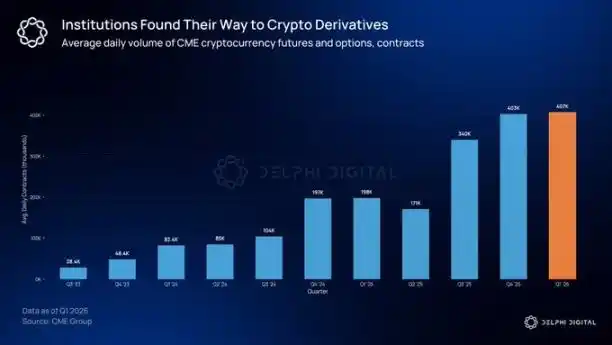
Reshaping the Landscape

By mid-2025, the total open interest in Bitcoin options reached $65 billion, surpassing futures open interest for the first time. Futures are leverage tools, while options allow funds to set a cap on losses for their $500 million Bitcoin holdings by paying a premium. This turning point indicates that tools with defined risk functions are gradually replacing pure leverage tools.

This growth has been concentrated on two platforms. Deribit has been the mainstream platform for cryptocurrency options trading for years. After being acquired by Coinbase for $2.9 billion in 2025, it gained institutional-grade endorsement. Meanwhile, IBIT options, launched in late 2024, brought traditional financial capital into this field. The options market is expanding rapidly, but the vast majority of trading still requires intermediaries.

On-Chain Options Are Still in Their Infancy

The market share of decentralized derivatives has climbed from 2% to over 10% in two years. Hyperliquid has proven that decentralized exchanges (DEXs) can rival centralized exchanges in speed and transparency. However, no similar representative project has emerged for on-chain options yet.

@DeriveXYZ remains the leading on-chain options protocol, with a nominal options trading volume exceeding $700 million in the past 30 days. The protocol was launched in August 2021 under the name Lyra as an options automated market maker (AMM). After weathering the bear market, it was completely rebuilt in 2023 and is now built on its own OP Stack Layer 2 with a gas-free central limit order book.
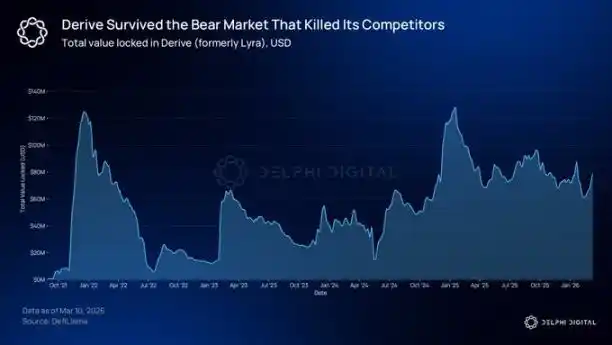
This rebuild fundamentally changed the pricing mechanism. Market makers quote prices directly on the order book, leading to narrower spreads, more precise pricing, and support for larger trades. Traders enjoy zero gas fees and sub-second execution speeds.

Its portfolio margin system has also attracted institutional attention. The system assesses overall position risk through scenario analysis. For example, if a trader holds both a long call option and a short put option on the same underlying asset, the system does not charge margin for each leg separately.

The collateral required for a hedged position is lower than the simple sum of the individual parts, which is the common logic in traditional financial derivatives trading desks. Derive also offers perpetual contracts and lending services on the same Layer 2, supporting cross-product cross-margining.

@KyanExchange is moving in the same direction but in a different way. This platform combines an order book matching engine with on-chain portfolio margining, supporting multi-leg operations in a single atomic transaction. Traders can deploy an iron condor strategy with just a few clicks.

Kyan's liquidation mechanism also differs from most DeFi protocols. When a margin threshold is breached, the platform does not liquidate the entire account but executes a partial close-out, only closing the minimum number of positions necessary to bring the account back to the margin requirement. Kyan is currently in the Arbitrum test phase, with a mainnet launch imminent.

Who Needs Options?

Asset management companies building structured products urgently need the clearly defined risk-return profiles provided by options. Take J.P. Morgan's Equity Premium Income ETF as an example. This fund is built on a covered call strategy and is one of the largest actively managed funds globally. The total assets under management for yield products based on derivatives exceed one hundred billion dollars. As more institutional capital moves on-chain, the corresponding hedging needs will migrate as well.

Currently, more and more institutional investors already hold or plan to allocate to digital assets in the short term. The open interest for IBIT options has surpassed that of the gold ETF GLD. In 2025, the CME processed a nominal trading volume of $3 trillion in cryptocurrency derivatives.

The Timing is Ripening

Most early on-chain options protocols failed to survive, primarily due to regulatory uncertainty. For instance, Opyn was fined by the CFTC for operating an unlicensed derivatives exchange. At that time, teams developing products could not predict whether their product would be deemed illegal the next quarter.

This situation is now improving. In September 2025, the U.S. Securities and Exchange Commission (SEC) and the Commodity Futures Trading Commission (CFTC) jointly issued a statement allowing regulated exchanges to conduct spot crypto asset trading. The CLARITY Act has passed the House of Representatives, proposing to place spot markets for digital commodities under CFTC oversight. The Senate version is still under negotiation and is currently stalled. CME Group will launch 24/7 cryptocurrency options trading on May 29th. While this does not guarantee that on-chain protocols will necessarily succeed, the overall environment has undergone a fundamental shift.


Пов'язані питання

QWhat major shift occurred in the Bitcoin derivatives market in mid-2025, and what does it signify?

AIn mid-2025, the total open interest for Bitcoin options reached $65 billion, surpassing that of futures for the first time. This signifies a shift is underway from purely leveraged tools (futures) to instruments with defined risk (options), as institutions seek better risk management tools for their large holdings.

QWhich two platforms are highlighted as the main drivers of growth in the cryptocurrency options market?

AThe growth is concentrated on two platforms: Deribit, which gained institutional credibility after its acquisition by Coinbase, and IBIT options, which introduced TradFi capital into the space starting in late 2024.

QWhat is the current state of on-chain options, and which protocol is mentioned as the current leader?

AOn-chain options are described as being in their infancy. The leading on-chain options protocol mentioned is @DeriveXYZ, which has processed over $700 million in notional options volume in the past 30 days.

QHow did the protocol @DeriveXYZ (formerly Lyra) improve its system after a 2023 overhaul?

AThe 2023 overhaul replaced its AMM model with a gas-free central limit order book (CLOB) built on its own OP Stack Layer 2. This allowed market makers to quote prices directly, leading to tighter spreads, more precise pricing, support for larger trades, and sub-second execution speeds for traders.

QWhat are two key reasons mentioned for why the environment for on-chain options is now more favorable than before?

ATwo key reasons are: 1) Improved regulatory clarity, exemplified by a joint SEC-CFTC statement allowing regulated exchanges to trade spot crypto assets and the progress of the CLARITY Act. 2) The growing institutional demand for defined-risk tools, as seen with the massive success of CME's crypto derivatives and IBIT options.

Пов'язані матеріали

From South Korea to the United States: Blue-Collar Jobs Are Becoming Increasingly Popular, Thanks to AI

AI is reshaping the labor market's value proposition. The traditional four-year college degree is losing its appeal as a guaranteed career path, while skilled blue-collar trades like electricians, welders, and plumbers are experiencing historic demand and wage premiums. This shift is driven by dual pressures: AI's displacement of certain white-collar roles and a booming need for physical infrastructure and data center construction. Data confirms the trend. In the U.S., vocational school revenue surged, and a significant portion of recent layoffs are AI-related. Surveys show a majority of Gen Z adults plan to pursue blue-collar work, citing better job security against AI automation. Vocational education interest has exploded recently. Experts cite a psychological shift as younger generations seek tangible, AI-resistant careers and avoid high student debt. In many cases, salaries for skilled trades now match or exceed those requiring a bachelor's degree. In South Korea, semiconductor vocational high schools boast near-total employment, with graduates securing high-paying roles at companies like Samsung. The shortage is structural, exacerbated by a retiring baby boomer workforce and massive infrastructure projects. Companies like JPMorgan Chase, Meta, and Lowe's are investing heavily in training programs. However, overcoming historical stigma and a "perception gap" around trade careers remains a key challenge to closing the talent gap.

marsbit25 хв тому

From South Korea to the United States: Blue-Collar Jobs Are Becoming Increasingly Popular, Thanks to AI

marsbit25 хв тому

Qualcomm: AI Hype Subsides, When Will Smartphones Emerge from the Gloom?

Qualcomm reported its Q3 FY2026 results (ending June 2026), with revenue of $9.95B, down 4% YoY but above expectations. Gross margin declined to 53.1%, pressured by rising costs across manufacturing and memory. Key business segments showed mixed performance: Handset revenue fell 19.6% YoY to $5.09B, dragged by an 11% decline in non-Apple Android shipments and weaker high-end mix. Conversely, Automotive revenue surged 61% to $1.59B, and IoT grew 9% to $1.83B. Core operating profit dropped 41% YoY due to margin compression and higher expenses. Management's Q4 FY2026 guidance projects revenue of $9.7B-$10.5B, in line with consensus, but Non-GAAP EPS guidance of $2.05-$2.25 fell short of expectations. Amidst persistent weakness in its core handset market, Qualcomm is pursuing growth in AI, focusing on Edge AI (smartphones, PCs, automotive) and Data Center AI. Its data center strategy includes four pillars: AI accelerators (e.g., AI200), commercial CPUs (Dragonfly C1000), custom silicon, and connectivity solutions. While these initiatives initially boosted its stock, concerns over AI capital expenditure sustainability have since erased those gains. The company targets $5B in data center revenue for FY2027 and $15B for FY2029. The report concludes that with the traditional handset business still under pressure, the data center opportunity is currently viewed as a longer-term option, and a more conservative valuation based on core operations may be warranted until AI contributions materialize.

marsbit29 хв тому

Qualcomm: AI Hype Subsides, When Will Smartphones Emerge from the Gloom?

marsbit29 хв тому

From TPU to Self-Evolving Agents: How Jeff Dean Predicts the Next Step in AI

At the 2026 YC Startup School, Jeff Dean outlined his vision for AI's next phase, shifting focus from simply scaling models to building intelligent, autonomous systems. He believes AI's progress is no longer just about creating smarter models, but about integrating them into systems capable of long-term, iterative work, automated experimentation, and continuous learning. This evolution moves the competition from "who has the bigger model" to "who can best organize intelligence." Dean suggests AI capabilities are now comparable to a junior engineer, enabling the automation of complex workflows. However, the true challenge and opportunity lie in managing these AI "workers" at scale. He emphasizes the importance of **context engineering**—structuring tools, memory, and feedback loops—over raw model power. For startups, this means building deep expertise in niche domains where general models currently fail (near 0-1% success rates), leveraging proprietary data, specialized tools, and domain-specific evaluators. A recurring theme is re-examining fundamental constraints. Dean's past work, like moving Google's search index to memory or creating the TPU, stemmed from questioning outdated assumptions about hardware and cost. He sees similar inflection points today, particularly in **specialized inference hardware** to drastically reduce latency and energy consumption for real-time Agent operation. Notably, he points out that in modern AI systems, the dominant cost is often not computation but **data movement**. Reliable, long-running Agents require robust system design, borrowing concepts from distributed computing like checkpointing, state management, and parallel exploration to handle failures and maintain progress over days or weeks. As AI automates execution, the scarcest human skills will shift to **defining clear specifications**, **judging what problems are worth solving** (taste), and designing effective feedback loops. Ultimately, Dean's framework prioritizes understanding the problem deeply, identifying the true bottlenecks, and systematically building closed-loop systems where AI can not only perform tasks but also improve AI itself.

marsbit29 хв тому

From TPU to Self-Evolving Agents: How Jeff Dean Predicts the Next Step in AI

marsbit29 хв тому

Торгівля

Спот
活动图片




