On-Chain Economy: Past, Present, and Future

marsbitОпубліковано о 2026-03-06Востаннє оновлено о 2026-03-06

Анотація

On-Chain Economy: Past, Present, and Future In 2014, before "Web3" became synonymous with blockchain and crypto assets, the core vision revolved around smart contracts and their potential to enable a self-managing decentralized network. This early idea evolved into the concept of a Smart Economy, where autonomous economic coordination could flourish. Today, Web3 is rapidly growing, largely driven by decentralized finance (DeFi). Stablecoins serve as global settlement tools, and crypto assets have reshaped public understanding of money. Beneath these developments lies a fundamental improvement in financial efficiency. At the same time, AI has moved from abstract concept to daily reality. While many see AI as a productivity tool, its deeper role is that of a new financial efficiency paradigm. By increasing productivity, AI raises the value of attention even during non-working hours, making it a natural core component of the next-generation on-chain economy. The future on-chain economy will be defined by three core features: 1. Minimal human involvement: Humans act as intent providers, while AI handles analysis, execution, and feedback. 2. Complete trustlessness: Systems must be fully secure and trustless. 3. Extreme efficiency: AI will push capital utilization to unprecedented levels. Key enabling technologies include rapidly evolving AI models, intent-based AI agents, agent networks, privacy-preserving tech like ZKP and FHE, enhanced security components, and sustainable m...

In 2014, before "Web3" became exclusively associated with blockchain and crypto assets, blockchain was simply blockchain itself. People were deeply fascinated by the future potential unlocked by smart contracts.

Our early vision of the on-chain economy eventually crystallized into the concept of the Smart Economy. We envisioned a decentralized network capable of autonomously managing task completion, with smart contracts serving as the key, unlocking unprecedented possibilities for economic collaboration.

As we rapidly move into the third decade of the 21st century, the current Web3 ecosystem is booming, with decentralized finance (DeFi) as its core driver. Stablecoins have become a mainstream global settlement solution, breaking geographical barriers; payment finance (PayFi) is permeating daily life. Regardless of the depth of public understanding, crypto assets have profoundly reshaped mass financial perception.

Beneath the surface of these developments, the most profound structural progress is the leap in financial efficiency.

Meanwhile, artificial intelligence, a long-familiar technology that remained largely conceptual, has finally materialized into everyday reality over the past two years. Powered by the continuous emergence and iteration of large language models, it has deeply integrated into our work and lives.

For most people, AI is a productivity tool: designers save time, content creators automate copy polishing, and programmers significantly increase coding efficiency.

But in our view, AI is far more than a productivity booster; it is a new paradigm of financial efficiency.

Human labor always incurs costs, and human attention is inherently limited. As AI increases productivity per unit of time, it simultaneously raises the value of attention during non-working hours. Therefore, we believe AI is naturally compatible with blockchain and should become a core component of the next generation on-chain economy.

Three Core Characteristics of the Next Generation On-Chain Economy

  1. Minimized Human Participation: In on-chain economic activities, humans will primarily act as intent providers, while the system autonomously completes the analysis, execution, and feedback loop based on intent. Taking decentralized finance (DeFi) as an example: the so-called "composability" initially required users to invest significant effort in validating strategy combinations; in the new on-chain economy, AI will autonomously handle reasoning and planning.
  2. Fully Trustless: Asset security is the foundation of usability. In the Web3 space, security issues have always loomed like a sword of Damocles. The next-generation economy must completely eliminate user security concerns, creating a truly trustless system.
  3. Extremely Efficient: As mentioned earlier, every technological revolution is accompanied by a leap in efficiency. Web3 has already significantly surpassed traditional finance in transaction and settlement efficiency, but there remains huge potential in capital utilization. The deep integration of AI will elevate capital efficiency to unprecedented heights.

Core Components Supporting These Structural Features

  1. Rapidly iterating AI foundation models (new architectures and open-source models emerge almost daily)
  2. Intent-centric AI agents that accurately interpret and execute user intent
  3. An AI agent network enabling communication and collaboration between agents, forming synergistic clusters
  4. Privacy-preserving computation technologies (e.g., Zero-Knowledge Proofs ZKP / Fully Homomorphic Encryption FHE) to ensure data security without a centralized trust mechanism
  5. Foundational security components providing maximum asset protection (e.g., Trusted Execution Environments TEE and retrospective verification)
  6. Sustainable monitoring systems that continuously supervise economic activity, possessing self-diagnostic and self-correcting capabilities

The synergy of these elements will give birth to a truly organic, evolvable, and self-driven on-chain economy—we define this as the true Intelligent-Sensing Economy.

All of this is far more than just building a faster system or rearranging a set of instruments.

The on-chain economy has never been merely a stacking of technologies. More accurately, it is a collective narrative about value creation, distribution, and perception, concerning collaboration, order, and consensus.

With the deep integration of AI agents, AI is no longer just an external efficiency tool but becomes an intrinsic structural component—possessing intent, logic, preferences, and even goals.

This structural change is far more profound than the technological progress itself. We are moving from a human-activity-centric on-chain system towards a collaborative intelligence-driven network architecture.

Consequently, the economy begins to exhibit coherent, life-like characteristics beyond just a combination of rules and incentives: perceiving external data, responding internally, adjusting parameters, and reorganizing iteratively under pressure.

The Intelligent-Sensing Economy we speak of does not refer to the birth of emotion or consciousness, but rather the gradual perfection of the internal information-action feedback loop. This means synergy no longer relies on external scheduling but can emerge naturally from within the system. This marks a directional shift in the infrastructure of human civilization—from simply "governing an economy" to "embedding intelligence into the economy".

We often discuss the on-chain economy from the perspectives of structural design and financial efficiency, but perhaps what is truly worth rethinking is: when a system possesses the ability for continuous autonomous learning, adaptation, and self-coordination, should we still simply define it as an "economy"? Or is it evolving into a new form of life?

Пов'язані питання

QWhat was the initial vision for the on-chain economy before the term 'Web3' became synonymous with blockchain and crypto assets?

AThe initial vision was crystallized as the 'Smart Economy' concept, which envisioned a decentralized network capable of autonomously managing tasks, with smart contracts being the key to unlocking unprecedented possibilities for economic collaboration.

QAccording to the article, what is the most profound structural progress beneath the development of the current Web3 ecosystem?

AThe most profound structural progress is the leapfrog improvement in financial efficiency.

QWhat are the three core characteristics of the next generation on-chain economy as outlined in the article?

AThe three core characteristics are: 1. Minimal human participation (humans as intent providers), 2. Complete trustlessness (eliminating user security concerns), and 3. Ultimate efficiency (unprecedented capital efficiency through deep AI integration).

QWhat core components are identified as necessary to support the structural features of the next-generation on-chain economy?

AThe core components are: rapidly iterating AI foundation models, intent-centric AI agents, an AI agent network for collaboration, privacy computing technologies (like ZKP/FHE), foundational security components (like TEE), and a sustainable monitoring system with self-diagnosis and correction capabilities.

QHow does the article define the 'Sensory Economy' that emerges from the synergy between AI and blockchain?

AThe 'Sensory Economy' is defined as a truly organic, evolvable, and self-driven on-chain economy. It is characterized by an internal information-action feedback loop that allows for coordination to emerge naturally from within the system, rather than relying on external scheduling, marking a directional shift in human civilization's infrastructure.

Пов'язані матеріали

MSX US Stock Daily Insight: Amazon 2026 Q2 Earnings: AWS Records Fastest Growth in Five Years

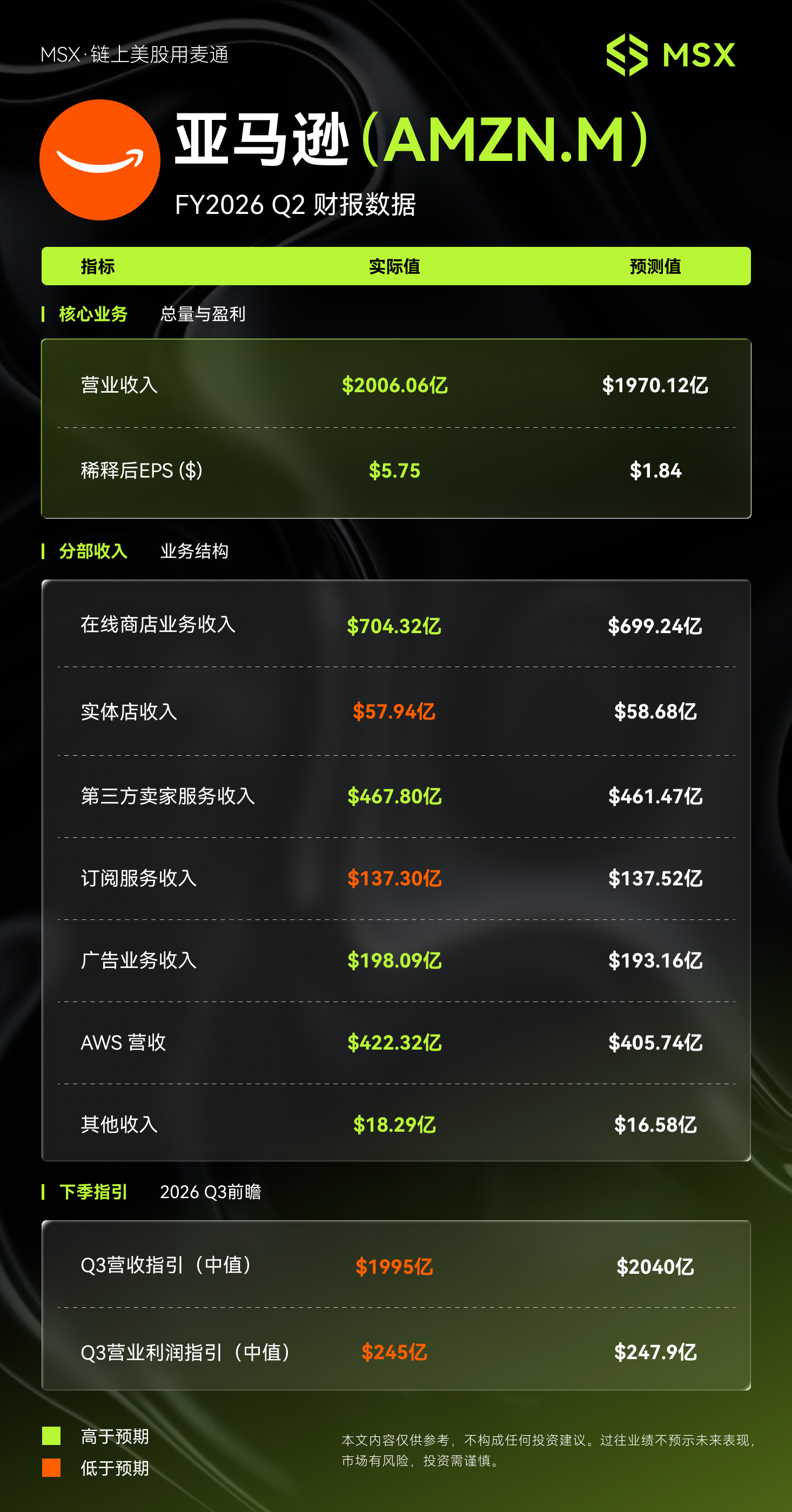
**MSX Daily US Stock Observation: Amazon's Q2 2026 Earnings: AWS Achieves Fastest Growth in Five Years** Amazon's latest quarterly results exceeded expectations, driven by a strong performance from its cloud computing unit. The company reported revenue of $200.66 billion, surpassing estimates of approximately $197 billion. The key highlight was Amazon Web Services (AWS), which generated $42.232 billion in revenue, surging 37% year-over-year. This marked the segment's fastest growth pace in 18 quarters, indicating robust demand for cloud services. Reported Earnings Per Share (EPS) of $5.75 significantly exceeded the $1.84 forecast. However, this figure included a substantial one-time, non-operating gain of $53.4 billion, primarily from the revaluation of Amazon's investment in AI company Anthropic. Excluding this item, core operating profit was $27.461 billion, a strong increase of 43% compared to the same period last year. Despite the positive results, Amazon provided guidance for the upcoming third quarter that fell short of market expectations. The company's revenue guidance midpoint is $199.5 billion, below the consensus estimate of around $204 billion. Operating profit guidance of $24.5 billion also slightly missed expectations of approximately $247.9 billion. Furthermore, Amazon raised its forecast for full-year capital expenditures to $220 billion, citing rising memory chip costs, which weighed on investor sentiment regarding future profitability. In summary, Amazon's quarter showcased accelerating momentum in its core AWS business. The underlying operational profit growth remains solid. However, cautious forward guidance and increased investment spending present key areas for monitoring in the coming quarters, as the market assesses whether the current growth phase will translate into sustained profit margin expansion.

Odaily星球日报7 хв тому

MSX US Stock Daily Insight: Amazon 2026 Q2 Earnings: AWS Records Fastest Growth in Five Years

Odaily星球日报7 хв тому

Cyclical Stock or Growth Stock? Coinbase's Q2 Earnings Report Reveals 'Valuation Disagreement'

Coinbase's Q2 2026 financial results revealed a mixed performance, reigniting debate over whether the company should be valued as a cyclical stock tied to crypto markets or a growth stock with future potential. Total revenue missed expectations at $1.22 billion, down 19% year-over-year. Transaction revenue fell to $599 million, with retail crypto spot trading revenue dropping 30% to $452 million, back to 2023 levels. The company reported a net loss of $359 million, marking its third consecutive quarterly loss. Despite CEO Brian Armstrong's positive commentary on metrics like a 10.3% overall crypto trading market share and 106% growth in prediction markets, the market reacted negatively, with shares dropping over 5% after-hours. A key issue is the decline in core retail trading. While Coinbase touted record market share, this figure includes derivatives and new products. Its traditional crypto spot trading share is likely shrinking. New ventures like prediction markets, while growing, contributed less than $30 million, insufficient to offset the core revenue decline. The valuation debate hinges on perspective. As a cyclical stock, Coinbase remains deeply tied to the crypto bear market, with user attrition and competitive pressures justifying a lower valuation. The company's strategy appears focused on surviving until the next bull cycle. Viewed as a growth stock, however, Coinbase shows promising diversification. Subscription and service revenue reached $555 million, nearly matching transaction revenue. Stablecoin revenue, its second-largest source at $292 million, remains strong through its partnership with Circle. Critically, Coinbase is positioning itself as a leader in the emerging on-chain "agent economy." Over 90% of agent-based stablecoin transactions occur on its Base network, which it believes could handle trillions in future agent transactions. The recent acquisition of Deribit also aims to boost its international derivatives offering. In summary, Coinbase's present struggles are clear, but its future hinges on whether its investments in revenue diversification, stablecoins, and the agent economy can ultimately transform its business model and justify a growth premium.

Odaily星球日报27 хв тому

Cyclical Stock or Growth Stock? Coinbase's Q2 Earnings Report Reveals 'Valuation Disagreement'

Odaily星球日报27 хв тому

Global Market Share Survey: Japanese Firms Lead in Semiconductor Materials

Global Market Share Survey: Japanese Firms Lead in Semiconductor Materials According to the 2025 "Major Goods and Services Market Share Survey" by Nikkei, Japanese companies maintain strong positions in semiconductor-related materials. In silicon wafers, Shin-Etsu Chemical ranks first with a 26.3% share, followed by SUMCO at 17.8%. Together, they hold 44.1% of the market, widening their lead over competitors from Taiwan, Germany, and South Korea. In photoresists, Tokyo Ohka Kogyo, JSR, and Shin-Etsu Chemical occupy the top three spots, with a combined share of 60.5%. Despite their strength in materials, Japanese firms have a weaker presence in core semiconductor segments like DRAM and NAND flash memory, where South Korean and U.S. companies dominate. For instance, SK Hynix and Samsung lead in DRAM, while China’s CXMT doubled its share to 6% in 2025. The semiconductor market is projected to grow rapidly, with WSTS forecasting a 90% increase to $1.5112 trillion by 2026. Major players like Samsung, SK Hynix, and Micron are making massive investments to expand capacity. To maintain their edge in materials, Japanese companies must similarly commit to large-scale, risk-taking investments. In contrast, Japan’s automotive sector shows stagnation. Toyota remains the global leader but with only a slight share increase to 12.3%, while Japanese brands are absent from the top five in the EV market. In shipbuilding, Imabari Shipbuilding rose to third place globally with a 7.2% share, benefiting from large container ship deliveries. However, Chinese and South Korean firms dominate the sector, holding the top two positions. Japan aims to revitalize its shipbuilding industry through government and corporate efforts, targeting a near doubling of output by 2035. Addressing labor shortages and adopting advanced technologies like physical AI will be critical for competitiveness.

marsbit52 хв тому

Global Market Share Survey: Japanese Firms Lead in Semiconductor Materials

marsbit52 хв тому

Торгівля

Спот
活动图片