Oil Prices Are Approaching a Tipping Point, What Will Happen in Mid-April?

marsbitОпубліковано о 2026-04-05Востаннє оновлено о 2026-04-05

Анотація

Oil prices are approaching a critical inflection point, with mid-April identified as a key threshold. The ongoing disruption in the Strait of Hormuz has halted oil tanker traffic, resulting in a production loss of nearly 11 million barrels per day from key producers including Iraq, Kuwait, the UAE, Saudi Arabia, and Bahrain. The release of 400 million barrels from strategic petroleum reserves (SPR) has provided a temporary buffer, delaying immediate price spikes but not resolving the structural supply deficit. If the conflict ends before mid-April, Brent crude could retreat to the $80–90 range. However, if disruptions persist beyond mid-April, the market faces a cumulative inventory drawdown of 210 million barrels or more, pushing prices toward $110–120 or even demand-destructive levels above $200. The conflict has shifted from a cycle of escalation and de-escalation to a test of market endurance. Iran appears incentivized to prolong the situation until the market reaches a breaking point, strengthening its negotiating position. Even if resolved soon, supply losses have already altered long-term oil balances, suggesting a structurally higher price floor ahead.

Editor's Note: This article argues that what truly drives oil prices is not just whether the conflict ends, but "when the tipping point is crossed".

In the Iran conflict, now in its fourth week, the oil market is experiencing a classic case of "time-based pricing." The release of strategic reserves has delayed the impact but cannot eliminate the supply gap; disruptions in tanker transport and lagging production recovery are causing inventory pressures to accumulate into the future. Once the key node in mid-April is passed, the pricing mechanism will shift from "buffered volatility" to "re-pricing dominated by the gap."

More notably, the structure of the game itself is changing. The conflict no longer follows an "escalate to de-escalate" path but has turned into an endurance test against the market's tipping point. Whoever can hold out until the supply-demand imbalance is priced in by the market gains the initiative in negotiations. This means that even if the conflict ends shortly, oil prices will struggle to return to their previous range. The supply losses occurring now are reshaping the global oil balance for the foreseeable future.

The original text follows:

In this article, I will break down the possible scenarios. With the Iran conflict now in its fourth week, how will this situation affect the oil market?

On March 9, we published a public article titled "My Latest Assessment of the Oil and Gas Market Under the Iran Conflict," which stated:

Below is the impact on oil prices under different scenarios ("barrels lost" already includes the time required for production recovery):

Scenario 1: Tanker transport resumes the next day

→ Brent crude annual average will be in the high $70s to low $80s range (approx. 210 million barrels lost)

Scenario 2: Tanker transport resumes by March 15

→ Brent annual average will be in the mid-to-high $80s (approx. 290 million barrels lost)

Scenario 3: Tanker transport resumes by March 22

→ Brent annual average will be in the low $90s (approx. 370 million barrels lost)

Scenario 4: Tanker transport resumes by March 29

→ Brent annual average will be in the mid-to-high $90s (approx. 450 million barrels lost)

If tanker transport cannot return to normal by March 29, the situation the oil market will face is almost unthinkable. The only way out would be forced demand contraction, pushing prices to extreme levels.

Shortly after the report was published, the International Energy Agency (IEA) announced a coordinated release of a total of 400 million barrels from global strategic petroleum reserves (SPR). This will somewhat mitigate the impact of the supply loss. But as we pointed out in a subsequent article, "IEA's Coordinated SPR Release is the Biggest Gift for the Bulls":

From a trading perspective, traders are in no rush to push oil prices higher until this "cushion" is depleted. The concentrated SPR release does ease short-term supply anxiety, but it is only a temporary solution. The market will remain tense; as long as tanker transport remains disrupted, oil prices will gradually rise.

On the other hand, if the situation eases quickly—for example, with an immediate ceasefire or agreement—oil prices will fall rapidly. For instance, if a peace deal is reached before March 15, global inventories would see an net increase of 110 million barrels (400 million released - 290 million lost).

This could push Brent prices back down to the mid-$70s range.

Conversely, without a peace deal and with the supply disruption lasting until the end of March, global inventories would see a net reduction of 50 million barrels, and the gap would widen by about 80 million barrels for each additional week.

Therefore, the SPR's role is merely to "buy time" and does not solve the core problem. Tanker transport must return to normal. However, it does prevent a catastrophic price spike in the short term, thereby avoiding a large-scale demand collapse.

Fast forward to now, we have entered the "March 29 scenario" set at the beginning of the month. Next, we assess the oil market's direction based on the latest facts.

Facts

Total production shutdowns from Saudi Arabia, UAE, Kuwait, Iraq, and Bahrain have reached 10.98 million barrels per day:

Iraq: -3.6 million bpd

Kuwait: -2.35 million bpd

UAE: -1.8 million bpd

Saudi Arabia: -3.05 million bpd

Bahrain: -0.18 million bpd

Saudi Arabia has maxed out the capacity of its East-West pipeline, currently exporting about 4 million bpd via the Red Sea. The UAE is also using bypass transport via the Abu Dhabi pipeline (Habshan-Fujairah), whose capacity of about 1.8 million bpd is also at its limit. Tanker traffic through the Strait of Hormuz remains completely interrupted. In fact, even if the war ended tomorrow, it would take months to restore production and rebuild normal transport.

Scenario Projections

I will outline three possible paths:

1) The war ends this week, transport resumes by the weekend

2) The war ends in mid-April

3) The war ends at the end of April

It is important to note that the release of 400 million barrels of SPR, compared to our initial assessment on March 9, has bought the market more time. The oil price scenarios below already reflect this change.

Scenario 1: Ends this week

Impact on global inventory: -50 million barrels (SPR already factored in)

Impact on Brent: Short-term pullback to low $80s, annual average in the mid-to-high $80s

Scenario 2: Ends in mid-April

Impact on global inventory: -210 million barrels

Impact on Brent: Short-term pullback to low $90s, annual average in the mid-to-high $90s

Scenario 3: Ends at the end of April

Impact on global inventory: -370 million barrels

Impact on Brent: Short-term spike to the $110 range, annual average at $110–$120

Key Inflection Point: Mid-April

For the oil market, there is a clear "tipping point." The current market consensus expects the conflict to end before mid-April, and this expectation is crucial for oil price pricing.

Oil prices are a product of "marginal pricing." As long as the market believes supply is "just about sufficient," panic will not ensue. This is precisely the current state of the oil market—a lack of panic.

Policy statements from the Trump administration, the relaxation of sanctions on Iranian and Russian crude, and the SPR release have collectively suppressed oil prices.

But once this tipping point is crossed, these factors will become ineffective.
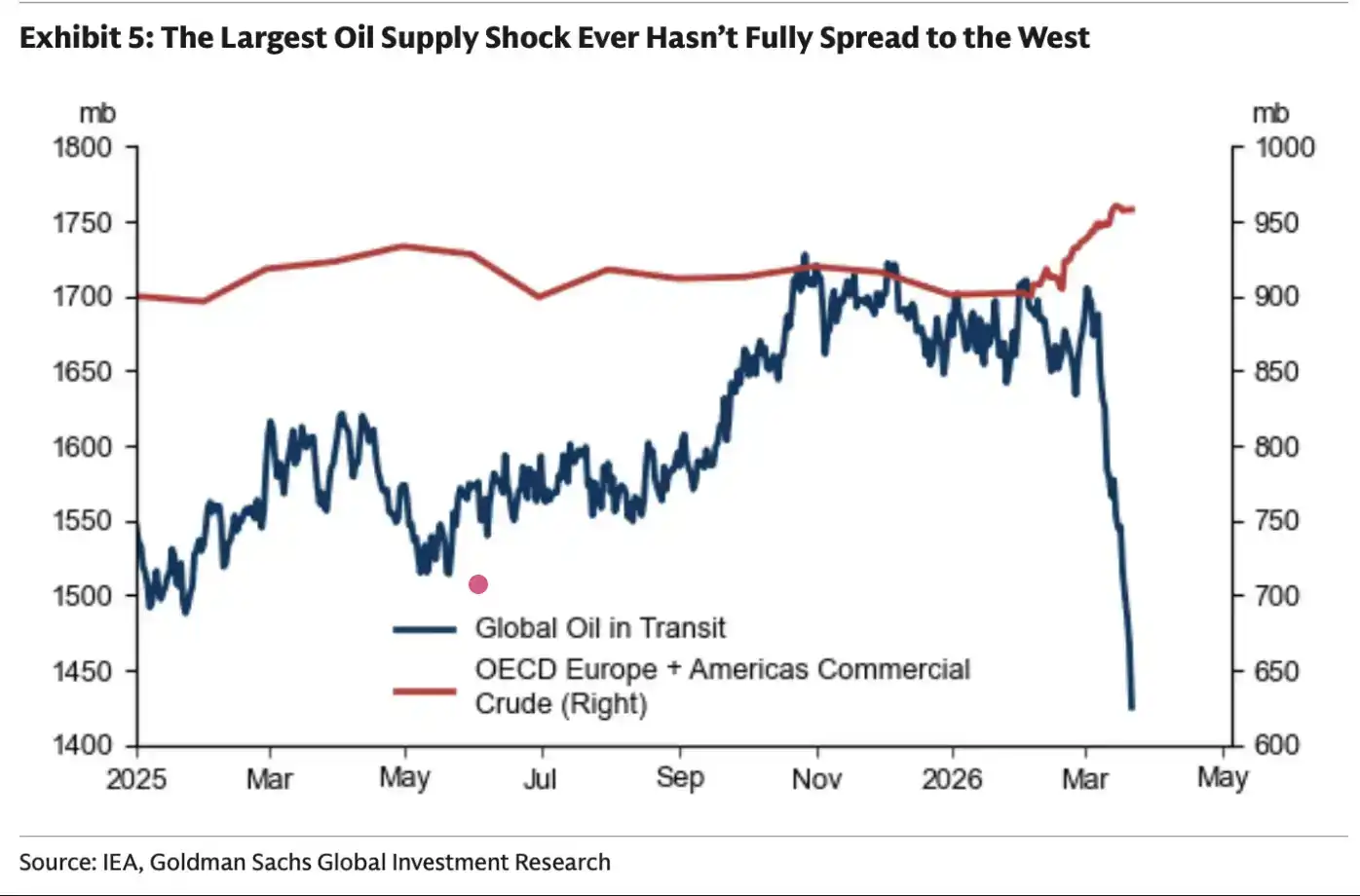
Currently, the evaporation effect of global "oil in transit" has not yet fully transmitted to onshore inventories. But our judgment is that by mid-April, this impact will become fully evident.

If the conflict remains unresolved by mid-April, the International Energy Agency (IEA) will have to coordinate another release of approximately 400 million barrels of strategic petroleum reserves (SPR). Otherwise, oil prices will surge into the "demand destruction" range ($200+).

Long-Term Impact

In Energy Aspect's latest weekly report, their estimate of the market's cumulative supply loss is about 930 million barrels. Among this, the cumulative production loss from May to December is about 340 million barrels.

This assessment is significantly more aggressive than ours. In our inventory sensitivity analysis, we did not fully account for the reality that countries like Iraq and Kuwait might need 3 to 4 months to restore production capacity. This means our previous estimates might have been too conservative.

For Goldman Sachs, the conclusion is straightforward: the longer the conflict lasts, the longer high oil prices will persist.
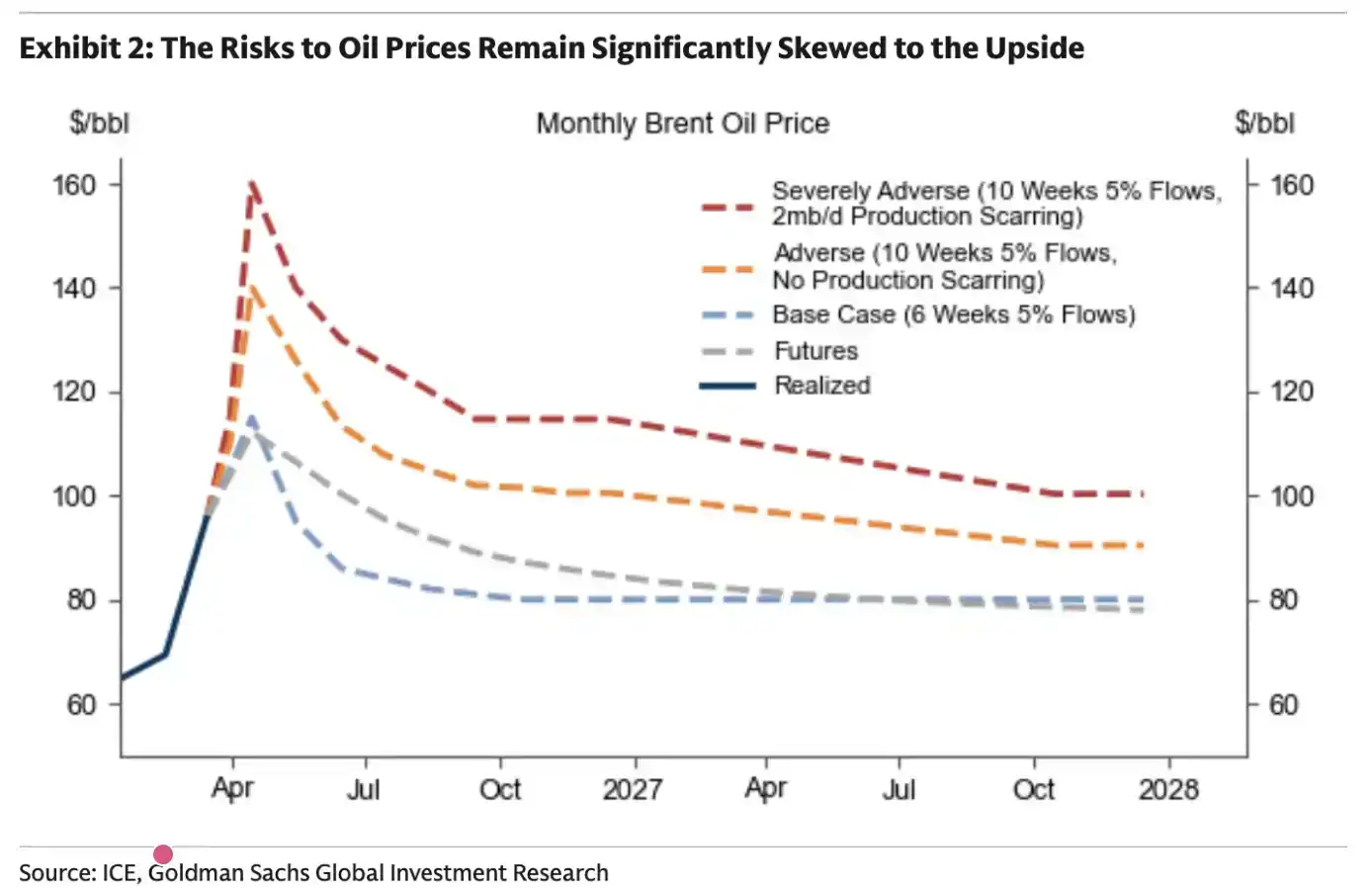
Under the above scenarios, Goldman Sachs also provided a hypothesis: what the market would look like if the conflict lasted another 10 weeks. Their judgment is largely consistent with our earlier projections.

In essence, the oil market has a "tipping point." Once this line is crossed, there is no turning back.

Readers should be prepared for expectations: future oil prices will be structurally higher. Even if the war ends this week, the supply losses that have already occurred will have a substantive impact on the future global oil supply-demand balance.

How long will it last?

Until now, I have avoided making judgments on "when this conflict will end." On one hand, I don't want to "tempt fate," and on the other hand, it is truly unpredictable.

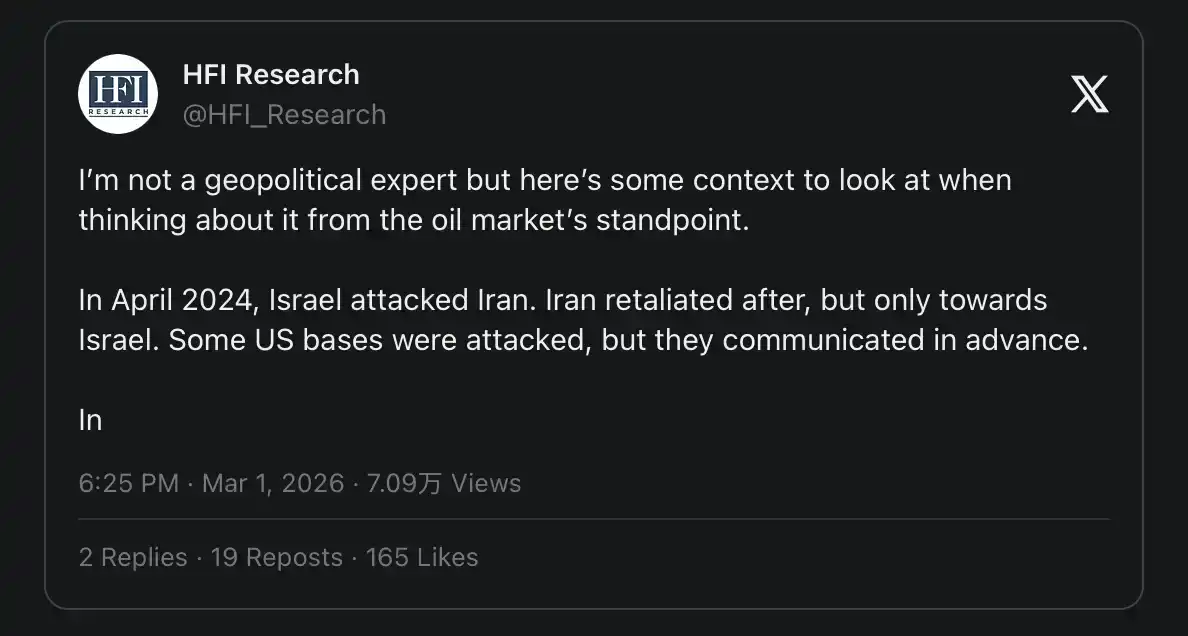
But one thing is clear: this time is different from past conflicts. The common strategy of "escalate to de-escalate" is not evident this time.

Retaliatory strikes occurred without warning; Iran's strike range also seems to have expanded beyond Israel to include Gulf countries. It was this pattern of response that made me realize from the beginning—this time, it's different.
As the conflict has lasted nearly four weeks, I am increasingly concerned: with an agreement迟迟无法达成, each day of delay significantly reduces the probability of reaching a deal. As we analyzed in "Time is Running Out," Iran understands the operating logic of the oil market very well. It only needs to wait for the market to hit that "tipping point" to secure the maximum concessions from the US in negotiations. From a tactical perspective, reaching an agreement now offers no advantage. The Strait of Hormuz card has been played and cannot be easily reused in the future.

For the Gulf countries, if the current Iranian regime is not overthrown, this situation of being "strangled" will recur in the future. Even if some kind of "toll" mechanism is established, this uncertainty would still be hard to accept.

Therefore, logically, the initiative does not lie with the US but with Iran. In this case, Iran has more incentive to push the situation towards the oil market's "tipping point" to test US endurance. All it needs to do is "hold on" for another three weeks, until the market begins to crack.

However, it must be emphasized that I am not a geopolitical expert and have no absolute certainty about such judgments. What I can provide is an assessment of the current situation based on fundamental analysis.


Пов'язані питання

QWhat is the critical point in the oil market mentioned in the article, and why is mid-April significant?

AThe critical point refers to the threshold where the oil market shifts from 'buffered volatility' to a 'gap-driven repricing.' Mid-April is significant because, by that time, the evaporation effect of global 'crude oil in transit' will fully manifest in onshore inventories. If the conflict is not resolved by then, the market could face severe supply shortages, potentially driving prices to extreme levels unless another strategic petroleum reserve (SPR) release is coordinated.

QHow does the release of strategic petroleum reserves (SPR) affect the oil market according to the article?

AThe release of SPRs, such as the 4 billion barrels coordinated by the IEA, acts as a temporary buffer that delays the impact of supply disruptions. It prevents immediate catastrophic price spikes and demand destruction but does not solve the core issue of supply gaps. Once the SPR buffer is depleted, the market must confront the underlying supply deficit, leading to potential price surges if normal tanker transport is not restored.

QWhat are the three scenarios for the conflict's resolution and their respective impacts on Brent crude prices?

A1) If the conflict ends this week with transport restored by the weekend: Brent crude would fall to the low $80s short-term, with an annual average in the mid-to-high $80s. 2) If it ends in mid-April: Short-term prices would drop to the low $90s, with an annual average in the mid-to-high $90s. 3) If it ends in late April: Short-term prices could spike to around $110, with an annual average of $110-$120.

QWhy does the article suggest that Iran has an incentive to push the conflict towards the oil market's critical point?

AIran understands the oil market's mechanics and recognizes that reaching the critical point (where supply gaps become acute) would strengthen its negotiating position. By prolonging the conflict until mid-April, Iran could force the U.S. into making greater concessions, as the U.S. and its allies would face severe economic pressure from soaring oil prices and supply shortages.

QWhat long-term impact does the article predict for global oil supply and demand, even if the conflict ends soon?

AEven if the conflict ends immediately, the supply losses already sustained (e.g., prolonged production recovery times in countries like Iraq and Kuwait) will structurally elevate oil prices and reshape global oil balance. The cumulative supply loss, estimated at up to 9.3 billion barrels by some analysts, implies that high oil prices will persist longer, affecting future供需平衡.

Пов'язані матеріали

Has Hook Summer Truly Arrived? sato, Lo0p, FLOOD Ignite the New Uniswap v4 Narrative

With the broader market showing signs of recovery, a new wave of interest has emerged around Ethereum-based meme coins. Following ASTEROID, tokens like sato, sat1, Lo0p, and FLOOD, built upon the Uniswap v4 Hook protocol, are capturing market attention. Their market capitalizations range from millions to tens of millions of dollars, injecting much-needed focused liquidity into a market lacking narratives. This article explores whether this trend signifies an incoming "Hook Summer" and its potential impact on UNI's price. Hooks are essentially plug-in smart contracts for Uniswap v4 liquidity pools, allowing developers to inject custom logic at key points in a pool's lifecycle (like initialization, adding/removing liquidity, swaps). This transforms the AMM into programmable building blocks. Key highlighted projects include: * **sato**: Peaked over $38M market cap. It utilizes a v4 curve for minting/burning; buying locks ETH as reserve to mint new tokens, while selling redeems ETH from the reserve and burns tokens. * **sat1**: Market cap briefly exceeded $10M, promoted as an "optimized sato," but later declined significantly. * **Lo0p**: Reached nearly $6.6M. It's a lending AMM protocol where buying LO0P tokens locks them as collateral, allowing users to borrow ETH from the pool reserve at 40% LTV, aiming to improve capital efficiency for idle ETH in LPs. * **FLOOD**: Peaked near $6M. Its mechanism directs asset reserves from buys into Aave v3 to generate yield, with fees and interest retained in the pool to potentially influence the token's price long-term. In the long term, the development of the Hook ecosystem can attract users and liquidity to Uniswap v4, benefiting UNI's fundamentals—especially combined with the recent activation of the protocol fee switch, where a portion of fees is used to burn UNI. However, in the short term, these Hook-based tokens are unlikely to directly drive significant UNI price appreciation. Their impact is moderated by factors like token sustainability, price volatility, and broader market and regulatory conditions. Currently, Uniswap v4's TVL ($595M) still trails behind v2 and v3, indicating adoption and growth will take time. The article concludes that while the Hook ecosystem provides long-term "nourishment" for UNI, its short-term role is more of a "catalyst" than a "booster." Readers are cautioned that these are early-stage experimental tokens and may carry unknown risks.

Odaily星球日报1 хв тому

Has Hook Summer Truly Arrived? sato, Lo0p, FLOOD Ignite the New Uniswap v4 Narrative

Odaily星球日报1 хв тому

Interview with Michael Saylor: I Did Say I Would Sell Bitcoin, But Never a Net Sale

Interview with Michael Saylor: I Said We'd Sell Bitcoin, But Never Be a Net Seller In a recent podcast, MicroStrategy Executive Chairman Michael Saylor clarified the company's stance on potentially selling Bitcoin. Following MicroStrategy's earnings call statement about being prepared to sell BTC to fund dividends for its STRC (Strategic) credit product, Saylor emphasized the distinction between selling and being a "net seller." Saylor explained the core business model: MicroStrategy sells credit instruments like STRC and uses the proceeds to buy Bitcoin, which is viewed as "digital capital" expected to appreciate around 30-40% annually. A portion of these capital gains can then be used to pay the dividends on the credit products. He stressed that even if the company sells some Bitcoin for dividends, it simultaneously buys much more with new credit issuance. For example, after raising $3.2 billion from STRC sales in April, the dividend obligation was only $80-90 million, making the company a net buyer. The clarification aims to counter market narratives questioning the value of Bitcoin on MicroStrategy's balance sheet if it were never sold, and to dismiss claims of a "Ponzi scheme." Saylor reiterated his personal philosophy for investors: "Don't be a net seller of bitcoin" and ensure your Bitcoin holdings increase each year. Saylor also discussed Bitcoin's role as the foundation for "digital credit," noting that STRC has become the largest and most liquid preferred stock issue in the U.S., offering high risk-adjusted returns (Sharpe ratio). He highlighted Bitcoin's deep liquidity, stating that even large purchases by MicroStrategy do not move the market significantly, which is driven by macro factors, geopolitical tensions, and capital flows from ETFs and credit products. Finally, Saylor reflected on his early inspiration from sci-fi books, which motivated his path to MIT, and maintained his fundamental thesis on Bitcoin remains unchanged: it is superior digital capital enabling superior digital credit.

链捕手5 хв тому

Interview with Michael Saylor: I Did Say I Would Sell Bitcoin, But Never a Net Sale

链捕手5 хв тому

Beaten SK Hynix Employees in China: Year-end Bonus Less Than 5% of Korean Staff's

"SK Hynix Chinese Staff Hit Hard: Bonuses Less Than 5% of Korean Counterparts" Driven by the AI boom, South Korea's SK Hynix is experiencing record performance, with media reports predicting massive year-end bonuses for its employees, making them highly desirable in the matchmaking market. However, this prosperity starkly contrasts with the situation for the company's Chinese employees. According to reports, SK Hynix operates under a rule allocating 10% of operating profit for employee bonuses. While projections suggest Korean employees could receive bonuses reaching millions of RMB, a Chinese employee with over a decade of technical experience revealed the disparity: "If they get 3 million, Chinese staff get less than 5% of that." After adjustments based on KPI ratings, this employee's highest bonus was slightly over 100,000 RMB. Bonuses are paid annually in Korea but semi-annually in China. During the industry downturn in 2023-2024, Chinese employees received no bonus at all. The gap extends beyond bonuses. Recruitment posts for SK Hynix's Chinese factories (in Wuxi, Dalian, Chongqing) show engineer monthly salaries ranging from 10,000 to 35,000 RMB, with a 13th-month salary promised. Chinese employees also receive standard benefits like annual leave but lack stock incentives, which are reportedly unavailable to them. Furthermore, management positions in China are predominantly held by Korean personnel, though industry observers note a gradual increase in local middle managers over time. SK Hynix has confirmed the 10% bonus rule but cautioned that specific future bonus amounts remain unpredictable. The company forecasts strong demand for HBM and other high-value enterprise products for the next 2-3 years, driven by AI infrastructure investment. This focus on business-to-business markets may continue to constrain supply for consumer products, potentially prolonging price increases for components like memory.

链捕手19 хв тому

Beaten SK Hynix Employees in China: Year-end Bonus Less Than 5% of Korean Staff's

链捕手19 хв тому

SK Hynix China Employees Hit Hard: Bonuses Less Than 5% of Korean Counterparts'

"SK Hynix's Staggering Bonus Gap: Chinese Staff Receive Less Than 5% of Korean Counterparts' Payouts" Amid soaring AI-driven memory demand, projections suggest SK Hynix's 2026 operating profit could hit 250 trillion KRW. Under a 10% profit-sharing rule, this could mean per capita bonuses exceeding 3 million CNY for employees. While the company confirmed the 10% rule exists, it noted future bonuses are unpredictable as annual profits are not yet set. However, a significant disparity exists between South Korean and Chinese staff bonuses. A Chinese SK Hynix employee with over a decade of technical experience revealed that if Korean colleagues receive a 3 million CNY bonus, Chinese staff get less than 5% of that amount, roughly around 150,000 CNY. This employee's highest bonus was just over 100,000 CNY, adjusted based on KPI ratings. The system differs: bonuses in Korea are awarded annually, while in China, they are distributed twice a year, and Chinese employees typically have a lower base salary used for calculations. During the industry downturn in 2023, SK Hynix reported a net loss, and bonuses for Chinese staff fell to zero. Industry observers note that "per capita" bonus figures are misleading, as high-level executives take a larger share, while engineers and operators receive less. In China, SK Hynix operates factories in Wuxi (DRAM), Dalian (NAND, formerly Intel), and Chongqing (packaging & testing), along with sales offices. Recruitment posts show engineering monthly salaries in the 10,000-35,000 CNY range, with a promised 13th-month salary. Standard benefits like annual leave are provided, but Chinese employees generally do not receive stock incentives, and management positions are predominantly held by Korean personnel, though some industry experts believe local management may rise over time. Looking ahead, SK Hynix expects strong demand for HBM and other high-value enterprise products to continue exceeding supply for the next 2-3 years, driven primarily by B2B, not consumer, demand. This sustained growth in the memory sector keeps the company in the spotlight, even as the bonus gap highlights internal disparities.

marsbit39 хв тому

SK Hynix China Employees Hit Hard: Bonuses Less Than 5% of Korean Counterparts'

marsbit39 хв тому

Торгівля

Спот
Ф'ючерси
活动图片




