OCC Proposes Framework To Implement GENIUS Act, Targets Stablecoin Yield Workarounds

bitcoinistОпубліковано о 2026-02-27Востаннє оновлено о 2026-02-27

Анотація

The Office of the Comptroller of the Currency (OCC) has released a proposed framework to implement the GENIUS Act, a landmark stablecoin regulation signed into law in 2025. The 376-page proposal outlines rules for stablecoin issuers under OCC jurisdiction, including reserve standards, liquidity requirements, and risk management controls. A key focus is addressing potential workarounds to the Act’s ban on interest payments for stablecoin holders. The OCC warns that issuers might use third-party arrangements to circumvent the prohibition and proposes a presumption that certain deals with affiliates or related parties would be considered illegal yield payments. The agency is seeking public feedback on the proposal to shape the final rule.

The Office of the Comptroller of the Currency (OCC) has asked the public for feedback on its proposed framework to regulate stablecoins under the landmark crypto regulation, including proposals to address potential workaround on the interest payments ban.

OCC Lays Out Framework For GENIUS Act Implementation

On Wednesday, the OCC issued a proposed rulemaking to implement the landmark stablecoin legislation, the Guiding and Establishing National Innovation for U.S. Stablecoins (GENIUS) Act.

The GENIUS Act was signed into law by US President Donald Trump on July 18, 2025. The legislation establishes a regulatory framework for payment stablecoin activities in the US.

In the 376-page document, the agency included regulations for permitted payment stablecoin issuers and foreign payment stablecoin issuers under the OCC’s jurisdiction and certain custody activities conducted by OCC-supervised entities.

Notably, the OCC will have regulatory authority over certain issuers, such as subsidiaries of national banks or federal savings associations, federal qualified issuers, state qualified issuers, and foreign issuers.

The proposed rules cover all regulations the OCC is required to promulgate under the GENIUS Act, including reserve asset standards, liquidity and custody requirements, risk management controls, audits, and supervisory examinations.

However, it exempts rules related to the Bank Secrecy Act, Anti-Money Laundering, and Office of Foreign Assets Control sanctions, which will be addressed in a separate rulemaking alongside the Department of the Treasury.

“The OCC has given thoughtful consideration to a proposed regulatory framework in which the stablecoin industry can flourish in a safe and sound manner,” said Comptroller of the Currency Jonathan Gould in a statement.

“We welcome feedback on the proposal to inform a final rule that is effective, practical and reflects broad industry perspective. The OCC will continue its work to implement the GENIUS Act and provide OCC regulated entities with more opportunities to meet the needs of their customers and communities,” he added.

Rules To Address Stablecoin Yield Workarounds

The proposed draft also tackled a key issue related to the regulation of these assets: the payments of interest or yield on stablecoins. For context, the legislation prohibits interest payments on the holding or use of payment-purpose stablecoins, but only addresses permitted issuers.

Based on this, the banking sector has argued that the GENIUS Act has “loopholes” that could pose risks to the financial system and has urged senators to include language in the crypto market structure bill, known as the CLARITY Act, that also bans digital asset exchanges, brokers, dealers, and related entities from offering yield.

The OCC expanded on the GENIUS Act ban, highlighting potential areas that must be addressed to prevent these “loopholes.” The agency argued that issuers could attempt workarounds to “make prohibited payments of interest or yield to payment stablecoin holders through arrangements with third parties.”

However, it noted that due to the large and changing variety of such arrangements, it would be impossible to identify and address all of them. Therefore, it proposed to include a presumption that “certain types of arrangements with certain types of persons” would be prohibited payments of yield or interest by the issuer.

The OCC would presume that an issuer is paying the holder any form of interest or yield if: the issuer “has a contract, agreement, or other arrangement with an affiliate or a related third party to pay interest or yield to the affiliate or related third party;” and if the affiliate or related third party “has a contract, agreement, or other arrangement to pay interest or yield (...) to a holder of any payment stablecoin issued” by the permitted issuer “solely in connection with the holding, use, or retention” of these tokens.

Nonetheless, the OCC clarified that the prohibition is not intended to prevent a merchant from independently offering a discount to a holder for using payment stablecoins. It is also not intended to prevent an issuer “from sharing in the profits derived from the payment stablecoin with a non-affiliate partner in a white-label arrangement.”
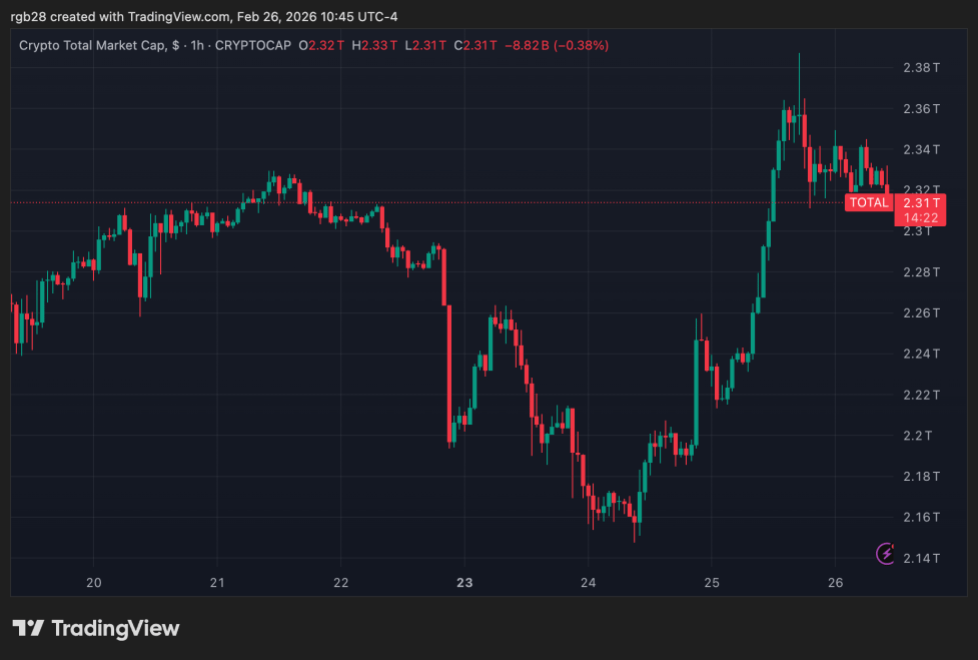
The total crypto market capitalization is at $2.31 trillion in the one-week chart. Source: TOTAL on TradingView


Пов'язані питання

QWhat is the main purpose of the OCC's proposed framework?

AThe main purpose of the OCC's proposed framework is to implement the GENIUS Act and establish regulations for stablecoin activities, including reserve asset standards, liquidity requirements, and measures to address potential workarounds on the interest payments ban.

QWhat specific entities will the OCC have regulatory authority over under the proposed rules?

AThe OCC will have regulatory authority over subsidiaries of national banks or federal savings associations, federal qualified issuers, state qualified issuers, and foreign issuers of payment stablecoins.

QWhat key issue related to stablecoin yield does the OCC's proposal specifically address?

AThe proposal specifically addresses the issue of potential workarounds where issuers might attempt to pay prohibited interest or yield to stablecoin holders through arrangements with third parties, such as affiliates.

QAccording to the OCC, what two conditions would lead to a presumption that an issuer is paying prohibited yield?

AThe OCC would presume an issuer is paying yield if: 1) it has an arrangement with an affiliate or related third party to pay them interest, and 2) that affiliate or third party has an arrangement to pay that interest to a stablecoin holder solely in connection with holding or using the tokens.

QWhat types of activities are NOT intended to be prevented by the OCC's proposed rules on yield?

AThe rules are not intended to prevent a merchant from independently offering a discount for using stablecoins, or to prevent an issuer from sharing profits with a non-affiliate partner in a white-label arrangement.

Пов'язані матеріали

Anthropic's IPO Launch: Commercial Miracle or Valuation Bubble?

Anthropic has confidentially filed for an IPO, led by Morgan Stanley and Goldman Sachs, potentially going public by October. Following its latest $650 billion funding round, its pre-IPO valuation stands at $965 billion, with projections reaching up to $2 trillion at listing, which would make it the highest-valued private company ever. The article, written by Fu Sheng, addresses skepticism that this represents an AI bubble akin to the 2000 dot-com crash. It argues the current situation differs fundamentally. Unlike the internet bubble era, which relied on speculative narratives with little revenue, Anthropic's valuation is backed by unprecedented, measurable financial performance. Key data points include: * **Revenue Growth:** ARR skyrocketed from $10 billion in early 2025 to $470 billion by May 2026, targeting $100 billion by year-end—a growth curve unmatched in business history. * **Profitability:** It achieved operating profitability in Q2 2026 with an estimated $5.6 billion profit. * **Efficiency:** With ~3,000 employees and ~$470 billion ARR, its revenue per employee exceeds $10 million. Products like Claude Code, launched less than a year ago, already generate $25 billion in annualized revenue. * **Enterprise Adoption:** It boasts a strong enterprise client base, with 8 of the Fortune 10 and over 1,000 large firms spending over $1 million annually on Claude. The valuation is framed using a traditional SaaS model (e.g., a 10x Price-to-Sales multiple on $100 billion revenue). The author contends the core question for analysts has shifted from "How big could this be?" to "How much is it earning and will earn next quarter?" The discussion extends beyond Anthropic to a broader paradigm shift: the transition from a "carbon-based" to a "silicon-based" economy. Companies are increasingly prioritizing investment in compute and AI capabilities over human resources, as these directly scale productivity and competitive advantage. Anthropic's IPO is thus positioned not just as a corporate milestone, but as a price anchor for this new economic era.

链捕手29 хв тому

Anthropic's IPO Launch: Commercial Miracle or Valuation Bubble?

链捕手29 хв тому

Near Returns to the AI Stage: Transformation into a Public Chain Due to 'Payroll Difficulties,' Agent and Privacy Emerge as New Growth Narratives

NEAR Returns to AI Origins: From Payroll Struggles to Blockchain, Now Focusing on AI Agents and Privacy NEAR Protocol's journey began not with grand blockchain ambitions, but from a practical hurdle: its AI startup founders, including Transformer paper co-author Illia Polosukhin, couldn't efficiently pay international developers in 2017. This led them to pivot and build a high-performance, scalable blockchain. After years navigating various crypto narratives like sharding and cross-chain interoperability, NEAR is now leveraging its AI roots to re-enter the AI arena. A key driver is its "NEAR Intents" layer, which abstracts complex cross-chain transactions. Users simply state their goal (e.g., swap BTC for ETH), and a solver network finds the optimal route. This system has processed over $20B in cross-chain volume, generating significant fee revenue. A major growth area is private transactions via "Confidential Intents/Swaps," which hide trade details until settlement to protect against MEV and front-running. Remarkably, private swaps recently accounted for over 40% of NEAR's transaction volume, highlighting strong demand but also potential regulatory scrutiny. With its AI-founder pedigree, NEAR is positioning itself at the intersection of blockchain, AI agents, and privacy, aiming to become infrastructure for the emerging agent economy while navigating the challenges of its rapid adoption.

marsbit3 год тому

Near Returns to the AI Stage: Transformation into a Public Chain Due to 'Payroll Difficulties,' Agent and Privacy Emerge as New Growth Narratives

marsbit3 год тому

From Ethereum to AI's 'CROPS': What Exactly is This Set of 'Slow Variables' That Vitalik Repeatedly Emphasizes?

In recent discussions, Vitalik Buterin has frequently emphasized the concept of "CROPS," a framework defining core values for Ethereum's development. CROPS stands for Censorship Resistance, Capture Resistance, Open Source, Privacy, and Security. Initially outlined in the Ethereum Foundation's "EF Mandate," it represents a commitment to user sovereignty, ensuring that the network resists external control, remains open, protects privacy, and prioritizes security. The relevance of CROPS extends beyond Ethereum's foundational principles, becoming crucial in the context of AI integration. As AI agents begin handling wallet operations and automated transactions, the risk increases that users may cede control over their digital assets, privacy, and intentions to centralized AI service providers. A "CROPS AI" would therefore emphasize local execution where possible, privacy-preserving remote model calls (e.g., using zero-knowledge proofs), and transparent, verifiable processes to maintain user agency. Vitalik highlights a significant convergence between "CROPS Ethereum access layer" and "CROPS AI." Both address the same fundamental challenge: how users can access powerful services—be it blockchain data via RPCs or AI models—without exposing sensitive information or relinquishing ultimate control. This intersection points toward a future digital entry point that is more private, secure, and user-controlled. Ultimately, CROPS is not merely an abstract ideal but a practical guidepost. It steers development—from protocol resilience and wallet design to AI agent safety—towards a future where users retain self-sovereignty even as digital systems grow more complex and powerful. In an era of accelerating AI adoption, these "slow variables" of censorship resistance, openness, privacy, and security may define Ethereum's enduring value.

marsbit3 год тому

From Ethereum to AI's 'CROPS': What Exactly is This Set of 'Slow Variables' That Vitalik Repeatedly Emphasizes?

marsbit3 год тому

Торгівля

Спот
Ф'ючерси
活动图片




