NYSE parent in talks to invest in crypto company MoonPay: Report

cointelegraphОпубліковано о 2025-12-18Востаннє оновлено о 2025-12-18

Анотація

Intercontinental Exchange (ICE), parent company of the New York Stock Exchange, is reportedly in talks to invest in cryptocurrency payments firm MoonPay, which is seeking a $5 billion valuation in its latest funding round. This follows ICE’s recent $2 billion investment in prediction platform Polymarket. MoonPay provides infrastructure for buying and selling crypto using traditional payment methods. The move reflects growing convergence between Wall Street and crypto, as seen in ICE's earlier partnership with Circle to explore stablecoin integration and the DTCC’s approval to offer tokenized bonds and stocks. These developments highlight the increasing institutional adoption of blockchain and tokenization technologies.

Intercontinental Exchange (ICE), the parent company of the New York Stock Exchange (NYSE), is in talks to invest in crypto payments company MoonPay as part of the company’s latest funding round.

MoonPay is seeking to raise funds at a $5 billion valuation, according to Bloomberg, which cited sources familiar with the deal and did not disclose the dollar amount of the potential investment.

In October, ICE invested $2 billion in prediction platform Polymarket, in a funding round that brought the company’s valuation to $9 billion.

MoonPay is a financial technology company that provides infrastructure for buying, selling and using cryptocurrencies through fiat on-ramps and off-ramps. Founded in 2019, it enables users to purchase crypto using traditional payment methods such as debit and credit cards, while offering services to wallets, exchanges and enterprises seeking to integrate crypto payments.

Polymarket founder Shayne Coplan (left) and Intercontinental Exchange CEO Jeffrey Sprecher (right) in front of the New York Stock Exchange after the $2 billion deal. Source: Shayne Coplan

Cointelegraph reached out to ICE and MoonPay but had not received a response at time of publication.

The investment deals reflect the growing ties between crypto and Wall Street, as traditional financial institutions adopt blockchain technology and form partnerships with crypto companies.

Related: Acting CFTC chair to join MoonPay after leaving agency

Wall Street and Crypto continue to converge, blurring the lines between both worlds

Stablecoin company Circle and ICE began exploring a stablecoin integration with ICE’s various clearing and data services in March.

The products being tested for possible integrations include Circle’s USDC (USDC) dollar-pegged stablecoin and its tokenized money market fund, US Yield Coin (USYC), an onchain yield-bearing product backed by short-term US Treasurys.

In December, the US Securities and Exchange Commission (SEC) gave the green light to the Depository Trust and Clearing Corporation (DTCC), a financial settlement and clearing infrastructure company, to begin offering tokenized bonds and stocks.

Real-world asset (RWA) tokenization is a way of representing physical or traditional assets on a blockchain, which allows for faster settlement times, cross-border transactions and the ability to use assets as collateral in decentralized finance (DeFi) applications.
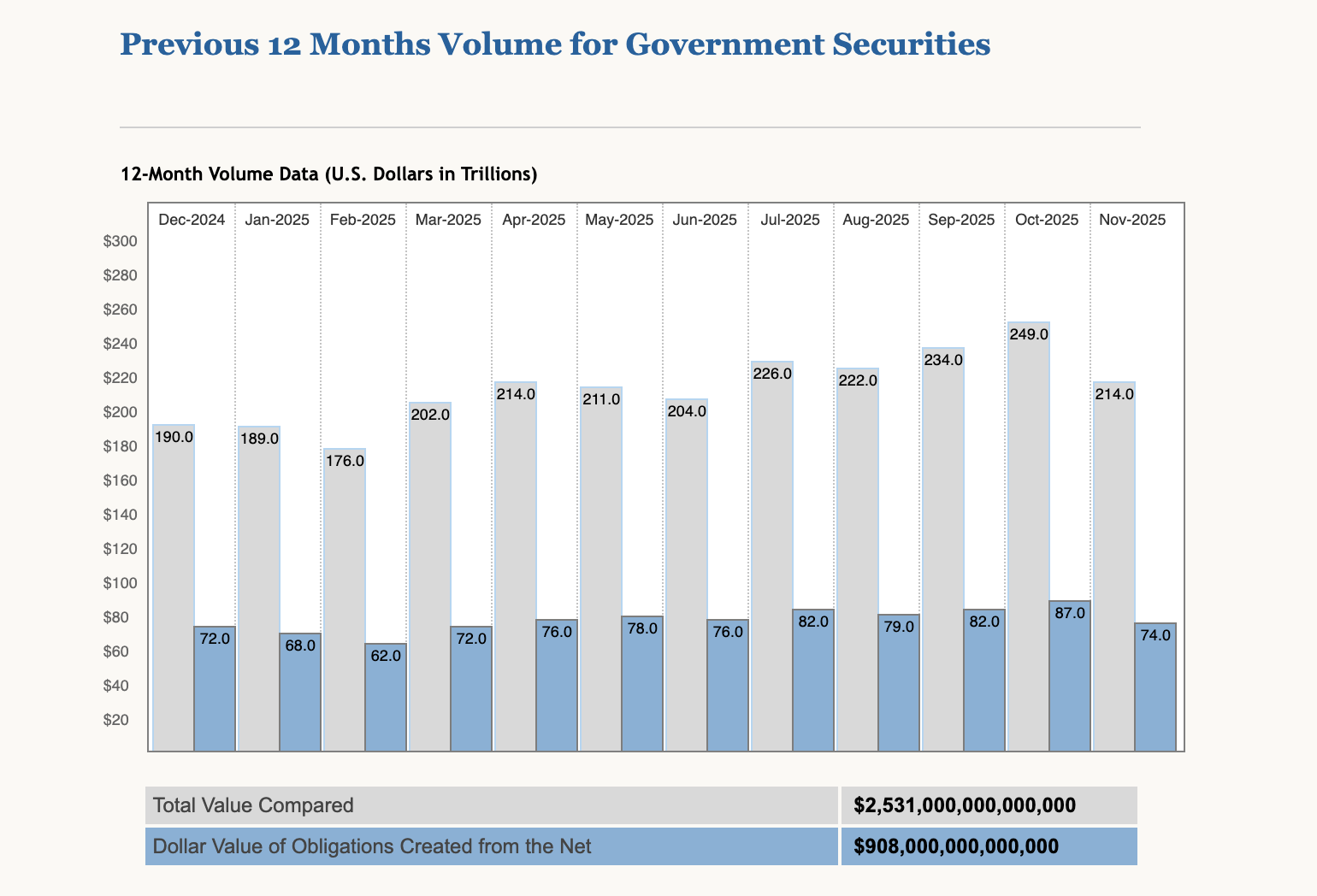
Volume of 12-month government securities settled using the DTCC’s infrastructure. Source: DTCC

DTCC handled about $3.7 quadrillion in settlement volume in 2024 and is considered the backbone of the traditional financial system, clearing transactions across the equity, bond, fixed income and financial derivatives markets.

The DTCC is expected to launch its tokenized trading services in the second half of 2026 and will mint some US Treasurys onchain using the Canton Network, a permissioned network of blockchain infrastructure geared toward financial institutions.

Magazine: Unstablecoins: Depegging, bank runs and other risks loom

Пов'язані питання

QWhat is the parent company of the New York Stock Exchange (NYSE) and which cryptocurrency firm is it reportedly in talks to invest in?

AIntercontinental Exchange (ICE), the parent company of the NYSE, is in talks to invest in the cryptocurrency payments company MoonPay.

QAt what valuation is MoonPay seeking to raise funds in its latest funding round, as reported by Bloomberg?

AMoonPay is seeking to raise funds at a valuation of $5 billion.

QWhat was the size of ICE's previous investment in Polymarket and what was the resulting valuation of that company?

AICE invested $2 billion in Polymarket, which brought the company's valuation to $9 billion.

QWhat specific services does MoonPay provide in the cryptocurrency space?

AMoonPay provides infrastructure for buying, selling, and using cryptocurrencies through fiat on-ramps and off-ramps. It enables users to purchase crypto using traditional payment methods like debit and credit cards, and offers services to wallets, exchanges, and enterprises.

QWhat major traditional financial infrastructure company received SEC approval to begin offering tokenized bonds and stocks, and what network will it use to mint some US Treasurys onchain?

AThe Depository Trust and Clearing Corporation (DTCC) received SEC approval to offer tokenized bonds and stocks. It will mint some US Treasurys onchain using the Canton Network.

Пов'язані матеріали

Annual Salary of Millions Competing for Electricians, Meta Rushes to Open Its Own Technical School

The AI boom is facing an unexpected bottleneck: a severe shortage of skilled construction workers and electricians. As tech giants like Meta, OpenAI, and Alphabet race to build massive data centers—such as OpenAI's $16 billion "Stargate" project—they are hitting a critical labor wall. The U.S. needs an estimated 130,000 more electricians, 240,000 construction workers, and 150,000 supervisors by 2030 for AI infrastructure alone, but tens of thousands of electrician jobs go unfilled each year. While AI companies offer high premiums, with electricians earning up to $280,000 annually, worker scarcity still causes massive losses—delays on a single project can cost $14.2 million per month. The complexity of building AI data centers, which require immense power (equivalent to powering hundreds of thousands of homes), sophisticated electrical systems, and advanced liquid cooling solutions, demands highly skilled technicians who are in short supply. To combat this, companies are investing heavily in training. Meta has committed $115 million to a free training school offering tuition, housing, and stipends, targeting 5,000 new workers. OpenAI is partnering with unions to secure skilled labor. These efforts are paying off, with a significant rise in Gen Z interest in trade schools over college. However, the power demands are staggering. AI data centers are driving a rapid surge in electricity consumption, projected to account for up to 12% of U.S. power use by 2028 and raising costs for consumers. Furthermore, the construction boom is project-based, leading to a potential future glut of trained workers once building peaks, which could depress wages industry-wide. The race for AI supremacy now depends as much on skilled hands as on advanced chips.

marsbit1 год тому

Annual Salary of Millions Competing for Electricians, Meta Rushes to Open Its Own Technical School

marsbit1 год тому

OpenAI No Longer Sells Its Most Expensive Model for Profit

OpenAI is shifting its business strategy away from promoting its most expensive, flagship models for every task. Recent price cuts—80% for GPT-5.6 Luna and 20% for Terra—signal a deeper change: the company now actively advises users that many tasks don't require the most powerful model. Instead, OpenAI recommends a tiered approach: use the high-end GPT-5.6 Sol for complex planning and analysis, then delegate execution to cheaper models like Luna. This mirrors moves by Anthropic, which recently launched Claude Opus 5 at half the price of its top model, Fable 5. Both companies are de-emphasizing flagship models as primary revenue drivers, using them instead for brand prestige and technological showcases. The industry is entering a "mass-market" phase, similar to automotive, where high-volume, cost-effective models handle daily operations and drive scale. OpenAI's price reductions are partly enabled by AI models themselves optimizing underlying code and infrastructure, creating a self-reinforcing cycle of efficiency gains and cost reduction. Competition is shifting from "who is smartest" to "who offers the best value." The goal is no longer selling individual models but fostering widespread API adoption and ecosystem lock-in. By making AI calls cheap and ubiquitous, companies like OpenAI aim to become the indispensable, utility-like infrastructure powering automated workflows—the "water and electricity" of software, quietly embedded everywhere.

marsbit1 год тому

OpenAI No Longer Sells Its Most Expensive Model for Profit

marsbit1 год тому

Торгівля

Спот
活动图片





