NYSE and Nasdaq Enter the Fray, U.S. Stock Tokenization Begins Close Combat

marsbitОпубліковано о 2026-03-25Востаннє оновлено о 2026-03-25

Анотація

On March 24, the New York Stock Exchange (NYSE) announced a partnership with tokenization platform Securitize to develop a digital trading platform for tokenized securities. Just six days earlier, the SEC approved Nasdaq’s rule amendments to enable tokenized versions of Russell 1000 stocks and major index ETFs. The two largest U.S. stock exchanges unveiled their tokenization strategies in the same month, marking a significant acceleration in institutional adoption. Throughout March, multiple major players advanced tokenization initiatives. Nasdaq partnered with Kraken’s parent company Payward to offer tokenized stock distribution for non-U.S. users. S&P Dow Jones licensed its flagship S&P 500 to on-chain protocol Trade.xyz for perpetual contracts on Hyperliquid. Invesco, managing $2.2 trillion in assets, took over Superstate’s $967 million on-chain treasury fund. The House Financial Services Committee also held a hearing titled "Tokenization and the Future of Securities." Notably, Nasdaq and NYSE are pursuing different technical approaches. Nasdaq’s model integrates with the existing Depository Trust Company (DTC) system, using blockchain as an optional layer while maintaining unified liquidity and settlement. In contrast, NYSE is building a separate, blockchain-native infrastructure with Securitize as its digital transfer agent, aiming for 24/7 trading and near-instant settlement. Regulatory progress is also advancing, including the CLARITY Act moving toward markup and an...

On March 24, the New York Stock Exchange announced the signing of a memorandum of understanding with tokenization platform Securitize to jointly develop a digital trading platform for tokenized securities. Just six days earlier, the SEC had approved Nasdaq's rule amendments to trade Russell 1000 component stocks and major index ETFs in tokenized form. The two largest stock exchanges in the United States each unveiled their own tokenization plans within the same month.

This is not an isolated move by one or two institutions. Spreading out the calendar for March reveals a rare density of activity.

On March 9, Nasdaq partnered with Payward, the parent company of crypto exchange Kraken, planning to provide a distribution channel for tokenized stocks to non-U.S. users. On March 18, the SEC approved Nasdaq's rule amendments; on the same day, S&P Dow Jones Indices licensed its flagship S&P 500 index to the on-chain protocol Trade.xyz to issue perpetual contracts on the decentralized derivatives platform Hyperliquid.

On March 24, the NYSE signed with Securitize; on the same day, Invesco, which manages $2.2 trillion in assets, announced it would take over the USTB fund from on-chain treasury management company Superstate, with a size of $967 million. On March 25, the U.S. House Financial Services Committee held a special hearing, "Tokenization and the Future of Securities: Modernizing Our Capital Markets." According to FinTech Weekly, attendees included Kenneth Bentsen Jr., CEO of the Securities Industry and Financial Markets Association (SIFMA), and Summer Mersinger, CEO of the Blockchain Association.
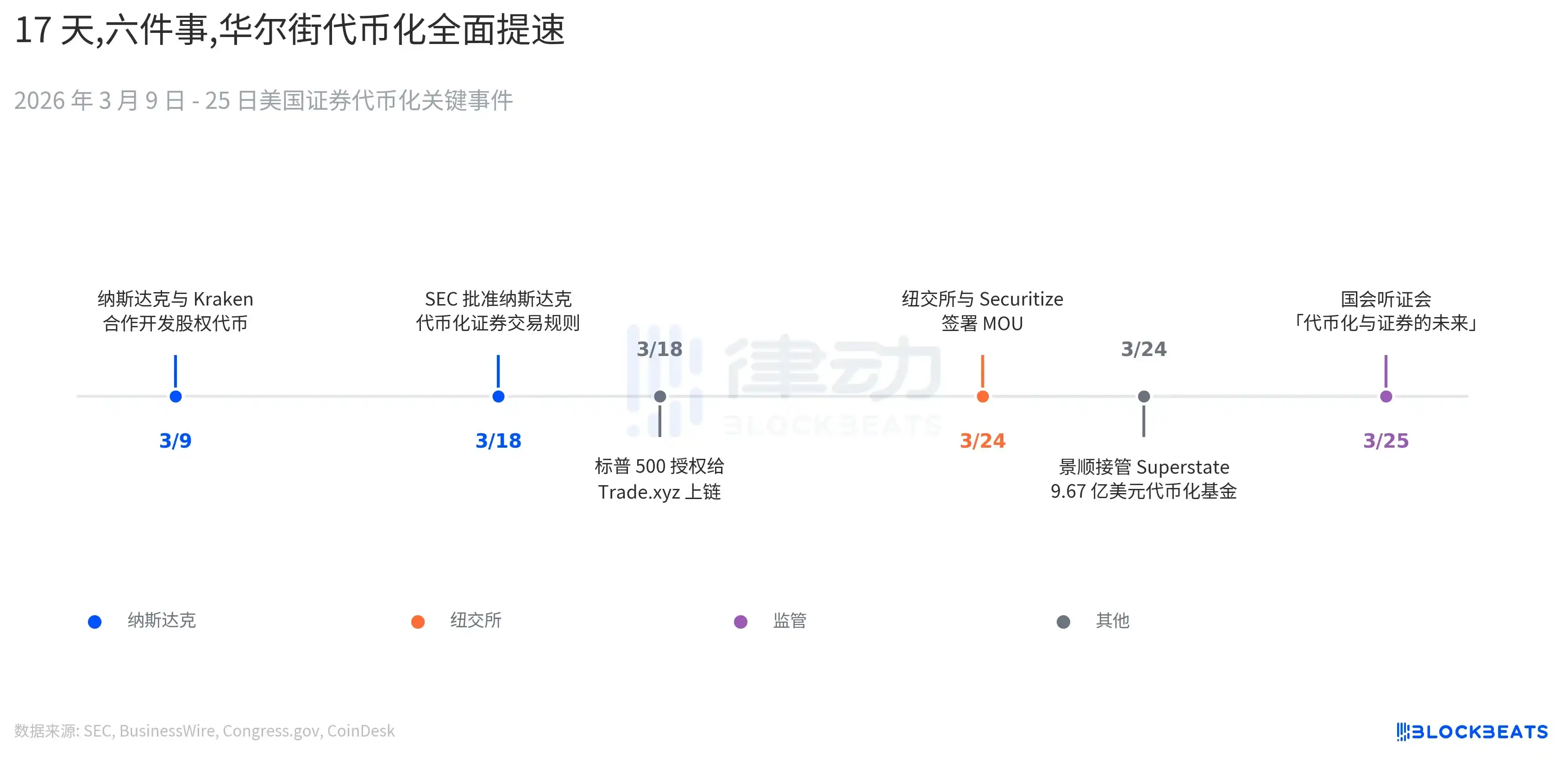
Six events in 17 days. Two major exchanges, three traditional asset management firms, one SEC approval, one congressional hearing. Among these events, the plans of Nasdaq and the NYSE are the most worthy of closer examination. The two are following different technical paths, and the divergence is greater than most realize.

Nasdaq is taking a compatibility route. According to the approval document (34-105047) released by the SEC on March 18, Nasdaq's tokenized securities trading will still be settled through the existing clearing system of the Depository Trust Company (DTC). Traders select a tokenized asset when placing an order, specify the blockchain and wallet address, and the DTC handles verification and settlement on the backend. Tokenized shares share the same CUSIP number as traditional shares, are matched on the same order book, and have identical execution priority. If the DTC determines that a participant is ineligible or the specified blockchain is incompatible, the transaction is automatically reverted to traditional settlement methods. In this setup, the blockchain is an optional wrapper; the underlying clearing pipeline remains unchanged. According to an analysis by the legal website Free Writings & Perspectives, eligible assets include Russell 1000 index components and ETFs tracking the S&P 500 and Nasdaq 100. The first tokenized trades are expected to launch in the third quarter of 2026.

The NYSE is taking a different path. According to a BusinessWire press release, the NYSE has designated Securitize as its first "Digital Transfer Agent," responsible for minting blockchain-native securities on-chain, maintaining ownership records, and handling corporate actions like dividends. According to CoinDesk, the NYSE is collaborating with Bank of New York Mellon and Citigroup to integrate tokenized deposits and stablecoin payments, aiming to enable 24/7 trading and near-instant settlement. This path is not about adding a layer on top of the existing clearing pipeline but about building an independent on-chain settlement infrastructure. The wording of Lynn Martin, President of NYSE Group, in the press release skipped "exploring" and "piloting," directly stating that the development of the new infrastructure must "preserve the trust, transparency, and protection that investors expect."
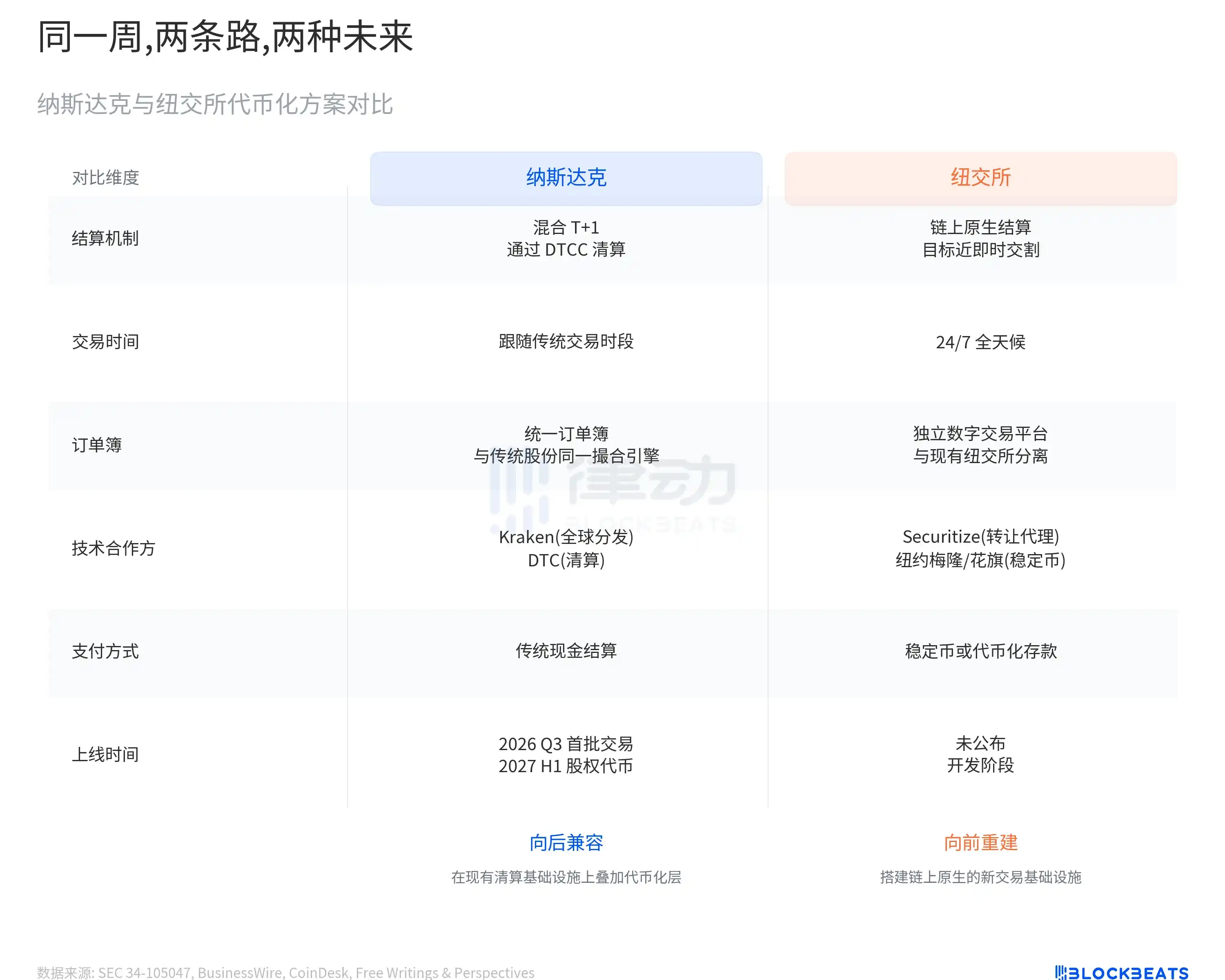
The core of the divergence is this: Nasdaq is adding functionality to its existing order book, maintaining unified liquidity, and can launch once the DTC updates its systems. The NYSE is building a separate digital trading platform that will run in parallel with the existing exchange, prioritizing 24/7 trading and instant settlement, though a specific launch date has not been announced according to CoinDesk. Securitize is the core technical support for the NYSE's plan. According to PRNewswire data, it currently manages approximately $4.6 billion, representing about 25% of the tokenized RWA market share.

It is also the technology provider for BlackRock's BUIDL fund. According to public data, BUIDL reached a size of $2.38 billion within 15 months of launch, making it the world's largest tokenized treasury fund. According to CoinDesk, Securitize's revenue for the first three quarters of 2025 grew 841% year-over-year to $55.6 million, and according to PRNewswire, it is going public via a SPAC with a valuation of $1.25 billion. By choosing Securitize as its first Digital Transfer Agent, the NYSE is entrusting the minting authority for tokenized securities to an infrastructure company on the verge of an IPO.

The regulatory side is also advancing. According to CoinDesk, the CLARITY Act, previously stalled for months due to stablecoin yield provisions, recently reached an "agreement in principle," and according to FinTech Weekly, the Senate Banking Committee has set a markup target for late April. In December 2025, the SEC issued a No-Action Letter to the DTC; according to a DTCC official announcement, this letter authorizes the DTC to provide tokenization services under a regulated framework, which is the prerequisite for Nasdaq's plan to proceed.

All of this happened within one month. What does this pace mean globally?
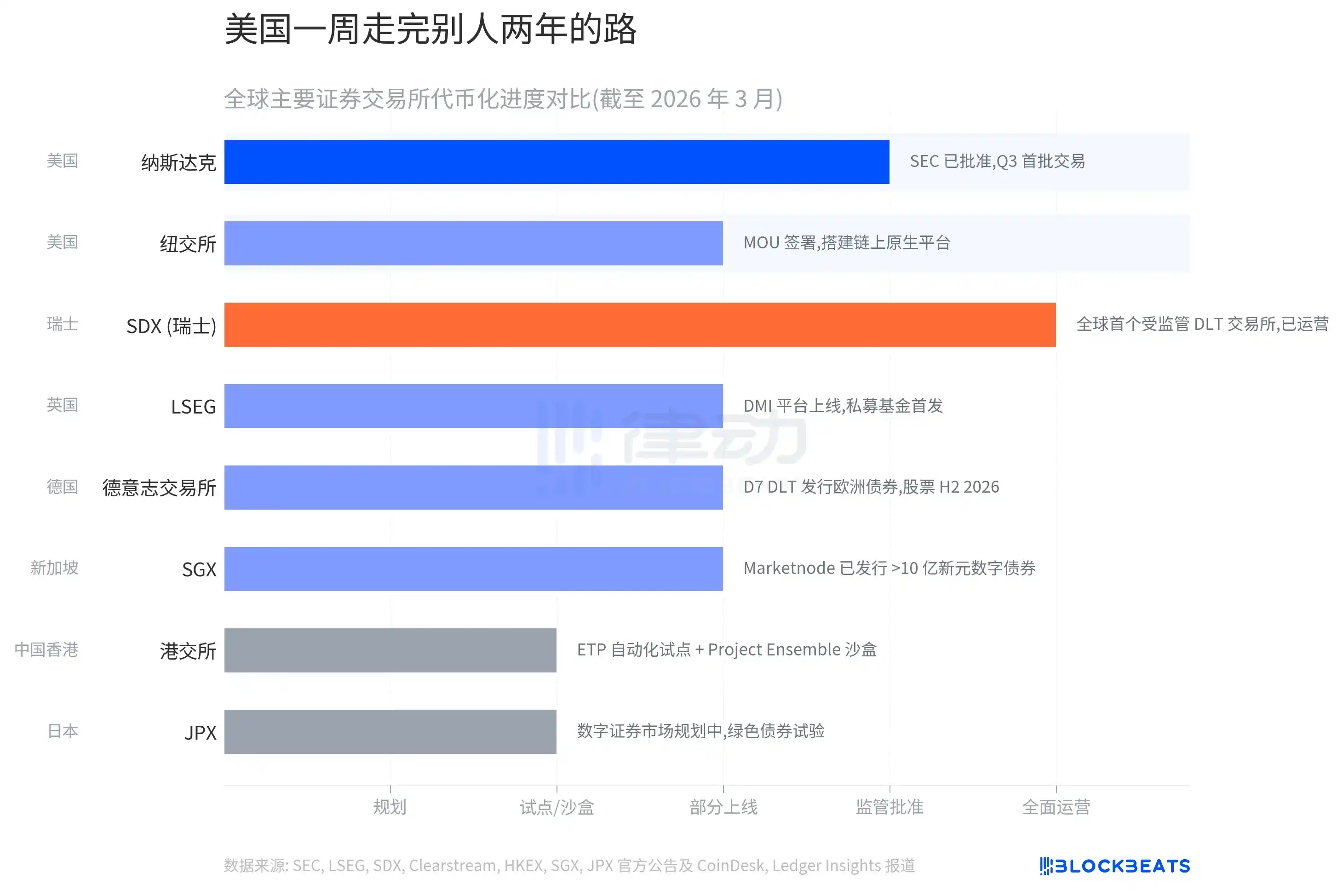
Switzerland's SIX Digital Exchange (SDX) was the world's first fully licensed DLT exchange, launching in 2021. According to Ledger Insights, it has issued over CHF 400 million in tokenized bonds, but its daily trading volume is only CHF 2-5 million, with influence largely confined to Switzerland. The London Stock Exchange Group (LSEG) launched its Digital Markets Infrastructure (DMI) platform in September 2025; according to an LSEG official announcement, the first transaction involved private fund tokenization, and it is currently applying for a Digital Securities Depository (DSD) license.

Deutsche Börse's Clearstream began issuing tokenized European bonds on its D7 platform in Q4 2025; according to the Clearstream website, tokenized equities are expected to launch in the second half of 2026. The Singapore Exchange (SGX), through its joint venture with Temasek, Marketnode, has issued over SGD 1 billion in digital bonds according to SGX website data. The Hong Kong Exchange (HKEX) and Japan Exchange Group (JPX) are still in the pilot and planning stages.

Most of these exchanges took two to three years to move from pilot to partial launch. Nasdaq went from SEC approval to its first expected trades in just over a quarter. The NYSE moved from signing an MOU directly to targeting on-chain native settlement. What took SDX five years to achieve, the two major U.S. exchanges have reached their respective starting lines for in a month. Nasdaq added a layer on the existing foundation; the NYSE is pouring a new foundation right next to it.


Пов'язані питання

QWhat are the two different technical approaches taken by NASDAQ and NYSE in their recent tokenization initiatives?

ANASDAQ is taking a compatibility approach, integrating tokenized securities into the existing DTC clearing system, where tokenized shares share the same CUSIP and order book as traditional shares. The NYSE is building an independent, blockchain-native digital trading platform with Securitize as its digital transfer agent, aiming for 24/7 trading and near-instant settlement.

QWhat key regulatory approval did NASDAQ receive from the SEC on March 18th, and what does it allow?

AOn March 18th, the SEC approved NASDAQ's rule filing (34-105047) to allow the trading of tokenized versions of Russell 1000 index constituents and major index ETFs, with the first tokenized trades expected to launch in Q3 2026.

QWhich company did the NYSE partner with as its first 'Digital Transfer Agent' and what is this company's significance in the market?

AThe NYSE partnered with Securitize as its first Digital Transfer Agent. Securitize is a significant player, managing approximately $4.6 billion in assets, representing about 25% of the tokenized RWA market, and is the technology provider for BlackRock's $2.38 billion BUIDL fund.

QHow does the speed of the US exchanges' tokenization progress compare to other global exchanges like SDX and LSEG?

AThe US exchanges are moving much faster. While Swiss SDX took years to launch and has limited volume, and LSEG is still applying for licenses, NASDAQ went from SEC approval to an expected launch in one quarter, and the NYSE is directly targeting native on-chain settlement, compressing a multi-year process into a single month.

QWhat role did the DTC's No-Action Letter from the SEC in December 2025 play in enabling these tokenization efforts?

AThe No-Action Letter authorized the DTC to provide tokenization services under a regulated framework. This was a critical prerequisite that enabled NASDAQ's compatibility-based approach to move forward, as it relies on the existing DTC clearing infrastructure.

Пов'язані матеріали

The Value Distribution of Stablecoins

**Summary: The Value Distribution of Stablecoins** The article argues that stablecoins are evolving from mere trading tools into broader channels for dollar access. It divides the stablecoin ecosystem into four layers to analyze how value is distributed: 1. **Issuance Layer:** Mints stablecoins, holds reserve assets, and captures the spread between reserve yield and user costs (e.g., Tether, Circle). This layer currently earns the largest profit margin. 2. **Infrastructure Layer:** Connects stablecoins to the traditional financial system, handling fiat on/off-ramps, banking integration, compliance (KYC/AML), and asset management (e.g., Bridge, BVNK). This is the "unglamorous" but critical work, building the essential bridges between crypto and real-world finance. 3. **Acquiring/Distribution Layer:** Integrates stablecoins into merchant systems, manages payment flows, and provides enterprise financial software (e.g., Stripe, Coinbase). They act as the access point for businesses. 4. **Application Layer:** The end-users and businesses that ultimately use stablecoins for payments, settlements, or as a store of value. They benefit from convenience but have little pricing power. The core thesis is that while the issuance layer currently dominates profits, the often-overlooked **infrastructure layer holds significant long-term potential**. The real challenge and barrier to mass adoption is not the on-chain transfer of stablecoins (which is simple), but the complex "last mile" integration into existing business workflows, banking systems, and regulatory frameworks across different countries. Companies in this layer are currently in a "land grab" phase, investing heavily to build networks, secure bank partnerships, and establish compliance pathways. While their position is currently pressured by the profitable issuers above and distribution platforms below, the article suggests that if stablecoins become a default financial rail for businesses, the infrastructure providers who have done the hard work of integration will ultimately gain strong pricing power and become entrenched, essential players.

marsbit5 год тому

The Value Distribution of Stablecoins

marsbit5 год тому

The Value Distribution of Stablecoins

The Value Distribution of Stablecoins The article argues that stablecoins are evolving from a mere trading tool into a broad "dollar channel." It analyzes the industry's value chain through four layers: 1. **Issuance Layer (e.g., Tether, Circle):** The top layer that mints stablecoins, holds reserve assets, and captures the thickest interest rate spread. 2. **Infrastructure Layer (e.g., Bridge, BVNK):** Connects stablecoins to the traditional financial system, handling critical but complex "dirty work" like fiat on/off-ramps, banking integration, compliance (KYC/AML), and cross-border settlement. 3. **Acquiring/Distribution Layer (e.g., Stripe, Coinbase):** Embeds stablecoins into merchant systems, manages payment flows, and integrates with enterprise software. 4. **Application Layer:** End-users and businesses that ultimately use stablecoins for payments, settlement, or storing value. The author posits that while the issuance layer currently captures the most profit, the most overlooked and potentially critical layer is infrastructure. The core challenge for stablecoin adoption isn't the on-chain transfer (which is simple), but bridging the gap between blockchain and the real-world financial system. This involves solving practical problems for businesses: fiat conversion, reconciliation, tax handling, and user onboarding. Infrastructure companies are currently in a difficult "land-grab" phase—building networks, securing banking relationships, and achieving compliance country-by-country. They face pressure from both the profitable issuance layer above and distribution platforms below. However, the author suggests this layer is building a crucial moat. Once stablecoins become a default business rail, the infrastructure players who have done the hard work of integration may gain significant, durable value and pricing power.

链捕手5 год тому

The Value Distribution of Stablecoins

链捕手5 год тому

How to Do Research Well: Deliberately Practice the Real Skills That Matter

No one truly teaches you how to do research. You're often given a desk, a pre-selected problem, and vague instructions to "create something new." Consequently, many people reverse-engineer the job based on visible outputs—papers, posts, announcements—learning only how to *appear* like a researcher rather than how to *become* one. True research capability is built from stacking small, trainable skills, nearly all of which can be developed through deliberate practice. **Pick Your Own Problem:** Most researchers absorb problems from advisors or trends, lacking the underlying reasoning. Choosing a problem you genuinely care about, as John Schulman advises, leads to original work. Develop "taste" like a muscle: predict experiment outcomes, guess paper results from methods, and track which findings remain important over time. **Upgrade Your Inputs:** Relying on shared reading lists (arXiv hot lists, filtered group chats) leads to unoriginal conclusions. Undervalued old literature often holds crucial insights (e.g., MoE, LSTM, backpropagation). Richard Sutton's "The Bitter Lesson" or Claude Shannon's 1952 talk on creative thinking are more predictive than lengthy modern surveys. Breadth matters as much as depth: draw from neuroscience, mechanism design, hardware knowledge, and honest statistics. Read papers directly, especially appendices and limitations sections. **Write Everything Down:** As Paul Graham noted, writing exposes flaws in seemingly mature ideas. Writing is the cheapest defense against self-deception. Following Feynman's principle, Darwin programmatically wrote down facts contradicting his theory to combat memory bias. Maintain a detailed log of hypotheses, setups, predictions, results, and updated understandings. Reviewing past logs fosters essential humility.

marsbit7 год тому

How to Do Research Well: Deliberately Practice the Real Skills That Matter

marsbit7 год тому

Торгівля

Спот
Ф'ючерси
活动图片