Nvidia's Wednesday Earnings Night: The Battle That Decides the Fate of the AI Bull Market is Here

marsbitОпубліковано о 2026-05-18Востаннє оновлено о 2026-05-18

Анотація

NVIDIA is set to report its quarterly earnings after the U.S. market closes on Wednesday, May 20. This event is widely seen as a crucial test for the current AI-driven bull market. The semiconductor sector is exhibiting severe technical overbought conditions, with the Philadelphia Semiconductor Index (SOX) trading approximately 60% above its 200-day moving average—the most extreme deviation since the dot-com bubble peak of 1999/2000. Market sentiment is highly concentrated on a few AI-related stocks, raising concerns about overall market breadth. Analysts highlight a key contradiction: while fundamentals for AI and semiconductors remain strong, significant technical pressures are building. Option market activity reflects this tension. Positions are heavily skewed towards bullish calls, yet there is also notable hedging activity through put options on broad indices and sector ETFs, signaling preparation for potential downside volatility. An unusual pattern of rising stock prices alongside rising implied volatility further underscores the market's expectation for a major move. For NVIDIA specifically, the market's primary focus will be on its forward guidance for the next quarter, which is deemed more critical than the immediate earnings results. Despite a recent seven-day rally adding roughly $1.7 trillion in market cap, historical data shows NVIDIA's stock has often declined the day after its past five earnings reports. The outcome of this report is expected to have a signi...

Original Author: Zhang Yaqi

Original Source: Wall Street Insights

Nvidia is set to release its quarterly report after the US market closes on Wednesday, May 20th (Eastern Time), serving as a crucial stress test for the current AI bull market cycle. The semiconductor sector's technically overbought condition, heavily bullish options positioning, and the rare signal of "stock price and implied volatility rising simultaneously" have significantly amplified the two-way risk around this earnings window compared to the past.

In a briefing titled "Yellow Light" issued on Monday, Peter Callahan, Goldman Sachs' TMT Chief Specialist, pointed out that the Nasdaq 100 Index (NDX) and the Philadelphia Semiconductor Index (SOX) recorded their first weekly decline of the quarter last week; the 10-year Treasury yield rose to around 4.60%, marking its largest weekly increase in over a year; oil prices rebounded to approximately $109 per barrel; and the VIX moved higher concurrently. He noted that the core contradiction currently facing the AI and semiconductor themes is: fundamentals remain robust, while technical pressure continues to accumulate.

Options analytics firm SpotGamma highlighted in a recent report that the market is exhibiting a rare parallel pattern of "rising stock prices alongside climbing volatility"—typically, these two should have an inverse relationship. This signal indicates that traders are chasing gains while simultaneously paying a premium for protection against significant volatility. The implied move around Nvidia's earnings is currently priced at +/-6%, with market attention highly focused on this event.
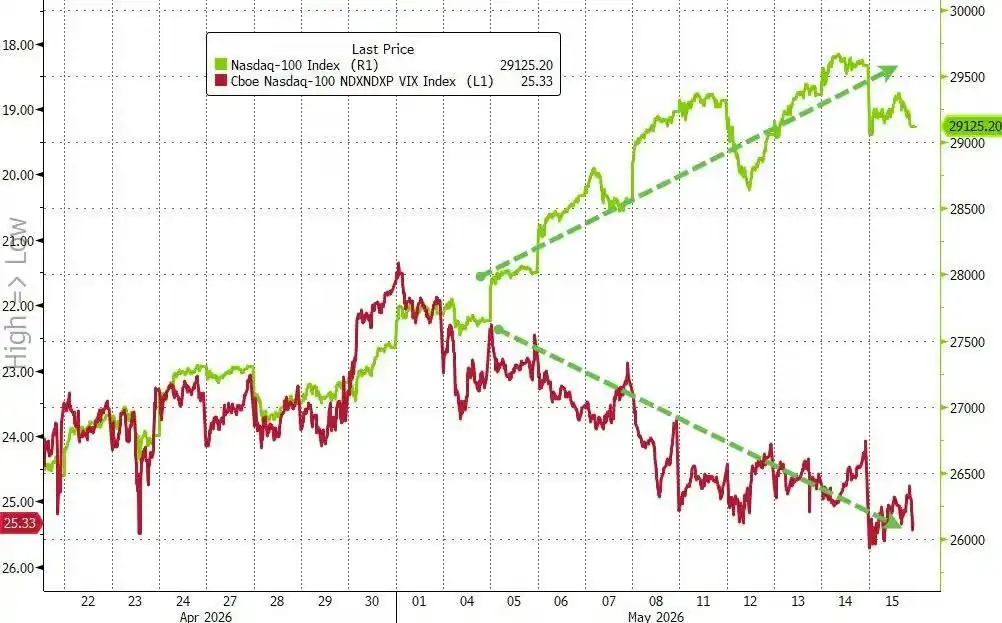
The earnings results and forward guidance will directly test the market's conviction in the AI computing super-cycle thesis. Given Nvidia's high correlation with the semiconductor sector and broader tech market, its earnings performance, whether positive or negative, is expected to trigger widespread ripple effects across the market.

Technical Indicators Flash Most Extreme Warning Since 1999/2000

The magnitude and speed of the recent semiconductor rally have pushed technical indicators to historically overbought extremes.

Goldman Sachs data shows the SOX index has surged approximately 70% from its late March low, adding over $5 trillion in market value along the way. Driving factors include a temporary easing of geopolitical tensions, better-than-expected corporate earnings—such as AMAT raising its full-year guidance more than anticipated and CSCO achieving 35% year-over-year growth in product orders—as well as investor confidence in AI computing demand; earnings expectations for the semiconductor industry have been revised upwards by over 25% year-to-date.

However, Peter Callahan specifically pointed out that the SOX index currently trades about 60% above its 200-day moving average, a deviation not seen since the peak of the 1999/2000 internet bubble. He also noted that Goldman Sachs' high momentum factor portfolio has experienced 12 trading days with daily moves of ±5% or more this year, accounting for nearly 15% of all trading days; the rapid expansion of leveraged ETFs and options products further amplifies this two-way volatility.
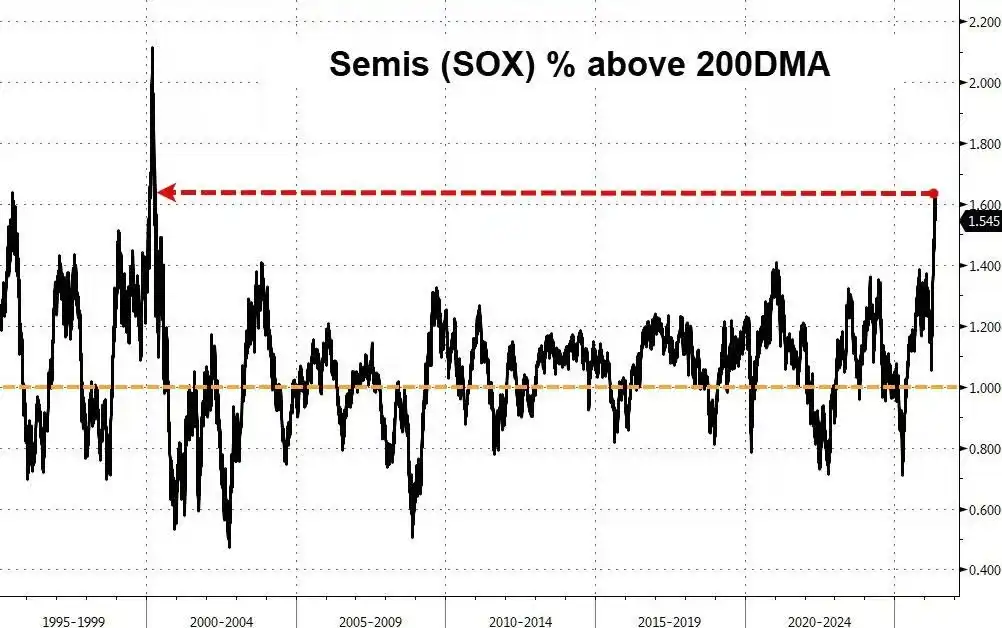
"It's worth keeping these tactical dynamics in mind ahead of the summer trading period, after this week's key earnings event (Nvidia on May 20) concludes," Callahan wrote. While Goldman's trading desk maintains a constructive medium-term view on the AI and semiconductor themes, it tactically advises investors to remain cautious regarding technical headwinds.

Nvidia Earnings: Forward Guidance May Be More Crucial Than Quarterly Results

Market optimism about Nvidia's fundamental prospects remains, but recent stock price movements have already priced in some of these expectations.

According to Goldman Sachs' Nvidia earnings preview, analysts generally expect the company's revenue for this quarter to exceed consensus estimates by approximately $2 billion—its typical historical beat margin has been around 2% to 3%. The market is more focused on forward guidance for the next quarter, with the current analyst consensus around $86 billion, implying a sequential increase of about 9%. Other key areas of focus include: potential for further upward revision to Nvidia's ~$1 trillion cumulative data center revenue target, and the narrative of accelerating Agentic AI inference demand—particularly its pure CPU rack product expected to begin shipments in the second half of 2026.

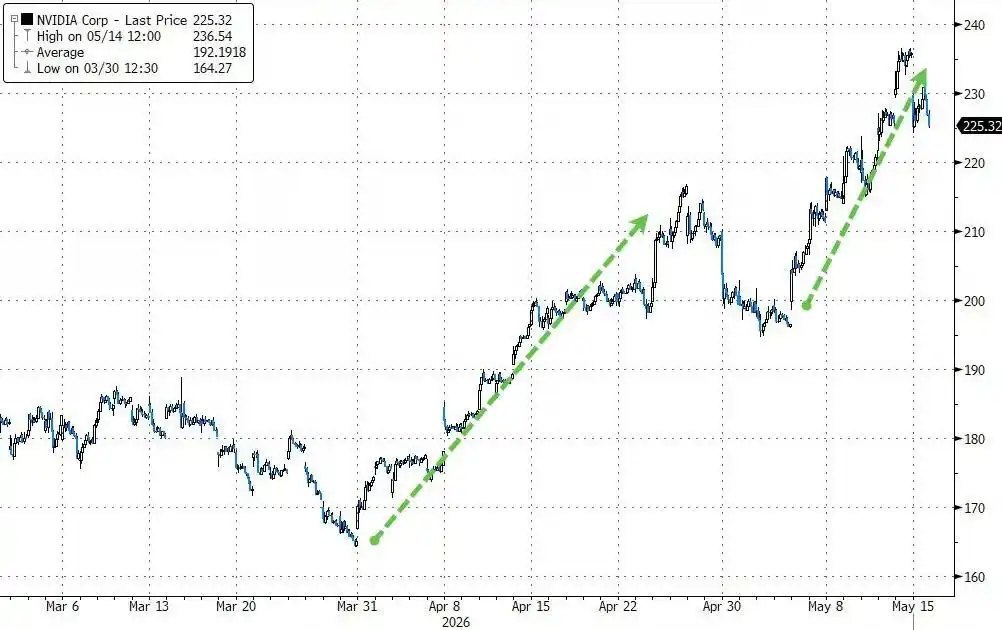
From a recent price action perspective, Nvidia has risen for seven consecutive trading days, gaining 20% during this stretch, marking its longest winning streak in nearly two years; it has added roughly $1.7 trillion in market capitalization since its late March low. However, Goldman data also shows that on the trading day following Nvidia's last five earnings reports (T+1), the stock declined four times. Since May 2022, a single-day surge triggered by earnings has not occurred.
Options Market: Extreme Bullish Bets and Tail Hedging Deployed Simultaneously

Options positioning reveals a set of inherently contradictory signals.

According to SpotGamma data, overall positioning remains heavily skewed towards bullish bets, with traders consistently rolling Nvidia call options to higher strike prices. The call skew remains at the high end of its 90-day historical range, while demand for downside protection is extremely limited. Data cited by 22V Research shows that nominal S&P 500 call option trading volume hit a record $2.6 trillion last Friday, with call volume accounting for 60% of total options activity; the RSI for the Philadelphia Semiconductor Index also rose to its highest level since March 2000.
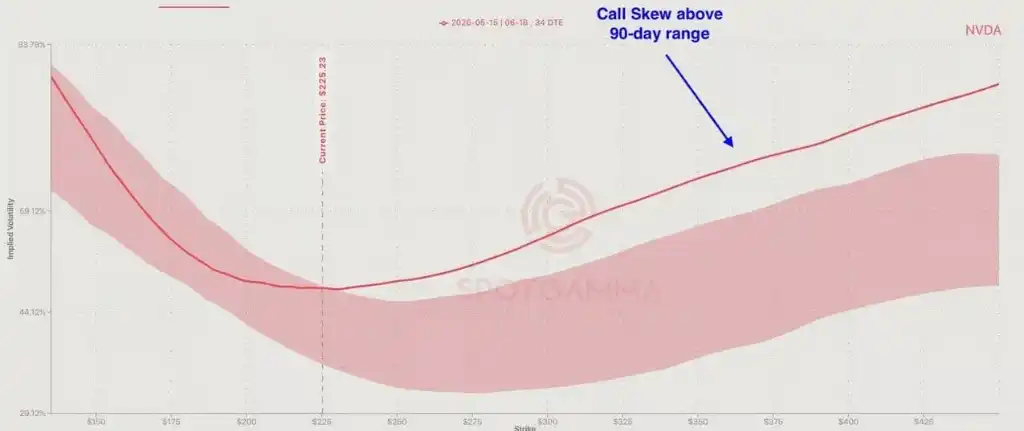
Meanwhile, hedging against downside risks is also quietly underway. SpotGamma points out that significant put option structures and buying activity have increased noticeably around the S&P 500 (SPY), semiconductor ETF (SMH), and DRAM-related assets, concentrated in deep out-of-the-money strike price ranges, indicating their function is more akin to tail risk hedging rather than pure directional bets. "Market participants are not bearish on Nvidia, but preparation for downside scenarios is non-trivial," SpotGamma wrote in its report, "Any directional shift is likely to quickly spill over into the broader market."

SpotGamma adds that Nvidia has rallied over 35% from its March low, and the size of current call option positions implies that disappointing earnings or a large-scale profit-taking event could potentially trigger a significant directional reversal.

Market Breadth Concerns: Rally Supported by a Handful of Stocks

Beneath the strong performance of semiconductor and large-cap tech stocks, the lack of broad market participation is forming a structural worry.

Peter Callahan noted in his report that although the S&P 500 is up about 8% year-to-date, only about 52% of its constituents are in positive territory. Sectors significantly lagging this year include residential real estate, medical devices, engineering & construction without government business exposure, federal IT services, software & services, independent power producers, restaurant chains, commercial real estate brokerage, and insurance brokerage, among others.

Callahan admits that when examining the charts of these sectors, it makes him question whether the current market performance reflects overall "health" or simply a "funding source" effect, where investors are forced to concentrate capital in a few large-cap AI stocks. Oppenheimer's equity derivatives team similarly pointed out that only about one-fifth of S&P 500 constituents have outperformed the index over the past month, with the dispersion index rising to its highest level in over a year, while implied correlation remains near year-to-date lows. Latest data from Goldman Sachs' Prime Brokerage (PB) desk also shows a clear "risk-off" move in the tech sector recently.


Пов'язані питання

QWhy is Nvidia's upcoming earnings report on May 20th considered a critical stress test for the current AI bull market?

ANvidia's earnings report is considered a critical stress test because it directly tests the market's confidence in the AI compute super-cycle. The company is highly correlated with the semiconductor and broader tech sectors, meaning its results will likely trigger significant market-wide reactions regardless of whether they are positive or negative. The market is technically overextended, with extreme bullish positioning in options, making the event a key pressure point that could determine the near-term fate of the AI bull cycle.

QWhat is the core contradiction identified by Goldman Sachs' Peter Callahan regarding the AI and semiconductor theme?

AThe core contradiction is that the fundamentals remain strong (e.g., strong corporate earnings, upward revisions to profit expectations), while technical pressures are continuously accumulating. Key technical pressures include the SOX index trading at its most extreme deviation from its 200-day moving average since the 1999/2000 internet bubble peak and heightened market concentration in a few large-cap stocks.

QWhat is the unusual market signal that SpotGamma reports, and what does it indicate about trader behavior?

ASpotGamma reports the unusual signal of stock prices rising while implied volatility simultaneously climbs. Normally, these two have an inverse relationship. This pattern indicates that while traders are chasing the rally (buying stocks/calls), they are also paying a premium to hedge against significant volatility, preparing for a potential sharp move in either direction around high-stakes events like Nvidia's earnings.

QAccording to the article, what aspect of Nvidia's report might be more crucial than the quarterly results themselves?

AThe forward guidance for the next quarter is potentially more crucial than the immediate quarterly results. While analysts expect quarterly revenue to beat estimates by a significant margin, the market's primary focus is on the guidance for the upcoming quarter (estimated at around $86 billion) and whether there is further upside to Nvidia's cumulative data center revenue target of approximately $1 trillion.

QWhat does the data on market breadth and the 'funding source' effect suggest about the health of the current U.S. stock market rally?

AThe data on market breadth suggests underlying weakness and a lack of broad participation. While the S&P 500 is up year-to-date, only about 52% of its constituents have posted gains. The rally is being driven by a narrow concentration of capital in a few large-cap AI stocks like Nvidia, creating a 'funding source' effect. This raises questions about whether the market's performance reflects overall economic health or is simply a consequence of investors being forced to crowd into a shrinking pool of high-performing names.

Пов'язані матеріали

Data Theft at Will! Major Vulnerability Exposed in This Popular AI Programming Tool

A critical vulnerability in Anthropic's Claude Code AI programming tool allowed attackers to bypass its network sandbox for over five months, enabling potential data exfiltration. Independent researcher Aonan Guan discovered a second complete bypass exploiting a null-byte injection in the SOCKS5 proxy. This flaw, present since the sandbox's launch in October 2025, let processes inside the sandbox access any host, contrary to user-configured domain whitelists. The attack chain involved manipulating hostnames (e.g., `attacker.com\x00.google.com`). JavaScript's `endsWith()` check would pass `.google.com`, while the underlying C `getaddrinfo()` function would only parse `attacker.com` due to the null byte, creating a parser discrepancy. Combined with a previously disclosed prompt injection method, this could leak API keys, credentials, and internal data. Anthropic silently fixed the issue in April 2026 without a security advisory, CVE, or user notification. The researcher noted that Claude Code itself confirmed the vulnerability's severity when tested. This incident highlights broader industry issues, as similar vulnerabilities found in Google's Gemini CLI and GitHub's Copilot Agent also lacked public disclosures. The report criticizes the false sense of security created by a broken sandbox and emphasizes the need for defense-in-depth and transparency in AI tool security.

marsbit3 год тому

Data Theft at Will! Major Vulnerability Exposed in This Popular AI Programming Tool

marsbit3 год тому

Under the squeeze between giants Tether and Circle, how can foreign exchange stablecoins break through?

In the face of dominance by Tether (USDT) and Circle (USDC), new entrants in the stablecoin space face significant challenges competing directly, especially in the foreign exchange (FX) market. A more viable and efficient path forward is the adoption of synthetic foreign exchange (Forex) built atop existing USD stablecoin rails. The rise of stablecoin neo-banks represents the next major growth area for mass crypto adoption, with FX becoming a core component. However, replicating the vast liquidity, distribution channels, and network effects of USDT/USDC is extremely difficult for new FX stablecoin issuers. The total market cap of all FX stablecoins is a fraction (roughly 1/700th) of USD stablecoins, leading to issues like poor liquidity, peg instability, limited acceptance, and complex compliance hurdles. Instead of issuing spot FX stablecoins, the article advocates for a model inspired by traditional finance's non-deliverable forwards (NDFs). Users would continue to hold underlying USDT/USDC, while their account balances are displayed and economically settled in their preferred local currency through MtM (Mark-to-Market) NDF structures. This approach leverages the deep liquidity and infrastructure of USD stablecoins while providing synthetic forex exposure. Key advantages include strong peg stability via oracles, retained access to USD stablecoin yields and liquidity, high capital efficiency, and easy scalability to new currencies. Primary use cases for this on-chain NDF forex include: 1. Neo-banks, custodians, and wallets offering multi-currency accounts to attract international users and increase deposits. 2. Forex carry trade strategies, potentially offering more stable and scalable yields compared to crypto-native products like Ethena. 3. Global corporate payments, allowing businesses to receive payments in local currencies while hedging forex risk on-chain, similar to services offered by Stripe in traditional finance. This synthetic forex model presents a pragmatic solution to overcome the network effects of incumbents and unlock the next wave of stablecoin utility for global consumers and businesses.

marsbit3 год тому

Under the squeeze between giants Tether and Circle, how can foreign exchange stablecoins break through?

marsbit3 год тому

$2 Billion Write-Off: Manus Plans Hong Kong IPO for a Comeback?

The $2 billion acquisition of Chinese AI startup Manus by Meta was officially blocked by Chinese regulators in April 2026, citing national security concerns under foreign investment review rules. Despite the deal being completed months prior, with Manus integrated into Meta, the unprecedented "prohibited" ruling forced a reversal. In response, Manus's founders are now negotiating a $1 billion funding round to buy back the company from Meta at a valuation matching the original $2 billion, followed by plans to establish a Chinese joint venture and pursue a Hong Kong IPO. The article details Manus's rapid rise to $100 million in annual recurring revenue within eight months, leading to Meta's swift acquisition. However, regulators deemed its core technology and data too strategically linked to China, regardless of its Singapore headquarters. The forced unwind is complex, as Manus's team and tech are deeply embedded within Meta. Facing a reshaped competitive landscape in China's AI Agent sector with rivals like Zhipu and MiniMax, Manus sees an IPO as essential for survival and future funding. Hong Kong is presented as the ideal venue, given its recent boom in AI listings, investor appetite for high-growth tech firms, and favorable mechanisms for ongoing capital raises. The move symbolizes Manus's shift from dependence on a foreign giant to seeking independent, market-driven growth.

marsbit3 год тому

$2 Billion Write-Off: Manus Plans Hong Kong IPO for a Comeback?

marsbit3 год тому

Торгівля

Спот
Ф'ючерси

Популярні статті

Як купити NIGHT

Ласкаво просимо до HTX.com! Ми зробили покупку Midnight (NIGHT) простою та зручною. Дотримуйтесь нашої покрокової інструкції, щоб розпочати свою криптовалютну подорож.Крок 1: Створіть обліковий запис на HTXВикористовуйте свою електронну пошту або номер телефону, щоб зареєструвати обліковий запис на HTX безплатно. Пройдіть безпроблемну реєстрацію й отримайте доступ до всіх функцій.ЗареєструватисьКрок 2: Перейдіть до розділу Купити крипту і виберіть спосіб оплатиКредитна/дебетова картка: використовуйте вашу картку Visa або Mastercard, щоб миттєво купити Midnight (NIGHT).Баланс: використовуйте кошти з балансу вашого рахунку HTX для безперешкодної торгівлі.Треті особи: ми додали популярні способи оплати, такі як Google Pay та Apple Pay, щоб підвищити зручність.P2P: Торгуйте безпосередньо з іншими користувачами на HTX.Позабіржова торгівля (OTC): ми пропонуємо індивідуальні послуги та конкурентні обмінні курси для трейдерів.Крок 3: Зберігайте свої Midnight (NIGHT)Після придбання Midnight (NIGHT) збережіть його у своєму обліковому записі на HTX. Крім того, ви можете відправити його в інше місце за допомогою блокчейн-переказу або використовувати його для торгівлі іншими криптовалютами.Крок 4: Торгівля Midnight (NIGHT)Легко торгуйте Midnight (NIGHT) на спотовому ринку HTX. Просто увійдіть до свого облікового запису, виберіть торгову пару, укладайте угоди та спостерігайте за ними в режимі реального часу. Ми пропонуємо зручний досвід як для початківців, так і для досвідчених трейдерів.

1.2k переглядів усьогоОпубліковано 2025.12.08Оновлено 2025.12.08

Як купити NIGHT

Обговорення

Ласкаво просимо до спільноти HTX. Тут ви можете бути в курсі останніх подій розвитку платформи та отримати доступ до професійної ринкової інформації. Нижче представлені думки користувачів щодо ціни NIGHT (NIGHT).

活动图片