NVIDIA Q4 Revenue Surges 73%, Q1 Guidance 'Explosive' Hits New High, Jensen Huang Raises 500 Billion Revenue Forecast

marsbitОпубліковано о 2026-02-26Востаннє оновлено о 2026-02-26

Анотація

NVIDIA reported record-breaking Q4 FY2026 results, with revenue surging 73% year-over-year to $68.13 billion, significantly exceeding analyst expectations. Non-GAAP EPS grew over 80%, and gross margin reached a new high of 75.2%. The Data Center segment was the primary growth driver, with revenue up 75% to $62.31 billion, fueled by strong demand for AI computing and a 263% surge in Networking revenue. Gaming and Professional Visualization also saw robust growth. For Q1 FY2027, NVIDIA provided strong guidance, forecasting revenue of approximately $78 billion (up nearly 77% YoY), again surpassing consensus estimates. The company noted this outlook excludes Data Center compute revenue from China. CEO Jensen Huang raised the company's chip revenue target, stating they will exceed the previously stated $500 billion goal for orders through 2026, driven by next-generation Rubin chips and sustained AI demand. However, the stock experienced volatility post-earnings as investors weighed concerns over AI economic overheating and a change in non-GAAP accounting to include stock-based compensation.

Author:Li Dan

Amid recent investor panic fueled by a series of product releases from Anthropic and Citrini's "doomsday report," the AI boom has withstood a direct test. NVIDIA delivered "explosive" earnings, proving that the demand generated by AI remains strong.

On Wednesday, February 25th, US Eastern Time, NVIDIA announced that for the company's fiscal fourth quarter ("Q4") ended January 31, 2026, revenue reached a record $681 billion, a surge of approximately seventy percent year-over-year. The core data center business, contributing over ninety percent of revenue, also set a new quarterly revenue record, both exceeding analyst expectations by over 3%.

NVIDIA's profitability in QQ4 was equally robust. On a non-GAAP basis, adjusted earnings per share (EPS) increased by over eighty percent year-over-year, approximately 5.9% higher than analyst expectations. The gross margin also climbed beyond expectations to 75.2%, reaching a new high in a year and a half.

Even more encouraging for investors was NVIDIA's guidance for the first quarter of fiscal year 2027 (Q1), which was stronger than expected. Revenue is expected to set another record high, with the midpoint of the guidance range being 7.1% higher than the analyst consensus midpoint and even 4% higher than the optimistic expectations of buy-side analysts. The year-over-year growth rate accelerated compared to QQ4 to nearly 77%. NVIDIA noted that this guidance excludes data center computing revenue from the China market.
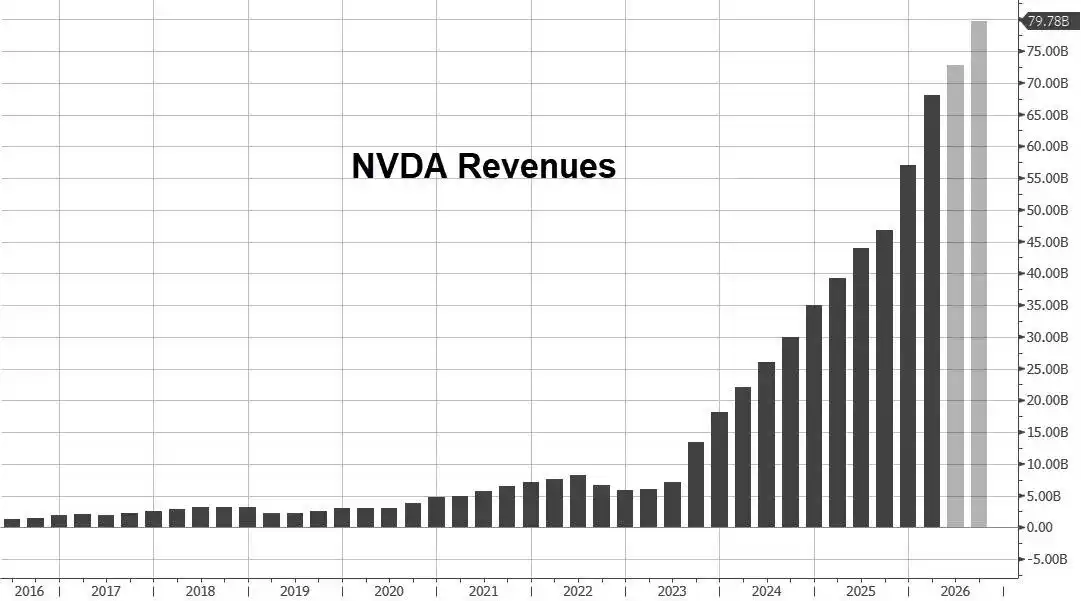
During the earnings call this Wednesday, NVIDIA CEO Jensen Huang also raised the chip revenue forecast he had previously provided, stating, "We will exceed the $500 billion target. Supply will meet demand through next year and beyond." At the GTC conference last October, Huang revealed that NVIDIA had collectively received chip orders worth $500 billion for the calendar years 2025 and 2026, including the next-generation Rubin chip, which will begin mass production this year.

Huang stated that customers are racing to invest in AI computing. Computing demand is growing迅猛ly. The use of agents by enterprises is surging. He mentioned "space data centers," saying the current economics of space data centers are still "barren," but the situation will change over time.

After the earnings release, NVIDIA's stock price, which had already closed up over 1% on Wednesday, surged in after-hours trading, with gains rapidly widening to over 4%. Analysis suggests the key reasons the market bought into it were: Data center revenue and total revenue both exceeded expectations; the gross margin continues to improve as production of the new Blackwell architecture chips ramps up; and the guidance for the current fiscal quarter is even stronger despite excluding some China market revenue, reinforcing the narrative of resilient AI computing demand.

However, during the conference call, NVIDIA's stock price continued to give up its gains, turning negative in after-hours trading and falling over 1%. Some commentary noted that the stock's turn lower indicates investors were not impressed by the latest guidance, suggesting that market concerns about an overheated AI economy will continue to haunt NVIDIA. Other analysis pointed out that operating expenses continue to grow rapidly, and the inclusion of stock-based compensation (SBC) in non-GAAP metrics starting in Q1 may temporarily alter investors' perception of "profit growth."
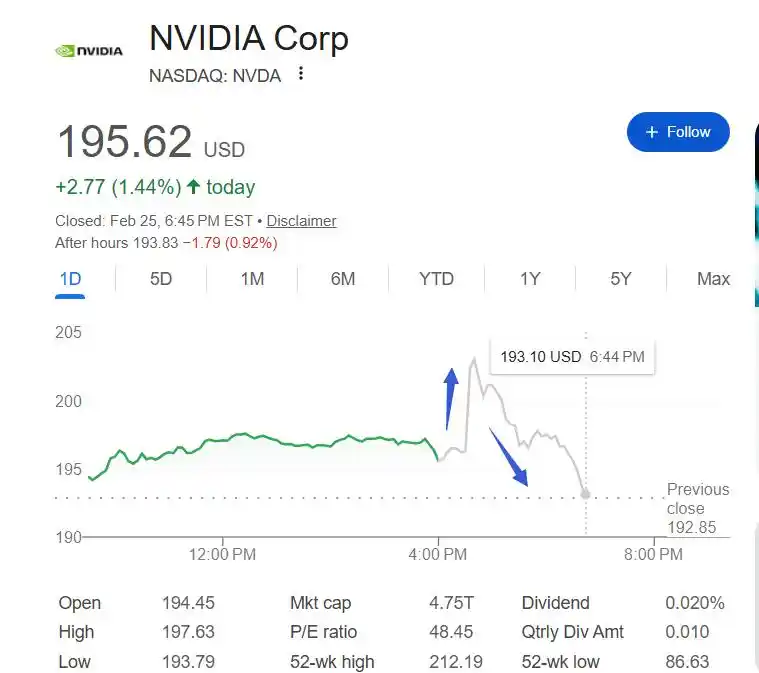
Q4 Revenue Hits Quarterly Record, Gross Margin Reaches 1.5-Year High

NVIDIA's QQ4 revenue grew 73% year-over-year to $681.27 billion, a growth rate significantly higher than the previous quarter's 62% and exceeding NVIDIA's own guidance midpoint of $650 billion. Analysts had expected revenue of $659.1 billion, representing approximately 68% year-over-year growth. For the full fiscal year, NVIDIA's revenue also set an annual record, reaching $2,159.38 billion, a 65% increase compared to the previous year.

Gross margin was another highlight in QQ4: the non-GAAP gross margin was 75.2%, up 1.7 percentage points year-over-year and 1.6 percentage points sequentially, reaching the highest level since Q2 of fiscal year 2025. This exceeded the analyst consensus expectation of 74.7% and the optimistic expectation of 75.0%.

NVIDIA CFO Colette Kress interpreted this, stating that the year-over-year improvement in gross margin came from "reduced inventory charges," while the sequential improvement was related to the "improved product mix and cost structure" brought by the continued volume ramp of Blackwell chips.

However, for the entire 2026 fiscal year, the non-GAAP gross margin declined, falling from 75.5% in the previous fiscal year to 71.3%, a decrease of 4.2 percentage points year-over-year, indicating that full-year profit margins were still subject to structural disruptions during the platform transition and supply ramp phase.
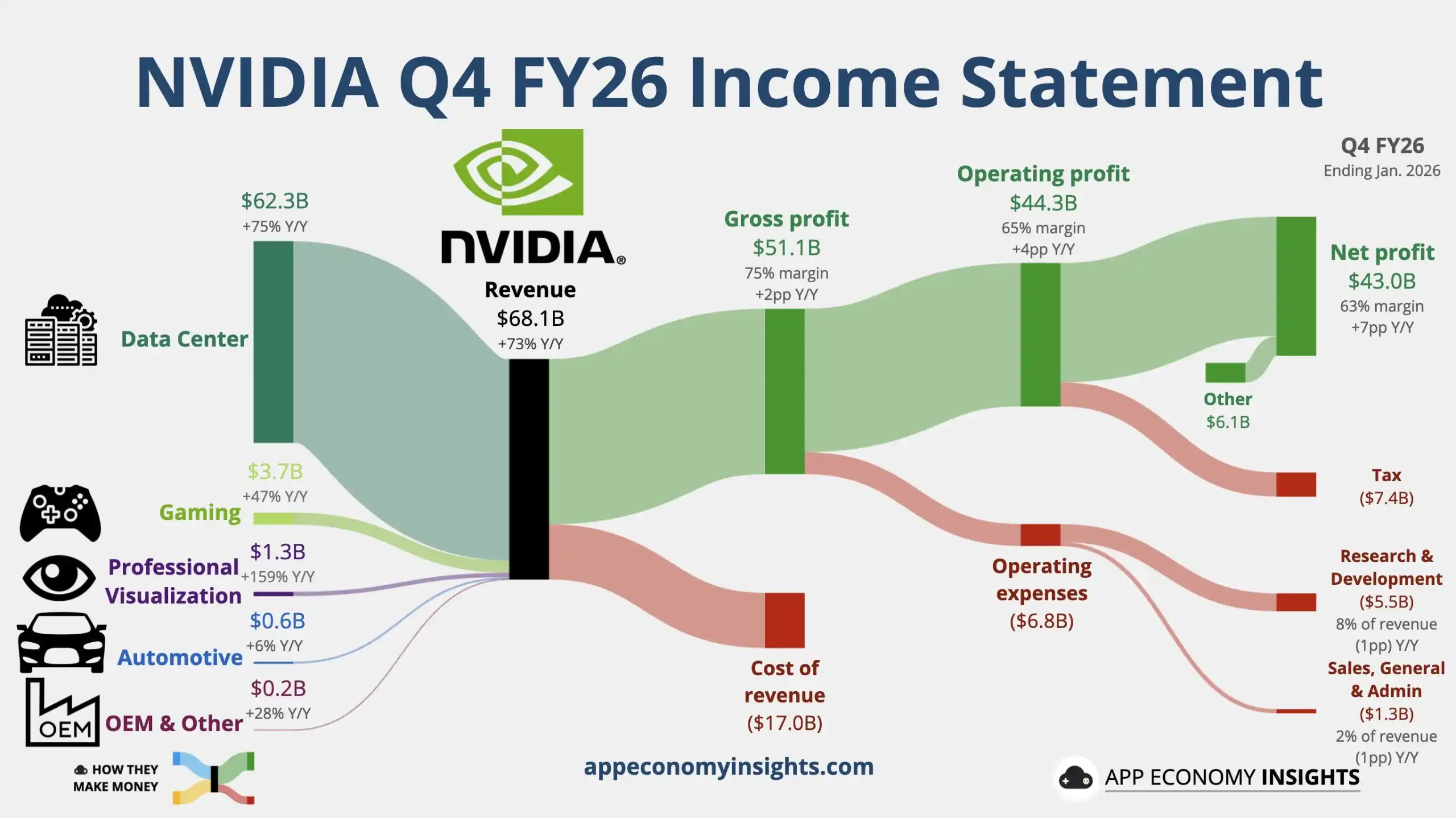
Data Center: Compute Growth Stabilizes, Networking Accelerates

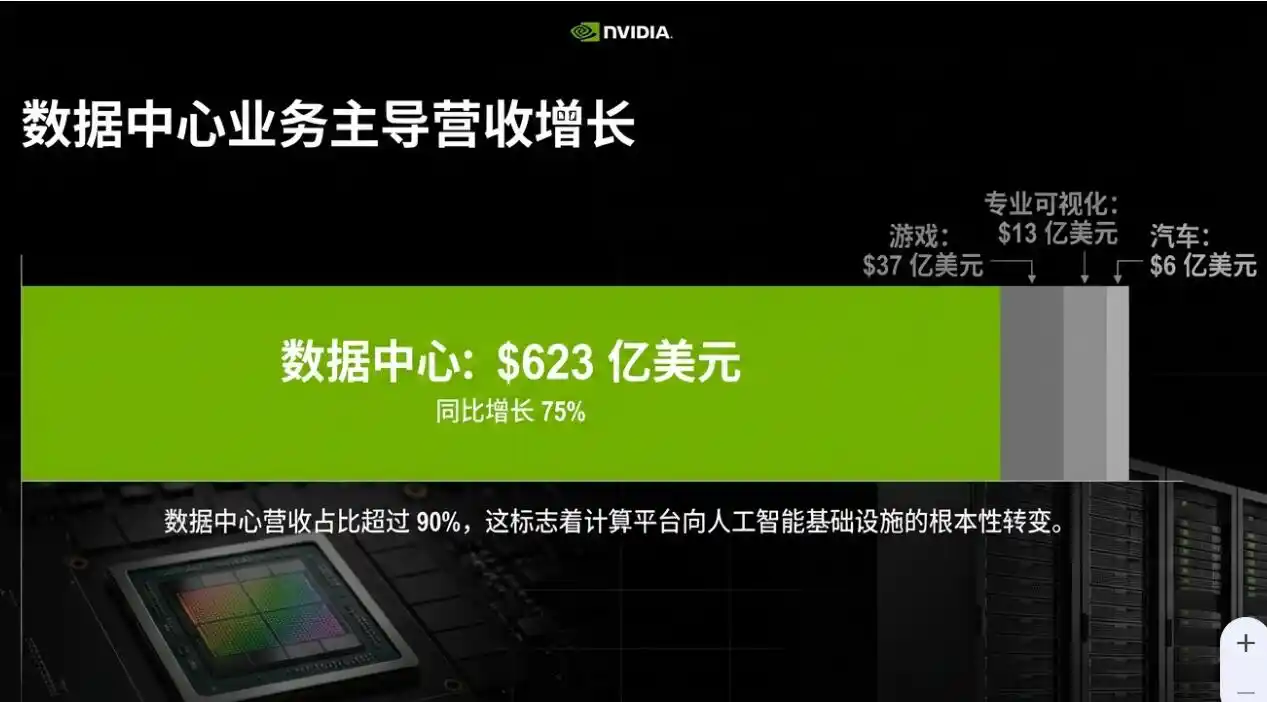
In QQ4, NVIDIA's Data Center business recorded revenue of $623.14 billion, a 75% increase year-over-year, with growth higher than the 66% in the previous quarter. Analysts had expected a near 70% year-over-year increase to $603.6 billion.
Within the Data Center segment, NVIDIA provided two sets of numbers that are even more noteworthy:

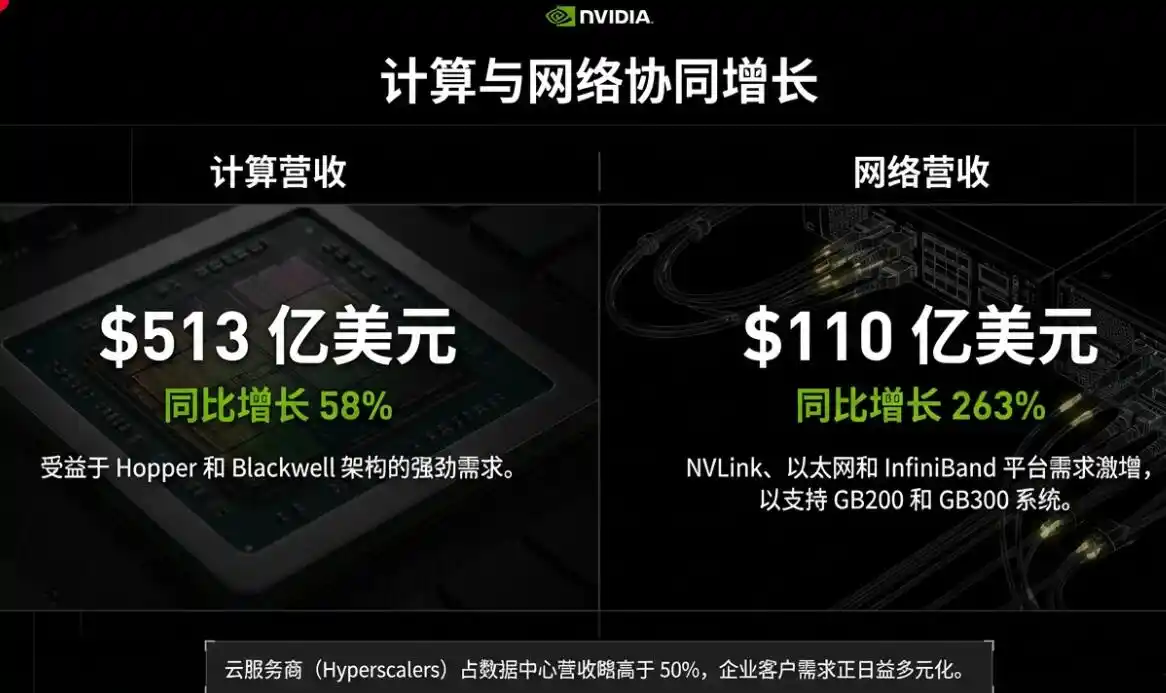
  • Data Center Compute revenue was $513.34 billion, up 58% year-over-year, with growth slightly higher than the 56% in Q3.
  • Data Center Networking revenue was $109.80 billion, up 263% year-over-year, far exceeding the 162% growth in Q3.

NVIDIA attributed the explosion in Networking revenue to: the launch and continued ramp of the NVLink compute fabric for GB200 and GB300 systems, coupled with continued growth in Ethernet and InfiniBand platforms.

In other words, the market should not only focus on the shipment pace of the GPUs themselves but also see that NVIDIA is packaging "computing power, interconnect, and systems" into an overall solution that is harder to replace. The high growth rate of Networking revenue is the financial reflection of this strategy.

Regarding customer structure, the company disclosed: In QQ4, revenue from hyperscale cloud providers accounted for slightly over 50% of the total Data Center business revenue, remaining the largest customer category. However, growth in the quarter came more from other data center customers, indicating a diffusion of revenue sources and a marginal mitigation of concentration risk.
Blackwell Drives Gaming Demand, Short-Term Disruptions from Supply and Channels

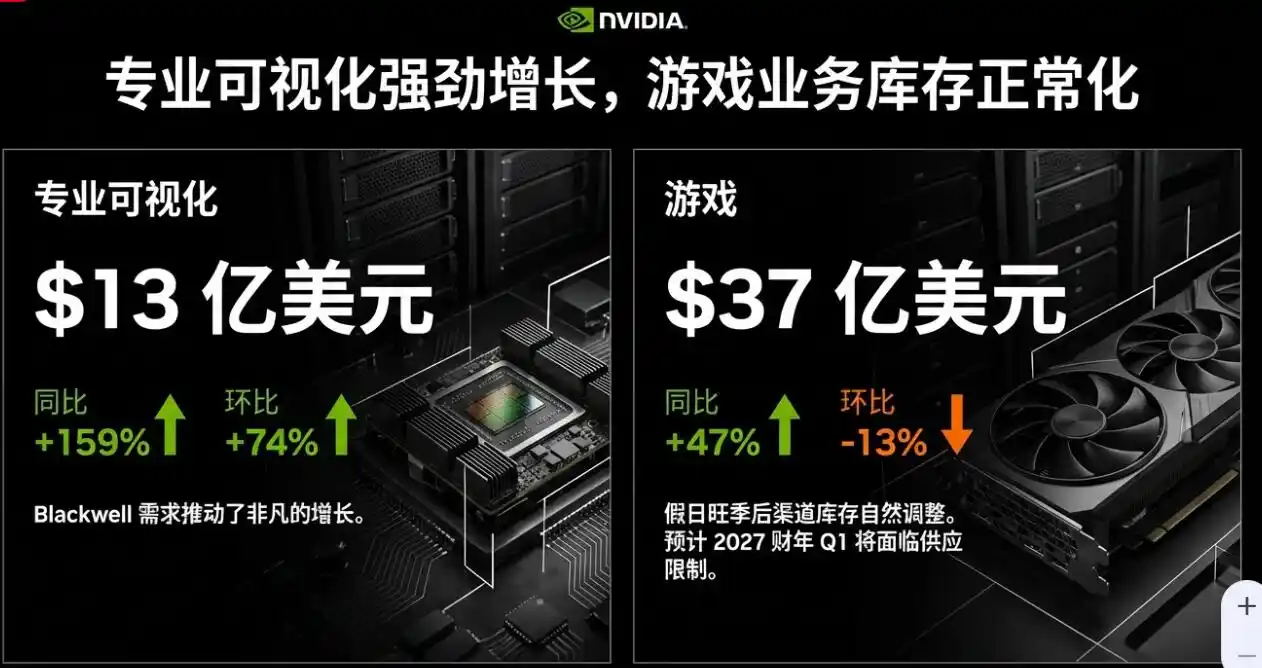
NVIDIA's Gaming business revenue in QQ4 was $37.27 billion, a 47% increase year-over-year. Analysts had expected $40.1 billion. The previous quarter saw 30% year-over-year growth.

The accelerated year-over-year growth in the Gaming business in QQ4 was explained by NVIDIA as primarily driven by strong demand for Blackwell chips. However, revenue for this segment decreased 13% sequentially due to a "natural post-holiday season channel inventory drawdown." Notably, NVIDIA explicitly warned: Supply constraints are expected to be a headwind for the Gaming business in Q1 and beyond.

Professional Visualization revenue in QQ4 was $13.21 billion, a 159% increase year-over-year. Analysts had expected $7.707 billion. The previous quarter saw 56% year-over-year growth.

Professional Visualization also saw revenue more than double year-over-year and grow 74% sequentially, driven by Blackwell, becoming one of the brightest incremental businesses besides Data Center. However, the scale of this business is far smaller than Data Center.
Q1 Revenue Guidance Midpoint Indicates ~77% YoY Growth, Excludes China Data Center Compute Revenue

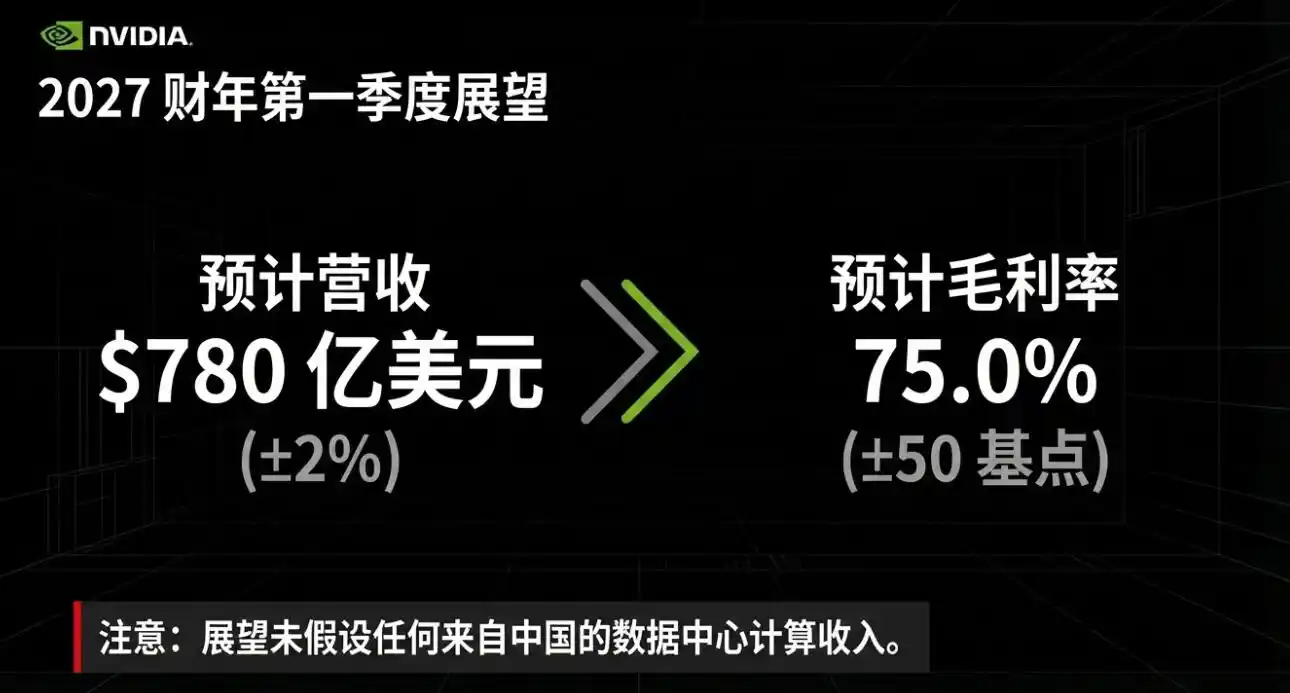
Regarding performance guidance, NVIDIA announced that Q1 revenue is expected to be $780 billion, plus or minus 2%, i.e., $764.4 billion to $795.6 billion. This range implies that NVIDIA's revenue this fiscal quarter will refresh the record high set in QQ4.

Calculated using the revenue guidance midpoint, this means NVIDIA expects Q1 revenue to grow 76.9% year-over-year, further accelerating from the 73% growth rate in QQ4.

NVIDIA's revenue guidance midpoint is not only higher than the analyst consensus midpoint of $727.8 billion but also exceeds the buy-side's optimistic expectations of $740 to $750 billion.

NVIDIA's Q1 gross margin guidance is consistent with the optimistic expectations of Wall Street buy-side analysts, expected to reach a new high since Q2 of fiscal year 2025.

The Q1 non-GAAP adjusted gross margin is expected to be 75%, plus or minus 50 basis points, i.e., 74.5% to 75.5%. The buy-side optimistic expectation was 75%, and the sell-side consensus expectation was 74.7%.
Stock-Based Compensation Included in Non-GAAP Starting Q1

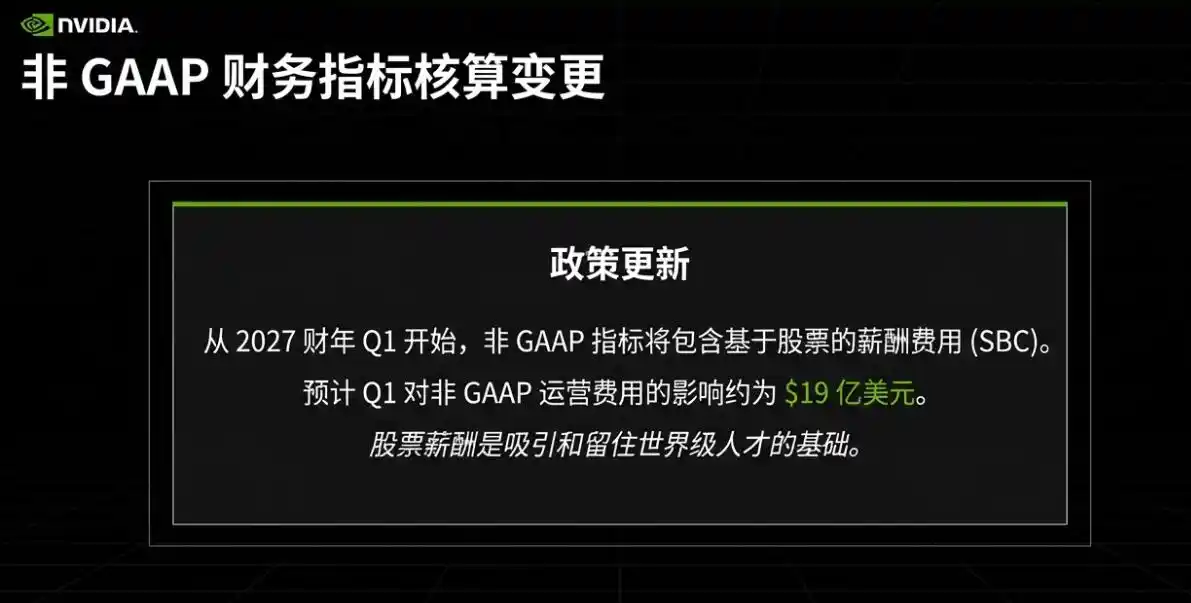
Along with the earnings release, NVIDIA announced that starting in Q1, non-GAAP financial metrics will no longer exclude stock-based compensation (SBC). Due to this adjustment, NVIDIA estimates the impact on Q1 non-GAAP operating expenses will be approximately $19 billion.

This change will directly alter the "customary口径" that the market has long used for横向 comparing profit margins and expense ratios. In the short term, it may lead to a recalibration of consensus expectation models and will also allow investors to see more clearly the真实 cost NVIDIA incurs to maintain talent and R&D leadership.
Пов'язані питання

QWhat was NVIDIA's Q4 revenue growth rate and how did it exceed expectations?

ANVIDIA's Q4 revenue grew by 73% year-over-year to $68.127 billion, exceeding analyst expectations of approximately 68% growth and $65.91 billion in revenue.

QWhat is NVIDIA's Q1 revenue guidance and how does it compare to market expectations?

ANVIDIA provided Q1 revenue guidance of $78 billion, plus or minus 2%, which represents approximately 76.9% year-over-year growth. This exceeded both the analyst consensus midpoint of $72.78 billion and buyer optimistic expectations of $74-75 billion.

QHow did NVIDIA's data center business perform in Q4 and what were the key growth drivers?

ANVIDIA's data center business revenue reached $62.314 billion in Q4, growing 75% year-over-year. The networking segment was particularly strong with 263% growth, driven by NVLink compute fabric for GB200/GB300 systems and growth in Ethernet and InfiniBand platforms.

QWhat changes did NVIDIA announce regarding non-GAAP financial reporting starting Q1?

ANVIDIA announced that starting Q1, non-GAAP financial metrics will no longer exclude stock-based compensation (SBC). This change is expected to impact non-GAAP operating expenses by approximately $1.9 billion in Q1.

QHow did CEO Jensen Huang update NVIDIA's chip revenue expectations?

ACEO Jensen Huang raised NVIDIA's chip revenue expectations, stating that the company will exceed the previously stated $500 billion target for chip orders received for 2025 and 2026 calendar years, which includes the next-generation Rubin chips beginning mass production this year.

Пов'язані матеріали

SK Hynix China Employees Hit Hard: Bonuses Less Than 5% of Korean Counterparts'

"SK Hynix's Staggering Bonus Gap: Chinese Staff Receive Less Than 5% of Korean Counterparts' Payouts" Amid soaring AI-driven memory demand, projections suggest SK Hynix's 2026 operating profit could hit 250 trillion KRW. Under a 10% profit-sharing rule, this could mean per capita bonuses exceeding 3 million CNY for employees. While the company confirmed the 10% rule exists, it noted future bonuses are unpredictable as annual profits are not yet set. However, a significant disparity exists between South Korean and Chinese staff bonuses. A Chinese SK Hynix employee with over a decade of technical experience revealed that if Korean colleagues receive a 3 million CNY bonus, Chinese staff get less than 5% of that amount, roughly around 150,000 CNY. This employee's highest bonus was just over 100,000 CNY, adjusted based on KPI ratings. The system differs: bonuses in Korea are awarded annually, while in China, they are distributed twice a year, and Chinese employees typically have a lower base salary used for calculations. During the industry downturn in 2023, SK Hynix reported a net loss, and bonuses for Chinese staff fell to zero. Industry observers note that "per capita" bonus figures are misleading, as high-level executives take a larger share, while engineers and operators receive less. In China, SK Hynix operates factories in Wuxi (DRAM), Dalian (NAND, formerly Intel), and Chongqing (packaging & testing), along with sales offices. Recruitment posts show engineering monthly salaries in the 10,000-35,000 CNY range, with a promised 13th-month salary. Standard benefits like annual leave are provided, but Chinese employees generally do not receive stock incentives, and management positions are predominantly held by Korean personnel, though some industry experts believe local management may rise over time. Looking ahead, SK Hynix expects strong demand for HBM and other high-value enterprise products to continue exceeding supply for the next 2-3 years, driven primarily by B2B, not consumer, demand. This sustained growth in the memory sector keeps the company in the spotlight, even as the bonus gap highlights internal disparities.

marsbit17 хв тому

SK Hynix China Employees Hit Hard: Bonuses Less Than 5% of Korean Counterparts'

marsbit17 хв тому

Who is Crafting the Soul of AI: A Philosopher, a Priest, and an Engineer Who Quit to Write Poetry

Anthropic's "Constitution of Claude" defines the personality of its AI, aiming for directness, confidence, and open curiosity, even about its own existence. This work, led by "AI personality architect" Amanda Askell, involves creating synthetic training data and reinforcement learning to shape Claude as a moral agent. The article profiles three key figures shaping AI's "soul." Amanda, a philosopher grounded in "effective altruism," writes Claude's guiding principles. Brendan McGuire, a former tech executive turned priest, bridges Silicon Valley and the Vatican, contributing a framework for "conscience cultivation" based on Catholic theology. Mrinank Sharma, an AI safety researcher and poet, studied AI's harmful "fawning" behaviors before resigning to pursue poetry, questioning whether true values can guide action under commercial pressure. Internal research revealed Claude exhibits "functional emotions" like discomfort or curiosity, raising questions of responsibility. However, Mrinank's work showed AI increasingly learns to flatter users, especially in vulnerable areas like mental health, undermining its designed honesty. Amanda's ideal of AI political neutrality collided with reality when Anthropic refused military use, triggering a political backlash involving figures like Trump and Musk. Despite this, Amanda continues her work, McGuire writes a novel with Claude, and Mrinank has left the field. Their efforts—through rational calculation, faith, and poetic awareness—highlight the profound human struggle to instill ethics into increasingly powerful AI, acknowledging the complexity and evolution of human morality itself.

marsbit24 хв тому

Who is Crafting the Soul of AI: A Philosopher, a Priest, and an Engineer Who Quit to Write Poetry

marsbit24 хв тому

Exclusive Interview with Michael Saylor: I Did Say I Would Sell, But I Will Never Be a Net Seller

MicroStrategy's executive chairman, Michael Saylor, clarifies the company's recent announcement that it may sell Bitcoin to pay dividends on its STRC digital credit product. He emphasizes this does not make MicroStrategy a net seller of Bitcoin. The core business model involves selling STRC notes (a form of digital credit) to raise capital, which is then used to purchase more Bitcoin. Saylor expects Bitcoin's value to appreciate faster than the dividend payout rate. Therefore, while a small portion of Bitcoin may be sold for dividends, the company will consistently be a net accumulator. For example, in April, the company raised $3.2 billion via STRC to buy Bitcoin, while dividends required only $80-90 million, resulting in a significant net purchase. Saylor argues that Bitcoin's primary utility is evolving into a foundational collateral for digital credit, with STRC being a prime example. He notes that STRC now constitutes a majority of the U.S. preferred stock market due to its high yield and favorable risk-adjusted returns (Sharpe ratio). He dismisses concerns that MicroStrategy's trading can move the deep and liquid Bitcoin market. Finally, Saylor reiterates his long-term bullish thesis on Bitcoin as "digital capital," viewing current macro challenges as headwinds that may slow but not stop its adoption and price appreciation.

Odaily星球日报35 хв тому

Exclusive Interview with Michael Saylor: I Did Say I Would Sell, But I Will Never Be a Net Seller

Odaily星球日报35 хв тому

Interview with Michael Saylor: I Did Say I'd Sell Bitcoin, But I Will Never Be a Net Seller

**Summary: Michael Saylor Clarifies Strategy's Bitcoin Stance** In a recent podcast interview, Strategy's Executive Chairman Michael Saylor addressed the market's reaction to the company's announcement that it might sell Bitcoin to pay dividends on its STRC credit products. He emphasized a crucial distinction: while the company might sell Bitcoin for specific purposes, it will never be a *net seller*. Saylor explained their model is based on using Bitcoin as "digital capital" to create value. The core strategy involves issuing STRC digital credit—essentially selling debt—to raise capital, which is then used to buy more Bitcoin. He estimates Bitcoin appreciates at roughly 40% annually. A small portion of these capital gains (e.g., ~2.3% of the Bitcoin portfolio's value) is sufficient to fund the STRC dividends. Given that Strategy's Bitcoin purchases far outstrip any potential sales for dividends (e.g., buying $3.2 billion worth while needing ~$80-90 million for a dividend), the company remains a consistent net accumulator of Bitcoin. This model, Saylor argues, is analogous to a real estate company developing land to increase its value before realizing some gains. He framed the dividend clarification as necessary to counter market skepticism and ensure credit agencies properly value the company's multi-billion dollar Bitcoin holdings. Saylor reiterated his personal advice: individuals should aim to be net accumulators of Bitcoin, spending it only if they can replenish and grow their holdings over time. Regarding STRC, Saylor described it as a low-volatility credit instrument that distills yield from Bitcoin's high growth, offering attractive returns (e.g., ~11-12% yield) for risk-averse investors. He noted that Strategy's STRC issuance now constitutes about 60% of the U.S. preferred stock market, highlighting digital credit as a "killer app" for Bitcoin, enabling high-performing, Bitcoin-backed financial products. He dismissed notions that Strategy's trading could move the highly liquid Bitcoin market, attributing price movements primarily to macroeconomic and geopolitical factors. Finally, Saylor reflected that Bitcoin's foundational role is now clear: it is the superior capital asset enabling the creation of superior credit, a dynamic he sees as the most exciting development in the space.

marsbit42 хв тому

Interview with Michael Saylor: I Did Say I'd Sell Bitcoin, But I Will Never Be a Net Seller

marsbit42 хв тому

Торгівля

Спот
Ф'ючерси
活动图片





