NVIDIA Launches DSX Platform, Expanding into AI Factory Infrastructure

marsbitОпубліковано о 2026-06-01Востаннє оновлено о 2026-06-01

Анотація

NVIDIA has unveiled the DSX platform at its GTC Taipei event, marking a strategic expansion from GPU sales into comprehensive AI factory infrastructure solutions. The platform addresses challenges like power supply, cooling, and resource orchestration as AI models scale, shifting the industry focus from single-chip performance to overall infrastructure efficiency. DSX integrates NVIDIA's chips, systems, software, and partner technologies to cover the entire AI factory lifecycle—from design and simulation to deployment and operations. It aims to accelerate deployment, improve reliability and operational efficiency, and reduce the cost per generated token in AI inference. The software suite includes DSX MaxLPS, which uses 45°C liquid cooling and rack-level optimization to allow up to 40% more GPUs per megawatt, and DSX OS, an open-source platform for AI factory operations. The platform also encompasses reference designs, digital twin simulation (DSX Sim), dynamic workload adjustment based on grid conditions (DSX Flex), and data exchange between systems. Early adopters include cloud providers like CoreWeave and Lambda. Major hardware partners, including Dell, HPE, Lenovo, and Supermicro, are developing DSX-ready systems. Pilot projects for DSX Flex are underway with energy providers. Strategically, DSX represents NVIDIA's ongoing transition from an AI chip supplier to a full-stack AI infrastructure platform provider, aiming to set industry standards and solidify its market l...

Summary: Jinshi Data

At the NVIDIA GTC Taipei conference held in Taipei, Taiwan, NVIDIA (NVDA.O) unveiled the NVIDIA DSX platform, further extending its business reach into the field of AI factory infrastructure.

Unlike its past focus on GPU sales, DSX aims to provide enterprises with a complete AI factory solution encompassing design, simulation, deployment, and operational management.

As AI models continue to scale, the challenges faced by data centers are no longer just about chip performance, but also involve power supply, cooling capacity, resource scheduling, and overall operational efficiency. NVIDIA believes that future competition in the AI industry will increasingly shift key metrics from single-chip performance to overall infrastructure efficiency—that is, how to produce more computing power and intelligent services under limited power, space, and resource constraints.

To this end, the DSX platform integrates NVIDIA's chips, systems, software, reference architectures, and partner technologies, covering the entire lifecycle of AI factory construction and operation. By unifying technology stacks across computing, software, and facilities, the platform helps customers improve deployment speed, reliability, and operational efficiency while reducing the cost of generating tokens during AI inference.

Jensen Huang stated:

"We're not just delivering chips—we're providing every infrastructure builder with a complete methodology for building AI factories. With the DSX platform, you can simulate the entire factory without spending a dime, validate performance before installing the first rack, and operate with the reliability required for production-grade AI."

The software suite announced this time primarily includes DSX MaxLPS and DSX OS.

Among them, DSX MaxLPS leverages 45-degree liquid cooling and rack-level power optimization technologies to increase token output per megawatt of power. NVIDIA stated that this technology allows for the deployment of up to 40% more GPUs with minimal impact on performance, thereby further reducing computing costs within a fixed power budget.

DSX OS is an open-source software platform for AI factory operations, supporting functions such as lifecycle management, intelligent scheduling, health automation, multi-tenant operations, and platform services. NVIDIA will also open-source modular software libraries, APIs, reference designs, and accelerated computing platforms to build a unified software architecture.

In addition to the core software, DSX integrates several existing capabilities. DSX Reference Design provides reference architectures covering computing, networking, storage, power, and cooling systems. DSX Sim supports digital twin simulation and optimization from planning to operation. DSX Flex dynamically adjusts workloads based on grid load and electricity price fluctuations. DSX Exchange facilitates data collaboration between computing, networking, energy, and cooling systems.

Regarding commercial deployment, cloud service providers such as CoreWeave, Crusoe, IREN, and Lambda have already deployed core DSX components to improve GPU utilization and shorten the time to market for AI cloud services.

The hardware ecosystem is also expanding simultaneously. Manufacturers including Dell Technologies (DELL.N), Hewlett Packard Enterprise (HPE.N), Lenovo Group (0992.HK), Supermicro (SMCI.O), ASUS, Foxconn, GIGABYTE, Pegatron, and QCT are developing NVIDIA DSX Ready systems to help customers build full-stack AI factories.

Meanwhile, DSX Flex has initiated commercial pilot projects with Emerald AI and Silicon Valley Power to validate the capability of AI factories to dynamically adjust power consumption based on grid demand.

From a strategic perspective, DSX marks NVIDIA's continued transition from an AI chip supplier to an AI infrastructure platform provider. By incorporating chips, software, data center architecture, operational management, and energy scheduling into a unified system, NVIDIA aims to establish industry standards covering the entire lifecycle of AI factories and further solidify its leading position in the global AI infrastructure market.


Пов'язані питання

QWhat is NVIDIA's DSX platform, and how does it extend the company's business strategy?

ANVIDIA's DSX platform is a comprehensive solution designed for building and operating AI factories. It extends NVIDIA's business strategy by moving beyond just selling GPUs to providing a full-stack infrastructure platform. The platform integrates NVIDIA's chips, systems, software, reference architectures, and partner technologies, covering the entire lifecycle of an AI factory from design and simulation to deployment and operations management.

QAccording to NVIDIA, what is becoming a key competitive metric in the AI industry, and how does DSX address this?

ANVIDIA believes the key competitive metric in the AI industry is shifting from single-chip performance to overall infrastructure efficiency. This focuses on how to produce more computing power and intelligent services under constraints of limited power, space, and resources. The DSX platform addresses this by providing integrated technology stacks to improve deployment speed, reliability, operational efficiency, and reduce the cost per token generated during AI inference.

QWhat are the two main software components announced as part of the DSX platform, and what are their primary functions?

AThe two main software components are DSX MaxLPS and DSX OS. DSX MaxLPS utilizes 45-degree liquid cooling and rack-level power optimization to increase token output per megawatt of power, allowing for up to 40% more GPU deployment with minimal performance impact. DSX OS is an open-source software platform for AI factory operations, supporting lifecycle management, intelligent scheduling, health automation, multi-tenant operations, and platform services.

QWhat is the DSX Flex component, and what is its current commercial status?

ADSX Flex is a component of the DSX platform designed to dynamically adjust AI factory workloads based on grid load and electricity price fluctuations. It is currently involved in commercial pilot projects with Emerald AI and Silicon Valley Power to validate the capability of AI factories to dynamically regulate power consumption according to grid demands.

QHow does the DSX platform represent a strategic shift for NVIDIA, and what is its goal?

AThe DSX platform represents NVIDIA's strategic shift from an AI chip supplier to an AI infrastructure platform provider. By unifying chips, software, data center architecture, operations management, and energy scheduling into a single system, NVIDIA aims to establish industry standards covering the entire AI factory lifecycle and further solidify its leading position in the global AI infrastructure market.
Пов'язані матеріали

For Hedging, Buy Gold and Oil; For Explosive Growth, Buy AI; Bitcoin, the 'Outdated' Asset, Enters a Bear Market

Bitcoin’s price has recently fallen sharply, hitting a two-month low near $66,000, with Ethereum also dropping to a three-month low. While surface explanations point to ETF outflows, geopolitical tensions, and corporate selling, a deeper issue is emerging: Bitcoin is losing a crucial asset competition. For years, Bitcoin thrived in a low-rate environment where investors sought alternatives amid inflation fears and dissatisfaction with traditional options. Now, the market landscape has shifted, leaving Bitcoin stuck in an "awkward middle ground," facing challenges on three fronts: 1. **As an inflation hedge, gold is winning.** Investors worried about persistent inflation are turning to tangible assets like gold, energy stocks, and commodity producers, which offer more direct pricing power and physical backing. 2. **For growth exposure, AI is winning.** Those seeking high growth now favor AI-related companies with actual revenues and profits, an area where Bitcoin's lack of cash flow puts it at a disadvantage. 3. **Within crypto, infrastructure and stablecoins are winning.** Even investors wanting crypto exposure have alternatives like exchanges, stablecoin issuers, and tokenization firms, whose performance is directly tied to real-world adoption and offers clearer operational leverage. The recent market reaction to inflation warnings highlights this shift. Instead of boosting Bitcoin as "digital gold," such news now drives flows toward traditional inflation-sensitive assets. Therefore, recent events like ETF outflows and corporate selling are seen not as causes, but as symptoms of this new reality. Capital has more compelling options, and investors are becoming more selective. The emerging bear case for Bitcoin is no longer about it being a fraud or failed technology, but rather that **scarcity alone is no longer enough**. It is no longer seen as the best hedge, the best growth asset, or the only crypto play.

marsbit14 хв тому

For Hedging, Buy Gold and Oil; For Explosive Growth, Buy AI; Bitcoin, the 'Outdated' Asset, Enters a Bear Market

marsbit14 хв тому

SaaS Battle Royale: The Survivors Who Win All Share One Common Trait

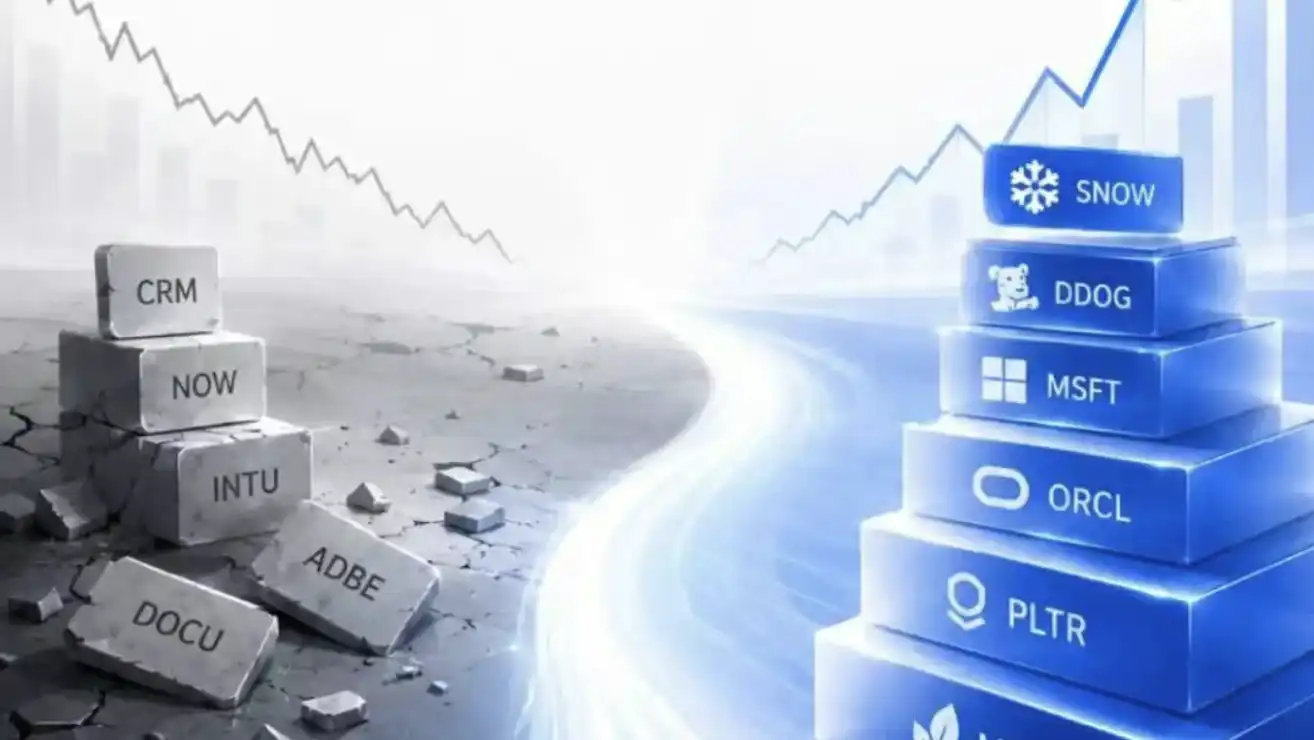
**Summary** The AI revolution has triggered a "SaaS apocalypse," forcing a brutal market shakeout. The key dividing line is the pricing model. Companies like Snowflake and Datadog, which charge based on consumption (e.g., data processed or compute used), are thriving. AI workloads actively *generate* more demand for their services, fueling growth. Datadog's accelerating revenue is a prime example. Microsoft and Palantir, as platform/ecosystem players, also benefit by acting as essential channels for AI deployment. In contrast, traditional SaaS firms built on per-seat or per-task licensing (e.g., Intuit, Adobe) face direct pressure, as AI threatens to automate the very human tasks their software supports. Companies like Salesforce, a per-seat giant, are caught in the middle. While showing strong AI monetization (e.g., its Agentforce platform) and experimenting with consumption-based "Flex Credits," its stock remains under pressure, illustrating that the market rewards *completed* transitions, not just the intent. The recent Microsoft Build conference underscored key trends: AI is evolving from an assistant to an autonomous "agent," and platform providers like Microsoft are consolidating their control. The market's recovery is highly selective, focused on identifying which companies are "fed by AI" versus "eaten by AI." Future focus will be on the diffusion of this recovery to transforming companies and the real-world adoption data of AI agents like Microsoft Copilot.

marsbit31 хв тому

SaaS Battle Royale: The Survivors Who Win All Share One Common Trait

marsbit31 хв тому

Торгівля

Спот
Ф'ючерси
活动图片