Nvidia Lands In Court Over Crypto Secret — Here Is What Investors Missed

bitcoinistОпубліковано о 2026-03-26Востаннє оновлено о 2026-03-26

Анотація

Nvidia faces a certified class action lawsuit over allegations it under-disclosed crypto mining revenue linked to its gaming GPU sales during the 2017–2018 period. Investors claim the company misled them by attributing significant revenue growth to gaming rather than cryptocurrency mining, creating a "revenue gap" between internal knowledge and public statements. After Nvidia’s CFO later acknowledged a revenue shortfall due to crypto-related inventory issues, the stock fell nearly 30%. The lawsuit, now moving forward, cites internal emails suggesting management was aware the stock price was artificially sustained by misleading disclosures. The case introduces legal and financial risks for Nvidia amid its current prominence in AI.

Nvidia is facing a certified class action over alleged under‐disclosure of crypto mining revenue.

A Crypto Scandal Resurrects Just In Time For Holy Week

After years of grueling legal back and forth between the giant gaming company and the American courts, a U.S. federal judge has certified a securities-fraud class action against Nvidia and CEO Jensen Huang over alleged under‐disclosure of crypto mining revenue in 2017–2018, according to a Wednesday order from Judge Haywood S. Gilliam Jr. in a California federal court. A class certification means the case can move ahead on behalf of a broad group of shareholders (the plaintiffs), raising the legal and financial stakes for Nvidia.

Investors claim Nvidia hid how much of its “gaming” GPU sales were actually driven by cryptocurrency miners, creating “revenue gaps” between public guidance and internal reality.

A Recap Of The Legal Battle

In order to properly understand this development, we must first go back to almost a decade ago, when investors sued the American tech company for the first time in 2018. Back then, the investors argued that $1 billion in crypto-linked GPU sales were misclassified or downplayed, with internal emails suggesting management knew the stock was “held high” by these statements.

It is important to remember that this happened in the context of the 2017–2018 mining boom, when Ethereum and other coins sent demand for Nvidia GPUs surging. Despite this, the company publicly emphasized gaming as the main growth driver.

The extent of Nvidia’s risk only became clear on November 2018, when CFO Colette Kress acknowledged that gaming revenue had fallen “short of expectations” because excess inventory built up during the crypto boom was taking longer than anticipated to clear. Gaming GPU prices were slower than expected to return to normal after the “sharp crypto falloff”, she claimed.

This disclosure not only triggered a roughly 28–29% share price crash, but also forward, in 2022, a $5.5 million SEC fine over inadequate crypto-mining disclosures in fiscal 2018, which the company already paid. Bitcoinist covered the story back then.

The lawsuit was first thrown out in 2021, then brought back to life on appeal, withstanding Nvidia’s unsuccessful attempt to get the U.S. Supreme Court to shut it down, and is now advancing as a certified class action.

And Now What?

Today, plaintiffs contend that a large portion of Nvidia’s crypto-fueled sales actually ran through its GeForce gaming GPUs, with most of that income booked under the gaming division, leaving the company heavily exposed to the boom‐and‐bust swings of the crypto market. Despite that, Nvidia had long insisted that the bulk of mining-related demand was captured in a distinct line item rather than in its main gaming segment and that crypto mining was a minor contributor to its overall business.

The judge highlighted an internal email from an Nvidia vice president, describing it as especially revealing:

The Court also notes that internal company emails support its conclusion here. Just before the November 2018 disclosure, NVIDIA’s then-VP of Investor Relations and Strategic Finance opined in response to a question from Huang that one reason “the market isn’t pricing in a bigger miss” following news that AMD had one or two quarters of post-crypto channel inventory was in part “because of comments we’ve made on . . . ring-fencing the crypto impact in OEM”

The newly certified class includes investors who purchased Nvidia shares between August 10, 2017 and November 15, 2018. A case management conference is set for April 21, when the judge is expected to lay out how the litigation will proceed.

It is notable that one of NVIDIA’s own VPs expressed the view that its stock price remained high because of the same types of earlier comments that Plaintiffs are pointing to, and the Court cannot conclude that there was no price impact in the face of such evidence.

For NVDA stock traders, a live, certified class action injects headline risk into one of the market’s most crowded AI plays, and any adverse ruling or settlement could weigh on multiples in a risk‐off tape. For crypto and mining‐adjacent names, the case is a reminder that opaque revenue accounting around mining cycles can come back years later, potentially tightening disclosure standards just as the sector eyes the next bull run.
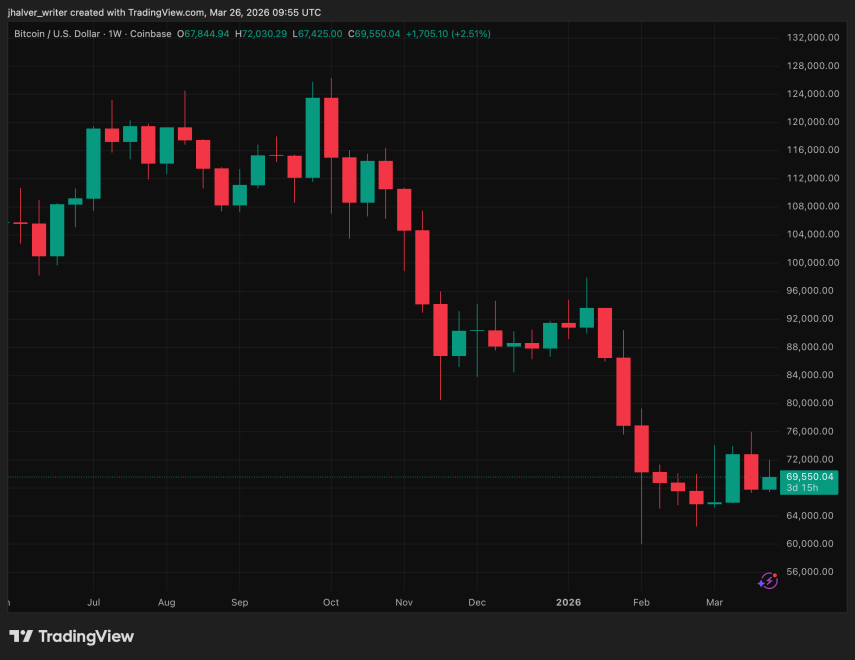
BTC’s price drops slightly after reaching $71k yesterday, trading for around $69k today. Source: BTCUSD on Tradingview

Cover image from Perplexity, BTCUSD chart from Tradingview

Пов'язані питання

QWhat is the main reason Nvidia is facing a certified class action lawsuit?

ANvidia is facing a certified class action lawsuit over alleged under-disclosure of crypto mining revenue, specifically for hiding how much of its 'gaming' GPU sales were actually driven by cryptocurrency miners during 2017-2018.

QWhat significant financial penalty did Nvidia already pay related to this issue?

ANvidia paid a $5.5 million SEC fine in 2022 over inadequate crypto-mining disclosures in fiscal 2018.

QWhat was the key consequence of Nvidia's November 2018 disclosure about its gaming revenue?

AThe November 2018 disclosure, where CFO Colette Kress acknowledged gaming revenue fell short due to excess crypto-related inventory, triggered a roughly 28-29% share price crash.

QWhat time period does the newly certified class action cover for investors?

AThe newly certified class includes investors who purchased Nvidia shares between August 10, 2017 and November 15, 2018.

QWhat did an internal email from an Nvidia VP reveal, according to the judge?

AThe judge highlighted an internal email where an Nvidia VP opined that the company's stock price remained high because of comments they had made about 'ring-fencing the crypto impact', suggesting management was aware the market was being misled.

Пов'язані матеріали

Li Fei-Fei's Latest Long-Form Article: When Video Generation, Robotics, and NVIDIA All Call Themselves World Models, We Need a Taxonomy

In a new article, Dr. Fei-Fei Li addresses the widespread and often inconsistent use of the term "world model" in AI. She proposes a clear, functional taxonomy rooted in the classic Partially Observable Markov Decision Process (POMDP) loop (agent → action → state → observation → agent). According to this framework, current systems called "world models" are different projections of this loop, categorized by their primary output: 1. **Renderers**: Output observations (pixels). Their goal is visual fidelity for human consumption (e.g., video generation models like Sora). They are the most commercially mature but are limited by a focus on appearance over physical accuracy. 2. **Simulators**: Output states (geometric, physical, dynamic representations). They provide a structurally accurate world for both human professionals (e.g., architects) and computational agents (e.g., robots for training). Li argues simulators are the crucial, underappreciated bridge, as they can underpin both rendering and planning. 3. **Planners**: Output actions. Given an observation and a goal, they decide what an agent should do next (e.g., robotic action models). This area is highly promising but remains the least mature for real-world deployment. Li highlights a key trend: the boundaries between these three categories are beginning to blur, as they all rely on a shared underlying understanding of geometry, physics, and dynamics. The logical endpoint is a unified world foundation model capable of switching between rendering, simulation, and planning based on downstream needs. This convergence, she concludes, is central to advancing spatial intelligence—enabling machines not just to talk about the world, but to truly understand, imagine, and interact with it.

marsbit2 год тому

Li Fei-Fei's Latest Long-Form Article: When Video Generation, Robotics, and NVIDIA All Call Themselves World Models, We Need a Taxonomy

marsbit2 год тому

Forbes Feature: Stablecoin Cross-Border Payments Are Faster, But Not Yet Cheaper

A Forbes feature delves into the state of stablecoin-based cross-border payments, noting rapid growth but a key shortfall: while faster and more accessible, they are not yet cheaper. At a recent industry conference in Mexico City, optimism about technology, regulation, and volume was tempered by discussions with practitioners. The core issue is liquidity. Traditional FX brokers charge 60-70 basis points, and stablecoins promise to slash this to 2-5 basis points. However, this theoretical cost advantage cannot be realized until deep liquidity pools are established at scale, requiring significant institutional capital inflow. A major adoption barrier is trust. Businesses often rely on long-standing relationships with traditional brokers, valuing reliability over marginal cost savings. This shift will be gradual. Furthermore, successful companies in the space are not positioning themselves as replacements for legacy systems like SWIFT, but as complements. They leverage stablecoins for speed while using traditional rails for their standardization and reliability in ensuring accurate payment details—a critical factor for supplier payments to avoid customs issues. Companies like Caliza, experiencing high monthly growth, exemplify this hybrid approach. The industry anticipates consolidation, as long-term viability will depend on securing the essential trifecta: proper licensing, robust fiat on/off-ramps, and deep liquidity. Without these, firms risk being mere intermediaries rather than building sustainable businesses.

marsbit2 год тому

Forbes Feature: Stablecoin Cross-Border Payments Are Faster, But Not Yet Cheaper

marsbit2 год тому

Торгівля

Спот
活动图片