NVIDIA Earnings Countdown: Beating Expectations Is a Near Certainty, but Wall Street Is Most Concerned About These Five Questions

marsbitОпубліковано о 2026-05-20Востаннє оновлено о 2026-05-20

Анотація

NVIDIA Earnings Countdown: Beating Expectations is a Given, but Wall Street Cares Most About These Five Issues The upcoming NVIDIA Q1 earnings report is expected to easily surpass the consensus revenue estimate of ~$78.7B. However, Wall Street's focus has shifted from the numbers themselves to five key strategic questions. **1. Shareholder Returns: Will "Frugality" Change?** Despite being the S&P 500's largest company, NVIDIA's shareholder returns (dividends + buybacks) averaged only 47% of its free cash flow from 2022-2025, far below the 80% peer average and its own historical norm. Its 0.02% dividend yield also lags the peer average of 0.89%. This low cash return, partly due to investments in AI ecosystem partners, is cited as a core reason for NVIDIA's valuation discount compared to other "Magnificent 7" stocks. Increasing returns could attract long-term income funds and be a catalyst. **2. Vera Rubin: The Next-Gen Chip Timeline** Analysts expect the next-generation Vera Rubin (R200) platform to ramp in the second half of 2026, following the current Blackwell series. It will use TSMC's 3nm process and share Blackwell Ultra's "Oberon" rack architecture, suggesting a smooth transition with limited gross margin impact. The market also awaits any update on NVIDIA's $1 trillion cumulative revenue forecast for 2025-2027. **3. Gross Margin: Can the 75% Level Hold?** Gross margin, a key valuation support, is expected to stabilize in the near term due to the shared architecture...

Original Author: Long Yue

Original Source: Wall Street News

NVIDIA earnings season—the most important thing is no longer the numbers themselves.

On May 18, Bank of America Securities analyst Vivek Arya's team released a preview report for NVIDIA's Q1 earnings, which will be announced after the U.S. market close on Wednesday, May 20.

According to NVIDIA's historical pattern over the past ten quarters, actual revenue has averaged 7% to 8% above management guidance. Management previously provided F1Q27 revenue guidance of $78 billion. Based on this calculation, actual revenue is highly likely to fall in the range of $83 billion to $84 billion, while the current market consensus is only $78.7 billion.

In other words, 'beating expectations' is almost a foregone conclusion. But analysts believe what will truly move the market's nerve after the earnings release are the following five questions.

Cash Return: Can NVIDIA Change Its 'Stinginess'?

This is the most discussed topic in the report and is considered by them to be the core reason for NVIDIA's long-term valuation discount.

NVIDIA is currently the largest company by market cap in the S&P 500, accounting for a high weight of 8.3% in the index, exceeding the historical peaks of Apple (7.9%) and Microsoft (7.2%). However, the problem is that NVIDIA's shareholder return efforts are severely mismatched with its size.

The data is straightforward: from 2022 to 2025, NVIDIA's free cash flow payout ratio (dividends + buybacks) averaged only 47%, while the average for comparable peers in the same period was 80%. Even NVIDIA's own average over the previous ten years was 80%.

Meanwhile, NVIDIA's current dividend yield is only 0.02%, while the peer average is 0.89%. Among equity income funds, NVIDIA is held by only 16% of funds, while Microsoft is held by 57% and Apple by 32%.
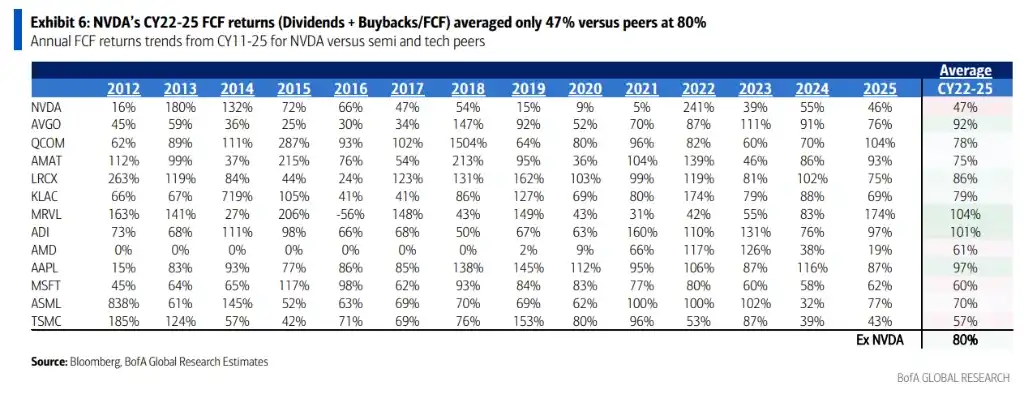
Where is the money going? Analysts point out that NVIDIA is investing heavily in the ecosystem—OpenAI, Anthropic, technology partners. These investments are seen as controversial by some outsiders, with voices suggesting it's "round-trip financing"—NVIDIA lends money to customers, who then use that money to buy NVIDIA's chips.

How large is the valuation discount? Data shows that NVIDIA's forward P/E ratio for 2026/2027 is 26x/19x, while the mean for other 'Magnificent Seven' members is 49x/42x, representing a discount of nearly 50%.

A more specific comparison: analysts predict NVIDIA's combined free cash flow for 2026+2027 will exceed $430 billion, higher than the combined ~$375 billion for Apple and Microsoft. However, NVIDIA's market cap is approximately $5.46 trillion, about 28% lower than the combined $7.5 trillion for Apple and Microsoft.
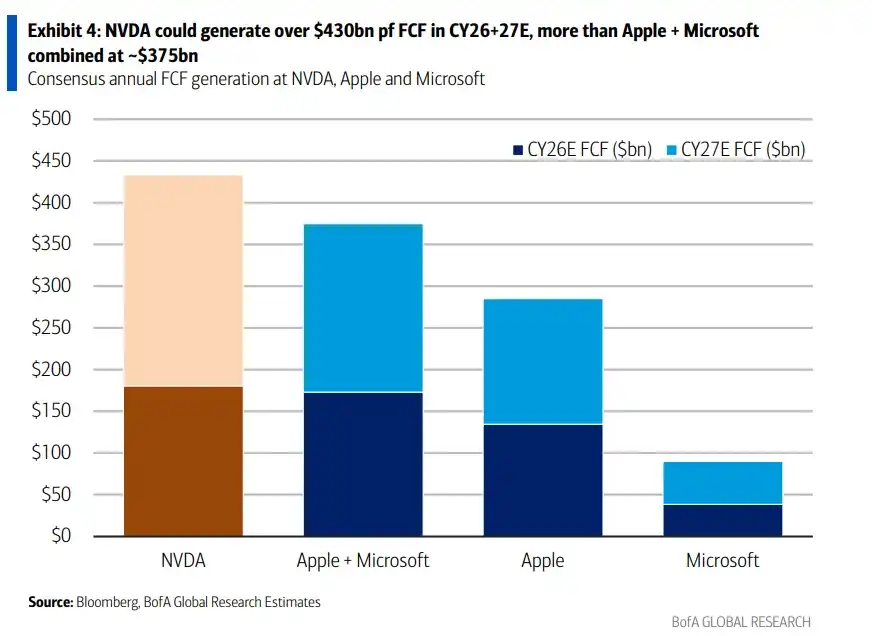
Analysts believe that if NVIDIA increases its dividend and buyback efforts, it could attract more long-term funds that prefer income, narrowing the valuation discount while also dispelling concerns about "round-trip financing." They list this change as a "potential catalyst for the second half of the year."

Vera Rubin: When Will the Next-Generation Chip Arrive?

NVIDIA's current main products are the Blackwell series. The market is concerned: when will the next-generation Vera Rubin platform officially ramp up?

The bank's judgment is the second half of 2026. Vera Rubin (codenamed R200) uses TSMC's 3nm process and shares the "Oberon" rack architecture with Blackwell Ultra, making the product transition relatively smooth, with limited expected impact on gross margins.

Looking further ahead, Vera Rubin Ultra (codenamed VR300) will be launched in the second half of 2027, featuring a completely new "Kyber" rack architecture, while the cost proportion of High Bandwidth Memory (HBM) will also further increase.
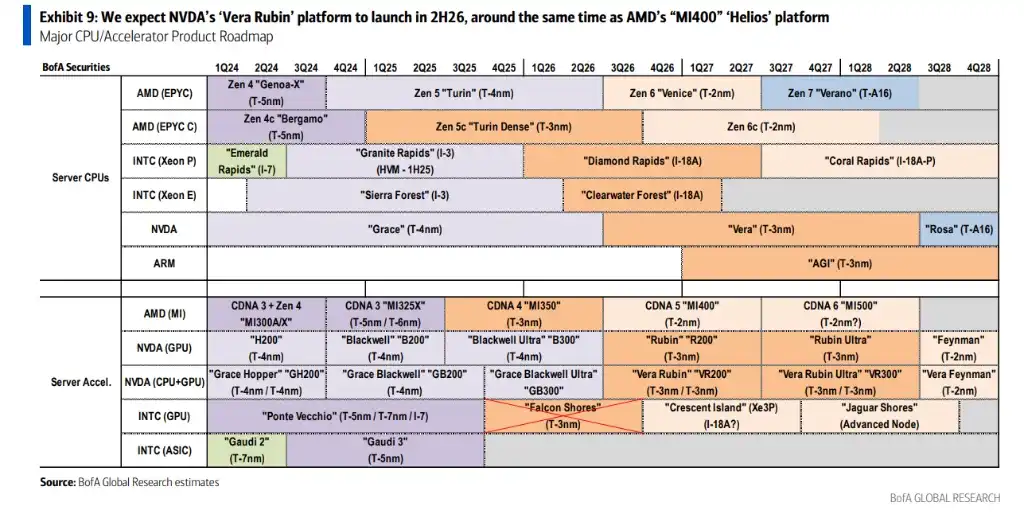
The market also wants to hear NVIDIA's latest stance on the "trillion-dollar revenue forecast" during the earnings call—NVIDIA previously gave an outlook for cumulative revenue of $1 trillion from 2025 to 2027, but contributions from LPU (Language Processing Unit) racks, CPUs, and Vera Rubin Ultra have not yet been included. Will this be updated this time?

Gross Margin: Can the 75% Defense Line Hold?

Gross margin is one of the core supports of NVIDIA's valuation.

Analysts judge: in the short term, because Vera Rubin reuses Blackwell's rack architecture, gross margins are relatively stable during the product transition period. However, in the medium to long term, the rising proportion of HBM memory costs is a persistent pressure source.
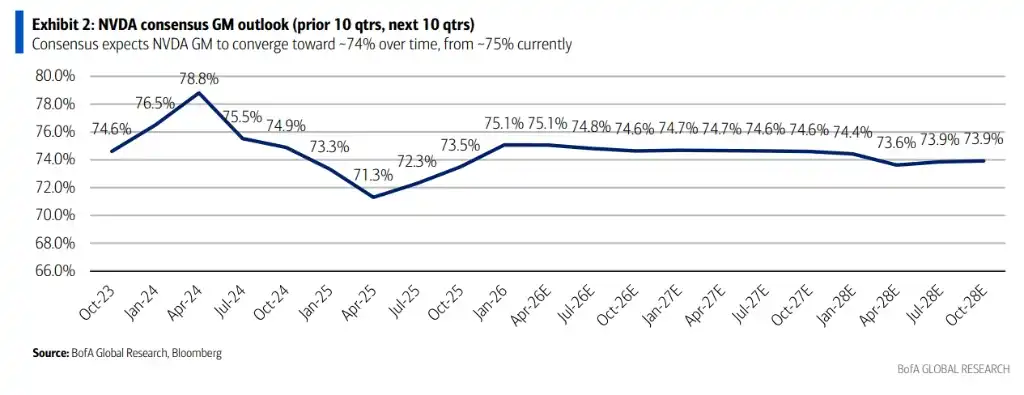
Market consensus shows NVIDIA's gross margin fluctuating within the 74% to 75% range. The bank has no disagreement with this but emphasizes that any better-than-expected gross margin performance will be a positive catalyst.

How Will the AI Accelerator Market Size Forecast Be Updated?

Bank of America previously provided NVIDIA's "trillion-dollar" prediction framework for the AI market from 2025 to 2027. This earnings report, the market is focused on whether NVIDIA will update this forecast, especially by incorporating three new growth drivers previously not counted:

  1. LPU (Language Processing Unit) racks
  2. Vera CPU (NVIDIA's self-developed server CPU)
  3. Vera Rubin Ultra

The bank expects that by 2030, the overall AI accelerator market size will reach approximately $1.17 trillion, with NVIDIA maintaining about 68% to 70% market share.
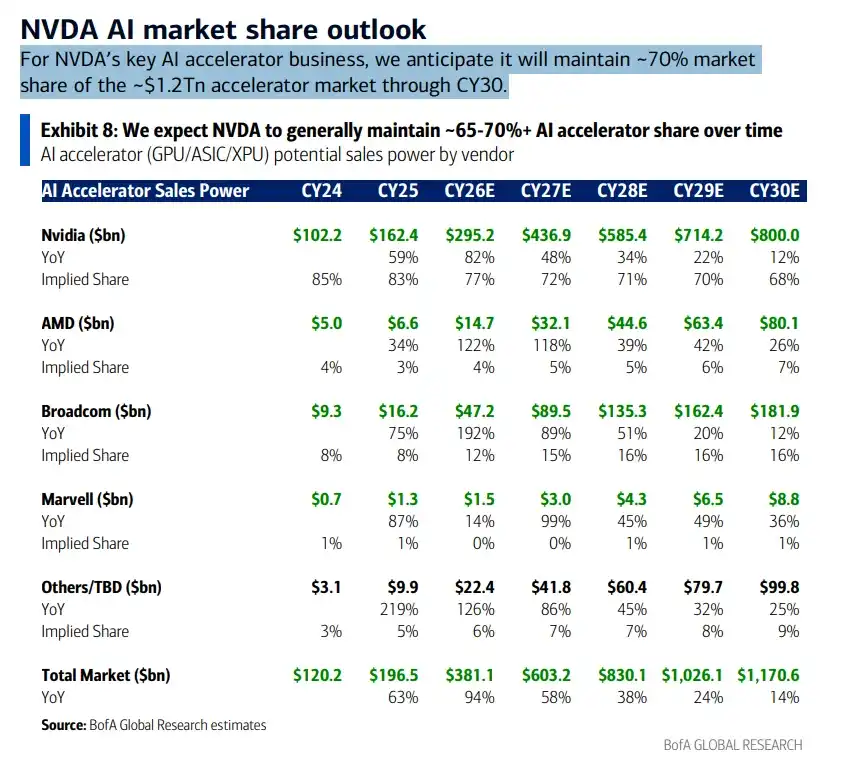
Specifically, NVIDIA's AI accelerator revenue is expected to grow from $102.2 billion in 2024 to $800 billion in 2030, AMD from $5 billion to $80.1 billion over the same period, and Broadcom from $9.3 billion to $181.9 billion.

Is the Competitive Threat from Google TPU and CPU Exaggerated?

A narrative has been circulating in the market recently: as AI enters the "Agentic AI" era, the importance of CPUs will surpass that of GPUs, thus threatening NVIDIA's moat.

The bank clearly disagrees with this, providing two reasons:

First, NVIDIA's self-developed "Vera CPU" will have new progress disclosed at the upcoming Computex conference, and its competitiveness in the standalone CPU market should not be underestimated.

Second, in already large-scale deployments of Blackwell and TPU clusters, the CPU-to-GPU ratio is already 1:2, which does not align with the narrative that "Agentic AI requires more CPUs."

The conclusion is: while the CPU market is large, there are many competitors (with strong contenders in both x86 and ARM architectures). NVIDIA's dominant position in the GPU/AI accelerator field is difficult to shake in the short term. It is estimated that by 2030, NVIDIA will maintain approximately 70% revenue share in a total addressable AI market exceeding $1.7 trillion.

Valuation: A 'Tech Leader' at a 50% Discount

Finally, back to valuation. The report uses a set of data to directly highlight NVIDIA's current valuation paradox.

Based on CY26/27 forward P/E ratios, NVIDIA is at 26x/19x, while the "Magnificent Seven" (Mag-7) average is 49x/42x—NVIDIA is at a nearly 50% discount.

Based on EV/FCF (Enterprise Value/Free Cash Flow), NVIDIA is at 28x/20x, while the Mag-7 average is 83x/59x—a discount exceeding 66%.

Based on PEG (Price/Earnings to Growth ratio), NVIDIA is at 0.41x, while the Mag-7 average is 2.61x, and the S&P 500 overall is above 1.3x.
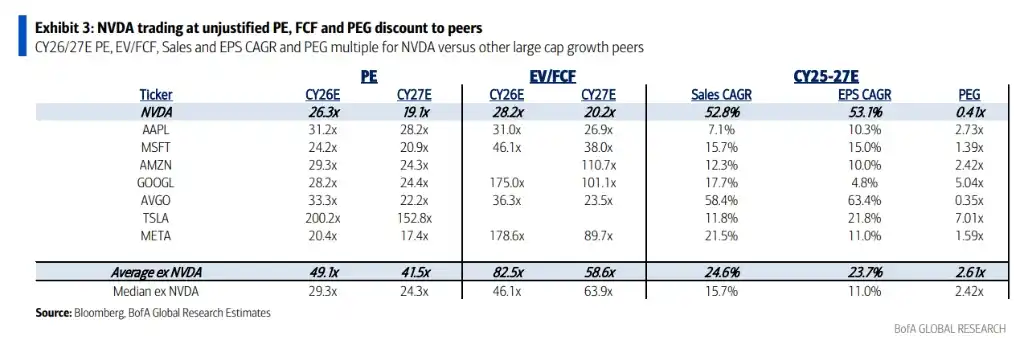
Bank of America maintains a "Buy" rating with a price target of $320, based on a CY27 forward P/E ratio of 28x (excluding cash), which is at the mid-to-low end of NVIDIA's historical valuation range of 25x to 56x.


Пов'язані питання

QAccording to the report, what is the core reason for NVIDIA's valuation discount relative to its 'Magnificent 7' peers?

AThe core reason is NVIDIA's relatively low shareholder return rate (dividends + buybacks). Its average free cash flow return rate from 2022-2025 is only 47%, compared to an industry average and its own ten-year historical average of 80%. Its low dividend yield of 0.02% (vs. peer avg. 0.89%) means fewer income-focused funds hold its stock, contributing to the valuation gap.

QWhen does Bank of America's analyst team expect NVIDIA's next-generation Vera Rubin platform to ramp up in volume?

AThe analyst team expects the Vera Rubin platform (code R200) to ramp up in volume in the second half of 2026.

QWhat are the three new growth areas that could be included in an update to NVIDIA's 'trillion-dollar revenue' forecast?

AThe three new growth areas are: 1) LPU (Language Processing Unit) racks, 2) Vera CPU (NVIDIA's self-developed server CPU), and 3) Vera Rubin Ultra.

QWhat two reasons does the report give for downplaying the competitive threat from CPUs (like Google's TPU) to NVIDIA?

A1) NVIDIA's self-developed 'Vera CPU' is a competitive contender in the standalone CPU market, with new details expected at Computex. 2) In already deployed large-scale Blackwell and TPU clusters, the CPU-to-GPU ratio is already 1:2, which doesn't support the narrative that 'Agentic AI' requires significantly more CPUs.

QWhat is Bank of America's price target for NVIDIA and what is the valuation metric used to derive it?

ABank of America maintains a 'Buy' rating with a $320 price target. This target is based on a CY27 estimated P/E of 28x (excluding cash), which is at the low-to-mid range of NVIDIA's historical valuation range of 25x to 56x.

Пов'язані матеріали

Google Officially Declares War

Google Declares War with AI-First I/O 2026 At its 2026 I/O developer conference, Google launched an aggressive, multi-pronged offensive, embedding AI across its ecosystem and challenging rivals on performance and price. The event showcased three major releases: Gemini 3.5 Flash, the video-centric Gemini Omni Flash, and the system-level AI assistant Spark. Gemini 3.5 Flash, despite being a smaller "Flash" model, outperforms its Pro counterpart in key benchmarks like mathematical reasoning (GSM8K) and coding (SWE-bench). Google attributes this to "extreme knowledge distillation" from a larger teacher model and a novel, highly granular MoE (Mixture of Experts) architecture with 256 experts, achieving sub-65ms response times. The native multi-modal model, Gemini Omni Flash, offers real-time video understanding with 120ms latency, enabling applications like preventing a cup from overfilling. The new Spark assistant gains deep Android system integration, allowing it to automate complex multi-app workflows based on voice commands. Complementing these, Google unveiled lightweight AI glasses featuring Micro-OLED displays and on-device Gemini chips for instant, offline translation and scene analysis. CEO Sundar Pichai announced Gemini has reached 900 million monthly active users, leveraged through integration into Chrome, Android, and Workspace. Google also slashed prices dramatically: the Gemini 3.5 Flash API is priced at a fraction of competitor rates. This price war is enabled by Google's vertically integrated TPU infrastructure. The strategy signals a shift: standalone AI models are becoming commoditized. Google's advantage lies in its "device + cloud + ecosystem + hardware" integration, aiming to reshape internet traffic from user-initiated searches to AI-driven service distribution. This move pressures pure-play AI firms like OpenAI and Anthropic on business models, and challenges Apple to respond in the next-generation, screen-less device race.

链捕手14 хв тому

Google Officially Declares War

链捕手14 хв тому

Top 10 Promising Emerging Hyperliquid Native Protocols to Watch

Title: A Review of 10 Emerging Native Protocols on Hyperliquid Hyperliquid is evolving beyond perpetual contracts into a comprehensive on-chain financial stack. This article highlights 10 key native protocols driving this growth: 1. **Monetrix**: A yield-optimizing protocol akin to Ethena, aggregating funding rates, HLP rewards, maker rebates, and HIP-3 into a single stablecoin yield. 2. **ROSETTA**: An automated stablecoin yield router, allocating USDC across top protocols (e.g., Felix, Aave, HLP) for optimal returns, factoring in gas and slippage. 3. **papertrade.xyz**: A fair-launched perpetuals protocol offering up to 1000x leverage, no funding rates, no slippage, and fully on-chain, oracle-based execution. 4. **alt.fun**: A launchpad where tokens are paired with leveraged perpetual positions (2x-5x), linking token price to trading activity and underlying position performance. 5. **Ventuals**: Pre-IPO perpetual contracts (built on HIP-3) allowing up to 10x leveraged speculation on valuations of private companies like SpaceX and Stripe. 6. **Liminal**: A delta-neutral yield protocol that captures funding rates via automated short positions and uses generated xTokens (xBTC, etc.) as DeFi collateral. 7. **Melt**: Brings tokenized stocks, commodities, and RWAs to Hyperliquid spot markets, enabling 24/7 trading alongside crypto assets. 8. **Chainsight**: An oracle and data infrastructure protocol providing low-latency (<3s) price feeds, volatility indices, and risk metrics for novel derivatives. 9. **rip.xyz**: Tokenized vault strategies on HyperEVM; its flagship rHYPURR offers liquidity and fractional exposure to a Hypurr NFT basket, priced hourly via NAV. 10. **Markets**: A perpetuals exchange (by Kinetiq) for trading stocks, forex, commodities, bonds, and crypto with up to 50x leverage, using USDH collateral and Kaiko oracles. These protocols form the foundational layer for generating real yield, liquidity, and innovative financial products natively on Hyperliquid.

marsbit1 год тому

Top 10 Promising Emerging Hyperliquid Native Protocols to Watch

marsbit1 год тому

Musk Posted a Recruitment Ad for SpaceX, and After Reading the Comments Section, I Understood

On May 20th, SpaceX filed for a landmark IPO with a $1.75 trillion valuation. Shortly after, Elon Musk posted a recruitment call on X, seeking "world-class engineers and physicists" for SpaceX. The application process was starkly simple: email with three bullet points proving "exceptional ability," with real, complex projects as a plus. Musk promised to review qualifying emails himself. The post garnered millions of views and thousands of replies, revealing a spectrum of responses. Most comments, including a highly-upvoted humorous one listing absurd "skills," merely listed credentials or experiences in a conventional, non-differentiating way. This highlighted a key insight: a traditional resume listing degrees and skills often fails to demonstrate true exceptionalism. Effective self-presentation requires "performance efficiency." A standout reply came from an OpenAI engineering lead, who simply stated "codex." This demonstrated that for those who have built significant, recognized products, the product itself becomes the ultimate resume. The article argues that in the AI era, any tangible, shareable output—a tool, research, or online project—serves as a living, self-evident credential more powerful than a list of attributes. However, a twist emerged when applicants found the provided email address non-functional, leading to speculation that the post might also serve as an IPO publicity stunt, projecting an image of aggressive talent acquisition to investors. Ultimately, the episode served as a microcosm: some participate through performance, others through proof of work, while some question the reality of the stage itself. It underscores the enduring challenge of defining and demonstrating value in an age of abundant, yet often superficial, content.

marsbit2 год тому

Musk Posted a Recruitment Ad for SpaceX, and After Reading the Comments Section, I Understood

marsbit2 год тому

Торгівля

Спот
Ф'ючерси
活动图片



