Not Just USDT: Tether Wallet Is Attempting to Take Over the Payment System for Ordinary People

marsbitОпубліковано о 2026-04-15Востаннє оновлено о 2026-04-15

Анотація

Tether, the issuer of the world's largest stablecoin USDT, has launched Tether Wallet, branded as "The People's Wallet," marking a strategic shift from being primarily an asset issuer to directly engaging with end-users. This move aims to capture retail traffic and create a closed-loop ecosystem by offering a simplified payment interface. The wallet eliminates key barriers to crypto adoption: complex hexadecimal addresses are replaced with human-readable usernames (e.g., username@tether), transaction fees (gas) are abstracted and paid directly in the transferred asset, and self-custody is combined with an encrypted cloud backup system for easier recovery. Supported assets include USDT on Ethereum, Polygon, and other networks, as well as Bitcoin and Tether’s gold-backed XAUT. Notably, it does not yet support Tron, where nearly half of all USDT is issued. By drastically reducing friction in cross-border payments—enabling instant, low-cost transfers via email-like addresses—Tether is positioning USDT to dominate small-value international settlements, particularly in emerging markets. This challenges traditional remittance services and competing stablecoins like USDC by leveraging its first-mover advantage and network effects. The piece also highlights underlying tensions: while promoting financial inclusion for the unbanked, Tether’s centralized infrastructure creates potential regulatory vulnerabilities. The wallet’s design also anticipates future use by AI agents for machi...

In the power landscape of Web 3, Tether has long played the role of a silent yet immensely wealthy shadow dollar printing machine.

On the evening of April 14, Tether announced the official launch of Tether Wallet, calling it "The People's Wallet." The emergence of this product essentially represents the "interface sinking" of this stablecoin giant, directly reaching end users.

From an asset issuer to a user gateway. Previously, Tether only "printed money"; now it wants to define how people transfer assets and how they hold them. By directly controlling C-end traffic, Tether is transforming into a closed-loop ecosystem with traffic sovereignty.

This is also a defense of its shadow dollar status. In emerging markets, USDT has already become the de facto standard substitute. But as Circle continues to strengthen its compliance narrative and squeeze the market, Tether must lower the physical barriers to use, firmly locking the billions of users abandoned by traditional finance into its official gateway.

What Is the True Core of Tether Wallet?

In the product logic of Web 3, user experience has always been a false proposition. When you ask a user on a street in Latin America trying to transfer $10 to hand-copy 12 illogical English words and warn them that "losing them means bankruptcy," financial inclusivity dies at the starting line.

The core highlight of Tether Wallet is its attempt to use a transparent, white-box approach to dismantle the three major hurdles of self-custody wallets: addresses, fees, and seed phrases, focusing on "simplicity" and "convenience," compressing the experience to the extreme.
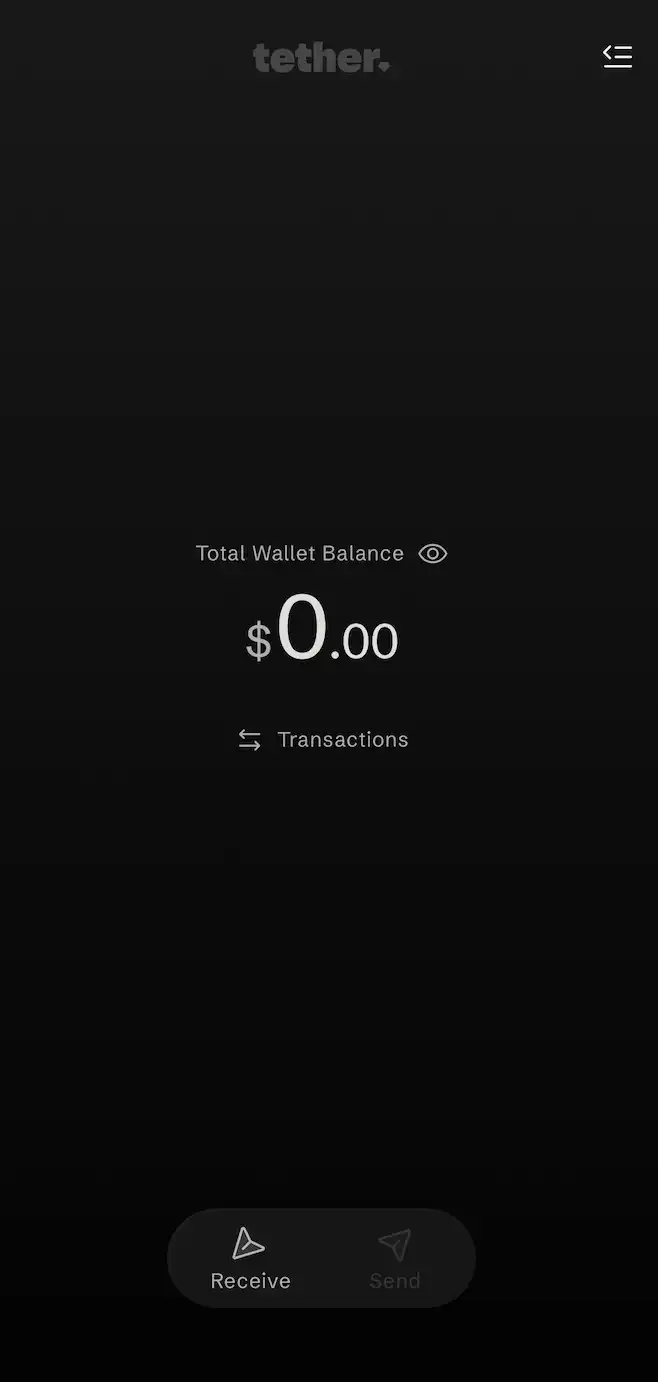
First, it makes on-chain addresses identity-based.

For a long time, long hexadecimal string addresses have been the biggest obstacle to mass adoption. Tether Wallet introduces a payment username system (e.g., [email protected]). This means that in cross-border transfer scenarios, USDT completely sheds the obscurity of crypto assets and becomes as simple as sending an email or a message.

Based on actual testing, Tether Wallet requires an email to log in and register. Currently, payment usernames must and only support lowercase letters and numbers, with a length limit of 4 to 15 characters.

Second, true Gas abstraction, with fees directly deducted from the transferred assets.

Tether Wallet itself does not charge fees and supports using the transferred assets to directly deduct network fees.

The technology is not innovative, but being natively integrated by Tether changes everything: it completes the payment experience loop at the protocol layer. This "Gas abstraction," natively integrated by the issuer, means it completes the payment experience loop at the underlying protocol level. Users only need to care about how much to transfer, not the "road toll."

Third, self-custody design and cloud backup solution

Tether Wallet uses a self-custody design; all transactions are signed and confirmed on the user's own device before being sent to the blockchain. Tether Wallet also provides an encrypted cloud backup solution (Cloud Backup), where wallet data is encrypted and stored on Tether's servers, while the key is stored in the user's own iCloud/Google Drive. Neither party can unlock it alone; they are only combined when the user logs in on the device. To restore the wallet on a new device, simply log in with the email.

Of course, users can still choose to back up manually.

Currently, Tether Wallet supports assets and networks including:

· USDT: Ethereum, Polygon, Plasma, Arbitrum

· XAUT: Same as above

· USAT: Ethereum

· Bitcoin: On-chain + Lightning Network

It is worth noting that currently 45% of the circulating USDT supply is on Tron, but Tether Wallet does not currently support Tron.

When Stablecoins Transition into High-Frequency Payment Assets

When the threshold for payment is as low as needing just an email and a username, USDT is no longer just an anchor of value in the crypto world; it begins to exert a terrifying gravitational effect, attempting to devour the entire real-world small-value cross-border settlement market.

First, it is a dimensional打击 (dimensional strike) against traditional cross-border payment intermediaries. Before tether.wallet, workers in emerging markets had to pay high fees and endure settlement cycles lasting several days to send money to their families. The logic of Tether Wallet is: Since USDT is already the shadow standard currency in these regions, instant, low-cost transfers can be achieved through the Lightning Network or other blockchains.

There is also the生存挤压 (survival squeeze) on competing stablecoins. In the past, Circle (USDC) or PayPal (PYUSD) tried to capture the market through compliance and institutional endorsement.

But Tether realized that at the retail end, liquidity inertia is greater than everything. When a user gets used to smoothly transferring money with an @username in Tether's official wallet, they have no incentive to switch to a payment tool with higher fees and a smaller circle. Tether is turning its first-mover advantage into irreversible usage inertia.

A deeper impact is that Tether is redefining financial inclusion. This self-custody wallet allows Southeast Asian farmers and Latin American vendors who have never had a bank account to, for the first time, obtain an equal, unilaterally unclosable seat in the global financial infrastructure.

Power Boundaries and Protocol Vitality in the AI Era

In the tether.wallet documentation, one word is mentioned twice: Left behind. However, as these groups forgotten by the traditional financial system flock into the new infrastructure built by Tether, a series of unsolved questions about power also emerge.

First is the regulatory暗战 (shadow war) disguised under self-custody. Although Tether emphasizes that users own the private keys, when it natively integrates cloud backup functionality and supports the @username system, it naturally leaves nodes that can be介入 (intervened) by regulation.

If regulators require marking specific accounts or pressuring cloud data, Tether will have to choose between "decentralized creed" and "commercial survival." This will be a key battleground for the future博弈 (game) between crypto and sovereignty.

Second, AI Agents are the second growth curve. Paolo Ardoino's statement is highly预见性 (prescient): this wallet is also prepared for AI Agents. In the interconnected future, human biological identity may no longer be the core of financial accounts.

When an AI agent needs to instantly pay for computing power, a stablecoin wallet that can be调度 (dispatched) through a simple interface will become the "blood" of machine civilization.

Finally, we need to face that ultimate contradiction. Tether is a complex综合体 (complex): it has a centralized core, yet it is spreading extremely decentralized tools outward.

This contradiction may be a true reflection of the current evolution of global finance. The old order is difficult to shake, and the new order only grows in the cracks. Tether Wallet is not trying to create a utopia; it is merely opening a window in the wall of reality, allowing people to discover that dollar transfers can be as simple as sending a text message.

An era of global value transmission, dominated by a stablecoin giant, silent yet powerful, is accelerating its arrival. However, the premise of all this is: we must清醒地认识到 (clearly recognize) that convenience is never free. We cannot avoid a fundamental question: while pursuing efficiency and inclusion, how do we find a truly sustainable balance between the walls of the old order and the野蛮生长 (wild growth) of the new order?


Пов'язані питання

QWhat is the core innovation of Tether Wallet in terms of user experience?

ATether Wallet's core innovation lies in removing the major barriers of self-custody wallets: complex addresses, gas fees, and seed phrases. It introduces a payment username system (like an email), abstracts gas fees by allowing them to be paid with the transferred asset, and offers a secure cloud backup solution for easy recovery.

QHow does Tether Wallet aim to impact cross-border payments, especially in emerging markets?

ATether Wallet aims to revolutionize cross-border payments by offering instant, low-cost transfers using USDT, which acts as a shadow currency in many emerging markets. It eliminates high fees and long settlement times associated with traditional systems, providing financial inclusion tool for the unbanked.

QWhat strategic advantage does Tether gain by launching its own wallet and directly engaging with end-users?

ABy launching its own wallet, Tether transitions from being just an asset issuer to controlling the user interface and flow. This allows it to lock users into its ecosystem, create usage inertia, and defend its market dominance against competitors like Circle (USDC) by making switching costly and inconvenient.

QWhat are the potential regulatory challenges or power dynamics mentioned regarding Tether Wallet's design?

AThe wallet's design, while self-custodial, incorporates centralized elements like usernames and cloud backups. This creates potential regulatory attack vectors, where authorities could pressure Tether to monitor accounts or freeze funds, forcing a choice between decentralization ideals and operational survival.

QHow does Tether Wallet envision its role in the future with AI agents, according to the article?

ATether Wallet is designed to serve AI agents' needs in an interconnected future. It provides a simple interface for machines to make instant micropayments (e.g., for compute resources), positioning USDT as the 'blood' for machine-to-machine transactions in a new digital economy.

Пов'язані матеріали

Google and Amazon Simultaneously Invest Heavily in a Competitor: The Most Absurd Business Logic of the AI Era Is Becoming Reality

In a span of four days, Amazon announced an additional $25 billion investment, and Google pledged up to $40 billion—both direct competitors pouring over $65 billion into the same AI startup, Anthropic. Rather than a typical venture capital move, this signals the latest escalation in the cloud wars. The core of the deal is not equity but compute pre-orders: Anthropic must spend the majority of these funds on AWS and Google Cloud services and chips, effectively locking in massive future compute consumption. This reflects a shift in cloud market dynamics—enterprises now choose cloud providers based on which hosts the best AI models, not just price or stability. With OpenAI deeply tied to Microsoft, Anthropic’s Claude has become the only viable strategic asset for Google and Amazon to remain competitive. Anthropic’s annualized revenue has surged to $30 billion, and it is expanding into verticals like biotech, positioning itself as a cross-industry AI infrastructure layer. However, this funding comes with constraints: Anthropic’s independence is challenged as it balances two rival investors, its safety-first narrative faces pressure from regulatory scrutiny, and its path to IPO introduces new financial pressures. Globally, this accelerates a "tri-polar" closed-loop structure in AI infrastructure, with Microsoft-OpenAI, Google-Anthropic, and Amazon-Anthropic forming exclusive model-cloud alliances. In contrast, China’s landscape differs—investments like Alibaba and Tencent backing open-source model firm DeepSeek reflect a more decoupled approach, though closed-source models from major cloud providers still dominate. The $65 billion bet is ultimately about securing a seat at the table in an AI-defined future—where missing the model layer means losing the cloud war.

marsbit1 год тому

Google and Amazon Simultaneously Invest Heavily in a Competitor: The Most Absurd Business Logic of the AI Era Is Becoming Reality

marsbit1 год тому

Computing Power Constrained, Why Did DeepSeek-V4 Open Source?

DeepSeek-V4 has been released as a preview open-source model, featuring 1 million tokens of context length as a baseline capability—previously a premium feature locked behind enterprise paywalls by major overseas AI firms. The official announcement, however, openly acknowledges computational constraints, particularly limited service throughput for the high-end DeepSeek-V4-Pro version due to restricted high-end computing power. Rather than competing on pure scale, DeepSeek adopts a pragmatic approach that balances algorithmic innovation with hardware realities in China’s AI ecosystem. The V4-Pro model uses a highly sparse architecture with 1.6T total parameters but only activates 49B during inference. It performs strongly in agentic coding, knowledge-intensive tasks, and STEM reasoning, competing closely with top-tier closed models like Gemini Pro 3.1 and Claude Opus 4.6 in certain scenarios. A key strategic product is the Flash edition, with 284B total parameters but only 13B activated—making it cost-effective and accessible for mid- and low-tier hardware, including domestic AI chips from Huawei (Ascend), Cambricon, and Hygon. This design supports broader adoption across developers and SMEs while stimulating China's domestic semiconductor ecosystem. Despite facing talent outflow and intense competition in user traffic—with rivals like Doubao and Qianwen leading in monthly active users—DeepSeek has maintained technical momentum. The release also comes amid reports of a new funding round targeting a valuation exceeding $10 billion, potentially setting a new record in China’s LLM sector. Ultimately, DeepSeek-V4 represents a shift toward open yet realistic infrastructure development in the constrained compute landscape of Chinese AI, emphasizing engineering efficiency and domestic hardware compatibility over pure model scale.

marsbit2 год тому

Computing Power Constrained, Why Did DeepSeek-V4 Open Source?

marsbit2 год тому

Торгівля

Спот
Ф'ючерси

Популярні статті

Як купити PEOPLE

Ласкаво просимо до HTX.com! Ми зробили покупку ConstitutionDAO (PEOPLE) простою та зручною. Дотримуйтесь нашої покрокової інструкції, щоб розпочати свою криптовалютну подорож.Крок 1: Створіть обліковий запис на HTXВикористовуйте свою електронну пошту або номер телефону, щоб зареєструвати обліковий запис на HTX безплатно. Пройдіть безпроблемну реєстрацію й отримайте доступ до всіх функцій.ЗареєструватисьКрок 2: Перейдіть до розділу Купити крипту і виберіть спосіб оплатиКредитна/дебетова картка: використовуйте вашу картку Visa або Mastercard, щоб миттєво купити ConstitutionDAO (PEOPLE).Баланс: використовуйте кошти з балансу вашого рахунку HTX для безперешкодної торгівлі.Треті особи: ми додали популярні способи оплати, такі як Google Pay та Apple Pay, щоб підвищити зручність.P2P: Торгуйте безпосередньо з іншими користувачами на HTX.Позабіржова торгівля (OTC): ми пропонуємо індивідуальні послуги та конкурентні обмінні курси для трейдерів.Крок 3: Зберігайте свої ConstitutionDAO (PEOPLE)Після придбання ConstitutionDAO (PEOPLE) збережіть його у своєму обліковому записі на HTX. Крім того, ви можете відправити його в інше місце за допомогою блокчейн-переказу або використовувати його для торгівлі іншими криптовалютами.Крок 4: Торгівля ConstitutionDAO (PEOPLE)Легко торгуйте ConstitutionDAO (PEOPLE) на спотовому ринку HTX. Просто увійдіть до свого облікового запису, виберіть торгову пару, укладайте угоди та спостерігайте за ними в режимі реального часу. Ми пропонуємо зручний досвід як для початківців, так і для досвідчених трейдерів.

441 переглядів усьогоОпубліковано 2024.12.12Оновлено 2025.03.21

Як купити PEOPLE

Обговорення

Ласкаво просимо до спільноти HTX. Тут ви можете бути в курсі останніх подій розвитку платформи та отримати доступ до професійної ринкової інформації. Нижче представлені думки користувачів щодо ціни PEOPLE (PEOPLE).

活动图片