Byline: Ma He, Foresight News
On July 6th, the FIFA World Cup Round of 16 kicked off at AT&T Stadium in Arlington. Portugal narrowly lost 0-1 to Spain, with Mikel Merino heading in the winner during the first minute of stoppage time. This marked the end of the sixth and final World Cup for 41-year-old Cristiano Ronaldo (Ronaldo). Ronaldo was visibly emotional—images of his red eyes, wiping his face, and fighting back tears were captured by global media and widely circulated.
Simultaneously, in the crypto prediction market, people were fiercely debating whether he actually cried or not.
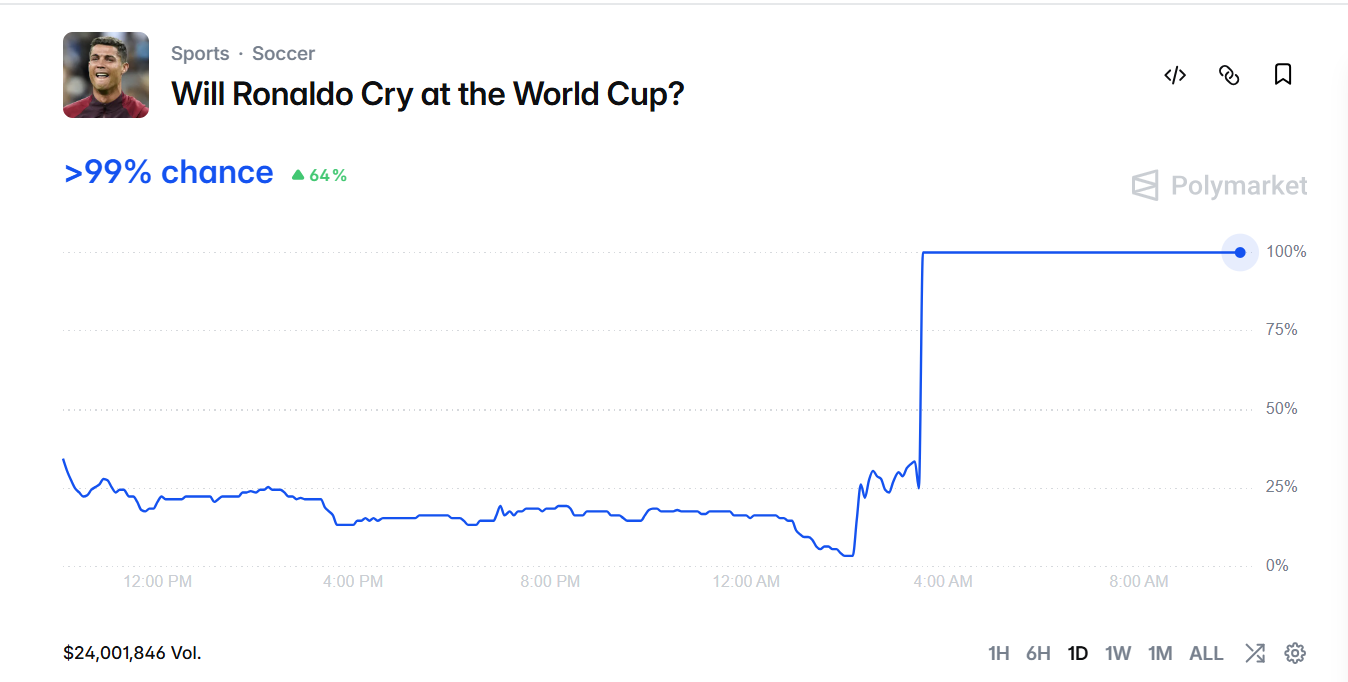
In June this year, Polymarket launched a prediction market on whether Ronaldo would cry during the World Cup, once again becoming a focal point. Its total trading volume has reached $23.94 million. On the evening of July 6th, the market price indicated a 15% probability for Yes, with No dominating. However, the result was twice proposed as "No," leading to a dispute. On July 8th, the probability for Yes suddenly surged to over 99%, with the final review period remaining about 1 day.
YES holders and NO holders argued fiercely: the core disagreement centered on whether it was "clearly crying" and if it met the rule requirement of clearly visible tears rolling down the face.
So, what exactly are the specific rules stated on Polymarket?
The rules are as follows: This market will resolve to Yes if, in any photograph or video from the 2026 FIFA World Cup while Ronaldo is representing Portugal, clearly visible tears are seen rolling down his face. Otherwise, it will resolve to No. "Crying" must occur while Ronaldo is on the field or in the technical/substitute bench area; crying in the locker room or other areas does not count. Crying may occur before, during, or after a match. Otherwise, this market will resolve to "No."
Therefore, the key issue returns to two core questions: whether Ronaldo's tears were clearly visible and where he was when crying.
Ronaldo's Final Match
There is no dispute about his red eyes on the pitch.
Multiple authoritative media outlets described Ronaldo's reaction immediately after the match. U.S. ESPN, the UK's The Independent, among others, consistently used phrases like "in tears," "tearful," "bursts into tears," and "emotional with tears in his eyes." Broadcasters like FOX Sports released post-match emotional reaction compilations, with fans and reporters capturing moments of Ronaldo's red eyes, wiping his face, and grim expressions in the stands and mixed zone.

These images were not from private areas but occurred in public spaces like the pitch, near the substitute bench, or the player tunnel, meeting the time and location requirements of "before, during, or after the match, on the field or in the technical/substitute bench area" per Polymarket rules. The images and videos are authentic on-site captures, with no suspicion of post-production, AI, or old footage.
On Xiaohongshu, topics related to Ronaldo's eyes welling up with tears once trended on the hot topics list.
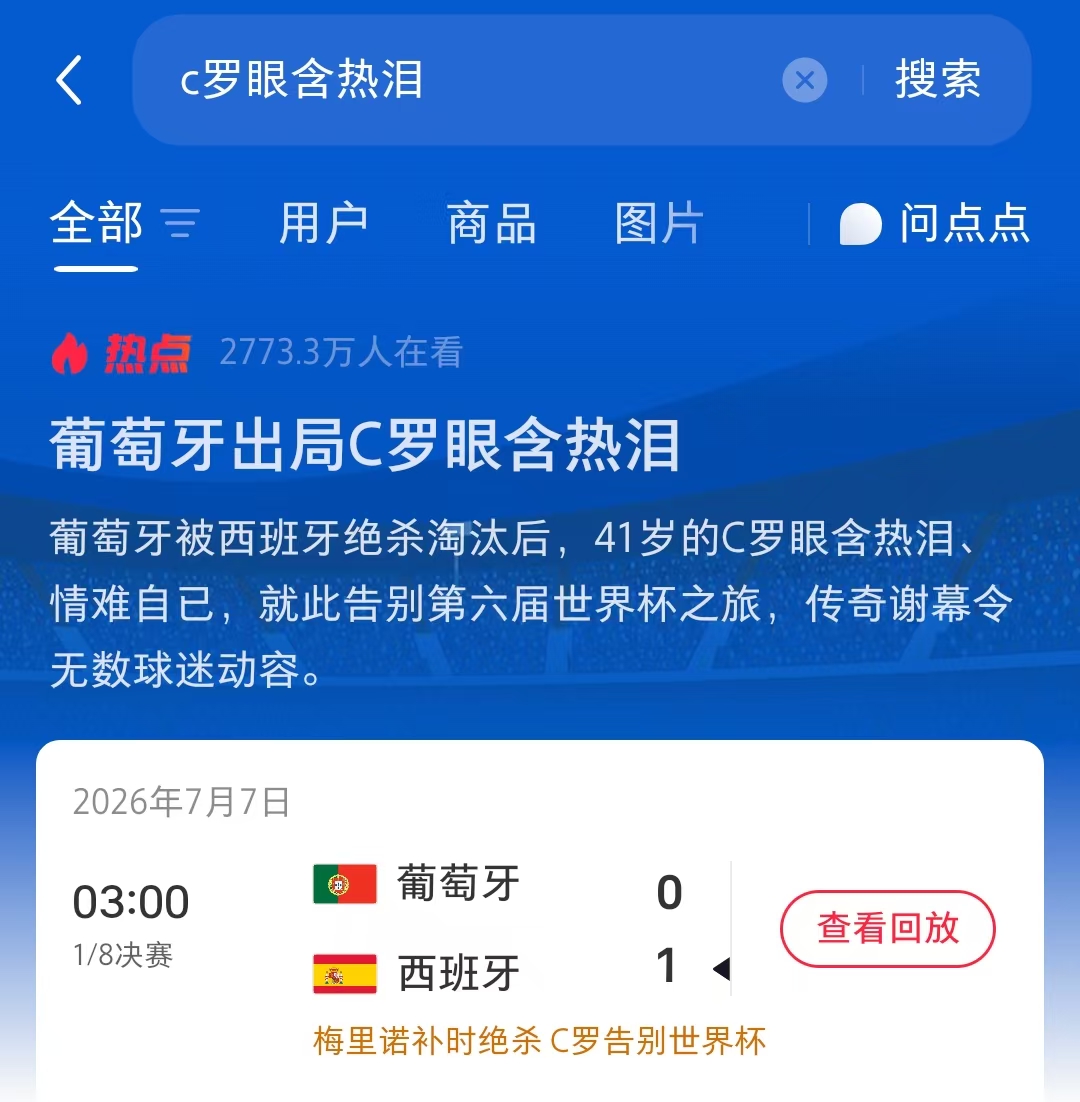
Upon examining video clips on Xiaohongshu, the author observed that his eyes indeed contained some tears, but it was impossible to clearly determine whether those tears noticeably rolled down his face.
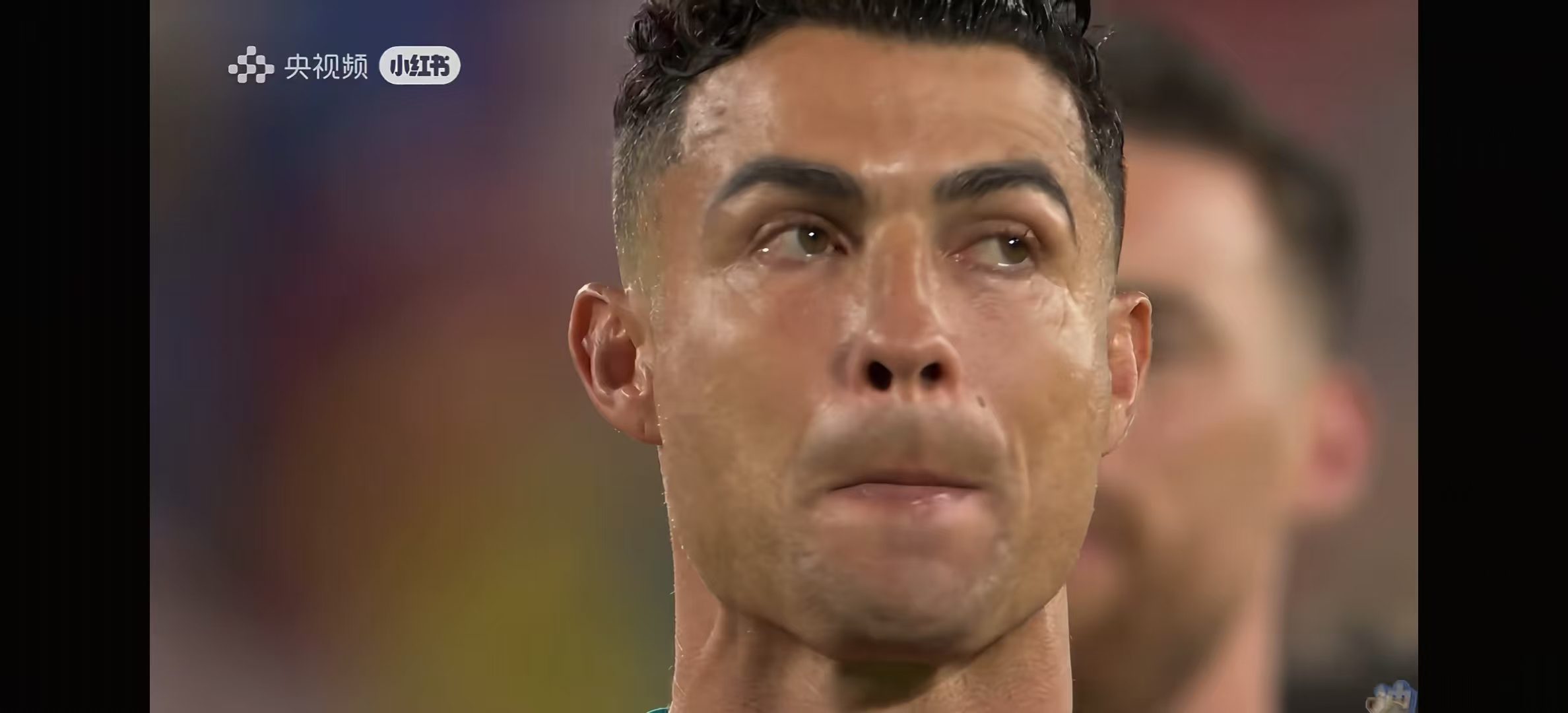
And this is precisely the focal point of the ongoing dispute on Polymarket.
The Controversy Erupts
The YES side argues that multiple high-definition photos and videos show Ronaldo's moist eyes, glistening tears, and wiping his face with his hand or sleeve. Global mainstream media reports and the photos/videos themselves are proof.
The NO side contends that the rules require a distinct teardrop rolling down the face, not just red eyes or suppressed tears. Some holders believe the available footage requires zooming in to barely discern, failing to meet the "clearly observable" detail.
Currently, the market has twice been proposed to resolve as No, both times met with protests, and has entered final review to be decided by a UMA oracle community vote—this is Polymarket's standard mechanism for handling disputes. However, oracle community votes often heavily favor large holders, making retail traders mere rule-takers.
This market once again proves: prediction markets are extremely efficient for quantifiable, verifiable events, but in scenarios involving subjective visual judgments and subtle emotional distinctions, they are prone to massive controversy.
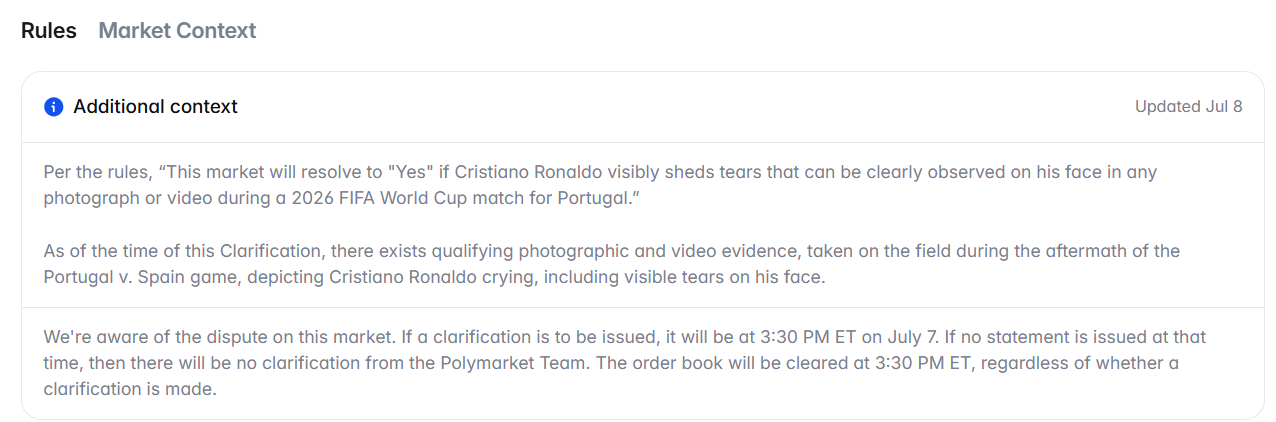
On July 8th, the platform added a detailed clarification: As of the time of this clarification, photo and video evidence meeting the conditions exists. This evidence was captured on the pitch after the Portugal vs. Spain match, showing Cristiano Ronaldo crying with visible tears on his face.
Similar controversies have played out multiple times in Polymarket's history. Recently, a prediction market on MicroStrategy selling Bitcoin also sparked significant controversy. While MicroStrategy did sell 32 BTC before May 31st, because the 8-K filing was issued on June 1st, Polymarket forcibly introduced a supplemental interpretation to resolve as NO, leading to widespread online outcry of "PolyScam."
This also reminds participants: when betting on emotional or visual events, one must carefully study the literal meaning of the rules, not just rely on public perception or media headlines.
Perhaps for Polymarket, the greater the controversy and the more irreconcilable the conflict, the higher the platform's trading volume, fees, and exposure on social media. The platform likely has no desire for airtight rules; gray areas with loopholes serve as bait to attract massive long and short capital to gamble. The platform pockets hefty fees, UMA gains governance relevance, while only the retail traders on both sides are left fighting in the ruins over whether a single tear rolled down a cheek.