Not A Threat: Stablecoin Yield Won’t Harm Banks, White House Economists Say

bitcoinistОпубліковано о 2026-04-09Востаннє оновлено о 2026-04-09

Анотація

In a positive development for crypto, a White House economic study by the Council of Economic Advisers (CEA) concludes that prohibiting stablecoin yield would have a negligible impact on bank lending, particularly for community banks. The study, addressing a key debate around bills like the GENIUS Act, found that eliminating yield would boost overall bank lending by only $2.1 billion, a mere 0.02% increase. Even under worst-case assumptions requiring implausible conditions like a sixfold growth in stablecoins, the increase would be moderate. The report contradicts banking industry claims that yield-bearing stablecoins could trigger massive deposit flight, arguing a yield prohibition would do little to protect lending while denying consumers competitive returns. It also highlights that regulatory uncertainty harms banks more than the crypto industry, as it prevents investment in new technology.

In a positive development for the crypto industry, a recent study by White House economists affirmed that stablecoin yield won’t harm community banks, and its prohibition won’t have a meaningful impact on overall lending in the banking system.

Stablecoin Yield Is Not A Threat

On Wednesday, the Council of Economic Advisers (CEA) released the highly anticipated study on a key issue that has become a major point of contention between the banking and crypto industries over the past few months: stablecoin yield and its potential impact on deposit flight and bank lending.

For context, the landmark crypto legislation, the GENIUS Act, requires issuers to maintain reserves backing outstanding stablecoins on a one-to-one basis and to hold these reserves in certain assets, including US dollars, Federal Reserve notes, and short-term US Treasuries.

The bill also introduced key restrictions that prohibit issuers from offering any form of interest or yield to stablecoin holders. The banking industry has urged US lawmakers to extend the prohibition to digital asset exchanges, brokers, dealers, and related entities, which has led to prolonged debate and delay of the crypto market structure bill, also known as the CLARITY Act.

While some analysts estimate that the effect of lending in the trillions of dollars, the CEA report found that eliminating stablecoin yield would only boost bank lending by $2.1 billion, equivalent to a 0.02% increase.

Large banks would conduct 76% of this additional lending, while community banks—which have assets below $10 billion—would lend the remaining 24%. In our baseline, that adds up to $500 million in additional lending from community banks, meaning their lending rising by 0.026%.

As they noted, even under the worst-case assumptions, the CEA’s model produced only $521 billion in additional aggregate lending, corresponding to a 4.4% increase in bank loans as of Q4 2025.

Moreover, that figure would require the stablecoin market to grow sixfold as a share of deposits, all reserves to be locked in unlendable cash instead of US treasuries, and the Federal Reserve (Fed) to “abandon its current monetary framework.”

“Even under those implausible conditions, community bank lending only rises by $129 billion, corresponding to an increase of 6.7%,” the White House economists emphasized, concluding that prohibiting yield would have only a moderate impact on overall lending in the banking system.

The conditions for finding a positive welfare effect from prohibiting yield are similarly implausible. In short, a yield prohibition would do very little to protect bank lending, while forgoing the consumer benefits of competitive returns on stablecoin holdings.

Regulatory Uncertainty More Harmful Than Rewards

The CEA study directly contradicts one of the banking sector’s main arguments for banning stablecoin yield: it would mostly affect community banks. In January, Bank of America CEO Brian Moynihan told investors that the banking industry could face significant challenges if the US Congress does not prohibit interest-bearing stablecoins.

During its Q4 earnings call, the executive stated that up to $6 trillion in deposits, roughly 30% to 35% of all US commercial bank deposits, could flow out of the banking system and into the stablecoin sector, citing Treasury Department studies.

The CEO asserted that while Bank of America would not be affected by this issue, small- and medium-sized businesses would be particularly hurt, as they’re “largely lent to end consumers by the banking industry.”

Earlier this year, the Independent Community Bankers of America affirmed that offering interest on payment stablecoins could drain community bank deposits and limit credit availability for local economies.

The group asserted that allowing digital asset entities to pay interest, yield, or “rewards” on payment stablecoins would significantly reduce community banks’ ability to support local lending needs, potentially losing $1.3 trillion in deposits and $850 billion in loans.

Nonetheless, a former Commodity Futures Trading Commission (CFTC) chief, Chris Giancarlo, said in March that banks require regulatory clarity more than the crypto industry. He argued that banks will be hesitant to invest in new technology without clear rules, and their systems will eventually be obsolete.

“The banks, however, can’t afford regulatory uncertainty. Their general counselors are telling their boards, you can’t invest billions of dollars in this (...) unless you’ve got regulatory certainty. (...) The banks need this clarity because they need to build this. They need to be in the forefront, not in the rear guard of this innovation,” he stated.
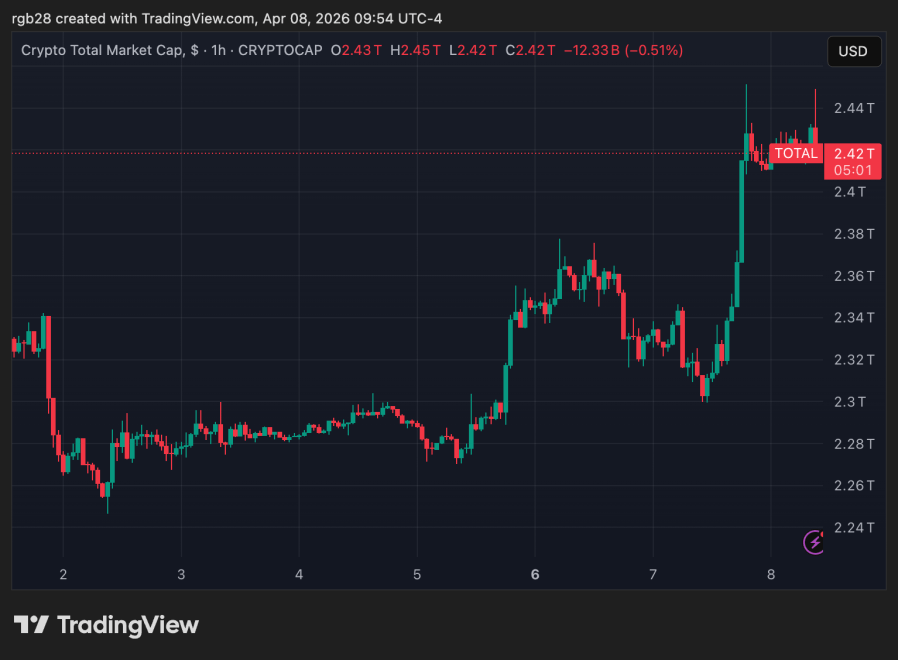
The total crypto market capitalization is at $2.42 trillion in the one-week chart. Source: TOTAL on TradingView


Трендові криптовалюти

Пов'язані питання

QWhat was the main finding of the White House economists' study regarding stablecoin yield and bank lending?

AThe study found that eliminating stablecoin yield would only boost overall bank lending by $2.1 billion, a negligible 0.02% increase, and concluded that prohibiting yield would have only a moderate impact on the banking system.

QAccording to the CEA report, what implausible conditions would be required for a significant $521 billion increase in bank lending?

AIt would require the stablecoin market to grow sixfold as a share of deposits, all reserves to be locked in unlendable cash instead of US Treasuries, and the Federal Reserve to abandon its current monetary framework.

QWhat argument from the banking sector did the CEA study directly contradict?

AThe study contradicted the banking sector's argument that prohibiting stablecoin yield is necessary to protect community banks, showing that even under worst-case scenarios, the impact on their lending would be minimal.

QWhat did Bank of America's CEO claim could happen if interest-bearing stablecoins are not prohibited?

ACEO Brian Moynihan claimed that up to $6 trillion in deposits, roughly 30-35% of all US commercial bank deposits, could flow out of the banking system and into the stablecoin sector.

QWhat did former CFTC chief Chris Giancarlo identify as a greater need for banks than for the crypto industry?

AHe stated that banks require regulatory clarity more than the crypto industry, as they cannot afford regulatory uncertainty and need clear rules to invest billions in new technology to avoid becoming obsolete.

Пов'язані матеріали

Will the Fed Definitely Raise Interest Rates in September? How Will Crypto and U.S. Stocks Withstand the Pressure?

The market's expectation for a September Fed rate hike surged dramatically in early August, jumping from under 50% to over 80% within a week. This shift followed a contentious July FOMC meeting, where a 9-3 vote to hold rates revealed growing dissent from hawkish members advocating for an immediate hike to combat persistent inflation. The primary catalyst for this repricing is rising oil prices, driven by renewed geopolitical tensions around the Strait of Hormuz, which threaten global supply. Energy costs directly influence inflation metrics, making the upcoming July CPI report (due August 12th) a critical data point. If it shows inflation reaccelerating, the probability of a September hike will solidify. For Bitcoin and crypto assets, this is typically bearish news. Bitcoin continues to behave as a high-beta, liquidity-sensitive risk asset. A rate hike raises the opportunity cost of holding non-yielding assets and could drive capital toward money markets, pressuring crypto prices in the short term. However, historical patterns suggest that if a hike is perceived as the end of a tightening cycle rather than the start, any negative price impact may be brief. U.S. stocks, particularly crypto-linked equities like Coinbase and growth-oriented tech stocks, are also vulnerable. Higher rates increase discount rates in valuation models, putting pressure on high-multiple companies. This coincides with a pivotal tech earnings season where investor focus has shifted from massive AI capital expenditure to tangible revenue and cash flow generation. Companies with negative cash flow and weak growth narratives could face heightened volatility if borrowing costs rise in September. In summary, a September Fed hike has evolved into a mainstream market scenario. Key factors to watch are oil prices, the July CPI report, and Fed communications, which will determine the final decision and its impact on volatile crypto and equity markets.

marsbit3 хв тому

Will the Fed Definitely Raise Interest Rates in September? How Will Crypto and U.S. Stocks Withstand the Pressure?

marsbit3 хв тому

A 'Overlooked' Market Event: Joint US-Japan-South Korea Intervention, Rare US Treasury Involvement, and Bessent's Quiet 'Market Rescue'?

Summary: The United States, Japan, and South Korea executed their largest coordinated foreign exchange intervention in nearly 30 years. The action targeted depreciation pressure on the Japanese yen and South Korean won. This move is seen as a significant effort by the US to stabilize the financial markets of its key allies and prevent the spillover of risks. Key details: * Japan reportedly intervened on July 30 using approximately 8.45 trillion yen (about $52.8 billion). South Korean authorities also intervened that day, selling dollars to support the won. * Notably, the US Treasury Department intervened directly in yen markets for the first time in roughly 30 years. The New York Fed, reportedly acting on behalf of the Treasury, sold euros to buy yen via Goldman Sachs and Morgan Stanley on July 31. Analysts view the use of the euro-yen pair as a way to alleviate yen pressure without adding selling pressure to the US dollar. * Prior to the action, the New York Fed conducted "rate checks" on both USD/JPY and EUR/JPY, a newer signaling tool that falls between verbal and physical intervention. The intervention is interpreted as going beyond traditional currency stabilization. Analysts, such as Michael Hartnett of Bank of America, suggest it resembles a "Price Keeping Operation" for the AI era. The core US objectives are perceived to be: 1. Preventing rapid yen depreciation from triggering a sharp rise in Japanese government bond yields. 2. Containing financial stress from spreading across Asian markets like South Korea and Japan. 3. Reducing the risk of disorderly capital flows impacting the US bond market. This coordinated action underscores the importance of Japan and South Korea as critical partners in the US semiconductor and AI supply chain. Stabilizing their financial markets is seen as vital to mitigating risks to the broader tech industry and the US market itself. The intervention coincides with market pressures, including the KOSDAQ index hitting a low since October 2022. While seen as a move to control volatility, some analysts caution it may not fundamentally reverse existing market trends.

marsbit7 хв тому

A 'Overlooked' Market Event: Joint US-Japan-South Korea Intervention, Rare US Treasury Involvement, and Bessent's Quiet 'Market Rescue'?

marsbit7 хв тому

Will the Federal Reserve Definitely Raise Interest Rates in September? How Will Cryptocurrencies and US Stocks Bear the Pressure?

In early August 2024, market expectations for a September Federal Reserve rate hike surged dramatically, from below 50% to over 80%, driven by renewed inflation concerns. This shift followed a contentious July FOMC meeting where a 9-3 vote to hold rates revealed a growing hawkish faction advocating for an immediate hike, citing prolonged above-target inflation. The key catalyst is escalating conflict near the Strait of Hormuz, which has pushed oil prices up approximately 20% in July, threatening to reignite inflation. The next critical data point is the July CPI report on August 12th; a hot reading could solidify hike expectations. For crypto assets, particularly Bitcoin, this represents near-term pressure. Bitcoin continues to exhibit high-beta, risk-on characteristics, making it sensitive to tightening liquidity and higher opportunity costs. However, historical precedent suggests that if a hike is perceived as the cycle's end rather than its start, the negative impact may be brief, with markets quickly pivoting to anticipate future rate cuts. U.S. stocks, especially crypto-linked equities like Coinbase and high-valuation tech stocks, face amplified volatility. Higher rates increase discount rates in valuation models, pressuring growth stocks. This coincides with a pivotal tech earnings season where investor focus has shifted from massive AI capital expenditures to demonstrable revenue and cash flow generation. Companies with negative cash flows and weak growth narratives could see severe pressure if a September hike materializes, as financing costs would rise. Key indicators to watch include oil prices, upcoming inflation data, and Fed commentary at events like the Jackson Hole symposium.

Odaily星球日报7 хв тому

Will the Federal Reserve Definitely Raise Interest Rates in September? How Will Cryptocurrencies and US Stocks Bear the Pressure?

Odaily星球日报7 хв тому

Торгівля

Спот

Популярні статті

Як купити HOUSE

Ласкаво просимо до HTX.com! Ми зробили покупку Housecoin (HOUSE) простою та зручною. Дотримуйтесь нашої покрокової інструкції, щоб розпочати свою криптовалютну подорож.Крок 1: Створіть обліковий запис на HTXВикористовуйте свою електронну пошту або номер телефону, щоб зареєструвати обліковий запис на HTX безплатно. Пройдіть безпроблемну реєстрацію й отримайте доступ до всіх функцій.ЗареєструватисьКрок 2: Перейдіть до розділу Купити крипту і виберіть спосіб оплатиКредитна/дебетова картка: використовуйте вашу картку Visa або Mastercard, щоб миттєво купити Housecoin (HOUSE).Баланс: використовуйте кошти з балансу вашого рахунку HTX для безперешкодної торгівлі.Треті особи: ми додали популярні способи оплати, такі як Google Pay та Apple Pay, щоб підвищити зручність.P2P: Торгуйте безпосередньо з іншими користувачами на HTX.Позабіржова торгівля (OTC): ми пропонуємо індивідуальні послуги та конкурентні обмінні курси для трейдерів.Крок 3: Зберігайте свої Housecoin (HOUSE)Після придбання Housecoin (HOUSE) збережіть його у своєму обліковому записі на HTX. Крім того, ви можете відправити його в інше місце за допомогою блокчейн-переказу або використовувати його для торгівлі іншими криптовалютами.Крок 4: Торгівля Housecoin (HOUSE)Легко торгуйте Housecoin (HOUSE) на спотовому ринку HTX. Просто увійдіть до свого облікового запису, виберіть торгову пару, укладайте угоди та спостерігайте за ними в режимі реального часу. Ми пропонуємо зручний досвід як для початківців, так і для досвідчених трейдерів.

548 переглядів усьогоОпубліковано 2025.04.27Оновлено 2026.06.02

Як купити HOUSE

Обговорення

Ласкаво просимо до спільноти HTX. Тут ви можете бути в курсі останніх подій розвитку платформи та отримати доступ до професійної ринкової інформації. Нижче представлені думки користувачів щодо ціни HOUSE (HOUSE).

活动图片