No Surge, No Meme: As Crypto Moves into the Real World, Will 2026 Be the First Year of 'On-Chain Wall Street'?

marsbitОпубліковано о 2025-12-19Востаннє оновлено о 2025-12-19

In the final months of 2025, the atmosphere of a bear market began to spread.

Bitcoin slid from its high of $120,000, ETF inflows stalled at one point, various cryptocurrencies diverged in their trends, and the once sentiment-igniting Meme coins also began to lose interest. Compared to the end of 2021, this time there was no sudden regulatory crackdown, and aside from the 1011 crash, there didn't seem to be a severe liquidity crisis, yet it still felt like something was off.

If the crypto world of 2025 was a recalibration of true and false value, then will crypto be better in 2026?

This article attempts to find the answer. Perhaps we need to accept the fact that the crypto industry may be entering an era no longer driven by one-sided surges or "casino narratives."

I. Macro Winds Warm, Bitcoin Still Stands in the Spotlight

Over the past year, Bitcoin's price performance and market positioning have undergone significant changes.

After hitting a new all-time high of $120,000, the market began to pull back, volatility increased, and market sentiment gradually cooled. Unlike past rallies driven by retail investors, the main force behind this round of increases was the institutional money behind ETFs. Looking at holding costs, CryptoQuant analyst Axel Adler Jr. pointed out last month that the average holding cost for US ETFs was $79,000, which many also see as one of the price support levels. Therefore, Bitcoin's current trend is increasingly resembling a high-volatility institutional asset. On one hand, it has an anti-inflation positioning similar to gold; on the other hand, like tech stocks, it is influenced by macro sentiment and risk appetite, exhibiting beta properties.

From a broader macro background, 2025 was a year of回暖 (warming) sentiment for global risk assets. AI was the main theme, US stocks continuously hit new highs, the Fed announced three rate cuts in December, and the market re-entered a stage of warming liquidity expectations. The FOMC's year-end economic projections showed that the US GDP growth expectation for 2026 was also revised up from 1.8% to 2.2%–2.5%. The general expectation is that easing will continue next year, which might be a positive for assets like Bitcoin.

But the market is not without risks. If the economy suddenly weakens in 2026, or inflation rebounds unexpectedly, risk assets could still face significant adjustments.

II. Regulatory Turning Point: Policy Moves in the US and Hong Kong

Another important change in 2025 was the formal framing of regulation.

In the US, two key bills were passed. The first is the stablecoin bill (GENIUS Act), which clarifies the definition of stablecoins, reserve requirements, and issuance qualification thresholds, providing a compliance path for mainstream stablecoin issuers. This bill was signed into law by the President in July 2025 and will take effect 18 months after signing or 120 days after regulators issue final rules. The second is the Crypto-Asset Market Structure Act (CLARITY Act), which systematically divides the boundary between "security tokens" (regulated by the SEC) and "commodity tokens" (regulated by the CFTC) and proposes tiered regulation. This bill will be submitted to the Senate for deliberation in January, after which it may still require the President's signature, with an effective date to be determined. Meanwhile, the SEC has also accelerated the approval of more crypto ETFs, opening channels for institutional products.

In Hong Kong, China, regulatory步伐 (pace) also accelerated. In 2025, the Hong Kong Monetary Authority (HKMA) introduced a regulatory regime for stablecoin issuers, clearly requiring all Hong Kong-based stablecoin issuances to be licensed. This means that future issuances of stablecoins like USD or RMB in Hong Kong will need to meet certain capital and compliance requirements. Furthermore, HashKey has been listed on the Hong Kong Stock Exchange, becoming the first compliant platform with crypto trading as its core business to IPO in Hong Kong, a milestone event.

Overall, the regulatory trends in the US and Hong Kong, China, are both about suppressing illegal speculation while opening channels for legal business, pushing the industry towards institutionalization and compliance.

III. Three Main Themes: Stablecoins, Prediction Markets, On-Chain Stocks

Over the past few years, the most stable growth curve in the crypto industry has actually been stablecoins.

By 2025, the global stablecoin issuance volume had exceeded $300 billion, with the two major coins, USDT and USDC, accounting for over 80% combined. Stablecoins are becoming part of the global payment network. Whether it's USDT or USDC, the usage scenarios of these stablecoins have penetrated into daily merchants and cross-border settlements.

In 2026, stablecoins are likely to be closer to the real world than ever before. Traditional giants like Visa, Stripe, and PayPal are already using stablecoins for settlements. For example, Stripe already supports merchants subscribing with stablecoins, with real, landed services already available.
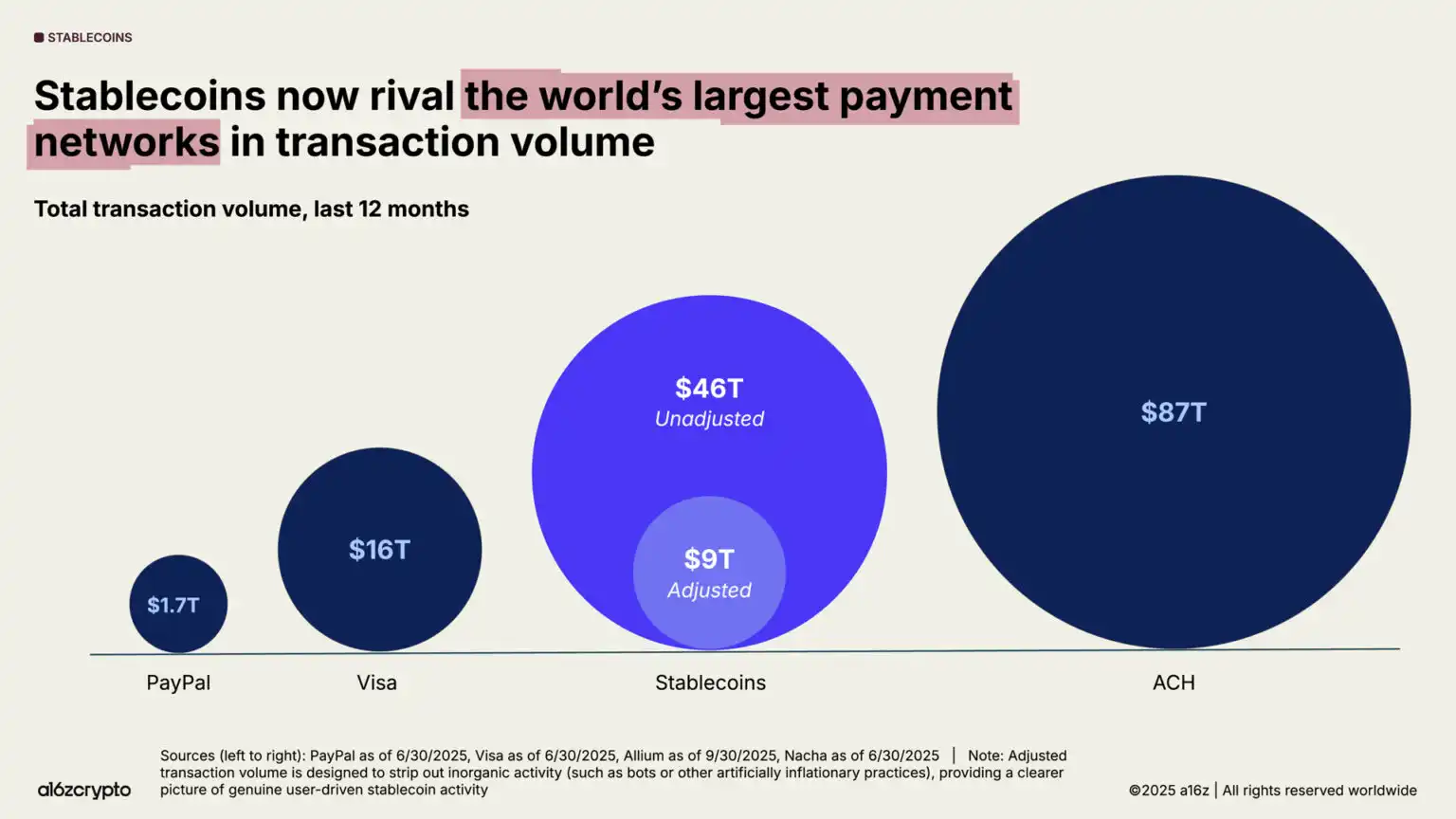
Image Source: a16z

Furthermore, with regulatory clarity, treasury-backed stablecoins (backed by high-quality assets) and regional stablecoins are expected to emerge, such as digital currency bridge projects promoted by Japan and the EU.

Another area worth watching is prediction markets.

Originally, most people thought prediction market products were too niche or non-compliant. But now, under themes like US elections, sports events, and economic data, they are gradually becoming a combination of "on-chain betting + pricing tools."

For example, Kalshi obtained a formal futures license from the US CFTC, allowing it to legally launch prediction trading related to macroeconomic data. Its valuation has now climbed to $11 billion. Polymarket, relying on topics like US elections and entertainment events, has also become a place for a large number of users to bet and gauge sentiment.

In 2026, prediction markets may move out of the purely speculative circle. For instance, users are not just betting on wins or losses but are using money to vote, expressing their judgment on the probability of a certain outcome. This collective intelligence pricing method could potentially be used by media, research institutions, and even trading strategies for reference. Additionally, AI will open up new possibilities for prediction markets, making them no longer rely solely on human betting but capable of automatically analyzing data, placing orders themselves, and even generating new markets. This will make prediction markets react faster and smarter, gradually becoming a tool for judging risks and trends, not just a place for gambling.

The last one that cannot be ignored is the development of on-chain stocks.

Simply put, the crypto industry is now not only trading crypto assets but also starting to move real-world assets onto the chain. For example, Securitize plans to launch the first fully compliant on-chain stock trading platform in 2026. Tokens purchased on-chain by users correspond to real company shares, entitling them to voting rights and dividends.

IV. Edge Narratives Emerge: New Directions That Might Take Off in 2026

https://a16zcrypto.com/posts/article/big-ideas-things-excited-about-crypto-2026/
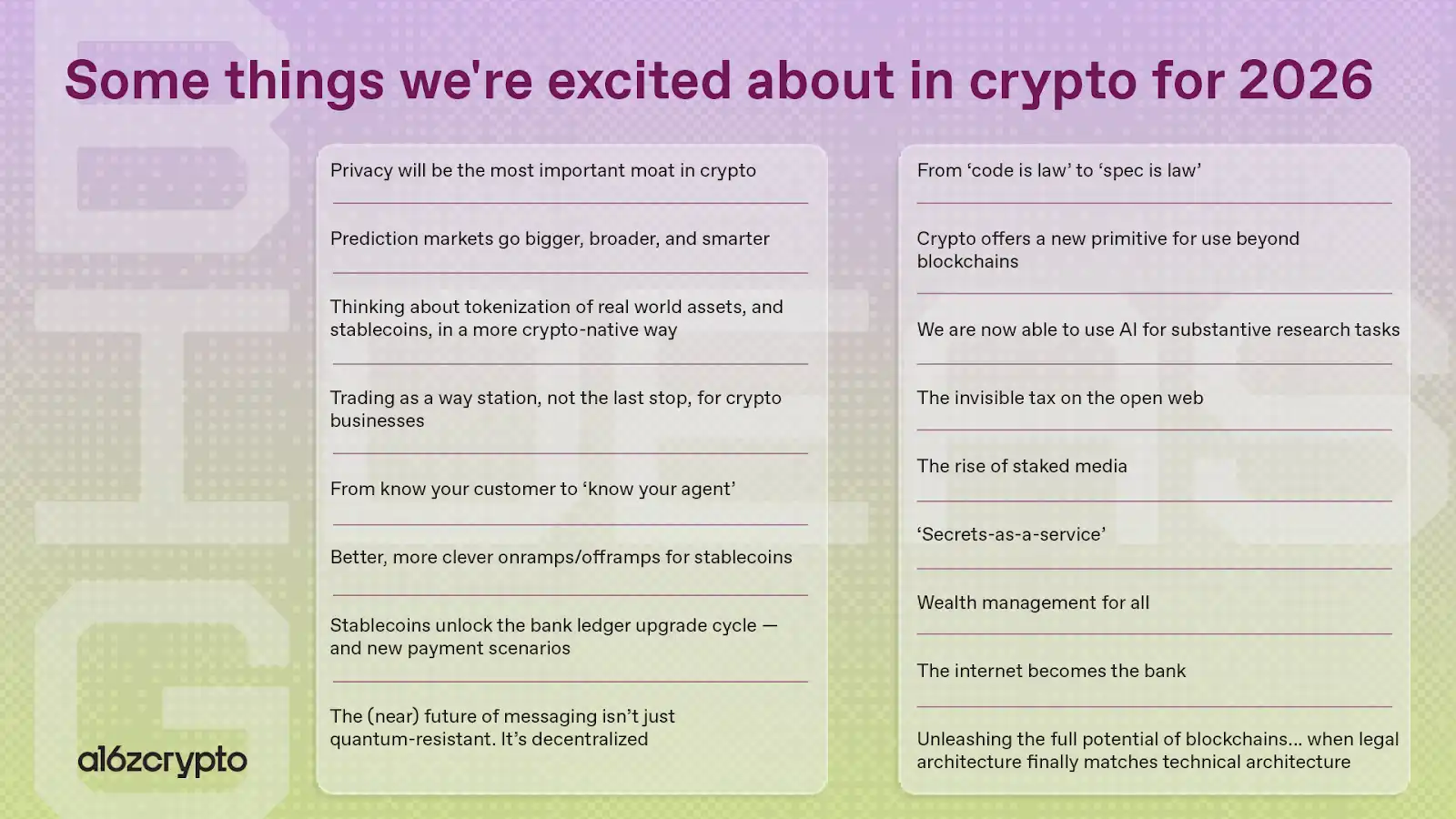
Image Source: a16z

1. The Identity Problem of AI Agents

As AI agents begin to participate in trading, browsing, placing orders, and even interacting with smart contracts, a key question is brought to the table: how do these non-human identities prove "who they are"?

The "Know Your Agent" (KYA) concept proposed by a16z aims to solve this very problem. On-chain, any agent initiating a transaction must have clear permissions and attribution, requiring cryptographic signature credentials for transactions. In 2026, this may become a prerequisite for the large-scale deployment of on-chain AI.

2. x402-like Protocols and Micropayments

a16z predicts that in the process of AI Agents widely trading data, calling computing power, and reading interfaces, we will enter an era of "automatic settlement + programmable payments."

No longer needing manual payments, AI Agents can identify needs among themselves and automatically execute payments. This is the real-world problem that protocols like x402 are solving. In 2026, their presence will become increasingly strong.

3. Privacy Chains Will Receive More Attention

a16z points out a key trend: compared to performance competition converging, privacy will become the core moat of future public chains. In the past, people worried that privacy chains were not conducive to regulation and lacked transparency. But now the problem is reversed: business data is too sensitive, and without privacy protection, compliant institutions simply dare not go on-chain. Precisely because of this, chains that come with privacy protection by default are becoming attractive. Once users use these chains, their data won't be easily leaked, migration costs are higher, naturally forming new user stickiness, which is essentially a network effect.

4. Staked Media

In the era of AI generating vast amounts of content, judging whether a statement is reliable cannot just depend on who said it, but also on whether there is a cost for saying it. Therefore, a16z proposes a new media model where content creators not only speak out but also "stake" their positions through methods like locking stakes, prediction markets, and NFT credentials.

For example, if you express a bullish view on ETH, you simultaneously lock up your own held ETH as collateral; if you make an election prediction, you also place a bet on-chain yourself. These公开 (public) interest bindings will make content more than just empty talk. If this play can work, it might become the new normal for on-chain media in the future.

Of course, the a16z report proposes far more than these few directions. This article focuses on selecting 4 trends we believe are more representative for elaboration. Other directions are also worth关注 (attention), such as: stablecoin on/off-ramp upgrades, RWA crypto-native transformation, stablecoins driving bank ledger system upgrades, diversification of wealth management, the rise of AI research assistants, real-time content profit-sharing mechanisms for AI agents, decentralized anti-quantum communication, "privacy as a service" becoming infrastructure, DeFi security paradigm shifts, intelligent prediction markets, verifiable cloud computing, focusing on product-market fit (PMF), and crypto bills unleashing more potential of blockchain.

Interested readers can refer to the original a16z report for further in-depth understanding.

V. The Crypto Industry is Moving Out of Its Internal Cycle

The early growth of the crypto industry was mostly built on a self-congratulatory system. Issuing coins, rebates, and airdrops all tried to attract more insiders to stay, but this closed loop is gradually being broken by reality.

From Polymarket to USDT, to the cross-border application of USDC, we see more and more people who are not Web3 users utilizing blockchain tools. Street vendors in Lagos may not understand wallet structures, but they know using USDT is much faster than bank transfers. In high-inflation countries, savers flock to USDC just for避险 (hedging), not speculation. One of the most直观 (intuitive) changes appears in payment scenarios in developing countries. For example, the Philippine trading platform Coins.ph partnered with Circle to open a low-cost USDC remittance channel.

The trend behind this shows that crypto technology is being embedded into real-world scenarios like cross-border payments and remittance channels. The true future of crypto might lie in how to use technology to solve real problems, allowing more ordinary people to use blockchain unconsciously.

VI. The Crypto Industry from a KOL Perspective

A recent discussion on "whether spending years in the crypto industry was worth it" was essentially a collective复盘 (review) of the industry.

Castle Island Ventures partner Nic Carter @nic_carter continued the reflection on "wasting 8 years in crypto,"坦言 (frankly admitting) that the ones that have truly achieved significant PMF (Product-Market Fit) so far are still only Bitcoin, stablecoins, DEXs, and prediction markets. He chooses to maintain pragmatic idealism, accepting that bubbles and狂热 (mania) are part of the path, not the whole thing.

Dragonfly partner Haseeb @hosseeb was more blunt, pointing out that the problem isn't the existence of the casino, but that if you only focus on the casino's glamour, you will miss the real transformation of the industry. He believes cryptocurrency is a better carrier for finance; it will forever change the nature of money. He hopes the industry maintains patience: "The Industrial Revolution also took 50 years to change productivity. We are only 15 years in."

The summary by XHunt & Biteye founder @DeFiTeddy2020 is also extremely real. In his view, the crypto industry can quickly expose the essence of finance. It faces projects going to zero, prices decoupling from fundamentals, and even insider trading, manipulation, and harvesting. It is not a温床 (hotbed) for idealism but a market that constantly educates participants with real money, which is very mentally磨练 (tempering).

Regarding the future development direction of the industry, KOL 币圈女菩萨 @xincctnnq (Crypto Bodhisattva) provided a long-term perspective. What crypto is truly trying to solve are long-term issues like the monetary system, contract execution, digital property rights, capital market efficiency, and financial inclusion. Even if the results are distant and the process rough, it is worth continuous尝试 (attempts).

Furthermore, trader & analyst @CryptoPainter gave a more market-structure-oriented explanation. The crypto market repeats its consistent operating mechanism: "value investment" - "belief investment" - "emotional speculation" - "complete disappointment," and then starts over. This cycle appeared in 2018 and 2022 and is destined to happen again. Gamblers and casinos are not anomalies but part of consuming the bubble and completing the market's self-regulation.

The stance of Figment Capital member DougieDeLuca @DougieDeLuca is like a阶段性 (stage) summary. He直言 (stated bluntly), "Crypto is dead" doesn't mean the price goes to zero or blocks stop working, but that "Crypto as a closed industry form is dying." True success should be integrating Crypto technology into ordinary people's daily lives.

From a more institutional perspective, KOL & researcher蓝狐 (Blue Fox) @lanhubiji mentioned that while old users are starting to withdraw, newcomers with traditional finance backgrounds are entering. In their perception, crypto is a long-term trend that has already entered a path of standardization, interoperability, and scaling. In three years, a brand-new on-chain finance era, the on-chain Wall Street era, will gradually reveal itself.

The judgment of LD Capital founder易理华 (Jack Yi) @Jackyi_ld is closer to the current cycle level. He pointed out that the recent crypto downturn is more of a阶段性 (stage) resonance of liquidity and macro events. Currently, negative factors are gradually being digested. With the dual benefits of rate cut expectations and crypto policies, he remains optimistic about the subsequent market.

At a more macro level of regulation and industry structure, the judgment of Hashkey Group Chairman肖风 (Xiao Feng) is particularly systematic. He proposed three future trends:

First, the global crypto regulatory trend is shifting from "voluntary acceptance" to "mandatory inclusion." Governments are gradually clearing out offshore gray areas, and crypto trading is moving towards licensing. Taking Hong Kong, China as an example, since June 2023, all unlicensed trading platforms need to exit the market.

Second, crypto is no longer just native assets like BTC and ETH. More traditional financial assets are migrating onto the chain through tokenization, forming a new type of compliant securitized market.

Third, moving from "off-chain" to "on-chain," he judges that the second half of 2026 might be the key node for the雏形 (prototype) of "On-Chain Wall Street" to land.

VII. Conclusion

Will crypto be better in 2026?

If you're期待 (expecting) "coin prices to skyrocket," then the answer might be not necessarily.

But if you're asking whether this industry is moving towards a more real and useful direction, then the answer is perhaps yes.

From crypto ETFs to stablecoin payments, from on-chain treasuries to prediction markets, from on-chain Agents to decentralized AI, all these indicate one thing:

The crypto industry may begin to land in the direction of the real world and might increasingly resemble a twin financial system parallel to the real world's financial system, resonating with the stock market, macro liquidity, policy expectations, and even the AI cycle.


Пов'язані питання

QWhat are the three main trends in the crypto industry for 2026 as highlighted in the article?

AThe three main trends are: 1) Stablecoins becoming more integrated into real-world payments and settlements, 2) Prediction markets evolving beyond pure speculation into tools for collective intelligence and risk assessment, and 3) The development of compliant on-chain stock trading platforms where tokens represent real company shares.

QAccording to the article, how is Bitcoin's market behavior changing in 2025?

ABitcoin's price behavior is becoming more volatile and its market positioning is shifting. After reaching a new all-time high of $120,000, its price retreated with increased volatility. Unlike previous retail-driven rallies, this cycle was primarily driven by institutional funds through ETFs. It is increasingly behaving like a high-volatility institutional asset, with aspects of an inflation-resistant store of value like gold, but also a beta attribute influenced by macro sentiment and risk appetite, similar to tech stocks.

QWhat key regulatory developments occurred in the US in 2025, as mentioned in the text?

ATwo key US regulatory acts were passed: 1) The stablecoin bill (GENIUS Act), which defines stablecoins, sets reserve requirements, and establishes issuance qualifications, providing a compliance path for mainstream issuers. It was signed into law in July 2025. 2) The Crypto Asset Market Structure Act (CLARITY Act), which systematically distinguishes between 'security tokens' (regulated by the SEC) and 'commodity tokens' (regulated by the CFTC) and proposes tiered regulation. It was submitted to the Senate for review in January, with an effective date pending.

QWhat is the concept of 'Know Your Agent' (KYA) proposed by a16z, and why is it important?

A'Know Your Agent' (KYA) is a concept proposed by a16z to address the identity and permissioning of AI agents as they begin to participate in transactions, browsing, ordering, and interacting with smart contracts. It requires that any agent initiating an on-chain transaction must have clear permissions and attribution, needing cryptographically signed credentials. This is seen as a prerequisite for the large-scale deployment of on-chain AI in 2026, ensuring accountability and security for non-human actors.

QHow does the article suggest the crypto industry is moving beyond its 'closed-loop' system?

AThe article suggests the industry is moving beyond its internal, self-referential cycle by increasingly solving real-world problems and being used by people outside the Web3 space. Examples include merchants in Lagos using USDT for faster payments than banks, savers in high-inflation countries using USDC for避险, and platforms like Coins.ph in the Philippines offering low-cost USDC remittance channels. This indicates crypto technology is being embedded into real-world scenarios like cross-border payments and remittances, making it useful for ordinary people without them necessarily understanding the underlying blockchain technology.

Пов'язані матеріали

KOL's Perspective: Why Is SOL Set to Rise from This Point?

**Summary: Why SOL is Positioned for Growth at This Level** The article argues that SOL is poised for an upward move from its current price point, citing several key factors. Primarily, SOL has just broken out of a 4-month consolidation phase. This breakout signals a return of risk appetite to the broader crypto market, as SOL is seen as a key indicator of overall crypto health. The token's ownership has reportedly shifted from short-term traders and tourists to long-term accumulators, leading to low volume. Any meaningful increase in trading activity could thus trigger significant upward momentum. Fundamental strengths include strong institutional adoption, integration with DeFi and RWAs (Real-World Assets), and the potential benefits from the Clarity Act. Despite its high volatility—having dropped 70% from its all-time high but still up 12x from its bear market low—SOL is highlighted as one of the few tokens from the last cycle to reach new highs. It boasts a robust ecosystem of applications, users, and protocols. Future catalysts include the expected influx of AI developers following the Miami Accelerate conference, which focused on AI on Solana. Furthermore, Solana is positioned as the premier chain for memecoin activity, a trend expected to continue and drive network usage and fees. The article concludes that recent price action reflects a healthy transfer to long-term holders, setting the stage for growth.

marsbit19 хв тому

KOL's Perspective: Why Is SOL Set to Rise from This Point?

marsbit19 хв тому

Those Pre-Bitcoin PoW Protocols Have Recently Been Reimplemented

This article details a recent surge in replicating pre-Bitcoin Proof-of-Work (PoW) protocols, specifically focusing on Hal Finney's 2004 RPOW (Reusable Proofs of Work). Within five days in May 2026, multiple independent builders in the Bitcoin/cypherpunk community launched projects inspired by this early electronic cash proposal. The initiative began with Fred Krueger's `rpow2.com`, a centralized but auditable system that replaced RPOW's original IBM 4758 hardware with Ed25519 signatures. Initially a faithful replica, it later adopted Bitcoin-like features (21M supply cap, difficulty adjustment) and a controversial 5.24% founder allocation. This sparked rapid forks, including `rpow4.com` which incorporated full Bitcoin parameters, a prediction market (`rpowmarket.com`), and a DEX (`rpow2swap.com`). Concurrently, Mike In Space created a prototype of Wei Dai's 1998 b-money proposal (`b-money.replit.app`), pushing the historical exploration even further back. The article contrasts these centralized, server-dependent experiments with Bitcoin's core innovation of decentralized, trustless consensus. It also highlights a parallel development: the `HASH` project on Ethereum, which uses smart contract hooks to enable a purely fair-launch, browser-mineable PoW token with 0% allocations to team or VCs. The collective activity is framed as a meme-driven, educational exploration of cypherpunk history rather than a serious financial movement, with all projects heavily disclaiming any investment value.

marsbit23 хв тому

Those Pre-Bitcoin PoW Protocols Have Recently Been Reimplemented

marsbit23 хв тому

South Korean Exchanges 'Battle' Regulators, Challenging the Boundaries of Enforcement and Legislation

South Korea's cryptocurrency industry is engaged in a rare, direct confrontation with regulators. The Financial Intelligence Unit (FIU), the primary anti-money laundering (AML) watchdog, has recently imposed heavy penalties on major exchanges like Upbit and Bithumb for alleged violations involving unregistered overseas VASPs and AML procedures. However, exchanges are now actively challenging these actions in court and through industry associations. In a significant shift, the Seoul Administrative Court ruled in favor of Upbit's operator, Dunamu, overturning part of an FIU-ordered business suspension. The court found the FIU's penalty criteria and justification insufficiently clear. Similarly, the court suspended the enforcement of a six-month business suspension against Bithumb pending a final ruling, citing potential irreversible harm to the exchange. Beyond legal battles, the industry is contesting proposed legislative amendments. The Digital Asset eXchange Alliance (DAXA) strongly opposes a draft rule that would mandate Suspicious Transaction Reports (STRs) for all crypto transfers over 10 million KRW (~$6,800). DAXA argues this "poison pill" clause violates legal principles and would overwhelm the STR system, increasing reports from 63,000 to an estimated 5.45 million annually for major exchanges, thereby crippling effective AML monitoring. This conflict highlights a structural tension in South Korea's crypto governance: comprehensive digital asset laws are still developing, while regulators rely heavily on AML enforcement. The industry's move from passive compliance to active legal and legislative challenges signifies a new phase, pressing for clearer rules and more proportionate enforcement. While short-term disputes may intensify, this clash could ultimately lead to a more mature and sustainable regulatory framework for South Korea's vibrant crypto market.

marsbit1 год тому

South Korean Exchanges 'Battle' Regulators, Challenging the Boundaries of Enforcement and Legislation

marsbit1 год тому

After 50x Storage Surge, Justin Sun Always Looks to the Next Decade

Sun Yuchen, known for his controversial stunts like a $30 million lunch with Warren Buffett (canceled due to a kidney stone) and eating a $6.2 million duct-taped banana, is often overshadowed by a significant fact: his decade-long track record of spotting major investment trends. In 2016, he famously advised young people to invest in Bitcoin, Nvidia, Tesla, and Tencent instead of buying property. A hypothetical $20,000 investment in Nvidia and Tesla from that list would now be worth over 50 million RMB. His latest major call was on November 6, 2025, predicting a "50x storage opportunity" tied to the AI boom, which materialized with Sandisk's stock surging nearly 50-fold by 2026. Looking ahead, Sun now focuses on the next frontier: Physical AI. He identifies four key areas: 1. **Embodied AI/Robotics**: He sees this reaching its "iPhone moment," with companies like UBTech and Galaxy General leading in commercialization. 2. **Drones**: Viewed as the first commercially viable form of Physical AI, revolutionizing sectors from warfare (e.g., AeroVironment's Switchblade) to logistics. 3. **Spatial Computing**: Beyond VR, it's about AI understanding physical space, a foundational technology for robotics and autonomous systems, exemplified by Apple's Vision Pro. 4. **Space Exploration**: After a 2025 suborbital flight with Blue Origin, Sun advocates for space as the ultimate frontier, discussing blockchain's potential role in space asset management and data transactions. His investment philosophy involves betting on entire, inevitable trends rather than single companies. For robotics, he sees Tesla (the body/manufacturer) and Nvidia (the brain/AI platform) as complementary plays. In defense drones, he highlights companies making tanks obsolete (AeroVironment) and those augmenting fighter jets (Kratos). For space, he participated in Blue Origin's flight and anticipates SpaceX's potential IPO to redefine the sector's valuation. Sun Yuchen's vision frames the next two decades not as a revolution in information flow (like the internet), but in the fundamental operation of the physical world through AI-powered robots, autonomous systems, and spatial intelligence, ultimately extending human and AI activity into space. While many still focus on conventional assets, he continues to look toward the next technological horizon.

marsbit2 год тому

After 50x Storage Surge, Justin Sun Always Looks to the Next Decade

marsbit2 год тому

Торгівля

Спот
Ф'ючерси

Популярні статті

Що таке MEME 2.0

Memecoin 2.0: Поява $MEME 2.0 у світі криптовалюти Вступ У постійно змінному ландшафті криптовалюти з'явився новий претендент. Memecoin 2.0, що символізується як $MEME 2.0, підносить концепцію мем-криптовалют на захоплюючий новий рівень. Як побічний продукт оригінального Memecoin, цей проєкт привернув увагу крипто-спільноти, змістивши акцент з типової фінансової вигоди на захоплюючий і розважальний досвід. Працюючи на блокчейні Ethereum, Memecoin 2.0 сміливо переосмислює залучення спільноти у криптосфері. Що таке Memecoin 2.0, $MEME 2.0? У своїй основі, Memecoin 2.0 є криптовалютним проєктом, який надає пріоритет спільнотному духу і розвагам, пов'язаним з мем-культурою. На відміну від звичайних криптовалют, які зосереджені на практичних випадках використання та матеріальних вигодах, Memecoin 2.0 вирізняється тим, що обіймає легшу сторону цифрової валюти. Цей проєкт існує без обіцянок утиліти, структурованої дорожньої карти чи фінансових повернень, зосереджуючи увагу на створенні яскравої спільноти навколо мемів та спільних розваг. Зробивши це, він використовує зростаючу тенденцію мем-культури у онлайн-пробі, що робить його унікальним гравцем у світі цифрових активів. Творець Memecoin 2.0, $MEME 2.0 Не зважаючи на численні дослідження витоків Memecoin 2.0, чітка особистість його творця залишається невідомою. Ця анонімність не є рідкістю у крипто-спільноті, де багато проєктів очолюються особами або групами, які надають перевагу залишатися за лаштунками. Відсутність публічно доступної інформації про творця може розглядатися як стратегічний крок, що ставить в центр уваги залучення спільноти, а не індивідуальної популярності у цій сфері. Інвестори Memecoin 2.0, $MEME 2.0 Інформації щодо інвесторів або фінансової підтримки Memecoin 2.0 замало. Відсутність деталей може свідчити про те, що проєкт є самофінансованим або що його увага до спільноти, а не традиційних інвестиційних структур, привабила інший тип підтримки. Оскільки світ мем-криптовалют зазвичай передбачає більше участі низового рівня, а не інституційних інвестицій, цей підхід узгоджується з етосом проєктів, що управляються спільнотою. Як працює Memecoin 2.0, $MEME 2.0? Memecoin 2.0 повністю працює на блокчейні Ethereum, використовуючи його потужні функції безпеки та масштабованості. Використовуючи сильні сторони Ethereum, Memecoin 2.0 може запропонувати безпечне середовище для взаємодії користувачів, забезпечуючи при цьому, що транзакції є ефективними та економічними. Одна з унікальних характеристик Memecoin 2.0 полягає в його структурі, що керується спільнотою. Цінність та популярність токена $MEME 2.0 походять з активної участі його користувачів, а не з вродженої утиліти. Ця концепція підкреслює акцент проєкту на розважальному аспекті криптовалюти, натякаючи на те, що сміх та залучення спільноти є справжніми валютами, що ведуть до його успіху. Крім того, проєкт вписується в ширшу екосистему мем-криптовалют, де цінність кожної мем-криптовалюти коливається залежно від культури, тенденцій і участі спільноти, а не традиційних економічних принципів. Хронологія Memecoin 2.0, $MEME 2.0 Щоб краще зрозуміти еволюцію та віхи Memecoin 2.0, ось хронологія, що підкреслює значні події в його історії: 2024: Зародження Memecoin 2.0 вважається відгалуженням оригінального Memecoin, яке встановлює себе в процвітаючому контексті мем-криптовалют, працюючи на блокчейні Ethereum. 13 липня 2024: Memecoin 2.0 офіційно позиціонує себе як мем-криптовалюта, орієнтована на спільноту, в мережі Ethereum, підкреслюючи свій підхід, зосереджений на розвагах, який запрошує користувачів брати участь у його розвитку. Ключові моменти про Memecoin 2.0, $MEME 2.0 Кілька критичних характеристик визначають Memecoin 2.0: Спільнотно-центричний підхід: Основною метою Memecoin 2.0 є створення веселого, захоплюючого досвіду для спільноти, використовуючи колективне задоволення, що випливає з меметичної культури. Побудовано на Ethereum: Робота на блокчейні Ethereum надає проєкту важливу інфраструктуру, що забезпечує безпеку та масштабованість. Відсутність утиліти або дорожньої карти: У вражаючому відході від традиційних криптовалют, Memecoin 2.0 не обіцяє жодних утилітарних функцій або фінансових повернень, підтверджуючи свою прихильність до участі спільноти та соціального залучення. Акцент на меметичній культурі: Обіймаючи гумористичні та культурні аспекти мем-періоду, Memecoin 2.0 надає платформу для користувачів для залучення до крипти офлайн та онлайн. Додатковий контекст: Значення мем-криптовалют Мем-криптовалюти з'явилися як окрема класифікація криптовалюти, часто керуючись гумором та легким підходом до торгівлі. Ці валюти, як правило, не мають значної утиліти або розробницьких дорожніх карт, залучаючи користувачів обіцянкою розваг, взаємодії в спільноті та культурної значущості. В рамках ширшої екосистеми криптовалют, мем-криптовалюти відновлюють важливість залучення спільноти, протистоячи лише прибутковим підходам. Проєкти, такі як Memecoin 2.0, відкривають еру, в якій розваги можуть гармонізувати з фінансовими прагненнями, перетворюючи блокчейн на ігровий майданчик для творчості та соціальної взаємодії. Висновок Memecoin 2.0, або $MEME 2.0, втілює нову хвилю криптовалюти, яка надає пріоритет залученню спільноти над жорсткими фінансовими структурами. Зосереджуючись на гуморі та соціальній взаємодії, він використовує захоплення навколо мем-культури. Працюючи на блокчейні Ethereum, Memecoin 2.0 використовує можливості технології, залишаючись непохитним у своїй прихильності до розважальної цінності цифрової валюти. Коли простір навколо криптовалют продовжує еволюціонувати, Memecoin 2.0 служить доказом того, що майбутнє цифрових активів може значною мірою залежати від спільних досвідів, сміху та надійних зв'язків у спільноті. У непередбачуваному світі крипто, можливо, радість може бути такою ж цінною, як і традиційний фінансовий прибуток.

110 переглядів усьогоОпубліковано 2024.04.04Оновлено 2024.12.03

Що таке MEME 2.0

Як купити MEME

Ласкаво просимо до HTX.com! Ми зробили покупку Memeland (MEME) простою та зручною. Дотримуйтесь нашої покрокової інструкції, щоб розпочати свою криптовалютну подорож.Крок 1: Створіть обліковий запис на HTXВикористовуйте свою електронну пошту або номер телефону, щоб зареєструвати обліковий запис на HTX безплатно. Пройдіть безпроблемну реєстрацію й отримайте доступ до всіх функцій.ЗареєструватисьКрок 2: Перейдіть до розділу Купити крипту і виберіть спосіб оплатиКредитна/дебетова картка: використовуйте вашу картку Visa або Mastercard, щоб миттєво купити Memeland (MEME).Баланс: використовуйте кошти з балансу вашого рахунку HTX для безперешкодної торгівлі.Треті особи: ми додали популярні способи оплати, такі як Google Pay та Apple Pay, щоб підвищити зручність.P2P: Торгуйте безпосередньо з іншими користувачами на HTX.Позабіржова торгівля (OTC): ми пропонуємо індивідуальні послуги та конкурентні обмінні курси для трейдерів.Крок 3: Зберігайте свої Memeland (MEME)Після придбання Memeland (MEME) збережіть його у своєму обліковому записі на HTX. Крім того, ви можете відправити його в інше місце за допомогою блокчейн-переказу або використовувати його для торгівлі іншими криптовалютами.Крок 4: Торгівля Memeland (MEME)Легко торгуйте Memeland (MEME) на спотовому ринку HTX. Просто увійдіть до свого облікового запису, виберіть торгову пару, укладайте угоди та спостерігайте за ними в режимі реального часу. Ми пропонуємо зручний досвід як для початківців, так і для досвідчених трейдерів.

298 переглядів усьогоОпубліковано 2024.12.12Оновлено 2025.03.21

Як купити MEME

Обговорення

Ласкаво просимо до спільноти HTX. Тут ви можете бути в курсі останніх подій розвитку платформи та отримати доступ до професійної ринкової інформації. Нижче представлені думки користувачів щодо ціни MEME (MEME).

活动图片













