Next Year, Can Pump.fun Tell a New Story?

深潮Опубліковано о 2025-12-17Востаннє оновлено о 2025-12-17

Анотація

Pump.fun remains a dominant meme coin launchpad, yet faces challenges in realizing its broader vision. While its core business is resilient, generating significant daily revenue even in a bear market, its foray into creator-driven tokens via streaming has largely struggled. The isolated success of @onlybagwork demonstrated potential—achieving viral events and substantial creator fees without token sales—but no subsequent creator tokens have sustained similar momentum. Most trend toward zero due to unclear value propositions and reputational risks for creators. Key issues for 2026 include designing sustainable incentive structures for creators, managing token unlocks, and expanding multi-chain via the Padre acquisition. The platform’s brand aligns with speculation and meme culture, making ventures into areas like ICM (initial community offerings) less natural fits. However, opportunities exist in iGaming or mobile expansion, which could leverage Pump’s user base and drive mainstream adoption. Despite market skepticism around long-term revenue and product execution, Pump’s low valuation multiple and aggressive token buybacks highlight potential upside. Success hinges on focusing its strategy—whether in streaming, gaming, or mobile—to attract non-crypto-native users and creators.

Author:Simon

Compiled by: Deep Tide TechFlow

The following content is excerpted from Delphi's upcoming "2026 Application Prospect Report," focusing on Pump(.)fun—one of the consumer applications we are most interested in for next year.

Since we published the initial Pump report (before its funding round), many things have changed. Many of the dynamics we predicted have been validated, but some areas have fallen short of expectations, disappointing users and investors. However, the core challenges facing Pump remain unchanged.

To achieve Pump's grand vision, the team needs to find a balance between the short-term profit-seeking nature of the crypto industry and its long-term vision for the platform. Notably, once a project launches a token, its operational environment shifts; the token itself becomes an independent product with inherent reflexivity, continuously influencing user expectations. Pump is no exception.

Since completing its funding round, the Pump team has increased its investment in crypto-native streaming, but this area has not developed as smoothly as we expected, at least not yet reaching the ideal state.

Pump has not yet successfully attracted core creators outside the crypto ecosystem, and the CCM meta (CCM universe) that emerged on the Pump platform was short-lived. The most notable moment came from the "Bagwork" event, which not only demonstrated the potential of creator-driven tokens but also revealed the structural issues hindering the development of this model.
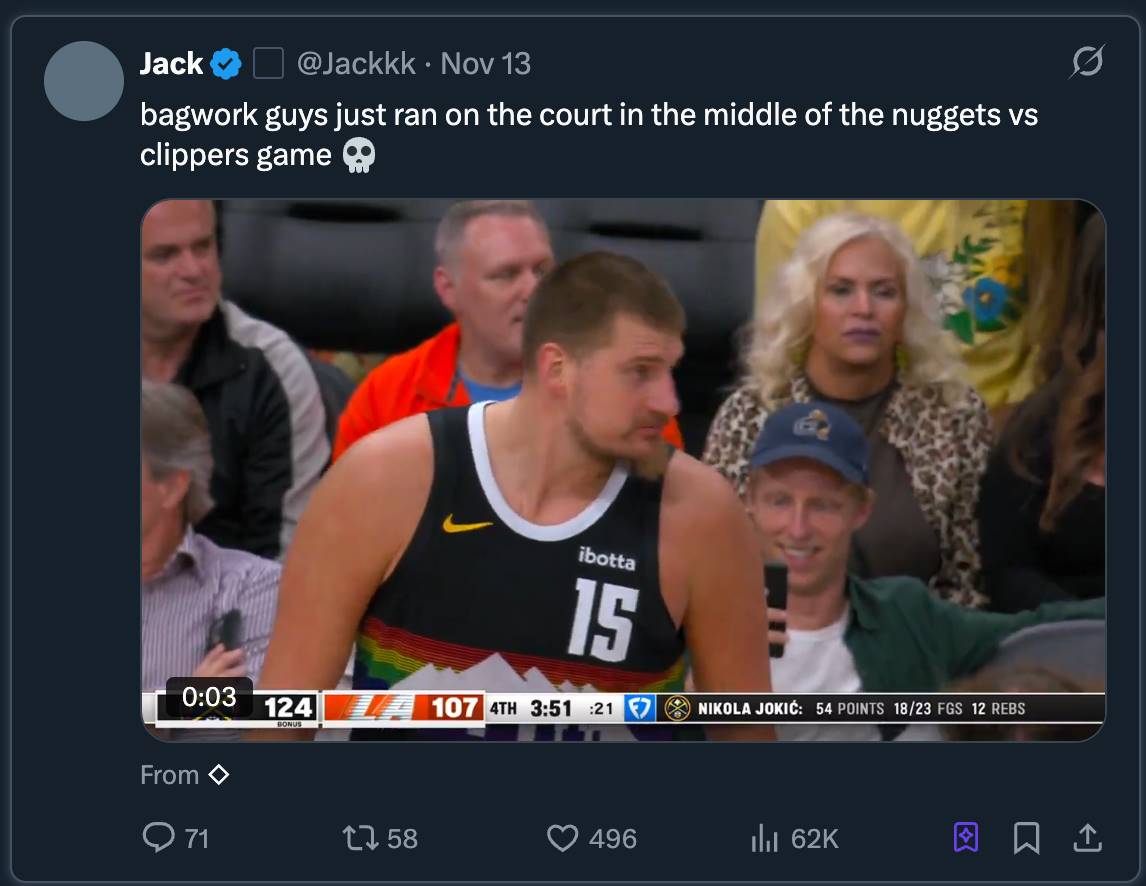
This viral explosion was led by a group of teenagers who, with some support from Pump, executed a series of sensational events: snatching Bradley Martyn's hat, storming the Dodgers' game field, rushing onto the Knicks' court, and even getting tattoos of Pumpfun and Bagwork.

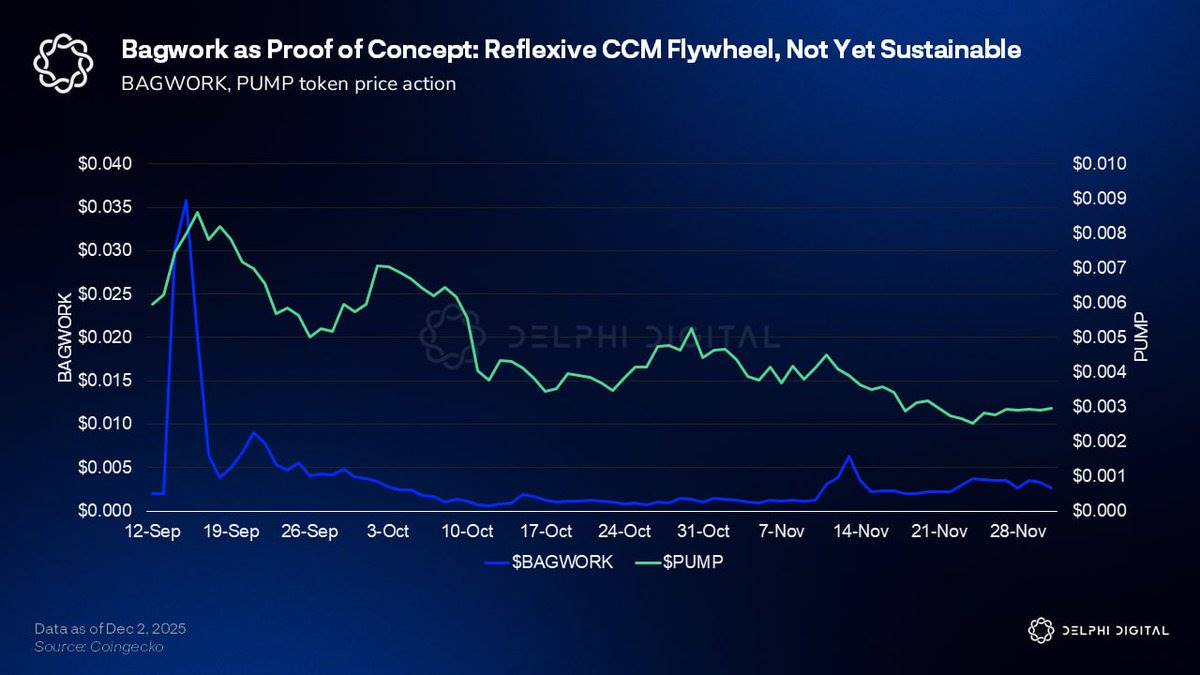
@onlybagwork 's rise almost perfectly coincided with the peak of Pump.fun's frenzy in mid-September. At that time, the fully diluted valuation (FDV) of $PUMP reached approximately $8.5 billion, and Bagwork's market cap once exceeded $50 million.

However, since then, no creator token has come close to such organic momentum or reached similar valuation peaks.

The Knicks court incident occurred more recently, long after the initial hype, and now Bagwork's market cap is just over $2 million.
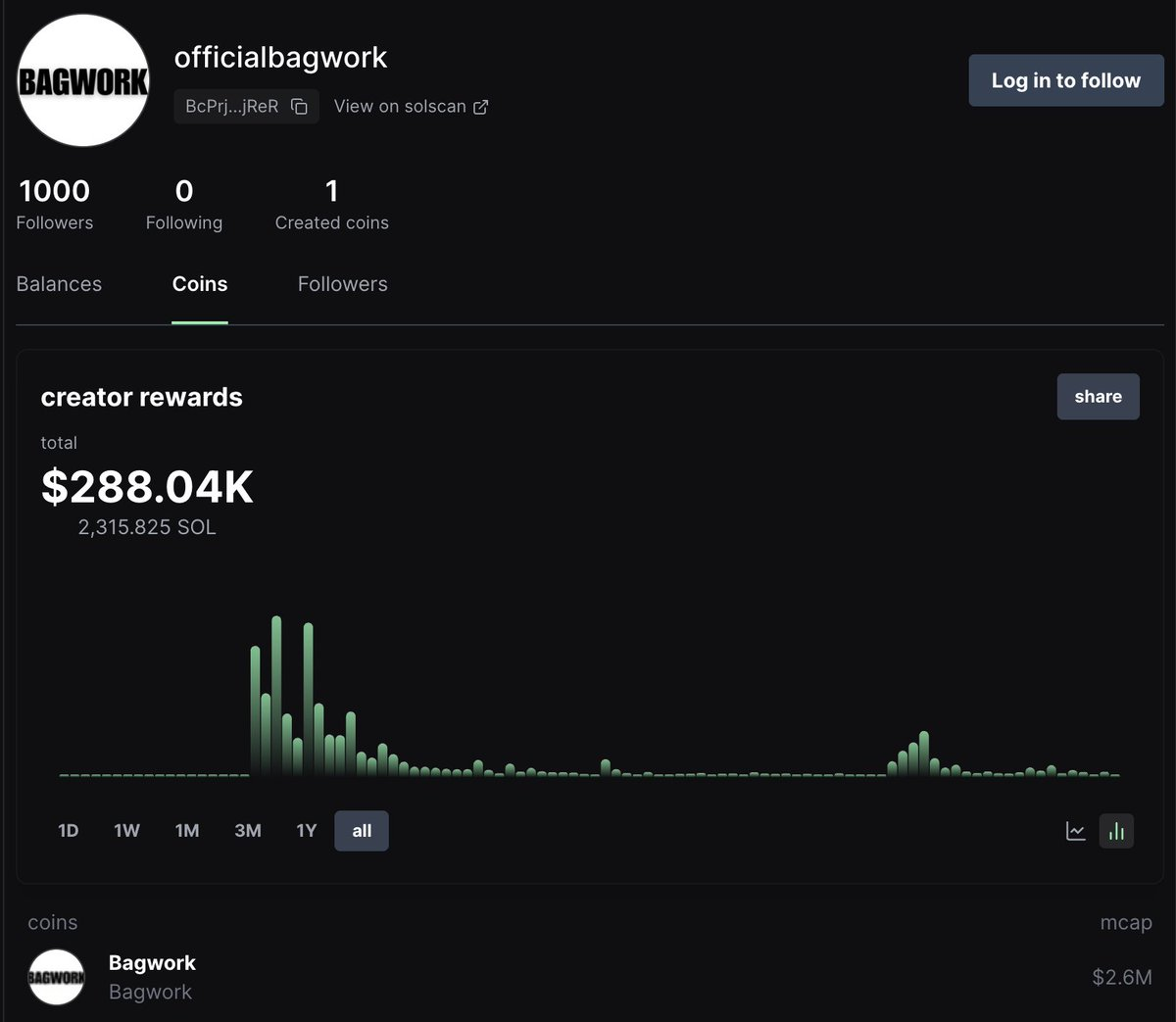
Bagwork is one of the few cases in Pump's streaming experiments that truly operated as intended. The Bagwork team earned over 2300 SOL in creator revenue from $BAGWORK trading fees (approximately $300,000 at current prices).

Notably, all of this was achieved without the team selling their holdings. Viral events directly translated into attention, trading volume, and fee revenue, creating Pump's closest case to a true creator token flywheel effect so far.

However, apart from Bagwork, Pump has struggled to realize its streaming vision. Creator tokens have consistently failed to maintain their value. This phenomenon can be traced back to a fundamental problem: the token itself is part of the product.

Currently, the economic rationale for owning or supporting a streamer's token remains unclear. Bagwork's early success quickly faded, and since then, every major streamer token has failed to gain similar traction, ultimately trending toward zero.
Creators can achieve short-term gains through the CCM fee structure, but the reputational risk associated with crashed tokens makes this model unattractive to larger, more established creators who could have helped the platform reach a broader audience. From a trader's perspective, these tokens remain a zero-sum game environment rather than genuine communities.

This is the most critical issue Pump needs to address as it enters 2026.

So far, the team has not made meaningful attempts at deeper creator incentive mechanisms, and airdrop allocations remain untouched. Apart from the informal support provided during the Bagwork frenzy, Pump has not taken any coordinated measures, such as targeted airdrops, creator rewards, or other incentive mechanisms that could have been used to kickstart early activities, create more PvE (Player vs. Environment)-style incentives, and provide creators with experimentation space without immediately disrupting their communities.

<极速mg style="max-width:100%;overflow:hidden;" src="https://d1x7dwosqaosdj.cloudfront.net/images/2025-12/00c4033fa2894c69972ce6c05278702e.jpg" alt="">

The good news is that this provides Pump with significant flexibility.

The unused "Community & Ecosystem Initiatives" fund pool remains a crucial lever the team can utilize once the model matures. If Pump can design a sustainable incentive structure for creator tokens, it will open up a new economic category for creators looking to leverage crypto mechanisms for monetization and audience expansion.

Although this potential gain is substantial, until then, streaming will continue to manifest as a series of short-lived hype cycles rather than a持久且可重复的垂直领域.

On the token side, the main catalyst driving $PUMP from around 0.025 to 0.085 was the team's decision to use 100% of net revenue for buybacks.
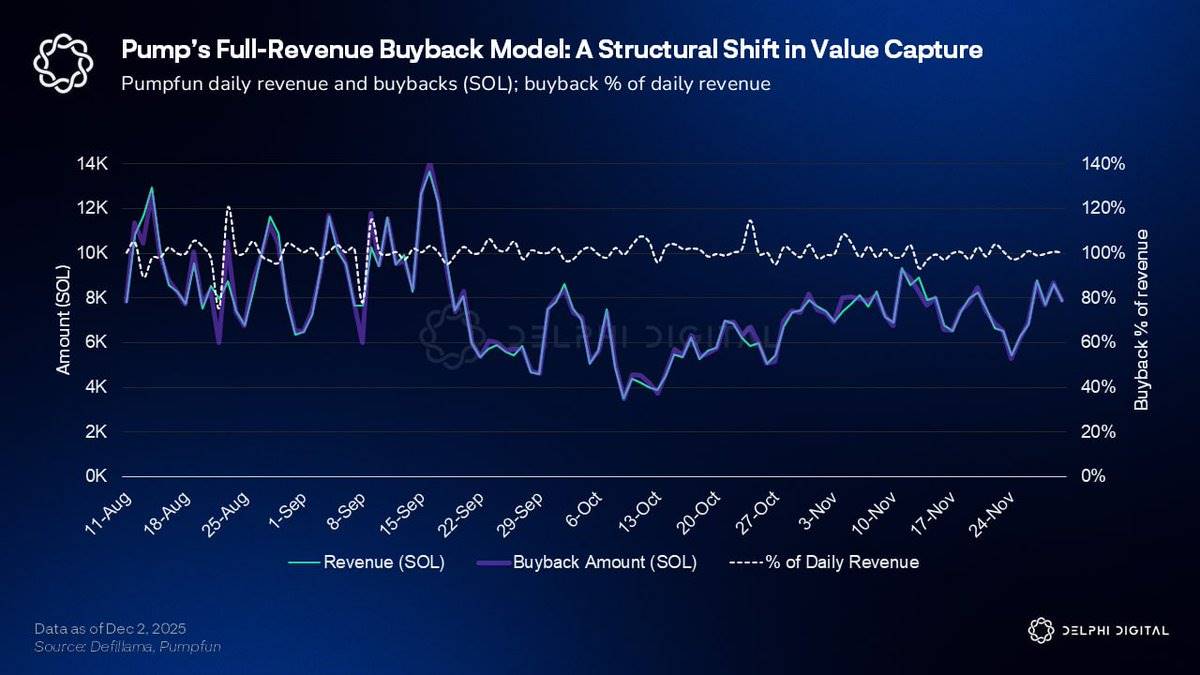
Pump shifted from initially planning to use about a quarter of its revenue for buybacks to almost entirely adopting a Hyperliquid-style buyback model. This change was made after the market clearly indicated that a partial buyback model would not be well-received. This shift ignited one of the strongest large-cap token rallies this year in a liquidity-scarce and challenging altcoin market.

In terms of the buyback-to-market cap ratio, no other major token currently trades at a lower multiple.
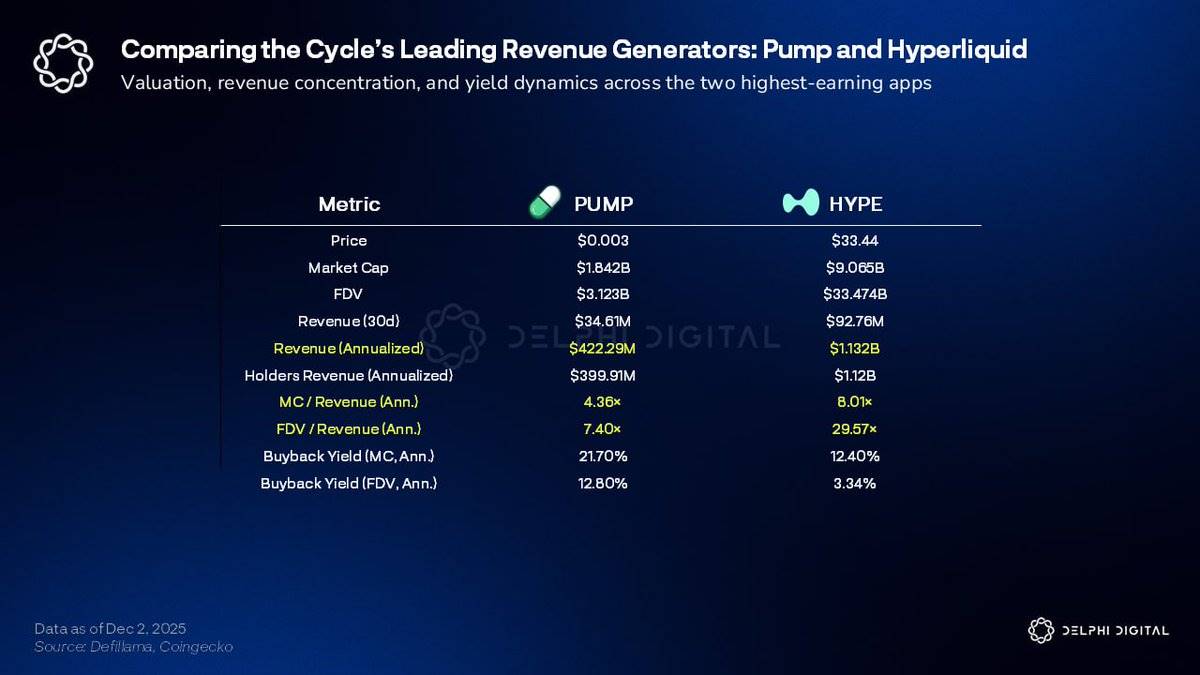
Based on current data, Pump's annualized revenue is $422 million, with a market cap of $1.84 billion, resulting in a market cap/revenue (MC/Rev) ratio of 4.36x and an annualized buyback yield of approximately 12.8%. This is significantly lower than other large-cap tokens, including Hyperliquid's约 8.01x MC/Rev and约 3.34% yield.

Even so, the market remains skeptical about Pump's long-term business prospects.

Market concerns may include: whether the team can consistently launch meaningful products; the impact of future unlocks on the market with约 40% of the token supply still locked; and uncertainty regarding the final allocation of airdrops and creator incentives. Additionally, the overall contraction of Meme coin activity in the crypto market, reduced end-user activity, and questions about the sustainability of Pump's revenue base also raise doubts.

Despite these concerns, Pump still dominates the Meme coin launchpad space. Even in the current extremely tough market environment, Pump still earns (and buys back) about $1 million daily.
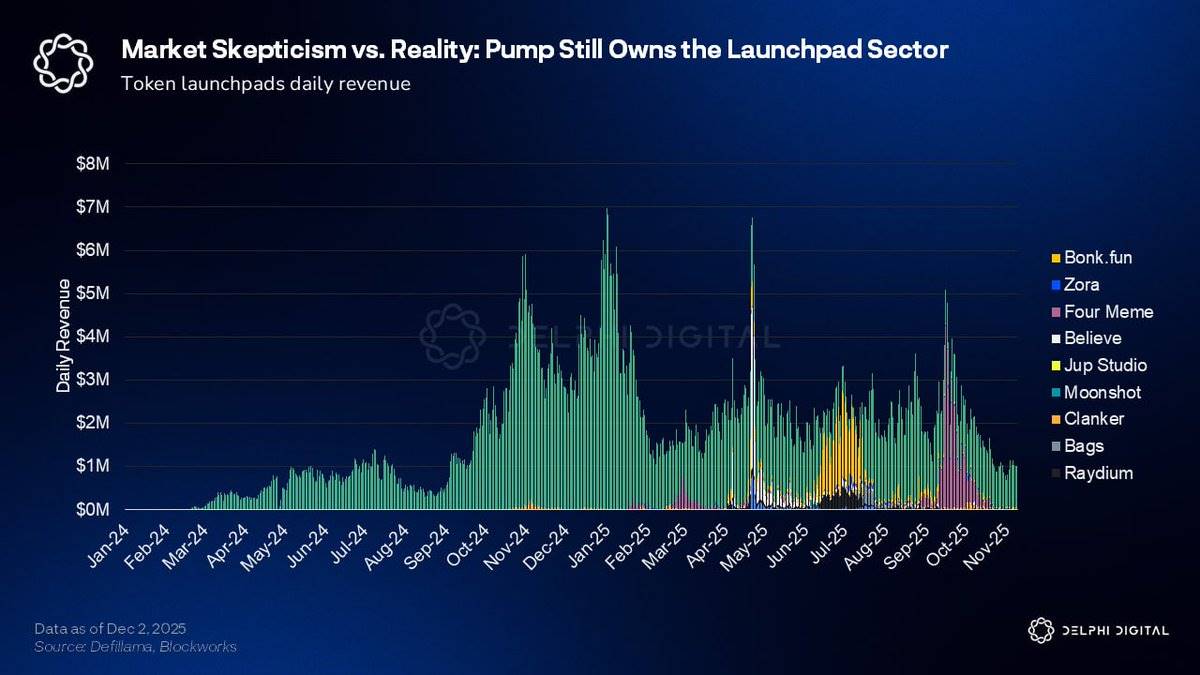
Pump's daily launchpad revenue has dropped by nearly 85% from its peak of almost $14 million earlier this year to currently around $2 million. However, competitors have only posed a threat for brief periods, failing to bring substantial challenges. This aligns with our prediction in the initial report regarding the短暂 Bonk and Raydium challenge phases: even during cyclical trading volume contractions, Pump has maintained structural advantages, dominating the industry's activity share.

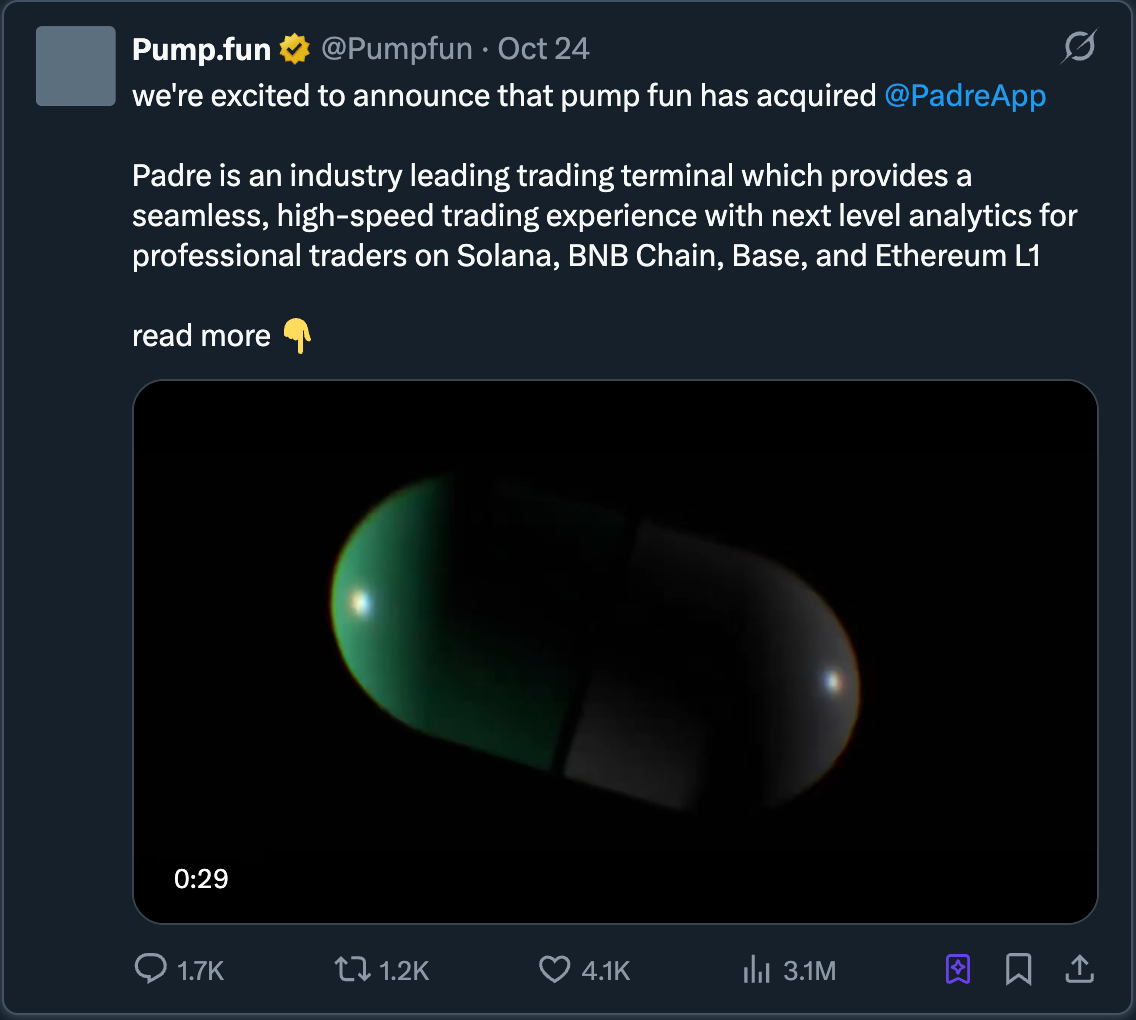
The acquisition of Padre supports the view that Pump intends to expand beyond Solana into a multi-chain ecosystem and has achieved support for BNB ecosystem assets through the Padre frontend. This also aligns with our earlier prediction that Pump would eventually acquire a terminal or terminal-related asset to strengthen user acquisition channels and integrate more of the user journey.
Beyond these actions, the team has recently maintained a low-profile strategy. An investor call is currently planned but has not been held as of writing, so more details may be disclosed later.

The leadership team has also expressed interest in the broader ICM (Initial Community Offering) category, although we believe this is not the core area of Pump's current brand positioning or product strengths. Pump initially tried the Believe model but failed to gain significant market attention. Meanwhile, MetaDAO has become the dominant player in the "high-quality founder + community" funding space.

Furthermore, the culture and structure of ICM seem less aligned with Pump's brand positioning. Pump's brand core revolves around speculation, speed, and the Meme culture of creators, rather than long-term governance or Futarchy-based systems. If Pump wants to succeed in the ICM space, they would need to lean towards more governance-focused structures and attract non-crypto teams looking to operate on-chain. However, this does not fully align with the needs and positioning of Pump's current users and creators. Although theoretically, ICM could offer certain potential gains if the team takes concrete action, we view this more as a secondary or optional direction rather than a natural extension of Pump's existing flywheel effect in 2026.
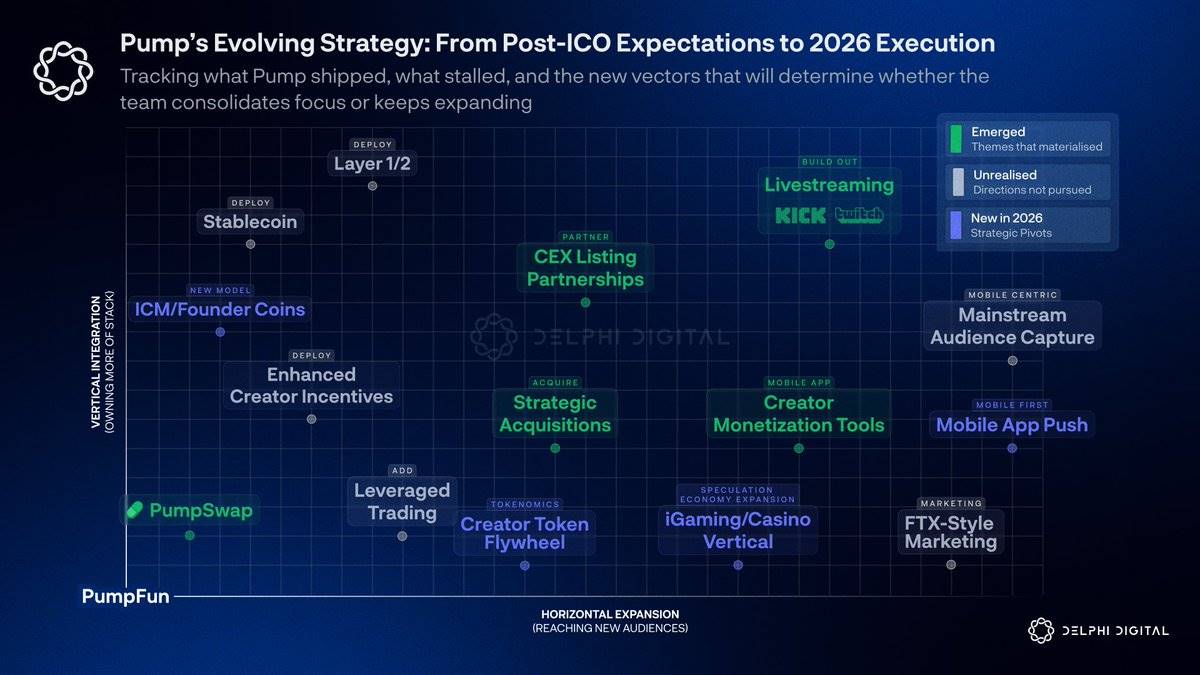
Looking ahead to 2026, Pump's main questions focus on the following aspects: whether it can finally establish an incentive-compatible creator token model; whether it can achieve substantial expansion into multi-chain markets through Padre; how to manage the risks associated with token unlocks and declining revenue visibility; and which product vertical to choose as its primary focus. Currently, Pump's strategy seems scattered across multiple directions, including streaming, ICM, and mobile.

At some point in the future, the team may need to clearly focus on a core breakthrough. For most of 2025, this breakthrough seemed to be streaming, but now this is no longer clear.

The bigger question is whether Pump can attract larger non-crypto creators. This may require redesigning the creator token flywheel mechanism, providing stronger, longer-term incentives to support viral spread beyond the crypto-native user base. Pump has the basic conditions to achieve this. The 2025 Bagwork frenzy briefly demonstrated the potential success of this model, when Pump seemed close to crossing the chasm.

Furthermore, Pump still has ample room to expand its product suite. One strategic direction the team should seriously evaluate is entering the iGaming or casino-related vertical. Adopting a model similar to Kick or Stake would naturally fit with Pump's speculation-driven user base. This direction would deeply synergize with its Meme coin and streaming strategic goals, and the profit potential in this field has already been proven.
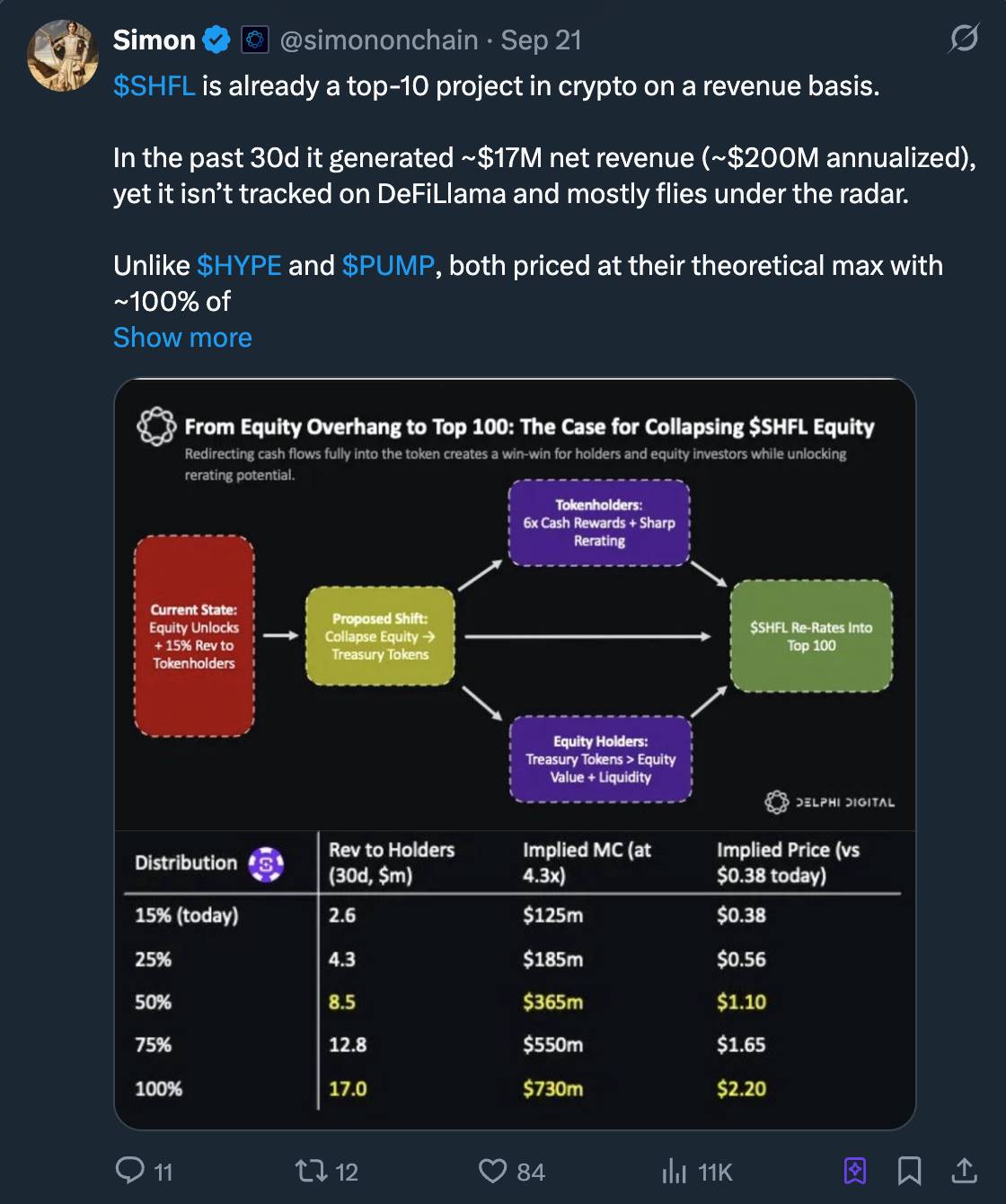
Shuffle's net gaming revenue and weekly lottery distribution demonstrate the huge potential of this field with successful execution.

Pump's mobile app is another underutilized advantage. Deeper expansion into mobile could broaden user acquisition channels, make the product more accessible to mainstream users, and provide creators with additional monetization scenarios. If combined with iGaming, this could not only significantly expand Pump's potential audience but also strengthen the platform's existing successful elements.

Despite the uncertainties, Pump remains one of the most resilient consumer applications of this cycle, maintaining its leading position even as the overall market landscape changes. Substantial progress in any key direction could trigger a significant shift in market sentiment and help Pump achieve a breakthrough, attracting a broader non-crypto-native user base.


Трендові криптовалюти

Пов'язані питання

QWhat was the core challenge that Pump.fun still faces according to the article?

AThe core challenge is balancing the crypto industry's short-term profit-seeking nature with the platform's long-term vision, particularly in creating a sustainable and incentive-compatible creator token model.

QWhich event was highlighted as the most significant case showing the potential of creator-driven tokens on Pump.fun?

AThe 'Bagwork' phenomenon, where a group of teens executed viral stunts, leading to a peak market cap of over $50 million for $BAGWORK and generating over 2300 SOL in creator fees without the team selling their holdings.

QWhat major change did the Pump.fun team make regarding its token $PUMP that acted as a key catalyst for its price surge?

AThe team decided to use 100% of its net revenue for buybacks, shifting from initially planning to use only about a quarter of the revenue, which ignited one of the strongest large-cap token rallies in the challenging altcoin market.

QWhat strategic acquisition did Pump.fun make to support its expansion beyond the Solana ecosystem?

APump.fun acquired Padre, which provided support for BNB chain assets through its front-end, indicating a move towards a multi-chain ecosystem.

QWhat new potential vertical does the article suggest could be a natural fit for Pump.fun's user base and strategic goals?

AThe article suggests entering the iGaming or casino-related vertical, similar to platforms like Kick or Stake, which aligns with Pump.fun's speculation-driven user base and could synergize with its meme coin and streaming strategies.

Пов'язані матеріали

The "Impossible Triad" Is Fundamentally a Pseudo-Problem

The article argues that blockchain's fundamental limitation is not the scalability trilemma (decentralization, scalability, security), which has been largely solved, but the lack of **privacy** and, until recently, clear **legitimacy**. Blockchain is described as a slow, expensive, globally shared computer whose core value is censorship resistance and verifiability. While ideal for native digital assets like money (e.g., stablecoins), its default transparency acts as a **tax**, exposing all transactions and enabling MEV extraction, which deters serious institutional capital. Simultaneously, its permissionless nature created regulatory ambiguity. The piece contends that **privacy** is the missing critical feature. It rejects the false choice between total transparency and complete anonymity. Modern cryptography (like zero-knowledge proofs) enables **compliant privacy**: users can prove facts (solvency, KYC status, compliance) without revealing the underlying sensitive data (specific holdings, identities). This preserves auditability for regulators and eliminates the leak of financial information. With recent regulatory progress (e.g., the GENIUS Act) addressing legitimacy, adding default, provably compliant privacy becomes a pure upgrade. It transforms blockchain from a costly, public ledger into a confidential settlement layer, finally bridging the gap to mainstream institutional and individual adoption of on-chain finance.

链捕手6 год тому

The "Impossible Triad" Is Fundamentally a Pseudo-Problem

链捕手6 год тому

Optical Chips: Collective Capacity Expansion

The global optical chip industry is experiencing a massive wave of expansion driven by surging AI data center demand. Major players across the US, Japan, Europe, and China are aggressively investing to ramp up production capacity. In the US, Coherent is expanding its 6-inch Indium Phosphide (InP) semiconductor fab in Texas, supported by CHIPS Act funding and a $2 billion strategic investment from NVIDIA. Lumentum is building a new factory for InP optical devices, and Nokia is scaling its advanced photonic chip packaging and testing capabilities. NVIDIA's investments aim to secure future supply of critical lasers and optical interconnect products for AI infrastructure. Japan's JX Advanced Metals, a leading InP substrate supplier, plans a multi-billion yen investment to increase its capacity 7-10 times, strengthening its grip on the crucial upstream materials market. In Europe, IQE and Tower Semiconductor settled a patent dispute and signed a multi-year InP epitaxial wafer supply agreement, highlighting that next-generation silicon photonics platforms will integrate high-performance InP components. STMicroelectronics and Sivers Semiconductors are also expanding silicon photonics production and partnerships. China is rapidly building out its domestic supply chain. Dongshan Precision's subsidiary, Source Photonics, announced a $12 billion project to expand optical chip and module production. Companies like Sanan Optoelectronics and Yunnan Germanium are scaling up InP chip manufacturing and substrate production, moving towards vertical integration from materials to modules. While debate continues around the exact future architecture—whether CPO (Co-Packaged Optics), NPO, or pluggables will dominate—analysts like Morgan Stanley argue the underlying driver is unchangeable: the explosive growth in bandwidth demand. This will inevitably increase the volume of optical engines, lasers, and related content per GPU, regardless of the final technical path. The competition for "more light" in the AI era has intensified into a global, full-chain capacity race.

marsbit8 год тому

Optical Chips: Collective Capacity Expansion

marsbit8 год тому

Stablecoins Finally Find Real Yield: An In-Depth Look at On-Chain Reinsurance Re | A Conversation with Re Founder Karan Saroya

Stablecoin Real Yield Found: A Deep Dive into On-Chain Reinsurance with Re's Karan Saroya As stablecoin supply exceeds $170 billion, the search for sustainable, non-speculative yield intensifies. Re, an on-chain reinsurance platform, provides an answer: connecting stablecoin capital to the trillion-dollar traditional reinsurance market. Re operates as a regulated reinsurer, accepting stablecoin deposits as collateral to back US insurance companies. These insurers pay premiums, generating yield that flows back to on-chain depositors. Currently supporting 35 insurers and underwriting $500 million, Re projects scaling to over $1 billion soon. Key insights from a Bankless podcast with founder Karan Saroya and investor Avichal of Electric Capital: 1. **Uncorrelated, Real-World Yield:** Re offers stablecoin holders access to reinsurance returns (targeting 12-14%+), an asset class entirely separate from crypto or equity markets. 2. **Operational Efficiency via Smart Contracts:** Re replaces traditional, labor-intensive capital fundraising with smart contracts, allowing a ~12-person team to compete with industry giants. 3. **Regulatory Leverage:** For every $1 of collateral, regulations allow backing $5-7 in written premiums. This leverage amplifies returns from the underlying risk-free rate. 4. **DeFi Integration:** Depositors receive receipt tokens, which can be used in protocols like Morpho for "looping," potentially pushing yields to 18-20%+. 5. **The "DeFi Mullet" Model:** A compliant front-end (regulated reinsurer) paired with a decentralized back-end (smart contracts, DeFi capital markets). 6. **RE Governance Token:** Modeled on Lloyd's of London, the token governs the central capital pool's allocation, counterparty acceptance, and parameters. 7. **Real Economic Impact:** Capital funds real-world productivity (factories, clinics, businesses) via insurance, moving beyond crypto's internal loops. The discussion highlights a pivotal moment: DeFi's supply-side infrastructure is now met by real demand for productive yield, potentially kickstarting a flywheel where vast on-chain stablecoin capital seeks these real-world returns.

链捕手10 год тому

Stablecoins Finally Find Real Yield: An In-Depth Look at On-Chain Reinsurance Re | A Conversation with Re Founder Karan Saroya

链捕手10 год тому

1996 or 1999? Walsh's First Test is 'How to View AI'

"1996 or 1999? Wall's First Big Test Is 'How to View AI'" Federal Reserve Chairman Wall's initial challenge is not whether to raise or cut rates, but a more fundamental judgment: what kind of boom is the current AI boom? This will determine the Fed's policy path and define his legacy. Economics is split between two opposing views, according to reporter Nick Timiraos. One sees imminent productivity gains that will increase supply and cool inflation, allowing the Fed to hold steady. The other argues that while productivity benefits are distant, demand shocks are here now, and waiting for data confirmation risks missing the intervention window, forcing sharper rate hikes later. Wall has signaled a leaning toward the first view, echoing 1996-era Alan Greenspan, who embraced strong, productivity-driven growth without fear of inflation. However, Wall faces a different macro environment than Greenspan did, with tariff pressures, expanding fiscal deficits, and diminishing globalization benefits, which could force more significant inflation pressures even if AI benefits materialize. Wall's logic, expressed before taking office, is that AI-driven productivity gains won't show in official data for years. If the Fed waits for confirmation, it might mistakenly tighten policy and choke off the very growth that could suppress inflation. This argues for using forward-looking narratives over lagging data. Chicago Fed President Austan Goolsbee presents a key counter-argument. He distinguishes between expected and unexpected productivity booms. A widely anticipated boom, like the current AI wave, can cause people to spend future wealth gains in advance, overheating the economy before productivity actually rises, thus requiring preemptive rate hikes. He cites rising costs for AI data centers as evidence of such overheating. Fed Governor Christopher Waller offers a rebuttal to Goolsbee, noting the "expected spending" mechanism only works if people can borrow against future income, which many households cannot do due to borrowing constraints. Wall also faces a paradox related to his desire to reduce the Fed's use of "forward guidance" (pre-announcing policy moves). This practice was established in 1999 when Greenspan began signaling hikes to avoid market shocks. If the economy follows a less optimistic path, Wall may be forced to choose between using the guidance he wants to abolish or risking market volatility by staying silent. The ultimate question defining Wall's first major test remains: Is this 1996 or 1999?

marsbit11 год тому

1996 or 1999? Walsh's First Test is 'How to View AI'

marsbit11 год тому

Торгівля

Спот
Ф'ючерси

Популярні статті

Як купити PUMP

Ласкаво просимо до HTX.com! Ми зробили покупку Big Pump (PUMP) простою та зручною. Дотримуйтесь нашої покрокової інструкції, щоб розпочати свою криптовалютну подорож.Крок 1: Створіть обліковий запис на HTXВикористовуйте свою електронну пошту або номер телефону, щоб зареєструвати обліковий запис на HTX безплатно. Пройдіть безпроблемну реєстрацію й отримайте доступ до всіх функцій.ЗареєструватисьКрок 2: Перейдіть до розділу Купити крипту і виберіть спосіб оплатиКредитна/дебетова картка: використовуйте вашу картку Visa або Mastercard, щоб миттєво купити Big Pump (PUMP).Баланс: використовуйте кошти з балансу вашого рахунку HTX для безперешкодної торгівлі.Треті особи: ми додали популярні способи оплати, такі як Google Pay та Apple Pay, щоб підвищити зручність.P2P: Торгуйте безпосередньо з іншими користувачами на HTX.Позабіржова торгівля (OTC): ми пропонуємо індивідуальні послуги та конкурентні обмінні курси для трейдерів.Крок 3: Зберігайте свої Big Pump (PUMP)Після придбання Big Pump (PUMP) збережіть його у своєму обліковому записі на HTX. Крім того, ви можете відправити його в інше місце за допомогою блокчейн-переказу або використовувати його для торгівлі іншими криптовалютами.Крок 4: Торгівля Big Pump (PUMP)Легко торгуйте Big Pump (PUMP) на спотовому ринку HTX. Просто увійдіть до свого облікового запису, виберіть торгову пару, укладайте угоди та спостерігайте за ними в режимі реального часу. Ми пропонуємо зручний досвід як для початківців, так і для досвідчених трейдерів.

322 переглядів усьогоОпубліковано 2024.12.12Оновлено 2026.06.02

Як купити PUMP

Обговорення

Ласкаво просимо до спільноти HTX. Тут ви можете бути в курсі останніх подій розвитку платформи та отримати доступ до професійної ринкової інформації. Нижче представлені думки користувачів щодо ціни PUMP (PUMP).

活动图片