New York Times Interview with Trump: 7 Key Points on the Logic of Power

Odaily星球日报Опубліковано о 2026-01-12Востаннє оновлено о 2026-01-12

Анотація

In a rare two-hour Oval Office interview, President Trump outlined his power philosophy to The New York Times, stating his authority is constrained only by his own morality, not international law. Key points include: He has chosen the next Fed Chair, demanding they support his low-interest-rate agenda. He ruled out pardons for figures like SBF, Maduro, or Sean Combs. U.S. control over Venezuela's oil may last "much longer" than expected. He defended his family's crypto and business dealings, citing public indifference. On sovereignty, he insisted owning Greenland is psychologically crucial versus leasing. He revealed a "de-naturalization" plan targeting some naturalized citizens, particularly Somali-Americans, for fraud. The interview showcased his "coercive diplomacy," using unpredictability and military threats to influence nations, as seen in a call with Colombia's president during the meeting.

Original | Odaily Planet Daily (@OdailyChina)

Author | jk
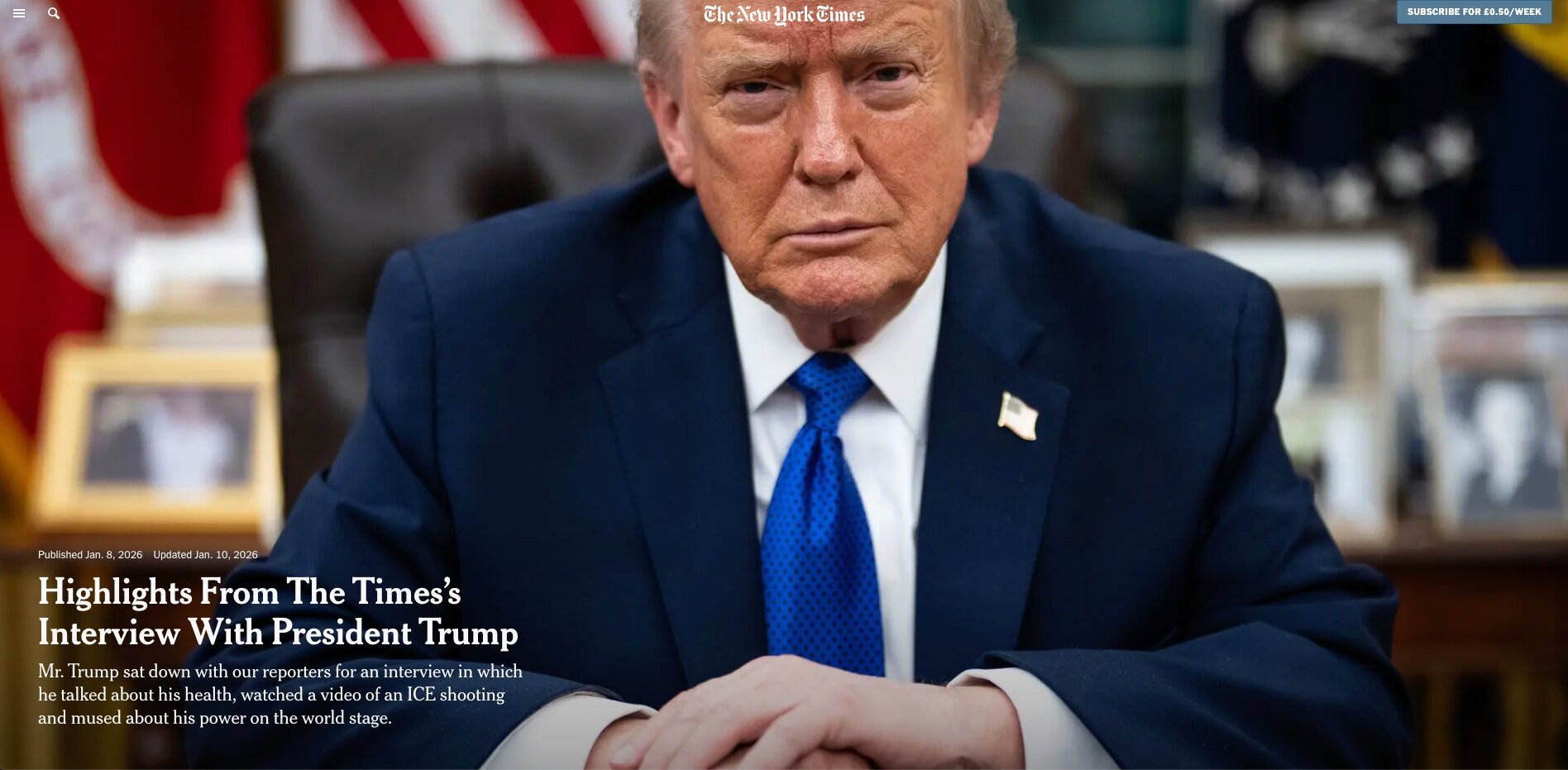
In the Oval Office of the White House this week, four New York Times reporters faced President Trump for a rare, nearly two-hour long interview.

"My power is constrained by only one thing, which is my own morality," Trump said. "I don't need international law." In the interview, he discussed topics ranging from Venezuela to Greenland, from the Federal Reserve to family business, and from immigration policy to pardon lists. This interview essentially clarified the logic of power for Trump's second term.

Here are the seven key points you need to know from this interview.

Has Chosen Next Fed Chair Nominee, But Refuses to Reveal

Trump stated that he has already decided whom to nominate as the next Federal Reserve Chair but refused to reveal the choice during the interview. "I've made a decision in my mind," he said during the interview on Wednesday evening, "but I haven't discussed it with anyone yet."

When specifically asked about his chief economic advisor, Kevin A. Hassett, Trump said, "I don't want to say," but described him as "certainly one of the people I like."

Treasury Secretary Scott Bessent stated at an event on Thursday that he expects Trump to make a decision on the Fed Chair this month, possibly around the time of the World Economic Forum in Davos. Bessent also hinted that the job was not guaranteed for Hassett, saying there were a total of four candidates.

According to the original purpose of the U.S. Congress, the Federal Reserve needs to be protected from political interference to ensure the central bank can pursue low and stable inflation and a healthy labor market unimpeded. But Trump has been outspoken in his desire to see the central bank act according to his wishes.

Trump made it clear that his choice for Fed Chair must support lowering borrowing costs, even stating outright that anyone who disagrees with his views would never get the job.

Whoever Trump chooses, the successor will take over the Fed at a critical juncture. At this moment, Trump is pressuring the Fed to significantly reduce borrowing costs. Powell will serve as Chair until his term ends in May; he has become a frequent target of Trump's attacks. It's hard to imagine what storm the next chair would face if they fail to meet the president's demands.

No Intention to Pardon SBF, Nor Other High-Profile Figures

Trump also stated he has no intention to pardon Sam Bankman-Fried. This question was raised when the New York Times asked Trump if he would pardon a series of high-profile individuals.

Other prominent figures mentioned included:

  • Nicolás Maduro: The recently captured leader of Venezuela, facing charges of narcoterrorism and conspiracy to import cocaine;
  • Robert Menendez: Former senator from New Jersey, convicted in 2024 for trading political influence for gold, cash, and a Mercedes convertible;
  • Sean Combs (aka Puff Daddy or Diddy): Reportedly wrote a letter to President Trump seeking a pardon, but Trump indicated he would not consider approving the request.

When asked if he would consider pardoning Derek Chauvin, the former Minneapolis police officer who knelt on George Floyd's neck during the 2020 arrest, Trump said, "No one has asked me that question."

Trump pardoned former Honduran President Juan Orlando Hernández last month, but when the New York Times asked if he would consider pardoning Maduro, who also faces drug trafficking charges, the president said, "No, I don't think so."

Maduro has pleaded not guilty to the federal charges.

U.S. Control Over Venezuela Could Last for Years

Trump indicated that U.S. oversight and oil extraction in Venezuela could last for many years. When asked if the duration would be three months, six months, a year, or even longer, he replied, "I would say much longer."

Trump expects the U.S. to operate in Venezuela for years to come and extract oil from the country's vast oil reserves. The U.S. has already announced it will receive 30 to 50 million barrels of Venezuelan heavy crude. However, Trump also acknowledged that reviving Venezuela's neglected oil industry will take years.

Trump expressed great pride in the successful operation to capture Maduro, stating he followed the training process of the operation forces throughout and revealed that the forces built a one-to-one scale model of the Caracas fortification at a military facility in Kentucky for this operation.

Trump emphasized that Maduro's allies, now the interim government, are "giving us everything we deem necessary."

Trump also sidestepped several questions: about why he recognized Maduro's vice president, Delcy Rodríguez, as the new leader of Venezuela, why he did not support opposition leader Machado, and made no mention of when elections would be held in Venezuela.

When asked how long the U.S. government would demand direct oversight of this South American country, he said, "Only time will tell."

Trump made these comments hours after government officials stated that the U.S. plans to effectively control Venezuela's oil sales indefinitely, as part of a three-phase plan outlined by Secretary of State Rubio to members of Congress.

"I Don't Need International Law," Trump Says His Power Is Constrained Only by "Own Morality"

When asked if there were any limits to his global power, Trump gave his most straightforward statement: "Yes, one thing. My own sense of morality. My own ideas. That's the only thing that stops me."

He added: "I don't need international law. I'm not out to hurt people." When the reporter pressed further on whether his administration needed to abide by international law, Trump said, "I will abide by it," but made it clear he would decide for himself when these constraints applied to the U.S. "It depends on what your definition of international law is," he said.

He made it clear that he would use his reputation for being "unpredictable" and his willingness to quickly resort to military action to coerce other countries.

Most notably, shortly after the New York Times journalists sat down with him, Trump paused the interview to take a call from Colombian President Gustavo Petro. Days earlier, Trump had threatened action against Colombia because the country is a hub for drug trafficking.

The content of the conversation was not public, but the leader was apparently concerned about the possibility of a U.S. attack on Colombia similar to the one on Venezuela.

After the call with Petro, Mr. Trump dictated a social media post to an aide, stating that the Colombian president had called "to explain the drug situation."

After the call, which lasted about an hour, the New York Times reporters noted that "the call seemed to remove any immediate threat of U.S. military action." Trump subsequently stated that he believed the collapse of the Maduro regime had intimidated other leaders in the region, "making them compliant."

The New York Times claimed they witnessed the actual operation of Trump's "coercive diplomacy" firsthand.

Greenland Sovereignty Issue: Trump Insists on "Ownership"

Trump reiterated his stance that the U.S. must own Greenland, claiming that merely reopening a military base on the land under the 1951 treaty is insufficient.

"Ownership is very important," Trump said. The New York Times commented that he discussed Greenland with a "real estate magnate's eye." The land is three times the size of Texas but has a population of less than 60,000. "I think psychologically, ownership is necessary for success. Whether you're talking about a lease or a treaty, ownership gives you something you can't get otherwise. Ownership gives you elements that signed documents cannot provide."

When asked whether Greenland or NATO was a higher priority, Trump refused to answer directly but admitted "it might be a choice." He made it clear that without the U.S. at its core, the transatlantic alliance was largely useless.

Family's Crypto Activities and Overseas Business Deals "Not a Problem"

In the interview, Trump made it clear that concerns about conflicts of interest raised by his family's global money-making activities over the past year do not bother him at all.

"I banned them from doing business in the first term, but got absolutely no credit for it," he said. "I didn't have to do that. It was really unfair to them." He added: "I found that nobody cared, and I'm allowed to do it."

Donald Trump Jr. has previously expressed similar views, but the president responded more comprehensively than in the past to concerns about his family's economic interests. The White House has repeatedly stated that Trump and his family never engage in conflicts of interest and that he always puts the interests of Americans first.

He also added that he has never accepted his presidential salary.

Trump defended his support for the cryptocurrency industry, which his family has become a major player in. "I got a lot of votes for supporting crypto, and I'm starting to like it," Trump said. "But he stated that the strong push for cryptocurrency was to make the U.S. the global leader in the industry.

Advancing "De-naturalization" Plan, Specifically Targeting Somali-Americans

Trump stated that his administration is taking steps to revoke the citizenship of some naturalized Americans, with a particular focus on people of Somali origin.

"I wouldn't hesitate to do it if they were dishonest," Trump said during the Oval Office interview. "I think many people from Somalia, they hate our country."

Trump said his administration is reviewing the criteria for denaturalization. He indicated this measure is not limited to the Somali community but refused to specify which other groups of foreign-born U.S. citizens his administration is targeting.

This would be a significant escalation of Trump's immigration crackdown, which has already begun to extend beyond targeting illegal immigrants. The New York Times reported last month that the administration issued guidance to USCIS field offices instructing them to "provide 100-200 denaturalization cases per month to the Office of Immigration Litigation in FY 2026."

Under federal law, citizenship can only be revoked if the person committed fraud on their citizenship application or in a few other specific circumstances. But activists warn that the denaturalization effort could sweep up those who made honest mistakes on their citizenship paperwork.


Пов'язані питання

QWhat did Trump say about the constraints on his power during his interview with The New York Times?

ATrump stated that his power is constrained by only one thing: his own morality. He said, 'I don't need international law,' and indicated that he would decide when such constraints apply to the United States.

QHas Trump selected the next Federal Reserve chair, and what are his criteria for the nominee?

AYes, Trump has decided on his nominee for the next Federal Reserve chair but has not revealed the name. He emphasized that the nominee must support lowering borrowing costs and that anyone who disagrees with his views would not get the job.

QDid Trump express any intention to pardon Sam Bankman-Fried or other high-profile figures like Nicolás Maduro?

ANo, Trump said he has no intention of pardoning Sam Bankman-Fried, Nicolás Maduro, or other figures like Robert Menendez and Sean Combs. He also mentioned he hasn't been asked about pardoning Derek Chauvin.

QHow long does Trump expect the U.S. to maintain control over Venezuela's oil and governance?

ATrump indicated that U.S. control over Venezuela's oil and governance could last 'much longer' than short-term estimates, potentially spanning several years. He acknowledged that revitalizing Venezuela's oil industry would take time.

QWhat is Trump's stance on Greenland, and how does he view its importance to the U.S.?

ATrump reiterated that the U.S. must own Greenland, emphasizing that 'ownership is very important' for psychological and strategic success. He believes ownership provides advantages that leases or treaties cannot, and he discussed it from a real estate perspective.

Пов'язані матеріали

KOL's Perspective: Why Is SOL Set to Rise from This Point?

**Summary: Why SOL is Positioned for Growth at This Level** The article argues that SOL is poised for an upward move from its current price point, citing several key factors. Primarily, SOL has just broken out of a 4-month consolidation phase. This breakout signals a return of risk appetite to the broader crypto market, as SOL is seen as a key indicator of overall crypto health. The token's ownership has reportedly shifted from short-term traders and tourists to long-term accumulators, leading to low volume. Any meaningful increase in trading activity could thus trigger significant upward momentum. Fundamental strengths include strong institutional adoption, integration with DeFi and RWAs (Real-World Assets), and the potential benefits from the Clarity Act. Despite its high volatility—having dropped 70% from its all-time high but still up 12x from its bear market low—SOL is highlighted as one of the few tokens from the last cycle to reach new highs. It boasts a robust ecosystem of applications, users, and protocols. Future catalysts include the expected influx of AI developers following the Miami Accelerate conference, which focused on AI on Solana. Furthermore, Solana is positioned as the premier chain for memecoin activity, a trend expected to continue and drive network usage and fees. The article concludes that recent price action reflects a healthy transfer to long-term holders, setting the stage for growth.

marsbit18 хв тому

KOL's Perspective: Why Is SOL Set to Rise from This Point?

marsbit18 хв тому

Those Pre-Bitcoin PoW Protocols Have Recently Been Reimplemented

This article details a recent surge in replicating pre-Bitcoin Proof-of-Work (PoW) protocols, specifically focusing on Hal Finney's 2004 RPOW (Reusable Proofs of Work). Within five days in May 2026, multiple independent builders in the Bitcoin/cypherpunk community launched projects inspired by this early electronic cash proposal. The initiative began with Fred Krueger's `rpow2.com`, a centralized but auditable system that replaced RPOW's original IBM 4758 hardware with Ed25519 signatures. Initially a faithful replica, it later adopted Bitcoin-like features (21M supply cap, difficulty adjustment) and a controversial 5.24% founder allocation. This sparked rapid forks, including `rpow4.com` which incorporated full Bitcoin parameters, a prediction market (`rpowmarket.com`), and a DEX (`rpow2swap.com`). Concurrently, Mike In Space created a prototype of Wei Dai's 1998 b-money proposal (`b-money.replit.app`), pushing the historical exploration even further back. The article contrasts these centralized, server-dependent experiments with Bitcoin's core innovation of decentralized, trustless consensus. It also highlights a parallel development: the `HASH` project on Ethereum, which uses smart contract hooks to enable a purely fair-launch, browser-mineable PoW token with 0% allocations to team or VCs. The collective activity is framed as a meme-driven, educational exploration of cypherpunk history rather than a serious financial movement, with all projects heavily disclaiming any investment value.

marsbit22 хв тому

Those Pre-Bitcoin PoW Protocols Have Recently Been Reimplemented

marsbit22 хв тому

South Korean Exchanges 'Battle' Regulators, Challenging the Boundaries of Enforcement and Legislation

South Korea's cryptocurrency industry is engaged in a rare, direct confrontation with regulators. The Financial Intelligence Unit (FIU), the primary anti-money laundering (AML) watchdog, has recently imposed heavy penalties on major exchanges like Upbit and Bithumb for alleged violations involving unregistered overseas VASPs and AML procedures. However, exchanges are now actively challenging these actions in court and through industry associations. In a significant shift, the Seoul Administrative Court ruled in favor of Upbit's operator, Dunamu, overturning part of an FIU-ordered business suspension. The court found the FIU's penalty criteria and justification insufficiently clear. Similarly, the court suspended the enforcement of a six-month business suspension against Bithumb pending a final ruling, citing potential irreversible harm to the exchange. Beyond legal battles, the industry is contesting proposed legislative amendments. The Digital Asset eXchange Alliance (DAXA) strongly opposes a draft rule that would mandate Suspicious Transaction Reports (STRs) for all crypto transfers over 10 million KRW (~$6,800). DAXA argues this "poison pill" clause violates legal principles and would overwhelm the STR system, increasing reports from 63,000 to an estimated 5.45 million annually for major exchanges, thereby crippling effective AML monitoring. This conflict highlights a structural tension in South Korea's crypto governance: comprehensive digital asset laws are still developing, while regulators rely heavily on AML enforcement. The industry's move from passive compliance to active legal and legislative challenges signifies a new phase, pressing for clearer rules and more proportionate enforcement. While short-term disputes may intensify, this clash could ultimately lead to a more mature and sustainable regulatory framework for South Korea's vibrant crypto market.

marsbit1 год тому

South Korean Exchanges 'Battle' Regulators, Challenging the Boundaries of Enforcement and Legislation

marsbit1 год тому

After 50x Storage Surge, Justin Sun Always Looks to the Next Decade

Sun Yuchen, known for his controversial stunts like a $30 million lunch with Warren Buffett (canceled due to a kidney stone) and eating a $6.2 million duct-taped banana, is often overshadowed by a significant fact: his decade-long track record of spotting major investment trends. In 2016, he famously advised young people to invest in Bitcoin, Nvidia, Tesla, and Tencent instead of buying property. A hypothetical $20,000 investment in Nvidia and Tesla from that list would now be worth over 50 million RMB. His latest major call was on November 6, 2025, predicting a "50x storage opportunity" tied to the AI boom, which materialized with Sandisk's stock surging nearly 50-fold by 2026. Looking ahead, Sun now focuses on the next frontier: Physical AI. He identifies four key areas: 1. **Embodied AI/Robotics**: He sees this reaching its "iPhone moment," with companies like UBTech and Galaxy General leading in commercialization. 2. **Drones**: Viewed as the first commercially viable form of Physical AI, revolutionizing sectors from warfare (e.g., AeroVironment's Switchblade) to logistics. 3. **Spatial Computing**: Beyond VR, it's about AI understanding physical space, a foundational technology for robotics and autonomous systems, exemplified by Apple's Vision Pro. 4. **Space Exploration**: After a 2025 suborbital flight with Blue Origin, Sun advocates for space as the ultimate frontier, discussing blockchain's potential role in space asset management and data transactions. His investment philosophy involves betting on entire, inevitable trends rather than single companies. For robotics, he sees Tesla (the body/manufacturer) and Nvidia (the brain/AI platform) as complementary plays. In defense drones, he highlights companies making tanks obsolete (AeroVironment) and those augmenting fighter jets (Kratos). For space, he participated in Blue Origin's flight and anticipates SpaceX's potential IPO to redefine the sector's valuation. Sun Yuchen's vision frames the next two decades not as a revolution in information flow (like the internet), but in the fundamental operation of the physical world through AI-powered robots, autonomous systems, and spatial intelligence, ultimately extending human and AI activity into space. While many still focus on conventional assets, he continues to look toward the next technological horizon.

marsbit2 год тому

After 50x Storage Surge, Justin Sun Always Looks to the Next Decade

marsbit2 год тому

Торгівля

Спот
Ф'ючерси
活动图片




