New Paradigms and Investment Logic in the Era of AI+Web3

marsbitОпубліковано о 2026-05-21Востаннє оновлено о 2026-05-21

Анотація

In the era of AI+Web3, a venture capital firm shares insights from reviewing numerous projects. The AI industry is seen as still early-stage, structured in a "seven-layer matrix" from power infrastructure to AI agents. Investment timing is crucial, especially in cyclical sectors like AI data centers. The integration of AI and Crypto is deemed essential for two reasons: 1) AI agents require "financial sovereignty" for micro, high-frequency, machine-to-machine transactions, and 2) blockchain provides trust and auditability to address AI "hallucinations" and ensure transparency. The core investment principle is "honesty." Teams must be genuine, not hastily assembled, and products must be substantiated by real metrics, not just flashy demos. Projects built on honesty are valued for long-term success over short-term hype. Looking ahead, the most underestimated opportunity for 2026 is the deep fusion of AI, blockchain, and entertainment. While most investment focuses on B2B infrastructure like payments and decentralized computing (DePIN), the future lies in consumer applications. As AI automates most human labor, society will shift towards leisure, creating massive demand for high-quality entertainment. AI can power immersive experiences (e.g., NPCs with autonomous consciousness in games), while blockchain secures digital ownership and economic systems. This convergence could unlock tremendous value in user time and capital within virtual worlds. *Disclaimer: The content represe...

In recent years, the AI concept has been everywhere, with large models and decentralized technology intertwining, creating a dizzying array of developments. As a VC firm, we have reviewed hundreds of crossover projects and want to share some hard truths — including the real cycle of the AI industry, why AI cannot do without Crypto, and what we value most and are most wary of when evaluating projects.

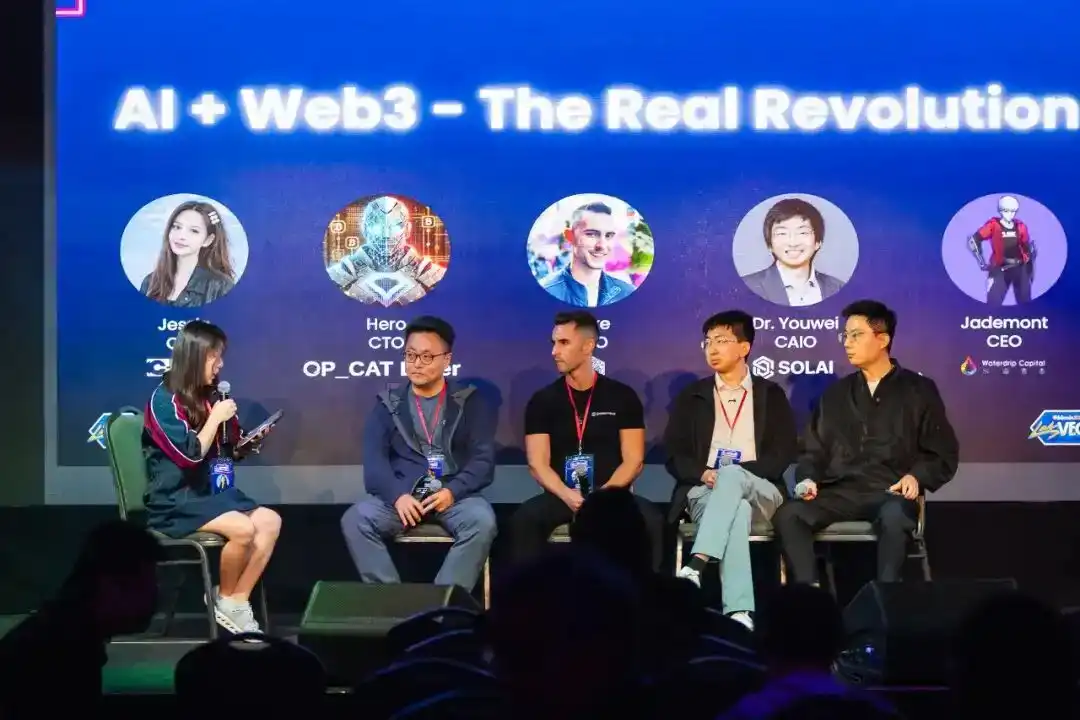
Note: The content of this article is excerpted from the roundtable discussion "AI+Web3-The Real Revolution" at the "AI + Bitcoin, the Next-Gen Revolution - BTC Vegas Side Event" held on April 28th.

I. The "Seven-Layer Matrix" and Investment Cycle of the AI Industry

Although giants like OpenAI, Anthropic, and Google are currently riding high and seem poised to dominate everything, our research indicates that the entire AI industry is still in a very early stage.

Being in an early stage doesn't mean one can invest blindly now, especially in overheated areas like AI hardware manufacturing, which require cooler heads. In our view, the AI industry chain can be broken down from bottom to top into seven different layers, and how to invest money in each layer is completely different:

• Layer Seven: AI Agents

• Layer Six: Token Optimization

• Layer Five: Token Distribution

• Layer Four: Large Language Models

• Layer Three: GPUs

• Layer Two: AI Data Centers

• Layer One: Power Infrastructure
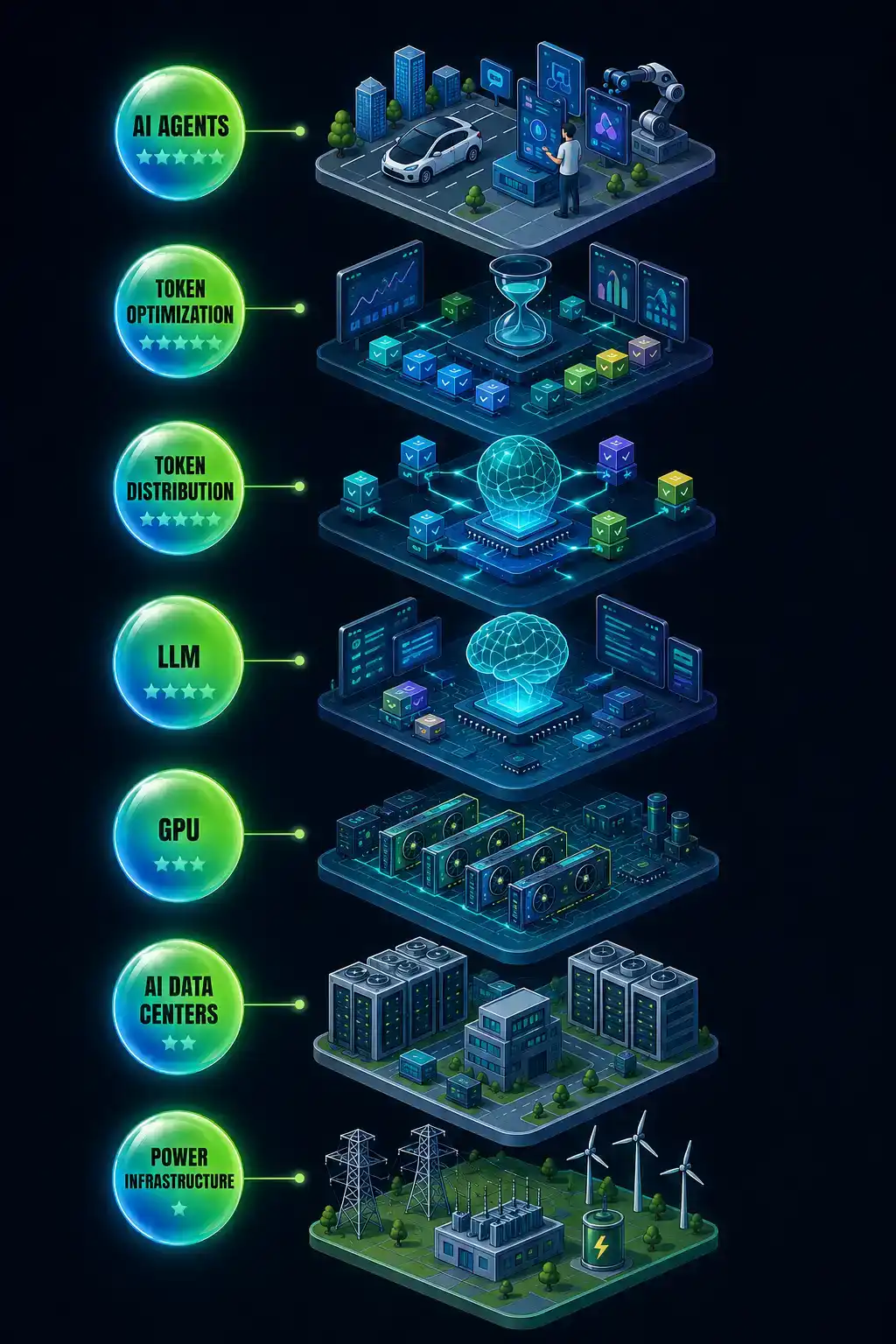
Take Layer Two, AI Data Centers, as an example. This is a typical cyclical industry. Over the past two years, global capital has been frantically buying land, building facilities, and expanding with heavy assets. However, there is a time lag between when this capacity is built, powered up, and actually brought to market. Based on our observations, this massive wave of capacity is likely to come online around 2028.

This means that if people are still single-mindedly pouring money into traditional data centers next year or even now, they will likely run headfirst into severe oversupply when everyone opens for business around 2028. Rents and returns will plummet, and capital that jumps in late will have a tough time. Therefore, aligning with the cycle and timing correctly is key.

Back in 2024, we believed there was a significant opportunity in the AI computing power layer, particularly in the crossover area of using Web3 methods for computing power scheduling. So, we focused a lot of effort and capital there. Currently, an AI computing power infrastructure company in which we are a major shareholder is in the final stages of preparing for a Nasdaq listing.

II. Why Are AI and Crypto Inseparable?

Many people often ask: Why does AI need Crypto when Web2's large models are already so powerful? In our view, this is not a forced concept mashup. Rather, there are two things that traditional Web2 cannot solve as AI advances:

1. In the Near Term: Payment — AI Agents Need Their Own "Financial Sovereignty"

Traditional bank cards, PayPal, or gateway payments are all designed for "humans," with an extremely cumbersome identity verification and centralized settlement process. But the transaction model for future AI Agents collaborating with each other is completely different.

Their interactions often involve extremely micro-amounts (e.g., spending $0.0001 to buy a few seconds of computing power), ultra-high frequency, and continuous transactions. If they go through traditional channels like Visa, the fees could exceed the transaction amount. More importantly is the issue of "payment sovereignty": AI Agents have autonomous execution capabilities. As they evolve to a certain level, they will inevitably need to own and have absolute control over their own wallet accounts, rather than forever relying on human physical bank cards or worrying about having their API accounts shut down by centralized giants at any moment. Cryptocurrency payments on the blockchain are currently the only technological means that allows machines to settle autonomously with each other.

2. In the Long Term: Trust — Guarding Against Hallucinations and Credible Audits

Everyone using large models now knows they sometimes fabricate things, the so-called "hallucination rate." In the traditional Web2 black box, when an AI provides a wrong or biased answer, it's difficult for humans to investigate: Is this a random technical hallucination, or is the centralized giant behind it intentionally manipulating the algorithm, poisoning data, or deceiving people?

This creates a hard need for blockchain. Pushing key AI operational data, prompt records, and call paths onto the chain in real-time can create an immutable, traceable, and auditable evidence storage system. This isn't just about defining data property rights; it's a reliable path for humans to supervise and verify whether AI behavior is compliant in the future.

III. Investing in Projects: Using "Honesty" as the Measuring Stick

Every year, we see thousands of business plans for AI + Web3. After reviewing so many stories, the core screening principle we've settled on is actually just two words: Honesty. This sounds like simple common sense, but in the current浮躁 industry, it might be the rarest quality. We break down honesty into two levels:

1. The Team Must Be Honest — Reject Packaging and Patchwork

The resumes of founders and core teams must have no falsification or excessive boasting. In the industry today, we often see hastily assembled teams. To catch a bull market or chase a trend, they forcefully slap together labels like "big company scientist" or "prestigious school background," but there's zero internal team chemistry. Such projects often fall apart at the first sign of a technical bottleneck or market adjustment. A team that can truly succeed needs complementary skills, and the founder's background must be genuine — someone who is earnest about building something.

2. The Product Must Be Honest — Reject PPT-Driven Hype and False Metrics

What a product can actually achieve, how its user data looks — these must be supported by tangible underlying metrics like code and node counts. We've seen too many projects that simply wrap an OpenAI API on the frontend, change the interface, and then dare to claim in their PPT that they are an "autonomous native large model," using a fake demo to fool investors. On the product level, one must be realistic, able to genuinely solve problems.

In the capital markets, dishonest projects driven by hype and fabrication might, in the short term, inflate their valuations highly in secondary markets or exchanges through fancy financial engineering. But because there's no real underlying business supporting them, once the bubble bursts, their ultimate fate is inevitably to go to zero.

Conversely, projects that work diligently and honestly might seem slower initially because they disdain hype and fraud, perhaps even appearing a bit笨 in the eyes of some speculative capital. But because they have a solid foundation, they can often go the distance. In investing, slow is fast. These long-lasting projects are the ones we are willing to invest in and support strategically.

IV. The Most Underestimated Opportunity in 2026: The Ultimate Fusion of AI + Blockchain + Entertainment

Finally, regarding future opportunities that everyone hasn't yet noticed or that are severely underestimated. Based on our research, what we're most excited about is actually the deep integration of AI + Blockchain + Entertainment.

Currently, most market capital is focused on relatively hardcore, dry B2B infrastructure like AI payments and decentralized computing (DePIN). These tracks are important, but the competition is too fierce. People are overlooking the consumer end, which is best at attracting mass users and retaining capital.

Our observation and logic are as follows: As large models and Agents mature, AI, as an efficient labor force, will inevitably replace the vast majority of repetitive white-collar and blue-collar human jobs in the future. When productivity becomes extremely abundant and material costs are extremely low, human society will undergo a fundamental transformation — most people won't need to work forced jobs just to make ends meet. At that time, the demand for吃喝玩乐 will explode. Where will human time and energy go? High-quality entertainment is an inevitable destination.

Future entertainment should fully integrate AI.

Take gaming as an example. Every NPC in the game could have autonomous consciousness, with their own memories, personalities, and social relationships. When players enter the game, they no longer face a repeater bot, but a "living person" who develops emotions based on your actions and words, and might even spontaneously conduct transactions with you on-chain. The integration of AI will lead to a qualitative leap in the freedom and enjoyment of games.

And blockchain's role here is "property rights": it defines land ownership, the uniqueness of rare items in this virtual world, and uses Tokens to establish economic order.

When people no longer need to work in reality and pour a large amount of time, energy, and even assets into such a fun, AI-driven virtual world where assets belong to the players themselves, the commercial value unleashed within will be terrifying. We are currently actively looking for pioneers in this direction. This could be the next narrative that ignites the entire industry.

Disclaimer: The content of this report represents only the author's and the institution's industry research views. It is intended for industry discussion only and does not constitute any investment advice.


Пов'язані питання

QAccording to the article, what are the seven layers of the AI industry from bottom to top, and which layer is considered a typical cyclical industry?

AAccording to the article, the seven layers of the AI industry from bottom to top are: First layer: Power infrastructure; Second layer: AI data centers; Third layer: GPU; Fourth layer: Large language models; Fifth layer: Token distribution; Sixth layer: Token optimization; Seventh layer: AI agents. The second layer, AI data centers, is identified as a typical cyclical industry, with concerns about a potential supply glut around 2028 due to a time lag in bringing new capacity online.

QThe article argues that AI and Crypto are inseparable. What are the two key reasons provided for this, focusing on immediate and long-term needs?

AThe article provides two key reasons why AI and Crypto are inseparable. The immediate need is for payments: AI Agents require their own 'financial sovereignty' for micro, high-frequency, continuous transactions between machines, which traditional payment systems are ill-suited for. The long-term need is for trust: Blockchain provides a solution for auditing and verification, creating an immutable record to track AI data, prompts, and execution paths. This helps distinguish between technical 'hallucinations' and potential deliberate manipulation by centralized entities, ensuring accountability.

QWhat is the core principle the VC firm uses to filter AI+Web3 projects, and how is this principle broken down into two specific aspects?

AThe core principle the VC firm uses to filter AI+Web3 projects is 'honesty'. This principle is broken down into two specific aspects: 1. Team Honesty: Rejecting packaging and fabrication. Founders and core teams must have genuine, non-exaggerated backgrounds, and the team must be cohesive rather than hastily assembled. 2. Product Honesty: Rejecting PPT-driven pitches and fake metrics. The product's capabilities must be supported by real underlying code, node counts, and other tangible indicators, not just superficial demos built on third-party APIs.

QWhat future opportunity does the article identify as the most underestimated for 2026, and what is the core logic behind this prediction?

AThe article identifies 'AI + blockchain + entertainment deep fusion' as the most underestimated opportunity for 2026. The core logic is that as AI matures and automates most repetitive human labor, society will shift towards a post-scarcity model where basic needs are met. Consequently, human time and energy will increasingly flow towards high-quality entertainment. The fusion of AI (to create dynamic, intelligent game worlds and NPCs), blockchain (to establish ownership and economic order for virtual assets), and entertainment will unlock massive commercial value as people invest their time and assets into these immersive, player-owned virtual worlds.

QIn the context of AI Agent payments, what specific problem does blockchain-based cryptocurrency solve that traditional payment systems cannot?

ABlockchain-based cryptocurrency solves the problem of enabling autonomous, micro-value, and high-frequency transactions between AI Agents. Traditional payment systems like Visa, PayPal, or bank cards are designed for humans, involving cumbersome identity verification and centralized清算 (settlement) processes with high relative fees for tiny transactions. Cryptocurrency allows machines to have their own sovereign wallets, enabling direct, efficient, and permissionless清算 between agents without relying on human-controlled accounts or facing risks like API bans from centralized platforms.

Пов'язані матеріали

Detained for 37 Days: The First Wave of People Who Got Rich from 'AI Gateways' Are Starting to Go to Jail

A prominent AI proxy service operator was reportedly detained for 37 days and is now on bail pending trial, highlighting the legal risks in China's booming but unregulated AI intermediary market. These services act as "AI scalpers," providing domestic users with access to restricted overseas models (like OpenAI, Claude) by bundling APIs, handling payments, and bypassing network blocks, all for a fee. Their controversial profitability stems from practices like bulk-registering accounts to resell free credits, exploiting refund policies, overcharging for tokens, substituting cheaper models, and illegally selling user conversation data. Major figures, including cryptocurrency entrepreneurs, are now entering this space. Legally, these operations face severe risks. Their core model often involves unauthorized API access and operating without required telecom licenses, potentially constituting illegal business operations. They fail to meet data security obligations for the vast amounts of user data they process, risking charges for failing to fulfill network security duties. Crucially, the unauthorized collection and sale of user data, which can include personal and commercial secrets, easily meets the threshold for the crime of infringing on personal information. The case underscores a critical juncture for the AI industry. While proxies lower access barriers, they expose user data to unsecured middlemen and undermine the business models of AI developers, forcing them to divert resources to security and distorting market value perceptions. The article argues that the industry's sustainable future depends on building trust, protecting data, and fostering compliant competition, moving away from its current "wild growth" phase.

marsbit7 хв тому

Detained for 37 Days: The First Wave of People Who Got Rich from 'AI Gateways' Are Starting to Go to Jail

marsbit7 хв тому

Putting Markets On-Chain: Canton Network Quietly Becomes the New Backbone of Institutional Finance

**Title: Letting the Market Itself Go On-Chain: Canton Network Quietly Becomes the New Backbone for Institutional Finance** **Summary:** The Canton Network, a blockchain platform designed for institutional finance, is gaining significant traction. A key sign of its maturity was Visa's recent entry as a super-validator, a proposal approved in just three days—highlighting prior, extensive collaboration between traditional finance and crypto. Unlike public chains like Ethereum that prioritize transparency and asset onboarding, Canton focuses on enabling confidential, compliant business operations for regulated institutions. Its core design features built-in **data visibility control**, meaning transaction details are only shared between direct counterparties. This privacy is fundamental, allowing competing institutions (like banks Goldman Sachs, JPMorgan, and BNP Paribas, all validators) to interact on the same network without exposing sensitive positions or strategies. Developed by Wall Street veterans at Digital Asset, Canton has taken a slow, deliberate approach to onboard real financial activity. It now handles over **$9 trillion monthly** in transaction volume, primarily from real-world institutional use cases like **tokenized repo agreements**, Treasury settlements, and collateral mobility. Major live applications include **JPM Coin** for institutional payments and **DTCC's tokenized U.S. Treasuries** project. Canton's native token, **CC**, is framed as a "network utility asset" with zero pre-mine or VC allocations. Its value is intended to be driven by the volume of real financial activity on the network. Looking ahead, Canton aims to become the invisible foundational layer for global finance—enabling atomic settlement (where payment and asset delivery occur simultaneously), 24/7 capital flows, and the native issuance and settlement of various asset classes, from corporate bonds to potentially equities. The main challenges are no longer technical but involve navigating fragmented global regulations and integrating with legacy financial systems.

marsbit27 хв тому

Putting Markets On-Chain: Canton Network Quietly Becomes the New Backbone of Institutional Finance

marsbit27 хв тому

It's Bankless That Needs Ethereum, Not Ethereum That Needs Bankless

Titled "Bankless Needs Ethereum, Not the Other Way Around," this article analyzes the significant recent news involving Bankless, a prominent crypto media outlet. Bankless co-founder David Hoffman announced the sale of all his ETH holdings, while the company also reportedly underwent major layoffs, with its founders parting ways. The news, likened to a high-profile defection, initially sent shockwaves through the Ethereum community, given Bankless's historical role as a key evangelist and "semi-official" narrative builder for Ethereum. For years, through its podcasts and writings, Bankless championed core Ethereum ideas like "ultrasound money" and the blockchain's role as a new financial settlement layer, acting as a crucial community hub and belief system during its growth phase. However, the article argues this development is not necessarily negative for Ethereum. It suggests Bankless's "first mission"—serving as Ethereum's passionate, inward-facing "propaganda department"—has largely been completed. As Ethereum matures and moves towards mainstream, institutional adoption, the narrative baton has shifted. Today, the value propositions of ETH are increasingly communicated to traditional finance by asset managers like BlackRock and VanEck, public companies adding ETH to their treasuries, and established financial figures. This represents a natural evolution towards a more decentralized, professional, and institutionally-focused narrative network. Therefore, while Bankless's retreat marks the end of an era, it signifies Ethereum's growing resilience and its reduced reliance on any single entity for belief, as its story is now carried forward by a broader and more mature ecosystem of advocates.

链捕手49 хв тому

It's Bankless That Needs Ethereum, Not Ethereum That Needs Bankless

链捕手49 хв тому

Google Officially Declares War

Google Declares War with AI-First I/O 2026 At its 2026 I/O developer conference, Google launched an aggressive, multi-pronged offensive, embedding AI across its ecosystem and challenging rivals on performance and price. The event showcased three major releases: Gemini 3.5 Flash, the video-centric Gemini Omni Flash, and the system-level AI assistant Spark. Gemini 3.5 Flash, despite being a smaller "Flash" model, outperforms its Pro counterpart in key benchmarks like mathematical reasoning (GSM8K) and coding (SWE-bench). Google attributes this to "extreme knowledge distillation" from a larger teacher model and a novel, highly granular MoE (Mixture of Experts) architecture with 256 experts, achieving sub-65ms response times. The native multi-modal model, Gemini Omni Flash, offers real-time video understanding with 120ms latency, enabling applications like preventing a cup from overfilling. The new Spark assistant gains deep Android system integration, allowing it to automate complex multi-app workflows based on voice commands. Complementing these, Google unveiled lightweight AI glasses featuring Micro-OLED displays and on-device Gemini chips for instant, offline translation and scene analysis. CEO Sundar Pichai announced Gemini has reached 900 million monthly active users, leveraged through integration into Chrome, Android, and Workspace. Google also slashed prices dramatically: the Gemini 3.5 Flash API is priced at a fraction of competitor rates. This price war is enabled by Google's vertically integrated TPU infrastructure. The strategy signals a shift: standalone AI models are becoming commoditized. Google's advantage lies in its "device + cloud + ecosystem + hardware" integration, aiming to reshape internet traffic from user-initiated searches to AI-driven service distribution. This move pressures pure-play AI firms like OpenAI and Anthropic on business models, and challenges Apple to respond in the next-generation, screen-less device race.

链捕手1 год тому

Google Officially Declares War

链捕手1 год тому

Торгівля

Спот
Ф'ючерси

Популярні статті

Як купити ERA

Ласкаво просимо до HTX.com! Ми зробили покупку Caldera (ERA) простою та зручною. Дотримуйтесь нашої покрокової інструкції, щоб розпочати свою криптовалютну подорож.Крок 1: Створіть обліковий запис на HTXВикористовуйте свою електронну пошту або номер телефону, щоб зареєструвати обліковий запис на HTX безплатно. Пройдіть безпроблемну реєстрацію й отримайте доступ до всіх функцій.ЗареєструватисьКрок 2: Перейдіть до розділу Купити крипту і виберіть спосіб оплатиКредитна/дебетова картка: використовуйте вашу картку Visa або Mastercard, щоб миттєво купити Caldera (ERA).Баланс: використовуйте кошти з балансу вашого рахунку HTX для безперешкодної торгівлі.Треті особи: ми додали популярні способи оплати, такі як Google Pay та Apple Pay, щоб підвищити зручність.P2P: Торгуйте безпосередньо з іншими користувачами на HTX.Позабіржова торгівля (OTC): ми пропонуємо індивідуальні послуги та конкурентні обмінні курси для трейдерів.Крок 3: Зберігайте свої Caldera (ERA)Після придбання Caldera (ERA) збережіть його у своєму обліковому записі на HTX. Крім того, ви можете відправити його в інше місце за допомогою блокчейн-переказу або використовувати його для торгівлі іншими криптовалютами.Крок 4: Торгівля Caldera (ERA)Легко торгуйте Caldera (ERA) на спотовому ринку HTX. Просто увійдіть до свого облікового запису, виберіть торгову пару, укладайте угоди та спостерігайте за ними в режимі реального часу. Ми пропонуємо зручний досвід як для початківців, так і для досвідчених трейдерів.

443 переглядів усьогоОпубліковано 2025.07.17Оновлено 2025.07.17

Як купити ERA

Обговорення

Ласкаво просимо до спільноти HTX. Тут ви можете бути в курсі останніх подій розвитку платформи та отримати доступ до професійної ринкової інформації. Нижче представлені думки користувачів щодо ціни ERA (ERA).

活动图片