New Crypto Market Structure Bill Draft Could Be Ready By Week’s End, Senator Scott Says

bitcoinistОпубліковано о 2026-03-19Востаннє оновлено о 2026-03-19

Анотація

Senator Tim Scott announced that a new draft of the crypto market structure bill (CLARITY Act) could be ready by the end of this week. Speaking at the DC Blockchain Summit 2026, Scott highlighted progress made over the past month, crediting White House involvement for breaking a two-month deadlock. Key issues include controversial policies around DeFi restrictions and stablecoin yield payments, which have caused tension between the banking and crypto industries. The bill previously stalled due to opposition to prohibiting interest payments to passive token holders. Scott expressed optimism, stating that bipartisan efforts are addressing remaining challenges, including DeFi, ethics, and AML regulations. He emphasized the importance of clear legislation and artificial deadlines to maintain momentum.

Senator Tim Scott discussed the impact of digital asset legislation and the progress on the highly anticipated crypto market structure bill on Tuesday, revealing that a fresh draft could be ready by the end of the week.

Crypto Market Structure Bill Sees Progress

Speaking at the DC Blockchain Summit 2026, Senate Banking Committee Chairman Tim Scott highlighted the “powerful impact for good” that the landmark stablecoin legislation, the GENIUS Act, has already had in the market.

Scott emphasized the importance of clear legislation, noting that politicians and bureaucrats often act arbitrarily without any rules of the road. “The market structure gives us the rules of the road for what I believe is going to be the most powerful force for good for kids like me growing up in poverty in a single-parent household,” he stated.

When asked about the status of the crypto market structure bill, known as the CLARITY Act, he humorously said, “Let us pray,” before revealing that significant progress has been made over the past month, largely due to the White House’s involvement.

For context, the crypto market structure bill has been stalled for two months since the Senate Banking Committee published its draft in mid-January. The text included several controversial policies, including significant restrictions for DeFi and the payment of interest on stablecoins.

The latter has become a major point of contention between the banking and crypto industries. As reported by Bitcoinist, the banking side has criticized the GENIUS Act for loopholes that could put the financial system at risk, arguing that allowing interest payments on stablecoins could distort market dynamics.

To address this issue, banks urged lawmakers to include language in the CLARITY Act to ban yield on stablecoins from crypto exchanges, brokers, and related entities, rather than only issuers.

The Senate Banking Committee’s draft proposed that issuers offer rewards for specific actions, such as account openings and cashback. However, it also prohibited interest payments to passive token holders, which ultimately delayed the bill’s January markup session due to backlash.

After weeks of negotiation, the US President’s Council of Advisors on Digital Assets stepped in, holding multiple meetings to negotiate key issues that have stalled the crypto market structure bill.

“I tell you, we have made a lot of progress over the last 30 days. Thank God for the White House getting involved. Patrick Witt has been incredibly helpful,” he told the DC Blockchain Summit.

Following the recent negotiations, Scott explained, lawmakers now have a bipartisan coalition working on “the more important issues that remain undone,” but added that they are making progress “on all the other parts that we don’t hear about,” including issues related to DeFi, ethics, and Anti-Money Laundering (AML).

CLARITY Could Come Soon

Speaking about the proposed deadlines that have not been met throughout the past two months, Scott shared that he had “some artificial deadlines (...) put in place to kind of force the conversation because it had been languishing for too long.”

“We missed lots of my artificial deadlines, but I put them in place so that we would actually have the conversation and create a sense of urgency because I do believe that at some point, politics takes over everything,” he affirmed.

The senator called the stablecoin yield compromise the “largest publicly celebrated challenge” lawmakers and crypto legislation have faced, but affirmed that “big Mo’ momentum is finally on our side, and we are heading in the right direction,” with a new, amended draft for the crypto bill potentially being completed this week.

“I believe that this week we will have the first proposal in my hands to take a look at. And if that actually happens before the end of this week, and I think that it will, we’ll at least know that the sketch looks like the person. And if that’s the case, I think we’re going to be in much better shape”, he concluded.
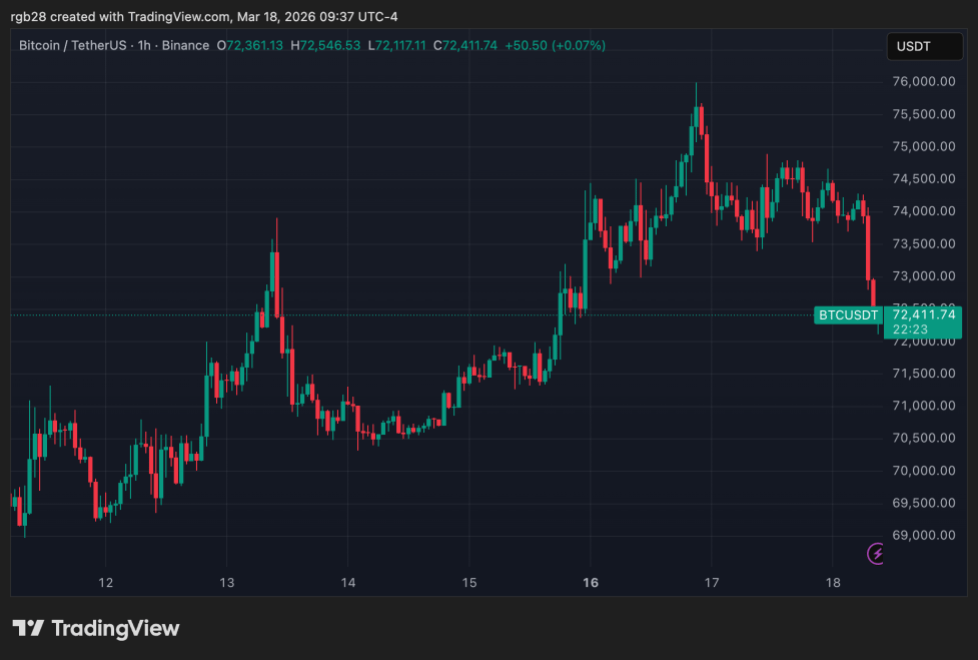
Bitcoin (BTC) trades at $72,411 in the one-week chart. Source: BTCUSDT on TradingView


Пов'язані питання

QWhat is the expected timeline for the new draft of the crypto market structure bill according to Senator Tim Scott?

ASenator Tim Scott stated that a fresh draft of the crypto market structure bill could be ready by the end of the week.

QWhat is the name of the stablecoin legislation mentioned in the article and what impact has it had?

AThe stablecoin legislation mentioned is the GENIUS Act, which has had a 'powerful impact for good' in the market according to Senator Scott.

QWhat was a major point of contention between the banking and crypto industries regarding the CLARITY Act?

AA major point of contention was the payment of interest on stablecoins. The banking industry criticized the GENIUS Act for loopholes and urged lawmakers to ban yield on stablecoins from crypto exchanges, brokers, and related entities, not just issuers.

QWhich key entity stepped in to help negotiate the stalled issues in the crypto market structure bill?

AThe US President’s Council of Advisors on Digital Assets stepped in, holding multiple meetings to negotiate key issues that had stalled the bill.

QWhat did Senator Scott call the 'largest publicly celebrated challenge' for lawmakers and crypto legislation?

ASenator Scott called the stablecoin yield compromise the 'largest publicly celebrated challenge' they have faced.

Пов'язані матеріали

In Conversation with Ray Dalio: We Are Currently in an AI Bubble, with 1% of My Portfolio in Bitcoin

Ray Dalio, founder of Bridgewater Associates, warns in an interview that the current AI boom shows classic bubble characteristics, which could lead to significant economic downturns as seen in past cycles like 1929 or 2000. He explains that speculative enthusiasm, fueled by debt and overvaluation, often precedes a crash when rising rates or taxation force asset sales, causing widespread losses and recession. Dalio also outlines his "Big Cycle" theory, describing an approximate 80-year pattern where widening wealth gaps, massive government deficits, and shifting geopolitical power (like China's rise) create internal conflict and global instability. He emphasizes that we are in a late-cycle, transitional phase where traditional powers like the US and UK face decline. For personal wealth protection, Dalio advises diversification beyond cash into assets like stocks, bonds, real estate, and particularly gold, which he prefers over Bitcoin. While he holds about 1% of his portfolio in Bitcoin as a non-printable hard asset, he views gold as more secure from technological or governmental threats. Regarding AI's impact, Dalio believes it will disproportionately benefit capital owners, worsening inequality by replacing both physical and cognitive labor. He suggests that human intuition and emotional intelligence, combined with AI, will be key for future workers. On taxation, Dalio argues that wealth taxes are impractical and risk triggering asset sell-offs, reducing productive investment. He points to the UK as a cautionary example of debt, low productivity, and political strife. Geopolitically, Dalio foresees a more regionalized world, with the US showing weakness in prolonged conflicts like with Iran, akin to past imperial declines. The ideal outcome, he suggests, is coexisting powerful blocs (e.g., Americas, China-Asia Pacific) without major war.

marsbit3 год тому

In Conversation with Ray Dalio: We Are Currently in an AI Bubble, with 1% of My Portfolio in Bitcoin

marsbit3 год тому

Daily 7.2 Trillion KRW: Foreign Capital's Record Net Buying on Friday! Wall Street Says Headwinds for Korean Stock Fund Flows Have Subsided

South Korean stock market sees a dramatic shift in fund flows. On July 31, foreign investors made a record net purchase of approximately KRW 7.2 trillion in KOSPI stocks, marking a fundamental reversal from the persistent large-scale net outflows seen in previous months. This contributed to a significant narrowing of foreign net selling in July to KRW 9.8 trillion, down sharply from KRW 48.4 trillion in June and KRW 44.5 trillion in May. Simultaneously, domestic institutional pressure eased. South Korean pension funds and asset managers turned to a net buying position in July, purchasing KRW 1.0 trillion worth of KOSPI shares, contrasting with net sales in May and June. Market volatility is expected to be dampened by new financial regulations. Effective July 31, the Financial Services Commission tightened access for retail investors to single-stock leveraged ETFs by raising the minimum cash deposit requirement. Trading volumes for these products subsequently dropped to about 50% of their monthly average. Citigroup Research maintains its year-end KOSPI target of 10,000 points. The firm cites several supportive factors: the substantial easing of headwinds from capital outflows, a robust fundamental outlook for the semiconductor sector, historically low market valuations, strong economic fundamentals, and the potential for policy support from financial authorities if needed.

marsbit3 год тому

Daily 7.2 Trillion KRW: Foreign Capital's Record Net Buying on Friday! Wall Street Says Headwinds for Korean Stock Fund Flows Have Subsided

marsbit3 год тому

Thanks to Dice Rolls, Bitcoin Keys Are Stored Offline, But Not Everyone Will Do It

The article discusses using dice rolls to generate secure Bitcoin wallet seeds, providing entropy independent of potentially flawed hardware random number generators. It explains that each fair dice roll offers about 2.585 bits of entropy, with around 50 rolls needed for a standard 12-word seed phrase and 99+ recommended for higher security. This method gained attention after a vulnerability was revealed in some Coldcard hardware wallets, where a faulty firmware RNG (dating back to 2021) compromised generated keys. The analysis notes that while a dice-generated main seed was safe from this specific flaw, other Coldcard functions (like creating paper wallets, backup keys, or passwords) could still be vulnerable if they used the defective RNG. The piece argues that while dice-based entropy is technically robust, the manual process is error-prone, tedious, and unrealistic for most new users, who might make mistakes in recording or inputting rolls. It concludes that while manual entropy generation should remain an option for advanced users, the long-term goal is to develop reliable, user-friendly hardware and software that securely generates randomness without requiring specialized knowledge. Coldcard users are advised to check their firmware version and replace any secondary secrets (like paper wallet keys) created with vulnerable devices, while also considering multi-signature setups with devices from different manufacturers for added security.

cryptonews.ru8 год тому

Thanks to Dice Rolls, Bitcoin Keys Are Stored Offline, But Not Everyone Will Do It

cryptonews.ru8 год тому

Торгівля

Спот
活动图片




