New Crypto Buyer Enters the Market: Kazakhstan Plans to Invest Up to $350 Million

marsbitОпубліковано о 2026-03-09Востаннє оновлено о 2026-03-09

Анотація

Kazakhstan's central bank, under Governor Timur Suleimanov, plans to invest up to $350 million from its gold and foreign exchange reserves into the crypto asset sector, with investments set to begin between April and May. The move, which represents a cautious 0.5% of the country's total reserves, will include not only cryptocurrencies but also stocks of high-tech companies, index funds, and other crypto-related financial instruments. The National Investment Corporation (NIC) will also incorporate confiscated crypto assets from law enforcement operations into the national crypto fund. This decision follows eased regulations in January, which recognized digital financial assets as a new asset class and allowed licensed crypto exchanges. Kazakhstan currently holds 3,544 bitcoins, ranking eighth globally in government crypto holdings.

By: Felix, PANews

On March 6, Timur Suleimanov, the Governor of the National Bank of Kazakhstan, stated that the central bank plans to use part of its gold and foreign exchange reserves to invest in the crypto asset sector, with an amount of up to $350 million.

Although the specific asset categories and timeline for the investment have not yet been disclosed, according to Aliya Moldabekova, Deputy Governor of the National Bank of Kazakhstan, the investment will begin between April and May.

Pilot Phase Allocation Accounts for 0.5% of Reserves

Despite the high-profile announcement of the purchase, Kazakhstan has demonstrated a cautious approach in every aspect of its national reserve plan for crypto assets.

The consideration phase alone took six months. As early as last July, Governor Timur Suleimenov indicated that the central bank was considering investing part of its foreign exchange reserves and national fund assets into crypto assets, emphasizing that this is a complex issue requiring careful handling due to the high volatility of such assets, despite their potential for high returns.

It was not until January of this year that Timur Suleimenov announced that an initial fund of $350 million had been allocated for this special purpose. This fund will be deployed using part of the foreign exchange and gold reserves.

Additionally, the investment approach is relatively diversified. Suleimanov stated during an interest rate briefing: "We are currently compiling a list of investments, which includes not only cryptocurrencies themselves but also high-tech company stocks related to cryptocurrencies and digital financial assets, index funds, and other instruments with dynamics similar to crypto assets."

Deputy Governor Aliya Moldabekova emphasized, "We are not making large-scale investments in cryptocurrencies. We are currently screening companies engaged in the digital asset business, such as those involved in building cryptocurrency infrastructure. We are in the process of selecting such companies."

Furthermore, the scale of the investment reflects a "cautious" approach, with the $350 million allocation accounting for only 0.5% of the country's total reserves. As of February 1, the National Bank of Kazakhstan's gold and foreign exchange reserves stood at $69.4 billion, while the assets of the national fund totaled $65.23 billion.

Easing Crypto Regulations and Incorporating Seized Assets into Crypto Fund

It is worth noting that not all of the reserved crypto assets will come from purchases; proceeds from law enforcement actions will also be a source.

In January of this year, the National Investment Corporation (NIC), the investment arm of the National Bank of Kazakhstan, announced plans to use cryptocurrencies seized by law enforcement agencies, along with foreign exchange and gold reserves, to enhance the national crypto reserve.

Kassym-Jomart Tokayev, President of Kazakhstan, revealed that during operations to "crack down on illegal mining farms," law enforcement agencies have shut down 130 illegal exchanges and seized assets worth over $5 million. These seized crypto assets, such as Bitcoin, will no longer serve merely as evidence but will be fully incorporated into the national crypto fund.

According to data from Bitcoin Treasuries, Kazakhstan currently ranks eighth in the global ranking of national crypto reserves (including law enforcement seizures), holding 3,544 BTC.
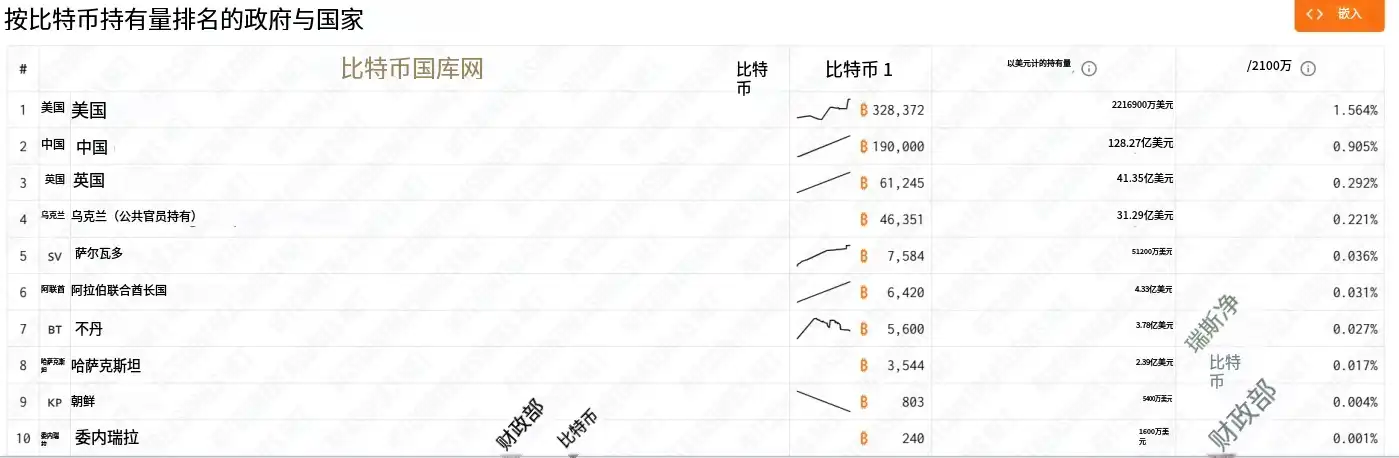
Governments and Countries Ranked by Bitcoin Holdings

Kazakhstan eased cryptocurrency regulations in January of this year, explicitly classifying digital financial assets (DFA) as a new asset category under regulation and allowing their circulation within the country. It also permitted the establishment of crypto exchanges licensed by the central bank. Additionally, the central bank will formulate a list of approved cryptocurrencies for circulation and impose certain restrictions on cryptocurrency trading activities.

Against the current macroeconomic backdrop of a crypto bear market, Kazakhstan's use of up to $350 million in reserve funds to invest in crypto assets not only reflects further recognition of cryptocurrencies by sovereign states but also provides a certain boost to the market. PANews will continue to monitor the specific allocation of subsequent funds.

Related reading: Is Venezuela's $60 Billion Bitcoin Shadow Reserve Real or Fake?

Пов'язані питання

QWhat is the maximum amount Kazakhstan's central bank plans to invest in crypto assets from its reserves?

AKazakhstan's central bank plans to invest up to $350 million from its gold and foreign exchange reserves into the crypto asset sector.

QWhen is the investment in crypto assets scheduled to begin, according to the Deputy Governor of the National Bank of Kazakhstan?

AAccording to Deputy Governor Aliya Moldabekova, the investment is scheduled to begin between April and May.

QWhat percentage of Kazakhstan's total reserves does the initial $350 million crypto investment represent?

AThe initial $350 million allocation represents 0.5% of Kazakhstan's total reserves.

QBesides purchasing crypto directly, what is another source of crypto assets for Kazakhstan's national fund?

AAnother source of crypto assets for the national fund is from assets seized by law enforcement agencies during operations against illegal mining and exchanges.

QWhat regulatory change did Kazakhstan implement regarding digital financial assets in January?

AIn January, Kazakhstan relaxed its cryptocurrency regulations by officially recognizing digital financial assets (DFA) as a new asset class, allowing their circulation within the country, and permitting the establishment of licensed crypto exchanges.

Пов'язані матеріали

$30 Billion DeFi Capital Exodus: LayerZero Stumbles, Chainlink Feasts

Following the major DeFi security incident involving Kelp DAO, a significant migration of funds is underway from the cross-chain protocol LayerZero to Chainlink's CCIP (Cross-Chain Interoperability Protocol). Over $30 billion in Total Value Locked (TVL) from protocols like Kelp DAO, Solv Protocol, Re, and Tydro has moved to Chainlink in the past week, driven by security concerns. LayerZero is facing a severe trust crisis after the attack. Initially denying responsibility, LayerZero Labs has now issued a public apology, acknowledging management oversights. These include a vulnerable "1/1" single-node configuration for its Decentralized Verification Network (DVN) and past misuse of a multi-signature wallet by a team member. The protocol's weekly bridge volume has slumped to near-historic lows of around $470 million. In contrast, Chainlink is experiencing a surge in adoption and activity. Its independent active addresses recently hit multi-month highs, and whales have been accumulating LINK tokens. Beyond DeFi, Chainlink is securing partnerships with traditional finance giants like DTCC, European stock exchange operator SIX Group, and asset manager Amundi. While LayerZero has announced security upgrades—such as migrating to stronger multi-signature configurations and developing a second DVN client—and contributed to a rescue fund, the event underscores that security is becoming a decisive competitive factor as DeFi matures.

marsbit3 хв тому

$30 Billion DeFi Capital Exodus: LayerZero Stumbles, Chainlink Feasts

marsbit3 хв тому

The $13 Trillion Repo Market Is Quietly Being Rewritten by Blockchain

The $13 trillion repurchase agreement (repo) market, a crucial artery for global short-term funding, is experiencing a significant transformation through blockchain technology. After years of limited impact in finance, blockchain is finding substantial adoption in repo transactions. Major institutions like JPMorgan Chase, HSBC, and Broadridge are deploying tokenized repo platforms, with daily volumes already reaching tens of billions of dollars. Traditional repo markets operate with fixed hours, rely on intermediaries, and involve manual, time-consuming processes. Tokenized repos, by contrast, use blockchain to create digital tokens representing cash and securities collateral. This enables near-instantaneous settlement, 24/7 trading, automated execution, and enhanced auditability. The key drivers for adoption include maturing technology, more receptive regulators, and growing client recognition of tangible benefits like reduced operational friction and capital efficiency. Analyses, such as one from Broadridge, indicate that moving a portion of repo activity onto blockchain can significantly reduce a bank's required liquidity buffers, potentially freeing up billions in capital. The infrastructure is also seen as foundational for a future of round-the-clock trading for traditional assets. Challenges remain, including the existence of fragmented blockchain networks, the need for stress testing under extreme market conditions, and the loss of operational flexibility compared to manual processes. However, the industry consensus is that these are implementation hurdles. Tokenized repo has moved beyond pilot stages to become one of blockchain's most concrete and impactful applications in traditional finance, marking a pivotal shift in how a core market functions.

marsbit4 хв тому

The $13 Trillion Repo Market Is Quietly Being Rewritten by Blockchain

marsbit4 хв тому

From Gas Limit to 'Keyed Nonces', How to Understand the Next Step in Ethereum Scalability?

Ethereum’s scalability efforts are shifting toward a user-centric approach—focusing not only on higher TPS, but on translating technical upgrades into lower costs, smoother operations, and better wallet experiences. Two recent developments highlight this direction: - **Raising the Gas Limit to 200 million**: Following the Fusaka upgrade that increased it to 60 million, a consensus has formed around a potential future increase to 200 million. This would boost Ethereum’s execution capacity, but it is planned alongside other upgrades—such as ePBS, Block-Level Access Lists (BAL), and EIP-8037—to manage state growth and keep node operation viable for average participants. - **Keyed Nonces (EIP-8250)**: This proposal aims to improve how transactions are queued. Instead of a single linear nonce per account, it introduces multiple independent nonce domains. This prevents different types of transactions—such as private payments, session keys, or batch operations—from blocking each other. Vitalik Buterin views this as a foundational step toward better privacy support and more flexible state scalability. Together, these upgrades are part of a broader move to push complexity from wallets, DApps, and relays back into the protocol layer. For everyday users, this means future Ethereum interactions could become less congested, more intuitive, and safer—especially as core improvements in account abstraction, cross-L2 interoperability, and node decentralization continue to progress. Ultimately, Ethereum is evolving to handle not just more transactions, but more varied and complex on-chain use cases while preserving its decentralized foundation.

marsbit26 хв тому

From Gas Limit to 'Keyed Nonces', How to Understand the Next Step in Ethereum Scalability?

marsbit26 хв тому

Leaving OpenAI, How Much Has Their Net Worth Increased?

Former OpenAI employees have collectively accrued near-trillion dollar valuations through ventures and investments, charting AI's future. The article highlights two main paths: founding high-value companies like Anthropic and Perplexity, or applying insider insights as investors. Leopold Aschenbrenner exemplifies the investor path. After being fired from OpenAI, he leveraged firsthand knowledge of AI's massive energy demands to make hugely successful public market bets on nuclear and fuel cell companies, practicing "cross-industry cognitive arbitrage." Other alumni, like the Zero Shot VC fund founders, use their technical foresight for early-stage investing. Their key advantage lies not just in picking winners, but in knowing which technical approaches are likely dead ends—a "veto list" derived from internal OpenAI experience. Angel investing within the network, as seen with Mira Murati and Sam Altman, operates on deep, pre-existing understanding of a founder's capabilities, reducing due diligence to near zero. This creates an ecosystem bound by a shared belief in AGI's imminent arrival, differing from networks like the "PayPal Mafia" which were built on shared past struggles. The shift of these builders to investors signals a profound conviction: their situational awareness of the AI landscape is now so clear that deploying capital based on that judgment is more efficient than building themselves. They are allocating bets on the future they helped shape from the inside.

marsbit37 хв тому

Leaving OpenAI, How Much Has Their Net Worth Increased?

marsbit37 хв тому

Торгівля

Спот
Ф'ючерси

Популярні статті

Як купити BAN

Ласкаво просимо до HTX.com! Ми зробили покупку Comedian (BAN) простою та зручною. Дотримуйтесь нашої покрокової інструкції, щоб розпочати свою криптовалютну подорож.Крок 1: Створіть обліковий запис на HTXВикористовуйте свою електронну пошту або номер телефону, щоб зареєструвати обліковий запис на HTX безплатно. Пройдіть безпроблемну реєстрацію й отримайте доступ до всіх функцій.ЗареєструватисьКрок 2: Перейдіть до розділу Купити крипту і виберіть спосіб оплатиКредитна/дебетова картка: використовуйте вашу картку Visa або Mastercard, щоб миттєво купити Comedian (BAN).Баланс: використовуйте кошти з балансу вашого рахунку HTX для безперешкодної торгівлі.Треті особи: ми додали популярні способи оплати, такі як Google Pay та Apple Pay, щоб підвищити зручність.P2P: Торгуйте безпосередньо з іншими користувачами на HTX.Позабіржова торгівля (OTC): ми пропонуємо індивідуальні послуги та конкурентні обмінні курси для трейдерів.Крок 3: Зберігайте свої Comedian (BAN)Після придбання Comedian (BAN) збережіть його у своєму обліковому записі на HTX. Крім того, ви можете відправити його в інше місце за допомогою блокчейн-переказу або використовувати його для торгівлі іншими криптовалютами.Крок 4: Торгівля Comedian (BAN)Легко торгуйте Comedian (BAN) на спотовому ринку HTX. Просто увійдіть до свого облікового запису, виберіть торгову пару, укладайте угоди та спостерігайте за ними в режимі реального часу. Ми пропонуємо зручний досвід як для початківців, так і для досвідчених трейдерів.

452 переглядів усьогоОпубліковано 2024.12.11Оновлено 2025.03.21

Як купити BAN

Обговорення

Ласкаво просимо до спільноти HTX. Тут ви можете бути в курсі останніх подій розвитку платформи та отримати доступ до професійної ринкової інформації. Нижче представлені думки користувачів щодо ціни BAN (BAN).

活动图片