New Chair, Old Inflation, Better-Than-Expected Jobs: How Are Global Assets Repriced After Wash's Debut?

marsbitОпубліковано о 2026-06-24Востаннє оновлено о 2026-06-24

Анотація

New Fed Chairman Kevin Wash's first FOMC meeting delivered a "hold" decision, keeping rates at 3.50%-3.75%. The key signal was a major shift in communication: the policy statement was shortened, and forward guidance was removed. Wash emphasized the Fed will no longer pre-commit to future actions, instead refocusing markets on economic data itself. The updated "dot plot" revealed a hawkish tilt, with the median forecast for the policy rate rising to 3.8% by year-end, suggesting a potential 25-basis-point hike in 2026. PCE inflation forecasts were also significantly raised. This reflects the Fed's current dilemma: a resilient job market (May nonfarm payrolls beat expectations) coupled with persistent inflation (PCE remains well above 2%) makes rate cuts unlikely and hikes a possibility. Wash inherits a deeply divided committee and a challenging macro environment reminiscent of 1994—strong growth with latent stagflation risks. His primary test is balancing inflation control against economic stability. Markets are repricing assets accordingly. The dollar strengthened on higher rate expectations. Treasury ETFs face pressure from potential hikes but may attract haven flows if growth fears emerge. Gold's role is more as a hedge amid conflicting forces. AI infrastructure stocks face valuation compression from higher rates, but the sector's fundamental demand logic remains intact if cloud CapEx holds. Defense stocks offer some resilience due to long-term government contracts. Look...

Last week, new Federal Reserve Chair Kevin Wash delivered his first monetary policy report card after taking office.

The Federal Open Market Committee decided to keep the target range for the federal funds rate unchanged at 3.50%-3.75%. All 12 voting members were in favor, with no dissenting votes (Extended Reading: "On the Eve of Wash's Debut: More Important Than a Rate Cut, How Will the Fed Reshape Expectations?"). It was a rather uneventful decision to "stand pat."

However, at the same time, this policy statement was compressed into three paragraphs and about a hundred words, significantly shorter than those of previous meetings. Phrases previously used to describe risk balance, future policy adjustments, and data dependence were directly deleted, and the "forward guidance" the market had grown accustomed to over many years also disappeared.

Wash explicitly stated at the press conference that the new statement is "shorter, simpler, and removes some of the old language." In his view, having lived through the most intense phase of the 2008 financial crisis, the current environment is changing too rapidly. The Fed should not promise too early what it will do in the future; instead, it should refocus the market's attention on the economic data itself.

This is perhaps the real signal released by the June FOMC meeting: the Fed under Wash's leadership is no longer trying to reduce uncertainty for the market but is preparing to hand some of that uncertainty back to the market.

A new communication framework has begun.

I. The Rate Stayed the Same, But the Fed's Policy Language Changed

For many investors, Wash is still a relatively unfamiliar name.

But he is not a newcomer to the Fed. From 2006 to 2011, Wash served as a Fed Governor, personally experiencing the 2008 financial crisis and the subsequent quantitative easing process. After leaving the Fed, he has long criticized the excessive expansion of central bank balance sheets, the proliferation of forward guidance, and the excessive intervention of monetary policy in financial markets.

Therefore, compared to reducing market volatility through repeated policy hints, Wash believes more in price signals and emphasizes monetary discipline more. His core idea can be summarized as "the central bank should make its objectives clear, but it doesn't need to tell the market every step of its operations in advance."

This thinking has been fully embodied in his first FOMC meeting.

Besides eliminating forward guidance, Wash also refused to submit his own interest rate path in this round of economic projections. He believes the current version of the dot plot is easily misunderstood by the market as a policy commitment, but in reality, each dot is only a conditional forecast made by officials based on the information available at that time.

He even described officials submitting their forecasts as if they were using "a big pencil with a large eraser"—once data changes, the forecast can be erased and rewritten at any time.

However, even though Wash tried to downplay the importance of the dot plot, the market still saw a very clear shift from it. Among the 18 participants who submitted forecasts this time, 9 expected at least one rate hike before the end of 2026, 8 expected rates to remain unchanged, and only 1 expected a rate cut.

More notably, among the 9 expecting hikes, 3 expected one hike, 5 expected two hikes, and 1 expected three hikes. The median policy rate at year-end also rose from the 3.4% predicted in March to 3.8%. This means that under the median scenario, the Fed will not only not cut rates this year but might actually raise them by 25 basis points.

Meanwhile, the Fed significantly raised its 2026 PCE inflation forecast from 2.7% in March to 3.6%, and the core PCE forecast from 2.7% to 3.3%.

In other words, the message from the June meeting is not complicated: the economy isn't weak enough to need rescue, but inflation is already strong enough that discussion of rate cuts must stop. This is also why the much-anticipated "Wash cut trade" quickly faded after his debut.

Additionally, when Trump nominated Wash, the market widely speculated that the new Chair might be more willing to cut rates than his predecessor. However, during the hearings, Wash made it clear that the President had never asked him to pre-commit to any interest rate decisions, and even if such a request were made, he would not accept it.

It seems now that Wash is not in a hurry to prove whether he is a hawk or a dove. First and foremost, he wants to prove that the Fed still has the ability to say no to inflation.

II. What Kind of "Hot Potato" Has Wash Inherited?

Objectively speaking, Wash's first major challenge is still inflation.

U.S. headline PCE rose 3.8% year-over-year in April, and core PCE rose 3.3% year-over-year, still a significant distance from the Fed's long-term 2% target.

What's more troublesome is that the current inflation doesn't stem entirely from a single factor.

On one hand, energy prices and geopolitical tensions continue to affect upstream costs; on the other hand, supply chains, tariffs, and service prices are still generating broader transmission pressures. Once energy price increases further spread to transportation, manufacturing, and household consumption, what the Fed will need to handle is no longer just a short-term shock, but the risk of inflation expectations re-emerging.

At the same time, the job market is much stronger than the market previously anticipated. The U.S. May jobs report released on June 5th showed non-farm payrolls increased by 172,000, about twice market expectations; the unemployment rate remained at 4.3%.

Under normal circumstances, this is data worth welcoming. But in the current environment, "good economic news" has been translated by the market into "bad monetary policy news." On the day the jobs data was released, the Nasdaq Composite Index fell 4.18%, its largest single-day drop in over a year. Semiconductor and high-valuation technology stocks were hit hardest, while bond yields rose significantly.

Trump subsequently posted on Truth Social, writing in bewilderment: "With such a good jobs report, stocks should go up, not down. It's been that way for the past 200 years."

This precisely reveals the most contradictory aspect of the current market. What Wash has inherited is not an economy on its last legs like during the pandemic, one in desperate need of central bank rescue and unlimited easing to stay alive, but rather an economy with a robust pulse on the surface, akin to 1994, yet carrying the hidden danger of stagflation, one that could lose momentum at any moment due to a single monetary policy misstep.

Now, raising rates risks stifling the recovery; cutting rates risks an inflation resurgence. This is precisely his most difficult situation.

This is also why what Wash truly faces is not a binary choice of "hike or cut," but a test of precise policy timing.

It's worth noting that in April this year, the Fed saw four dissenting votes, the first large-scale internal dissent since 1992, and this split did not appear suddenly. Over the past two years, cracks within the Fed have long been accumulating: Doves believe the job market has already cooled and rate cuts should be initiated soon to prevent a hard landing; Hawks insist that inflation is not truly tamed and cutting rates would only undo all the progress.

The unexpected 50-basis-point sharp rate cut in September 2024 sparked fierce internal debate. Then-Governor Michelle Bowman cast a dissenting vote, becoming the first Fed Governor in nearly two decades to publicly oppose the Chair on a rate decision. Trump appointing new members and pressuring Fed independence has made this political dimension seep into monetary policy discussions at a visible pace.

Therefore, Wash has taken over a team deeply divided on policy direction. Now the chair has a new occupant, but those accumulated divisions have not dissipated with the change. Wash hasn't just taken over a position; he's taken over a powder keg that could explode at any public meeting.

Building internal consensus itself is Wash's first test.

III. How Are Global Assets Being Repriced?

For the market, the hawkish tone of this FOMC has become a bellwether for stocks.

First and foremost are the dollar and U.S. Treasuries, the most direct rate trades.

Translated to the asset level, the logic for the dollar-bullish ETF UUP.M is relatively straightforward. After all, the higher the market's expectations for the policy rate, the greater the interest rate advantage of U.S. assets compared to other currency-denominated assets typically becomes. Therefore, the dollar index rose about 0.5% after the June FOMC, a result of the market repricing for a potential rate hike.

The environment for the intermediate-term Treasury ETF IEF.M is more complex. As is well known, bond prices move inversely to yields. So if inflation forecasts continue to be revised upward and the market further bets on rate hikes, intermediate-term Treasury yields may remain high, putting pressure on IEF.M.

But this doesn't mean U.S. Treasuries only have a one-way downside logic. If employment or consumption data suddenly weakens, reigniting recession fears, safe-haven funds could quickly flow back into Treasuries. Therefore, what affects U.S. Treasuries is not just whether the Fed will hike next, but also how the market judges the growth outlook after any hike.

Gold ETFs like GLD.M and IAU.M are relatively tricky assets to position currently. High real rates theoretically suppress gold, but geopolitical risks in the Middle East and ongoing gold purchases by global central banks provide another source of support. Therefore, when these two forces pull against each other, gold is better understood as a hedge rather than an offensive allocation.

Silver ETFs SLV.M and SIVR.M have an additional industrial logic compared to gold. The demand pull from AI infrastructure on power infrastructure and industrial metals gives silver independent demand support beyond its monetary properties. This provides it with an extra layer of cushion under the same macro pressures compared to gold.
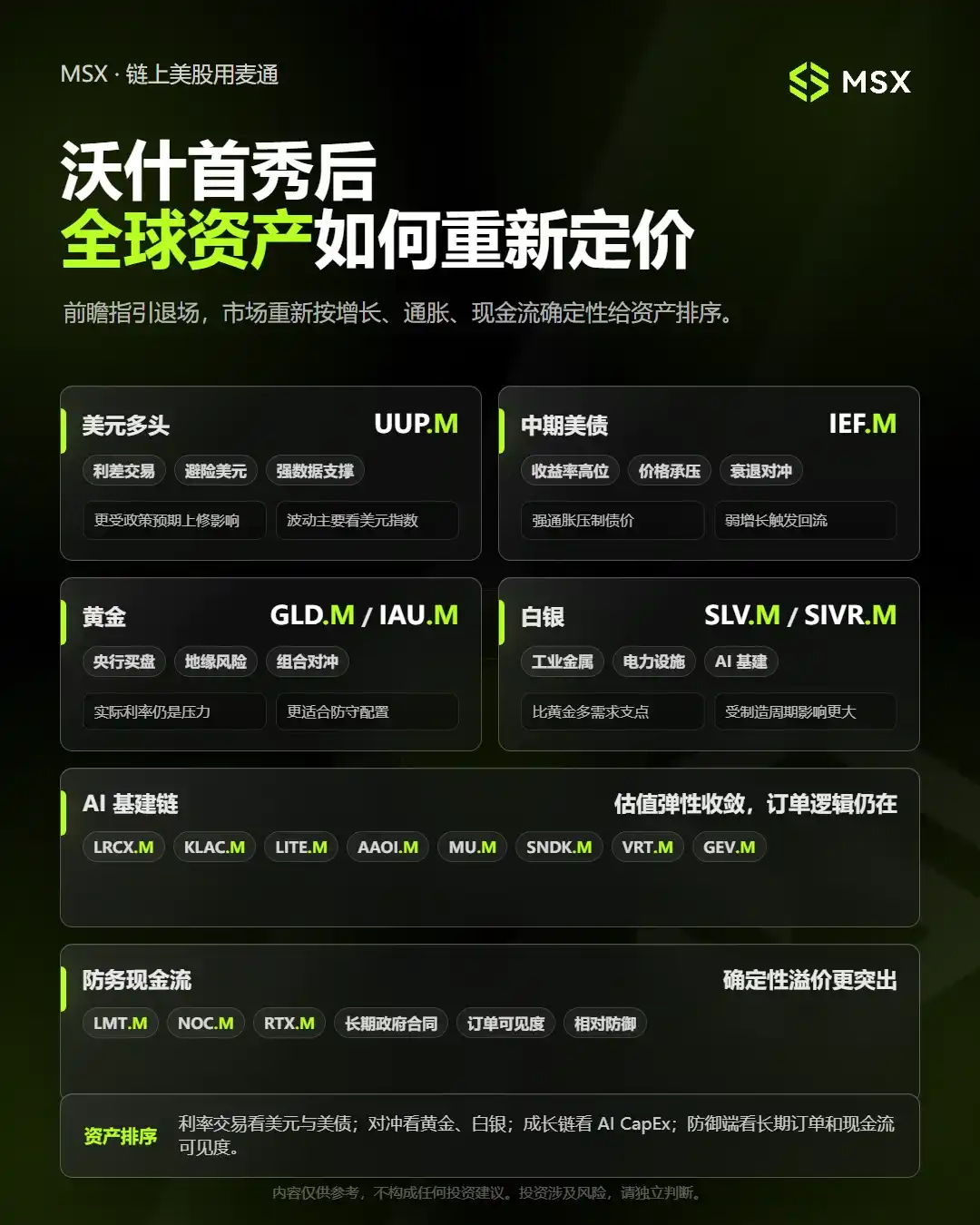
As for the impact of high rates on the AI infrastructure theme, it operates on two levels; one cannot simply say, "If rates rise, AI infrastructure is finished":

  • First is valuation pressure: Stocks like semiconductor equipment makers LRCX.M and KLAC.M, optical communication stocks like LITE.M and AAOI.M, memory stocks like MU.M and SNDK.M, and power infrastructure stocks like VRT.M and GEV.M. These companies' valuations are built on revenues expected to materialize over the coming years. The higher the interest rate, the higher the discount rate, and the lower the present value of future cash flows.
  • The second layer is capital expenditure risk: Cloud providers' AI CapEx is the lifeblood of the entire chain. In a high-rate environment with rising financing costs, might cloud providers shrink their budgets? Currently, it appears that Microsoft, Google, and Amazon's CapEx are still expanding; the demand-side logic hasn't changed due to rate hikes. Furthermore, rates pressure valuations; the number of orders hasn't decreased. As long as cloud provider CapEx shows no contraction, the industrial logic for AI infrastructure still holds, it's just that the space for valuation expansion is compressed. Reviewing Google's performance in Q1 2026 can lead to this conclusion.

The defense sector also possesses certain defensive attributes.

Companies like LMT.M, NOC.M, and RTX.M derive their revenue mainly from long-term government contracts, with order and cash flow visibility typically higher than that of high-valuation growth stocks. During periods of high interest rates and market preference for certain cash flows, defense assets may gain a relative advantage.

However, this doesn't mean defense stocks are completely immune to interest rates. Rising yields can still pressure their valuations. What truly provides support is the policy certainty of defense budgets and long-term orders, not absolute immunity to interest rate risk.

IV. Looking Ahead, What Should the Market Really Watch?

Wash's first FOMC has given a preliminary answer: the Fed is not prepared to continue planning every step of the policy path for the market; future volatility will be more driven by the data itself.

But this is still just the beginning. Over the next few months, several key nodes are worth investors' continued attention.

First is the June Non-Farm Payrolls on July 2nd. This is the first full-month employment report under Wash's tenure and the most important labor market signal he will receive before the July meeting. If employment remains strong, the window for rate cuts closes further, and the discussion of hikes will shift from expectation to reality. If the data weakens significantly, the market's expectations for the monetary policy path will loosen again, at which point the logic for cuts will have space for repricing.

Therefore, this single data point will likely directly determine the tone of the July meeting.
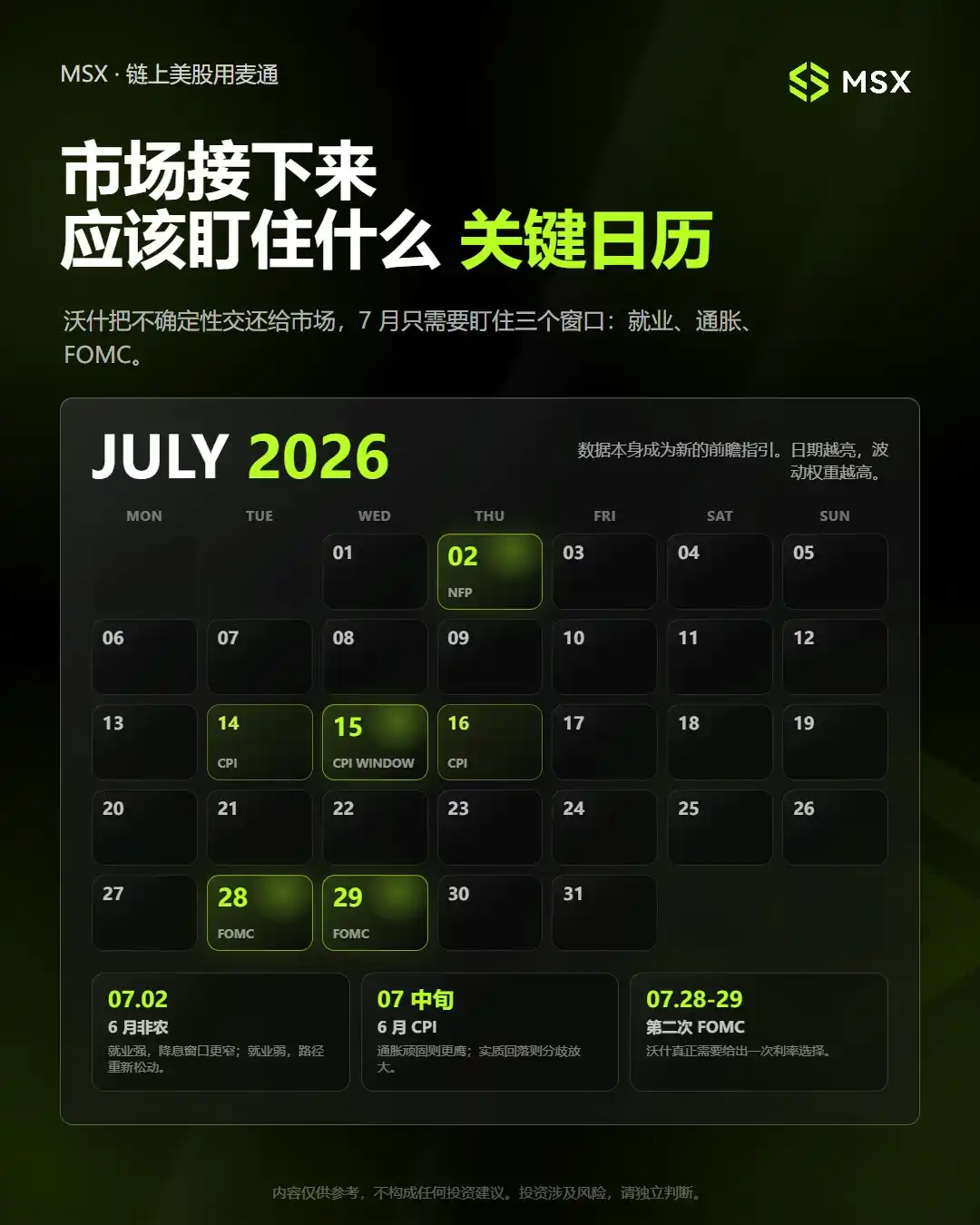
Next is the June CPI in mid-July, the most unignorable data point between two FOMC meetings. Wash made it very clear at the press conference: price stability is the current primary objective. If CPI remains stubborn, his stance at the July meeting will only be more hawkish. If inflation shows substantial easing, the market will diverge in its judgment of his next move. Regardless of the outcome, this data will trigger significant volatility on its release day.

Finally, the second FOMC meeting on July 28-29 might be the first true rate decision belonging to Wash. For the July meeting, with the accumulated data from Non-Farm Payrolls and CPI, he will need to make a real policy choice. By then, the market's understanding of his judgment will be clearer, and the outline of the direction will be more complete.

Of course, the midterm elections in the second half of the year are undoubtedly a variable on a longer time dimension. As the election approaches, the tension between the White House and the Fed is destined to intensify again. Trump's desire for rate cuts will not disappear, and Wash's statement at the hearings, "I won't promise that," will be tested repeatedly every time political pressure heats up.

The proposition of monetary policy independence will continue to be background noise for the market throughout the second half of the year.


Трендові криптовалюти

Пов'язані питання

QWhat were the key changes in communication style introduced by new Fed Chair Kevin Warsh during his first FOMC meeting?

AKevin Warsh's first FOMC meeting featured significant changes in communication style. The policy statement was shortened to about a hundred words across three paragraphs, removing forward guidance and language describing risk balance, future policy adjustments, and data dependence. Warsh explicitly stated that the Fed should not make premature promises about future actions but rather refocus market attention on economic data itself, signaling a shift towards less market hand-holding and a return of uncertainty to the markets.

QAccording to the June FOMC meeting's economic projections (dot plot), what is the Fed's median expectation for the policy interest rate by the end of the year, and what does this signal?

AAccording to the June FOMC meeting's economic projections (dot plot), the median expectation for the policy interest rate by the end of the year was revised upwards to 3.8% from 3.4% in March. This signals that, in the median scenario, the Fed does not expect to cut rates this year and instead sees a possibility of a 25 basis point rate hike, reflecting a more hawkish stance due to persistent inflation.

QWhat are the two main conflicting pressures that Fed Chair Kevin Warsh faces in setting monetary policy, as described in the article?

AFed Chair Kevin Warsh faces two main conflicting pressures: the risk of stifling the economic recovery by raising interest rates and the risk of fueling a resurgence of inflation by cutting rates. The economy shows strong signs like robust employment but carries underlying stagflation risks, making precise timing of policy adjustments his primary challenge.

QHow did the article describe the potential impact of high interest rates on the AI infrastructure investment theme?

AThe article describes the impact of high interest rates on the AI infrastructure theme in two layers. First, it creates valuation pressure on companies (e.g., semiconductor, optical communication, storage, power infrastructure) by increasing the discount rate, which lowers the present value of future cash flows. Second, it raises capital expenditure (CapEx) risks for cloud providers, the main source of investment. However, as long as cloud provider CapEx (e.g., from Microsoft, Google, Amazon) does not contract, the industrial logic for AI infrastructure remains intact, though valuation expansion space is compressed.

QWhat are the key upcoming data points and events that the article suggests market participants should closely monitor following Warsh's first FOMC meeting?

AFollowing Warsh's first FOMC, key upcoming data and events to monitor are: 1) The July 2nd release of the June Non-Farm Payrolls report, which will heavily influence the July FOMC tone. 2) The mid-July release of the June CPI data, crucial for gauging inflation persistence. 3) The second FOMC meeting on July 28-29, which will represent Warsh's first substantive policy decision with more data. 4) The broader political context, especially the upcoming midterm elections and associated pressures on Fed independence.

Пов'язані матеріали

How xBubble Breaks Through in the VC-Heavily-Backed OPC Economy

xBubble: Addressing the Structural Gap in the VC-Backed OPC Economy The concept of OPC (One Person Company) is evolving from a buzzword to a significant AI-driven market. While AI coding tools like Replit and Lovable have validated demand from non-technical users wanting to build applications, a key gap remains: the leap from creating a demo to running a stable, evolving business. These tools still require users to manage the development process, including technical judgments for integrations, modifications, and deployments—a major hurdle for OPCs. xBubble, by DAPPOS, tackles this by shifting from "Prompt-to-Code" to "SOP-to-Business." Instead of generating code from instructions, its core is a system of pre-organized SOPs (Standard Operating Procedures) that translate business goals—like "sell World Cup merchandise"—into complete, executable workflows. This includes generating cohesive assets, pages, payment systems, and backend logic. The platform is augmented by a network of third-party service providers who handle infrastructure (hosting, domains, payment setup), acting like "on-site service engineers." Users can pay for these services directly with xBubble credits, simplifying onboarding. This ecosystem aims to deliver not just an app, but a complete, modifiable business launch path. xBubble targets a clear OPC segment: small commercial nodes (e.g., creators, merchants) with existing products, customers, or channels, but for whom a full tech team is unjustifiable. Its potential lies in SOPs accumulating expertise from real cases, improving reliability and reducing delivery costs over time. Additionally, its native support for crypto payments caters to global or digital-native OPCs. In summary, as AI democratizes software creation, xBubble's opportunity is to prove that "SOP-to-Business" provides more immediate value for launching a real, operational business than a powerful but unstructured AI coding tool.

链捕手2 хв тому

How xBubble Breaks Through in the VC-Heavily-Backed OPC Economy

链捕手2 хв тому

If It's Not a Clear Yes, It's a No: A Nine-Year Retrospective by a VC Who Survived Four Cycles

**"Invest Only When Certain": A Nine-Year Retrospective from a VC Across Four Cycles** IOSG founder Jocy shares hard-earned lessons from nine years and over a hundred investments in Web3. The core challenge isn't identifying successful founders, but understanding why talented founders with solid ideas still fail. Through building a "failed founder database," IOSG identified six recurring failure patterns. **Founder Trait Red Flags:** 1. **Emotionally Unstable:** Founders who react defensively to criticism or publicly lash out under pressure (e.g., 80% drawdowns) often fail. Resilience is key. 2. **Lacking Hunger / Having a Fallback:** Founders with significant safety nets (family wealth, cushy fallback jobs) may lack the "do-or-die" commitment needed to survive crypto's brutal cycles. 3. **Unchecked Ego:** Includes "polished execution machines" who excel in known frameworks but struggle when paradigms shift, and "professor-types" who are technically brilliant but resistant to commercial feedback or coaching. **Project Structure Red Flags:** 4. **Token-First, Not Product-First:** Treating the token solely as a fundraising tool with no real utility or connection to product value is a major warning sign. The project should have value even if the token goes to zero. 5. **No Day-1 Exit Thesis:** Founders must have a clear, staged capital strategy from the start, understanding what each funding round needs to prove to unlock the next. "Exit before entry" is crucial. 6. **No Full-Cycle Experience:** Founders who haven't lived through a complete crypto bull/bear cycle (e.g., 2018, 2022) often underestimate their vulnerability. IOSG limits initial checks for such teams to $250k, sizing for risk. **The Positive Flipside: Desirable Founder Traits** The ideal candidate exhibits: obsessive problem-depth, being a second-time founder with a non-consensus vision, strong communication skills with *controlled* ego, relentless perseverance, and a global perspective with agency and taste (increasingly vital in the AI era). **Three Survival Tips for Founders:** 1. **Cash Flow Over Narrative:** Real revenue is what sustains projects, not vanity metrics. 2. **Tokens Are a Liability:** Avoid issuing a token unless absolutely necessary. The hidden costs (market making, liquidity, compliance) are immense, often a multi-million-dollar burden. 3. **Respect Liquidity:** Sell during peaks to build treasury, buy back to support the protocol during troughs. Be realistic about valuations and your ability to deliver for the next round. The final principle is simple yet paramount: **"If it's a borderline 'yes' or 'no,' don't invest."** In an industry that reinvents itself every few years, the discipline to consistently say "no" is the ultimate secret to longevity.

Foresight News27 хв тому

If It's Not a Clear Yes, It's a No: A Nine-Year Retrospective by a VC Who Survived Four Cycles

Foresight News27 хв тому

SemiAnalysis Deep Dive into CXMT: $50 Billion Revenue, An IPO Amidst a Supercycle

SemiAnalysis' in-depth report on ChangXin Memory Technologies (CXMT) details its rapid rise as China's largest upcoming semiconductor IPO. Founded in 2016 by Zhu Yiming, CXMT built its DRAM foundation on acquired patents and talent from the bankrupt German firm Qimonda. It achieved its first annual profit in 2025 after nearly a decade of significant capital support, primarily from patient Hefei municipal investors who fostered a local supply chain. The company is now capitalizing on a strong DRAM supercycle. Its revenue soared from ~$3.3B in 2024 to ~$8.6B in 2025, with Q1 2026 alone reaching ~$7.3B. SemiAnalysis projects full-year 2026 revenue could exceed $50B, driven by soaring ASPs rather than massive market share gains. While CXMT is closing the capacity gap with Micron, its product mix remains heavily focused on commodity DDR/LPDDR, which currently offers higher margins than its nascent HBM business. CXMT faces significant challenges in HBM, struggling with yield and stability for HBM3 8-Hi stacks while lagging behind the big three (Samsung, SK Hynix, Micron) in advanced nodes. However, strategic national priorities for AI self-sufficiency may push it to accelerate HBM capacity. Its complex IPO structure reveals heavy state-backed ownership and voting control over its fabs, with Alibaba appearing as both a key cloud customer and a minority shareholder. The IPO aims to raise ~$4.1B, primarily to strengthen its core DRAM manufacturing base.

marsbit48 хв тому

SemiAnalysis Deep Dive into CXMT: $50 Billion Revenue, An IPO Amidst a Supercycle

marsbit48 хв тому

Торгівля

Спот
Ф'ючерси

Популярні статті

Що таке $S$

Розуміння SPERO: Комплексний огляд Вступ до SPERO Оскільки ландшафт інновацій продовжує еволюціонувати, виникнення технологій web3 та криптовалютних проектів відіграє ключову роль у формуванні цифрового майбутнього. Один з проектів, який привернув увагу в цій динамічній сфері, — це SPERO, позначений як SPERO,$$s$. Ця стаття має на меті зібрати та представити детальну інформацію про SPERO, щоб допомогти ентузіастам та інвесторам зрозуміти його основи, цілі та інновації в рамках web3 та крипто-сектору. Що таке SPERO,$$s$? SPERO,$$s$ — це унікальний проект у криптопросторі, який прагне використати принципи децентралізації та технології блокчейн для створення екосистеми, що сприяє залученню, корисності та фінансовій інклюзії. Проект розроблений для полегшення взаємодії між користувачами новими способами, надаючи їм інноваційні фінансові рішення та послуги. У своїй основі SPERO,$$s$ прагне надати можливості індивідам, забезпечуючи інструменти та платформи, які покращують користувацький досвід у криптовалютному просторі. Це включає в себе можливість більш гнучких методів транзакцій, сприяння ініціативам, що підтримуються спільнотою, та створення шляхів для фінансових можливостей через децентралізовані додатки (dApps). Основна концепція SPERO,$$s$ обертається навколо інклюзивності, прагнучи зменшити розриви в традиційній фінансовій системі, використовуючи переваги технології блокчейн. Хто є творцем SPERO,$$s$? Особистість творця SPERO,$$s$ залишається дещо невідомою, оскільки є обмежені публічно доступні ресурси, що надають детальну інформацію про його засновників. Ця відсутність прозорості може бути наслідком зобов'язання проекту до децентралізації — етики, яку багато проектів web3 поділяють, ставлячи колективні внески вище за індивідуальне визнання. Зосереджуючи обговорення навколо спільноти та її колективних цілей, SPERO,$$s$ втілює суть наділення без виділення конкретних осіб. Таким чином, розуміння етики та місії SPERO є більш важливим, ніж ідентифікація єдиного творця. Хто є інвесторами SPERO,$$s$? SPERO,$$s$ підтримується різноманітними інвесторами, починаючи від венчурних капіталістів до ангельських інвесторів, які прагнуть сприяти інноваціям у крипто-секторі. Зосередження цих інвесторів зазвичай узгоджується з місією SPERO — пріоритет надається проектам, які обіцяють технологічний прогрес у суспільстві, фінансову інклюзію та децентралізоване управління. Ці інвесторські фонди зазвичай зацікавлені в проектах, які не лише пропонують інноваційні продукти, але й позитивно впливають на спільноту блокчейн та її екосистеми. Підтримка з боку цих інвесторів підкріплює SPERO,$$s$ як значного конкурента в швидко змінюваній сфері крипто-проектів. Як працює SPERO,$$s$? SPERO,$$s$ використовує багатогранну структуру, яка відрізняє його від традиційних криптовалютних проектів. Ось деякі ключові особливості, які підкреслюють його унікальність та інноваційність: Децентралізоване управління: SPERO,$$s$ інтегрує моделі децентралізованого управління, надаючи користувачам можливість активно брати участь у процесах прийняття рішень щодо майбутнього проекту. Цей підхід сприяє відчуттю власності та відповідальності серед членів спільноти. Корисність токена: SPERO,$$s$ використовує свій власний криптовалютний токен, розроблений для виконання різних функцій в екосистемі. Ці токени дозволяють здійснювати транзакції, отримувати винагороди та полегшувати послуги, що пропонуються на платформі, підвищуючи загальну залученість та корисність. Шарова архітектура: Технічна архітектура SPERO,$$s$ підтримує модульність та масштабованість, що дозволяє безперешкодно інтегрувати додаткові функції та додатки в міру розвитку проекту. Ця адаптивність є надзвичайно важливою для збереження актуальності в постійно змінюваному крипто-ландшафті. Залучення спільноти: Проект підкреслює ініціативи, що підтримуються спільнотою, використовуючи механізми, які стимулюють співпрацю та зворотний зв'язок. Підтримуючи сильну спільноту, SPERO,$$s$ може краще задовольняти потреби користувачів та адаптуватися до ринкових тенденцій. Фокус на інклюзію: Пропонуючи низькі комісії за транзакції та зручні інтерфейси, SPERO,$$s$ прагне залучити різноманітну базу користувачів, включаючи осіб, які раніше не брали участі в крипто-просторі. Це зобов'язання до інклюзії узгоджується з його загальною місією наділення через доступність. Хронологія SPERO,$$s$ Розуміння історії проекту надає важливі уявлення про його розвиток та етапи. Нижче наведено пропоновану хронологію, що відображає значні події в еволюції SPERO,$$s$: Етап концептуалізації та ідеації: Початкові ідеї, що стали основою SPERO,$$s$, були сформовані, тісно пов'язані з принципами децентралізації та фокусом на спільноті в індустрії блокчейн. Запуск білого паперу проекту: Після концептуального етапу був випущений комплексний білий папір, що детально описує бачення, цілі та технологічну інфраструктуру SPERO,$$s$, щоб залучити інтерес та зворотний зв'язок від спільноти. Створення спільноти та ранні залучення: Активні зусилля були спрямовані на створення спільноти ранніх прихильників та потенційних інвесторів, що полегшило обговорення цілей проекту та отримання підтримки. Подія генерації токенів: SPERO,$$s$ провів подію генерації токенів (TGE) для розподілу своїх рідних токенів серед ранніх прихильників та встановлення початкової ліквідності в екосистемі. Запуск початкового dApp: Перший децентралізований додаток (dApp), пов'язаний з SPERO,$$s$, став доступним, дозволяючи користувачам взаємодіяти з основними функціями платформи. Постійний розвиток та партнерства: Безперервні оновлення та вдосконалення пропозицій проекту, включаючи стратегічні партнерства з іншими учасниками блокчейн-простору, сформували SPERO,$$s$ у конкурентоспроможного та еволюціонуючого гравця на крипто-ринку. Висновок SPERO,$$s$ є свідченням потенціалу web3 та криптовалют для революціонізації фінансових систем та наділення індивідів. Завдяки зобов'язанню до децентралізованого управління, залучення спільноти та інноваційно спроектованих функцій, він прокладає шлях до більш інклюзивного фінансового ландшафту. Як і з будь-якими інвестиціями в швидко змінюваному крипто-просторі, потенційним інвесторам та користувачам рекомендується ретельно досліджувати та обдумано взаємодіяти з поточними подіями в SPERO,$$s$. Проект демонструє інноваційний дух крипто-індустрії, запрошуючи до подальшого дослідження його численних можливостей. Хоча подорож SPERO,$$s$ ще триває, його основні принципи можуть справді вплинути на майбутнє того, як ми взаємодіємо з технологією, фінансами та один з одним у взаємопов'язаних цифрових екосистемах.

81 переглядів усьогоОпубліковано 2024.12.17Оновлено 2024.12.17

Що таке $S$

Що таке AGENT S

Агент S: Майбутнє автономної взаємодії в Web3 Вступ У постійно змінюваному ландшафті Web3 та криптовалюти інновації постійно переосмислюють, як люди взаємодіють з цифровими платформами. Один з таких новаторських проектів, Агент S, обіцяє революціонізувати взаємодію людини з комп'ютером через свою відкриту агентну структуру. Прокладаючи шлях для автономних взаємодій, Агент S прагне спростити складні завдання, пропонуючи трансформаційні застосування в штучному інтелекті (ШІ). Це детальне дослідження заглиблюється в складності проекту, його унікальні особливості та наслідки для сфери криптовалюти. Що таке Агент S? Агент S є революційною відкритою агентною структурою, спеціально розробленою для вирішення трьох основних викликів в автоматизації комп'ютерних завдань: Набуття специфічних знань у галузі: Структура інтелектуально навчається з різних зовнішніх джерел знань та внутрішнього досвіду. Цей подвійний підхід дозволяє їй створити багатий репозиторій специфічних знань у галузі, покращуючи її продуктивність у виконанні завдань. Планування на довгих горизонтах завдань: Агент S використовує планування з підкріпленням досвіду, стратегічний підхід, який полегшує ефективний розподіл та виконання складних завдань. Ця функція значно підвищує її здатність ефективно та результативно управляти кількома підзавданнями. Обробка динамічних, неоднорідних інтерфейсів: Проект представляє Інтерфейс Агент-Комп'ютер (ACI), інноваційне рішення, яке покращує взаємодію між агентами та користувачами. Використовуючи багатомодальні великі мовні моделі (MLLMs), Агент S може безперешкодно орієнтуватися та маніпулювати різноманітними графічними інтерфейсами користувача. Завдяки цим новаторським функціям Агент S надає надійну структуру, яка вирішує складнощі, пов'язані з автоматизацією людської взаємодії з машинами, прокладаючи шлях для численних застосувань у ШІ та за його межами. Хто є творцем Агент S? Хоча концепція Агент S є фундаментально новаторською, конкретна інформація про його творця залишається невідомою. Творець наразі невідомий, що підкреслює або початкову стадію проекту, або стратегічний вибір зберегти засновників у таємниці. Незважаючи на анонімність, акцент залишається на можливостях та потенціалі структури. Хто є інвесторами Агент S? Оскільки Агент S є відносно новим у криптографічній екосистемі, детальна інформація про його інвесторів та фінансових спонсорів не задокументована. Відсутність публічно доступних відомостей про інвестиційні фонди або організації, що підтримують проект, викликає питання щодо його фінансової структури та дорожньої карти розвитку. Розуміння підтримки є критично важливим для оцінки стійкості проекту та потенційного впливу на ринок. Як працює Агент S? В основі Агент S лежить передова технологія, яка дозволяє йому ефективно функціонувати в різних умовах. Його операційна модель побудована навколо кількох ключових функцій: Взаємодія з комп'ютером, подібна до людської: Структура пропонує розширене планування ШІ, прагнучи зробити взаємодії з комп'ютерами більш інтуїтивними. Імітуючи людську поведінку при виконанні завдань, вона обіцяє підвищити досвід користувачів. Наративна пам'ять: Використовується для використання високорівневого досвіду, Агент S використовує наративну пам'ять для відстеження історій завдань, тим самим покращуючи свої процеси прийняття рішень. Епізодична пам'ять: Ця функція надає користувачам покрокові інструкції, дозволяючи структурі пропонувати контекстуальну підтримку в міру виконання завдань. Підтримка OpenACI: Завдяки можливості працювати локально, Агент S дозволяє користувачам зберігати контроль над своїми взаємодіями та робочими процесами, узгоджуючи з децентралізованою етикою Web3. Легка інтеграція з зовнішніми API: Його універсальність і сумісність з різними платформами ШІ забезпечують те, що Агент S може безперешкодно вписатися в існуючі технологічні екосистеми, роблячи його привабливим вибором для розробників та організацій. Ці функціональні можливості колективно сприяють унікальному положенню Агент S у крипто-просторі, оскільки він автоматизує складні, багатоступеневі завдання з мінімальним втручанням людини. У міру розвитку проекту його потенційні застосування в Web3 можуть переосмислити, як відбуваються цифрові взаємодії. Хронологія Агент S Розробка та етапи Агент S можуть бути узагальнені в хронології, яка підкреслює його значні події: 27 вересня 2024 року: Концепція Агент S була представлена в комплексній науковій статті під назвою “Відкрита агентна структура, яка використовує комп'ютери як людина”, що демонструє основи проекту. 10 жовтня 2024 року: Наукова стаття була опублікована на arXiv, пропонуючи детальне дослідження структури та її оцінки продуктивності на основі бенчмарку OSWorld. 12 жовтня 2024 року: Було випущено відеопрезентацію, що надає візуальне уявлення про можливості та особливості Агент S, ще більше залучаючи потенційних користувачів та інвесторів. Ці маркери в хронології не лише ілюструють прогрес Агент S, але й вказують на його прихильність до прозорості та залучення громади. Ключові моменти про Агент S У міру розвитку структури Агент S кілька ключових характеристик виділяються, підкреслюючи її новаторський характер та потенціал: Інноваційна структура: Розроблена для забезпечення інтуїтивного використання комп'ютерів, подібного до людської взаємодії, Агент S пропонує новий підхід до автоматизації завдань. Автономна взаємодія: Здатність автономно взаємодіяти з комп'ютерами через GUI означає стрибок до більш інтелектуальних та ефективних обчислювальних рішень. Автоматизація складних завдань: Завдяки своїй надійній методології він може автоматизувати складні, багатоступеневі завдання, роблячи процеси швидшими та менш схильними до помилок. Безперервне вдосконалення: Механізми навчання дозволяють Агенту S покращуватися на основі минулого досвіду, постійно підвищуючи свою продуктивність та ефективність. Універсальність: Його адаптивність до різних операційних середовищ, таких як OSWorld та WindowsAgentArena, забезпечує його здатність служити широкому спектру застосувань. Оскільки Агент S займає своє місце в ландшафті Web3 та криптовалюти, його потенціал покращити можливості взаємодії та автоматизувати процеси означає значний прогрес у технологіях ШІ. Завдяки своїй інноваційній структурі Агент S є прикладом майбутнього цифрових взаємодій, обіцяючи більш безперешкодний та ефективний досвід для користувачів у різних галузях. Висновок Агент S представляє собою сміливий крок вперед у поєднанні ШІ та Web3, з можливістю переосмислити, як ми взаємодіємо з технологією. Хоча проект все ще на ранніх стадіях, можливості для його застосування є величезними та переконливими. Завдяки своїй комплексній структурі, що вирішує критичні виклики, Агент S прагне вивести автономні взаємодії на передній план цифрового досвіду. У міру того, як ми заглиблюємося в сфери криптовалюти та децентралізації, проекти, подібні до Агент S, безсумнівно, відіграватимуть ключову роль у формуванні майбутнього технологій та співпраці людини з комп'ютером.

706 переглядів усьогоОпубліковано 2025.01.14Оновлено 2025.01.14

Що таке AGENT S

Як купити S

Ласкаво просимо до HTX.com! Ми зробили покупку Sonic (S) простою та зручною. Дотримуйтесь нашої покрокової інструкції, щоб розпочати свою криптовалютну подорож.Крок 1: Створіть обліковий запис на HTXВикористовуйте свою електронну пошту або номер телефону, щоб зареєструвати обліковий запис на HTX безплатно. Пройдіть безпроблемну реєстрацію й отримайте доступ до всіх функцій.ЗареєструватисьКрок 2: Перейдіть до розділу Купити крипту і виберіть спосіб оплатиКредитна/дебетова картка: використовуйте вашу картку Visa або Mastercard, щоб миттєво купити Sonic (S).Баланс: використовуйте кошти з балансу вашого рахунку HTX для безперешкодної торгівлі.Треті особи: ми додали популярні способи оплати, такі як Google Pay та Apple Pay, щоб підвищити зручність.P2P: Торгуйте безпосередньо з іншими користувачами на HTX.Позабіржова торгівля (OTC): ми пропонуємо індивідуальні послуги та конкурентні обмінні курси для трейдерів.Крок 3: Зберігайте свої Sonic (S)Після придбання Sonic (S) збережіть його у своєму обліковому записі на HTX. Крім того, ви можете відправити його в інше місце за допомогою блокчейн-переказу або використовувати його для торгівлі іншими криптовалютами.Крок 4: Торгівля Sonic (S)Легко торгуйте Sonic (S) на спотовому ринку HTX. Просто увійдіть до свого облікового запису, виберіть торгову пару, укладайте угоди та спостерігайте за ними в режимі реального часу. Ми пропонуємо зручний досвід як для початківців, так і для досвідчених трейдерів.

1.6k переглядів усьогоОпубліковано 2025.01.15Оновлено 2026.06.02

Як купити S

Обговорення

Ласкаво просимо до спільноти HTX. Тут ви можете бути в курсі останніх подій розвитку платформи та отримати доступ до професійної ринкової інформації. Нижче представлені думки користувачів щодо ціни S (S).

活动图片