New AMD Paper Overturns Conventional Wisdom: FP4 Training Instability's Cause Is Not Insufficient Randomness

marsbitОпубліковано о 2026-05-27Востаннє оновлено о 2026-05-27

Анотація

AMD's new research challenges the conventional understanding of FP4 training instability. While reducing precision from FP8 to FP4 promises doubled computational throughput and is supported by new hardware like NVIDIA Blackwell and AMD MI350 series, training large language models natively with FP4 has been notoriously unstable, often attributed to insufficient stochasticity. The paper "Pretraining large language models with MXFP4 on Native FP4 Hardware" demonstrates successful end-to-end FP4 pre-training of Llama 3.1-8B on AMD MI355X GPUs using the MXFP4 format, achieving a 9-10% overall speedup over FP8. Crucially, it identifies the root cause of instability: not randomness, but the accumulation of *structural micro-scaling errors* along the sensitive weight gradient (Wgrad) path. Through controlled experiments, researchers found that quantizing the Wgrad operation to FP4 caused significant convergence degradation. Counterintuitively, common stochasticity-based mitigation techniques like stochastic rounding and randomized Hadamard transforms worsened performance. In contrast, applying a *deterministic* Hadamard transform successfully stabilized training by ensuring consistent error patterns, reducing the extra token cost from 26-27% to just 8-9%. This work has significant implications: 1) It provides a clear diagnostic for low-precision training instability, steering focus towards structural errors. 2) It pushes FP4 from a primarily inference-focused format into the realm...

As is well known, training large models is extremely costly.

However, it's also widely understood that reducing training precision can significantly lower training costs. DeepSeek-V3's use of FP8 training brought the cost down to $5.6 million, already capturing the attention of the entire industry.

Following the success of FP8, the industry continues to explore the boundaries of lower precision: from FP8 down to FP4, how much more can training costs be reduced?

Theoretically, FP4 computational throughput could be twice that of FP8. Both NVIDIA's Blackwell and AMD's MI350 series have already natively supported FP4 operations at the hardware level, with the former claiming FP4 performance up to 4500 TOPS (sparse) on the B200. The hardware is ready, but the software and algorithm side has been stuck on one problem:

Training large models from scratch with FP4 is highly unstable.

Over the past two years, works like LLM-FP4 and NVFP4 pre-training have attempted this path, but few solutions have cleanly and efficiently executed full pipeline pre-training at 4-bit precision while maintaining convergence quality close to FP8.

More troublesome is that the cause of the collapse has been unclear. Analysis suggested the instability in FP4 training was likely due to insufficient randomness.

But recently, AMD, in collaboration with Pennsylvania State University, published a paper that overturns this traditional understanding, offering a new and clear diagnosis for native FP4 training.
  • Paper Title: Pretraining large language models with MXFP4 on Native FP4 Hardware
  • Paper Link: https://arxiv.org/abs/2605.09825

This paper successfully completed the full-pipeline pre-training of Llama 3.1-8B using the MXFP4 format on AMD Instinct MI355X GPUs, achieving 9-10% faster end-to-end training speed compared to the FP8 baseline, with only an 8-9% additional token cost. This is the first complete experiment to finish large model pre-training on native FP4 hardware (not software simulation).

More importantly, the paper reveals the core issue: The source of FP4 training instability is not insufficient randomness, but the cumulative amplification of structural microscaling errors along sensitive gradient paths.

What is MXFP4

Before dissecting the paper, it's necessary to understand the MXFP4 data format.

Traditional integer quantization typically uses a single scaling factor for an entire tensor. The core design of MXFP4 is called "Micro-scaling": splitting a tensor into small blocks (e.g., groups of 32 elements), assigning a shared exponent (E8M0 format) to each block, where each element within the block is represented by a 4-bit floating-point number. The reconstruction formula can be written as:

Where E_shared is the maximum exponent within the block, and Q_FP4 is the value rounded to the nearest representable 4-bit floating-point value.

The benefit of micro-scaling is that each small block has its own dynamic range and won't be "held hostage" by global outliers. This significantly improves the representational quality of 4-bit floating-point numbers compared to naive global quantization.

However, even with micro-scaling, FP4 training remains unstable.

Troubleshooting Experiments: The Root of Instability

The research team first designed a step-by-step controlled troubleshooting experiment.

A complete Transformer linear layer computation involves three general matrix multiplication operations:

Fprop (Forward Propagation): Computes Y = XW^T, producing activation values.

Dgrad (Activation Gradient): Computes ∇X = ∇Y · W, propagating gradients back to the input.

Wgrad (Weight Gradient): Computes ∇W = (∇Y)^T · X, producing the gradient used to update the weights.

Keeping all other factors constant, the research team gradually replaced these three operations from FP8 to MXFP4, observing the impact of each step on convergence. All experiments were executed using native FP4 tensor cores on AMD Instinct MI355X, without relying on software simulation.

The training task followed the MLPerf standard setup, pre-training Llama 3.1-8B on the C4 dataset, with a convergence target of achieving a validation perplexity of 3.3.

The first two steps only incurred a modest additional token cost. However, once Wgrad was also switched to MXFP4, the cost directly jumped to 26-27%.

Wgrad is the bottleneck for FP4 training. Forward propagation and activation gradient have considerable tolerance for FP4 quantization, but once the weight gradient is quantized to 4 bits, convergence quality degrades significantly.

The industry's prevailing intuition was that FP4 quantization error is essentially a noise problem, which could be "smoothed" by injecting randomness. Two common strategies are:

Stochastic Rounding: Introduces randomness during quantization to make the expected value of rounding error zero.

Randomized Hadamard Rotation: Uses a Hadamard transform with random sign flips to scatter the data distribution before quantization.
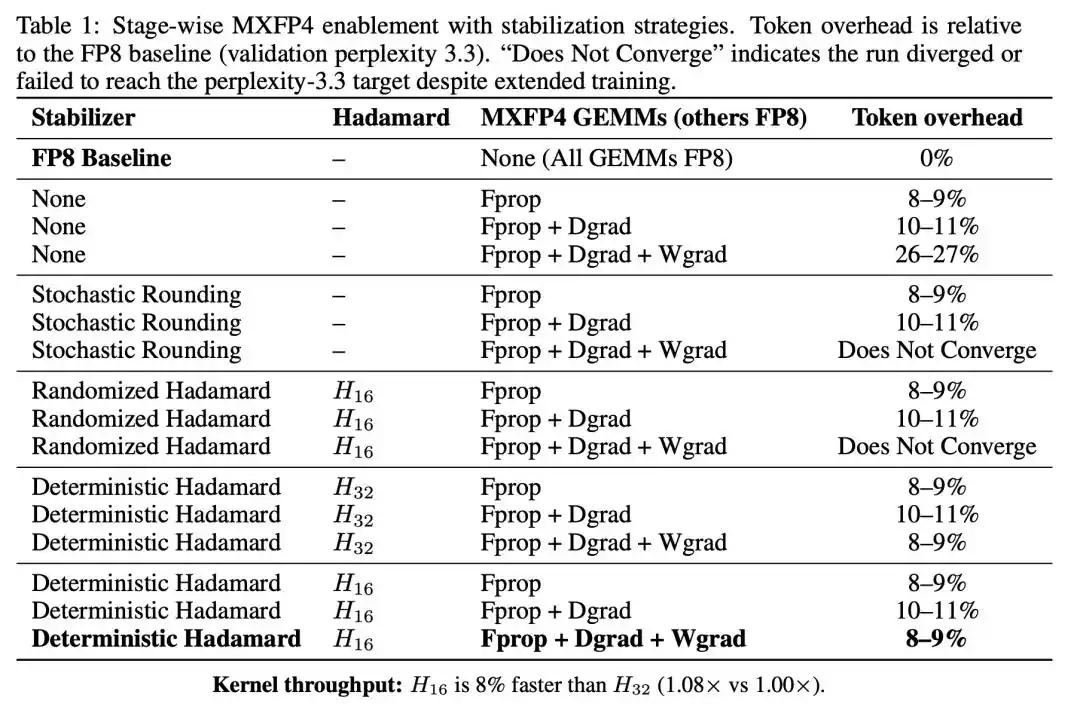
When Wgrad is quantized, both randomness strategies not only failed to stabilize training but directly caused non-convergence. Randomness didn't help; instead, it introduced more effective quantization error on the critical gradient path.

In contrast, deterministic Hadamard rotation dramatically reduced the full-pipeline token cost from 26-27% back to 8-9%, with the training trajectory closely tracking the FP8 baseline.

This is a highly diagnostic result. Both random and deterministic Hadamard rotations are orthogonal transformations that can scatter outlier energy distribution; theoretically, their effects on mitigating quantization error should be similar. Yet, their performance in the Wgrad scenario is completely opposite, revealing the nature of the problem:

FP4 training instability is driven by structural errors generated by MXFP4 micro-scaling on sensitive gradient paths. Randomness strategies failed because they introduced varying error patterns at each step, and these changing patterns accumulated along the gradient path, amplifying instability. Deterministic rotation was effective precisely because it applied the same transformation at every step, keeping the error pattern consistent and preventing error accumulation.

End-to-End Efficiency: Training Step Throughput +20%, Comprehensive Speedup 9-10%

After applying deterministic Hadamard rotation to the full-pipeline MXFP4, the efficiency data is as follows:
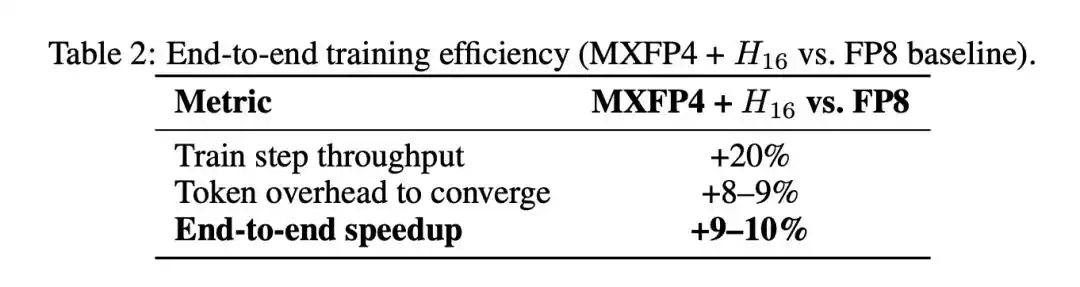
Training step throughput increased by 20%. After accounting for the additional 8-9% token cost, the end-to-end comprehensive speedup remains 9-10%.

Considering this directly halves precision from 8 bits to 4 bits, this convergence quality and speedup magnitude are quite significant.
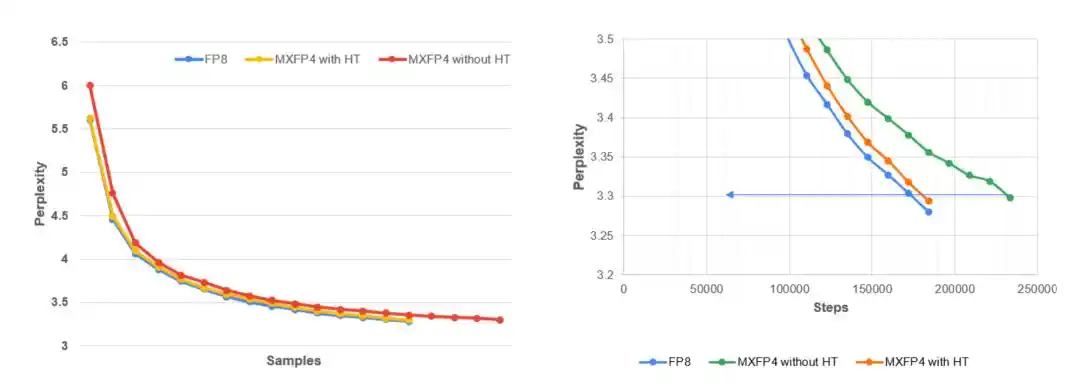
Left: Curve showing the validation perplexity of Llama 3.1–8B versus training token count during MLPerf pre-training on the C4 dataset. Results show MXFP4 + deterministic Hadamard performs very close to FP8, while unstabilized full-pipeline MXFP4 converges slower and is less stable. Right: Zoomed-in view of the later training stage. The MLPerf target perplexity is 3.3. Compared to the unstabilized MXFP4 run, deterministic Hadamard (H16) maintains much tighter alignment with the FP8 baseline.

Notably, the authors explicitly emphasize an important limitation in the paper: The effectiveness of this FP4 training scheme (MLPerf C4 dataset + Llama 3.1-8B) has been verified, but it cannot be assumed to seamlessly transfer to all models, all datasets, and all training methods. FP4 training behavior might be highly setting-dependent, and specific stabilization strategies need re-validation per scenario.

Conclusion

Placing this paper within the broader industry context reveals at least three layers of significance.

First layer: It answers a fundamental "why". Previous FP4 training work mostly focused on "how to make it not crash." This paper provides the first clear causal diagnosis: collapse stems from structural microscaling errors on the Wgrad path, not insufficient randomness. This diagnosis itself holds methodological value, telling subsequent researchers that when encountering instability in low-precision training, they should prioritize investigating structural error sources rather than blindly adding randomness.

Second layer: It pushes FP4 from "inference-only" towards "usable for training". Previously, the industry consensus was that FP4 was only suitable for inference quantization, with FP8 being the minimum for training. NVIDIA's emphasis on FP4 inference rather than training on Blackwell also reflects this judgment. This paper successfully ran full-pipeline pre-training on native FP4 hardware, meaning that the FP4 compute power prepared for inference on MI355X and Blackwell could theoretically also be used for training. If FP4 training proves viable on larger models and more scenarios, it effectively doubles the usable training compute of existing hardware.

Third layer: It utilizes the OCP open standard. MXFP4 is part of the OCP Microscaling format standard, jointly supported by seven companies: AMD, NVIDIA, Intel, Meta, Microsoft, Arm, and Qualcomm. Basing on an open standard means this method has portability across different vendors' hardware and won't be locked into a single ecosystem.

From FP16 to FP8, DeepSeek-V3 has already proven that halving precision can dramatically reduce training costs. From FP8 to FP4, this paper takes the critical first step. With each slash in precision, the entire economics of large model training are shifting.

This article is from the WeChat public account "Machine Heart" (ID: almosthuman2014), edited by Leng Mao.


Пов'язані питання

QAccording to AMD's new research, what is the root cause of training instability when using FP4 precision for large language models, and why do common randomization strategies fail to address it?

AAccording to the AMD and Penn State University paper, the root cause of instability in native FP4 training is not insufficient randomness, but rather the amplification of structural microscaling error accumulation along the sensitive gradient path, specifically the weight gradient (Wgrad) path. Common randomization strategies like stochastic rounding and randomized Hadamard transforms fail because they introduce varying error patterns at each step. When these inconsistent patterns accumulate along the gradient path, they amplify instability instead of mitigating it. In contrast, a deterministic Hadamard transform is effective because it applies the same consistent transformation at every step, preventing the accumulation of divergent error patterns.

QWhat is MXFP4, and how does its 'micro-scaling' design differ from traditional quantization methods?

AMXFP4 is a 4-bit floating-point data format part of the OCP Microscaling (MSFP) standard. Its core design feature is 'micro-scaling', which differs from traditional tensor-level quantization that uses a single scaling factor for an entire tensor. In MXFP4, a tensor is divided into small blocks (e.g., groups of 32 elements). Each block is assigned a shared exponent (E8M0 format), and each element within the block is represented by a 4-bit mantissa. This approach allows each block to have its own dynamic range, preventing the representation quality of the entire block from being 'held hostage' by a few global outliers, thereby improving representation quality compared to naive global quantization.

QIn the diagnostic experiment, which specific operation (Fprop, Dgrad, or Wgrad) was identified as the bottleneck when quantized to MXFP4, and what was the observed impact on training efficiency?

AIn the step-by-step diagnostic experiment, quantizing the Weight Gradient (Wgrad) operation to MXFP4 was identified as the bottleneck. While replacing the Forward Propagation (Fprop) and Activation Gradient (Dgrad) operations with MXFP4 incurred only a modest additional token overhead, replacing Wgrad with MXFP4 caused the token overhead to jump significantly to 26-27%, indicating a substantial degradation in convergence quality and training stability.

QWhat were the key performance results of the end-to-end MXFP4 training with the deterministic Hadamard stabilization on the Llama 3.1-8B model?

AThe end-to-end MXFP4 training with deterministic Hadamard stabilization on the Llama 3.1-8B model achieved a 20% improvement in training step throughput. After accounting for the additional 8-9% token overhead required for convergence compared to the FP8 baseline, the net end-to-end training speedup was 9-10%. The validation perplexity curve closely tracked that of the FP8 baseline, successfully meeting the MLPerf target perplexity of 3.3 on the C4 dataset.

QWhat are the broader implications of this research for the AI hardware and training ecosystem, according to the article's conclusion?

AThe research has three key broader implications for the ecosystem. First, it provides a fundamental diagnostic methodology, shifting the focus from adding randomness to identifying and addressing structural error sources in low-precision training. Second, it potentially moves FP4 from a 'inference-only' to a 'training-viable' precision, effectively doubling the usable training compute on native FP4 hardware like AMD MI355X and NVIDIA Blackwell if validated at scale. Third, by building on the OCP Microscaling (MXFP) open standard supported by multiple major companies, the approach promotes hardware portability and avoids vendor lock-in, benefiting the wider industry.

Пов'язані матеріали

Morning Post | Michael Saylor Releases Bitcoin Tracker Info; Aave Publishes Kelp rsETH Bridge Attack Post-Incident Investigation; Gravity Bridge Announces Service Suspension Following Attack

ChainCatcher Daily Summary - June 1, 2026 In regulatory news, the U.S. OCC granted preliminary conditional approval for Laser Digital to establish a federally regulated trust bank. In Vietnam, a draft law amendment proposes allowing SMEs to use digital and virtual assets as loan collateral. Hong Kong's SFC chairman reported that trading volume on the city's 12 licensed virtual asset platforms grew nearly 300% YoY in Q1 2026. Notable incidents include the Cosmos ecosystem cross-chain bridge Gravity Bridge pausing services after an attack. Aave published a post-mortem on the April 18th Kelp rsETH bridge attack, attributing it to a third-party bridge infrastructure vulnerability via an RPC poisoning attack, not the Aave protocol itself. In market developments, MicroStrategy's Michael Saylor hinted at a potential upcoming Bitcoin purchase announcement. Fed Governor Waller commented that widespread stablecoin adoption could amplify the impact of U.S. monetary policy. Meanwhile, sentiment analysis from Santiment indicates a record-high Bitcoin long/short ratio of 2.23, potentially signaling a short-term price correction, while Ethereum shows signs of FUD among commentators. In legal matters, the SEC sued the founder of Privvy Investments for an alleged $12.3 million crypto AI trading bot scam. In China, a Qingdao man was sentenced to 10 years and 9 months for stealing 107 BTC by obtaining a victim's wallet seed phrase. Top trending meme tokens on ETH, Solana, and Base networks for the past 24 hours are also listed.

链捕手43 хв тому

Morning Post | Michael Saylor Releases Bitcoin Tracker Info; Aave Publishes Kelp rsETH Bridge Attack Post-Incident Investigation; Gravity Bridge Announces Service Suspension Following Attack

链捕手43 хв тому

Alibaba 'Stocks Up', ByteDance 'Trains'

"In late May, two closely timed events in China's AI industry clearly revealed the divergent strategic approaches of two tech giants: Alibaba and ByteDance. Alibaba is aggressively integrating AI into its existing commercial ecosystem, prioritizing immediate monetization. Its Qwen App now fully integrates with Taobao, leveraging the platform's 4-billion-item database for AI-powered shopping features like virtual try-on and price comparison. Internally, Alibaba has reorganized to incentivize AI-driven business growth, notably through the 'Agentic Commerce Trust Protocol' to enable AI-agent transactions. Financially, it emphasizes ROI, with CEO Daniel Wu stating every AI chip purchased is generating revenue. Alibaba's strategy bets that foundational AI model capabilities won't be leapfrogged in the next five years, allowing its 'AI-as-a-utility' approach to succeed. In stark contrast, ByteDance's Seed division focuses on pushing the frontiers of AGI with a long-term, research-oriented mindset. Its video generation model, Seedance 2.0, topped international benchmarks. The division, led by researchers Wu Yonghui and product head Zhu Wenjia, is tasked with 'exploring the upper limits of intelligence,' even considering open-sourcing its models—a rare move among Chinese firms. ByteDance is investing heavily, with reports of its 2026 capital expenditure plan being nearly triple that of 2024, funded by its substantial private profits. This allows it to pursue projects like an 8-month research paper questioning if video models are true 'world models,' devoid of immediate commercial pressure. The core divergence is less about corporate philosophy and more about structural constraints. As a publicly traded company, Alibaba is bound to quarterly financial expectations, forcing a pragmatic, revenue-focused AI integration. As a private entity, ByteDance has the luxury to fund long-term, high-risk foundational research without answering to public markets. The article concludes that the true determinant of a Chinese company's AI path is its IPO status, suggesting that if ByteDance were public, or if Alibaba were private, their strategies might well be reversed."

marsbit2 год тому

Alibaba 'Stocks Up', ByteDance 'Trains'

marsbit2 год тому

Why More AI Agents Does Not Equal Higher Productivity?

Editor's Note: As AI Agents become cheaper and easier to use, a new constraint emerges: the cost isn't in launching more Agents, but in the human attention required to manage, judge, and integrate their outputs. This hidden cost is called the "orchestration tax." The article argues that a developer's cognitive bandwidth is the key bottleneck—a serial, non-parallelizable resource akin to a Global Interpreter Lock (GIL). While many Agents can run concurrently, their results ultimately require human judgment for review, conflict resolution, and final integration. Therefore, more Agents don't automatically mean higher productivity; they can simply create longer queues, lead to cognitive fatigue, and create the illusion of busyness without real output. The core solution is to design workflows around this scarce human attention. Key strategies include: scaling the number of Agents to match review capacity (not UI capacity), categorizing tasks (delegating independent ones, keeping complex judgment-heavy ones serial), batch reviewing results to minimize context-switching costs, automating verifiable checks to reserve human judgment for critical decisions, and protecting focused, uninterrupted thinking time. Ultimately, the critical skill is not launching many Agents, but architecting systems that respect the fundamental limit of human attention. Unpaid "orchestration tax" accumulates as both technical and cognitive debt, undermining system understanding and quality. True productivity comes from thoughtfully managing the single-threaded resource—your focus.

marsbit3 год тому

Why More AI Agents Does Not Equal Higher Productivity?

marsbit3 год тому

Торгівля

Спот
Ф'ючерси

Популярні статті

Що таке $S$

Розуміння SPERO: Комплексний огляд Вступ до SPERO Оскільки ландшафт інновацій продовжує еволюціонувати, виникнення технологій web3 та криптовалютних проектів відіграє ключову роль у формуванні цифрового майбутнього. Один з проектів, який привернув увагу в цій динамічній сфері, — це SPERO, позначений як SPERO,$$s$. Ця стаття має на меті зібрати та представити детальну інформацію про SPERO, щоб допомогти ентузіастам та інвесторам зрозуміти його основи, цілі та інновації в рамках web3 та крипто-сектору. Що таке SPERO,$$s$? SPERO,$$s$ — це унікальний проект у криптопросторі, який прагне використати принципи децентралізації та технології блокчейн для створення екосистеми, що сприяє залученню, корисності та фінансовій інклюзії. Проект розроблений для полегшення взаємодії між користувачами новими способами, надаючи їм інноваційні фінансові рішення та послуги. У своїй основі SPERO,$$s$ прагне надати можливості індивідам, забезпечуючи інструменти та платформи, які покращують користувацький досвід у криптовалютному просторі. Це включає в себе можливість більш гнучких методів транзакцій, сприяння ініціативам, що підтримуються спільнотою, та створення шляхів для фінансових можливостей через децентралізовані додатки (dApps). Основна концепція SPERO,$$s$ обертається навколо інклюзивності, прагнучи зменшити розриви в традиційній фінансовій системі, використовуючи переваги технології блокчейн. Хто є творцем SPERO,$$s$? Особистість творця SPERO,$$s$ залишається дещо невідомою, оскільки є обмежені публічно доступні ресурси, що надають детальну інформацію про його засновників. Ця відсутність прозорості може бути наслідком зобов'язання проекту до децентралізації — етики, яку багато проектів web3 поділяють, ставлячи колективні внески вище за індивідуальне визнання. Зосереджуючи обговорення навколо спільноти та її колективних цілей, SPERO,$$s$ втілює суть наділення без виділення конкретних осіб. Таким чином, розуміння етики та місії SPERO є більш важливим, ніж ідентифікація єдиного творця. Хто є інвесторами SPERO,$$s$? SPERO,$$s$ підтримується різноманітними інвесторами, починаючи від венчурних капіталістів до ангельських інвесторів, які прагнуть сприяти інноваціям у крипто-секторі. Зосередження цих інвесторів зазвичай узгоджується з місією SPERO — пріоритет надається проектам, які обіцяють технологічний прогрес у суспільстві, фінансову інклюзію та децентралізоване управління. Ці інвесторські фонди зазвичай зацікавлені в проектах, які не лише пропонують інноваційні продукти, але й позитивно впливають на спільноту блокчейн та її екосистеми. Підтримка з боку цих інвесторів підкріплює SPERO,$$s$ як значного конкурента в швидко змінюваній сфері крипто-проектів. Як працює SPERO,$$s$? SPERO,$$s$ використовує багатогранну структуру, яка відрізняє його від традиційних криптовалютних проектів. Ось деякі ключові особливості, які підкреслюють його унікальність та інноваційність: Децентралізоване управління: SPERO,$$s$ інтегрує моделі децентралізованого управління, надаючи користувачам можливість активно брати участь у процесах прийняття рішень щодо майбутнього проекту. Цей підхід сприяє відчуттю власності та відповідальності серед членів спільноти. Корисність токена: SPERO,$$s$ використовує свій власний криптовалютний токен, розроблений для виконання різних функцій в екосистемі. Ці токени дозволяють здійснювати транзакції, отримувати винагороди та полегшувати послуги, що пропонуються на платформі, підвищуючи загальну залученість та корисність. Шарова архітектура: Технічна архітектура SPERO,$$s$ підтримує модульність та масштабованість, що дозволяє безперешкодно інтегрувати додаткові функції та додатки в міру розвитку проекту. Ця адаптивність є надзвичайно важливою для збереження актуальності в постійно змінюваному крипто-ландшафті. Залучення спільноти: Проект підкреслює ініціативи, що підтримуються спільнотою, використовуючи механізми, які стимулюють співпрацю та зворотний зв'язок. Підтримуючи сильну спільноту, SPERO,$$s$ може краще задовольняти потреби користувачів та адаптуватися до ринкових тенденцій. Фокус на інклюзію: Пропонуючи низькі комісії за транзакції та зручні інтерфейси, SPERO,$$s$ прагне залучити різноманітну базу користувачів, включаючи осіб, які раніше не брали участі в крипто-просторі. Це зобов'язання до інклюзії узгоджується з його загальною місією наділення через доступність. Хронологія SPERO,$$s$ Розуміння історії проекту надає важливі уявлення про його розвиток та етапи. Нижче наведено пропоновану хронологію, що відображає значні події в еволюції SPERO,$$s$: Етап концептуалізації та ідеації: Початкові ідеї, що стали основою SPERO,$$s$, були сформовані, тісно пов'язані з принципами децентралізації та фокусом на спільноті в індустрії блокчейн. Запуск білого паперу проекту: Після концептуального етапу був випущений комплексний білий папір, що детально описує бачення, цілі та технологічну інфраструктуру SPERO,$$s$, щоб залучити інтерес та зворотний зв'язок від спільноти. Створення спільноти та ранні залучення: Активні зусилля були спрямовані на створення спільноти ранніх прихильників та потенційних інвесторів, що полегшило обговорення цілей проекту та отримання підтримки. Подія генерації токенів: SPERO,$$s$ провів подію генерації токенів (TGE) для розподілу своїх рідних токенів серед ранніх прихильників та встановлення початкової ліквідності в екосистемі. Запуск початкового dApp: Перший децентралізований додаток (dApp), пов'язаний з SPERO,$$s$, став доступним, дозволяючи користувачам взаємодіяти з основними функціями платформи. Постійний розвиток та партнерства: Безперервні оновлення та вдосконалення пропозицій проекту, включаючи стратегічні партнерства з іншими учасниками блокчейн-простору, сформували SPERO,$$s$ у конкурентоспроможного та еволюціонуючого гравця на крипто-ринку. Висновок SPERO,$$s$ є свідченням потенціалу web3 та криптовалют для революціонізації фінансових систем та наділення індивідів. Завдяки зобов'язанню до децентралізованого управління, залучення спільноти та інноваційно спроектованих функцій, він прокладає шлях до більш інклюзивного фінансового ландшафту. Як і з будь-якими інвестиціями в швидко змінюваному крипто-просторі, потенційним інвесторам та користувачам рекомендується ретельно досліджувати та обдумано взаємодіяти з поточними подіями в SPERO,$$s$. Проект демонструє інноваційний дух крипто-індустрії, запрошуючи до подальшого дослідження його численних можливостей. Хоча подорож SPERO,$$s$ ще триває, його основні принципи можуть справді вплинути на майбутнє того, як ми взаємодіємо з технологією, фінансами та один з одним у взаємопов'язаних цифрових екосистемах.

73 переглядів усьогоОпубліковано 2024.12.17Оновлено 2024.12.17

Що таке $S$

Що таке AGENT S

Агент S: Майбутнє автономної взаємодії в Web3 Вступ У постійно змінюваному ландшафті Web3 та криптовалюти інновації постійно переосмислюють, як люди взаємодіють з цифровими платформами. Один з таких новаторських проектів, Агент S, обіцяє революціонізувати взаємодію людини з комп'ютером через свою відкриту агентну структуру. Прокладаючи шлях для автономних взаємодій, Агент S прагне спростити складні завдання, пропонуючи трансформаційні застосування в штучному інтелекті (ШІ). Це детальне дослідження заглиблюється в складності проекту, його унікальні особливості та наслідки для сфери криптовалюти. Що таке Агент S? Агент S є революційною відкритою агентною структурою, спеціально розробленою для вирішення трьох основних викликів в автоматизації комп'ютерних завдань: Набуття специфічних знань у галузі: Структура інтелектуально навчається з різних зовнішніх джерел знань та внутрішнього досвіду. Цей подвійний підхід дозволяє їй створити багатий репозиторій специфічних знань у галузі, покращуючи її продуктивність у виконанні завдань. Планування на довгих горизонтах завдань: Агент S використовує планування з підкріпленням досвіду, стратегічний підхід, який полегшує ефективний розподіл та виконання складних завдань. Ця функція значно підвищує її здатність ефективно та результативно управляти кількома підзавданнями. Обробка динамічних, неоднорідних інтерфейсів: Проект представляє Інтерфейс Агент-Комп'ютер (ACI), інноваційне рішення, яке покращує взаємодію між агентами та користувачами. Використовуючи багатомодальні великі мовні моделі (MLLMs), Агент S може безперешкодно орієнтуватися та маніпулювати різноманітними графічними інтерфейсами користувача. Завдяки цим новаторським функціям Агент S надає надійну структуру, яка вирішує складнощі, пов'язані з автоматизацією людської взаємодії з машинами, прокладаючи шлях для численних застосувань у ШІ та за його межами. Хто є творцем Агент S? Хоча концепція Агент S є фундаментально новаторською, конкретна інформація про його творця залишається невідомою. Творець наразі невідомий, що підкреслює або початкову стадію проекту, або стратегічний вибір зберегти засновників у таємниці. Незважаючи на анонімність, акцент залишається на можливостях та потенціалі структури. Хто є інвесторами Агент S? Оскільки Агент S є відносно новим у криптографічній екосистемі, детальна інформація про його інвесторів та фінансових спонсорів не задокументована. Відсутність публічно доступних відомостей про інвестиційні фонди або організації, що підтримують проект, викликає питання щодо його фінансової структури та дорожньої карти розвитку. Розуміння підтримки є критично важливим для оцінки стійкості проекту та потенційного впливу на ринок. Як працює Агент S? В основі Агент S лежить передова технологія, яка дозволяє йому ефективно функціонувати в різних умовах. Його операційна модель побудована навколо кількох ключових функцій: Взаємодія з комп'ютером, подібна до людської: Структура пропонує розширене планування ШІ, прагнучи зробити взаємодії з комп'ютерами більш інтуїтивними. Імітуючи людську поведінку при виконанні завдань, вона обіцяє підвищити досвід користувачів. Наративна пам'ять: Використовується для використання високорівневого досвіду, Агент S використовує наративну пам'ять для відстеження історій завдань, тим самим покращуючи свої процеси прийняття рішень. Епізодична пам'ять: Ця функція надає користувачам покрокові інструкції, дозволяючи структурі пропонувати контекстуальну підтримку в міру виконання завдань. Підтримка OpenACI: Завдяки можливості працювати локально, Агент S дозволяє користувачам зберігати контроль над своїми взаємодіями та робочими процесами, узгоджуючи з децентралізованою етикою Web3. Легка інтеграція з зовнішніми API: Його універсальність і сумісність з різними платформами ШІ забезпечують те, що Агент S може безперешкодно вписатися в існуючі технологічні екосистеми, роблячи його привабливим вибором для розробників та організацій. Ці функціональні можливості колективно сприяють унікальному положенню Агент S у крипто-просторі, оскільки він автоматизує складні, багатоступеневі завдання з мінімальним втручанням людини. У міру розвитку проекту його потенційні застосування в Web3 можуть переосмислити, як відбуваються цифрові взаємодії. Хронологія Агент S Розробка та етапи Агент S можуть бути узагальнені в хронології, яка підкреслює його значні події: 27 вересня 2024 року: Концепція Агент S була представлена в комплексній науковій статті під назвою “Відкрита агентна структура, яка використовує комп'ютери як людина”, що демонструє основи проекту. 10 жовтня 2024 року: Наукова стаття була опублікована на arXiv, пропонуючи детальне дослідження структури та її оцінки продуктивності на основі бенчмарку OSWorld. 12 жовтня 2024 року: Було випущено відеопрезентацію, що надає візуальне уявлення про можливості та особливості Агент S, ще більше залучаючи потенційних користувачів та інвесторів. Ці маркери в хронології не лише ілюструють прогрес Агент S, але й вказують на його прихильність до прозорості та залучення громади. Ключові моменти про Агент S У міру розвитку структури Агент S кілька ключових характеристик виділяються, підкреслюючи її новаторський характер та потенціал: Інноваційна структура: Розроблена для забезпечення інтуїтивного використання комп'ютерів, подібного до людської взаємодії, Агент S пропонує новий підхід до автоматизації завдань. Автономна взаємодія: Здатність автономно взаємодіяти з комп'ютерами через GUI означає стрибок до більш інтелектуальних та ефективних обчислювальних рішень. Автоматизація складних завдань: Завдяки своїй надійній методології він може автоматизувати складні, багатоступеневі завдання, роблячи процеси швидшими та менш схильними до помилок. Безперервне вдосконалення: Механізми навчання дозволяють Агенту S покращуватися на основі минулого досвіду, постійно підвищуючи свою продуктивність та ефективність. Універсальність: Його адаптивність до різних операційних середовищ, таких як OSWorld та WindowsAgentArena, забезпечує його здатність служити широкому спектру застосувань. Оскільки Агент S займає своє місце в ландшафті Web3 та криптовалюти, його потенціал покращити можливості взаємодії та автоматизувати процеси означає значний прогрес у технологіях ШІ. Завдяки своїй інноваційній структурі Агент S є прикладом майбутнього цифрових взаємодій, обіцяючи більш безперешкодний та ефективний досвід для користувачів у різних галузях. Висновок Агент S представляє собою сміливий крок вперед у поєднанні ШІ та Web3, з можливістю переосмислити, як ми взаємодіємо з технологією. Хоча проект все ще на ранніх стадіях, можливості для його застосування є величезними та переконливими. Завдяки своїй комплексній структурі, що вирішує критичні виклики, Агент S прагне вивести автономні взаємодії на передній план цифрового досвіду. У міру того, як ми заглиблюємося в сфери криптовалюти та децентралізації, проекти, подібні до Агент S, безсумнівно, відіграватимуть ключову роль у формуванні майбутнього технологій та співпраці людини з комп'ютером.

666 переглядів усьогоОпубліковано 2025.01.14Оновлено 2025.01.14

Що таке AGENT S

Як купити S

Ласкаво просимо до HTX.com! Ми зробили покупку Sonic (S) простою та зручною. Дотримуйтесь нашої покрокової інструкції, щоб розпочати свою криптовалютну подорож.Крок 1: Створіть обліковий запис на HTXВикористовуйте свою електронну пошту або номер телефону, щоб зареєструвати обліковий запис на HTX безплатно. Пройдіть безпроблемну реєстрацію й отримайте доступ до всіх функцій.ЗареєструватисьКрок 2: Перейдіть до розділу Купити крипту і виберіть спосіб оплатиКредитна/дебетова картка: використовуйте вашу картку Visa або Mastercard, щоб миттєво купити Sonic (S).Баланс: використовуйте кошти з балансу вашого рахунку HTX для безперешкодної торгівлі.Треті особи: ми додали популярні способи оплати, такі як Google Pay та Apple Pay, щоб підвищити зручність.P2P: Торгуйте безпосередньо з іншими користувачами на HTX.Позабіржова торгівля (OTC): ми пропонуємо індивідуальні послуги та конкурентні обмінні курси для трейдерів.Крок 3: Зберігайте свої Sonic (S)Після придбання Sonic (S) збережіть його у своєму обліковому записі на HTX. Крім того, ви можете відправити його в інше місце за допомогою блокчейн-переказу або використовувати його для торгівлі іншими криптовалютами.Крок 4: Торгівля Sonic (S)Легко торгуйте Sonic (S) на спотовому ринку HTX. Просто увійдіть до свого облікового запису, виберіть торгову пару, укладайте угоди та спостерігайте за ними в режимі реального часу. Ми пропонуємо зручний досвід як для початківців, так і для досвідчених трейдерів.

1.5k переглядів усьогоОпубліковано 2025.01.15Оновлено 2025.03.21

Як купити S

Обговорення

Ласкаво просимо до спільноти HTX. Тут ви можете бути в курсі останніх подій розвитку платформи та отримати доступ до професійної ринкової інформації. Нижче представлені думки користувачів щодо ціни S (S).

活动图片













