Nevada Fails To Stop Coinbase Prediction Markets: $LIQUID Brings Liquidity Together

bitcoinistОпубліковано о 2026-02-05Востаннє оновлено о 2026-02-05

Анотація

Nevada regulators have encountered an early setback in their attempt to block Coinbase from operating prediction markets, suggesting that federal commodity definitions may override state-level gambling classifications. This development could pave the way for institutional capital to enter the prediction market sector, significantly increasing trading volume compared to offshore platforms. However, the current infrastructure remains fragmented, with liquidity isolated across different blockchains. LiquidChain ($LIQUID) is presented as a solution, offering a Layer-3 infrastructure that unifies Bitcoin, Ethereum, and Solana into a single execution environment to eliminate this friction. The project's ongoing presale, having raised over $527K, reflects growing investor interest in interoperability infrastructure that can support the next wave of DeFi applications.

Las Vegas just lost a brick from its regulatory wall.

In a clash being watched closely by Wall Street and crypto natives alike, Nevada regulators have hit an early snag in their attempt to block Coinbase’s entry into prediction markets.

The conflict boils down to a single, expensive definition: are prediction markets, where users trade on the outcome of future events, financial hedging instruments, or just disguised sports betting?

Nevada’s argument relies on protecting its state-sanctioned gaming monopoly. But the inability to immediately halt Coinbase’s operations suggests that federal commodity definitions might actually supersede state-level gambling classifications.

Why does that matter? Because it signals a potential green light for institutional capital to enter the prediction sector. If Coinbase can operate regulated prediction markets in the US, the volume potential dwarfs the activity currently seen on offshore platforms like Polymarket.

But there’s a catch. While regulatory friction eases, infrastructure friction is still a nightmare. Right now, traders have to navigate a fragmented maze of wrapped assets and bridged tokens just to find liquidity.

A prediction market on Ethereum can’t easily tap into Bitcoin capital, and Solana users are walled off entirely. As the regulatory gates open, the market is realizing that legal clarity is useless without a unified execution layer to handle the volume.

That structural gap is exactly why investors are turning toward interoperability solutions capable of fusing these isolated capital pools – projects like LiquidChain ($LIQUID).

LiquidChain Unifies the Fragmented DeFi Layer

Coinbase’s win highlights a demand for seamless trading, but let’s be honest: on-chain reality is messy. LiquidChain ($LIQUID) has emerged specifically to fix the liquidity fragmentation that plagues high-frequency sectors like prediction markets.

Rather than relying on risk-heavy bridges or wrapped assets, which introduce counterparty risk, LiquidChain operates as a Layer 3 infrastructure that unifies Bitcoin, Ethereum, and Solana into a single execution environment.
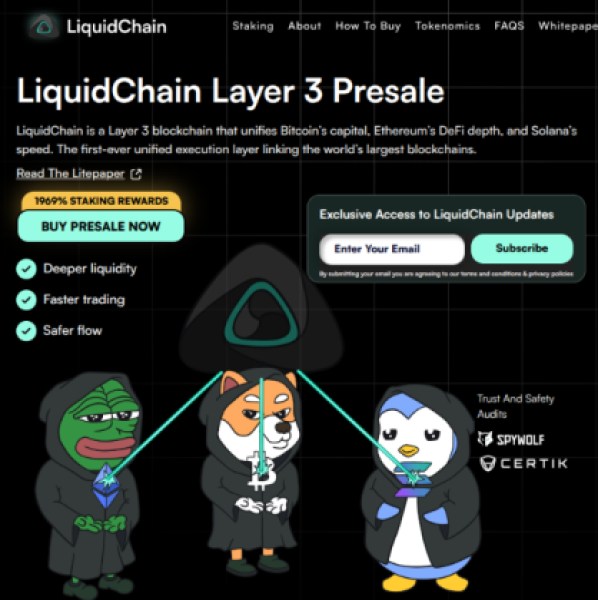
This architecture changes the game for developers. Currently, a team building a decentralized prediction market has to pick a home chain, effectively alienating users from every other ecosystem. LiquidChain allows for a ‘deploy-once, access-all’ framework.

A developer can launch an application on the LiquidChain L3, and the protocol’s Cross-Chain Virtual Machine (VM) handles the settlement across the underlying L1s automatically.
For the user? The complexity just disappears.

A trader holding $SOL can interact with a contract originally designed for $ETH liquidity without ever leaving their wallet environment. This ‘Single-Step Execution’ capability is critical for the adoption of the sophisticated financial products Coinbase is fighting to normalize.

By aggregating liquidity rather than fragmenting it, LiquidChain positions itself as the necessary plumbing for the next wave of DeFi applications that require deep, verifiable settlement across multiple chains simultaneously.

BUY YOUR $LIQUID HERE

Presale Data Signals Appetite for Infrastructure Plays

Smart money is eyeing infrastructure layers, largely because they tend to capture value regardless of which specific application wins the adoption war. We’re seeing this sentiment reflected in the capital flows surrounding the LiquidChain presale. The numbers back this up: the project has raised over $527K, a figure that suggests growing confidence in the ‘unified liquidity’ thesis despite broader market chop.

The token, currently priced at $0.01355, offers an entry point into what effectively functions as a decentralized liquidity clearinghouse. The economic model behind $LIQUID is designed to fuel this ecosystem; tokens aren’t just for governance, they’re the gas that powers the cross-chain settlement engine.

As more applications (whether prediction markets, DEXs, or lending protocols) use the LiquidChain L3, the demand for the token scales with network activity.

Investors seem to be betting on a shift away from ‘chain maximalism’ toward ‘chain agnosticism.’ The ability to use Bitcoin’s security, Ethereum’s smart contracts, and Solana’s speed within a single transaction is a compelling value proposition.

With the presale ongoing, the market is pricing in the potential for LiquidChain to become the standard for cross-chain execution, solving the very fragmentation issues that would otherwise bottleneck the institutional volume that Coinbase’s legal wins are unlocking.

VISIT THE OFFICIAL LIQUIDCHAIN ($LIQUID) PRESALE SITE

This article is for informational purposes only and does not constitute financial advice. Cryptocurrencies are volatile assets. Always conduct your own due diligence before making investment decisions.

Пов'язані питання

QWhat was the outcome of Nevada's attempt to block Coinbase's entry into prediction markets?

ANevada regulators hit an early snag and were unable to immediately halt Coinbase's operations, suggesting federal commodity definitions might supersede state-level gambling classifications.

QWhat is the main infrastructure problem facing prediction markets even as regulatory friction eases?

AThe infrastructure friction is still a nightmare, with traders having to navigate a fragmented maze of wrapped assets and bridged tokens to find liquidity across different blockchains.

QHow does LiquidChain ($LIQUID) propose to solve the liquidity fragmentation problem in DeFi?

ALiquidChain operates as a Layer 3 infrastructure that unifies Bitcoin, Ethereum, and Solana into a single execution environment, allowing for 'deploy-once, access-all' applications and single-step execution for users.

QWhat does the success of the LiquidChain presale, raising over $527K, indicate about investor sentiment?

AIt signals growing confidence in the 'unified liquidity' thesis and a bet on infrastructure layers that capture value regardless of which specific application wins, moving away from chain maximalism toward chain agnosticism.

QWhy is the regulatory clarity for Coinbase's prediction markets significant for institutional capital?

AIt signals a potential green light for institutional capital to enter the prediction sector, as operating regulated markets in the US would allow volume potential that dwarfs current activity on offshore platforms.

Пов'язані матеріали

Has Hook Summer Really Arrived? sato, Lo0p, FLOOD Ignite the New Narrative of Uniswap v4

"Hook Summer" Arrives? Sato, Lo0p, FLOOD Ignite Uniswap v4 Narrative Amidst a slight market recovery, attention within the Ethereum ecosystem has shifted to Meme coins built on Uniswap v4's Hook protocol. Following ASTEROID, tokens like sato, sat1, Lo0p, and FLOOD have become market focal points, with market caps ranging from millions to tens of millions, bringing concentrated liquidity to a narrative-dry market. Uniswap v4 Hooks are "plugin smart contracts" that allow developers to inject custom logic at key points in a liquidity pool's lifecycle (initialization, adding/removing liquidity, swaps, etc.), making the AMM programmable. Recent representative projects include: * **sato**: Market cap peaked over $38M; uses a v4 curve mechanism for minting/burning, locking ETH as reserve. * **sat1**: Market cap briefly exceeded $10M, positioning as an "optimized sato," but later declined significantly. * **Lo0p**: Market cap neared $6.6M; a "lending AMM protocol" allowing users to borrow ETH against deposited LO0P tokens without immediate selling pressure. * **FLOOD**: Market cap approached $6M; channels trading reserves into Aave v3 to generate yield, which is retained in the pool. The emergence of these Hook-based tokens could drive long-term growth for the Uniswap ecosystem by attracting users and liquidity to v4 pools. Combined with Uniswap's activated fee switch (partially used to burn UNI), the long-term outlook for UNI appears positive. However, short-term UNI price appreciation is not directly guaranteed. Factors include the sustainability and lifecycle of these new tokens, their price volatility, overall market conditions, and regulatory pressures. Currently, Uniswap v4's TVL ($595M) lags behind v3 and v2, indicating Hook adoption still requires time to mature. In summary, the Hook ecosystem serves as "long-term nourishment" for UNI, but acts more as a "catalyst" than a direct "booster" in the short term. Note: These are early-stage experimental tokens and may carry unknown risks.

marsbit13 хв тому

Has Hook Summer Really Arrived? sato, Lo0p, FLOOD Ignite the New Narrative of Uniswap v4

marsbit13 хв тому

Has Hook Summer Truly Arrived? sato, Lo0p, FLOOD Ignite the New Uniswap v4 Narrative

With the broader market showing signs of recovery, a new wave of interest has emerged around Ethereum-based meme coins. Following ASTEROID, tokens like sato, sat1, Lo0p, and FLOOD, built upon the Uniswap v4 Hook protocol, are capturing market attention. Their market capitalizations range from millions to tens of millions of dollars, injecting much-needed focused liquidity into a market lacking narratives. This article explores whether this trend signifies an incoming "Hook Summer" and its potential impact on UNI's price. Hooks are essentially plug-in smart contracts for Uniswap v4 liquidity pools, allowing developers to inject custom logic at key points in a pool's lifecycle (like initialization, adding/removing liquidity, swaps). This transforms the AMM into programmable building blocks. Key highlighted projects include: * **sato**: Peaked over $38M market cap. It utilizes a v4 curve for minting/burning; buying locks ETH as reserve to mint new tokens, while selling redeems ETH from the reserve and burns tokens. * **sat1**: Market cap briefly exceeded $10M, promoted as an "optimized sato," but later declined significantly. * **Lo0p**: Reached nearly $6.6M. It's a lending AMM protocol where buying LO0P tokens locks them as collateral, allowing users to borrow ETH from the pool reserve at 40% LTV, aiming to improve capital efficiency for idle ETH in LPs. * **FLOOD**: Peaked near $6M. Its mechanism directs asset reserves from buys into Aave v3 to generate yield, with fees and interest retained in the pool to potentially influence the token's price long-term. In the long term, the development of the Hook ecosystem can attract users and liquidity to Uniswap v4, benefiting UNI's fundamentals—especially combined with the recent activation of the protocol fee switch, where a portion of fees is used to burn UNI. However, in the short term, these Hook-based tokens are unlikely to directly drive significant UNI price appreciation. Their impact is moderated by factors like token sustainability, price volatility, and broader market and regulatory conditions. Currently, Uniswap v4's TVL ($595M) still trails behind v2 and v3, indicating adoption and growth will take time. The article concludes that while the Hook ecosystem provides long-term "nourishment" for UNI, its short-term role is more of a "catalyst" than a "booster." Readers are cautioned that these are early-stage experimental tokens and may carry unknown risks.

Odaily星球日报25 хв тому

Has Hook Summer Truly Arrived? sato, Lo0p, FLOOD Ignite the New Uniswap v4 Narrative

Odaily星球日报25 хв тому

Interview with Michael Saylor: I Did Say I Would Sell Bitcoin, But Never a Net Sale

Interview with Michael Saylor: I Said We'd Sell Bitcoin, But Never Be a Net Seller In a recent podcast, MicroStrategy Executive Chairman Michael Saylor clarified the company's stance on potentially selling Bitcoin. Following MicroStrategy's earnings call statement about being prepared to sell BTC to fund dividends for its STRC (Strategic) credit product, Saylor emphasized the distinction between selling and being a "net seller." Saylor explained the core business model: MicroStrategy sells credit instruments like STRC and uses the proceeds to buy Bitcoin, which is viewed as "digital capital" expected to appreciate around 30-40% annually. A portion of these capital gains can then be used to pay the dividends on the credit products. He stressed that even if the company sells some Bitcoin for dividends, it simultaneously buys much more with new credit issuance. For example, after raising $3.2 billion from STRC sales in April, the dividend obligation was only $80-90 million, making the company a net buyer. The clarification aims to counter market narratives questioning the value of Bitcoin on MicroStrategy's balance sheet if it were never sold, and to dismiss claims of a "Ponzi scheme." Saylor reiterated his personal philosophy for investors: "Don't be a net seller of bitcoin" and ensure your Bitcoin holdings increase each year. Saylor also discussed Bitcoin's role as the foundation for "digital credit," noting that STRC has become the largest and most liquid preferred stock issue in the U.S., offering high risk-adjusted returns (Sharpe ratio). He highlighted Bitcoin's deep liquidity, stating that even large purchases by MicroStrategy do not move the market significantly, which is driven by macro factors, geopolitical tensions, and capital flows from ETFs and credit products. Finally, Saylor reflected on his early inspiration from sci-fi books, which motivated his path to MIT, and maintained his fundamental thesis on Bitcoin remains unchanged: it is superior digital capital enabling superior digital credit.

链捕手29 хв тому

Interview with Michael Saylor: I Did Say I Would Sell Bitcoin, But Never a Net Sale

链捕手29 хв тому

Beaten SK Hynix Employees in China: Year-end Bonus Less Than 5% of Korean Staff's

"SK Hynix Chinese Staff Hit Hard: Bonuses Less Than 5% of Korean Counterparts" Driven by the AI boom, South Korea's SK Hynix is experiencing record performance, with media reports predicting massive year-end bonuses for its employees, making them highly desirable in the matchmaking market. However, this prosperity starkly contrasts with the situation for the company's Chinese employees. According to reports, SK Hynix operates under a rule allocating 10% of operating profit for employee bonuses. While projections suggest Korean employees could receive bonuses reaching millions of RMB, a Chinese employee with over a decade of technical experience revealed the disparity: "If they get 3 million, Chinese staff get less than 5% of that." After adjustments based on KPI ratings, this employee's highest bonus was slightly over 100,000 RMB. Bonuses are paid annually in Korea but semi-annually in China. During the industry downturn in 2023-2024, Chinese employees received no bonus at all. The gap extends beyond bonuses. Recruitment posts for SK Hynix's Chinese factories (in Wuxi, Dalian, Chongqing) show engineer monthly salaries ranging from 10,000 to 35,000 RMB, with a 13th-month salary promised. Chinese employees also receive standard benefits like annual leave but lack stock incentives, which are reportedly unavailable to them. Furthermore, management positions in China are predominantly held by Korean personnel, though industry observers note a gradual increase in local middle managers over time. SK Hynix has confirmed the 10% bonus rule but cautioned that specific future bonus amounts remain unpredictable. The company forecasts strong demand for HBM and other high-value enterprise products for the next 2-3 years, driven by AI infrastructure investment. This focus on business-to-business markets may continue to constrain supply for consumer products, potentially prolonging price increases for components like memory.

链捕手43 хв тому

Beaten SK Hynix Employees in China: Year-end Bonus Less Than 5% of Korean Staff's

链捕手43 хв тому

Торгівля

Спот
Ф'ючерси
活动图片