Netflix Founder Goes to His Most Feared Place

marsbitОпубліковано о 2026-04-17Востаннє оновлено о 2026-04-17

Анотація

Netflix co-founder and chairman Reed Hastings is stepping down from the board after nearly 30 years with the company, despite Netflix posting its strongest-ever quarterly results with revenue up 16% and net profit surging 83% year-over-year. The move comes as Hastings deepens his involvement in AI governance, having joined the board of Anthropic last year through its Long-Term Benefit Trust, an independent body focused on aligning AI development with humanity’s long-term interests. Hastings, who studied AI in the 1980s, has shifted from optimism to caution regarding AI’s impact. He recently identified AI as the biggest threat to Netflix, fearing that AI-generated content could eventually make free platforms like YouTube so compelling that paid subscriptions become less attractive. His concerns are grounded in Netflix’s own history of disrupting traditional media through technology. While Netflix is actively integrating AI into production—including a recent $600 million acquisition of an AI-assisted filmmaking tools company—Hastings appears to be hedging against a future where AI fundamentally alters content creation and consumption. His departure marks a symbolic moment, reflecting both his personal pivot toward AI ethics and the broader existential questions facing the entertainment industry.

Author: David, Deep Tide TechFlow
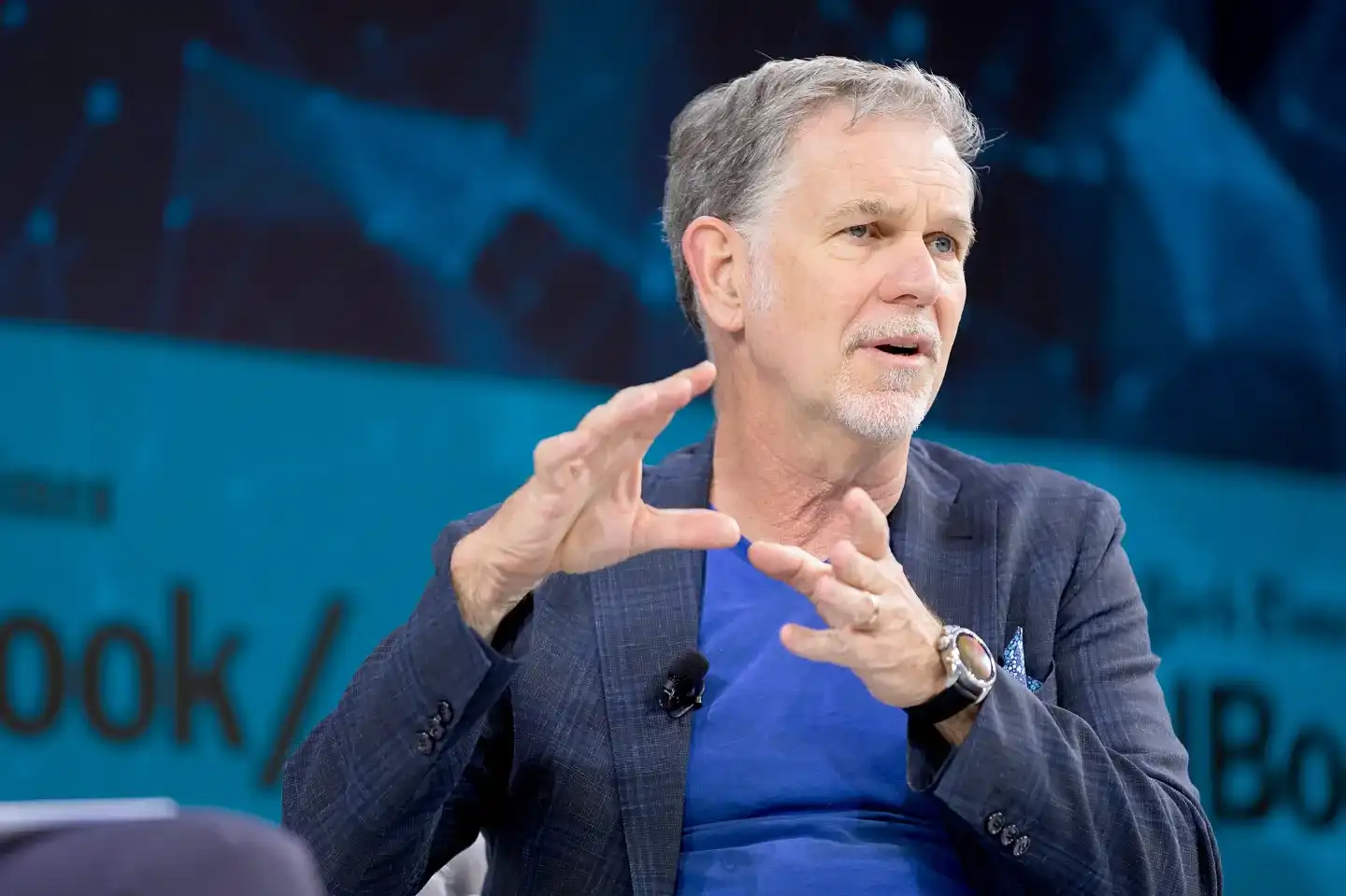
Netflix has never been as profitable as it is now, yet its founder chose this moment to leave.

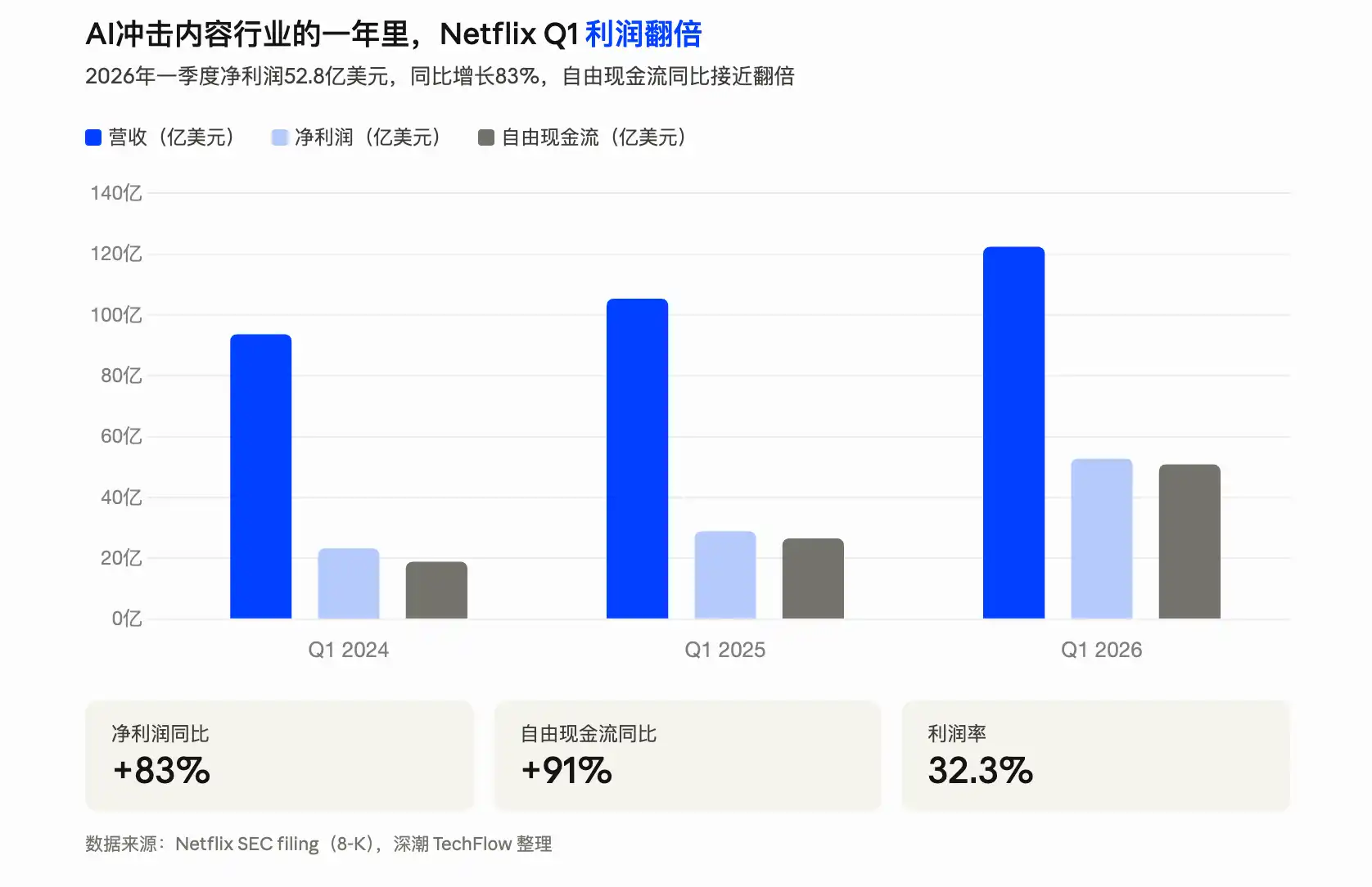
On April 16, Netflix released its Q1 2026 financial report, with revenue of $12.25 billion, a 16% year-over-year increase, and net profit surging 83% year-over-year. Earnings per share were $1.23, nearly 60% higher than Wall Street's expectation of $0.76.

But the report also announced another matter: Co-founder and current Chairman Reed Hastings will not seek re-election after his term ends in June.

Hastings founded Netflix in 1997, building it from a DVD-by-mail business into a streaming giant with over 325 million paid subscribers worldwide, working for nearly 30 years. In 2023, he handed over the CEO role to his successor and stepped back to chairman. Now, he's leaving the chairman position too.

In the filing submitted to the U.S. Securities and Exchange Commission, Netflix specifically wrote: "This decision is not related to any disagreement with the company."

But the more they emphasize no disagreement, the more it makes people wonder what he is actually going to do.

A little-known fact is that in May last year, Hastings had already joined the board of Anthropic. For nearly 30 years, his business has essentially been about getting people to pay for content, while Anthropic's Claude, though not directly generating video, is changing the way content is produced.

From text to images to video, the cost is getting lower and the speed faster.

Netflix's profitability relies on good content being worth paying for. If AI lowers the barrier to content creation enough, does this premise still hold?

Hastings is clearly already thinking about this question.

What is he afraid of?

As a top global content producer and distributor, Netflix's founder has always had an intellectual concern regarding AI.

You might not know this, but in 1988, Hastings was studying for a master's degree in AI at Stanford. Yes, 40 years ago he was researching artificial intelligence. It's just that the AI of that era was nothing like the useful tool it is today...

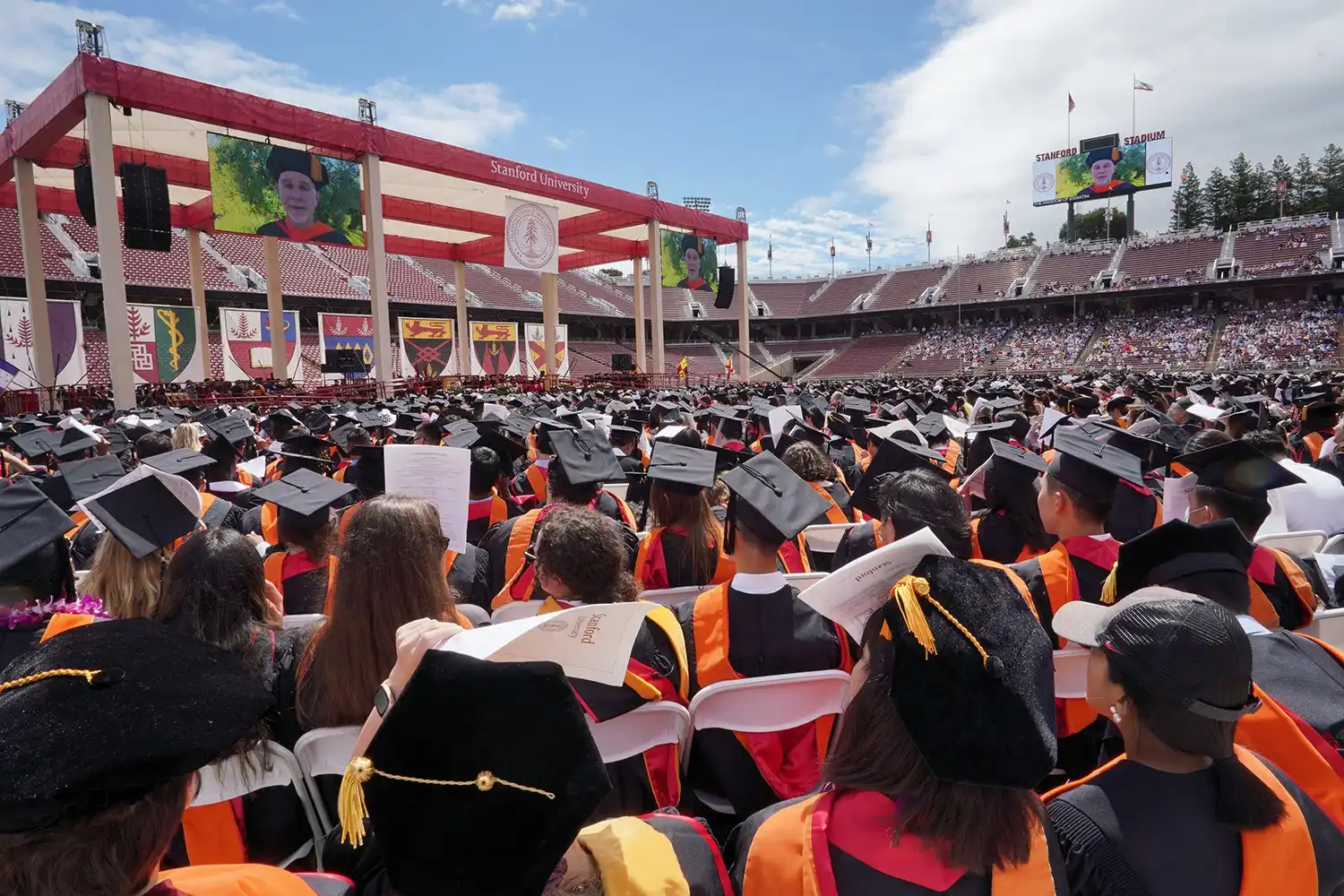
In 2022, Hastings was invited as a speaker at Stanford University's graduation ceremony.
He later mentioned this himself, sounding like he was telling a joke about a wrong turn taken in his youth. AI didn't work out, so he turned to starting a software company, and later founded Netflix, which he worked on for nearly 30 years.

Someone who studied AI couldn't help but pay attention to the field.

In a 2024 interview discussing AI, he was quite relaxed: "AI will help us become more creative; we can use these tools to make more shows." Back then, his attitude was one of embrace. AI was a tool, here to help, not to take jobs.

In March 2025, he donated $50 million to his alma mater, Bowdoin College.

This liberal arts college in Maine doesn't work on large models; Hastings gave them money for a research initiative called "AI and Humanity," specifically studying the impact of AI on work, education, and human relationships.

On the day of the donation, he said something completely different from his relaxed tone a year earlier: "We are fighting for the survival and prosperity of humanity."

Within a year, AI had advanced rapidly, and his stance shifted from AI helping work to AI being a threat to humanity.

Two months later, he joined the board of Anthropic.

He was appointed by an independent body called the "Long-Term Benefit Trust," whose five members hold no Anthropic stock, with the sole duty of ensuring AI development aligns with humanity's long-term interests.

In March of this year, he spelled it out most clearly in another interview. The host asked him what the biggest risk facing Netflix was; he skipped over competitors and subscriber growth and said two words directly:

AI.
He said if AI makes the free content on YouTube cool and attractive enough, and all the young people go watch free content, then who will pay for Netflix?

From public information, you can find Hastings calling himself an "extreme techno-optimist." He doesn't think AI itself is bad; the problem lies in the speed gap.

AI technology is advancing too fast, and humanity's moral and institutional systems can't keep up.

This explains his seemingly contradictory choices over the past year. Donating not to a technical AI lab, but to a humanities college; joining not the advisory board of any commercial AI company, but the safety committee of Anthropic.

The author believes Hastings is more qualified than most to be concerned about whether AI will颠覆 industries.

Netflix itself was the disruptor in the last cycle. It used streaming to kill DVD rentals, crippled cable TV, and forced all of Hollywood to rebuild its distribution system. He personally did the thing: "Use new technology to drive content and distribution costs low enough to kill the previous winners."

Now he looks at AI and probably wonders who's next.

So, Hastings is simultaneously a major shareholder of Netflix and a director at Anthropic. Holding shares in the company he founded, he takes a seat in the industry that might颠覆 it.

This might not be called retirement, but hedging.

Despite the AI impact, Netflix has actually never been better

Four years ago, Netflix was a company with just over $30 billion in annual revenue and less than 20% profit margins, being chased by Wall Street asking "when will you start making real money?" Four years later, this earnings report provided the answer.

In Q1 2026, net profit was $5.28 billion, up 83% year-over-year. Free cash flow was $5.09 billion, almost double that of the same period last year. Meanwhile, the profit margin reached 32%. The full-year revenue guidance is $50.7 to $51.7 billion. If they actually achieve this by year-end, it would mean Netflix's revenue has nearly doubled in three years.
Beyond daily operations, Netflix is not blind to AI either.

A few weeks ago, it spent up to $600 million to acquire InterPositive, a company that makes AI-assisted film and television production tools, using AI to accelerate script development, scene previews, and post-production. Netflix also specifically mentioned generative AI in its earnings letter, saying it will use it to improve content production and user experience.

Using AI to reduce production costs and improve efficiency is a sound strategy. In fact, the entire Hollywood or content production industry is moving in this direction.

It's just that the concern founder Hastings expressed in the interview might be about a different issue.

In February of this year, ByteDance released its video generation model Seedance 2.0. Upload a photo, and in 60 seconds it generates a 2K video with camera movement, sound effects, and lip-syncing.

At the time, Feng Ji, producer of "Black Myth: Wukong," tested it and said four words: "The childhood era of AIGC is over." Director Jia Zhangke posted on Weibo saying he was preparing to use it to make a short film...

More concrete numbers come from within the industry. According to Securities Times reports, in the e-commerce advertising sector, one person using Seedance 2.0 can complete in 30 minutes what used to take 7 people 3 days, with a cost reduction of over 99%.

Extras in Hengdian, video editors, special effects producers—people across the entire industry chain are talking about the same term—job anxiety.

Gong Yu, founder of iQiyi, publicly stated a judgment late last year: AI could reduce the cost of the film and television industry by an order of magnitude, increase the number of creators by an order of magnitude, and increase the number of works by two orders of magnitude.

Netflix using AI to reduce production costs is equivalent to improving efficiency within the existing model. But what Seedance and others are doing is lowering the barrier to "making video" from millions of dollars to a few dollars.

The future Hastings spoke of, where "free content on YouTube becomes good enough," is step by step becoming reality.

Of course, all of this may not be directly related to his decision to leave Netflix now. He started handing over power in 2023—CEO, chairman—step by step, with a transition period of at least three years.

It's just that the timing is indeed微妙. Netflix delivered its best-ever financial report, and the stock fell 8% after hours. On the same day, the founder announced his complete departure.

After June, Hastings' name will disappear from Netflix's board list.

His current titles are Director at Anthropic, Director at Bloomberg, and owner of a ski resort in Utah. He still holds Netflix stock; Forbes estimates his net worth at $5.8 billion, mostly tied to Netflix.

He holds Netflix's money while sitting at AI's table.

As for whether this choice is foresight or overcaution, we might only get the answer when AI can truly produce a movie that audiences are willing to watch till the end.


Пов'язані питання

QWhy did Reed Hastings, the co-founder of Netflix, decide to leave the company's board of directors?

AHe is stepping down after his term ends in June, with Netflix stating the decision was not due to any disagreement with the company. He is shifting his focus to other roles, including a board position at AI company Anthropic.

QWhat is Reed Hastings' educational background in AI, and how has his view on AI evolved recently?

AHe studied AI for his master's degree at Stanford in 1988. His view has evolved from seeing AI as a tool to enhance creativity in 2024 to expressing concern in 2025 that AI is a threat to human existence and prosperity, and is the biggest risk to Netflix.

QWhat specific concern does Hastings have about AI's impact on Netflix's business model?

AHe is concerned that AI could make free content on platforms like YouTube so compelling and attractive that younger audiences will abandon paid subscriptions, undermining Netflix's core business of providing premium content worth paying for.

QDespite AI concerns, how is Netflix's current financial performance?

ANetflix is performing exceptionally well financially. Its Q1 2026 report showed revenue of $12.25 billion (up 16% YoY), net profit of $5.28 billion (up 83% YoY), and a profit margin that reached 32%.

QWhat action has Netflix taken to integrate AI into its own operations?

ANetflix acquired InterPositive for up to $600 million, a company that makes AI-assisted film and television production tools. The company also mentioned in its earnings letter that it is using generative AI to improve content production and user experience.

Пов'язані матеріали

Can DeepSeek Save China One Trillion Dollars?

"DeepSeek and the $1 Trillion Infrastructure Question" The article examines whether DeepSeek's AI optimization breakthroughs could potentially save China $1 trillion in future AI infrastructure costs. The analysis begins with Nvidia's upcoming Vera Rubin AI platform, costing ~$7.8 million, where memory (HBM4/LPDDR5X) constitutes $2 million—a 435% cost increase in one year, highlighting how AI hardware spending is shifting toward expensive memory components. DeepSeek's approach works in the opposite direction. Through three key technical innovations showcased in DeepSeek V4, the company dramatically improves hardware efficiency: 1. **Memory Compression (MLA)**: Re-engineers the attention mechanism to compress long-context memory (KV Cache) by over 90%, drastically reducing expensive HBM usage. 2. **Selective Activation (MoE)**: Employs Mixture-of-Experts architecture where only a small fraction of parameters (e.g., 49B out of 1.6T in V4-Pro) are activated per token, allowing most parameters to reside in cheaper memory/SSD. 3. **Computation Caching**: Reuses previously computed results via cache hits, replacing expensive GPU computations with cheap memory reads. Combined, these optimizations allow the same hardware to produce approximately 4x more tokens, effectively reducing required hardware investment by 75%. DeepSeek's pricing reflects this: a 10-billion token workload costs ~$522 monthly versus ~$9,000-$10,000 for competitors. The $1 trillion savings projection stems from McKinsey's estimate that global AI infrastructure will require ~$5.2 trillion investment by 2030. As China's daily token consumption grows toward quadrillions, even marginal efficiency gains scale massively. With a conservative 4x throughput improvement, China could avoid building tens of thousands of AI data centers equivalent to ~7 trillion RMB ($1 trillion) in saved investment. Critically, this strategy shifts dependency from scarce, expensive GPU/HBM—where China lags—toward more accessible storage, caching, and systems engineering where domestic suppliers like CXMT are gaining strength. Rather than "replacing Nvidia," DeepSeek rebalances AI's value chain away from monolithic hardware dependency. Ultimately, DeepSeek's technical breakthroughs could lower the barrier to AI adoption across Chinese industries by making advanced capabilities affordable at scale—transforming who can access next-generation AI.

marsbit46 хв тому

Can DeepSeek Save China One Trillion Dollars?

marsbit46 хв тому

Overturning the Mainstream Approach to Hallucinations: Metacognition is the New Solution for Large Models to Break the Hallucination Barrier

This paper, "Hallucinations Undermine Trust; Metacognition is a Way Forward," proposes a paradigm shift in combating AI hallucination. It argues that the current mainstream approaches—striving for omniscience by scaling data/models or having AI abstain from uncertain answers—are fundamentally flawed. The former has inevitable knowledge gaps, while the latter imposes a crippling "utility tax," requiring the rejection of many correct answers to achieve high accuracy, due to models' poor "discrimination" (the ability to distinguish correct from incorrect answers internally). The core contribution is redefining hallucination not as "being wrong," but as "expressing false information with unwarranted certainty." The proposed solution is **Faithful Uncertainty** or **Metacognition**: enabling AI to accurately perceive its internal uncertainty and honestly express it in its language (e.g., using hedging phrases when unsure). This creates a more reliable assistant that provides useful information while signaling its confidence, minimizing harm from errors. The paper emphasizes that metacognition is critical for the era of AI Agents. Without it, Agents cannot intelligently decide when to use tools like search engines, leading to inefficiency and misuse. Key implementation challenges are highlighted: the "bootstrapping paradox" of training with static uncertainty data, the "alignment distortion signal" where human preference training suppresses internal uncertainty cues, and the difficulty of causally evaluating true metacognition vs. its superficial imitation. The paper concludes that the goal should not be an infallible AI, but one that is honest about the limits of its knowledge, thereby building user trust through transparent communication of its certainty.

marsbit51 хв тому

Overturning the Mainstream Approach to Hallucinations: Metacognition is the New Solution for Large Models to Break the Hallucination Barrier

marsbit51 хв тому

Hedge by Buying Gold and Oil, Chase Soaring Returns with AI. ‘Dated’ Bitcoin Enters a Bear Market

Bitcoin has recently declined, hitting a two-month low near $66,123, while Ethereum fell to a three-month low around $1,837. Analysts suggest the drop is not merely due to factors like ETF outflows or MicroStrategy's selling but reflects a deeper issue: Bitcoin is losing a broader asset competition. In a near-zero interest rate environment, Bitcoin previously thrived as an outlet for investor dissatisfaction with inflation and limited options. However, the market landscape has shifted. Bitcoin now occupies an "awkward middle ground," facing competition on three fronts. For inflation hedging, investors prefer gold, energy stocks, and commodity producers—assets with tangible backing and clearer pricing power. For growth exposure, AI-related companies with actual revenues and profits are more attractive. Even within crypto, investors can choose stablecoins, exchanges, or infrastructure firms tied directly to adoption, offering clearer business models and leverage. Thus, Bitcoin is no longer the top choice for hedging, growth, or crypto exposure. This shift is evident in market reactions: despite recent warnings about persistent inflation from a Fed official, Bitcoin did not rally as it might have in the past. Instead, capital flowed to assets with direct commodity or energy exposure. The recent ETF outflows and MicroStrategy sales are symptoms, not causes, of this new reality. Investors are becoming more selective, demanding clearer value propositions beyond mere scarcity. The emerging bear case for Bitcoin is not about it being a bubble or failed technology, but that scarcity alone is no longer sufficient.

华尔街日报54 хв тому

Hedge by Buying Gold and Oil, Chase Soaring Returns with AI. ‘Dated’ Bitcoin Enters a Bear Market

华尔街日报54 хв тому

Торгівля

Спот
Ф'ючерси
活动图片




