Naval Steps Into the Arena: A Historic Collision Between Ordinary People and Venture Capital

marsbitОпубліковано о 2026-04-25Востаннє оновлено о 2026-04-25

Анотація

Naval Ravikant, co-founder of AngelList and a prominent Silicon Valley thinker, has taken a hands-on role as the chairman of the investment committee at USVC—a new SEC-registered fund allowing non-accredited investors to access high-growth private tech companies with a minimum investment of $500. The fund’s initial portfolio includes leading AI firms like OpenAI, Anthropic, xAI, and others. This move represents a significant shift in democratizing access to venture capital, a space traditionally dominated by institutional investors and high-net-worth individuals. USVC aims to let ordinary investors participate in the high-alpha, pre-IPO growth phase of tech companies—a stage where much of the value creation now occurs before public listings. However, the fund is not without complexities. It offers limited liquidity, with potential quarterly redemptions capped at 5%, and charges an all-in fee of 2.5% in its first year. While this is higher than traditional ETFs, it is positioned as a more accessible alternative to conventional VC fee structures. Ultimately, USVC symbolizes a broader movement toward financial inclusion in high-stakes tech investing—not through crypto or Web3 mechanisms, but via regulated, retail-friendly investment vehicles. It offers a ticket to early-stage innovation, though risks typical of venture capital remain.

Author: 0xMedia

Naval is stepping into the arena.

This time, he's not just discussing wealth, freedom, and leverage on a podcast, nor is he commenting on startup trends as a Silicon Valley thinker and angel investor. Instead, he is directly taking on the role of Chairman of the Investment Committee at USVC.
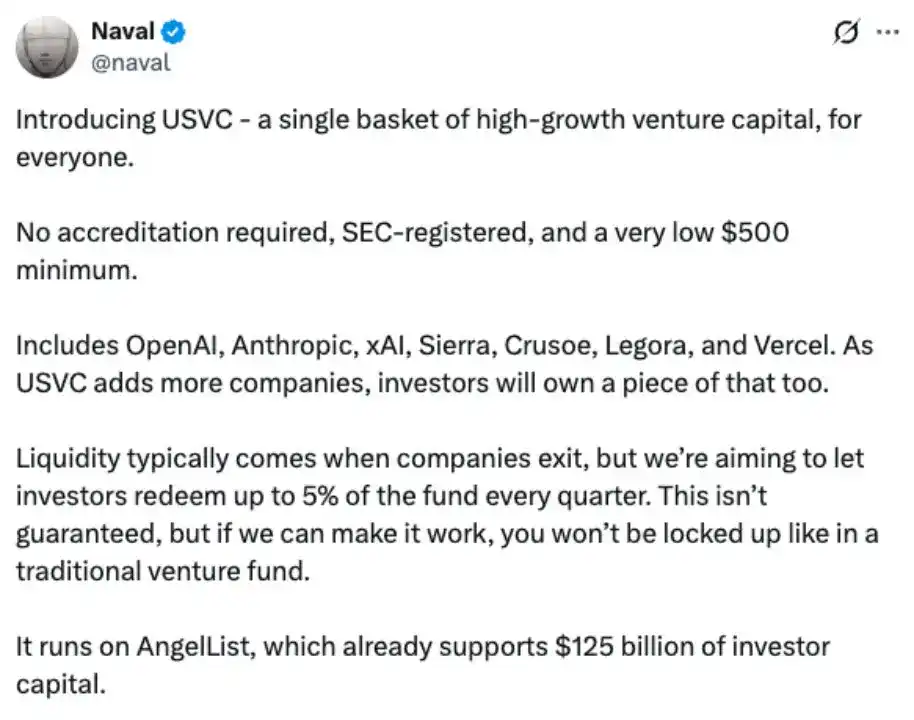
This signal itself is very telling. Naval is not someone who would easily endorse a financial product. His persona is complex: co-founder of @AngelList, a representative figure of early-stage investment culture, an evangelist for the Silicon Valley entrepreneurial spirit, and a long-standing intellectual symbol in the Web3 world.

So when Naval @naval chooses to step into the forefront for USVC, it's not just about the launch of a new fund. It seems more like a retail extension of AngelList's over-a-decade-long infrastructure for startup financing.

In the past, AngelList served entrepreneurs, angel investors, fund managers, and private capital networks. Now, it is attempting to break down a portion of the access to venture capital, once reserved for a select few, into a gateway that ordinary people can also participate in.

USVC is an SEC-registered fund with a minimum investment of $500, requiring no accredited investor status. Its early portfolio includes companies like OpenAI, Anthropic, xAI, Sierra, Crusoe, Legora, and Vercel.
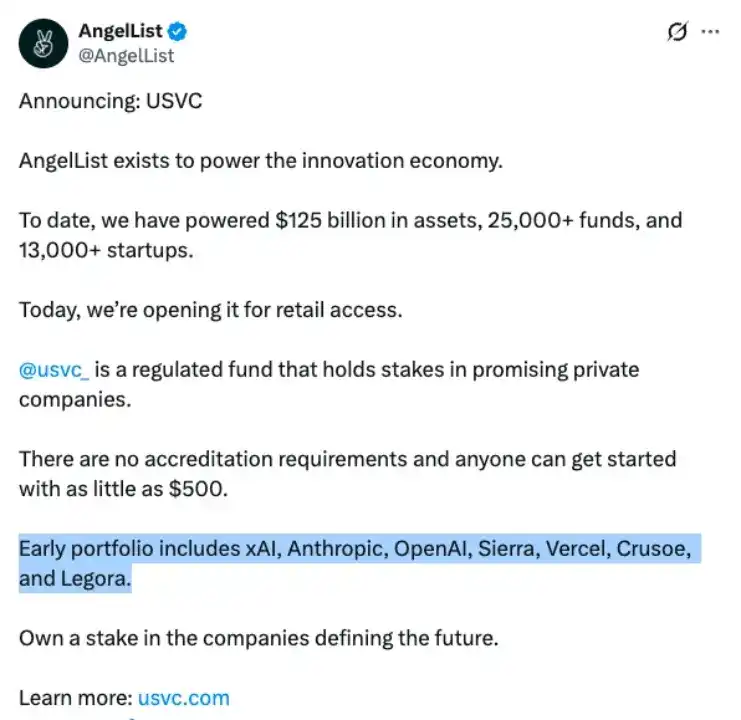
This is the real point of discussion that USVC provokes. It's not simply selling a basket of AI star companies; it's responding to an increasingly尖锐的时代问题: when the most explosive tech growth happens earlier and earlier in the private markets, can ordinary people still participate in the future sooner?

Over the past decade, the most brutal change in tech investing hasn't been the AI explosion, nor the revaluation of SaaS or chip stocks, but the overall forward shift of the wealth creation timeline.

Many of the most important companies complete multiple rounds of massive funding and value leaps long before entering the public markets. By the time ordinary investors can finally buy in through an IPO or the secondary market, the story has often been told many times over, valuations have been fully priced by earlier rounds of capital, and the truly asymmetric alpha has already been captured upfront by private capital.

For example, as we all know, Benchmark merely led a $75 million funding round in April 2025 for Manus, securing a position in this AI Agent newcomer's most critical growth window.

At that time, Manus @ManusAI was valued at around $500 million, and just months later, Meta acquired it for over $2 billion, delivering early capital an approximate 4x paper return in a very short time.

This is the most alluring aspect of venture capital. The real alpha often occurs when ordinary people don't yet have the qualifications to enter.

Names like OpenAI, Anthropic, xAI, and Vercel are exciting not just because they represent AI, large models, developer tools, and next-generation software infrastructure, but because they symbolize a fact: the future is being bought earlier and earlier.

Ordinary people use these products daily, contributing data, attention, subscription revenue, and ecosystem growth, but at the capital level, they often can only stand outside the glass window, watching institutions, funds, and high-net-worth investors participate in the value revaluation.

It is precisely this glass pane that USVC is attempting to shatter.

The entry point it offers is very direct: ordinary people can participate with a minimum of $500 in a venture capital basket composed of high-growth private tech companies. This threshold, placed alongside the names of these assets, creates a stark contrast.
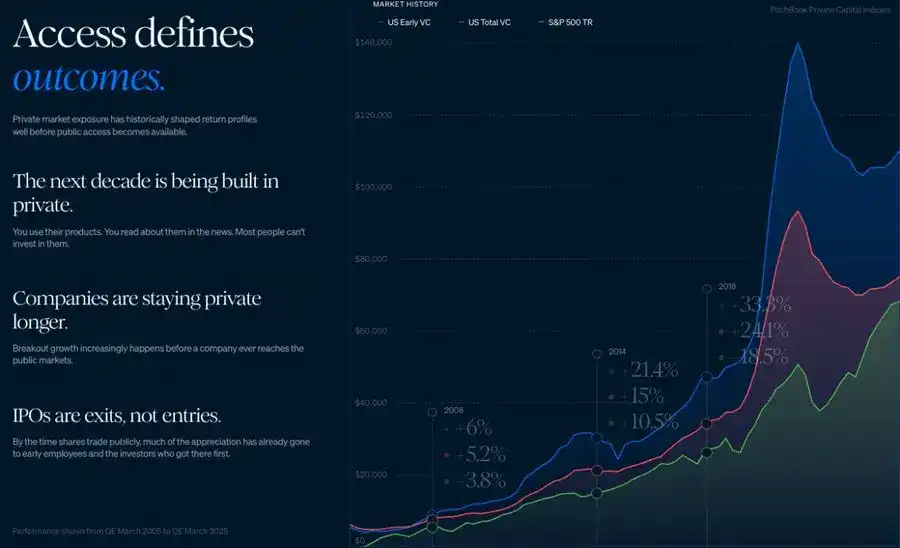
* US Early VC vs. S&P 500 returns, from USVC website https://usvc.com/

In the past, those who could access such assets were typically top VCs, family offices, sovereign wealth funds, university endowments, or accredited high-net-worth investors. Now, USVC is attempting to productize,合规化, and retail this asset exposure, placing it before ordinary investors.

But precisely because of this, USVC cannot be understood merely as an emotional product of "$500 to buy OpenAI." The真正复杂的地方在于, venture capital is never just about buying the name of a good company, but about the price, stage, structure, fees, and liquidity terms at which one buys.

OpenAI, Anthropic, and xAI are certainly the most watched tech companies of this era, but a great company does not automatically equate to a great investment. Especially after they have undergone multiple rounds of high-valuation funding, what investors真正需要判断 is not whether these companies are strong enough, but whether the future returns through USVC still possess sufficient吸引力.

This is also why Naval's involvement is crucial. Naval's symbolic significance is not just his influence, but that he represents a long-term understanding of entrepreneurship, capital, networks, and leverage.
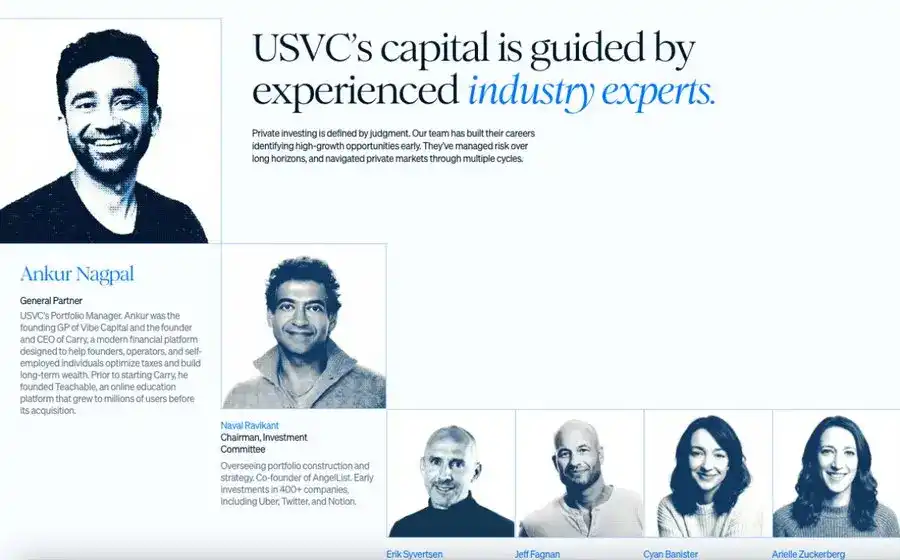
One of the most important things AngelList did back in the day was to partially loosen startup financing from extremely closed circles, allowing more angel investors, entrepreneurs, and new fund managers to connect through the platform.

What USVC is doing today is, in a sense, a continuation of the same logic: if AngelList once reduced the organizational cost of the startup financing network, then USVC is now attempting to lower the barrier to entry for ordinary people to access venture capital assets.

However, the expansion of access does not mean the disappearance of risk.

USVC is not an ETF. It cannot be traded intraday like a Nasdaq ETF, nor can it be bought and sold at any time like public stocks. Its underlying assets are private companies and private fund shares, inherently characterized by low liquidity, opaque valuation, and long exit cycles.

The team mentions hoping to achieve up to 5% fund redemptions quarterly in the future, but this does not mean investors can exit at any time. More accurately, this is a designed partial liquidity, not the天然具备的高流动性 of the underlying assets.

The fee issue同样不能回避. USVC's current all-in fee for the first year is 2.5%. At first glance, this number is certainly high compared to S&P 500 ETFs, Nasdaq ETFs, or other low-cost index products.

But if compared within the traditional venture capital system, the situation becomes much more complex. The common fee structure for traditional VCs is 2/20, meaning a 2% annual management fee plus a 20% performance fee (carried interest).

If investing indirectly through a fund of funds, an additional layer of fees might be stacked on top of the underlying VC fees. USVC's proposition is that the current 2.5% includes fees related to the underlying funds, with AngelList absorbing costs exceeding that比例 in the first year, and USVC charging no additional fees for direct investments.

If it were merely repackaging already very expensive late-stage star assets for retail investors, then 2.5% would be hard to call cheap. But if it can consistently secure truly scarce, completely inaccessible-to-ordinary-people, and still attractively valued优质私募资产 through the AngelList and Naval network, then this fee更像是一种进入风险资本网络的通行成本.

In other words, the greatest value of USVC lies not in being cheap, but in whether it can持续提供真实的、稀缺的、值得付费的风投权限.

This is also where USVC subtly intersects with the Web3 narrative.

Over the past few years, Web3 has been talking about financial inclusion. DeFi allows ordinary people to lend, trade, market-make, and participate in yield strategies on-chain; RWA attempts to bring real-world assets on-chain; stablecoins have made dollar payments globalized, low-friction, and real-time.

But USVC is taking a different path. It hasn't used tokens to achieve asset openness, nor has it used on-chain mechanisms to provide liquidity. Instead, through an SEC-registered fund, NAV, an investment committee, the AngelList network, and compliant distribution channels, it is bringing exposure to previously closed private tech assets before ordinary investors.

The paths are different, but the underlying question is similar: Who is qualified to own the future? USVC might not be a ticket to guaranteed returns, but rather a ticket to get closer to the future, sooner. DYOR.


Пов'язані питання

QWhat is the significance of Naval Ravikant's role as the Investment Committee Chair at USVC?

ANaval Ravikant's involvement is significant because he is a respected Silicon Valley thinker, co-founder of AngelList, and a symbol of early investment culture. His endorsement signals that USVC is not just another financial product but a serious attempt to democratize access to high-growth private tech investments, extending AngelList's mission of making venture capital more accessible.

QHow does USVC aim to change普通人's access to venture capital investments?

AUSVC aims to democratize access by offering an SEC-registered fund with a minimum investment of $500, open to non-accredited investors. It provides exposure to a basket of high-growth private tech companies like OpenAI, Anthropic, and xAI, which were previously only available to institutional investors, VCs, or high-net-worth individuals.

QWhat are some key risks associated with investing in USVC?

AKey risks include low liquidity (as the fund holds private company shares and私募基金份额, with limited quarterly redemptions), valuation opacity, long investment horizons, and fees (an all-in fee of 2.5% annually). Unlike public ETFs, it lacks daily tradability and transparency in pricing.

QHow does USVC's fee structure compare to traditional venture capital funds?

AUSVC charges an all-in fee of 2.5% annually, which includes underlying fund fees. This is lower than the traditional VC '2 and 20' model (2% management fee plus 20% performance fee). However, it is higher than low-cost public market ETFs, and its value depends on USVC's ability to source稀缺, high-quality private assets at attractive valuations.

QWhat is the broader implication of USVC in the context of financial democratization and Web3 narratives?

AUSVC represents an alternative path to financial democratization, contrasting with Web3's use of tokens and DeFi for open access. It uses SEC-regulated funds and traditional structures to provide retail investors with exposure to private tech assets. This addresses the core issue of who gets to participate in early-stage wealth creation from high-growth companies before they go public.

Пов'язані матеріали

The Age of Decoupling Has Arrived: Bitcoin is No Longer the Sole Compass of Crypto

The era of the cryptocurrency market moving in lockstep with Bitcoin is ending, as the industry splits into two distinct asset categories: endogenous and exogenous. Endogenous assets, like Bitcoin, derive value purely from the crypto market's cycles. Their narratives swing between being "interstellar money" in bull markets and "digital collectibles" in bear markets. Exogenous assets, however, are nominally crypto but operate with independent value drivers. Examples include: * **Venice:** An AI inference service using tokens for payments; its consumer-AI business model is decoupled from crypto price swings. * **Figure:** A fintech lender using blockchain to speed up loan approvals; its core value is in credit, not crypto. * **Stablecoin firms like BVNK:** Acquired by traditional finance giants (Mastercard, Stripe), their growth is tied to payment infrastructure, not market cycles. Hybrid projects like **Hyperliquid** (a decentralized exchange) show a shift, with a growing share of non-crypto trading (e.g., prediction markets). This divergence is fundamental. Endogenous assets remain highly correlated to Bitcoin, similar to gold miners to gold. Exogenous assets are evolving to have their own fundamentals, like the weak correlation between gold and the S&P 500. This changes investment analysis. Evaluating exogenous assets requires traditional fundamental research—assessing user bases, unit economics, and moats—more akin to fintech investing than charting Bitcoin. Promising exogenous sectors include: on-chain exchanges/brokers, AI-crypto fusion, privacy-focused digital banks, lending (institutional/private credit), stablecoins/real-world asset tokenization, payment rails, and non-financial crypto-consumer products. Currently, investing via equity is often safer than via tokens, as token value accrual mechanisms need further regulatory and industry development (e.g., the CLARITY Act). Nonetheless, the core trend is clear: crypto market drivers are diversifying from a single factor (Bitcoin) to multiple fundamentals, ending the era of uniform market moves.

marsbit42 хв тому

The Age of Decoupling Has Arrived: Bitcoin is No Longer the Sole Compass of Crypto

marsbit42 хв тому

Five Cryptos That Could Outperform Bitcoin Over the Next Cycle Due To Higher Growth Velocity

Bitcoin's growth often sets market trends, but analysts believe the next cycle's highest percentage gains may come from assets with greater growth velocity. While Bitcoin provides stability, several cryptocurrencies are positioned for stronger relative upside. This article highlights five such assets, with a particular focus on Ozak AI as the potential high-growth standout of the cycle. Ethereum (ETH) is noted for its ongoing evolution and institutional adoption. Solana (SOL) is recognized for its high throughput and history of sharp rallies. Chainlink (LINK) is highlighted as essential infrastructure for DeFi and AI applications. Avalanche (AVAX) is mentioned for its subnet architecture and enterprise potential. Ozak AI ($OZ) is presented as a distinct early-stage opportunity, currently in presale at $0.014 with a target listing price of $1.00. The project is building a full AI-native blockchain ecosystem, including prediction agents, a data stream network, and structured data vaults. Analysts suggest its early valuation stage and focus on AI infrastructure could allow for exponential growth velocity compared to more mature assets like Bitcoin, which requires massive capital inflows for significant price movement. The final takeaway positions Ozak AI as a high-asymmetry bet for investors seeking exponential upside alongside more stable assets.

TheNewsCrypto1 год тому

Five Cryptos That Could Outperform Bitcoin Over the Next Cycle Due To Higher Growth Velocity

TheNewsCrypto1 год тому

What's New in Jensen Huang's 'Agent Factory'?

In a keynote at COMPUTEX 2026, NVIDIA CEO Jensen Huang shifted the company's focus from hardware "full-stack" solutions to the era of AI Agents. The centerpiece is the Vera Rubin platform, now in production, which is designed specifically for Agent workloads and offers 10x the efficiency of its predecessor. The platform features the new Vera CPU, built for AI, and incorporates Spectrum-X Ethernet Photonics with CPO technology for improved networking and energy efficiency. NVIDIA introduced DSX, an integrated toolkit for designing, simulating, and operating AI data centers, aiming to streamline "AI factory" deployment and management. For end-user deployment, the company unveiled DGX Station for Windows, a desktop AI supercomputer for running Agents locally, and the RTX Spark SoC for AI PCs. On the software front, NVIDIA launched the 550B-parameter Nemotron 3 Ultra model for enterprise Agents and the Cosmos 3 foundation model for physical AI, unifying visual reasoning and action prediction. In robotics, a partnership with Unitree yielded the H2 Plus, a reference humanoid robot built on the Isaac GR00T platform to lower development barriers. Security was emphasized with enhanced confidential computing for Vera Rubin and new data path security features for the BlueField-4 STX storage platform. The presentation highlighted a strategic pivot: NVIDIA is reorganizing its entire technology stack—from chips and data centers to models, software, and robots—around the emerging ecosystem of autonomous, practical AI Agents.

marsbit1 год тому

What's New in Jensen Huang's 'Agent Factory'?

marsbit1 год тому

Торгівля

Спот
Ф'ючерси

Популярні статті

Як купити PEOPLE

Ласкаво просимо до HTX.com! Ми зробили покупку ConstitutionDAO (PEOPLE) простою та зручною. Дотримуйтесь нашої покрокової інструкції, щоб розпочати свою криптовалютну подорож.Крок 1: Створіть обліковий запис на HTXВикористовуйте свою електронну пошту або номер телефону, щоб зареєструвати обліковий запис на HTX безплатно. Пройдіть безпроблемну реєстрацію й отримайте доступ до всіх функцій.ЗареєструватисьКрок 2: Перейдіть до розділу Купити крипту і виберіть спосіб оплатиКредитна/дебетова картка: використовуйте вашу картку Visa або Mastercard, щоб миттєво купити ConstitutionDAO (PEOPLE).Баланс: використовуйте кошти з балансу вашого рахунку HTX для безперешкодної торгівлі.Треті особи: ми додали популярні способи оплати, такі як Google Pay та Apple Pay, щоб підвищити зручність.P2P: Торгуйте безпосередньо з іншими користувачами на HTX.Позабіржова торгівля (OTC): ми пропонуємо індивідуальні послуги та конкурентні обмінні курси для трейдерів.Крок 3: Зберігайте свої ConstitutionDAO (PEOPLE)Після придбання ConstitutionDAO (PEOPLE) збережіть його у своєму обліковому записі на HTX. Крім того, ви можете відправити його в інше місце за допомогою блокчейн-переказу або використовувати його для торгівлі іншими криптовалютами.Крок 4: Торгівля ConstitutionDAO (PEOPLE)Легко торгуйте ConstitutionDAO (PEOPLE) на спотовому ринку HTX. Просто увійдіть до свого облікового запису, виберіть торгову пару, укладайте угоди та спостерігайте за ними в режимі реального часу. Ми пропонуємо зручний досвід як для початківців, так і для досвідчених трейдерів.

466 переглядів усьогоОпубліковано 2024.12.12Оновлено 2026.06.01

Як купити PEOPLE

Обговорення

Ласкаво просимо до спільноти HTX. Тут ви можете бути в курсі останніх подій розвитку платформи та отримати доступ до професійної ринкової інформації. Нижче представлені думки користувачів щодо ціни PEOPLE (PEOPLE).

活动图片












