Native Privacy Features: Ethereum's Lifesaver?

marsbitОпубліковано о 2026-05-29Востаннє оновлено о 2026-05-29

Анотація

"The Native Privacy Function: Ethereum's Lifeline?" While Ethereum's ETH price struggles, privacy coins like Zcash (ZEC) are rallying, highlighting growing market demand for financial privacy. Ethereum's developers are now racing to implement native privacy features, seen as critical for its future. Currently, all Ethereum asset balances and transaction histories are fully public, deterring institutional adoption and eroding its core value as a settlement layer. Industry experts warn Ethereum must deliver usable privacy within 12 months or risk falling behind competitors like Solana and Tron, which are already gaining market share and revenue. Data shows a significant decline in holdings among mid-sized and large Ethereum wallets, adding pressure. A broader industry shift towards financial privacy is underway, driven by stablecoin adoption, on-chain applications, and sophisticated AI-powered tracking. Privacy is no longer a niche concern but a mainstream need for both individuals and businesses wanting confidential transactions. Ethereum's co-founder Vitalik Buterin is prioritizing privacy, with a roadmap focusing on three key areas: Account Abstraction (improving wallet programmability and obscuring patterns), FOCIL (to combat transaction censorship), and stealth address mechanisms to break linkability between transactions. Additionally, the Ethereum Foundation's Kohaku toolkit aims to solve pre-chain data leaks at the RPC level. For Ethereum, native privacy is crucial ...

Original author: Oluwapelumi Adejumo

Original compilation: Chopper, Foresight News

TL;DR

  • While the current ETH market is sluggish, privacy coins are defying the trend and strengthening, prompting Ethereum developers to expedite the implementation of native privacy features.
  • Ethereum's on-chain asset balances and transaction records are completely public, which not only deters institutional investors but also undermines its core competitiveness as the industry's default settlement layer.
  • Industry insiders state that Ethereum's privacy features must be launched within 12 months; otherwise, they will remain at the research stage, and user traffic and attention will continue to be captured by competitors.

As market funds gradually shift towards privacy-focused assets, coupled with issues like negative publicity and ambiguous development positioning, Ethereum is struggling to retain investor attention. In response, developers are working at full capacity to equip the world's largest smart contract public blockchain with native privacy capabilities.

Year-to-date, ETH price has fallen approximately 30%, recently trading around $2,000; in contrast, Zcash (ZEC) has achieved double-digit gains, creating a stark divergence in their price movements.

This market contrast has turned privacy protection from a long-term vision of the cypherpunk community into a mandatory product goal that Ethereum must deliver on schedule.

Currently, Ethereum still dominates stablecoin settlement, asset tokenization, decentralized finance (DeFi), and Layer-2 ecosystems. However, the completely public nature of on-chain data poses a major pain point for both retail users and institutions, as asset balances, counterparties, and transaction histories are publicly traceable in real-time.

Tom Dunleavy, Head of Venture at Varys Capital, is highly optimistic about Ethereum's privacy upgrade but emphasizes the need to accelerate progress: "I am extremely bullish on Ethereum's implementation of privacy features, but the entire solution must be launched within 12 months, otherwise it will lose all significance. Ethereum is now in a fierce product race, facing competitors with strong funding, execution capabilities, and industry resources that Ethereum currently lacks. Only by delivering on time can it avoid being left behind."

This warning comes as Ethereum's market position is already under pressure. Data from GSR Research shows that blockchain sector revenue is increasingly flowing to competitors like Solana, Tron, and Hyperliquid; the ETH/Bitcoin price ratio has also fallen to its lowest level since mid-2025.
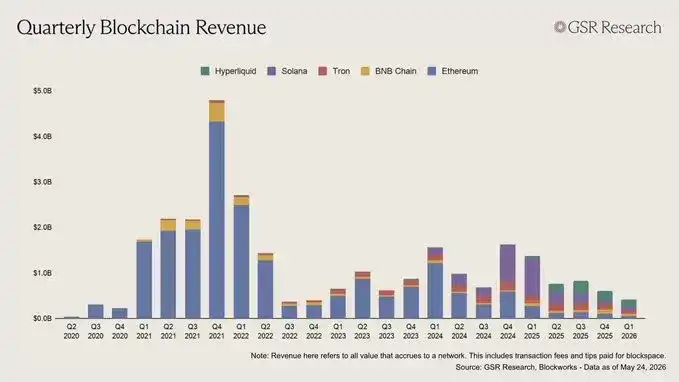
Blockchain Quarterly Revenue, Source: GSR Research

Data from CryptoQuant also reflects the crisis, showing that medium and small Ethereum holders are exiting on a large scale. Over the past three years, wallets holding between 100 and 1,000 ETH have seen their total holdings nearly halve, dropping from a peak of 16.2 million ETH in 2023 to about 8.75 million currently.

Large holders are also reducing their positions. Addresses holding 1,000 to 10,000 ETH, which fueled the 2024 ETH rally, have been gradually decreasing their holdings since late last year.
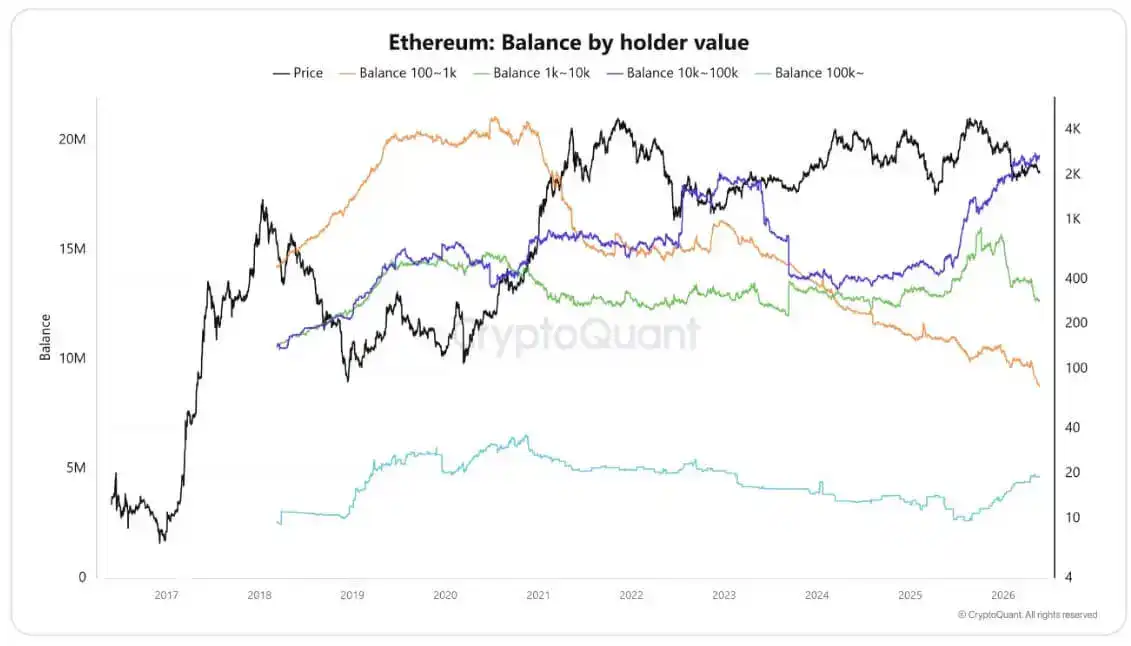
Ethereum Holder Balances

The capital outflow cannot be entirely attributed to the rising demand for privacy, but amidst increasing interest in privacy assets and investors actively seeking catalysts to boost ETH's price, the loss of holdings further intensifies the developmental pressure on Ethereum.

Privacy Has Become the New Main Theme in the Crypto Market

While Ethereum focuses on privacy features, a consensus is forming across the industry: financial privacy will dominate the next major crypto market cycle.

A recent Grayscale Research analysis points out that the digital asset industry is on the verge of a third wave of widespread focus on financial privacy.
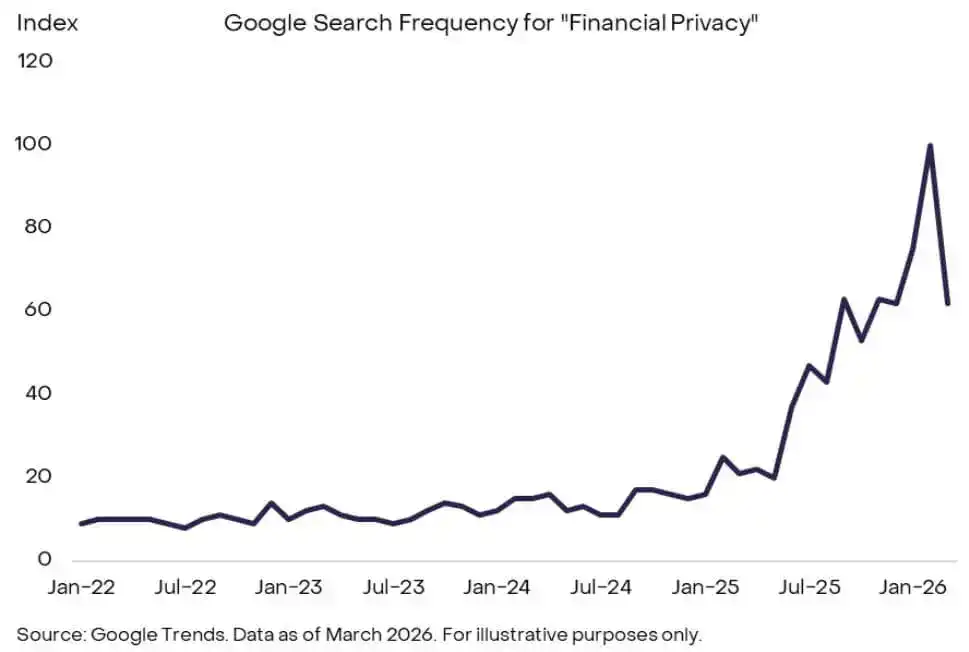
Search Volume for Financial Privacy on Google, Source: Grayscale

This trend is driven by the widespread adoption of stablecoins, the implementation of on-chain applications, and the rapid development of artificial intelligence technology. Grayscale warns that AI tools have given rise to more sophisticated financial tracking methods, while on traditional public blockchains, asset balances, counterparties, and transaction histories are permanently public.

The market's demand for privacy does not come solely from those seeking complete anonymity; it is also a normal desire from the general public and businesses to keep financial information confidential.

Ordinary users do not want their spending records made public; businesses need confidentiality for supplier payments, salary disbursements, and company fund flows; various institutions simply cannot accept having their wallet address structures analyzed in real-time.

However, implementing privacy features also requires weighing commercial trade-offs. Historical experience shows that strong privacy attributes often reduce asset liquidity and create obstacles for exchange listings, regulatory compliance, and wallet integration.

Despite these challenges, Barry Silbert, Chairman of Grayscale Investments, has stated that the era of privacy in the digital asset industry has officially arrived.
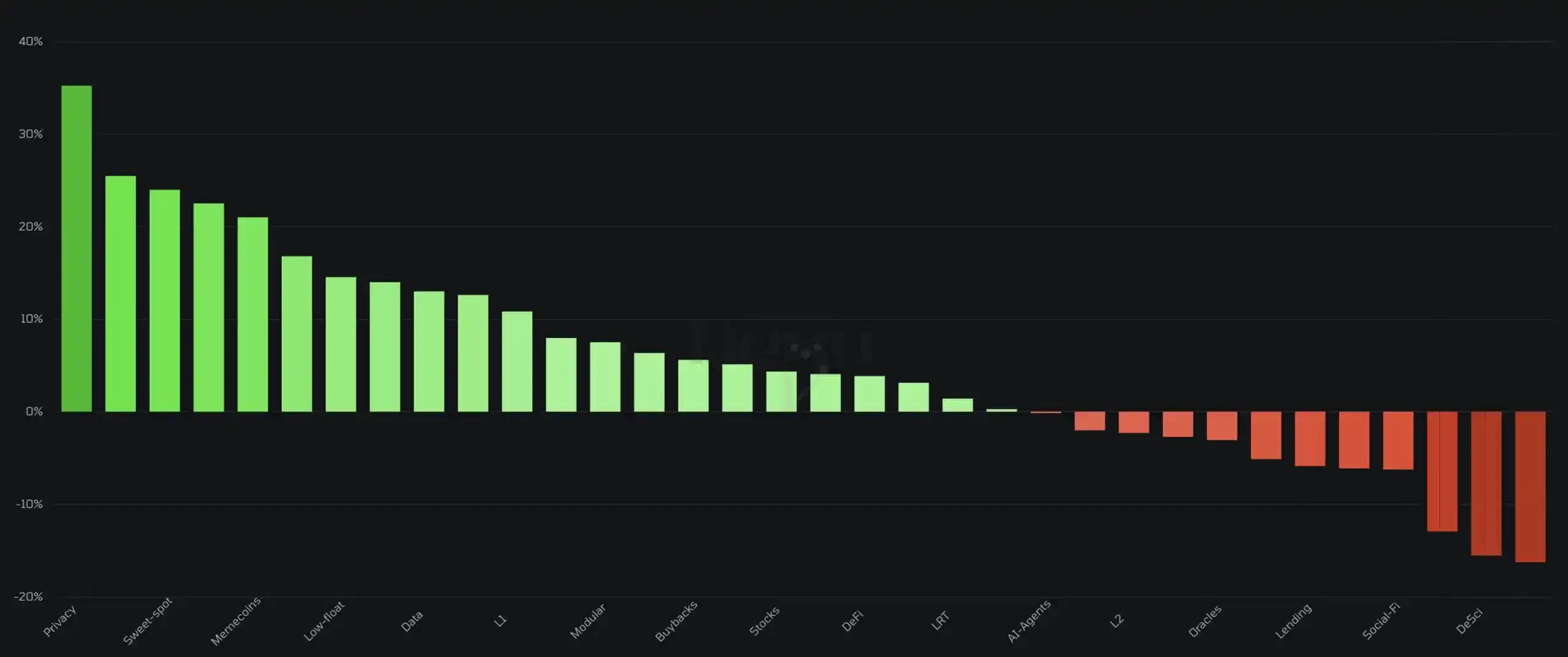
Privacy Coins Begin to Dominate the Crypto Industry

The shift in market focus is vividly reflected in price performance: over the past year, ZEC's market cap has skyrocketed over 900%, nearing $10 billion; Monero (XMR), long troubled by regulatory controversies, has also doubled in price.

Ethereum Co-Founder Advocates for Privacy Upgrade

Recently, Ethereum co-founder Vitalik Buterin has once again placed privacy development at the top of the technical agenda. After years of research and discussion, he is urging developers to accelerate the realization of the privacy vision pursued by cypherpunks.

Ethereum's short-term privacy roadmap primarily focuses on three directions: Account Abstraction and FOCIL, Key Randomization, and Access Layer Privacy Overhaul. The entire set of proposals aims to enhance the censorship resistance of on-chain transactions, sever address correlations, and reduce reliance on trusted third-party infrastructure.

FOCIL, or Forcefully Opened Censorship-Inclusion List, aims to address transaction censorship issues.

Currently, transactions enter a public mempool before being included in a block, allowing block builders and intermediaries to view pending transactions, enabling interception, front-running, and data monitoring. The FOCIL mechanism allows a committee of validators to propose a transaction list, which block builders are forced to include. Blocks that violate this rule are rejected by the network, reducing the risk of privacy-centric transactions being censored at the source.

Account Abstraction addresses another flaw in Ethereum's current design, where most users still rely on externally owned accounts controlled by a single private key. Account Abstraction makes accounts behave more like programmable smart contracts, supporting social recovery, multi-signature authorization, third-party fee payment, and other features.

From a privacy perspective, this feature can optimize wallet behavior patterns, preventing all activities from being exposed through a single account, and also facilitates third-party fee payment.

Key Randomization aims to solve a narrower but crucial metadata leakage problem. Ethereum relies on a nonce to prevent transaction replay; this value increments sequentially, allowing external observers to link seemingly unrelated transactions and trace them back to the same account. The new proposal splits the account counter into multiple independent domains, with different types of transactions using different key randomizations, significantly increasing the difficulty of address tracing.

Additionally, the Ethereum Foundation has launched the Kohaku open-source toolkit, which is the most ambitious part of this privacy upgrade. This project is not solely focused on transaction privacy but also addresses the data leakage issue at the access layer before transactions are submitted to the chain.

Even if transactions themselves are made private, when users query on-chain balances, call contracts, or initiate transactions, their wallets still leak information like IP addresses and wallet identities to the Remote Procedure Call (RPC) node. Kohaku provides wallet developers with privacy and security components that can be directly integrated into existing products. Its features cover private transactions, secure key management, private on-chain queries, and include a reference wallet. The toolkit can also interface with Ethereum's existing privacy protocol Railgun and the still-in-development Privacy Pools. Its goal is to allow users to experience private transactions and private DeFi services without switching their commonly used wallets or using niche tools.

Ethereum researcher soispoke.eth stated that if the aforementioned proposals are implemented simultaneously, Ethereum could achieve native, trustless, censorship-resistant private transactions as early as next year.

Why Privacy Features Are Crucial for Ethereum

Crypto lawyer Gabriel Shapiro believes that the privacy upgrade will help Ethereum compete for the institutional asset tokenization market. Businesses have strong confidentiality needs in scenarios like security tokenization, fund management, and DeFi interactions.

This also touches upon Ethereum's core investment thesis. For a long time, Ethereum's advantage has been its comprehensive ecosystem, covering stablecoins, lending, decentralized exchanges, asset tokenization, Layer-2 networks, and various development infrastructures. However, if all financial interactions remain completely public by default, relying solely on ecosystem breadth will be insufficient to sustain its position.

For institutions, settlement without privacy protection is inherently risky: companies do not want competitors to understand their supply chain dealings; asset managers do not want their trading paths tracked; banks cannot let their clients' tokenized security activities be exposed on a public chain.

Ethereum possesses the underlying infrastructure to serve institutional clients, but the market demands a delivered product, not just theoretical research.

This confirms Dunleavy's 12-month countdown warning. Zcash has long established a clear privacy narrative, and Monero remains a mainstream privacy coin despite regulatory pressure. Meanwhile, competitors like Solana, Tron, and Hyperliquid continue to capture market attention, and Bitcoin still firmly holds institutional capital preference.

Currently, the scale of tokenized assets on Ethereum exceeds $350 billion, and its application ecosystem remains the deepest in the industry, but this leading advantage is not permanently secure.

If Ethereum can launch a mature, usable privacy product within a year, it will further solidify its position as settlement infrastructure for both individuals and institutions. Conversely, if the privacy upgrade remains stuck at the technical planning stage, market funds will continue to flow towards projects that have made privacy their core positioning from the outset.


Пов'язані питання

QAccording to the article, why is there an urgent need for Ethereum to implement native privacy features within the next 12 months?

AThere is an urgent need because Ethereum is facing intense competition from other blockchains with strong execution and resources. If privacy features are not delivered within 12 months, the momentum and relevance will shift to competitors who already offer or prioritize privacy, turning Ethereum's efforts into mere technical research without real-world impact.

QWhat are the three main short-term privacy roadmap directions mentioned for Ethereum's development?

AThe three main short-term privacy roadmap directions are: 1) Account abstraction and FOCIL (Enforced Branch Selection Inclusion Lists), 2) Key nonce separation, and 3) Improvements to the access layer for privacy.

QWhat major problem does the FOCIL mechanism aim to solve for Ethereum transactions?

AThe FOCIL mechanism aims to solve the problem of transaction censorship. It allows a committee of validators to propose lists of transactions that block builders must include, preventing them from intercepting, front-running, or monitoring transactions before they are confirmed on-chain.

QHow does the article characterize the current performance of privacy-focused cryptocurrencies like Zcash (ZEC) compared to Ethereum (ETH)?

AThe article notes a stark divergence in performance. While ETH's price has fallen by approximately 30% year-to-date, Zcash (ZEC) has seen double-digit gains, with its market capitalization soaring over 900% in the past year, indicating strong market interest in the privacy asset category.

QWhat is the primary goal of the Ethereum Foundation's Kohaku toolkit, as described in the article?

AThe primary goal of the Kohaku toolkit is to solve access-layer data leakage problems. It provides wallet developers with components to integrate privacy and security features directly into existing products, enabling private transactions, key management, and private on-chain queries without requiring users to switch to niche or specialized wallets.

Пов'язані матеріали

ETH Bull and Bear Views Compilation: Can Ethereum's Value Flow Back to ETH?

Titled "ETH Bull and Bear Views: Can Ethereum's Value Flow Back to ETH?", this article synthesizes the current heated debate around Ethereum's native token, ETH, following Bankless co-founder David Hoffman's decision to sell his entire ETH holdings. The **bullish case**, represented by figures like Tom Lee (BitMine CEO) and Raoul Pal, argues that ETH's core thesis remains intact. They contend Ethereum is the essential, secure, and neutral foundational layer for future finance—encompassing stablecoins, RWA, DeFi, L2s, and Agentic AI. Bulls bet on ETH's long-term revaluation as institutional adoption of on-chain finance grows, with significant buying activity from entities like BitMine and Consensys cited as evidence. Conversely, the **bearish perspective**, led by Hoffman and analysts like Markus Thielen, questions ETH's value capture mechanism. They acknowledge Ethereum's network success but argue that the value created by L2s, DeFi, and applications does not sufficiently accrue to the ETH token itself. Bears point to ETH's prolonged underperformance versus the broader crypto market, lack of traditional cash flows, weakening "ultrasound money" narrative, and apparent institutional retreat (e.g., Harvard Management Company exiting its ETH ETF position) as key concerns. The debate highlights a pivotal shift: ETH is no longer just a community belief asset. The central question is whether ETH can transition from being a "**used infrastructure**" to a "**continuously bought and held core asset**" as more value enters the Ethereum ecosystem. The market is now critically examining the direct link between network growth and ETH's value.

marsbit45 хв тому

ETH Bull and Bear Views Compilation: Can Ethereum's Value Flow Back to ETH?

marsbit45 хв тому

Crypto is dead, Perps are forever

The crypto industry is shifting from a focus on creating native assets (like altcoins and protocol tokens) to becoming a "global asset pipeline." Native cryptocurrencies, except for Bitcoin, are seen as failing in their value storage and utility promises, with demand driven largely by speculation. Attention and liquidity are now moving toward real-world assets (RWAs) like U.S. stocks, bonds, gold, and oil traded on-chain via perpetual contracts (Perps). Stablecoins like USDT and USDC set the precedent, proving blockchain's core strength is efficient global settlement and transfer, not inventing new monetary systems. Meanwhile, assets like Ethereum and many DeFi tokens struggle as their narratives weaken against tangible traditional assets and the rapid real-world progress of AI. Perpetual contracts have emerged as a pivotal innovation. They simplify trading by offering pure price exposure to any asset, bypassing complexities of ownership, custody, and traditional market hours. Projects like Hyperliquid gained traction by combining CEX-like efficiency with on-chain transparency, capitalizing on post-FTX distrust, macroeconomic volatility, and the surge in demand for 24/7 stock trading. In conclusion, while the era of speculative native "crypto assets" may be over, perpetual contracts persist as the industry's most potent financial instrument—transforming all assets into globally accessible, constantly tradable instruments centered on price speculation.

marsbit50 хв тому

Crypto is dead, Perps are forever

marsbit50 хв тому

Tencent, Alibaba, ByteDance in a Battle for the Skill Store

Skill is becoming a key concept in the AI field, essentially serving as a structured "instruction manual" for AI Agents that specifies tool calls, decision logic, and output standards. This allows Agents to execute predefined tasks. As the number of Skills grows, distribution platforms have emerged. Major tech companies are swiftly entering this space. In March, Tencent, Alibaba, and ByteDance launched Skill stores within their respective Agent platforms. Subsequently, players like Zhipu AI, Meituan, and Xiaohongshu joined the fray. This competition for the "Skill store" is fundamentally a battle for the AI-era user entry point; whoever controls distribution controls the users. While ByteDance's Coze has experimented with paid Skills, most platforms offer them for free. The real value lies not in the stores themselves but in using them to attract and retain users within an ecosystem, driving revenue from services like cloud computing, model calls, or advertising. The landscape features three main player types: 1) **Internet giants** (e.g., Alibaba, ByteDance, Tencent, Meituan), leveraging Skills to drive traffic and monetize through their broader ecosystems (cloud services, transactions, ads). 2) **Large model companies** (e.g., Zhipu AI, Moonshot AI), using Skill stores to increase user engagement and monetize model API calls. 3) **Content platforms** (e.g., Xiaohongshu), treating Skills as a new content format to generate traffic and ad revenue. However, transforming Skill stores into a sustainable business faces significant hurdles. Key challenges include: the **difficulty in pricing Skills** due to inconsistent outputs across different models and contexts; **lack of cost transparency** (varying token consumption); **security risks** like Skill poisoning; and the **absence of standardized protocols** for development and evaluation. Unlike standardized mobile apps, Skills are often personalized workflows resistant to uniformity, which hinders the establishment of a reliable review and monetization system akin to the App Store. While there is genuine user demand for paid Skills—particularly in enterprise (e.g., contract review) and certain personal productivity scenarios—current platforms offer developers limited and unpredictable distribution. The future of Skill stores depends on overcoming these standardization, evaluation, and safety challenges to make acquiring a Skill as straightforward as downloading an app. For now, the stores function more as display shelves than robust marketplaces.

marsbit50 хв тому

Tencent, Alibaba, ByteDance in a Battle for the Skill Store

marsbit50 хв тому

The Crypto Scene Is Dead, Perpetual Swaps Are Eternal

The crypto industry is undergoing a fundamental shift. The era defined by minting novel, native digital assets (altcoins) is fading. These assets, lacking real-world cash flows or clear value, are losing relevance as attention and capital flow elsewhere. Two powerful external forces are reshaping the space. First, traditional assets like U.S. stocks, bonds, gold, and oil are being tokenized and traded on-chain. Second, the explosive growth of AI, with its tangible products, has overshadowed crypto's once-dominant "future narrative." This marks a critical pivot: crypto is transitioning from being a "factory for new assets" to becoming a "global conduit for existing assets." Its validated utility is not complex financial reinvention but efficient global settlement, transfer, and trading—the original promise of blockchain. Stablecoins like USDT and USDC exemplify this, offering faster dollar movement rather than replacing it. Consequently, native ecosystems like Ethereum face profound challenges. While still crucial infrastructure, ETH struggles to capture value as users interact with Layer 2s or trade traditional assets without needing to hold it. DeFi's grand narrative of rebuilding finance has narrowed to core needs like cheap transfers and deep liquidity. The true breakout innovation is the perpetual contract (Perp). It brilliantly bypasses the complexities of direct asset ownership (custody, compliance, dividends) by creating pure price exposure. Users can speculate on the price movement of *any* asset—NVIDIA, gold, oil—24/7, globally, and with leverage. This "price casino" model, while risky and ethically fraught, delivers unmatched liquidity and accessibility. Projects like Hyperliquid succeeded not by inventing new mechanics but by perfecting the timing and execution of this model. Key drivers included making on-chain Perps feel like centralized exchanges, post-FTX trust migration towards transparency, and rising demand to trade macro assets and equities round-the-clock. In conclusion, the crypto world's most enduring successes are the dollar (via stablecoins), Bitcoin, and trading. Its new frontier is not creating alternative assets but providing a seamless, perpetual trading layer—a new API—for the world's existing financial system. The age of native altcoins is over; the age of perpetual synthetic exposure has begun.

Odaily星球日报59 хв тому

The Crypto Scene Is Dead, Perpetual Swaps Are Eternal

Odaily星球日报59 хв тому

Торгівля

Спот
Ф'ючерси

Популярні статті

Що таке $S$

Розуміння SPERO: Комплексний огляд Вступ до SPERO Оскільки ландшафт інновацій продовжує еволюціонувати, виникнення технологій web3 та криптовалютних проектів відіграє ключову роль у формуванні цифрового майбутнього. Один з проектів, який привернув увагу в цій динамічній сфері, — це SPERO, позначений як SPERO,$$s$. Ця стаття має на меті зібрати та представити детальну інформацію про SPERO, щоб допомогти ентузіастам та інвесторам зрозуміти його основи, цілі та інновації в рамках web3 та крипто-сектору. Що таке SPERO,$$s$? SPERO,$$s$ — це унікальний проект у криптопросторі, який прагне використати принципи децентралізації та технології блокчейн для створення екосистеми, що сприяє залученню, корисності та фінансовій інклюзії. Проект розроблений для полегшення взаємодії між користувачами новими способами, надаючи їм інноваційні фінансові рішення та послуги. У своїй основі SPERO,$$s$ прагне надати можливості індивідам, забезпечуючи інструменти та платформи, які покращують користувацький досвід у криптовалютному просторі. Це включає в себе можливість більш гнучких методів транзакцій, сприяння ініціативам, що підтримуються спільнотою, та створення шляхів для фінансових можливостей через децентралізовані додатки (dApps). Основна концепція SPERO,$$s$ обертається навколо інклюзивності, прагнучи зменшити розриви в традиційній фінансовій системі, використовуючи переваги технології блокчейн. Хто є творцем SPERO,$$s$? Особистість творця SPERO,$$s$ залишається дещо невідомою, оскільки є обмежені публічно доступні ресурси, що надають детальну інформацію про його засновників. Ця відсутність прозорості може бути наслідком зобов'язання проекту до децентралізації — етики, яку багато проектів web3 поділяють, ставлячи колективні внески вище за індивідуальне визнання. Зосереджуючи обговорення навколо спільноти та її колективних цілей, SPERO,$$s$ втілює суть наділення без виділення конкретних осіб. Таким чином, розуміння етики та місії SPERO є більш важливим, ніж ідентифікація єдиного творця. Хто є інвесторами SPERO,$$s$? SPERO,$$s$ підтримується різноманітними інвесторами, починаючи від венчурних капіталістів до ангельських інвесторів, які прагнуть сприяти інноваціям у крипто-секторі. Зосередження цих інвесторів зазвичай узгоджується з місією SPERO — пріоритет надається проектам, які обіцяють технологічний прогрес у суспільстві, фінансову інклюзію та децентралізоване управління. Ці інвесторські фонди зазвичай зацікавлені в проектах, які не лише пропонують інноваційні продукти, але й позитивно впливають на спільноту блокчейн та її екосистеми. Підтримка з боку цих інвесторів підкріплює SPERO,$$s$ як значного конкурента в швидко змінюваній сфері крипто-проектів. Як працює SPERO,$$s$? SPERO,$$s$ використовує багатогранну структуру, яка відрізняє його від традиційних криптовалютних проектів. Ось деякі ключові особливості, які підкреслюють його унікальність та інноваційність: Децентралізоване управління: SPERO,$$s$ інтегрує моделі децентралізованого управління, надаючи користувачам можливість активно брати участь у процесах прийняття рішень щодо майбутнього проекту. Цей підхід сприяє відчуттю власності та відповідальності серед членів спільноти. Корисність токена: SPERO,$$s$ використовує свій власний криптовалютний токен, розроблений для виконання різних функцій в екосистемі. Ці токени дозволяють здійснювати транзакції, отримувати винагороди та полегшувати послуги, що пропонуються на платформі, підвищуючи загальну залученість та корисність. Шарова архітектура: Технічна архітектура SPERO,$$s$ підтримує модульність та масштабованість, що дозволяє безперешкодно інтегрувати додаткові функції та додатки в міру розвитку проекту. Ця адаптивність є надзвичайно важливою для збереження актуальності в постійно змінюваному крипто-ландшафті. Залучення спільноти: Проект підкреслює ініціативи, що підтримуються спільнотою, використовуючи механізми, які стимулюють співпрацю та зворотний зв'язок. Підтримуючи сильну спільноту, SPERO,$$s$ може краще задовольняти потреби користувачів та адаптуватися до ринкових тенденцій. Фокус на інклюзію: Пропонуючи низькі комісії за транзакції та зручні інтерфейси, SPERO,$$s$ прагне залучити різноманітну базу користувачів, включаючи осіб, які раніше не брали участі в крипто-просторі. Це зобов'язання до інклюзії узгоджується з його загальною місією наділення через доступність. Хронологія SPERO,$$s$ Розуміння історії проекту надає важливі уявлення про його розвиток та етапи. Нижче наведено пропоновану хронологію, що відображає значні події в еволюції SPERO,$$s$: Етап концептуалізації та ідеації: Початкові ідеї, що стали основою SPERO,$$s$, були сформовані, тісно пов'язані з принципами децентралізації та фокусом на спільноті в індустрії блокчейн. Запуск білого паперу проекту: Після концептуального етапу був випущений комплексний білий папір, що детально описує бачення, цілі та технологічну інфраструктуру SPERO,$$s$, щоб залучити інтерес та зворотний зв'язок від спільноти. Створення спільноти та ранні залучення: Активні зусилля були спрямовані на створення спільноти ранніх прихильників та потенційних інвесторів, що полегшило обговорення цілей проекту та отримання підтримки. Подія генерації токенів: SPERO,$$s$ провів подію генерації токенів (TGE) для розподілу своїх рідних токенів серед ранніх прихильників та встановлення початкової ліквідності в екосистемі. Запуск початкового dApp: Перший децентралізований додаток (dApp), пов'язаний з SPERO,$$s$, став доступним, дозволяючи користувачам взаємодіяти з основними функціями платформи. Постійний розвиток та партнерства: Безперервні оновлення та вдосконалення пропозицій проекту, включаючи стратегічні партнерства з іншими учасниками блокчейн-простору, сформували SPERO,$$s$ у конкурентоспроможного та еволюціонуючого гравця на крипто-ринку. Висновок SPERO,$$s$ є свідченням потенціалу web3 та криптовалют для революціонізації фінансових систем та наділення індивідів. Завдяки зобов'язанню до децентралізованого управління, залучення спільноти та інноваційно спроектованих функцій, він прокладає шлях до більш інклюзивного фінансового ландшафту. Як і з будь-якими інвестиціями в швидко змінюваному крипто-просторі, потенційним інвесторам та користувачам рекомендується ретельно досліджувати та обдумано взаємодіяти з поточними подіями в SPERO,$$s$. Проект демонструє інноваційний дух крипто-індустрії, запрошуючи до подальшого дослідження його численних можливостей. Хоча подорож SPERO,$$s$ ще триває, його основні принципи можуть справді вплинути на майбутнє того, як ми взаємодіємо з технологією, фінансами та один з одним у взаємопов'язаних цифрових екосистемах.

73 переглядів усьогоОпубліковано 2024.12.17Оновлено 2024.12.17

Що таке $S$

Що таке AGENT S

Агент S: Майбутнє автономної взаємодії в Web3 Вступ У постійно змінюваному ландшафті Web3 та криптовалюти інновації постійно переосмислюють, як люди взаємодіють з цифровими платформами. Один з таких новаторських проектів, Агент S, обіцяє революціонізувати взаємодію людини з комп'ютером через свою відкриту агентну структуру. Прокладаючи шлях для автономних взаємодій, Агент S прагне спростити складні завдання, пропонуючи трансформаційні застосування в штучному інтелекті (ШІ). Це детальне дослідження заглиблюється в складності проекту, його унікальні особливості та наслідки для сфери криптовалюти. Що таке Агент S? Агент S є революційною відкритою агентною структурою, спеціально розробленою для вирішення трьох основних викликів в автоматизації комп'ютерних завдань: Набуття специфічних знань у галузі: Структура інтелектуально навчається з різних зовнішніх джерел знань та внутрішнього досвіду. Цей подвійний підхід дозволяє їй створити багатий репозиторій специфічних знань у галузі, покращуючи її продуктивність у виконанні завдань. Планування на довгих горизонтах завдань: Агент S використовує планування з підкріпленням досвіду, стратегічний підхід, який полегшує ефективний розподіл та виконання складних завдань. Ця функція значно підвищує її здатність ефективно та результативно управляти кількома підзавданнями. Обробка динамічних, неоднорідних інтерфейсів: Проект представляє Інтерфейс Агент-Комп'ютер (ACI), інноваційне рішення, яке покращує взаємодію між агентами та користувачами. Використовуючи багатомодальні великі мовні моделі (MLLMs), Агент S може безперешкодно орієнтуватися та маніпулювати різноманітними графічними інтерфейсами користувача. Завдяки цим новаторським функціям Агент S надає надійну структуру, яка вирішує складнощі, пов'язані з автоматизацією людської взаємодії з машинами, прокладаючи шлях для численних застосувань у ШІ та за його межами. Хто є творцем Агент S? Хоча концепція Агент S є фундаментально новаторською, конкретна інформація про його творця залишається невідомою. Творець наразі невідомий, що підкреслює або початкову стадію проекту, або стратегічний вибір зберегти засновників у таємниці. Незважаючи на анонімність, акцент залишається на можливостях та потенціалі структури. Хто є інвесторами Агент S? Оскільки Агент S є відносно новим у криптографічній екосистемі, детальна інформація про його інвесторів та фінансових спонсорів не задокументована. Відсутність публічно доступних відомостей про інвестиційні фонди або організації, що підтримують проект, викликає питання щодо його фінансової структури та дорожньої карти розвитку. Розуміння підтримки є критично важливим для оцінки стійкості проекту та потенційного впливу на ринок. Як працює Агент S? В основі Агент S лежить передова технологія, яка дозволяє йому ефективно функціонувати в різних умовах. Його операційна модель побудована навколо кількох ключових функцій: Взаємодія з комп'ютером, подібна до людської: Структура пропонує розширене планування ШІ, прагнучи зробити взаємодії з комп'ютерами більш інтуїтивними. Імітуючи людську поведінку при виконанні завдань, вона обіцяє підвищити досвід користувачів. Наративна пам'ять: Використовується для використання високорівневого досвіду, Агент S використовує наративну пам'ять для відстеження історій завдань, тим самим покращуючи свої процеси прийняття рішень. Епізодична пам'ять: Ця функція надає користувачам покрокові інструкції, дозволяючи структурі пропонувати контекстуальну підтримку в міру виконання завдань. Підтримка OpenACI: Завдяки можливості працювати локально, Агент S дозволяє користувачам зберігати контроль над своїми взаємодіями та робочими процесами, узгоджуючи з децентралізованою етикою Web3. Легка інтеграція з зовнішніми API: Його універсальність і сумісність з різними платформами ШІ забезпечують те, що Агент S може безперешкодно вписатися в існуючі технологічні екосистеми, роблячи його привабливим вибором для розробників та організацій. Ці функціональні можливості колективно сприяють унікальному положенню Агент S у крипто-просторі, оскільки він автоматизує складні, багатоступеневі завдання з мінімальним втручанням людини. У міру розвитку проекту його потенційні застосування в Web3 можуть переосмислити, як відбуваються цифрові взаємодії. Хронологія Агент S Розробка та етапи Агент S можуть бути узагальнені в хронології, яка підкреслює його значні події: 27 вересня 2024 року: Концепція Агент S була представлена в комплексній науковій статті під назвою “Відкрита агентна структура, яка використовує комп'ютери як людина”, що демонструє основи проекту. 10 жовтня 2024 року: Наукова стаття була опублікована на arXiv, пропонуючи детальне дослідження структури та її оцінки продуктивності на основі бенчмарку OSWorld. 12 жовтня 2024 року: Було випущено відеопрезентацію, що надає візуальне уявлення про можливості та особливості Агент S, ще більше залучаючи потенційних користувачів та інвесторів. Ці маркери в хронології не лише ілюструють прогрес Агент S, але й вказують на його прихильність до прозорості та залучення громади. Ключові моменти про Агент S У міру розвитку структури Агент S кілька ключових характеристик виділяються, підкреслюючи її новаторський характер та потенціал: Інноваційна структура: Розроблена для забезпечення інтуїтивного використання комп'ютерів, подібного до людської взаємодії, Агент S пропонує новий підхід до автоматизації завдань. Автономна взаємодія: Здатність автономно взаємодіяти з комп'ютерами через GUI означає стрибок до більш інтелектуальних та ефективних обчислювальних рішень. Автоматизація складних завдань: Завдяки своїй надійній методології він може автоматизувати складні, багатоступеневі завдання, роблячи процеси швидшими та менш схильними до помилок. Безперервне вдосконалення: Механізми навчання дозволяють Агенту S покращуватися на основі минулого досвіду, постійно підвищуючи свою продуктивність та ефективність. Універсальність: Його адаптивність до різних операційних середовищ, таких як OSWorld та WindowsAgentArena, забезпечує його здатність служити широкому спектру застосувань. Оскільки Агент S займає своє місце в ландшафті Web3 та криптовалюти, його потенціал покращити можливості взаємодії та автоматизувати процеси означає значний прогрес у технологіях ШІ. Завдяки своїй інноваційній структурі Агент S є прикладом майбутнього цифрових взаємодій, обіцяючи більш безперешкодний та ефективний досвід для користувачів у різних галузях. Висновок Агент S представляє собою сміливий крок вперед у поєднанні ШІ та Web3, з можливістю переосмислити, як ми взаємодіємо з технологією. Хоча проект все ще на ранніх стадіях, можливості для його застосування є величезними та переконливими. Завдяки своїй комплексній структурі, що вирішує критичні виклики, Агент S прагне вивести автономні взаємодії на передній план цифрового досвіду. У міру того, як ми заглиблюємося в сфери криптовалюти та децентралізації, проекти, подібні до Агент S, безсумнівно, відіграватимуть ключову роль у формуванні майбутнього технологій та співпраці людини з комп'ютером.

672 переглядів усьогоОпубліковано 2025.01.14Оновлено 2025.01.14

Що таке AGENT S

Як купити S

Ласкаво просимо до HTX.com! Ми зробили покупку Sonic (S) простою та зручною. Дотримуйтесь нашої покрокової інструкції, щоб розпочати свою криптовалютну подорож.Крок 1: Створіть обліковий запис на HTXВикористовуйте свою електронну пошту або номер телефону, щоб зареєструвати обліковий запис на HTX безплатно. Пройдіть безпроблемну реєстрацію й отримайте доступ до всіх функцій.ЗареєструватисьКрок 2: Перейдіть до розділу Купити крипту і виберіть спосіб оплатиКредитна/дебетова картка: використовуйте вашу картку Visa або Mastercard, щоб миттєво купити Sonic (S).Баланс: використовуйте кошти з балансу вашого рахунку HTX для безперешкодної торгівлі.Треті особи: ми додали популярні способи оплати, такі як Google Pay та Apple Pay, щоб підвищити зручність.P2P: Торгуйте безпосередньо з іншими користувачами на HTX.Позабіржова торгівля (OTC): ми пропонуємо індивідуальні послуги та конкурентні обмінні курси для трейдерів.Крок 3: Зберігайте свої Sonic (S)Після придбання Sonic (S) збережіть його у своєму обліковому записі на HTX. Крім того, ви можете відправити його в інше місце за допомогою блокчейн-переказу або використовувати його для торгівлі іншими криптовалютами.Крок 4: Торгівля Sonic (S)Легко торгуйте Sonic (S) на спотовому ринку HTX. Просто увійдіть до свого облікового запису, виберіть торгову пару, укладайте угоди та спостерігайте за ними в режимі реального часу. Ми пропонуємо зручний досвід як для початківців, так і для досвідчених трейдерів.

1.5k переглядів усьогоОпубліковано 2025.01.15Оновлено 2026.06.02

Як купити S

Обговорення

Ласкаво просимо до спільноти HTX. Тут ви можете бути в курсі останніх подій розвитку платформи та отримати доступ до професійної ринкової інформації. Нижче представлені думки користувачів щодо ціни S (S).

活动图片