Narrative Collapse, Trust Reset to Zero: Trove Kicks Off This Year's Crypto Rights Protection Campaign

marsbitОпубліковано о 2026-01-19Востаннє оновлено о 2026-01-19

Анотація

Trove, a Perp DEX platform that claimed to tokenize and trade illiquid collectibles like trading cards and luxury watches, has collapsed amid allegations of fraud and insider manipulation. The project initially built momentum with high-profile partnerships and a $20M+ HYPE token acquisition, leading to a successful $11.5M ICO. However, the team abruptly extended then reversed the ICO timeline, enabling insider betting on prediction markets like Polymarket. Soon after, Trove abandoned its original blockchain, Hyperliquid, and attempted to dump millions in HYPE tokens. Investigations revealed undisclosed payments to influencers, preferential investment terms for insiders, and false public statements. With trust shattered and legal risks under MiCA regulations mounting, Trove’s token is expected to crash at launch, marking a severe breach of trust in the crypto community.

Trove once had a perfect narrative.

As a Perp DEX targeting collectibles and RWA, Trove claimed to be able to transform illiquid "cultural assets," such as Pokémon cards, CSGO skins, and luxury items like high-end watches, into tradable financial assets, providing a hedging venue for collectors.

However, within just ten days, the Trove team staged a farce through a series of astonishing operations. In the process, they emptied the pockets of onlookers.

Bait

At the end of October last year, Trove founder @unwisecap discussed the concept of "Everything Can Be Perped" in several articles and announced that Trove would be built based on HIP-3, building up the community's anticipation.

Over the following month, Trove successively announced collaborations with Kalshi and CARDS (Collector_Crypt), receiving official Twitter replies as "endorsements" from these well-known project teams (P.S. As of the time of writing, Kalshi had already completed the "cutting off," deleting their reply under Trove's official tweet).

In mid-December, Trove announced that it had spent over $20 million to acquire 500,000 HYPE tokens to meet the integration requirements of HIP-3. Shortly after, the testnet points program was launched, and the trading volume on the platform exceeded $1 million within two weeks. Everything seemed to be progressing as expected. Until...

A Textbook Case of Insider Trading

On January 6th, Trove suddenly announced an ICO with a $20 million FDV. The public sale adopted an "oversubscription" model, offering priority allocation rights to points holders. Accompanied by concentrated promotions from a group of KOLs sporting Trove badges, Trove successfully raised $11.5 million, oversubscribed by 4.6 times.

At this point, with less than two hours left until the ICO deadline, the probability of the "Trove ICO total fundraising amount greater than $20 million" prediction market on Polymarket had approached zero.

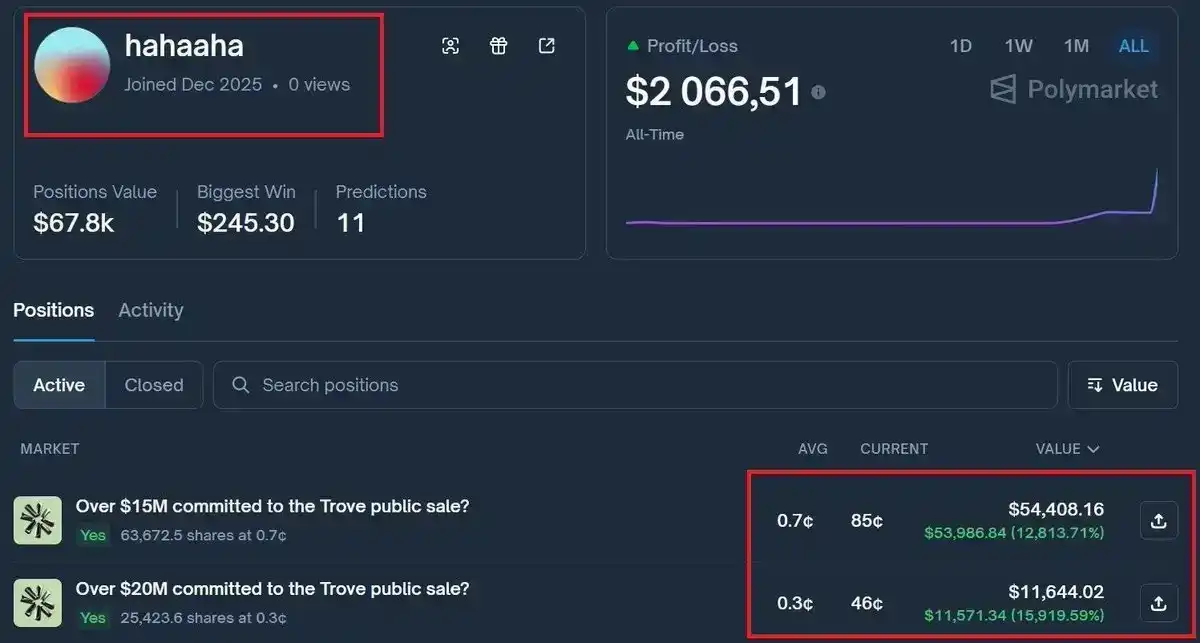
The real show began shortly after. The team suddenly broke the rules, announcing an extension of the ICO by five days to ensure fair allocation. The "YES" option on Polymarket instantly skyrocketed from the bottom to nearly 60%. Insider funds were clearly a step ahead; on-chain data showed that specific wallets placed precise bets before the announcement was made and quickly exited after the price surge.
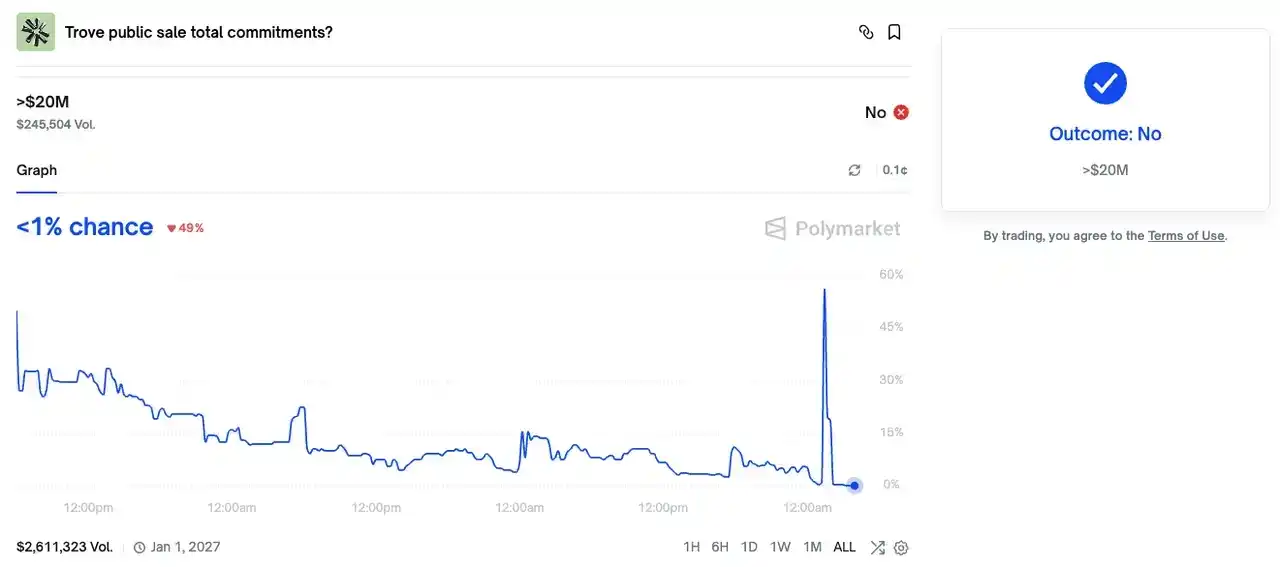
Perhaps deeming the liquidity of the prediction market insufficient to satisfy their appetite, and amidst a wave of community skepticism, the Trove team seized the opportunity to stage a dramatic "crying wolf" scenario: they announced the withdrawal of the extension decision, ending the ICO as originally planned.

Following this announcement, the corresponding market directly zeroed out and settled. Polymarket data indicated that related wallets had placed precise bets before the news was released and continued to profit from the subsequent reversal.
The Great Retreat

On January 17th, Trove suddenly announced it was abandoning Hyperliquid and would instead issue its token on Solana. For a project that had been fundraising under the banner of the Hyperliquid ecosystem, this was nothing short of pulling the rug out from under everyone.

Simultaneously, on-chain detective MLM caught the Trove team using a timed sell function, attempting to sell half of their HYPE tokens within 40 minutes.

Choosing to sell tens of millions worth of tokens in 40 minutes on a weekend, during the lowest trading volume, showed the Trove team was truly desperate.
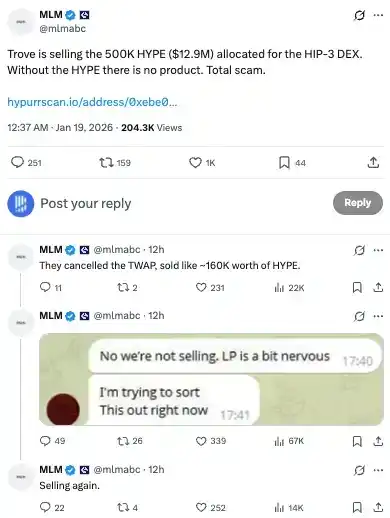
Faced with质疑 (queries/doubt), the explanation provided by the Trove team seemed feeble: "The backers got nervous and decided to exit." However, on-chain transaction records showed these sell-offs were conducted simultaneously while the team was publicly denying "we are selling tokens."

This inconsistency between words and actions彻底击穿了 (completely shattered) the community's trust底线 (bottom line). As trust collapsed, more shady details were uncovered.

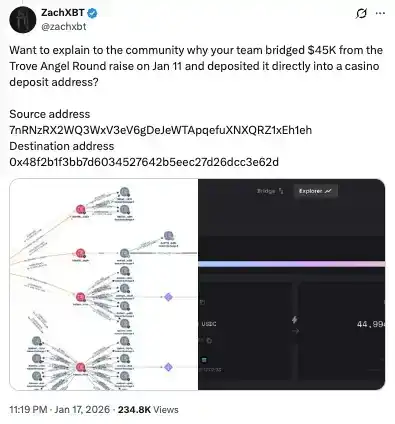
Renowned on-chain detective ZachXBT disclosed that the Trove team paid @TJRTrades a hefty marketing fee of $45,000, directly depositing it into the KOL's online gambling site top-up address.
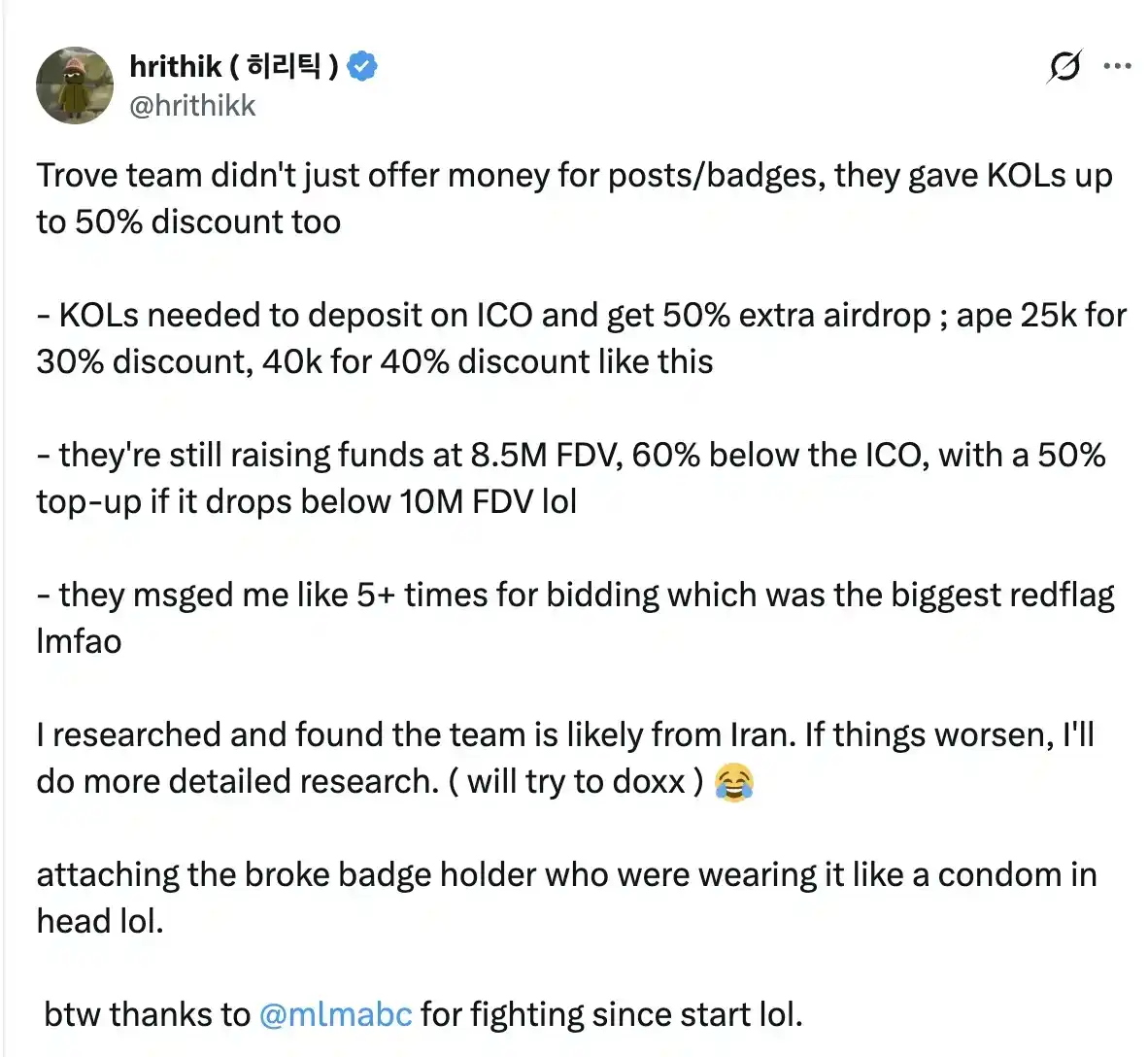
KOL @hrithikk stated that the Trove team not only provided KOLs with substantial marketing fees but also privately offered ICO allocations at valuations as low as $8.5 million, a discount of up to 60%, accompanied by huge airdrop rewards. Trove is still selling shares at low prices and has contacted him over 5 times asking if he would invest in Trove.
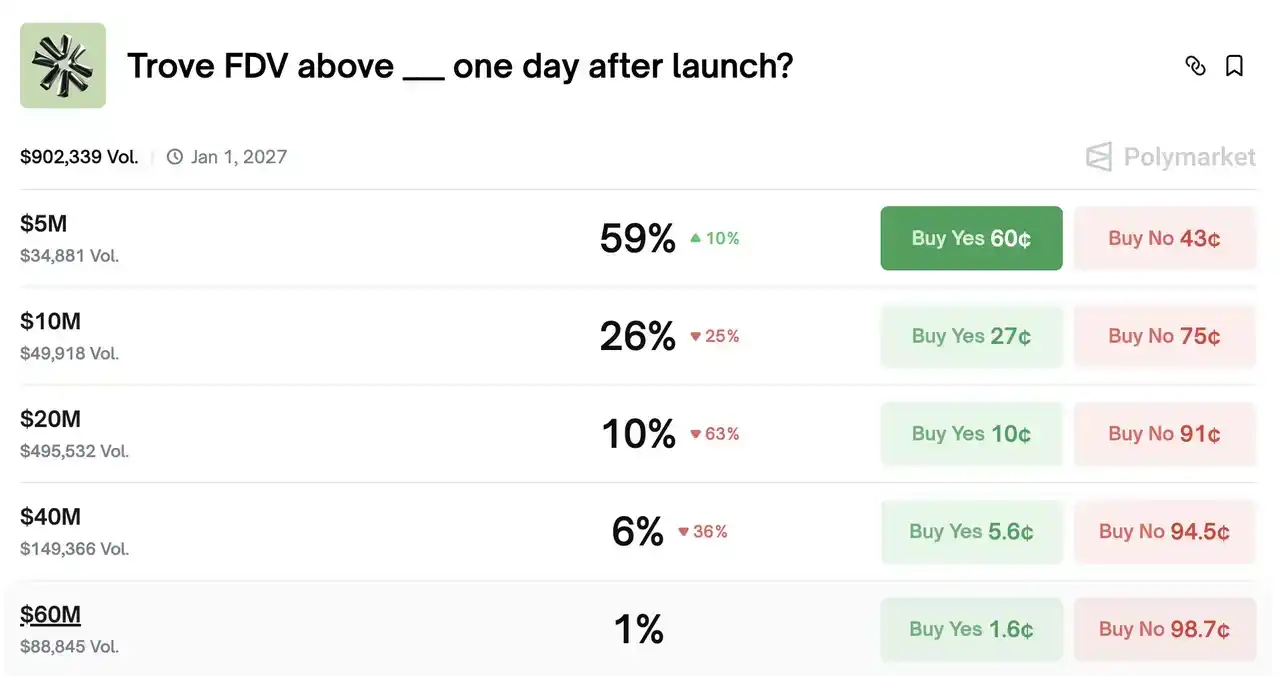
Trove's TGE is scheduled for January 20th at 1:00 AM Beijing Time. The prediction market on Polymarket shows, based on the pre-sale valuation, a 90% probability that the TROVE token will fall below its issuance price.
The good news is that this farce might not end with a simple "Soft Rug." Trove had previously claimed on its official website to comply with EU MiCA regulations. Now, facing accusations of false advertising and potential fraud, angry investors have every reason to initiate civil lawsuits based on MiCA provisions.

The bad news is, as revealed in chat screenshots by a KOL, team members appear to be from Iran.

The Hyperliquid ecosystem is known for its strong community cohesion, but this atmosphere of abundant trust also provides fertile ground for scammers to thrive.


Пов'язані питання

QWhat was Trove's original value proposition and narrative before its controversial actions?

ATrove was a Perp DEX for collectibles and RWA that claimed to convert illiquid 'cultural assets' like Pokémon cards, CSGO skins, and luxury watches into tradable financial assets, providing a hedging venue for collectors.

QWhat key event on January 6th marked the beginning of Trove's 'insider trading textbook' scandal?

AOn January 6th, Trove announced an ICO with a $20 million FDV using an 'oversubscription' model, but then suddenly extended the ICO by 5 days after it was nearly complete, allowing insiders to profit on prediction markets like Polymarket with prior knowledge.

QWhat action did Trove take on January 17th that completely shattered community trust and was described as 'pulling the rug from the cauldron'?

AOn January 17th, Trove abruptly announced it was abandoning the Hyperliquid blockchain to issue its token on Solana instead, despite having fundraised under the Hyperliquid ecosystem, and was caught attempting to dump its HYPE tokens in a short time frame.

QAccording to on-chain detectives, what evidence exposed Trove's unethical practices regarding influencer marketing and private allocations?

AZachXBT revealed Trove paid a KOL $45,000 for marketing to a gambling site deposit address, and KOL @hrithikk disclosed that the team offered private ICO allocations at a 60% discount ($8.5M valuation vs. public $20M) with massive airdrop bonuses.

QWhat potential legal repercussions does Trove face according to the article, and what complicating factor was mentioned?

AInvestors could file civil lawsuits under EU's MiCA regulations for false advertising and potential fraud, but a complicating factor is that team members are allegedly from Iran, which may hinder legal action.

Пов'язані матеріали

Should You Buy SpaceX Stock at $1.7 Trillion? Here's What the Market Is Worried About

SpaceX is preparing for a massive IPO aiming to raise around $75 billion at a valuation of approximately $1.75 trillion. While its achievements in reusable rockets and the profitable Starlink satellite internet service are clear, the market is concerned about the aggressive valuation. Key issues include: the current $1.75 trillion valuation, which is about 94 times 2025 revenue, seems to price in not just existing businesses but also unproven future ventures like AI infrastructure and orbital data centers. Financially, while Starlink is profitable, the AI division, bolstered by the acquisition of xAI, is incurring massive losses and consuming the majority of capital expenditures. This acquisition also introduced complex related-party financing arrangements and debt onto SpaceX's balance sheet. Furthermore, corporate governance poses a challenge. SpaceX's dual-class share structure ensures founder Elon Musk retains absolute control, limiting ordinary shareholders' influence over high-risk, long-term strategic decisions. The future success of ambitious projects like the Starship rocket—critical for lowering costs and enabling new services—remains a significant variable for the valuation. In summary, the market's apprehension (FUD) centers not on doubting SpaceX's past technological triumphs but on questioning how much premium public investors should pay for a future that combines proven profits with highly speculative and capital-intensive new ventures, all under a governance structure that offers limited shareholder oversight.

marsbit33 хв тому

Should You Buy SpaceX Stock at $1.7 Trillion? Here's What the Market Is Worried About

marsbit33 хв тому

Breaking the DeFi Cascading Liquidation Curse: Vitalik Proposes a New Solution

Vitalik Buterin has proposed a new DeFi design to eliminate the automatic liquidation mechanism that causes market instability during sharp downturns. The current system, used by protocols like Aave, triggers forced sales when collateral value falls below a threshold, often exacerbating price drops and creating systemic selling pressure. Buterin's alternative model is based on splitting an asset like ETH into two synthetic option-like tokens, P and N, pegged to a price index. Their combined value always equals one ETH. Instead of sudden liquidation, a position's value gradually drifts from its target peg if the market moves. Users must proactively rebalance their holdings to maintain their desired exposure, transferring the management burden from the protocol to the user or automated tools. A key advantage is the reduced reliance on real-time oracles. Pricing decisions are deferred until contract expiry, allowing for more robust, fault-tolerant oracle designs. This removes a clear liquidation threshold that speculators can target for manipulation or MEV extraction. However, significant challenges remain. Frequent rebalancing could incur high slippage and transaction costs, necessitating new liquidity provider models. The design is better suited for hedging instruments than for stablecoins requiring a rigid 1:1 peg. While not an immediate replacement for existing systems, the proposal challenges the foundational assumption that instantaneous forced liquidation is an unavoidable necessity in DeFi, opening the door for fundamentally different risk management architectures.

marsbit38 хв тому

Breaking the DeFi Cascading Liquidation Curse: Vitalik Proposes a New Solution

marsbit38 хв тому

The End of Single-Factor Cryptography

The article "The End of Single-Factor Crypto" posits a fundamental shift in the cryptocurrency ecosystem. It argues the era where crypto asset valuations were predominantly driven by, and correlated with, Bitcoin's price is ending. The space is bifurcating into two distinct economies: endogenous and exogenous. The endogenous economy represents traditional crypto, where token and project values are directly tied to crypto market prices. The emerging exogenous economy comprises projects and businesses that may utilize blockchain technology or tokens but derive their fundamental value from external, non-crypto factors like consumer demand, subscription revenue, or real-world utility. Examples include AI inference platforms like Venice, fintech lenders using blockchain for efficiency, and stablecoin/payment infrastructure companies acquired by giants like Mastercard and Stripe. This shift means investment analysis must change. For exogenous assets, evaluating traditional business fundamentals—such as revenue streams, unit economics, and competitive moats—becomes more critical than tracking Bitcoin charts. While endogenous assets like Bitcoin remain relevant, the growth of the exogenous category is driven by measurable demand independent of crypto price cycles, paving the way for a new, more diversified market phase. Consequently, crypto is evolving from a single-factor, reflexive asset class into a multifaceted ecosystem with varied drivers and investment theses.

marsbit38 хв тому

The End of Single-Factor Cryptography

marsbit38 хв тому

Morning Post | Bitmine Plans to Raise $300 Million Through Preferred Stock Issuance; Polymarket Accuses Kalshi of Commercial Espionage

ChainCatcher's Daily Crypto Brief: Key developments from the past 24 hours include significant funding moves, regulatory actions, and market predictions. Bitmine announced a $300 million preferred stock fundraising. Polymarket accused rival prediction platform Kalshi of corporate espionage, citing numerous suspicious coincidences in product launches, a claim Kalshi strongly denied. The U.S. Department of Justice, in a joint "Disruption Week" anti-fraud operation with companies like Coinbase and Meta, froze over $3.8 million in cryptocurrency linked to scams. In infrastructure news, Macau completed its integration with the multi-central bank digital currency bridge, mBridge, aiming to build efficient cross-border payment channels. Cosmos Labs acquired the block explorer Mintscan. Market-wise, Geoffrey Kendrick, Standard Chartered's Head of Digital Assets Research, stated Bitcoin is nearing a bottom around $63,000, maintaining a year-end target of $100,000. He noted stability in U.S. spot Bitcoin ETF holdings. Ahead of SpaceX's anticipated IPO, internal insiders at Rocket Lab (RKLB) sold over $18.41 million in stock. In tokenization, Goldman Sachs partnered with Apex and Archax to launch a tokenized real estate fund. The meme token tracker GMGN reported the top trending tokens: on Ethereum, HEX, SHIB, LINK, PEPE, mUSD; on Solana, TROLL, swarms, WORLDCUP, neet, Buttcoin; and on Base, PEPE, toby, ODDS, ELSA, SKI.

链捕手52 хв тому

Morning Post | Bitmine Plans to Raise $300 Million Through Preferred Stock Issuance; Polymarket Accuses Kalshi of Commercial Espionage

链捕手52 хв тому

Торгівля

Спот
Ф'ючерси
活动图片