Narrative Collapse, Trust Reset to Zero: Trove Kicks Off This Year's Crypto Rights Protection Campaign

marsbitОпубліковано о 2026-01-19Востаннє оновлено о 2026-01-19

Анотація

Trove, a Perp DEX platform that claimed to tokenize and trade illiquid collectibles like trading cards and luxury watches, has collapsed amid allegations of fraud and insider manipulation. The project initially built momentum with high-profile partnerships and a $20M+ HYPE token acquisition, leading to a successful $11.5M ICO. However, the team abruptly extended then reversed the ICO timeline, enabling insider betting on prediction markets like Polymarket. Soon after, Trove abandoned its original blockchain, Hyperliquid, and attempted to dump millions in HYPE tokens. Investigations revealed undisclosed payments to influencers, preferential investment terms for insiders, and false public statements. With trust shattered and legal risks under MiCA regulations mounting, Trove’s token is expected to crash at launch, marking a severe breach of trust in the crypto community.

Trove once had a perfect narrative.

As a Perp DEX targeting collectibles and RWA, Trove claimed to be able to transform illiquid "cultural assets," such as Pokémon cards, CSGO skins, and luxury items like high-end watches, into tradable financial assets, providing a hedging venue for collectors.

However, within just ten days, the Trove team staged a farce through a series of astonishing operations. In the process, they emptied the pockets of onlookers.

Bait

At the end of October last year, Trove founder @unwisecap discussed the concept of "Everything Can Be Perped" in several articles and announced that Trove would be built based on HIP-3, building up the community's anticipation.

Over the following month, Trove successively announced collaborations with Kalshi and CARDS (Collector_Crypt), receiving official Twitter replies as "endorsements" from these well-known project teams (P.S. As of the time of writing, Kalshi had already completed the "cutting off," deleting their reply under Trove's official tweet).

In mid-December, Trove announced that it had spent over $20 million to acquire 500,000 HYPE tokens to meet the integration requirements of HIP-3. Shortly after, the testnet points program was launched, and the trading volume on the platform exceeded $1 million within two weeks. Everything seemed to be progressing as expected. Until...

A Textbook Case of Insider Trading

On January 6th, Trove suddenly announced an ICO with a $20 million FDV. The public sale adopted an "oversubscription" model, offering priority allocation rights to points holders. Accompanied by concentrated promotions from a group of KOLs sporting Trove badges, Trove successfully raised $11.5 million, oversubscribed by 4.6 times.

At this point, with less than two hours left until the ICO deadline, the probability of the "Trove ICO total fundraising amount greater than $20 million" prediction market on Polymarket had approached zero.

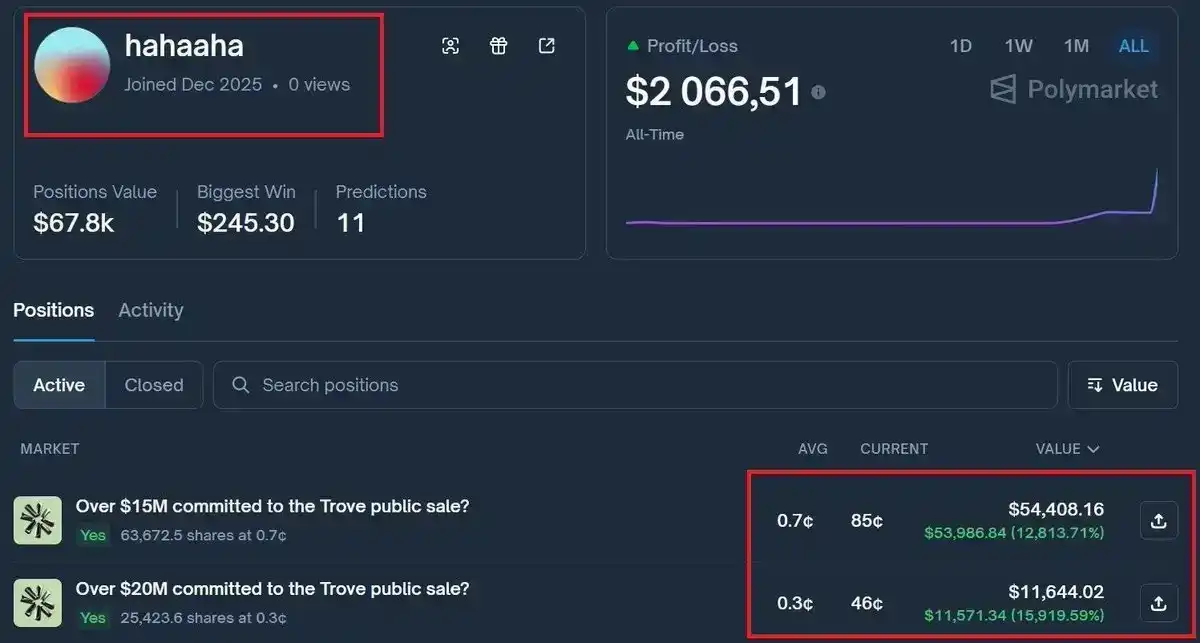
The real show began shortly after. The team suddenly broke the rules, announcing an extension of the ICO by five days to ensure fair allocation. The "YES" option on Polymarket instantly skyrocketed from the bottom to nearly 60%. Insider funds were clearly a step ahead; on-chain data showed that specific wallets placed precise bets before the announcement was made and quickly exited after the price surge.
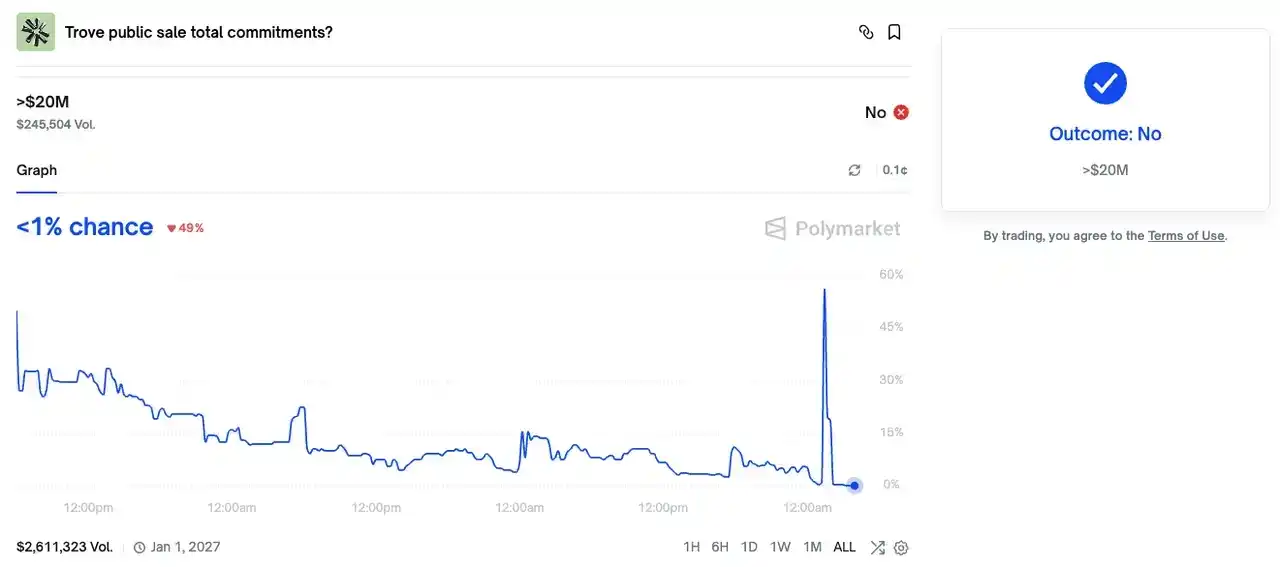
Perhaps deeming the liquidity of the prediction market insufficient to satisfy their appetite, and amidst a wave of community skepticism, the Trove team seized the opportunity to stage a dramatic "crying wolf" scenario: they announced the withdrawal of the extension decision, ending the ICO as originally planned.

Following this announcement, the corresponding market directly zeroed out and settled. Polymarket data indicated that related wallets had placed precise bets before the news was released and continued to profit from the subsequent reversal.
The Great Retreat

On January 17th, Trove suddenly announced it was abandoning Hyperliquid and would instead issue its token on Solana. For a project that had been fundraising under the banner of the Hyperliquid ecosystem, this was nothing short of pulling the rug out from under everyone.

Simultaneously, on-chain detective MLM caught the Trove team using a timed sell function, attempting to sell half of their HYPE tokens within 40 minutes.

Choosing to sell tens of millions worth of tokens in 40 minutes on a weekend, during the lowest trading volume, showed the Trove team was truly desperate.

Faced with质疑 (queries/doubt), the explanation provided by the Trove team seemed feeble: "The backers got nervous and decided to exit." However, on-chain transaction records showed these sell-offs were conducted simultaneously while the team was publicly denying "we are selling tokens."

This inconsistency between words and actions彻底击穿了 (completely shattered) the community's trust底线 (bottom line). As trust collapsed, more shady details were uncovered.

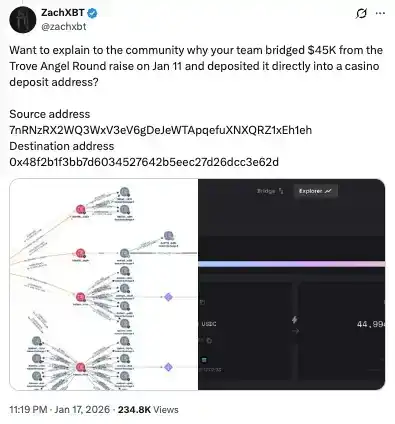
Renowned on-chain detective ZachXBT disclosed that the Trove team paid @TJRTrades a hefty marketing fee of $45,000, directly depositing it into the KOL's online gambling site top-up address.
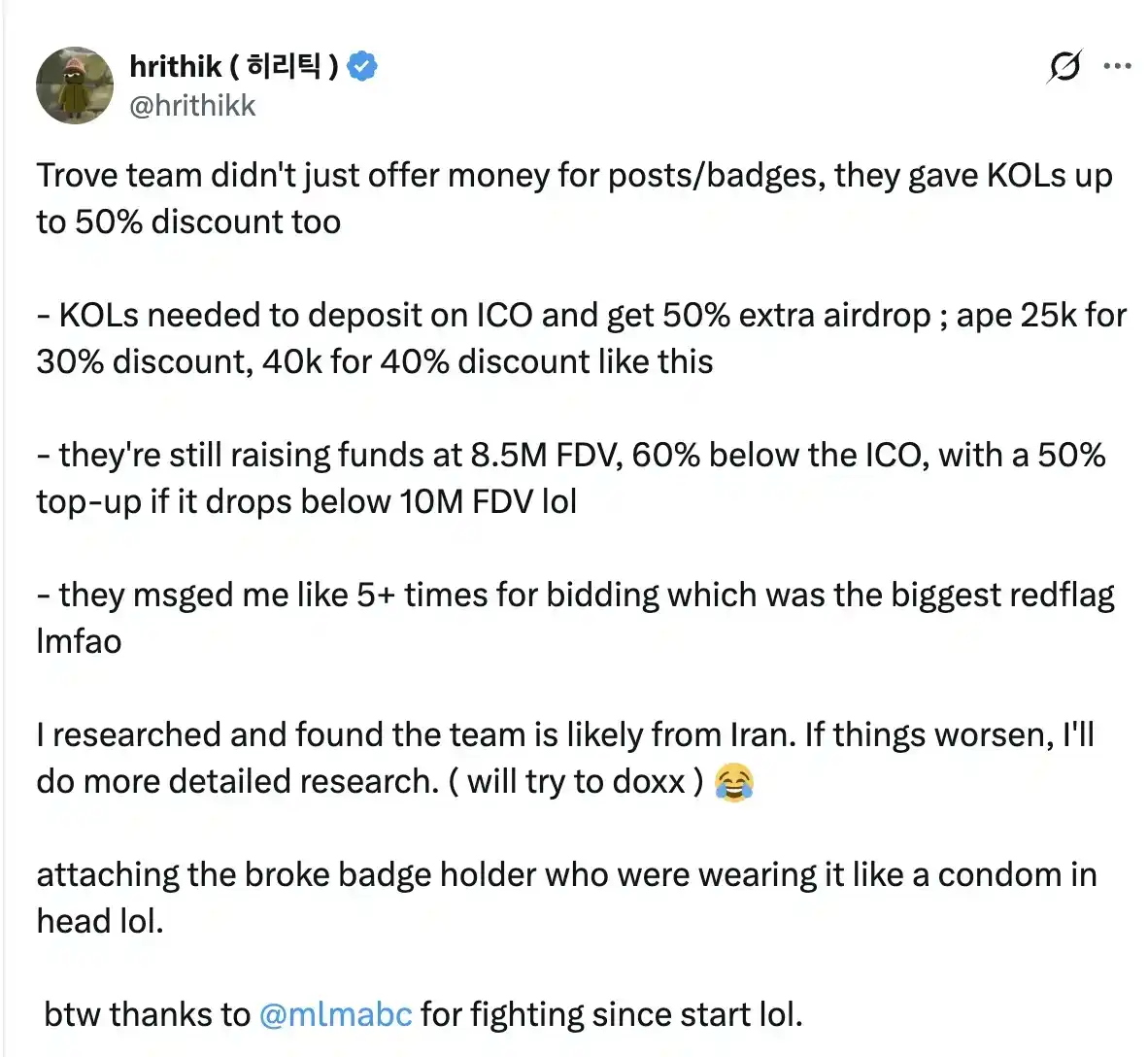
KOL @hrithikk stated that the Trove team not only provided KOLs with substantial marketing fees but also privately offered ICO allocations at valuations as low as $8.5 million, a discount of up to 60%, accompanied by huge airdrop rewards. Trove is still selling shares at low prices and has contacted him over 5 times asking if he would invest in Trove.
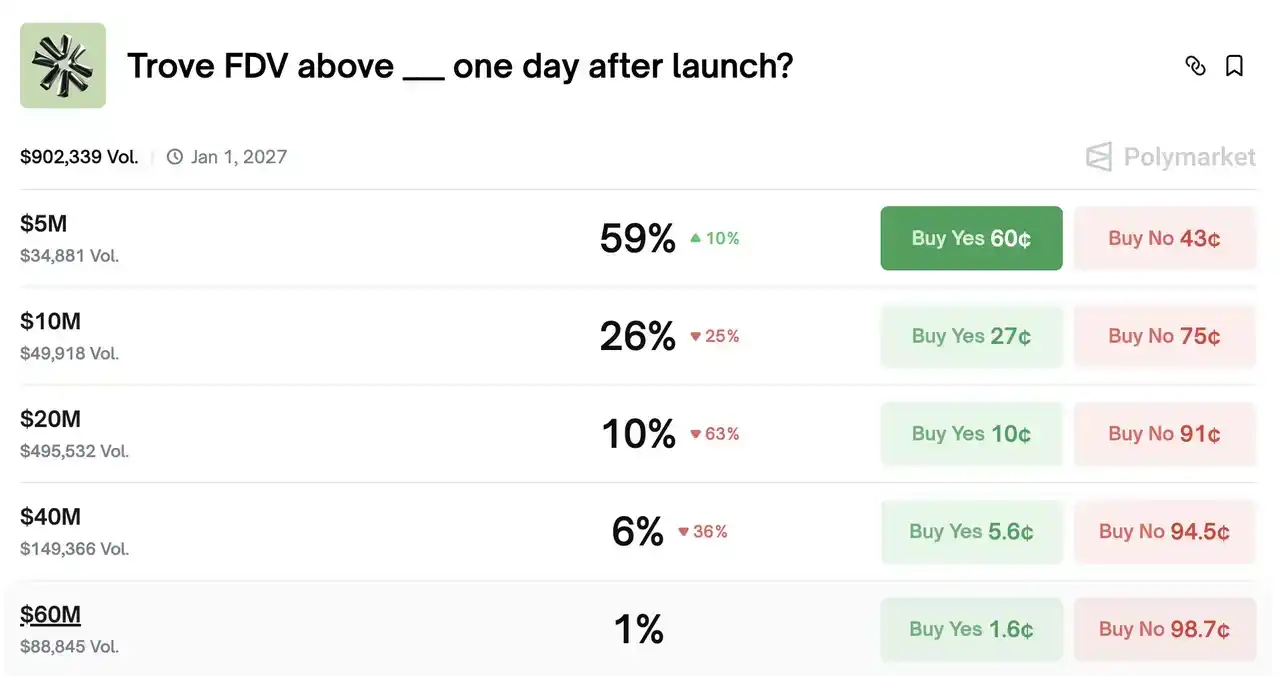
Trove's TGE is scheduled for January 20th at 1:00 AM Beijing Time. The prediction market on Polymarket shows, based on the pre-sale valuation, a 90% probability that the TROVE token will fall below its issuance price.
The good news is that this farce might not end with a simple "Soft Rug." Trove had previously claimed on its official website to comply with EU MiCA regulations. Now, facing accusations of false advertising and potential fraud, angry investors have every reason to initiate civil lawsuits based on MiCA provisions.

The bad news is, as revealed in chat screenshots by a KOL, team members appear to be from Iran.

The Hyperliquid ecosystem is known for its strong community cohesion, but this atmosphere of abundant trust also provides fertile ground for scammers to thrive.


Пов'язані питання

QWhat was Trove's original value proposition and narrative before its controversial actions?

ATrove was a Perp DEX for collectibles and RWA that claimed to convert illiquid 'cultural assets' like Pokémon cards, CSGO skins, and luxury watches into tradable financial assets, providing a hedging venue for collectors.

QWhat key event on January 6th marked the beginning of Trove's 'insider trading textbook' scandal?

AOn January 6th, Trove announced an ICO with a $20 million FDV using an 'oversubscription' model, but then suddenly extended the ICO by 5 days after it was nearly complete, allowing insiders to profit on prediction markets like Polymarket with prior knowledge.

QWhat action did Trove take on January 17th that completely shattered community trust and was described as 'pulling the rug from the cauldron'?

AOn January 17th, Trove abruptly announced it was abandoning the Hyperliquid blockchain to issue its token on Solana instead, despite having fundraised under the Hyperliquid ecosystem, and was caught attempting to dump its HYPE tokens in a short time frame.

QAccording to on-chain detectives, what evidence exposed Trove's unethical practices regarding influencer marketing and private allocations?

AZachXBT revealed Trove paid a KOL $45,000 for marketing to a gambling site deposit address, and KOL @hrithikk disclosed that the team offered private ICO allocations at a 60% discount ($8.5M valuation vs. public $20M) with massive airdrop bonuses.

QWhat potential legal repercussions does Trove face according to the article, and what complicating factor was mentioned?

AInvestors could file civil lawsuits under EU's MiCA regulations for false advertising and potential fraud, but a complicating factor is that team members are allegedly from Iran, which may hinder legal action.

Пов'язані матеріали

Super-Rich Hoarded Record Cash in February, Stock Market Hit New Highs Four Months Later: Who's Getting Fooled?

In February, the total assets in US money market funds reached a record high of approximately $8.25 trillion, a trend highlighted by high-net-worth individuals increasing their cash holdings. Notably, Warren Buffett's Berkshire Hathaway amassed a $381.7 billion cash pile ahead of his 2025 retirement, while other prominent figures like Peter Thiel sold tech stocks, fueling narratives of wealthy investors seeking safety. However, by June, the trend reversed. Money market fund assets fell to around $7.87 trillion, indicating a flow of capital back into equities. Concurrently, the S&P 500 and Nasdaq reached all-time highs, with the S&P 500 surpassing 7600 points. This market surge occurred despite the earlier defensive moves, highlighting a potential opportunity cost for those who retreated to cash. Analysis shows that since early 2022, the S&P 500's total return significantly outpaced that of prime money market funds. The capital shifted from equities appears to have been partly reallocated into alternative investments like real estate, art, and private credit, especially among ultra-high-net-worth individuals. Meanwhile, major investment banks like Goldman Sachs and Morgan Stanley have raised their year-end targets for the S&P 500, citing AI-driven earnings growth, while also cautioning about risks including market concentration and economic fragility beneath the surface rally.

marsbit18 хв тому

Super-Rich Hoarded Record Cash in February, Stock Market Hit New Highs Four Months Later: Who's Getting Fooled?

marsbit18 хв тому

Robot Vacuums Have Been Competing for 20 Years, So Why Are 90% of Chinese Households Still Hesitant?

The article explores why over 90% of Chinese households are still hesitant to adopt robotic vacuum cleaners despite two decades of industry development, identifying a core "trust gap" as the primary barrier. The central issue is not a lack of need, but user concerns about reliability in dynamic, real-world home environments. Common anxieties include the robot dragging pet waste, colliding with transparent objects, tangling in cords, scattering cat litter, getting stuck on thresholds, missing corners under furniture, and requiring high-maintenance bases that develop odors. The industry's past focus on competing on technical specs (suction power, mopping functions) has not adequately addressed these practical usability and trust problems. The piece then examines DJI's entry into the market with its ROMO 2 model as a potential new approach. Leveraging its expertise in spatial perception and obstacle avoidance from drones, DJI's solution emphasizes "less intervention" through three key principles: less manual re-cleaning, less user rescue missions, and less maintenance. Specific ROMO 2 features highlighted include advanced obstacle recognition (handling transparent objects and small items), adaptive leg mechanisms for climbing thresholds (up to 8.5cm), an extendable arm for reaching under furniture, AI for identifying and appropriately handling different mess types (e.g., avoiding scattering dry debris), and a self-cleaning base designed to minimize user upkeep. The article argues the next phase of competition should shift from a "parameter race" to a "trust race." It draws a parallel to the iPhone's simplification of the smartphone, suggesting that focusing on a reliable, low-hassle user experience—where people feel confident leaving their floors to the machine—is what's needed to finally convince the vast majority of观望ing families. The ultimate test for products like the ROMO 2 will be long-term user adoption, retention, and口碑, not just technical specifications.

marsbit18 хв тому

Robot Vacuums Have Been Competing for 20 Years, So Why Are 90% of Chinese Households Still Hesitant?

marsbit18 хв тому

The Unclear American Economy: Resilient or Cooling Down?

**U.S. Economic Outlook: Resilient or Cooling Down?** This analysis examines whether the U.S. economy is heading towards a recession. While still growing, the economy shows significant signs of strain. Key data points include Q1 2026 GDP growth of 1.6% and Q1 PCE inflation at 4.5% (annualized), more than double the Fed's target. The labor market remains resilient but is softening, with unemployment at 4.3%. Critical recession indicators present a mixed picture: the yield curve has normalized after a prolonged inversion (historically a late-cycle signal), and the Conference Board's Leading Economic Index has been declining. Current recession probability for 2026 is estimated at 19%, but rises to 41% for 2027, indicating heightened delayed risks. Major pressures are building: a wall of corporate debt refinancing at higher rates, depleted consumer savings, a contracting housing sector, and an energy price shock. The economy exhibits stagflationary characteristics—high inflation alongside slowing growth—which constrains the Federal Reserve's policy options. Historical patterns show recessions are often preceded by Fed tightening and yield curve inversions. If a recession occurs, it is expected to be mild, similar to 2001 rather than 2008. For investors, a defensive portfolio shift toward staples, healthcare, and short-term high-quality bonds may be prudent, while maintaining a long-term, diversified perspective. Key developments to monitor include upcoming GDP, employment, and inflation data, as well as policy signals from the new Fed Chair.

marsbit26 хв тому

The Unclear American Economy: Resilient or Cooling Down?

marsbit26 хв тому

Торгівля

Спот
Ф'ючерси
活动图片




