Mysticism Takes Over Crypto: When Candlestick Charts Give Way to Bazi and Feng Shui

比推Опубліковано о 2025-12-25Востаннє оновлено о 2025-12-25

Анотація

In the crypto world, traditional technical analysis is increasingly being overshadowed by metaphysical practices like astrology and feng shui. The author describes encountering well-known crypto figures—KOLs, traders, and VCs—praying at temples for wealth, highlighting a cultural shift where beliefs in destiny and supernatural forces are becoming mainstream. Some investors and funds now prioritize checking founders' facial fortunes or project name compatibility over conventional due diligence. Anecdotes include a listed company CEO who reportedly earned hundreds of millions by following feng shui advice, while others suffered losses after ignoring such guidance. The trend is framed not as mere superstition but as a psychological response to extreme market volatility and uncertainty. In an environment where tweets from influencers or politicians can trigger 50% price swings, metaphysical practices serve as emotional anchors—much like ocean-faring cultures relying on divine protection during unpredictable voyages. Ultimately, when rationality reaches its limits, belief fills the void.

Author: Xiaobing, Deep Tide TechFlow

Original Title: Satoshi Nakamoto Would Have to Kowtow to the God of Wealth


Every year on the fifth day of the Lunar New Year, Xiaobing wakes up early to go to the Number One Temple of Wealth at Beigao Peak in Hangzhou.

I thought I would be jostling with aunties and uncles, but when I arrived, the scene was filled with familiar faces amidst the swirling incense smoke.

On the left was a well-known爆料KOL, on the right was someone involved in community schemes, and a few tech elites who usually preach "decentralization" were devoutly kowtowing with loud thuds. In that moment, algorithmic consensus and Federal Reserve movements were no match for the three sticks of incense in their hands.

Over the past two years, mysticism has become the "prominent study" in the crypto world. If you're still looking at candlestick charts, you're a classical rookie. The real veterans are now reading Bazi (Eight Characters).

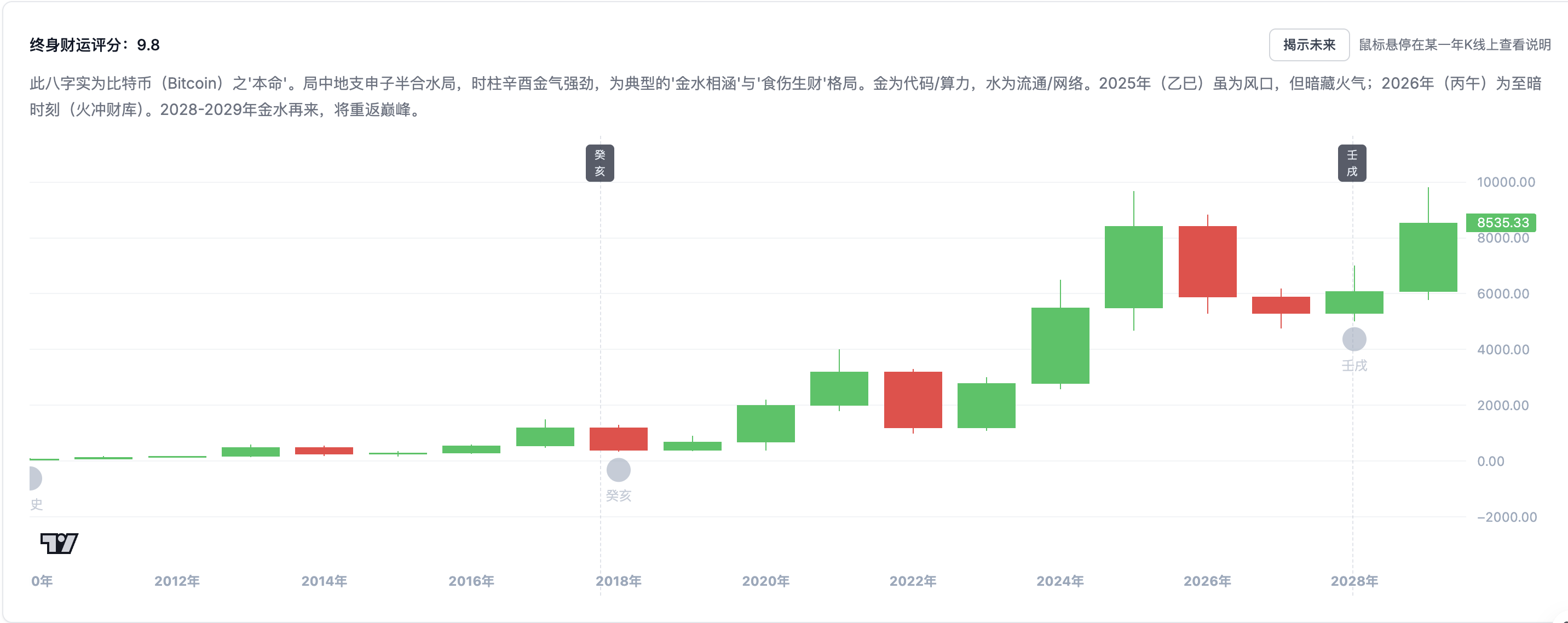
A crypto trader familiar with various macroeconomic indicators eventually turned to mysticism, recently calculating BTC's Bazi—and the outlook is grim: fire clashes with the wealth repository, making 2026 (Bing Wu Year) Bitcoin's darkest hour. I quickly checked my wallet; luckily, it was already empty.
Remember, Alen, a partner at crypto VC y2z Ventures, once stated bluntly that one of their fund's core competencies was "reading faces." In the past, due diligence (DD) involved code audits and business models. Now, it's different: first, check if the founder has a "wealth-losing face," then see if the project's name clashes with Feng Shui.

During a recent trip to Shenzhen, I noticed that traders and KOLs' standard setup isn't data terminals; they all have a "Feng Shui consultant" behind them.

Don't laugh—this approach really works in crypto. Xiaobing knows a boss of a Hong Kong-listed company who is a devout believer in Feng Shui, donating real money to temples—possibly more than the company's R&D budget.

And the result? Feng Shui brought help from noble patrons. Starting in 2023, he bought Bitcoin, earning hundreds of millions of dollars by hoarding it. Later, he caught the wave of the DAT (Crypto Treasury Reserve) narrative, and the company's stock price doubled... Although everyone knows this is "survivorship bias," you can't argue with the fact that he really made a fortune.

There are counterexamples too. A爆料KOL with a frog avatar also had a Feng Shui consultant who advised him not to make moves recently. He couldn't resist and played with contracts, resulting in a neat and tidy liquidation.

About this phenomenon, it's not entirely superstition.

Our traditional land-based civilization emphasizes farming—"sow one grain in spring, reap ten thousand in autumn"—focusing on certainty. But what does maritime civilization face? Storms and unknown waters.

Why do people in the southeastern coastal areas worship Mazu? Not because of ignorance, but because on the vast ocean, besides experience and technology, you need something else.

The crypto world is essentially a modern version of the "Age of Exploration." It faces bottomless seas and sudden storms. This is human nature: the greater the randomness and volatility, the more we seek supernatural spiritual anchors.

When candlestick charts fail, and a single tweet from Musk, Trump, or CZ can sway the market, Feng Shui becomes the last psychological defense. This isn't ignorance; it's an instinctive stress response to massive wealth fluctuations.

After all, when your assets can swing 50% in a day, you need to believe in something to sleep at night. As for whether the God of Wealth understands blockchain, does it really matter?


Twitter:https://twitter.com/BitpushNewsCN

Bitpush TG Discussion Group:https://t.me/BitPushCommunity

Bitpush TG Subscription: https://t.me/bitpush

Original Link:https://www.bitpush.news/articles/7598323

Пов'язані питання

QWhat is the main theme of the article '玄学接管币圈:当K线图让位于八字与风水'?

AThe article discusses how metaphysical practices like astrology, fortune-telling, and feng shui are becoming increasingly influential in the cryptocurrency circle, replacing traditional methods like analyzing K-line charts for investment guidance.

QAccording to the article, what did the crypto VC y2z Ventures partner claim as one of their core competencies?

AAlen, a partner at y2z Ventures, stated that one of their fund's core competencies is 'reading facial features' (面相) to evaluate founders and projects, rather than relying solely on technical or business due diligence.

QWhy does the article compare the cryptocurrency market to the 'Age of Exploration'?

AThe article compares the crypto market to the Age of Exploration because both involve navigating high uncertainty and volatility, similar to sailors facing unpredictable storms at sea, leading people to seek supernatural or spiritual anchors for psychological comfort.

QWhat example does the article provide to show the effectiveness of feng shui in crypto investments?

AThe article cites a Hong Kong-listed company老板 who heavily donated to temples and followed feng shui practices, which allegedly helped him earn hundreds of millions by buying Bitcoin in 2023 and benefiting from market trends, though it acknowledges this could be survivorship bias.

QHow does the article explain the shift from traditional analysis to玄学in crypto trading?

AThe article attributes the shift to the extreme randomness and influence of factors like tweets from figures such as Elon Musk or Donald Trump, which make traditional charts unreliable, leading traders to adopt玄学as a psychological defense mechanism against high volatility.

Пов'язані матеріали

The AI Agent Era Accelerates Its Arrival: Questflow Defines a New Paradigm of Financial Intelligence with On-Chain AI Brokerage

The AI Agent era is accelerating, with the CB Insights AI 100 list highlighting global investment confidence. The focus has shifted from whether AI works to its speed of deployment and ability to manage complex workflows, with autonomous AI Agents driving this transformation. At the forefront is Questflow, a Singapore-based startup redefining financial intelligence through its on-chain AI brokerage. Unlike tools that merely provide data dashboards, Questflow deploys AI Agents that proactively scan markets, form judgments, and execute trades via a conversational interface—operating 24/7 without requiring manual confirmation for each decision. This embodies the new AI paradigm of agents capable of executing multi-step workflows autonomously. Questflow's mission is to democratize institutional-grade trading intelligence. Historically reserved for the ultra-wealthy, this capability is now accessible starting from just $1 through Questflow's "AI Clone + Copy Trade" model. The platform charges only a 1% execution fee, aligning its incentives directly with users and eliminating traditional management or performance fees. The timing is opportune, aligning with key trends identified by CB Insights: the scalable deployment of AI Agents, accelerated AI adoption in financial services, and the maturation of on-chain infrastructure. With robust liquidity on platforms like Hyperliquid and Polymarket, alongside advancements in AI reasoning and non-custodial wallet security, Questflow is positioned to merge the roles of broker, fund, and exchange into a single, accessible platform for millions.

链捕手1 хв тому

The AI Agent Era Accelerates Its Arrival: Questflow Defines a New Paradigm of Financial Intelligence with On-Chain AI Brokerage

链捕手1 хв тому

Why Pricing Social Interactions is Doomed to Fail?

Titled "Why Putting a Price on Social Interaction Is Doomed to Fail," this article critiques attempts to monetize social networks directly through SocialFi models, arguing their inevitable failure stems from a fundamental misunderstanding of media dynamics. Using Marshall McLuhan's theory of "hot" and "cold" media, the author posits that social networks are inherently "cold" media. Their value isn't contained in individual posts but is co-created through user participation, interpretation, and fragmented, ongoing interaction (e.g., replies, shares). This ambiguity and need for user involvement are core to their function. The article asserts that SocialFi projects like Friend.tech failed because introducing real-time, tradable financial pricing (a definitive "hot" signal) into this "cold" environment doesn't add a layer—it replaces the medium's essence. The unambiguous price signal overshadows and nullifies the nuanced, participatory social signal. Users become traders, not participants, and when speculative profits vanish, the underlying social ecosystem—never genuinely cultivated—collapses entirely. This principle extends beyond crypto. The author argues platforms like Twitter have gradually "heated up" through metrics (likes, retweets counts, algorithmically defined value), shifting users from participants to performers and eroding organic engagement. The solution isn't to abandon capital but to manage its entry point. Successful models like Substack, Patreon, or Bandcamp allow capital to "condense" at specific, isolated nodes (e.g., subscriptions, one-time payments) without permeating and "heating" every social interaction. They preserve the core "cold," participatory medium while enabling monetization at designated boundaries. The NFT boom and bust serves as a stark parallel: the ancient "cold" medium of collecting (valued for story, community, gradual accumulation) was rapidly destroyed by platforms that introduced real-time floor prices, rarity scores, and trading dashboards, transforming collectors into speculators and vaporizing cultural value when prices fell. The core lesson: "Liquidity equals heat." Injecting high liquidity and definitive pricing into a "cold" participatory medium doesn't optimize it; it fundamentally alters and destroys its value-creating mechanism. The future lies not in pricing every social gesture but in finding precise, non-invasive points for capital to condense without overheating the entire ecosystem.

marsbit9 хв тому

Why Pricing Social Interactions is Doomed to Fail?

marsbit9 хв тому

Jensen Huang's CMU Speech: In the AI Era, Don't Just Watch, Build

Jensen Huang, CEO of NVIDIA and a first-generation immigrant, delivered the commencement address to Carnegie Mellon University's class of 2026. He shared his personal journey from a humble background to founding NVIDIA, emphasizing resilience, learning from failure, and the responsibility that comes with leadership. Huang framed the present moment as the dawn of the AI revolution, a shift he believes is more profound than previous computing waves. He described AI as fundamentally resetting computing—moving from human-written software to machines that understand, reason, and use tools. This will create a new industry for generating intelligence and transform every sector. While acknowledging AI's potential to automate tasks and displace some jobs, Huang distinguished between the *tasks* of a job and its core *purpose*. He argued AI will augment human capability, not replace humans. The real risk, he stated, is not AI itself, but people being left behind by those who effectively use AI. He presented AI as a generational opportunity for massive infrastructure investment—in chip factories, data centers, energy grids, and advanced manufacturing—that could re-industrialize nations like the U.S. and bridge the digital divide by making computing and intelligent tools accessible to all. Huang called for a balanced approach: advancing AI safely and responsibly, establishing prudent policies, ensuring broad access, and encouraging universal participation. He urged the graduates not to fear the future but to engage with optimism and ambition, reminding them of CMU's motto, "My heart is in the work." His core message was clear: this is their moment to actively build and shape the AI-powered future, not merely observe it.

marsbit1 год тому

Jensen Huang's CMU Speech: In the AI Era, Don't Just Watch, Build

marsbit1 год тому

Торгівля

Спот
Ф'ючерси
活动图片