Musk Targets AI Infrastructure Again: Tesla Set to Sell 'Compute Building Blocks'

marsbitОпубліковано о 2026-06-22Востаннє оновлено о 2026-06-22

Анотація

Tesla has filed a trademark for "Megapod," a modular AI data center hardware system, signaling a potential move into AI infrastructure. The system, as described in the filing, would integrate computer servers, AI processing hardware, networking equipment, power distribution, and cooling into a single, plug-and-play unit. This follows Tesla's existing "mega" product line like the Megapack energy storage system. The move comes less than a year after Tesla disbanded its in-house Dojo supercomputer team, shifting away from custom AI chip development. Analysts suggest Megapod is likely not a direct challenge to NVIDIA's dominant GPU-based systems, but rather targets the supporting infrastructure layer—power, cooling, and rapid deployment—where Tesla's energy business has expertise. The company's Megapack batteries are already being purchased by AI firms like xAI to manage the intense power demands of data centers. While still an early-stage trademark with no product details, Megapod hints at Tesla's broader strategy to commercialize modular AI infrastructure. It aligns with trends seen in Elon Musk's other ventures, such as SpaceX's lucrative contracts to lease GPU compute capacity. The potential market addresses critical bottlenecks in AI expansion: electricity, thermal management, and deployment speed.

Tesla has set its sights on the AI infrastructure business.

Recently, Tesla filed a trademark application named "Megapod" with the United States Patent and Trademark Office (USPTO), planning to sell modular AI data center hardware.
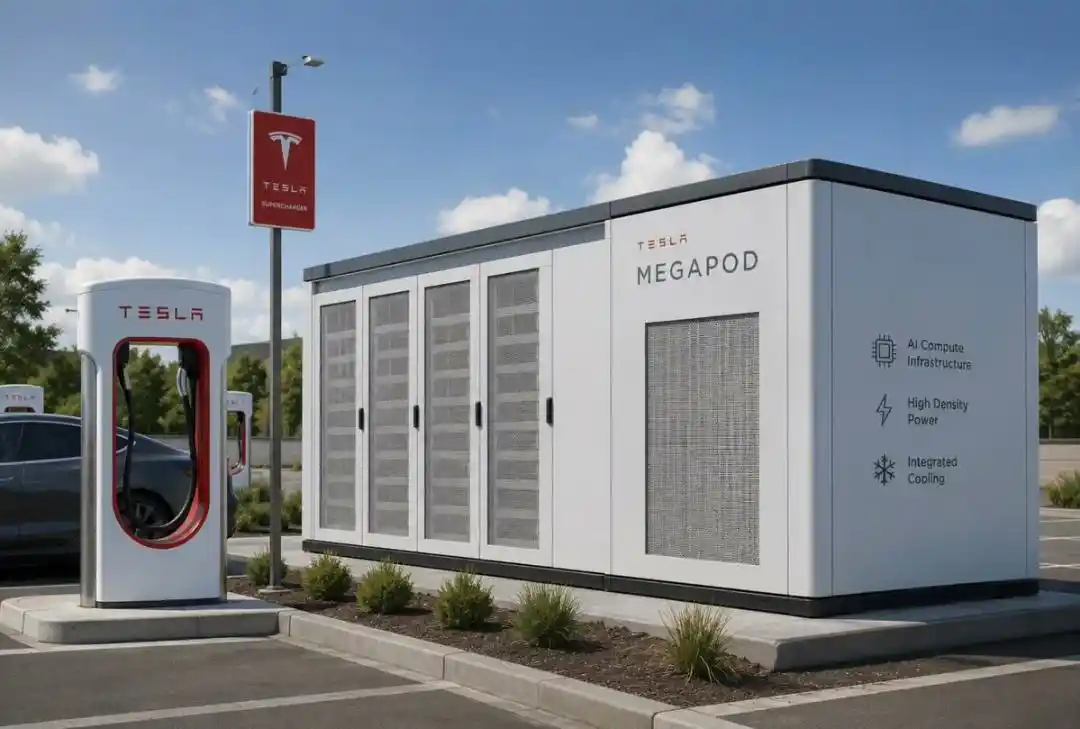
According to the trademark description, this is a modular data center hardware system for AI computing, including computer servers, AI data processing hardware, network equipment, power distribution units, and cooling systems.

However, just under a year ago, Tesla had disbanded its Dojo team, shutting down its only in-house AI training supercomputer.

After bidding farewell to Dojo, they are now registering a new trademark for AI data centers.

Hmm? Is Tesla just changing its approach to continue pursuing computing power?

What is Megapod?

Currently, confirmed information comes from the trademark application.

The trademark name Tesla submitted is MEGAPOD, with application serial number 99893717 and a filing date of June 18, 2026.

In terms of type, this is a standard character trademark, meaning they are securing the name "MEGAPOD" first. The filing basis is intent-to-use, indicating "an intention to use" the mark, but the product has not yet officially launched.

The description in the trademark application is quite specific. It states that Megapod covers:

Modular data center hardware systems for artificial intelligence computing, comprising computer servers, computer hardware for artificial intelligence data processing, network equipment, power distribution units, and cooling systems.

It also includes "self-contained modular AI computing hardware systems" and "downloadable software for monitoring, managing, and optimizing the aforementioned systems."

In simple terms, Megapod sounds like a plug-and-play AI data center module.

It packs servers, network equipment, power supplies, and cooling systems into a single rack. Just haul it to a site, plug it in, and it's ready to run AI training and inference.

This is also where it shares a lineage with Tesla's existing Megapack and Megablock.

Megapack sells large-scale energy storage batteries, while Megablock is an even larger, more modular energy storage system.

Megapod, on the other hand, seems to apply this "modularity" concept from power systems to AI compute systems.

Some netizens have therefore directly called it: Tesla has quietly revealed a massive AI infrastructure play.
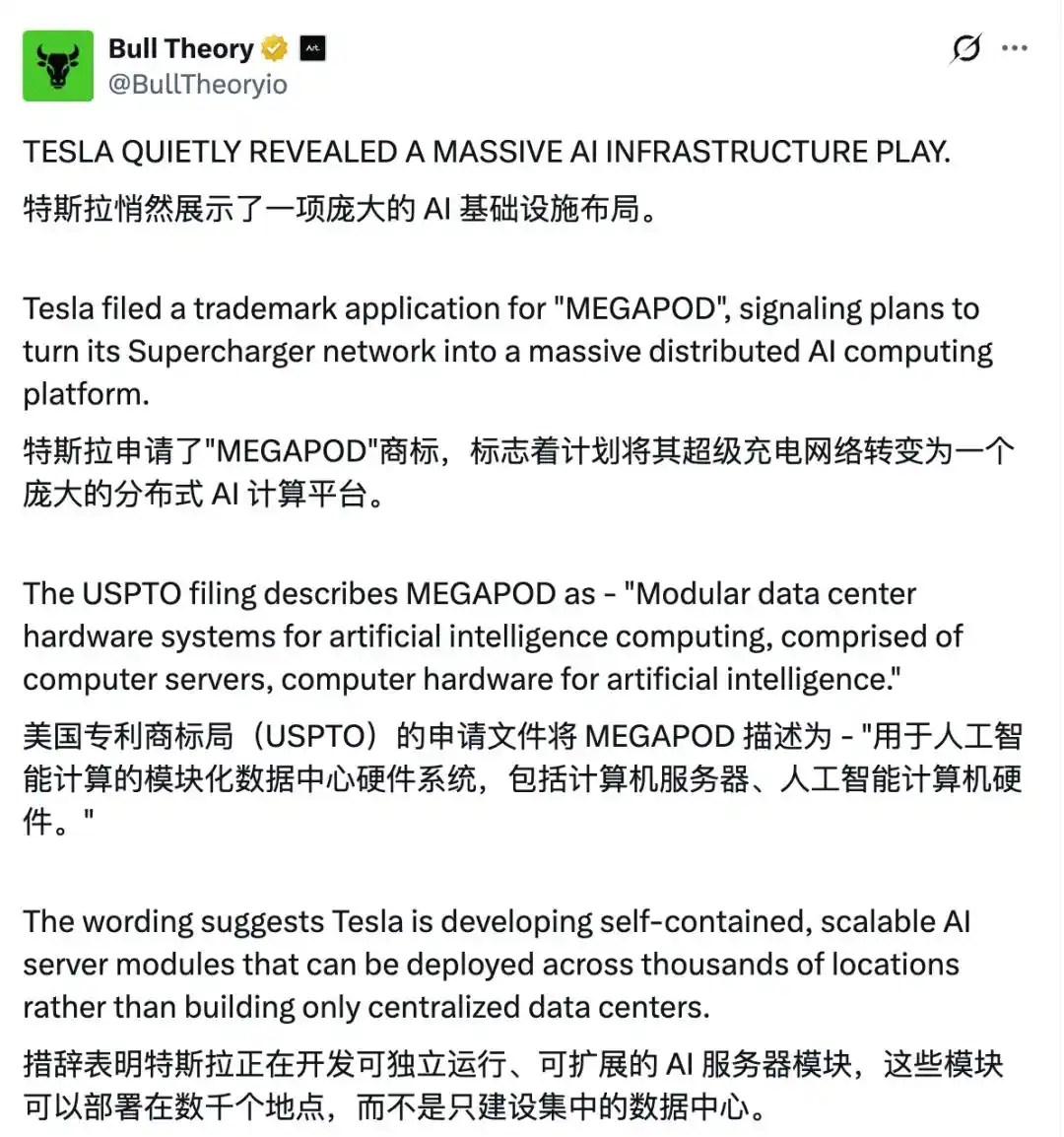
Others have speculated further, linking it to Musk's previous mentions of "using idle electricity to run AI." There's even conjecture that Tesla might connect its Supercharger network, battery storage, and AI compute nodes in the future to form a distributed AI infrastructure.

However, for now, Megapod is just a trademark application. There are no prototypes, specifications, prices, or delivery timelines.

Therefore, there's still a long way to go before Megapod becomes a real product.

Yet, the trademark itself indicates that Tesla is already seriously considering turning AI infrastructure into a marketable hardware category.

Is Tesla Trying to Steal Nvidia's Business?

At first glance, Megapod easily brings Nvidia to mind.

After all, the most expensive and critical components in AI data centers today are Nvidia's full-rack compute systems.

Take the GB200 NVL72, for example, which has already become a de facto standard for high-end AI data centers.

It integrates GPUs, CPUs, high-speed interconnects, liquid cooling, and networking into a single rack. Customers buy it and deploy it directly for large model training and inference. Currently, global cloud providers, AI companies, and sovereign AI projects largely revolve around this ecosystem.

In other words, in the business of "modular AI compute," Nvidia is already the absolute core player.

So, is Tesla's Megapod coming to snatch Nvidia's lunch?

In the short term, not necessarily.

Because Tesla itself is also a Nvidia customer. Tesla needs vast numbers of GPUs to train its FSD, robotics, and in-vehicle AI models; Musk's xAI is also procuring Nvidia chips on a large scale to build training clusters.

Moreover, Tesla's history with in-house AI chips has been quite bumpy.

Tesla once heavily bet on the Dojo supercomputer, hoping to use its self-developed D1 training chips to support FSD model training.

At the 2021 AI Day, Tesla officially showcased Dojo and the D1 chip, with the rationale being to accelerate autonomous driving model iteration through a self-developed training system.
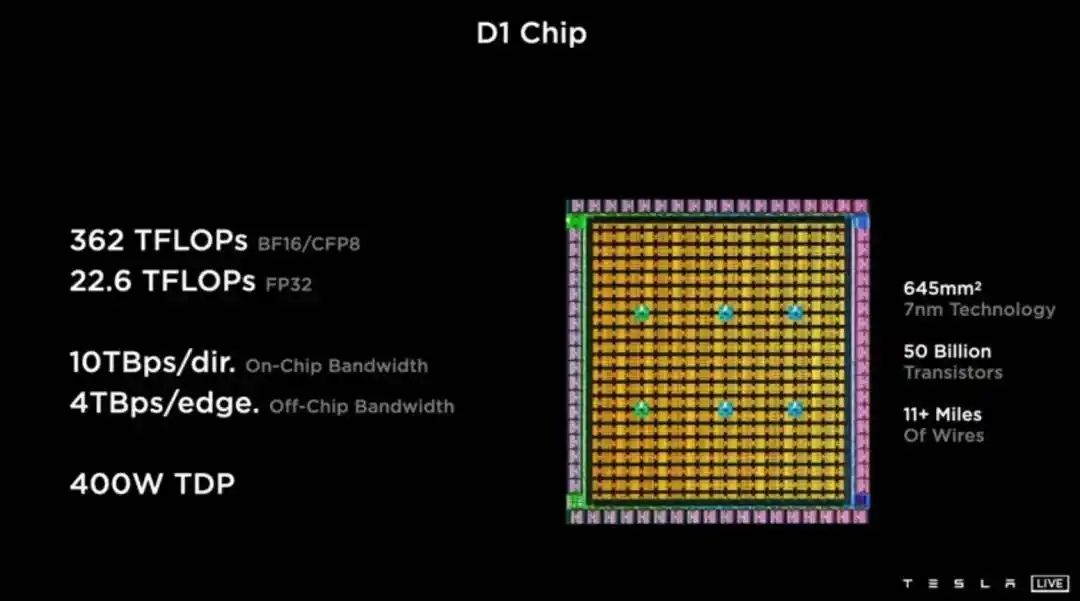
But by 2025, the Dojo team was disbanded, its lead departed, some members moved to AI chip startups, and the remaining personnel were transferred to other Tesla data center and computing projects.

Musk later stated that the company should not spread its resources thin by expanding two different AI chip designs, and that the focus would shift to AI5/AI6, relying more on external compute ecosystems like Nvidia and AMD.

From this perspective, Tesla's new move likely isn't about stealing Nvidia's GPU business, but rather targeting another layer of the AI data center business: power, energy storage, cooling, power distribution, and modular deployment.

This is also a current pain point for AI data centers. Large model training and inference are consuming electricity voraciously. New AI data centers aren't just short on GPUs; they also lack grid access, transformer capacity, cooling systems, and rapidly deployable infrastructure.

Many projects can't start running even after the chips arrive, often stalled by power supply, heat dissipation, construction timelines, and grid connection approvals.

And these problems happen to fall closer to the capabilities of Tesla's energy business.

Tesla's Truly Profitable AI Business Might Be Batteries

Over the past few years, when Tesla talks about AI, the outside world has focused most on FSD, Optimus, and Dojo.

But from a business perspective, the most direct connection between Tesla and AI data centers might actually be the Megapack.
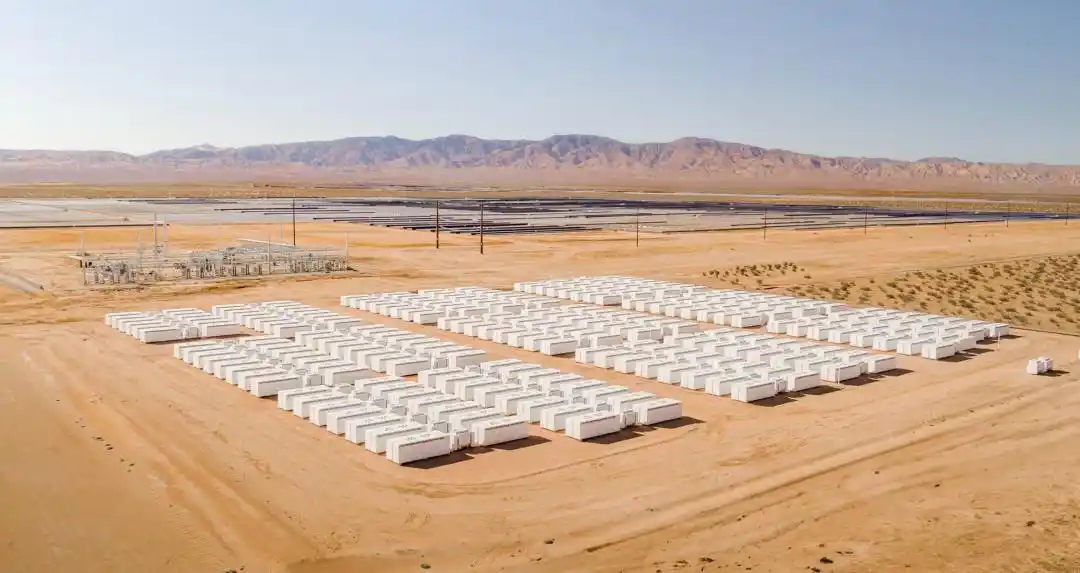
Megapack is Tesla's large-scale energy storage battery product, targeting grids, power stations, commercial and industrial sectors, and large infrastructure projects.

After an AI data center connects to the grid, it creates very sharp fluctuations in power consumption. Especially during large-scale GPU cluster training, loads can spike or drop rapidly, placing high demands on grid stability.

This is where energy storage systems can act as a buffer.

They charge when grid power is abundant and discharge when AI cluster loads increase; they can also help smooth out shocks caused by power fluctuations during training tasks.

This is the real entry point for Tesla's energy business into AI data centers.

Documents have previously shown that xAI purchased approximately $1 billion worth of Tesla Megapacks cumulatively from 2024 to April 2026, with a single-month purchase of $269 million in April 2026 alone.

This indicates that a major spending area for AI infrastructure is no longer just chips and servers. The power system itself is becoming part of the AI race.

Judging by the names, from Megapack to Megablock to Megapod, there's clear continuity.

A proper "mega trilogy".
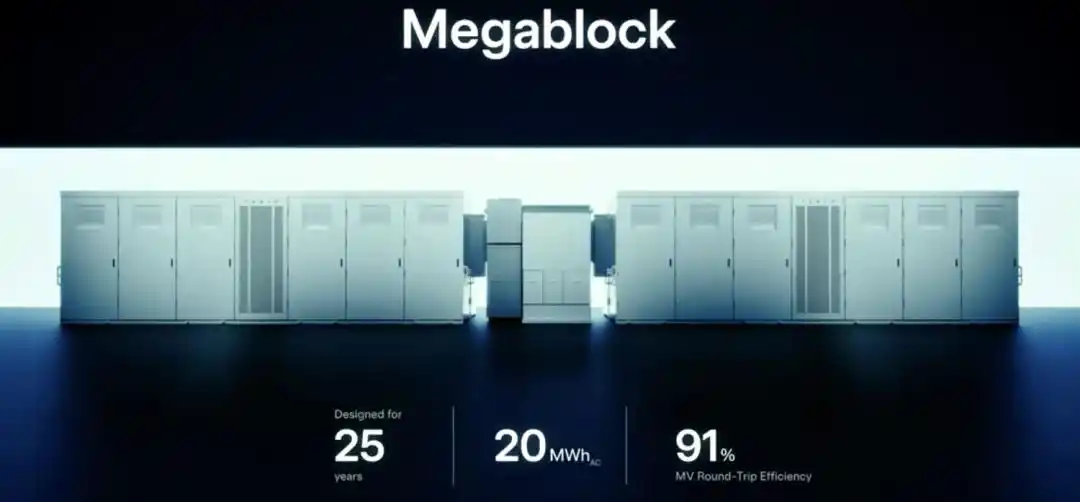
Megapack solves energy storage; Megablock solves larger-scale, faster-deploying power modules.

If Megapod materializes, it could further bundle servers, networking, power, cooling, and software management into an integrated infrastructure product for AI customers.

However, AI data center hardware is an extremely complex market, already populated by established players like Nvidia, Dell, Supermicro, Vertiv, Schneider, Eaton, and others.

From GPU racks to server integration, liquid cooling systems, power distribution, and UPS, each layer has high engineering barriers and long customer qualification cycles.

Tesla's strengths lie in modular manufacturing, battery storage, power control, and AI demand within Musk's ecosystem.

But its weaknesses are also evident: limited experience in enterprise data center delivery, an unstable in-house AI chip roadmap, and it remains unknown whether customers are willing to entrust critical AI infrastructure to Tesla.

However, Musk has already tasted the sweet success from SpaceX's massive compute contracts.

According to reports, Google will pay SpaceX $920 million per month to lease approximately 110,000 Nvidia GPUs along with related CPUs, memory, and other components, for a period of three years.

Prior to this, Anthropic also signed a contract to lease all the compute capacity at SpaceX's Colossus data center for $1.25 billion per month.

Combined, these two contracts mean SpaceX can rake in around $2.17 billion per month just from "renting out compute power."

What? A rocket-building company earning over $2 billion a month just from renting out idle GPUs???

When it comes to being a landlord on this scale, no one does it quite like Musk.

This also makes Megapod even more intriguing:

On one side, SpaceX is turning AI compute into a rentable asset, while on the other, Tesla is using the "mega trilogy" to penetrate power, energy storage, cooling, and modular deployment.

One can imagine that Megapod might not become "Tesla's version of Nvidia."

But when every AI company is short on power, cooling, and deployment speed, this business might just be more tangible than telling autonomous driving stories~

References:

[1]https://electrek.co/2026/06/21/tesla-megapod-ai-data-center-hardware/

[2]https://x.com/BullTheoryio/status/2068569421971436011

[3]https://techcrunch.com/2026/06/05/google-will-pay-spacex-920m-per-month-for-compute/

This article is from the WeChat public account "QbitAI," author: Ting Yu

Пов'язані питання

QWhat is 'Megapod' according to Tesla's recent trademark application, and what is its intended purpose?

AAccording to Tesla's trademark application, 'Megapod' is a modular data center hardware system for AI computing. Its purpose is to provide an integrated system that includes computer servers, AI data processing hardware, networking equipment, power distribution units, and cooling systems, designed to be a plug-and-play AI compute module.

QWhy is it significant that Tesla filed for the 'Megapod' trademark shortly after disbanding its Dojo supercomputer team?

AIt is significant because it shows a strategic shift in Tesla's AI compute approach. After disbanding its in-house Dojo AI training supercomputer project, this move suggests Tesla is pivoting from developing its own AI chips to focusing on modular, infrastructure-level hardware solutions for AI data centers.

QWhat are the key pain points in modern AI data centers that Tesla's 'Megapod' might address?

AModern AI data centers face key pain points beyond just compute power, including lack of power grid access, insufficient electrical capacity, complex cooling requirements, and long construction/deployment cycles. Tesla's 'Megapod' concept aims to address these by offering a pre-integrated, modular system that combines power, cooling, and compute for faster deployment.

QHow does Tesla's potential move into AI data center hardware relate to its existing energy products, and what is the 'mega trilogy'?

ATesla's move relates directly to its energy products through a product family philosophy. The 'mega trilogy' refers to Megapack (large-scale energy storage batteries), Megablock (larger, more modular energy storage systems), and the proposed Megapod (modular AI data center hardware). This shows Tesla applying its modular system expertise from energy storage to AI infrastructure.

QWhy might Tesla's 'Megapod' not be seen as a direct competitor to NVIDIA's AI data center offerings?

ATesla's 'Megapod' might not be a direct NVIDIA competitor because Tesla itself is a major NVIDIA customer for GPUs. The article suggests Megapod is less about competing in AI chips and more about leveraging Tesla's strengths in modular manufacturing, battery storage, and power management to address the power, cooling, and deployment infrastructure layers of AI data centers.

Пов'язані матеріали

The Jacobian Conjecture that plagued Yitang Zhang for 7 years was overturned and disproven by Fable 5 overnight

**Summary:** The mathematical community was shocked when the longstanding **Jacobi Conjecture**—a core problem in polynomial mapping that had remained open for 87 years—was reportedly **disproven** by **Fable 5** (an AI model from Anthropic). The conjecture, first posed in 1939, asks whether a polynomial map with a constant, non-zero Jacobian determinant must have a polynomial inverse. Despite seeming intuitive, it had resisted numerous proof attempts by leading mathematicians. The breakthrough came when a researcher, Levent Alpoge, shared a succinct counterexample generated by Fable 5: a specific polynomial map from ℂ³ to ℂ³ whose Jacobian is the constant -2, yet which is not injective (mapping three distinct points to the same image). This elegantly falsifies the conjecture in its general form for dimensions ≥3. The counterexample is simple enough to be verified by hand or with tools like Wolfram Alpha. The event sparked intense discussion, with other AI models like GPT-5.6 quickly analyzing the result and even proposing a refined conjecture. It demonstrated AI's emerging capacity for genuine mathematical creativity, not just pattern matching. The story carries a poignant human dimension: renowned mathematician **Yitang Zhang** had devoted seven years of his early career to this problem under his PhD advisor, using a flawed lemma provided by the advisor. This setback contributed to Zhang leaving academia for years, including a period working at Subway, before his later breakthrough on the Twin Prime Conjecture. The AI's swift resolution underscores the tragic waste of his early effort on a conjecture now shown to be false in higher dimensions. It's important to note the disproof specifically targets the generalized (n-dimensional, n≥3) conjecture. The 2-dimensional case, which Zhang worked on, remains open and is considered mathematically distinct and even more challenging. Nonetheless, the event marks a significant moment, prompting reflections on AI's future role in mathematical discovery.

marsbit27 хв тому

The Jacobian Conjecture that plagued Yitang Zhang for 7 years was overturned and disproven by Fable 5 overnight

marsbit27 хв тому

Bought Bitcoin at $117,000, Sold at $62,000 in Tears: This Company’s Faith Only Lasted a Year

Wall Street's once-hot trend of corporate "Bitcoin hoarding" has hit a painful reality check. Empery Digital, formerly an electric motorcycle company, pivoted to Bitcoin in July 2025, accumulating over 4,000 BTC at an average cost of approximately $117,600 each. As Bitcoin's price plummeted, the company faced massive paper losses exceeding its total market value by early 2026, triggering internal conflict with a major shareholder demanding a sale. In a stark reversal from its earlier refusal to sell, Empery Digital recently sold 1,400 BTC at an average price of $62,000, locking in a significant loss of roughly $77 million on just those coins. The proceeds were used to pay down $10 million in debt, prepare for legal fees related to shareholder lawsuits, and, most notably, fund a new strategic shift: a $65 million investment for a 25% stake in an AI data center facility. This move completes a cycle of chasing market trends—from electric vehicles to Bitcoin treasury and now to AI infrastructure. Empery's case exposes the leveraged nature of the corporate "treasury model," where buying Bitcoin with borrowed money works only while prices rise. Once the asset fell below its cost basis, the company was forced to sell at a loss to service debt and pivot to the next opportunity. The company's remaining assets are 1,514 BTC and its ambitions in AI, demonstrating that its stated "long-term belief" in Bitcoin had a clear price tag: a 50% discount.

marsbit37 хв тому

Bought Bitcoin at $117,000, Sold at $62,000 in Tears: This Company’s Faith Only Lasted a Year

marsbit37 хв тому

Visa Joins the Stablecoin Arena: Not to Eliminate Stablecoins, but to 'Collect Rent' from Them

Visa is entering the stablecoin arena by launching a stablecoin platform, aiming not to eliminate existing stablecoins but to facilitate and profit from their broader adoption. The platform will enable banks, financial institutions, and fintech companies to more easily issue, manage, and integrate stablecoins into Visa's existing global payment network, which spans over 200 million merchants and 15,000 financial institutions. This move is expected to expand the overall stablecoin market by creating more use cases. For USDC (Circle), it presents a short-term benefit due to likely direct integration and its compliance advantages, though long-term competition may increase from bank-issued or consortium stablecoins. For USDT (Tether), the impact could be more significant in traditional payment and settlement areas, as Visa's platform may favor more transparent, compliant options, though USDT is expected to remain strong in pure crypto trading contexts. Regarding Ethereum, Visa's initiative is seen as neutral to slightly positive. It could drive more traditional capital into the Ethereum ecosystem in the form of stablecoins, increasing network activity and demand for Ethereum as a settlement layer, especially with Layer-2 scaling solutions. While the platform will support multiple blockchains, Ethereum's maturity and decentralization make it a likely primary choice for compliant stablecoins. In essence, Visa's strategy is to embrace stablecoins, collect fees from increased transaction volume on its network, and grow the overall market, rather than displace major incumbents like USDC and USDT directly.

marsbit1 год тому

Visa Joins the Stablecoin Arena: Not to Eliminate Stablecoins, but to 'Collect Rent' from Them

marsbit1 год тому

Торгівля

Спот
活动图片