Musk Poaches the Web3 Prodigy Who Laid the Foundation for the Aave App

marsbitОпубліковано о 2026-03-26Востаннє оновлено о 2026-03-26

Анотація

Elon Musk has recruited Benji Taylor, a 26-year-old design prodigy and former design lead at Base, to lead design at X (formerly Twitter). Taylor, who began his career at 16 and gained early recognition for his creative work, is known for his groundbreaking contributions to Web3 and consumer app design. He founded Los Feliz Engineering (LFE), where he created Honk—a real-time chat app with no send button or message history—which gained a cult following before shutting down due to product-market fit challenges. Later, he developed Family, a highly praised self-custody crypto wallet often regarded as one of the best-designed in the industry. LFE was acquired by Aave Labs in 2023, and Taylor’s work became foundational to the Aave App’s user experience. His recruitment signals Musk’s continued interest in integrating crypto and payment features into X, leveraging Taylor’s rare expertise in social apps, crypto UX, and minimalist design. Taylor has expressed that his motivation lies in building at scale and reaching billions of users—a goal now within reach at X.

At 1:00 AM Beijing time on March 26, former Base Design Lead Benji Taylor announced that he is joining Musk's X and will lead design efforts.
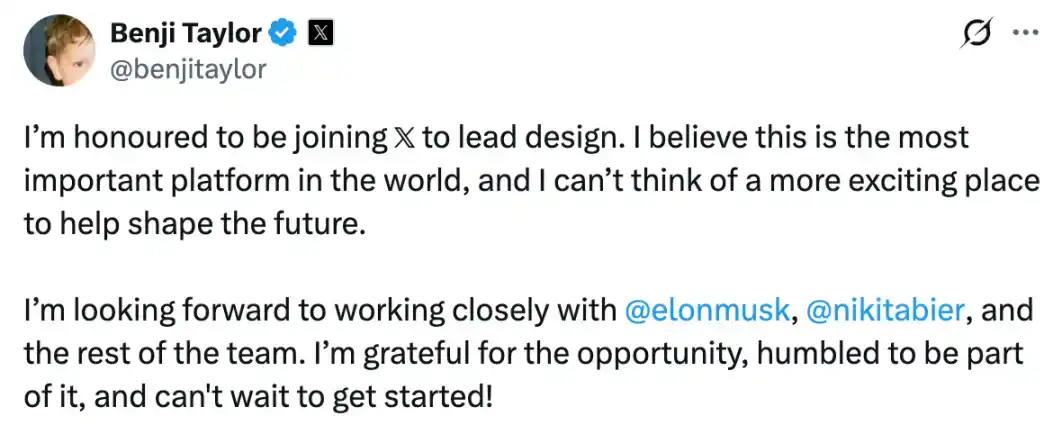
Personnel changes are never big news in the Web3 industry, but this post reaching nearly 15 million reads tells me things are not that simple.

After a deeper look, I realized this person is far from just the Base Design Lead.

Rebellion and Talent

Benji Taylor is only about 26 years old, likely a standard "Gen Z".

Unlike most conventional life paths, Benji Taylor was already somewhat famous by the age of 16. In 2016, this 16-year-old "Creative Director" from London, UK, was interviewed by the renowned British fashion and culture magazine 《Dazed》.

At an age when many are still studying hard in high school classrooms, Benji Taylor was already making huge waves across the Atlantic. Numerous artists, including Ram Riddlz and A$AP Ant, had collaborated with him. Not only that, he also found time to develop apps, design his own playing cards, and start his own design company, Next Exit.

These weren't things he *started* doing at 16; they were things he had already *done*. According to the interview, Next Exit had been operating for at least a year.

"To be honest, I'm not great at art, I just have a lot of ideas and decide to put them into practice."

In Benji Taylor's view, homogeneous design styles disgusted him. As someone who considered himself not great at art, he still felt his work surpassed that of many others.

In this interview from a decade ago, Benji Taylor displayed a maturity beyond his years. Besides expressing dissatisfaction with homogenized education, when asked for advice for other young creatives, he said:

"Be more self-aware and understand that things don't just happen by themselves. School doesn't guarantee you a job, nor does it guarantee a happy and stable life. You're young, maybe still living with your parents, not paying rent—take advantage of that. Every penny you earn is profit, why wait until real life knocks you down?"

From Honk to Aave

Around 2020, Benji Taylor came to the US. Soon after, a company named Los Feliz Engineering (LFE), after the first community he lived in upon arriving, was established.

The first product launched by this company was a blockbuster.

In December 2020, Honk burst onto the scene. The app was initially promoted on TikTok, where a single video garnered over 140k likes.

Honk's design was ingenious: the app had no send button; inputted chat content was displayed to the other party character by character. You could see the person you were chatting with modifying and deleting content, like a "live chat." Additionally, the app had no chat history; once you left the chatroom, all historical content was permanently deleted.
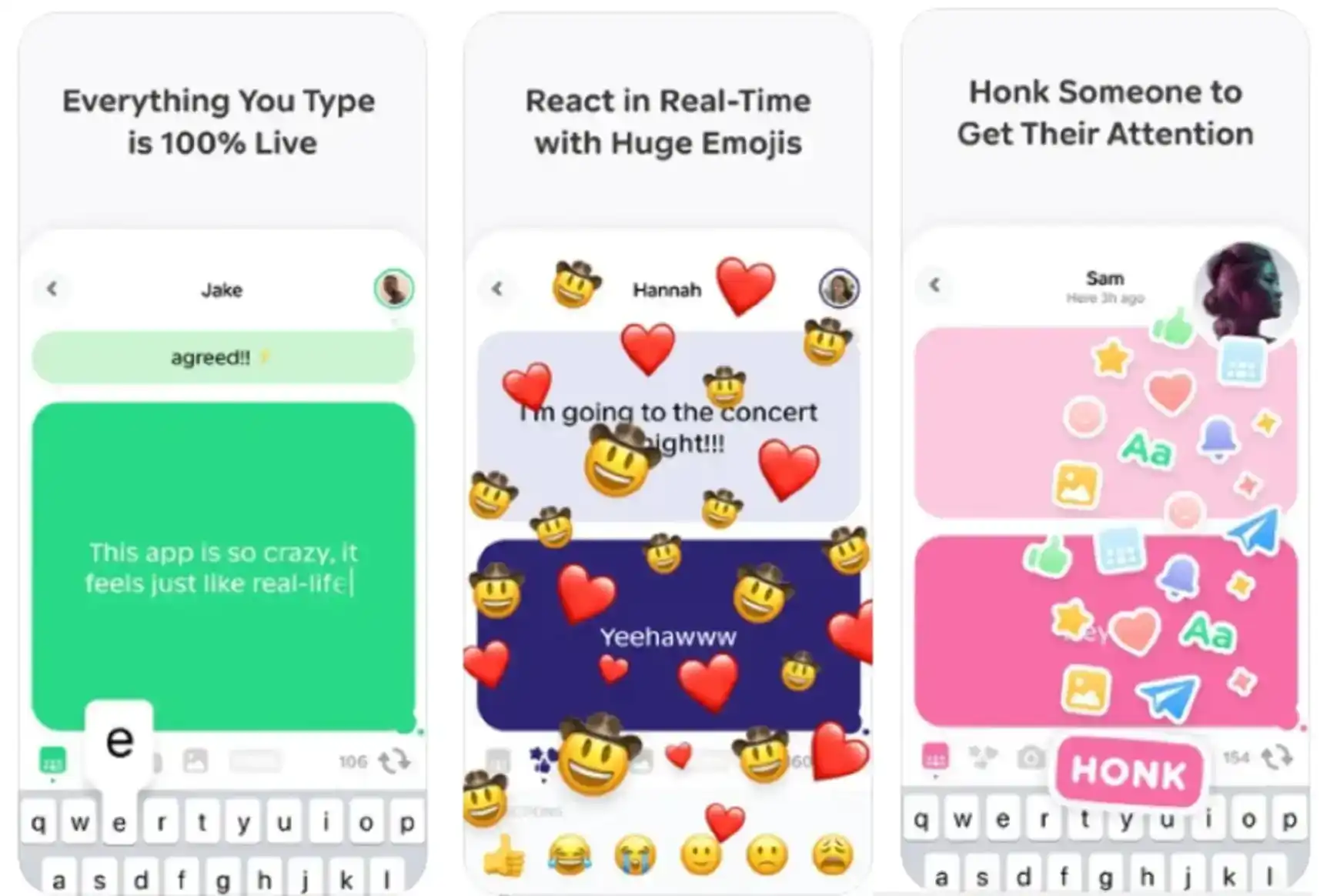
If you wanted to pull someone into a chatroom, you could send a "Honk"; the other person would receive a prominent notification that someone was "calling" them. This method of translating the experience of offline, face-to-face chatting into an online format through mechanism design was very novel.

In 2021, Honk expanded from熟人社交 (acquaintance social) to陌生人社交 (stranger social). Users could randomly match with strangers using a function similar to WeChat's "Shake." At its peak, Honk's open rate even surpassed Instagram's. By the time it was shut down, Honk had accumulated 2.6 billion characters input, 170 million "Honks" sent, and hundreds of millions of image, audio, and video exchanges. It gained a loyal user base in fields like fashion and tech.

That's right, this app was shut down years ago. Although highly praised by its users, and even today many product managers and designers miss this "honkish" style, the product's PMF (Product-Market Fit) was genuinely challenged.

The core reason was that the app required both parties to be online simultaneously. Furthermore, Honk had no group chat and never launched an Android version.

Perhaps this app was god-like in certain niche circles, but a social app seems destined to fail without enough people.

In 2022, the LFE team began developing Family, a self-custody cryptocurrency wallet focused on design.
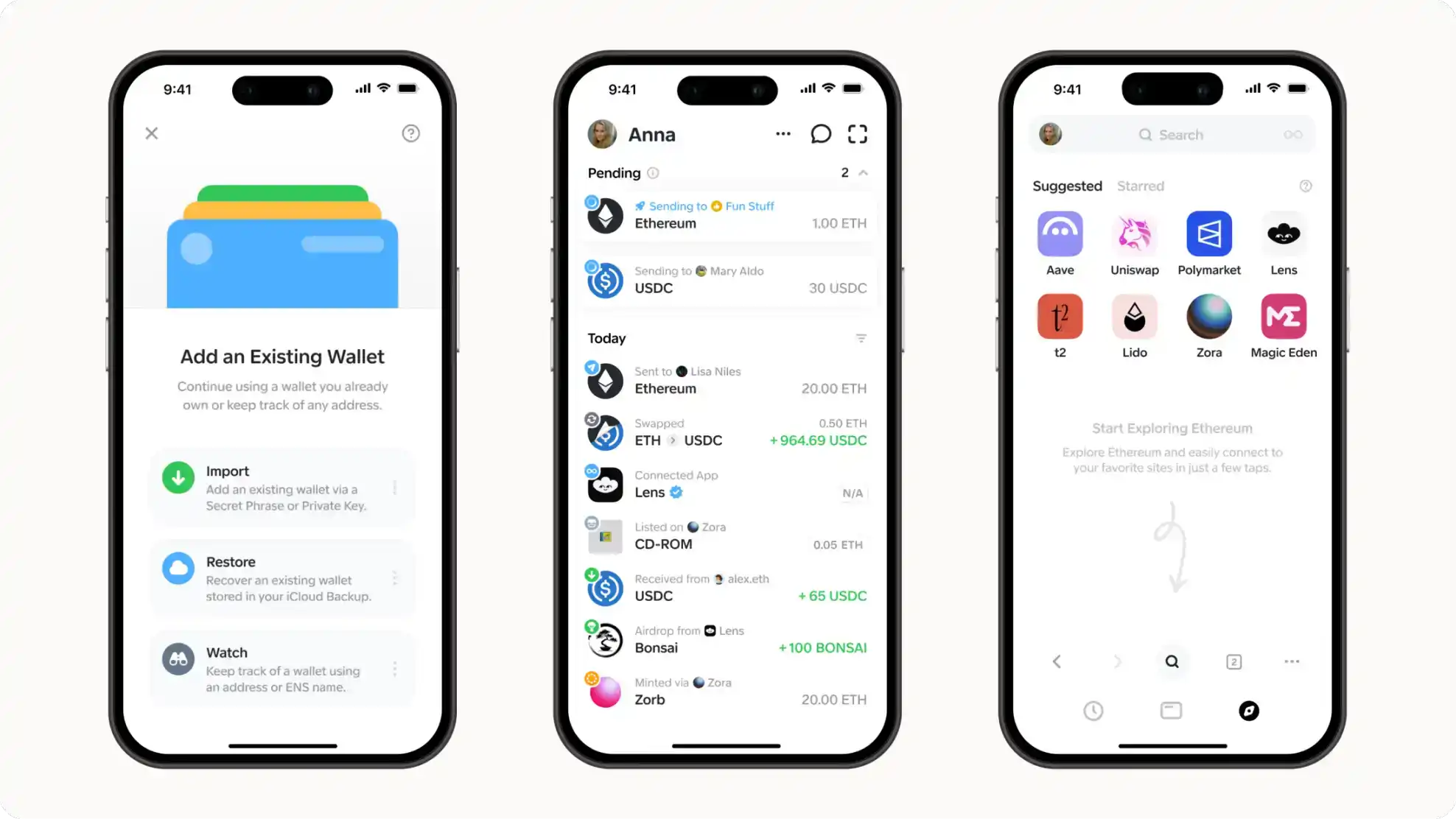
If you've seen wallet apps with interfaces resembling the one in the image above, they might have been inspired by Benji Taylor's design. This wallet product was also highly praised within the industry, with many users calling it the "best体验 (experience)加密钱包 (crypto wallet)." Of course, you might not have heard of this wallet because they really didn't do well in market promotion.

Perhaps frustrated that good products weren't gaining market recognition, Benji Taylor decided to leverage a platform. In 2023, LFE was acquired by Aave Labs. Concurrently, Honk was shut down, while the Family wallet continued operating. Unfortunately, this wallet was also abandoned in February this year. Aave's explanation was a focus on DeFi business, believing that attracting users to Web3 requires designing for specific purposes, not a通用型 (general-purpose) wallet.

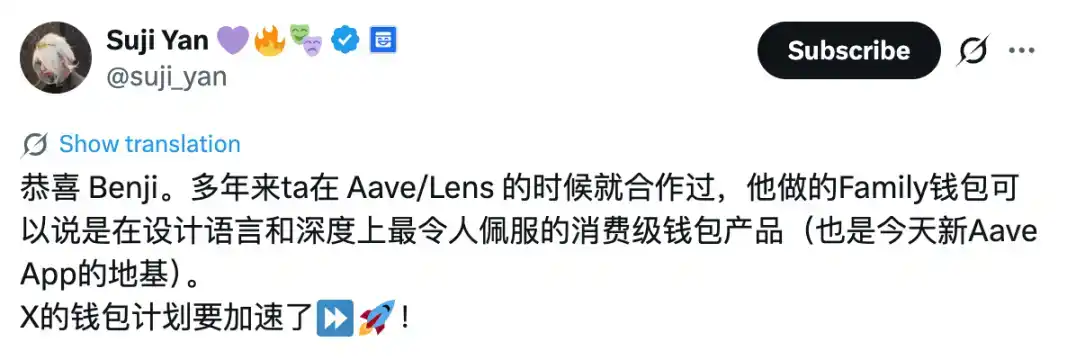
Suji, founder of Mask Network (which acquired Lens), also said on X today that the Family wallet was the most impressive consumer-grade wallet product in terms of design language and depth, and was the foundation of the Aave App.
In October 2025, Benji Taylor left Aave and joined Base as Head of Design. If you pay attention, you'll notice that the more well-known mobile Apps in the Web3 industry today definitely include Aave and Base. An investor in the industry once told me that the mobile App experience for most Web3 products is abysmal. With far more global mobile users than PC users, the fact that only the PC experience is passable is also a hindrance to Web3's user expansion.

This is partly due to imperfect infrastructure and the complications brought by decentralization, which make many processes impossible to simplify. But precisely because of this, only designers like Benji Taylor can create mobile applications for Web3 that might be considered just及格 (passing) by Web2 standards.

The Man Chosen by Musk

The fact that the extremely picky Musk personally tweeted to welcome his加入 (joining) speaks volumes.

There is much speculation on X about his arrival. Some believe that Nikita Bier, the product lead who served as an advisor to Solana Labs, combined with the former Base design lead, their cryptocurrency industry backgrounds suggest Musk intends to add more cryptocurrency-related features to X.

Others speculate that his experience with social apps and crypto wallets could aid X's encrypted communication app X Chat and payment products.

Benji Taylor himself provided the answer:
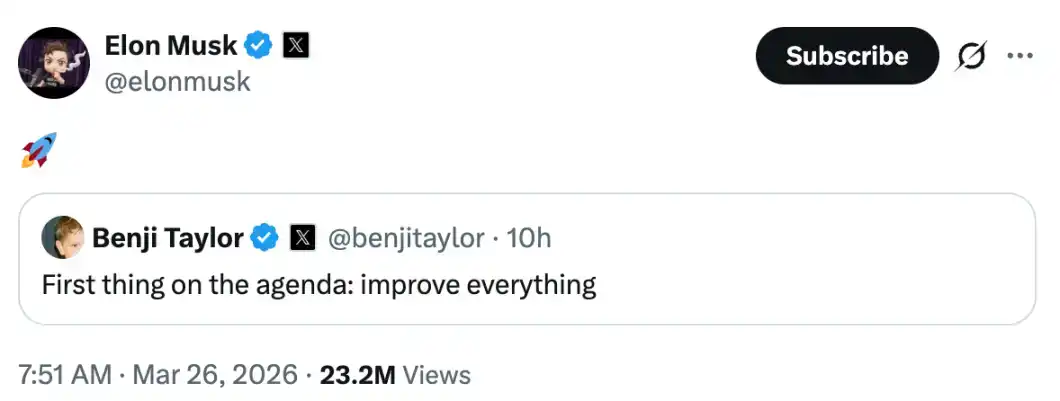
In the past, this brilliantly talented young man created many astonishing designs, but from a purely commercial perspective, they seemed曲高和寡 (too highbrow to be popular). After several years of ups and downs, it's believed that within this company integrating social app X, AI model xAI, and Mars-aiming SpaceX, Benji Taylor can utilize his talent to the fullest.

AI's design capabilities are not weak, but the highest level of审美 (aesthetics) does not come from billions or trillions of parameters; it stems from the innate gifts of geniuses.


Пов'язані питання

QWho is Benji Taylor and what is his new role at X?

ABenji Taylor is a 26-year-old design prodigy who previously worked as the design lead at Base and was instrumental in the development of Aave App. He has recently joined Elon Musk's X to lead the design team.

QWhat was Benji Taylor's first major product after moving to the US, and what made it unique?

ABenji Taylor's first major product was Honk, a social app launched in 2020. It was unique because it featured live typing without a send button, no chat history, and a 'Honk' notification to invite others into chat rooms, mimicking real-time, in-person conversations.

QWhy did Honk eventually fail despite its innovative design?

AHonk failed primarily because it required both users to be online simultaneously, lacked group chat functionality, and never released an Android version, which limited its user base and product-market fit.

QWhat was the name of the self-custody cryptocurrency wallet developed by Benji Taylor's team, and how was it received?

AThe self-custody cryptocurrency wallet was called Family. It was highly praised within the industry, with many users considering it the 'best-experienced crypto wallet' due to its design language and depth, though it struggled with market推广.

QWhat are the speculations about Benji Taylor's role at X regarding cryptocurrency?

ASpeculations suggest that Benji Taylor's experience with crypto products, combined with his background in social apps, might help X integrate more cryptocurrency-related features, such as enhancing X Chat for encrypted communications or developing payment products.

Пов'язані матеріали

KOL's Perspective: Why Is SOL Set to Rise from This Point?

**Summary: Why SOL is Positioned for Growth at This Level** The article argues that SOL is poised for an upward move from its current price point, citing several key factors. Primarily, SOL has just broken out of a 4-month consolidation phase. This breakout signals a return of risk appetite to the broader crypto market, as SOL is seen as a key indicator of overall crypto health. The token's ownership has reportedly shifted from short-term traders and tourists to long-term accumulators, leading to low volume. Any meaningful increase in trading activity could thus trigger significant upward momentum. Fundamental strengths include strong institutional adoption, integration with DeFi and RWAs (Real-World Assets), and the potential benefits from the Clarity Act. Despite its high volatility—having dropped 70% from its all-time high but still up 12x from its bear market low—SOL is highlighted as one of the few tokens from the last cycle to reach new highs. It boasts a robust ecosystem of applications, users, and protocols. Future catalysts include the expected influx of AI developers following the Miami Accelerate conference, which focused on AI on Solana. Furthermore, Solana is positioned as the premier chain for memecoin activity, a trend expected to continue and drive network usage and fees. The article concludes that recent price action reflects a healthy transfer to long-term holders, setting the stage for growth.

marsbit45 хв тому

KOL's Perspective: Why Is SOL Set to Rise from This Point?

marsbit45 хв тому

Those Pre-Bitcoin PoW Protocols Have Recently Been Reimplemented

This article details a recent surge in replicating pre-Bitcoin Proof-of-Work (PoW) protocols, specifically focusing on Hal Finney's 2004 RPOW (Reusable Proofs of Work). Within five days in May 2026, multiple independent builders in the Bitcoin/cypherpunk community launched projects inspired by this early electronic cash proposal. The initiative began with Fred Krueger's `rpow2.com`, a centralized but auditable system that replaced RPOW's original IBM 4758 hardware with Ed25519 signatures. Initially a faithful replica, it later adopted Bitcoin-like features (21M supply cap, difficulty adjustment) and a controversial 5.24% founder allocation. This sparked rapid forks, including `rpow4.com` which incorporated full Bitcoin parameters, a prediction market (`rpowmarket.com`), and a DEX (`rpow2swap.com`). Concurrently, Mike In Space created a prototype of Wei Dai's 1998 b-money proposal (`b-money.replit.app`), pushing the historical exploration even further back. The article contrasts these centralized, server-dependent experiments with Bitcoin's core innovation of decentralized, trustless consensus. It also highlights a parallel development: the `HASH` project on Ethereum, which uses smart contract hooks to enable a purely fair-launch, browser-mineable PoW token with 0% allocations to team or VCs. The collective activity is framed as a meme-driven, educational exploration of cypherpunk history rather than a serious financial movement, with all projects heavily disclaiming any investment value.

marsbit50 хв тому

Those Pre-Bitcoin PoW Protocols Have Recently Been Reimplemented

marsbit50 хв тому

South Korean Exchanges 'Battle' Regulators, Challenging the Boundaries of Enforcement and Legislation

South Korea's cryptocurrency industry is engaged in a rare, direct confrontation with regulators. The Financial Intelligence Unit (FIU), the primary anti-money laundering (AML) watchdog, has recently imposed heavy penalties on major exchanges like Upbit and Bithumb for alleged violations involving unregistered overseas VASPs and AML procedures. However, exchanges are now actively challenging these actions in court and through industry associations. In a significant shift, the Seoul Administrative Court ruled in favor of Upbit's operator, Dunamu, overturning part of an FIU-ordered business suspension. The court found the FIU's penalty criteria and justification insufficiently clear. Similarly, the court suspended the enforcement of a six-month business suspension against Bithumb pending a final ruling, citing potential irreversible harm to the exchange. Beyond legal battles, the industry is contesting proposed legislative amendments. The Digital Asset eXchange Alliance (DAXA) strongly opposes a draft rule that would mandate Suspicious Transaction Reports (STRs) for all crypto transfers over 10 million KRW (~$6,800). DAXA argues this "poison pill" clause violates legal principles and would overwhelm the STR system, increasing reports from 63,000 to an estimated 5.45 million annually for major exchanges, thereby crippling effective AML monitoring. This conflict highlights a structural tension in South Korea's crypto governance: comprehensive digital asset laws are still developing, while regulators rely heavily on AML enforcement. The industry's move from passive compliance to active legal and legislative challenges signifies a new phase, pressing for clearer rules and more proportionate enforcement. While short-term disputes may intensify, this clash could ultimately lead to a more mature and sustainable regulatory framework for South Korea's vibrant crypto market.

marsbit1 год тому

South Korean Exchanges 'Battle' Regulators, Challenging the Boundaries of Enforcement and Legislation

marsbit1 год тому

After 50x Storage Surge, Justin Sun Always Looks to the Next Decade

Sun Yuchen, known for his controversial stunts like a $30 million lunch with Warren Buffett (canceled due to a kidney stone) and eating a $6.2 million duct-taped banana, is often overshadowed by a significant fact: his decade-long track record of spotting major investment trends. In 2016, he famously advised young people to invest in Bitcoin, Nvidia, Tesla, and Tencent instead of buying property. A hypothetical $20,000 investment in Nvidia and Tesla from that list would now be worth over 50 million RMB. His latest major call was on November 6, 2025, predicting a "50x storage opportunity" tied to the AI boom, which materialized with Sandisk's stock surging nearly 50-fold by 2026. Looking ahead, Sun now focuses on the next frontier: Physical AI. He identifies four key areas: 1. **Embodied AI/Robotics**: He sees this reaching its "iPhone moment," with companies like UBTech and Galaxy General leading in commercialization. 2. **Drones**: Viewed as the first commercially viable form of Physical AI, revolutionizing sectors from warfare (e.g., AeroVironment's Switchblade) to logistics. 3. **Spatial Computing**: Beyond VR, it's about AI understanding physical space, a foundational technology for robotics and autonomous systems, exemplified by Apple's Vision Pro. 4. **Space Exploration**: After a 2025 suborbital flight with Blue Origin, Sun advocates for space as the ultimate frontier, discussing blockchain's potential role in space asset management and data transactions. His investment philosophy involves betting on entire, inevitable trends rather than single companies. For robotics, he sees Tesla (the body/manufacturer) and Nvidia (the brain/AI platform) as complementary plays. In defense drones, he highlights companies making tanks obsolete (AeroVironment) and those augmenting fighter jets (Kratos). For space, he participated in Blue Origin's flight and anticipates SpaceX's potential IPO to redefine the sector's valuation. Sun Yuchen's vision frames the next two decades not as a revolution in information flow (like the internet), but in the fundamental operation of the physical world through AI-powered robots, autonomous systems, and spatial intelligence, ultimately extending human and AI activity into space. While many still focus on conventional assets, he continues to look toward the next technological horizon.

marsbit2 год тому

After 50x Storage Surge, Justin Sun Always Looks to the Next Decade

marsbit2 год тому

Торгівля

Спот
Ф'ючерси

Популярні статті

Як купити AAVE

Ласкаво просимо до HTX.com! Ми зробили покупку Aave Protocol (AAVE) простою та зручною. Дотримуйтесь нашої покрокової інструкції, щоб розпочати свою криптовалютну подорож.Крок 1: Створіть обліковий запис на HTXВикористовуйте свою електронну пошту або номер телефону, щоб зареєструвати обліковий запис на HTX безплатно. Пройдіть безпроблемну реєстрацію й отримайте доступ до всіх функцій.ЗареєструватисьКрок 2: Перейдіть до розділу Купити крипту і виберіть спосіб оплатиКредитна/дебетова картка: використовуйте вашу картку Visa або Mastercard, щоб миттєво купити Aave Protocol (AAVE).Баланс: використовуйте кошти з балансу вашого рахунку HTX для безперешкодної торгівлі.Треті особи: ми додали популярні способи оплати, такі як Google Pay та Apple Pay, щоб підвищити зручність.P2P: Торгуйте безпосередньо з іншими користувачами на HTX.Позабіржова торгівля (OTC): ми пропонуємо індивідуальні послуги та конкурентні обмінні курси для трейдерів.Крок 3: Зберігайте свої Aave Protocol (AAVE)Після придбання Aave Protocol (AAVE) збережіть його у своєму обліковому записі на HTX. Крім того, ви можете відправити його в інше місце за допомогою блокчейн-переказу або використовувати його для торгівлі іншими криптовалютами.Крок 4: Торгівля Aave Protocol (AAVE)Легко торгуйте Aave Protocol (AAVE) на спотовому ринку HTX. Просто увійдіть до свого облікового запису, виберіть торгову пару, укладайте угоди та спостерігайте за ними в режимі реального часу. Ми пропонуємо зручний досвід як для початківців, так і для досвідчених трейдерів.

295 переглядів усьогоОпубліковано 2024.12.11Оновлено 2025.03.21

Як купити AAVE

Обговорення

Ласкаво просимо до спільноти HTX. Тут ви можете бути в курсі останніх подій розвитку платформи та отримати доступ до професійної ринкової інформації. Нижче представлені думки користувачів щодо ціни AAVE (AAVE).

活动图片