Moutai Moment: When Liquidity Dries Up, Everyone Huddles Around HYPE and ZEC

marsbitОпубліковано о 2026-05-21Востаннє оновлено о 2026-05-21

Анотація

In May 2026, a notable sentiment shift is occurring in the crypto market, symbolized by prominent Ethereum advocate David Hoffman selling his remaining ETH. While major assets like ETH and SOL struggle—ETH is down over 50% from its 2025 high—two assets, HYPE and ZEC, are rallying strongly. This divergence mirrors the "core asset crowding" phenomenon seen in traditional markets during liquidity crunches, where capital concentrates in few perceived safe havens. The market faces liquidity pressure, partly due to Bitcoin ETF outflows and stalled narratives for major Layer 1s. In contrast, Hyperliquid (HYPE) attracts capital due to its strong fundamentals as a leading decentralized perp exchange with substantial protocol revenue and a share of USDC reserve yields. Its tokenomics, heavily favoring users, add to its appeal. Meanwhile, Zcash (ZEC) surges as a "privacy beta" play, driven by growing fears over AI-driven deanonymization and quantum computing threats. Endorsements from figures like Arthur Hayes and Multicoin Capital's Tushar Jain, alongside regulatory clarity and ETF expectations, fuel its rise. This crowding poses risks. Similar to the A股白酒 rally that ended when liquidity returned, the current crypto crowding could unravel if macro conditions improve or if positions become too concentrated, leading to a sharp correction. The article concludes by questioning whether investors hold assets out of conviction or inertia and prompts consideration of what the next crowded tr...

Author: Deep Tide TechFlow

David Hoffman tweeted at dawn on May 21, 2026.

Just one sentence: "Has the vibe on Crypto Twitter genuinely shifted over the last two weeks, or have I just sold my last ETH?"
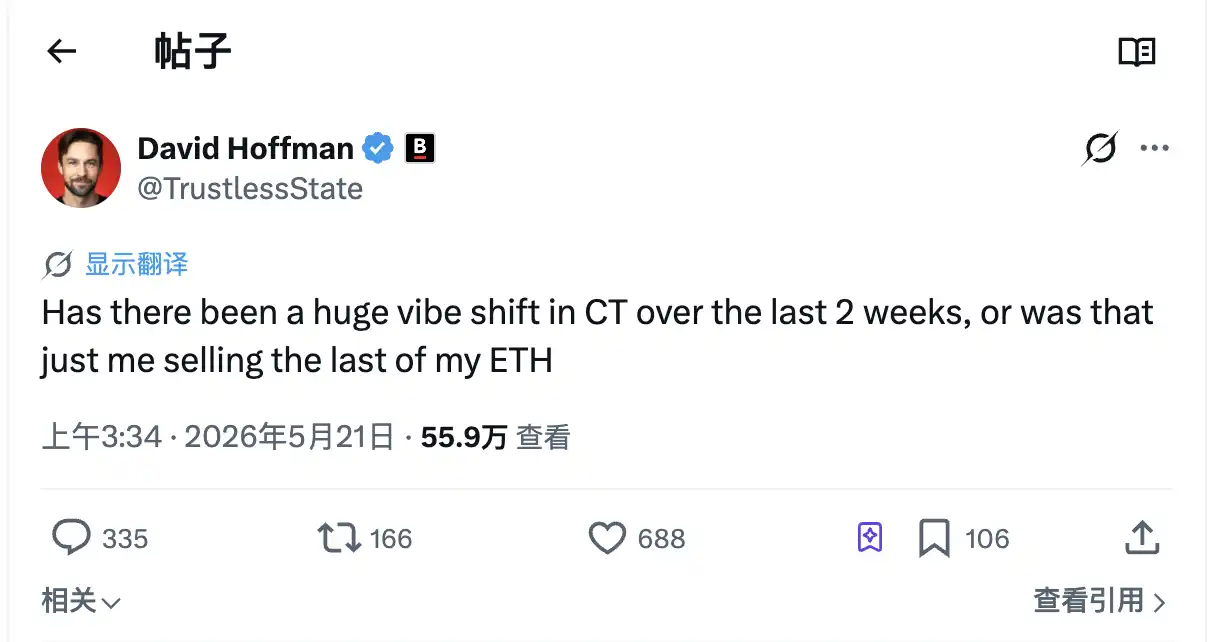
David Hoffman is the co-founder of Bankless, one of Ethereum's biggest public evangelists over the past six years. He once wrote on his personal page, "99% of wealth isn't in banks, it's on Ethereum." This is the man who authored "Ether: The Triple Point Asset" and was a core missionary in the narrative that defined ETH as "ultrasound money."

Now, he has cleared his position.

If last year some still viewed ETH as "the bond of the future world" and SOL as "a high-speed Nasdaq," by May 2026, the market had voted with its prices to complete a thorough de-faithing. ETH is currently struggling around $2,100, halved from its peak of $4,946 in August 2025.

Yet, in the very same market, HYPE is just one step away from its all-time high of $59.39, up 15% in the past seven days; ZEC has more than doubled in the past month, with a year-to-date increase of over 1400%, and its market cap has already squeezed into the top 20.

One market, two different climates.

The Former Baijiu

This isn't the first time such a split has appeared in the crypto world. But you need to temporarily look away from the screen and return to the A-share market in 2020.

From the second half of 2020 to early 2021, A-share liquidity peaked and receded, forcing mutual funds to make a choice: either spread their positions evenly across over 3,000 stocks and accept mediocre beta returns, or concentrate their ammunition on a handful of core assets with clear future cash flow stories. Everyone ultimately chose the latter. The result was that Moutai and Wuliangye were lifted to the sky, while the rest of the stocks were thrown into "garbage time" by the market.

That year, there was a very precise term called "core asset huddling." Its essence wasn't fund managers colluding, but an inevitable reaction in an environment of contracting liquidity. When the water in the pool shrinks, all the fish swim to the deepest corner.

The crypto market is now swimming towards that deepest corner.

What happened in the past year? Bitcoin ETFs absorbed roughly $70 billion in funds from 2024-2025, turning Bitcoin into an "asset priced by Wall Street." But this also means Bitcoin's marginal buying power began to be constrained by macro interest rates and stock market risk appetite. Q1 2026 inflation data exceeded expectations, coupled with a single-week net outflow of $1 billion from ETFs, causing the entire market to tremble.

What's more critical is the collapse of the narrative side. Citi cut its 12-month target price for ETH from $4,304 to $3,175 at the beginning of 2026, citing "stalled market structure legislation and weakening on-chain activity"; JPMorgan stated more bluntly in a May 19 report, "ETH needs stronger network growth and DeFi adoption to reverse its weakness relative to Bitcoin." The short-selling research firm Culper Research even publicly shorted ETH and released a report claiming that the Fusaka upgrade weakened the burn mechanism of EIP-1559, stripping ETH of its previous deflationary properties.

Solana is caught in another dilemma. It remains the best chain for DePIN, meme coins, and on-chain transaction experience, but when the market enters a risk-averse period, its greatest asset in the past, "high beta," ironically becomes a liability. Tushar Jain from Multicoin, the man who once carried Solana out of the ruins, publicly announced at Consensus Miami in May that Multicoin had taken a significant long position in Zcash.

This is a landmark moment. Solana's earliest and largest financial backer began shifting faith to another chain.

Huddling Around HYPE and ZEC

So, where did the money go?

The answer is surprisingly consistent: HYPE and ZEC.

The story of Hyperliquid was actually foreshadowed from the almost perfect airdrop in November 2024. The team, led by Harvard alumni Jeff and Iliensinc with backgrounds from Caltech/MIT/Citadel/Hudson River Trading, did something almost no one in crypto had managed in the past decade: distributing 76% of the tokens to users, with zero VC allocation.

If you only see this, you only see its "morality story." What truly propelled HYPE to rise against the trend during the liquidity drought of 2026 is its "cash flow story."

HYPE is not a traditional "narrative token." It is a complete chain, more accurately, a high-speed on-chain ATM in operation: as the largest decentralized perpetual contract exchange, it generates over $1.2 billion in annual protocol revenue; it has an agreement with Circle to share 90% of the USDC reserve yield, a stream alone contributing $135 to $160 million annually to token buybacks; this week (May 19), Bitwise announced adding HYPE to its balance sheet and launched an ETF product based on HYPE.

HYPE's contract open interest currently stands at $2.1 billion, and the funding rate has turned positive, indicating that new long-side capital is continuously entering, not a false prosperity from short squeezes.

The story of ZEC belongs to a completely different dimension. It's not a "cash flow story"; it's a "fear story."

Arthur Hayes wrote directly in his January essay, "This year's dominant narrative is privacy, and ZEC will be the privacy beta. To outperform Bitcoin and Ethereum, I will sell BTC to fund my privacy positions." His fund, Maelstrom, started building positions from Q3 2025.

Then, in early May, Multicoin Capital's Tushar Jain publicly doubled down at Consensus. CoinDesk's March research labeled ZEC with the tag "encryption supremacy," meaning privacy networks have become a dominant infrastructure. The underlying logic chain is the simultaneous convergence of three factors: AI gaining the ability to deanonymize users en masse on transparent blockchains, the threat of quantum computing creating long-term uncertainty for existing wallet encryption systems, and on-chain quarterly trading volume surpassing $100 billion for the first time, turning "wealth visible to the entire network" into a real fear.

The proportion of ZEC supply locked in shielded addresses has reached 30%, a historical high, meaning real privacy demand has quantifiable evidence on-chain, no longer just a literary narrative. The SEC officially closed its over-two-year investigation into the Zcash Foundation on May 20 without proposing any enforcement action. Robinhood has already listed ZEC, and expectations for a Grayscale ZEC ETF are being pushed to the forefront.

Hayes predicts ZEC's market cap will eventually reach 10% of Bitcoin's, corresponding to a token price 15-20 times above current levels.

Will the Huddle Dissolve?

When will the huddle break?

The A-share baijiu huddle broke after the Lunar New Year in 2021. The trigger wasn't deteriorating fundamentals, but a shift in central bank policy, turning the market from a zero-sum game back to a game of incremental funds. When the water in the pool starts to rise, all the fish no longer need to cram into the deepest corner.

When will the crypto world's pool expand? That depends on when the Fed cuts rates, when ETF funds flow back in, when stablecoin market cap hits new highs, and when traditional finance moves more money on-chain.

But one must also be wary of another possibility: the huddle could collapse under its own weight from becoming "too tight." ZEC's contract open interest surged 40% in the past 24 hours to $1.3 billion. This concentration itself is a risk signal. Hayes, Multicoin, retail traders, Robinhood users—everyone crowding into the same trade means the exit of any marginal buyer could trigger a chain reaction of long liquidations. HYPE's funding rate has turned positive and continues to rise, building up financing costs.

The endgame of a huddle is either a rising tide lifts all boats, and everyone takes profits together; or a stampede for the exit, with the last person in taking all the chips.

At which stage are we now? No one can give a definitive answer. But one question is worth asking for everyone reading this article:

If even David Hoffman has sold, the ETH still in your wallet—do you hold it because you believe in it, or because you forgot it was there?

The next question is more practical: When a market has only two names left to huddle around, what will the third name be? Aave? Maker? Some undiscovered privacy L2? Some high-performance chain yet to issue a token?

The person who figures this out will be the first to join the next huddle.

The person who doesn't will be the last to hold the bag when the next huddle breaks.

Трендові криптовалюти

Пов'язані питання

QWhy is the crypto market showing such a split performance between assets like ETH and HYPE/ZEC?

AThe crypto market is experiencing a significant liquidity contraction. As Bitcoin ETFs have absorbed massive inflows and traditional finance factors now influence its price, broader market liquidity has dried up. In such an environment, capital tends to 'huddle' towards a few select assets with the strongest narratives or fundamentals. HYPE offers a strong cash flow story through its protocol revenue and tokenomics, while ZEC is seen as a prime 'privacy beta' hedge against increasing surveillance and AI-driven de-anonymization threats on transparent blockchains. This creates a two-tier market where money flows only to the perceived safest or highest-conviction bets, leaving former leaders like ETH behind.

QWhat are the main reasons for HYPE's (Hyperliquid) strong performance during the market downturn?

AHYPE's strength is driven by its dual narrative of 'moral legitimacy' and a robust 'cash flow story.' Firstly, its token distribution, with 76% allocated to users and no VC allocation, builds strong community trust. More importantly, it functions as a cash-generating machine: it's the largest decentralized perpetual exchange, generating over $1.2B in annual protocol revenue. A key revenue stream is its agreement with Circle, sharing 90% of the USDC reserve yield, which contributes $135-160M annually for token buybacks. Its recent inclusion in Bitwise's balance sheet and the launch of an HYPE-based ETF further solidify its status as a 'quality asset' in a risk-off environment.

QWhat is the core narrative driving the massive surge in ZEC's price?

AThe surge in ZEC is driven by a 'fear narrative' centered on privacy becoming a critical infrastructure need. Key catalysts include the growing capability of AI to de-anonymize users on transparent blockchains, the long-term threat of quantum computing to existing cryptographic security, and the psychological impact of managing increasingly large, publicly visible on-chain wealth. Figures like Arthur Hayes and funds like Multicoin Capital have publicly endorsed ZEC as the premier 'privacy beta' play. Tangible evidence includes a record 30% of ZEC's supply being locked in shielded addresses, indicating real usage. Furthermore, the SEC's closure of its investigation into the Zcash Foundation without action removed a regulatory overhang, boosting confidence.

QWhat historical market phenomenon does the article compare the current crypto market situation to?

AThe article compares the current situation in crypto to the 'core asset huddle' (or '抱团') seen in China's A-share market in 2020-2021. During that period, as market liquidity peaked and began to recede, mutual funds concentrated their capital into a handful of 'core assets' like Kweichow Moutai (茅台) and Wuliangye (五粮液) that had clear future cash flow stories, while neglecting the broader market. The article uses the metaphor: 'When the water in the pond decreases, all the fish swim to the deepest corner.' This mirrors the current crypto environment where shrinking liquidity is forcing capital to concentrate in assets like HYPE and ZEC.

QAccording to the article, what are the potential outcomes for the current market 'huddle' around HYPE and ZEC?

AThe article outlines two potential outcomes for the current 'huddle.' The first is a positive scenario where 'the tide lifts all boats'—increased overall market liquidity from factors like Fed rate cuts, ETF inflows, or stablecoin growth allows everyone in the trade to profitably exit. The second is a negative, self-destructive scenario where the huddle becomes too crowded and collapses. Warning signs include ZEC's open interest surging 40% in 24 hours and HYPE's funding rate turning positive and rising, indicating high leverage and concentrated positions. A single shift in marginal buying pressure could trigger a cascade of liquidations, leaving the last entrants holding the bag ('the last person to enter takes all the chips').

Пов'язані матеріали

After Three Consecutive Quarters of Decline, Can the Crypto Market Find a Window for Stabilization in Q3?

The cryptocurrency market has just concluded its worst-performing quarter since 2022, with total capitalization dropping 12.6% to $2.1 trillion. All core metrics indicate capital is leaving the sector, not just rotating within it. Bitcoin fell 14.2% and Ethereum dropped 25.4% in Q2, breaking their previous correlation with US tech stocks. A key driver is the reversal in US spot Bitcoin ETF flows, which saw a net outflow of approximately $4.67 billion in Q2, including a record monthly outflow near $4.5 billion in June. While recent data suggests long-term holders are accumulating again, sustained ETF outflows mean continued selling pressure. Market focus is now singularly on the Federal Reserve. The upcoming July FOMC meeting is seen as the most critical event for Q3. A dovish signal could support Bitcoin reclaiming a $68,000-$84,000 range, while a hawkish stance might establish a new trading band around $50,000-$56,000. Additionally, regulatory uncertainty persists, with the progress of the crucial *CLARITY Act* stalling in the Senate, reducing its perceived 2026 passage probability to 40-45%. Despite the broad downturn, a few sectors showed growth. Prediction markets saw nominal volume surge 48.7% year-over-year to $113.8 billion, and tokenized collectibles transaction volume rose 143% quarterly to $1.4 billion. The Real-World Asset (RWA) tokenization sector also continued steady growth, now representing ~$28.1 billion in on-chain value. The market's foundation for an extreme crash appears limited, with Bitcoin price hovering near its 200-week moving average. However, the trading paradigm has shifted from narrative-driven speculation to decisions based on price action, policy developments, and interest rate expectations, making a broad sentiment-driven rally unlikely in the near term.

marsbit4 год тому

After Three Consecutive Quarters of Decline, Can the Crypto Market Find a Window for Stabilization in Q3?

marsbit4 год тому

BIT Trading Moment: BTC Still Suppressed by Weekly 200 EMA, Rejection May Restart Decline; Storage and Semiconductors that Surged Last Night Begin Falling in Evening Trading

**Crypto & Stock Market Wrap: Bitcoin Tests Resistance, Stocks Retreat After AI Surge** Bitcoin consolidates around $66,000, facing key resistance near $68,000—an area seen as a major psychological and technical hurdle where previous rallies have failed. Analysts note the cryptocurrency is caught between its 200-week moving average (~$63,333) and 200-week EMA (~$68,328). A clear break above $68k is needed to signal a stronger bullish trend, while a rejection could lead to a retest of $63k support. Market sentiment remains cautious, with low futures open interest pointing to a low-liquidity rebound rather than a full bull market. Bitcoin spot ETFs saw another $203 million inflow. US stock futures pointed lower after a strong Tuesday session led by a massive rebound in semiconductors and memory stocks. The rally was fueled by renewed optimism about AI-driven hardware demand, with Micron, SanDisk, and SK Hynix surging. However, those gains reversed in pre-market trading. Super Micro Computer (SMCI) soared over 20% after hours on strong guidance and a record backlog. Other standouts included Rocket Lab and nuclear energy plays Oklo and X-Energy. Rising oil prices (Brent above $91) and climbing Treasury yields (10-year near 4.64%), however, are reigniting inflation concerns and acting as a headwind for equities. In Asia, markets were mixed. South Korea's KOSPI pared early gains to close slightly higher as semiconductor stocks like SK Hynix gave back initial surges. Japan's Nikkei edged lower as the yen hit a fresh 38-year low against the dollar, raising fears of potential market intervention. Key events to watch include the Samsung Galaxy launch, AMD's AI event, and a slew of major tech earnings from Alphabet, Tesla, and IBM after the close on Wednesday, followed by the ECB meeting and Intel's earnings on Thursday.

marsbit5 год тому

BIT Trading Moment: BTC Still Suppressed by Weekly 200 EMA, Rejection May Restart Decline; Storage and Semiconductors that Surged Last Night Begin Falling in Evening Trading

marsbit5 год тому

Former CFTC Chairman, Circle President Tarbert: Preaching Long-Termism While Cashing Out $30 Million Himself

Former CFTC Chairman and Circle President Heath Tarbert has consistently advocated for a long-term vision in public, urging patience from investors as Circle’s stock price has fallen significantly from its peak. However, it has been revealed that since Circle’s IPO, Tarbert has continuously sold his CRCL shares through pre-arranged trading plans, cashing out approximately $30 million, without making any public market purchases. This contrast between his public messaging and personal actions has drawn criticism. Tarbert joined Circle in July 2023 as Chief Legal Officer, leveraging his regulatory experience to help guide the company through its IPO and expansion. Despite promoting stablecoins as long-term infrastructure, he established a 10b5-1 trading plan just before Circle went public, leading to substantial stock sales over the following year. In March 2026, he initiated another plan to sell more shares. His career trajectory highlights a pattern of moving between high-level regulatory roles and influential positions in the financial sector. After resigning as CFTC Chairman in early 2021, he joined Citadel Securities as Chief Legal Officer just 27 days later, during a period of intense regulatory scrutiny for the firm. He later joined Circle, aiding its efforts to navigate regulatory challenges for its public listing. While Tarbert's expertise in policy and compliance is valuable to companies like Circle, his actions—advocating long-term confidence while personally divesting—raise questions about the alignment between his public statements and his private financial decisions, leaving investors who followed his advice to bear the market risks.

marsbit5 год тому

Former CFTC Chairman, Circle President Tarbert: Preaching Long-Termism While Cashing Out $30 Million Himself

marsbit5 год тому

Gate Research Institute: The 'Wall Street-ization' Wave of Crypto Financial Products – Competition or Integration?

The article titled "Gate Research Institute: Are Crypto Financial Products Sparking a 'Wall Street' Wave—Competition or Convergence?" explores the evolving relationship between the crypto ecosystem and traditional finance (TradFi). The piece begins by reflecting on Bitcoin's original 2009 vision of decentralization, disintermediation, and moving away from banks. It then contrasts this with the 2024 landscape, where key crypto assets like Bitcoin are increasingly held through Wall Street products like ETFs issued by giants like BlackRock. The article questions whether this signifies that TradFi is systematically taking over the rights to issue, price, custody, and distribute crypto financial assets. The core argument is that this is not a zero-sum takeover but rather a bidirectional convergence where each side addresses the other's weaknesses. Crypto offers 24/7 global markets, programmable settlement, and open access but lacks compliant channels, institutional-grade custody, deep fiat liquidity, and mainstream distribution. TradFi possesses these but is constrained by legacy systems, limited operating hours, and slow settlement. Two primary convergence paths are highlighted: * **Path A (CEX to TradFi):** Exemplified by Gate, which has progressed from offering tokenized stocks and CFDs to providing direct, real stock trading (US, Hong Kong, South Korea) within its platform, using USDT. * **Path B (TradFi to Crypto):** Exemplified by Robinhood, which has integrated crypto trading, acquired exchanges like Bitstamp, and is moving traditional assets like stocks onto the blockchain via tokenization and its own Layer 2. Both paths are ultimately competing to become the next-generation, unified financial account—a "super account" where users can seamlessly trade cryptocurrencies, stocks, ETFs, RWA (Real World Assets), and tokenized treasury products in one interface. The growth of RWA and tokenized treasuries (e.g., BlackRock's BUIDL) is presented as the asset-layer fusion, providing stable, yield-bearing assets on-chain and acting as a bridge between the two worlds. In conclusion, the "Wall Street-ization" of crypto is framed as a mutual transformation. Decentralized ideals persist in the protocol layer, while at the application layer, a more efficient, global, and accessible unified capital market is emerging from this convergence. The future competition lies not between crypto exchanges and stockbrokers, but between platforms vying to offer the most comprehensive asset coverage, liquidity, and user experience within a single account.

marsbit5 год тому

Gate Research Institute: The 'Wall Street-ization' Wave of Crypto Financial Products – Competition or Integration?

marsbit5 год тому

Торгівля

Спот

Популярні статті

Як купити HYPE

Ласкаво просимо до HTX.com! Ми зробили покупку Hyperliquid (HYPE) простою та зручною. Дотримуйтесь нашої покрокової інструкції, щоб розпочати свою криптовалютну подорож.Крок 1: Створіть обліковий запис на HTXВикористовуйте свою електронну пошту або номер телефону, щоб зареєструвати обліковий запис на HTX безплатно. Пройдіть безпроблемну реєстрацію й отримайте доступ до всіх функцій.ЗареєструватисьКрок 2: Перейдіть до розділу Купити крипту і виберіть спосіб оплатиКредитна/дебетова картка: використовуйте вашу картку Visa або Mastercard, щоб миттєво купити Hyperliquid (HYPE).Баланс: використовуйте кошти з балансу вашого рахунку HTX для безперешкодної торгівлі.Треті особи: ми додали популярні способи оплати, такі як Google Pay та Apple Pay, щоб підвищити зручність.P2P: Торгуйте безпосередньо з іншими користувачами на HTX.Позабіржова торгівля (OTC): ми пропонуємо індивідуальні послуги та конкурентні обмінні курси для трейдерів.Крок 3: Зберігайте свої Hyperliquid (HYPE)Після придбання Hyperliquid (HYPE) збережіть його у своєму обліковому записі на HTX. Крім того, ви можете відправити його в інше місце за допомогою блокчейн-переказу або використовувати його для торгівлі іншими криптовалютами.Крок 4: Торгівля Hyperliquid (HYPE)Легко торгуйте Hyperliquid (HYPE) на спотовому ринку HTX. Просто увійдіть до свого облікового запису, виберіть торгову пару, укладайте угоди та спостерігайте за ними в режимі реального часу. Ми пропонуємо зручний досвід як для початківців, так і для досвідчених трейдерів.

341 переглядів усьогоОпубліковано 2024.12.11Оновлено 2026.06.02

Як купити HYPE

Обговорення

Ласкаво просимо до спільноти HTX. Тут ви можете бути в курсі останніх подій розвитку платформи та отримати доступ до професійної ринкової інформації. Нижче представлені думки користувачів щодо ціни HYPE (HYPE).

活动图片













