Moscow Exchange Set to Launch $XRP Indices and Futures Contracts

bitcoinistОпубліковано о 2026-02-03Востаннє оновлено о 2026-02-03

Анотація

The Moscow Exchange (MOEX), Russia's largest financial marketplace, is preparing to launch indices and futures contracts for XRP, marking a significant shift in the country's approach to digital assets. This move is seen as a pragmatic step toward using cryptocurrencies for cross-border liquidity outside the SWIFT system, particularly given XRP's institutional settlement utility. The introduction of futures will allow Russian institutional investors to hedge crypto exposure without direct token ownership. In contrast, the retail market is showing increased interest in high-risk, high-reward projects like Maxi Doge ($MAXI), an Ethereum-based token that promotes a high-leverage trading culture. It features gamified trading competitions and a staking system offering 68% APY to incentivize long-term holding. The project has raised $4.5M in its presale, targeting traders seeking aggressive returns in the current bull market.

Sanctions evasion and digital asset adoption have reached a critical flashpoint in Russia.

The Moscow Exchange (MOEX), the country’s largest financial marketplace, is reportedly finalizing the infrastructure to launch indices and futures contracts for $XRP, according to local media outlet RBC. That milestone marks a sharp pivot from the Kremlin’s historical skepticism regarding cryptocurrencies.

It signals a pragmatic shift toward assets that facilitate cross-border liquidity outside the SWIFT system.

Why $XRP? It’s long been positioned by Ripple Labs as a bridge currency for institutional settlement. (The irony of a U.S.-based blockchain firm becoming a liquidity rail for a sanctioned economy isn’t lost on anyone.)

The introduction of futures contracts on MOEX allows domestic institutional investors to hedge exposure to crypto assets without holding the underlying tokens directly, a massive step for integrating digital assets into the broader Russian economy. The choice of $XRP over other altcoins stems from its speed and established utility in global banking pilots.

While Bitcoin remains the primary store of value, $XRP’s lower transaction costs and sub-second finality make it a more attractive vehicle for the high-frequency nature of futures trading. The move effectively institutionalizes volatility, transforming what was once a speculative retail playground into a regulated derivative market.

But while institutions build compliant rails for $XRP, the retail sector is looking elsewhere. Traders are gravitating toward assets that embody the raw, unbridled energy of the current bull cycle. As traditional finance adopts crypto utility, the ‘degen’ economy is doubling down on high-leverage culture, seeking projects that mirror the relentless grind of market speculation. Projects like Maxi Doge ($MAXI).

Maxi Doge brings ‘Leverage King’ Culture to Ethereum

As the Moscow Exchange prepares to formalize crypto trading for the elite, the retail market is witnessing the rise of Maxi Doge ($MAXI), a project that arguably captures the current market zeitgeist better than any institutional derivative. Built on the Ethereum network, Maxi Doge positions itself as the ‘heavier,’ more aggressive cousin to the original Dogecoin, specifically targeting traders who live for high-leverage environments.
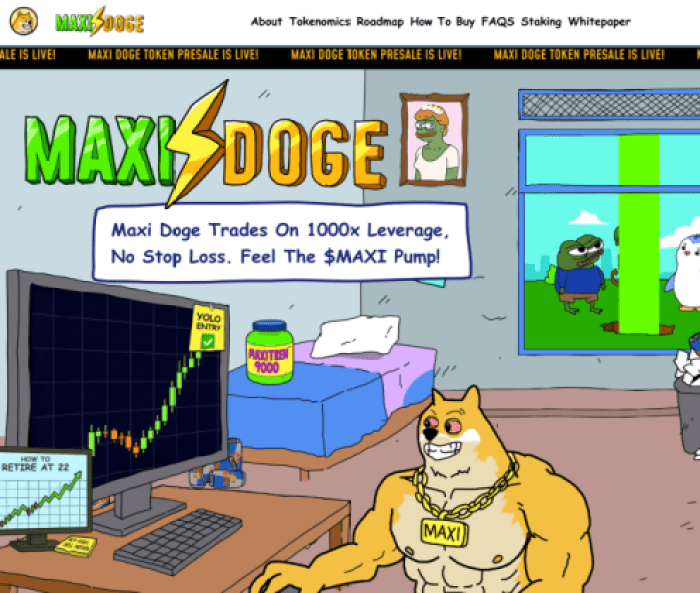
The project plans to differentiate itself through a gamified ‘Leverage King’ culture. Rather than relying solely on passive holding, Maxi Doge integrates holder-only trading competitions where participants vie for leaderboard rewards. It’s a shift that transforms the community from passive spectators into active participants.

This answers a specific behavioral shift in the market: retail traders aren’t satisfied with slow gains anymore; they’re seeking outsized returns and the social validation that comes with high-stakes trading.

By gamifying the grind of the bull market, Maxi Doge creates a sticky ecosystem that rewards conviction, a stark contrast to the sterile, regulated environment being built by traditional exchanges like MOEX.

FIND OUT MORE IN OUR ‘WHAT IS MAXI DOGE?’ GUIDE

Presale Momentum and Dynamic Staking Rewards

While the narrative drives the community, the numbers underpinning Maxi Doge reveal a financial structure designed for sustainability. The project has moved well beyond the conceptual phase, with the official presale already raising $4.5M.

This capital injection is being directed toward the ‘Maxi Fund’ treasury, which supports liquidity provision and future partnership developments (potentially even integrations with futures platforms down the line).

At the current presale price of $0.0002802, the token offers an accessible entry point for retail investors who missed the early days of legacy meme coins. But frankly, the protocol’s staking mechanism is where the long-term value proposition becomes clear.

Maxi Doge employs a dynamic APY system (currently offering 68% rewards), planning to distribute rewards daily from a dedicated 5% staking allocation pool. This smart contract-governed distribution is designed to incentivize lock-ups for up to one year, reducing circulating supply pressure while rewarding those with the ‘diamond hands’ mentality the project espouses.

The security of the ERC-20 standard provides the technical backbone, but the economic model is distinctively modern. By combining the viral appeal of ‘gym bro’ humor, ‘Never skip leg-day, never skip a pump,’ with hard-coded financial incentives, Maxi Doge attempts to solve the liquidity flight often seen in meme tokens.

It creates a feedback loop where staking reduces sell pressure, potentially amplifying price action when market volatility spikes.

BUY $MAXI NOW FROM ITS OFFICIAL PRESALE SITE.

The content provided in this article is for informational purposes only and does not constitute financial advice. Cryptocurrency markets, including derivatives on the Moscow Exchange and meme tokens like Maxi Doge, are highly volatile and carry significant risk. Always conduct your own due diligence before investing.


Пов'язані питання

QWhat is the Moscow Exchange planning to launch for $XRP, and why is this significant?

AThe Moscow Exchange is finalizing the infrastructure to launch indices and futures contracts for $XRP. This is significant because it marks a major shift from Russia's historical skepticism of cryptocurrencies and represents a pragmatic move toward using digital assets for cross-border liquidity outside the SWIFT system.

QAccording to the article, what are the two main reasons $XRP was chosen over other altcoins for this initiative?

A$XRP was chosen for its speed and its established utility in global banking pilots, making it more attractive for the high-frequency nature of futures trading due to its lower transaction costs and sub-second finality.

QHow does the article contrast the institutional adoption of $XRP with the current trend in the retail crypto market?

AThe article contrasts the institutional, compliant rails being built for $XRP with the retail trend of gravitating towards high-leverage, speculative projects like Maxi Doge ($MAXI), which embodies the 'degen' economy and raw energy of the current bull cycle.

QWhat is the core concept behind Maxi Doge's 'Leverage King' culture?

AMaxi Doge's 'Leverage King' culture is a gamified system that features holder-only trading competitions where participants compete for leaderboard rewards, transforming the community from passive holders into active participants seeking outsized returns and social validation.

QWhat are two key features of Maxi Doge's ($MAXI) financial structure mentioned in the article?

ATwo key features are its dynamic APY staking system (currently 68%), which rewards users daily from a dedicated pool to incentivize long-term lock-ups, and its 'Maxi Fund' treasury, which uses presale funds to support liquidity and future development.

Пов'язані матеріали

Annual Salary of Millions Competing for Electricians, Meta Rushes to Open Its Own Technical School

The AI boom is facing an unexpected bottleneck: a severe shortage of skilled construction workers and electricians. As tech giants like Meta, OpenAI, and Alphabet race to build massive data centers—such as OpenAI's $16 billion "Stargate" project—they are hitting a critical labor wall. The U.S. needs an estimated 130,000 more electricians, 240,000 construction workers, and 150,000 supervisors by 2030 for AI infrastructure alone, but tens of thousands of electrician jobs go unfilled each year. While AI companies offer high premiums, with electricians earning up to $280,000 annually, worker scarcity still causes massive losses—delays on a single project can cost $14.2 million per month. The complexity of building AI data centers, which require immense power (equivalent to powering hundreds of thousands of homes), sophisticated electrical systems, and advanced liquid cooling solutions, demands highly skilled technicians who are in short supply. To combat this, companies are investing heavily in training. Meta has committed $115 million to a free training school offering tuition, housing, and stipends, targeting 5,000 new workers. OpenAI is partnering with unions to secure skilled labor. These efforts are paying off, with a significant rise in Gen Z interest in trade schools over college. However, the power demands are staggering. AI data centers are driving a rapid surge in electricity consumption, projected to account for up to 12% of U.S. power use by 2028 and raising costs for consumers. Furthermore, the construction boom is project-based, leading to a potential future glut of trained workers once building peaks, which could depress wages industry-wide. The race for AI supremacy now depends as much on skilled hands as on advanced chips.

marsbit1 год тому

Annual Salary of Millions Competing for Electricians, Meta Rushes to Open Its Own Technical School

marsbit1 год тому

OpenAI No Longer Sells Its Most Expensive Model for Profit

OpenAI is shifting its business strategy away from promoting its most expensive, flagship models for every task. Recent price cuts—80% for GPT-5.6 Luna and 20% for Terra—signal a deeper change: the company now actively advises users that many tasks don't require the most powerful model. Instead, OpenAI recommends a tiered approach: use the high-end GPT-5.6 Sol for complex planning and analysis, then delegate execution to cheaper models like Luna. This mirrors moves by Anthropic, which recently launched Claude Opus 5 at half the price of its top model, Fable 5. Both companies are de-emphasizing flagship models as primary revenue drivers, using them instead for brand prestige and technological showcases. The industry is entering a "mass-market" phase, similar to automotive, where high-volume, cost-effective models handle daily operations and drive scale. OpenAI's price reductions are partly enabled by AI models themselves optimizing underlying code and infrastructure, creating a self-reinforcing cycle of efficiency gains and cost reduction. Competition is shifting from "who is smartest" to "who offers the best value." The goal is no longer selling individual models but fostering widespread API adoption and ecosystem lock-in. By making AI calls cheap and ubiquitous, companies like OpenAI aim to become the indispensable, utility-like infrastructure powering automated workflows—the "water and electricity" of software, quietly embedded everywhere.

marsbit1 год тому

OpenAI No Longer Sells Its Most Expensive Model for Profit

marsbit1 год тому

Торгівля

Спот
活动图片




