Morning Post | Hyperliquid Launches Off-chain Event Prediction Market Contract; Strategy Completes $1.5 Billion Debt Buyback; Kelp DAO Announces rsETH Fully Restored

链捕手Опубліковано о 2026-05-27Востаннє оновлено о 2026-05-27

Анотація

Crypto Market Digest (May 27, 2026) Ondo Finance's founder Nathan Allman has passed away, with President Ian De Bode taking over as CEO. In regulatory news, Hong Kong authorities concluded a consultation on virtual asset service provider licensing, aiming to align rules with traditional finance. Kelp DAO announced its rsETH token has fully recovered five weeks after a $293 million hack by Lazarus Group, though the incident caused significant damage to DeFi lending protocols like Aave. Key industry developments include Hyperliquid launching off-chain event prediction market contracts, and the CME introducing futures for Avalanche and Sui. A report highlights the rise of AI Agent payments, with over $73 million settled on-chain in a year, predominantly using USDC. Meanwhile, blockchain detective ZachXBT exposed market manipulation involving several BSC tokens. In investment news, a firm referred to as "Strategy" completed a $1.5 billion debt buyback. Political contributions from the crypto sector for the 2026 U.S. elections have surpassed $500 million, heavily favoring Republican candidates. BitMEX founder Arthur Hayes revealed Zcash is his second-largest holding, citing the growing necessity for monetary privacy. The digest concludes with trending memecoins on Ethereum, Solana, and Base networks, and highlights in-depth articles covering the impending SpaceX IPO, Polymarket's regulatory challenges, and an analysis of the on-chain treasury landscape.

Compiled by: ChainCatcher


Key Information:

  • Ondo Finance founder Nathan Allman passed away unexpectedly, with President Ian De Bode taking over as CEO.
  • Hyperliquid announced the launch of off-chain event prediction market contracts.
  • Kelp DAO announced that rsETH has been fully restored after five weeks of repairs, following a $293 million hack.
  • Strategy completed a $1.5 billion debt buyback, with BTC yielding 13.3% year-to-date.
  • CME launched Avalanche and Sui futures contracts.
  • Report: AI Agents have completed over $73 million in on-chain payments, with USDC becoming the default settlement asset.

What important events happened in the past 24 hours?

Strategy completed a $1.5 billion debt buyback, with BTC yielding 13.3% year-to-date.

Hong Kong's Financial Services and Treasury Bureau and SFC release consultation conclusion on virtual asset regulatory regime.

ChainCatcher news, according to a Jinshi report, the Hong Kong Financial Services and Treasury Bureau and the Securities and Futures Commission published a consultation conclusion on the regulatory regime for virtual asset advice and management services. The proposed licensing regime for virtual asset advice and management received broad market support during the consultation period.

The new licensing regime will follow the principle of "same business, same risks, same rules," aligning its scope with the relevant regulated activities under the Securities and Futures Ordinance. This new series of regimes will enhance participation in Hong Kong's digital asset market and help build a robust and secure ecosystem.

Report: AI Agents have completed over $73 million in on-chain payments, with USDC becoming the default settlement asset.

ChainCatcher news, a report titled "Who Pays the Agent?" released by crypto market maker Keyrock, in collaboration with Coinbase, Tempo, and Virtuals Protocol, states that AI Agents are rapidly becoming key participants in the on-chain economy. Data shows that between May 2025 and April 2026, AI Agents have cumulatively completed approximately 176 million on-chain transactions, with a total settlement amount exceeding $73 million. The report notes that the average single payment amount for AI Agents is only $0.31 to $0.48, indicating the formation of a machine-native micropayment economy. About 76% of transaction amounts are below the $0.30 fixed fee threshold of Visa, showing that traditional card and bank payment systems are increasingly ill-suited for AI's high-frequency, small-amount, autonomous payment demands.

Data shows that 98.6% of AI Agent payments are settled using USDC. As of Q1 2026, over 104,000 AI Agents have completed registration. The report states that on the Base network, the cost of a USDC transfer is about $0.0001, accounting for only about 0.03% of a $0.31 transaction amount, demonstrating significant cost advantages over traditional payment systems. The report believes that stablecoins are gradually becoming the "default monetary infrastructure" for economic activities between AIs and machines. However, Keyrock also warns that the current high dependency of the AI payment ecosystem on USDC poses centralization risks, meaning this emerging AI payment system relies heavily on the regulatory and infrastructure stability of a single stablecoin issuer.

Furthermore, several tech and payment companies have begun building AI Agent payment infrastructure, including Coinbase's x402 protocol, Stripe and Tempo's Machine Payments Protocol (MPP), Google's AP2 delegated payment system, and Visa's extended tokenized payment credential services. The report also points out that current regulatory frameworks, including Europe's MiCA regulation, the US GENIUS Act, and the EU AI Act, still lack comprehensive regulatory standards for AI autonomous financial transactions and inter-machine payments.

ZachXBT: Same entity linked to multiple BSC token manipulations, ESPORTS plunges 93% in a day.

ChainCatcher news, on-chain detective ZachXBT posted on a personal channel stating that a certain entity previously received ESPORTS, RIVER, and LIGHT tokens via Sablier vesting contracts and is directly linked to three multisig wallet signers of the LAB multisig. These BSC tokens have all experienced market manipulation incidents on centralized exchanges.

ZachXBT had previously flagged anomalies with LAB and RIVER, and now the ESPORTS token has experienced a flash crash, plummeting 93% briefly. The CEX deposit addresses linked to this entity and the LAB signer addresses have been publicly disclosed.

Crypto industry invests over $500 million in 2026 US elections, with Republicans receiving far more funding than Democrats.

ChainCatcher news, according to a Cointelegraph report, crypto-related political action committees (PACs) and industry executives have invested over $500 million in the 2026 US elections.

Data from Follow the Crypto shows that crypto industry companies and related individuals have contributed over $320 million, while crypto-related PACs still hold more than $245 million in cash; Republican-related candidates/committees received approximately $127 million in support, significantly higher than the approximately $11.5 million for Democrats.

Arthur Hayes: Monetary privacy will be "very necessary," therefore holds Zcash as second-largest position.

ChainCatcher news, Arthur Hayes stated that as large tech companies, governments, and AI expand their surveillance scope, monetary privacy will "become very necessary" in the future.

Arthur Hayes said this is why he holds the privacy coin Zcash (ZEC) as his second-largest personal asset position.

Kelp DAO announces rsETH fully restored after five weeks of repairs, following $293 million hack.

ChainCatcher news, Kelp DAO announced on Monday that rsETH has been fully restored after five weeks of repairs following the April 18 attack by North Korea's Lazarus Group, which resulted in a $293 million loss. Kelp DAO stated that the final batch of 20,373.7 rsETH has been sent to the LayerZero smart contract responsible for cross-chain transfers, officially concluding the operational phase of the rsETH recovery plan.

Multiple crypto protocols contributed funds to support the restoration of rsETH through the DeFi United initiative. The first batch of 25,000 rsETH was transferred on May 13, with withdrawals reopening the following day; currently, minting, redemption, and reward operations are all functioning normally. The attack caused a chain reaction in the DeFi lending market, with the attacker using a large amount of stolen rsETH as collateral on Aave to borrow WETH, resulting in $190 million in bad debt for Aave and causing its TVL to drop from $26.4 billion to below $14 billion, where it remains, fluctuating between $13.9 billion and $15.1 billion without recovery. There were 25 crypto hack incidents in April, with total losses of $630 million.

Meme Popularity Ranking

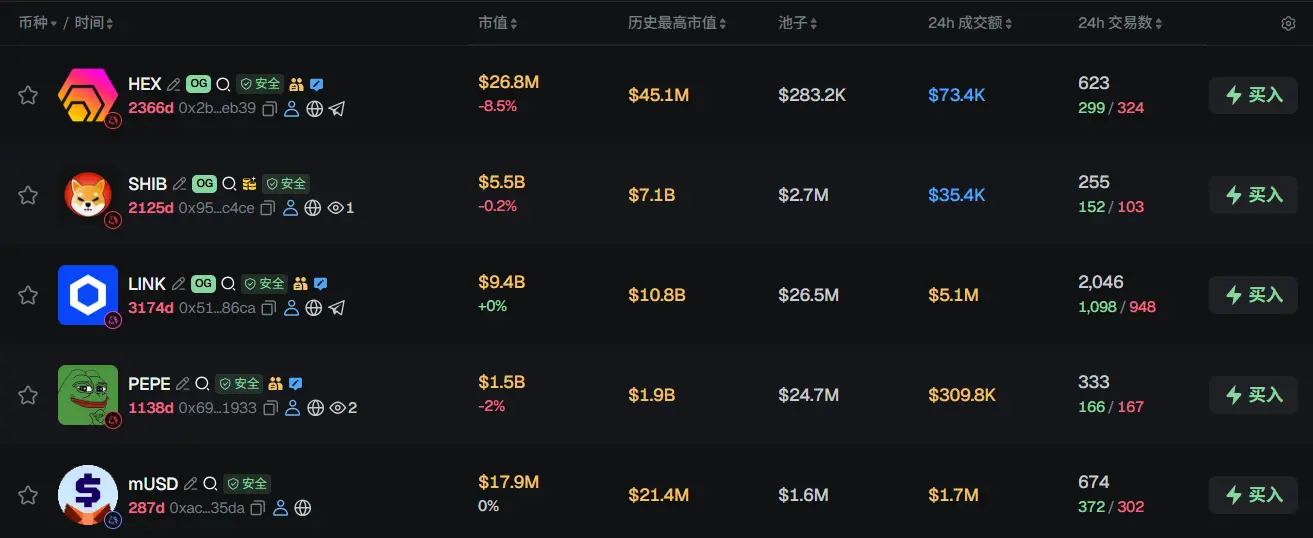
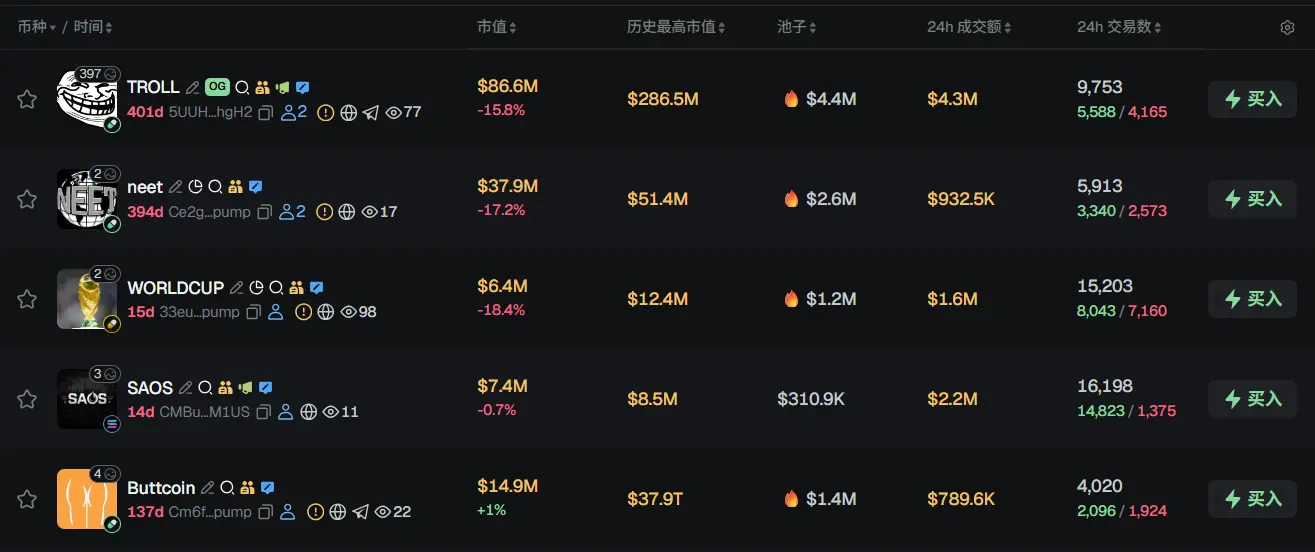
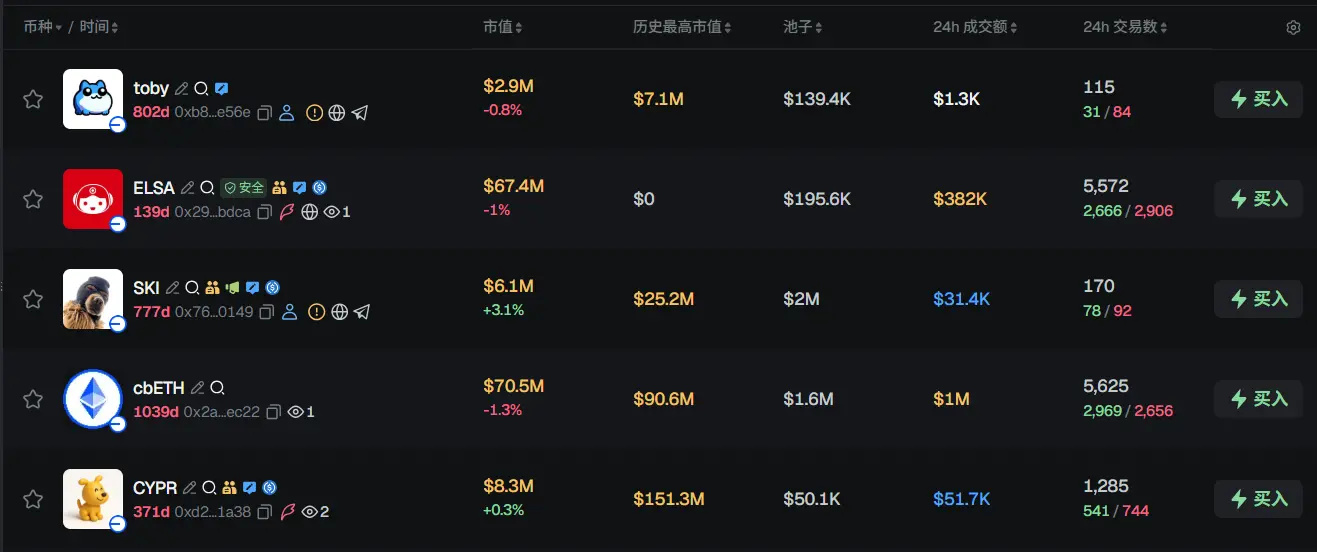
According to data from the meme token tracking and analysis platform GMGN, as of 09:00 on May 27,

The top five popular ETH-based tokens in the past 24h are: HEX, SHIB, LINK, PEPE, mUSD
The top five popular Solana-based tokens in the past 24h are: TROLL, neet, WORLDCUP, SAOS, Buttcoin
The top five popular Base-based tokens in the past 24h are: toby, ELSA, SKI, cbETH, CYPR
Which noteworthy articles are worth reading from the past 24 hours?

Those Betting on Musk in the Inner Circle Are Reaping "Historic-Level Returns"

The largest initial public offering (IPO) in global history has entered the countdown phase. Elon Musk's SpaceX is expected to price its IPO on June 12 and begin trading the next day.

Investors are eyeing a valuation of around $2 trillion. At that level, Musk himself would directly become the world's first trillionaire. But the real drama of this deal is that the wealth won't flow only to Musk. With the disclosure of the prospectus, the value of the holdings of a group of long-time loyal lieutenants and early allies who have remained in Musk's shadow has surfaced for the first time.

Their "loyalty" and patience are being rewarded with one of the most substantial payouts in history.

Easy to Conquer, Hard to Rule: Polymarket Must Humble Itself Everywhere to Plant Its Flag Globally

Last week, the prediction market went dark in India. Users connecting to polymarket.com only saw an "This site can't be reached" error message. India's Ministry of Electronics and Information Technology (MeitY) had issued a blocking order, requiring domestic internet service providers to cut off access, on the grounds that India had classified the platform as "online money gambling," a category that is completely prohibited.

Moreover, on the same day, Bloomberg cited informed sources revealing that Polymarket has appointed a local representative in Japan and is preparing to lobby for the "legalization of prediction markets," aiming to obtain Japanese government approval before 2030.

This simultaneous advance and retreat accurately describes Polymarket's situation: while the prediction market continues to grow in scale, regulatory hurdles in various countries are making progress difficult.

Deconstructing On-Chain Vaults in 10,000 Words: Eight Tracks, Who Is Rising and Who Is Declining?

This section of the report provides a quantitative analysis of the vault landscape to offer a comprehensive picture of the field and its evolution. We analyze the ecosystem by category, tracking TVL shifts across different vaults and curators.

We dissect the concentration of curators and provide an outlook on major capital flows, placing the structural shifts defining this year's vault landscape into specific context.

Vaults should not be viewed as a single, all-encompassing market but should be assessed based on their different implementations, each with distinct parameters, risk vectors, and responses to stress tests. Aggregate data only provides a partial picture; a more nuanced analytical perspective is urgently needed.

Before beginning the analysis, it's important to define the term "vault" as the foundation of our methodology.


Пов'язані питання

QWhat major incident occurred to Kelp DAO, and what is the current status of rsETH?

AKelp DAO suffered a $293 million hack by the Lazarus Group in mid-April 2026. After five weeks of restoration efforts, the protocol has announced that its liquid restaking token, rsETH, is now fully restored. The final batch of over 20,000 rsETH tokens has been transferred to the LayerZero smart contract for cross-chain operations, marking the completion of the recovery plan's operational phase. Minting, redeeming, and reward operations have all returned to normal.

QAccording to the report mentioned, what are the key findings about AI Agent payments on-chain?

AA report titled 'Who Pays the Agent?' by Keyrock, Coinbase, Tempo, and Virtuals Protocol found that AI Agents are rapidly becoming significant participants in the on-chain economy. From May 2025 to April 2026, AI Agents completed approximately 176 million on-chain transactions, with a total settlement value exceeding $73 million. The average transaction amount is very small, between $0.31 and $0.48, indicating a nascent machine-native micro-payment economy. Notably, 98.6% of these payments are settled using USDC, making it the default settlement asset. The report warns of centralization risks due to this heavy reliance on a single stablecoin.

QWhat significant regulatory development was announced in Hong Kong regarding virtual assets?

AThe Hong Kong Financial Services and the Treasury Bureau (FSTB) and the Securities and Futures Commission (SFC) jointly published a consultation conclusion on a new regulatory regime for virtual asset advisory and management services. The proposed licensing regime received broad market support during the consultation. It will follow the principle of 'same business, same risks, same rules,' aligning its scope with regulated activities under the existing Securities and Futures Ordinance. The new framework aims to enhance participation in Hong Kong's digital asset market and help build a robust and secure ecosystem.

QWhy did Arthur Hayes state that monetary privacy will be 'very necessary,' and what action did he take as a result?

AArthur Hayes argued that as large tech companies, governments, and AI expand their surveillance capabilities, monetary privacy will become 'very necessary' in the future. Citing this belief in the growing importance of financial privacy, he disclosed that he holds the privacy-focused cryptocurrency Zcash (ZEC) as his second-largest personal investment.

QWhat issue did ZachXBT identify regarding several BSC tokens, and which token experienced a sharp price drop?

AOn-chain investigator ZachXBT identified market manipulation involving several Binance Smart Chain (BSC) tokens—ESPORTS, RIVER, and LIGHT. He linked these tokens to a single entity that received them via a Sablier vesting contract, which was directly connected to three multisig signers of the LAB project's multisig wallet. ZachXBT had previously flagged anomalies with LAB and RIVER. Following his disclosure, the ESPORTS token experienced a flash crash, plummeting 93% in a short period.

Пов'язані матеріали

Seeking Alpha's Hot Article: Why Might the U.S. Stock Market Crash in June?

In a recent Seeking Alpha article, financial professor and analyst Damir Tokic argues that the US stock market may be poised for a significant crash in June 2026. The core thesis centers on a "mega-bubble" in equities, particularly within the technology sector, which has driven the S&P 500 to near-record valuations, with a Shiller P/E ratio exceeding 40—a level comparable to the 2000 dot-com bubble. Tokic identifies two primary catalysts for a potential collapse. First, he points to unsustainable market exuberance fueled by what he terms the "Trump Stimulus"—massive AI capital expenditure by tech giants, which he believes is politically driven and cannot last. Second, and more urgently, he highlights the escalating Iran war as a critical threat. The ongoing closure of the Strait of Hormuz has created a severe global energy supply crunch. Strategic petroleum reserves are projected to hit critically low operational levels by June, potentially causing oil prices to spike above $200 per barrel and triggering a severe, supply-driven inflationary shock. This scenario, Tokic warns, would force the Federal Reserve's hand. Despite currently maintaining a dovish bias, the Fed would likely be compelled to officially pivot to a hawkish stance at its June FOMC meeting to combat soaring inflation and bond yields. He contends that such a shift—or even a failure to act, which would destroy Fed credibility—could be the trigger that punctures the market bubble. The resulting downturn, he concludes, could rival the bear markets of 2000 and 2008, advising investors to prepare for a major correction.

marsbit16 хв тому

Seeking Alpha's Hot Article: Why Might the U.S. Stock Market Crash in June?

marsbit16 хв тому

AI PC Battle: Bet on the Toll Booth, Not the Camp

**Title:** The AI PC Battle: Don't Bet on Sides, Bet on the Tollbooth **Summary:** The AI PC competition is moving beyond simple "x86 vs. Arm" narratives. The core investment thesis should focus on identifying which players can sustain margins, cash flow, and pricing power throughout the upgrade cycle, rather than backing a particular architecture. The opportunity is analyzed in three layers: 1. **The Advanced Foundry Tollbooth:** TSMC is positioned to collect "tolls" regardless of which chip designer wins, due to its dominant ~70% share in advanced semiconductor manufacturing, which is essential for high-end AI PC chips. 2. **Compute & Platform Spillover:** AMD represents an offensive in the x86 CPU+GPU space, while NVIDIA leverages its GPU and CUDA software stack dominance. Both benefit from the demand for increased local AI compute. 3. **Architecture Diffusion & Turnaround Plays:** ARM and Intel offer potential for significant upside (elasticity), but investments here require stricter discipline due to higher execution risks and competitive challenges. The industry is transitioning from concept to shipment validation. While short-term forecasts for AI PC adoption have been revised down slightly due to tariffs and procurement delays, the long-term trend towards AI becoming a standard PC feature remains intact. The key driver for upgrade cycles will be whether compelling enterprise applications (e.g., privacy-sensitive computing, low-latency inference) emerge beyond consumer-focused features like meeting summarization. Investment strategy should prioritize companies with platform-level advantages and recurring revenue streams. TSMC offers high certainty as the foundational tollbooth. AMD presents a strong offensive play within the established ecosystem. ARM and Intel are higher-risk, higher-potential-reward turnaround bets. The report cautions against chasing short-term hype and emphasizes a disciplined, long-term approach focused on buying ecosystem strength and cash-flow certainty after market enthusiasm subsides. **Key Risks:** Underwhelming AI PC applications slowing upgrade cycles; slow improvement in Windows on Arm compatibility; macro/tariff impacts on PC demand; potential advanced node supply-demand mismatches affecting TSMC; high overall AI sector valuations making stocks vulnerable to a risk-off shift in markets.

marsbit30 хв тому

AI PC Battle: Bet on the Toll Booth, Not the Camp

marsbit30 хв тому

Ten-Thousand-Word Analysis: From $10 to $290, MRVL Wins the Entire AI Era by 'Not Making GPUs'

Marvell Technology's stock price surged from under $10 in 2016 to a record $290 in June 2026, fueled not by making GPUs, but by dominating AI infrastructure connectivity. This analysis argues the market misvalues MRVL as merely a smaller Broadcom in custom AI chips, overlooking its true, unique position. Marvell's core strength lies in enabling high-speed data flow for AI clusters through three interconnected businesses. First, it holds a commanding ~70% market share in high-speed optical DSPs (essential for data center light modules), a deep-moat business with accelerating growth. Second, its custom AI chip design business serves hyperscalers like AWS, Microsoft, and Google, with a significant revenue pipeline despite lower margins. Third, stable cash flows come from Ethernet switch chips and enterprise storage controllers. Together, they form a full-stack "AI data movement" platform. CEO Matt Murphy's transformative leadership since 2016, involving strategic divestments, key acquisitions (like Inphi for optical DSPs), and securing long-term agreements with major cloud providers, repositioned the company. A pivotal $2 billion strategic investment from NVIDIA in 2026 underscored Marvell's critical role in the AI ecosystem, particularly through collaborations like NVLink Fusion. While Marvell faces risks—including client concentration (losing the Amazon Trainium3 design), lower-margin business mix, competitive threats, insider selling, and complex supply chains—its fundamentals remain strong. The optical interconnect moat is widening with the acquisition of Celestial AI (photonics fabric), and financial metrics show accelerating revenue growth and operating leverage. With a PEG ratio suggesting undervaluation relative to its growth, the thesis is that the market undervalues Marvell's monopolistic position in AI "plumbing" while overemphasizing its competitive custom chip segment. The story transcends investing, symbolizing how in any complex system—from the internet to AI—the value of "connection" ultimately surpasses that of individual "nodes."

marsbit1 год тому

Ten-Thousand-Word Analysis: From $10 to $290, MRVL Wins the Entire AI Era by 'Not Making GPUs'

marsbit1 год тому

AI Relay Stations Spark Heated Debate on Zhihu: Behind Cheap Tokens, What Are Users Really Worried About?

A discussion on Zhihu about "AI relay stations" shifted the niche developer topic of "cheap tokens" into broader user awareness. Users moved beyond simply questioning the legitimacy of these services to focus on practical concerns: Where do cheap tokens truly come from? Is the model being accessed the real one? Can relay stations see prompts, code, and API keys? For occasional users, are the risks worth it? The core debate centered less on price and more on trust. A primary worry is model authenticity—the risk of "model swapping," where users paying for a premium model might be routed to a cheaper one, creating an information asymmetry. Others argued that cost comparisons matter; while cheaper than official pay-as-you-go APIs, relay stations may not be the lowest-cost option versus subscriptions, domestic models, or free tiers, making user needs assessment crucial. Speculation about token sources ranged from legitimate bulk discounts to gray-area methods like account sharing or exploiting regional pricing. This opacity makes risk assessment difficult for users. Data security emerged as a critical concern, especially for enterprise use. When processing sensitive information like code, contracts, or client data, the inability to verify a relay station's data handling, retention, or access policies poses significant compliance and confidentiality risks. The evolving consensus suggests relay stations can be used cautiously for low-sensitivity, disposable tasks (e.g., summarizing public info, simple translation). However, they should not be the default for sensitive, professional, or production workflows involving proprietary data, Agents, or automated systems. Recommendations include avoiding large prepayments, not relying on a single service, using test prompts to monitor quality, anonymizing data where possible, and keeping official channels as backups. Ultimately, the discussion framed tokens not just as a billing unit but as a measure of real cost encompassing price, model integrity, data security, and service stability. The popularity of relay stations highlights user demand for affordable access, but the debate underscores a key trade-off: the savings from cheap tokens may come at the price of trust, transparency, and control over one's data and AI experience.

marsbit1 год тому

AI Relay Stations Spark Heated Debate on Zhihu: Behind Cheap Tokens, What Are Users Really Worried About?

marsbit1 год тому

Торгівля

Спот
Ф'ючерси

Популярні статті

Як купити ONDO

Ласкаво просимо до HTX.com! Ми зробили покупку OndoFinance (ONDO) простою та зручною. Дотримуйтесь нашої покрокової інструкції, щоб розпочати свою криптовалютну подорож.Крок 1: Створіть обліковий запис на HTXВикористовуйте свою електронну пошту або номер телефону, щоб зареєструвати обліковий запис на HTX безплатно. Пройдіть безпроблемну реєстрацію й отримайте доступ до всіх функцій.ЗареєструватисьКрок 2: Перейдіть до розділу Купити крипту і виберіть спосіб оплатиКредитна/дебетова картка: використовуйте вашу картку Visa або Mastercard, щоб миттєво купити OndoFinance (ONDO).Баланс: використовуйте кошти з балансу вашого рахунку HTX для безперешкодної торгівлі.Треті особи: ми додали популярні способи оплати, такі як Google Pay та Apple Pay, щоб підвищити зручність.P2P: Торгуйте безпосередньо з іншими користувачами на HTX.Позабіржова торгівля (OTC): ми пропонуємо індивідуальні послуги та конкурентні обмінні курси для трейдерів.Крок 3: Зберігайте свої OndoFinance (ONDO)Після придбання OndoFinance (ONDO) збережіть його у своєму обліковому записі на HTX. Крім того, ви можете відправити його в інше місце за допомогою блокчейн-переказу або використовувати його для торгівлі іншими криптовалютами.Крок 4: Торгівля OndoFinance (ONDO)Легко торгуйте OndoFinance (ONDO) на спотовому ринку HTX. Просто увійдіть до свого облікового запису, виберіть торгову пару, укладайте угоди та спостерігайте за ними в режимі реального часу. Ми пропонуємо зручний досвід як для початківців, так і для досвідчених трейдерів.

337 переглядів усьогоОпубліковано 2024.12.12Оновлено 2026.06.02

Як купити ONDO

Обговорення

Ласкаво просимо до спільноти HTX. Тут ви можете бути в курсі останніх подій розвитку платформи та отримати доступ до професійної ринкової інформації. Нижче представлені думки користувачів щодо ціни ONDO (ONDO).

活动图片