Morgan Stanley Research Report Analysis: Google at a 12% Premium, Meta at a 30% Discount - Internet Giants' Valuations Diverge

marsbitОпубліковано о 2026-08-27Востаннє оновлено о 2026-08-27

Анотація

In a volatile end to the summer for internet stocks, Morgan Stanley's latest valuation report highlights a significant divergence in how the market is pricing major tech giants. While the sector's average forward EV/EBITDA multiple trades below historical averages, individual company valuations are splitting, largely driven by perceived AI capabilities. Alphabet (Google) is the standout, trading at a 12% premium to its 3-year average on an EV/EBITDA basis. This premium is attributed to upward revisions for its AI hardware (TPU) sales potential, advancements in its Gemini models, and cloud margin expansion. In stark contrast, Meta trades at a deep 30% discount to its 2-year average, as concerns over social media advertising competition outweigh its progress in AI-powered ad tools. Amazon sits in the middle, trading at a moderate discount. The report notes a broader sector trend: EV/Sales multiples are expanding while EV/EBITDA multiples are contracting, indicating the market is placing a higher premium on profitability over pure revenue growth. Sub-sectors like e-commerce and digital media face the most valuation pressure. Furthermore, adjusting earnings for stock-based compensation (SBC) reveals significantly higher "true" valuation multiples across the board. Morgan Stanley concludes that valuation recovery for the internet sector will depend on upward revisions to profit estimates—driven by catalysts like new AI product cycles and cloud growth stabilization—rather than s...

Written by: Rita

The summer rally in the internet sector concluded amidst volatility. Over the past week, the average performance of internet companies covered by Morgan Stanley fell by 2%, moving in sync with the S&P 500 and Nasdaq indices. However, individual stock performances varied significantly, with Meta dropping approximately 7%, Amazon falling about 2%, and Google remaining largely flat.

On August 25th, Morgan Stanley released a valuation dynamics report for the internet industry, providing a detailed breakdown of the valuation positions of the three giants. Amazon currently trades at 19 times its 2026 estimated P/E ratio, representing a 36% discount to its historical average; Google trades at 17 times, a 36% premium; and Meta trades at 17 times, a 24% discount. Google's valuation premium stands in stark contrast to Meta's deep discount. Morgan Stanley maintains an "Attractive" rating for the internet sector.

This summer, the market's pricing logic for these three companies has seen a fundamental divergence. AI capabilities are becoming the core variable driving valuation differentiation.

Google's Valuation Premium Coexists with Meta's Deep Discount

Google is the only company among the three giants trading above its historical average valuation. On an EV/EBITDA basis, its current multiple of 15.1x represents an 8% premium to the 2-year average and a 12% premium to the 3-year average.
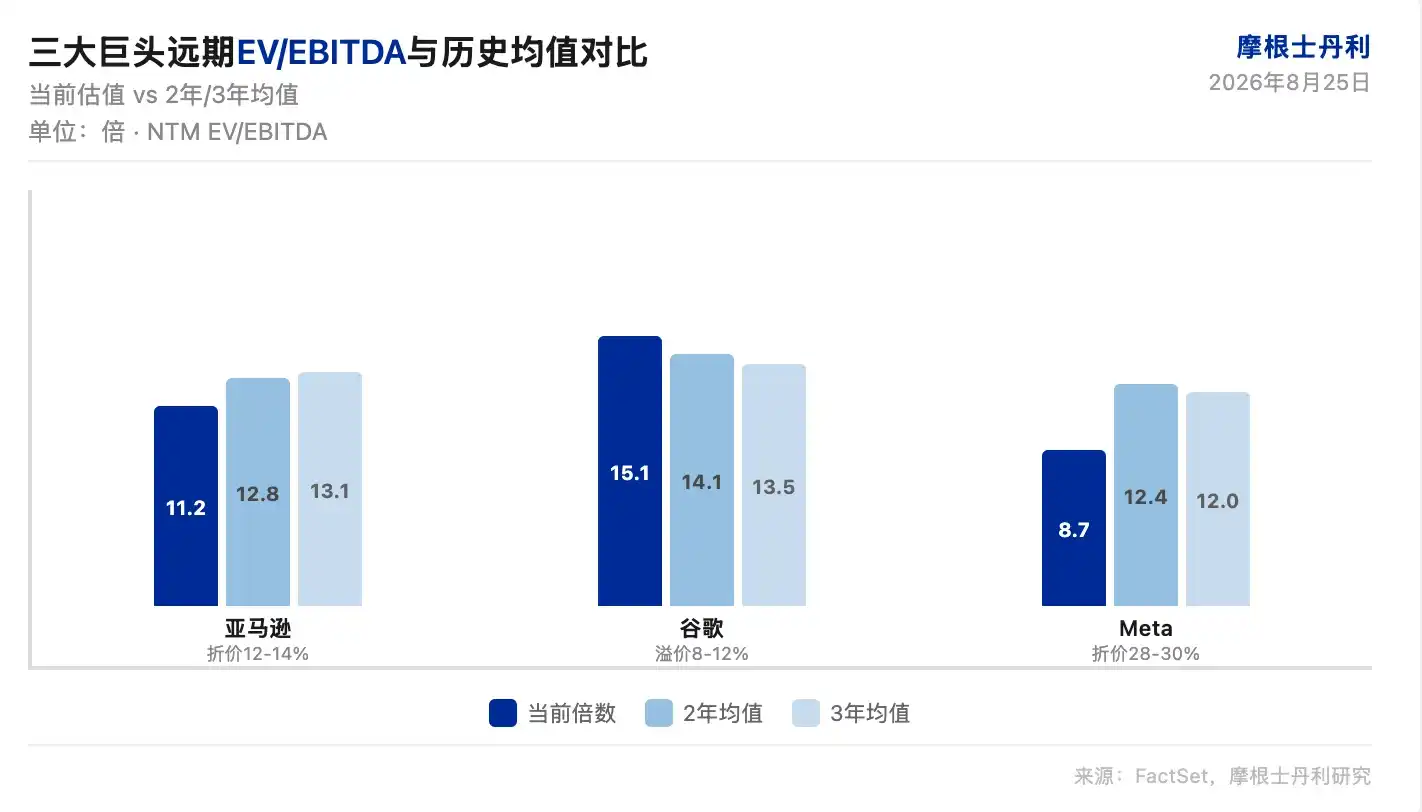
Google's valuation premium stems from the market's reassessment of its AI capabilities. Upward revisions for external TPU sales (Morgan Stanley previously raised its revenue per GW assumption from $20 billion to $27 billion), iterations of the Gemini model, and expanding margins in its cloud business collectively support the valuation. The market is willing to price in AI-driven growth ahead of time.

Meta's valuation is moving in the opposite direction. Its current forward EV/EBITDA multiple of 8.7x represents a 30% discount to the 2-year average and a 28% discount to the 3-year average. Although Meta is making good progress in monetizing its AI advertising tools, market concerns about competition in social media advertising continue to suppress its valuation. Amazon sits in the middle, with a current forward EV/EBITDA of 11.2x, representing discounts of 12% and 14% to the 2-year and 3-year averages, respectively.

Sector Valuations Show Divergence in Pricing for Revenue vs. Profit

Morgan Stanley data shows that the internet sector's current forward EV/EBITDA multiple is 9% below its 5-year average and 16% below its 10-year average. Over the same period, the EV/Sales multiple is 16% above the 5-year average and 17% above the 10-year average. Revenue multiples are expanding while profit multiples are contracting, indicating that the market is raising its requirements for earnings quality.

E-commerce and digital media are the sub-sectors with the most concentrated valuation discounts. The median forward EV/EBITDA for the digital media sub-sector is around 9.6x, with companies like SNAP still operating at a loss. The e-commerce sub-sector's valuation is also under pressure, mainly due to the dual impact of slowing consumer spending and intensifying competition.

SBC Adjustment Reveals True Valuation Pressure

After adjusting for stock-based compensation (SBC) as a cash expense, the true valuation multiples for each sub-sector are significantly higher than the apparent numbers.

The adjusted EV/EBITDA multiple for the digital media sub-sector rises by an average of approximately 36%, the e-commerce sub-sector by about 30%, and the travel & shared economy sub-sector by around 44%. The proportion of SBC in tech companies continues to grow, widening the gap between valuation multiples calculated on cash profits versus those based on reported profits. Solely looking at reported EV/EBITDA may underestimate the true valuation pressure. Recalculating by treating SBC as a cash expense better reflects the actual costs borne by shareholders.

Valuation Recovery Requires Earnings Revisions, Not Just Mean Reversion

Morgan Stanley believes that a recovery in internet sector valuations requires new catalysts. Key variables to monitor in the coming quarters include: the release cadence and market acceptance of Google's Gemini 4, whether Amazon AWS's growth rate stabilizes, Meta's progress in monetizing AI advertising tools, and the ongoing impact of changes in the interest rate environment on high-valuation growth stocks.

In the near term, overall sector valuations are within a reasonable range. Discounts exist in e-commerce and digital media, but the discount itself is not a buy signal. Valuation recovery needs to be driven by upward revisions to earnings expectations, not merely mean reversion.

Disclaimer

This article is Chaoxiang Research's organization and interpretation of a third-party brokerage research report (Morgan Stanley, August 25, 2026), combined with publicly available market information. The ratings, target prices, earnings forecasts, and related judgments cited in the text are the views of that brokerage's analyst, representing solely the position of their affiliated institution. They do not represent the views of Chaoxiang Research nor constitute any investment advice.

The market carries risks; decisions should be made independently. This article should not be used as a basis for trading any securities.


Пов'язані питання

QAccording to Morgan Stanley's report, what are the current valuation premiums/discounts for Google, Meta, and Amazon compared to their historical averages (using the EV/EBITDA metric)?

AAccording to Morgan Stanley's report, Google's current valuation is at a premium: 8% above its 2-year average and 12% above its 3-year average EV/EBITDA. Meta is at a significant discount: 30% below its 2-year average and 28% below its 3-year average. Amazon is at a moderate discount: 12% below its 2-year average and 14% below its 3-year average.

QWhat is identified as the core variable driving the fundamental divergence in the market's pricing logic for the three internet giants?

AThe article identifies AI capability as the core variable driving the fundamental divergence in the market's pricing logic for Google, Meta, and Amazon.

QWhat does the article highlight as a key reason for Google's valuation premium?

AThe article highlights that Google's valuation premium comes from the market's reassessment of its AI capabilities, specifically citing factors like upward revisions for its TPU external sales, iterations of the Gemini model, and margin expansion in its cloud business.

QWhy does the article suggest that looking at reported EV/EBITDA might underestimate true valuation pressure, and what adjustment does it propose?

AThe article suggests that reported EV/EBITDA might underestimate true valuation pressure because it doesn't account for Stock-Based Compensation (SBC) as a cash expense. It proposes adjusting for SBC as a cash outflow to calculate valuation multiples that better reflect the actual cost borne by shareholders.

QAccording to Morgan Stanley's conclusion, what does the valuation repair for the internet sector require, rather than simple mean reversion?

AAccording to Morgan Stanley, valuation repair for the internet sector requires upward revisions in earnings expectations (profit upgrades) to drive it, not just simple mean reversion or the existence of a discount itself.

Пов'язані матеріали

SEC to Relax Crypto Regulations: Projects Don't Need Full Decentralization, 'Functional' is Enough

The U.S. Securities and Exchange Commission (SEC), led by Commissioner Hester Peirce, has proposed a new regulatory safe harbor for crypto assets. This rule, part of the "Regulation of Crypto Assets," would allow tokens to exit the securities law framework once the underlying project becomes "functional" or decentralized, rather than requiring full decentralization from the start. Currently, tokens are often deemed securities due to the central managerial efforts needed during early development. The proposal addresses this "catch-22" where projects need to distribute tokens to grow but face securities regulations for doing so. The safe harbor grants developers up to four years of temporary exemption from certain securities laws while they build their networks. A key shift is the exit criteria: tokens cease to be investment contracts when the network matures into either a "decentralized" or "functional" state, no longer reliant on a single entity for essential managerial or entrepreneurial efforts. The term "functional" is not strictly defined but appears to be a pragmatic version of decentralization, emphasizing broad community involvement over perfect, Bitcoin-like decentralization. Crucially, the rule permits developers to continue maintaining and improving the network even after achieving this status, as such activities are not considered "essential managerial efforts." This offers a clearer, more feasible compliance path for token issuers. The proposal places the onus on projects to self-certify when they meet the exit criteria, which may incentivize more realistic promises and potentially foster greater genuine decentralization—a core principle the crypto industry has long advocated but often failed to implement.

marsbit4 хв тому

SEC to Relax Crypto Regulations: Projects Don't Need Full Decentralization, 'Functional' is Enough

marsbit4 хв тому

The Global Debt Cycle May Enter a Phase of 'Erasing Debt Out of Thin Air'

Global debt cycles may be entering a phase of "debt cancellation," warns macro strategist Simon White. As long-term bond yields rise, pressure from high debt levels has sparked calls in France to cancel a portion of public debt—a sentiment that risks spreading. White argues such proposals are a form of monetary financing that would inevitably fuel significant inflation and devalue financial assets. The article cites past examples, like the 2011 U.S. proposal to mint a $1 trillion platinum coin to circumvent the debt ceiling, highlighting how unconventional ideas gain traction during fiscal stress. With the U.S. "twin deficits" exceptionally large and interest payments soaring, political polarization increases the likelihood of such extreme measures being seriously considered. White outlines six potential ways to reduce government debt—fiscal consolidation, growth/inflation, financial repression, asset sales, default/restructuring, and debt cancellation. Most alternatives are politically untenable, economically damaging, or insufficient, potentially making direct debt cancellation seem like an attractive "easy" option. However, canceling debt held by a central bank would permanently monetize it, turning quantitative easing's temporary liquidity into permanent money creation. This would breach a critical threshold, almost certainly triggering severe inflation as the private sector abandons expectations of future fiscal discipline. The core warning is that as governments avoid painful but sustainable solutions, the pursuit of short-term monetary fixes raises the probability of these high-impact "tail risks," setting the global economy on a dangerous path toward inflation and financial instability.

marsbit7 хв тому

The Global Debt Cycle May Enter a Phase of 'Erasing Debt Out of Thin Air'

marsbit7 хв тому

Quantum Protection for Bitcoin and Fed Expectations: Key Crypto News This Morning

"RBC-Crypto" issues a standard disclaimer that the article is for informational purposes only, noting that cryptocurrency is a volatile asset that can lead to financial losses. **Market Summary (Aug 27)** Bitcoin ($BTC) trades just below $79K with little daily change. Ethereum ($ETH) is near $2.5K, gaining over 1%. The total crypto market cap is above $2.65 trillion. The market sentiment index is at 71 (out of 100), indicating "greed" and a tendency for investors to buy. Top gainer: memecoin SPX6900 (+15%); top loser: Polygon's POL token (-13%). **ETF Inflows** On August 26, Bitcoin ETFs saw inflows exceeding $232 million, and Ethereum ETFs attracted nearly $192 million. These funds have recorded eight consecutive days of capital inflows. **Bitcoin News: Security and Outlook** Company StarkWare has reportedly developed a prototype method to protect a Bitcoin transaction from a potential future quantum computer attack. However, this is a test solution that currently only applies to BTC during the sending process, not to coins passively stored in vulnerable addresses. Market volatility is low, but positive sentiment remains. BlackRock's Head of Digital Assets, Robert Mitchnick, stated Bitcoin "will continue to grow," while brokerage Bernstein predicts a price of $200K by mid-2027. **Key Market Event** Traders are focused on the ongoing annual economic symposium in Jackson Hole, USA (Aug 27-29). A speech by Federal Reserve Chair Kevin Warsh on August 28 is being closely watched by all market participants, including in crypto.

cryptonews.ru10 хв тому

Quantum Protection for Bitcoin and Fed Expectations: Key Crypto News This Morning

cryptonews.ru10 хв тому

Торгівля

Спот
活动图片