Morgan Stanley Files For Ethereum ETF Amid Major Crypto Push

bitcoinistОпубліковано о 2026-01-08Востаннє оновлено о 2026-01-08

Анотація

Morgan Stanley has filed an S-1 form with the SEC for a spot Ethereum ETF, named the Morgan Stanley Ethereum Trust. The proposed fund aims to track the price of ETH and generate returns, including through staking a portion of the trust's assets. This filing follows the bank's recent submissions for spot Bitcoin and Solana ETFs, which also include staking plans for the Solana fund. This move is part of the firm's broader expansion into crypto, which includes offering crypto ETFs to its wealth management clients and enabling cryptocurrency access through its E-Trade platform. The push aligns with a wider regulatory shift in the U.S. towards embracing digital assets.

Wall Street behemoth Morgan Stanley is expanding its recent push into crypto Exchange-Traded Funds (ETFs) and has filed a registration statement for an Ethereum (ETH) Trust with the US Securities and Exchange Commission (SEC).

Morgan Stanley Files For Ethereum Trust

On Tuesday, banking giant Morgan Stanley submitted an S-1 form with the US SEC for its Morgan Stanley Ethereum Trust, which seeks to generate returns for investors by tracking the price of ETH and to “reflect rewards from staking a portion of the Trust’s ether.”

The SEC Filing shows that the bank “plans to engage one or more Staking Services Providers to conduct such Staking Activities,” using a staking model that “aims to maximize the portion of the Trust’s ether available for staking while controlling for liquidity and redemption risks.
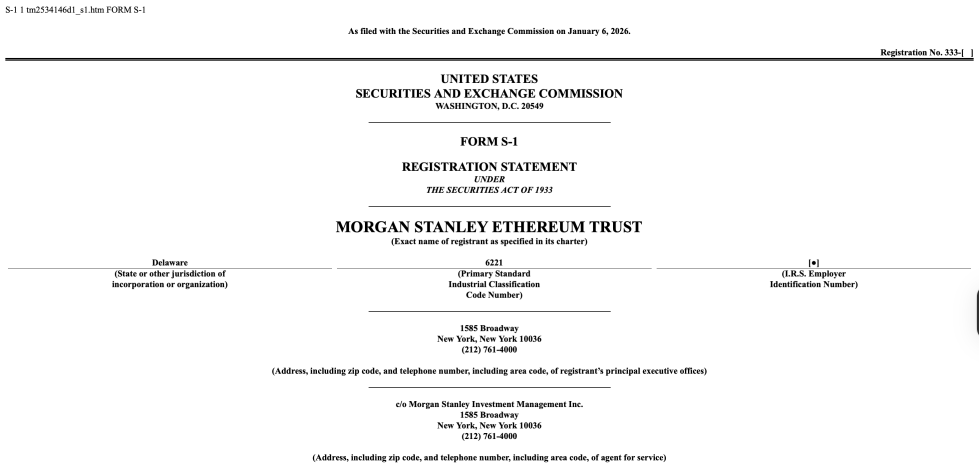
Morgan Stanley files S-1 form for Ethereum ETF. Source: sec.gov

Nonetheless, the document doesn’t address key details, such as the exchange on which the fund will be listed, the Trust’s custodian, or the ticker. Morgan Stanley’s Ethereum ETF filing follows recent efforts to launch other investment products based on some of the largest cryptocurrencies by market capitalization.

As reported by Bitcoinst, the Wall Street giant announced that it had submitted preliminary filings for spot Bitcoin (BTC) and Solana (SOL) Trusts on Tuesday, seeking to hold and generate returns by tracking these two cryptocurrencies.

In a January 6 statement, the bank detailed that “Morgan Stanley Bitcoin Trust and Morgan Stanley Solana Trust are pending regulatory approval and would be passive investment vehicles that seek to track the performance of the price of the relevant cryptocurrency.”

Similar to its submitted Ethereum ETF, the Solana fund will include an allocation for staking, and plans to engage one or more third-party staking service providers to conduct these activities.

A Broader Crypto Push

Notably, Morgan Stanley’s crypto ETF move is part of a broader shift toward a more welcoming approach that expands the presence of traditional institutions in the digital assets industry.

This pivot follows US regulatory efforts led by the Trump administration to turn the country into the “crypto capital of the world.” Amid this major push, the SEC has published new generic listing standards for crypto-based ETFs, which have seen a successful run since their initial launch nearly two years ago.

In 2024, Morgan Stanley, which had built one of the most significant Bitcoin ETF holdings in the US, allowed its managers to offer the products as an investment option for its wealthy customers. This enabled access to individuals with a minimum of $1.5 million in assets and an aggressive risk tolerance.

In October 2025, it expanded its access to crypto fund investments for all clients, including those with retirement accounts, moving away from its previous customer restrictions. The shift allowed its financial advisors to present crypto funds to any client.

It also announced last year that it would enable trading of the largest cryptocurrencies, Bitcoin, Ethereum, and Solana, through its E-Trade subsidiary.
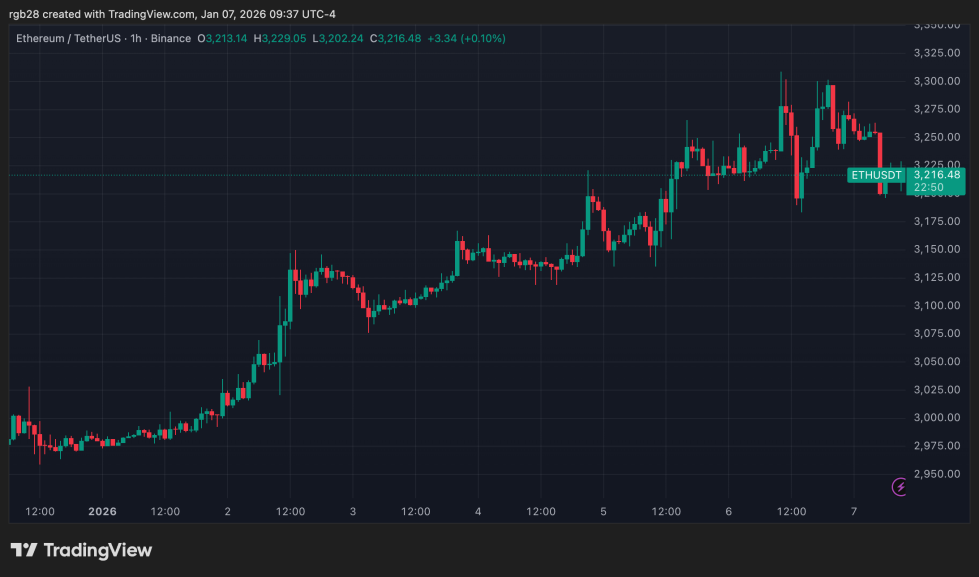
Ethereum trades at $3,216 in the one-week chart. Source: ETHUSDT on TradingView


Трендові криптовалюти

Пов'язані питання

QWhat type of financial product has Morgan Stanley filed for with the SEC, and which cryptocurrency does it track?

AMorgan Stanley has filed an S-1 form for a Morgan Stanley Ethereum Trust, an Exchange-Traded Fund (ETF) that seeks to generate returns by tracking the price of Ethereum (ETH).

QBeyond price tracking, what additional feature does the proposed Morgan Stanley Ethereum Trust include to generate returns?

AThe Trust also aims to reflect rewards from staking a portion of its ether holdings, and it plans to engage one or more Staking Services Providers to conduct these staking activities.

QBesides an Ethereum ETF, what other two cryptocurrency-based investment products did Morgan Stanley file for on the same day?

AOn the same day, Morgan Stanley also submitted preliminary filings for a spot Bitcoin (BTC) Trust and a Solana (SOL) Trust.

QHow has Morgan Stanley's policy on offering crypto investments to its clients evolved since 2024?

AIn 2024, it allowed managers to offer Bitcoin ETFs only to wealthy customers with at least $1.5M in assets. By October 2025, it expanded access to crypto funds for all clients, including those with retirement accounts, and allowed financial advisors to present them to any client.

QThrough which subsidiary did Morgan Stanley announce it would enable direct trading of Bitcoin, Ethereum, and Solana?

AMorgan Stanley announced it would enable trading of these major cryptocurrencies through its E-Trade subsidiary.

Пов'язані матеріали

Crypto Advisor Bessent's Tyler Williams Leaves Treasury Department as Voting Time for CLARITY Bill Lapses

Tyler Williams, the chief digital assets adviser to Treasury Secretary Scott Bessent, has left his federal government position and is expected to return to the private sector. His departure came just before the Senate's August recess and before a vote on the key industry bill, the CLARITY Act, which has now expired. Williams was appointed in February 2025 and played a significant role, contributing to a major White House report on digital assets and working on the CLARITY Act. His exit is seen as part of a broader trend of crypto-friendly figures leaving Washington. The CLARITY Act, which aims to clarify regulatory oversight between the SEC and CFTC and protect blockchain developers, faced significant hurdles. With the Senate recess starting August 10th, the bill needed at least seven Democratic votes to reach the 60 required for advancement, but seven Democratic senators blocked it due to ethical and security concerns. Senate Majority Leader John Thune expressed a desire for a vote but did not confirm next steps, and the bill was not on the Senate schedule as of August 3rd. Analysts have lowered the probability of the CLARITY Act passing in 2026 from 50% to 30%. While its failure could negatively impact digital asset markets, support from a coalition including major financial firms like BlackRock and Fidelity persists. Supporters argue the bill has bipartisan understanding among younger lawmakers and should be passed.

cryptonews.ru2 хв тому

Crypto Advisor Bessent's Tyler Williams Leaves Treasury Department as Voting Time for CLARITY Bill Lapses

cryptonews.ru2 хв тому

Mathematicians Refute Open AI's Claim of Proving Connes Rigidity Conjecture Within 24 Hours: 'AI Proved Every Sentence Correct, but They Are No Longer About the Original Conjecture'

Mathematician Refutes OpenAI's Claim of Disproving Connes Rigidity Conjecture in 24 Hours OpenAI claimed its next-generation AI model solved 10 world-class problems, including disproving the Connes Rigidity Conjecture. The next day, mathematician J. L. Nielsen from the University of Kansas published a paper refuting the AI's counterexample. Nielsen meticulously reviewed OpenAI's publicly released 37,000 lines of Lean 4 code, mapping each object back to its mathematical origin. He identified two independent failure paths in the AI's argument. He concluded that one of the two groups constructed by the AI does not satisfy the required conditions (specifically ICC and Kazhdan's property (T)) necessary to serve as a valid counterexample to the original conjecture. This means the AI may have successfully proven something about its constructed objects, but that statement is not equivalent to disproving the Connes Rigidity Conjecture itself. The incident highlights a crucial limitation of formal verification tools like Lean. While Lean's kernel can verify the logical correctness of a proof's steps, it cannot verify whether the formal statement being proven correctly corresponds to the intended mathematical conjecture. Human oversight remains essential to ensure the alignment between the formalized problem and the original research question. This case exemplifies what researchers call "successfully proving the wrong statement." The Connes Rigidity Conjecture, concerning the uniqueness of group von Neumann algebras under certain conditions, remains an open problem.

marsbit42 хв тому

Mathematicians Refute Open AI's Claim of Proving Connes Rigidity Conjecture Within 24 Hours: 'AI Proved Every Sentence Correct, but They Are No Longer About the Original Conjecture'

marsbit42 хв тому

Торгівля

Спот

Популярні статті

Як купити PUSH

Ласкаво просимо до HTX.com! Ми зробили покупку Push Protocol (PUSH) простою та зручною. Дотримуйтесь нашої покрокової інструкції, щоб розпочати свою криптовалютну подорож.Крок 1: Створіть обліковий запис на HTXВикористовуйте свою електронну пошту або номер телефону, щоб зареєструвати обліковий запис на HTX безплатно. Пройдіть безпроблемну реєстрацію й отримайте доступ до всіх функцій.ЗареєструватисьКрок 2: Перейдіть до розділу Купити крипту і виберіть спосіб оплатиКредитна/дебетова картка: використовуйте вашу картку Visa або Mastercard, щоб миттєво купити Push Protocol (PUSH).Баланс: використовуйте кошти з балансу вашого рахунку HTX для безперешкодної торгівлі.Треті особи: ми додали популярні способи оплати, такі як Google Pay та Apple Pay, щоб підвищити зручність.P2P: Торгуйте безпосередньо з іншими користувачами на HTX.Позабіржова торгівля (OTC): ми пропонуємо індивідуальні послуги та конкурентні обмінні курси для трейдерів.Крок 3: Зберігайте свої Push Protocol (PUSH)Після придбання Push Protocol (PUSH) збережіть його у своєму обліковому записі на HTX. Крім того, ви можете відправити його в інше місце за допомогою блокчейн-переказу або використовувати його для торгівлі іншими криптовалютами.Крок 4: Торгівля Push Protocol (PUSH)Легко торгуйте Push Protocol (PUSH) на спотовому ринку HTX. Просто увійдіть до свого облікового запису, виберіть торгову пару, укладайте угоди та спостерігайте за ними в режимі реального часу. Ми пропонуємо зручний досвід як для початківців, так і для досвідчених трейдерів.

630 переглядів усьогоОпубліковано 2024.12.13Оновлено 2026.06.02

Як купити PUSH

Обговорення

Ласкаво просимо до спільноти HTX. Тут ви можете бути в курсі останніх подій розвитку платформи та отримати доступ до професійної ринкової інформації. Нижче представлені думки користувачів щодо ціни PUSH (PUSH).

活动图片