More Than One Person Has Wasted Three Years on Base

比推Опубліковано о 2026-01-14Востаннє оновлено о 2026-01-14

Анотація

A developer known as tuna, co-founder of Pandemic Labs, publicly criticized Base, the Ethereum L2 network backed by Coinbase, for failing to support builders despite initial promises. After nearly three years of developing 10 different products—including games, AI agents, and prediction markets—on Base, tuna received no meaningful support, even after creating the hit game *Infected*, which gained 50,000 users. In contrast, within 48 hours of launching a game on Solana, *Addicted*, it generated $4 million in revenue. Tuna expressed frustration that Base appears to prioritize certain projects like Farcaster and Zora while ignoring independent developers. Other builders, such as Shivam Tandon of zkCross Network and Jacek from the DEGEN project, shared similar experiences, citing ignored outreach and a lack of engagement from Base and its lead, Jesse. Despite bringing significant traffic and value, these teams felt overlooked, with DEGEN even choosing to expand to Solana, where they received immediate support and recognition. Critics argue that Base operates with a top-down, “narrative-driven” approach aligned with Coinbase’s interests, rather than fostering an open, community-oriented ecosystem like Solana. While Base’s 2026 roadmap focuses on asset tokenization and the Base App, many developers question whether it truly intends to serve the broader community or mainly functions as an extension of Coinbase.

Author: Eric, Foresight News

Original Title: More Than One Person Has Wasted Three Years on Base


At 1:13 AM Beijing time on January 13, the co-founder of game studio Pandemic Labs, a user with the X handle "tuna," published an article criticizing Base for its inaction.
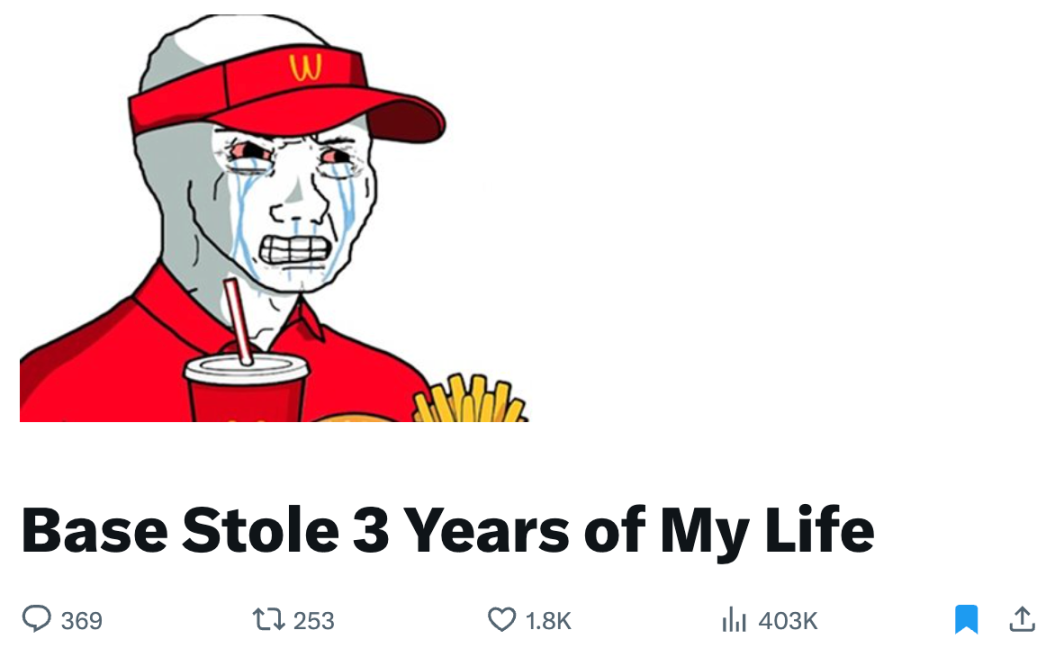
In the article, Tuna stated that Jesse's philosophy of Base being "application-first" rather than focusing on infrastructure attracted him to develop products on Base. However, after "three years" (Base's mainnet has only been live for about two and a half years) of developing 10 products including games, AI Agents, prediction markets, and zkTLS, the promised support from Base never materialized.

After launching the hit game Infected and gaining 50,000 followers in a month, Base proactively contacted tuna and promised support, but ultimately nothing came of it. Tuna mentioned that before Infected, they tried to reach Base officials through X, Discord, and Telegram but received no response.

Disheartened, tuna switched to Solana and developed the game Addicted, which generated $4 million in revenue within 48 hours of its launch on Solana. The stark contrast of earning $4 million in 2 days versus achieving nothing in nearly 3 years led tuna to lament that, compared to Base, which constantly promotes Farcaster and Zora, he had finally found an "organization" that treats developers like human beings.

Shivam Tandon, founder of zkCross Network, had a similar experience. He also initially believed in Jesse's story of prioritizing products and builders. However, after developing Surf on Base, their efforts to contact Base via email and private messages similarly went unanswered. Shivam Tandon stated that he doesn't mind if Base wants to support projects invested in by Coinbase, but he wishes they would be upfront about it and not waste developers' time.

Although some pragmatic users believe Base has its own preferences and that project failures shouldn't be blamed on this, most people expressed support for tuna.

Developer criticism of Base didn't start this year. In February 2025, a user with the X handle Lamboland felt that Base's approach seemed insufficiently "degen." Coinbase offered no support for a high-traffic project like Virtuals but listed the VVV token on its launch day. Lamboland mentioned that many projects were considering migrating to Solana, primarily because Base's marketing was out of touch, lacking "seasoned veterans" who understand CT culture to build a good community environment.

Similarly, just two weeks ago, Jacek, a member of DEGEN—which airdropped $50 million in tokens to Farcaster users and once had a market cap exceeding $1 billion—also posted a long thread expressing disappointment with Base.

Jacek stated that developers choose Base largely because of its connection to Coinbase, hoping to gain support or brand endorsement. However, as the previous two mentioned, Base devoted significant effort to projects like Zora, while even the official Base Twitter account didn't follow or retweet projects like DEGEN that brought massive traffic to Base. In Jacek's view, to Base, anything outside the mainstream narrative simply doesn't exist.

Furthermore, DEGEN's proposal for a $1 million airdrop on Base and the Base App was ignored. Jacek noted that when DEGEN announced plans to cross-chain to Solana, they immediately received attention and support from Solana. At offline events, Solana officials were eager to interact with ecosystem projects, even giving out Bonk keychains. It's these small, seemingly insignificant details that demonstrate official respect for developers and participants. In contrast, Jacek expressed that he doesn't mind Base promoting Zora, but the attitude of completely ignoring other projects is disappointing.

Interestingly, despite such severe public criticism, neither Base nor Jesse offered any explanation or proposed solutions in the replies to these tweets. On the 9th of this month, Jesse retweeted a post from Base product manager Nick, expressing Base's willingness to assist developers, but the comments were filled with skepticism, with the most common question being: How exactly do you plan to help?

Over the past year, Base has indeed been a gold rush destination, but it almost experienced "sudden death" after its flagship projects fizzled out. Unlike Solana, Base is part of the Coinbase ecosystem, an extension of the exchange, born with the attribute of serving stakeholders. Clearly, the unhealthy tendencies existing within the already large Coinbase have also affected Base's operations. Perhaps Base's sudden popularity was indeed supported by Coinbase's strong resources, but the core contributors to its brief success were still the talented developers in the community.

Coinbase's plans for Base in 2026 primarily revolve around on-chain assets and the Base App. Coinbase plans to gradually evolve into a comprehensive exchange in the future, with aspects like stock tokenization and commodity tokenization mainly being handled by Base. Additionally, the Base App is planned to be developed into a Web3 traffic入口 (entry point) integrating trading, social features, and a wallet. This indicates that Base will likely continue to adhere to its recognized "mainstream narrative," and its functional role in assisting Coinbase will remain stronger than being an open community itself.

Over the past year, Base wanted to use its influence to strongly promote projects like Farcaster and Zora, which have capital backing and "orthodox" narratives, but misjudged the "crazy" mainstream style of this market cycle. For Coinbase, it needs to clarify whether Base is merely a tool to serve the exchange and Coinbase Ventures, or a truly open network for the entire world. If it's the latter, it must adopt an operational philosophy like Solana's—"from the masses, to the masses."


Twitter:https://twitter.com/BitpushNewsCN

BitPush TG Discussion Group:https://t.me/BitPushCommunity

BitPush TG Subscription: https://t.me/bitpush

Original article link:https://www.bitpush.news/articles/7602760

Пов'язані питання

QWhat was the main complaint of the game studio Pandemic Labs' co-founder (tuna) against Base?

ATuna complained that despite Base's initial promise of an 'application-first' approach and support for developers, after nearly three years of developing 10 different products (including games, AI Agent, prediction markets, zkTLS) on Base, the promised support never materialized. Even after creating a hit game 'Infected' that gained 50,000 followers, Base's offer of support ultimately came to nothing.

QWhat contrasting result did tuna experience after switching from Base to Solana?

AAfter switching to Solana and developing the game 'Addicted', tuna generated $4 million in revenue within just 48 hours of its launch. This starkly contrasted with nearly three years of achieving nothing on Base, leading him to feel that Solana was an organization that treated developers with respect.

QAccording to the article, what is a common criticism from developers like Shivam Tandon (zkCross Network) and Jacek (DEGEN) regarding Base's support?

ADevelopers like Shivam Tandon and Jacek criticized Base for ignoring their attempts to make contact via emails and private messages, and for showing preferential support to projects like Zora and those backed by Coinbase Ventures, while neglecting other developers who brought significant traffic and value to the ecosystem, such as DEGEN which airdropped $50 million to users.

QHow did the article characterize Base's relationship with Coinbase and its potential future focus?

AThe article characterized Base as an extension of the Coinbase exchange, born with the attribute of serving its stakeholders. Its future planning for 2026 is focused primarily on on-chain assets and the Base App, aiming to develop into a comprehensive exchange handling stock tokenization, commodity tokenization, and acting as a Web3 traffic entry point. Its functional role in assisting Coinbase is seen as stronger than being a truly open community.

QWhat key difference in community engagement did Jacek highlight between Solana and Base?

AJacek highlighted that when DEGEN announced plans to bridge to Solana, they immediately received attention and support from Solana. At offline events, Solana's official staff were eager to interact with ecosystem projects, even giving out small gifts like Bonk keychains. This demonstrated a respect for developers and participants that was lacking in Base's approach, which largely ignored projects outside its 'mainstream narrative'.

Пов'язані матеріали

Anthropic's IPO Launch: Commercial Miracle or Valuation Bubble?

Anthropic has confidentially filed for an IPO, led by Morgan Stanley and Goldman Sachs, potentially going public by October. Following its latest $650 billion funding round, its pre-IPO valuation stands at $965 billion, with projections reaching up to $2 trillion at listing, which would make it the highest-valued private company ever. The article, written by Fu Sheng, addresses skepticism that this represents an AI bubble akin to the 2000 dot-com crash. It argues the current situation differs fundamentally. Unlike the internet bubble era, which relied on speculative narratives with little revenue, Anthropic's valuation is backed by unprecedented, measurable financial performance. Key data points include: * **Revenue Growth:** ARR skyrocketed from $10 billion in early 2025 to $470 billion by May 2026, targeting $100 billion by year-end—a growth curve unmatched in business history. * **Profitability:** It achieved operating profitability in Q2 2026 with an estimated $5.6 billion profit. * **Efficiency:** With ~3,000 employees and ~$470 billion ARR, its revenue per employee exceeds $10 million. Products like Claude Code, launched less than a year ago, already generate $25 billion in annualized revenue. * **Enterprise Adoption:** It boasts a strong enterprise client base, with 8 of the Fortune 10 and over 1,000 large firms spending over $1 million annually on Claude. The valuation is framed using a traditional SaaS model (e.g., a 10x Price-to-Sales multiple on $100 billion revenue). The author contends the core question for analysts has shifted from "How big could this be?" to "How much is it earning and will earn next quarter?" The discussion extends beyond Anthropic to a broader paradigm shift: the transition from a "carbon-based" to a "silicon-based" economy. Companies are increasingly prioritizing investment in compute and AI capabilities over human resources, as these directly scale productivity and competitive advantage. Anthropic's IPO is thus positioned not just as a corporate milestone, but as a price anchor for this new economic era.

链捕手1 год тому

Anthropic's IPO Launch: Commercial Miracle or Valuation Bubble?

链捕手1 год тому

Near Returns to the AI Stage: Transformation into a Public Chain Due to 'Payroll Difficulties,' Agent and Privacy Emerge as New Growth Narratives

NEAR Returns to AI Origins: From Payroll Struggles to Blockchain, Now Focusing on AI Agents and Privacy NEAR Protocol's journey began not with grand blockchain ambitions, but from a practical hurdle: its AI startup founders, including Transformer paper co-author Illia Polosukhin, couldn't efficiently pay international developers in 2017. This led them to pivot and build a high-performance, scalable blockchain. After years navigating various crypto narratives like sharding and cross-chain interoperability, NEAR is now leveraging its AI roots to re-enter the AI arena. A key driver is its "NEAR Intents" layer, which abstracts complex cross-chain transactions. Users simply state their goal (e.g., swap BTC for ETH), and a solver network finds the optimal route. This system has processed over $20B in cross-chain volume, generating significant fee revenue. A major growth area is private transactions via "Confidential Intents/Swaps," which hide trade details until settlement to protect against MEV and front-running. Remarkably, private swaps recently accounted for over 40% of NEAR's transaction volume, highlighting strong demand but also potential regulatory scrutiny. With its AI-founder pedigree, NEAR is positioning itself at the intersection of blockchain, AI agents, and privacy, aiming to become infrastructure for the emerging agent economy while navigating the challenges of its rapid adoption.

marsbit4 год тому

Near Returns to the AI Stage: Transformation into a Public Chain Due to 'Payroll Difficulties,' Agent and Privacy Emerge as New Growth Narratives

marsbit4 год тому

Торгівля

Спот
Ф'ючерси

Популярні статті

Як купити ONE

Ласкаво просимо до HTX.com! Ми зробили покупку Harmony (ONE) простою та зручною. Дотримуйтесь нашої покрокової інструкції, щоб розпочати свою криптовалютну подорож.Крок 1: Створіть обліковий запис на HTXВикористовуйте свою електронну пошту або номер телефону, щоб зареєструвати обліковий запис на HTX безплатно. Пройдіть безпроблемну реєстрацію й отримайте доступ до всіх функцій.ЗареєструватисьКрок 2: Перейдіть до розділу Купити крипту і виберіть спосіб оплатиКредитна/дебетова картка: використовуйте вашу картку Visa або Mastercard, щоб миттєво купити Harmony (ONE).Баланс: використовуйте кошти з балансу вашого рахунку HTX для безперешкодної торгівлі.Треті особи: ми додали популярні способи оплати, такі як Google Pay та Apple Pay, щоб підвищити зручність.P2P: Торгуйте безпосередньо з іншими користувачами на HTX.Позабіржова торгівля (OTC): ми пропонуємо індивідуальні послуги та конкурентні обмінні курси для трейдерів.Крок 3: Зберігайте свої Harmony (ONE)Після придбання Harmony (ONE) збережіть його у своєму обліковому записі на HTX. Крім того, ви можете відправити його в інше місце за допомогою блокчейн-переказу або використовувати його для торгівлі іншими криптовалютами.Крок 4: Торгівля Harmony (ONE)Легко торгуйте Harmony (ONE) на спотовому ринку HTX. Просто увійдіть до свого облікового запису, виберіть торгову пару, укладайте угоди та спостерігайте за ними в режимі реального часу. Ми пропонуємо зручний досвід як для початківців, так і для досвідчених трейдерів.

346 переглядів усьогоОпубліковано 2024.12.12Оновлено 2026.06.02

Як купити ONE

Обговорення

Ласкаво просимо до спільноти HTX. Тут ви можете бути в курсі останніх подій розвитку платформи та отримати доступ до професійної ринкової інформації. Нижче представлені думки користувачів щодо ціни ONE (ONE).

活动图片