Monkey-Selling Lifeline Finally Turns Fortunes: Machi Big Brother Turns $150k Into $12.72 Million In Three Days

marsbitОпубліковано о 2026-08-25Востаннє оновлено о 2026-08-25

Анотація

Machi Big Brother, a prominent crypto whale, has staged a dramatic comeback. After ten months of significant losses, he turned a $150,000 capital into $12.72 million in just three days during last week's market rally. This 84x gain was achieved through aggressive "rolling" strategies on the Hyperliquid platform, where unrealized profits are continuously used as collateral to increase leveraged long positions. His current portfolio holds $100.7 million in assets backing $123.72 million in open long positions, primarily in ETH, with an overall leverage of approximately 13.1x. However, this massive position is highly precarious; a roughly 10% drop in ETH's price to $2,229 would trigger automatic liquidation, wiping out his recent profits. His trading history is marked by high leverage, frequent liquidations, and poor risk management, having been liquidated 71 times in a single month in 2025. To fund these risky trades and meet margin calls in recent months, he has been selling his NFT holdings, including Bored Ape Yacht Club (BAYC) assets, at substantial losses—a move the community dubbed "selling monkeys to stay alive." Despite the recent windfall, his cumulative losses remain high, and his high-risk strategy leaves him vulnerable to sudden market reversals.

As the tide of market recovery rolls in, the undercurrents on-chain have long churned up stormy seas. Machi Big Brother has once again become the protagonist in the on-chain arena of public opinion.

Over the past ten months, this crypto whale has been repeatedly submerged by each wave surge, with a persistent record of losses like a heavy report card. But in last week's one-sided market movement, starting with $150,000 in capital, he rolled a leveraged long position into $12.72 million within three days, netting a single-trade profit of $12.5 million, an 84x return on his principal.

As of 18:00 on August 24th, the total assets in the Hyperliquid account machibigbrother.eth stood at $10.07 million, supporting a massive long position worth $124 million. Leverage hangs by a thread, positions weigh like a heavy hammer—the paper gains and losses of this single individual are precisely a concentrated snapshot of current market sentiment, liquidity battles, and risk appetite. On-chain numbers do not lie, inscribing both frenzy and calm within the holdings data.
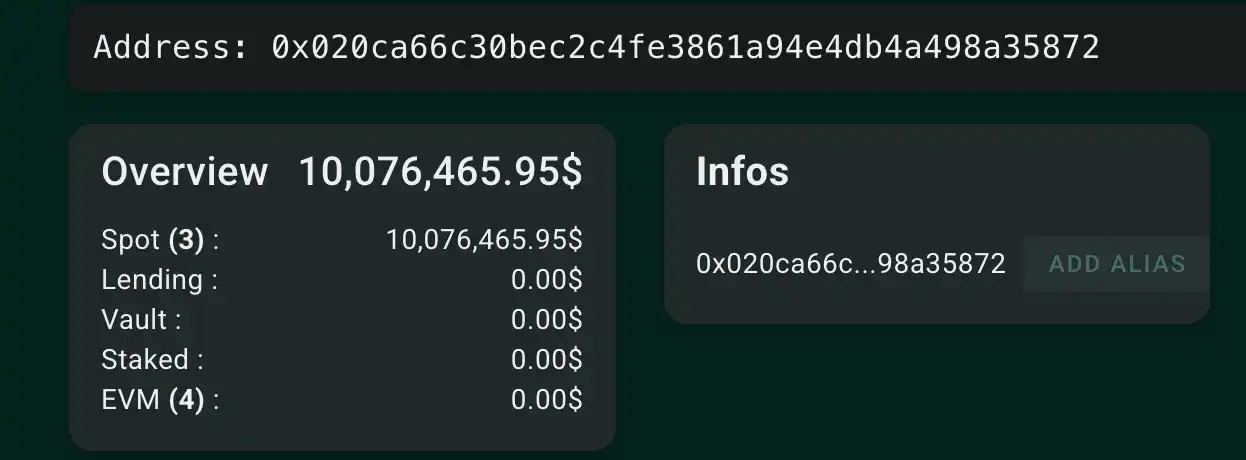
Current Positions: $10 Million Supporting $133 Million

Analysts differ slightly in their accounts. According to analyst Yu Jin's data, Machi Big Brother had accumulated losses of $35 million from long ETH positions over the past 10 months, which narrowed to approximately $24 million after this profitable trade.

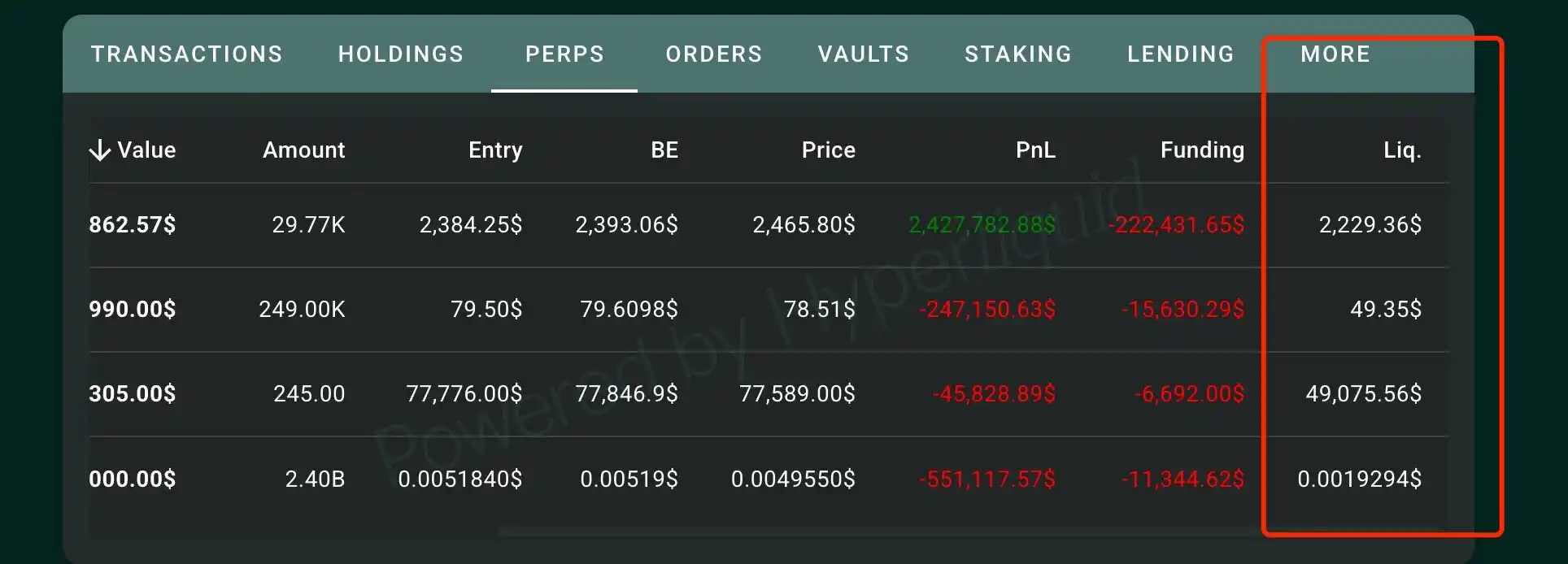
A clearer picture of his current position composition can be seen from HypurrScan's real-time on-chain data (data retrieved at 18:00, August 24th, 2026):

__IMG_1__

The four positions total $123.72 million, showing an overall unrealized profit of approximately $1.435 million at current prices. But breaking it down: the HYPE, BTC, and PUMP positions are all below their break-even prices. Only the ETH position remains 2.9% above its break-even price. Essentially, all profits are being propped up by the single ETH trade (unrealized profit ~$2.36 million), while the other three combined show an unrealized loss of $920,000.

Furthermore, to maintain these four long positions, he has already paid cumulative funding fees of approximately $256,000—this is the holding cost for perpetual contracts, deducted every hour regardless of price movement; the longer the position is held, the more is deducted.

The most critical factor is the 'liquidation price.' Once the price hits this level, the system will automatically sell his position to stop losses without his consent. The tightest among the four is ETH—$2,229, roughly 10% below the current price. And the ETH position alone constitutes 59% of his total portfolio, making it the entire account's line of death.

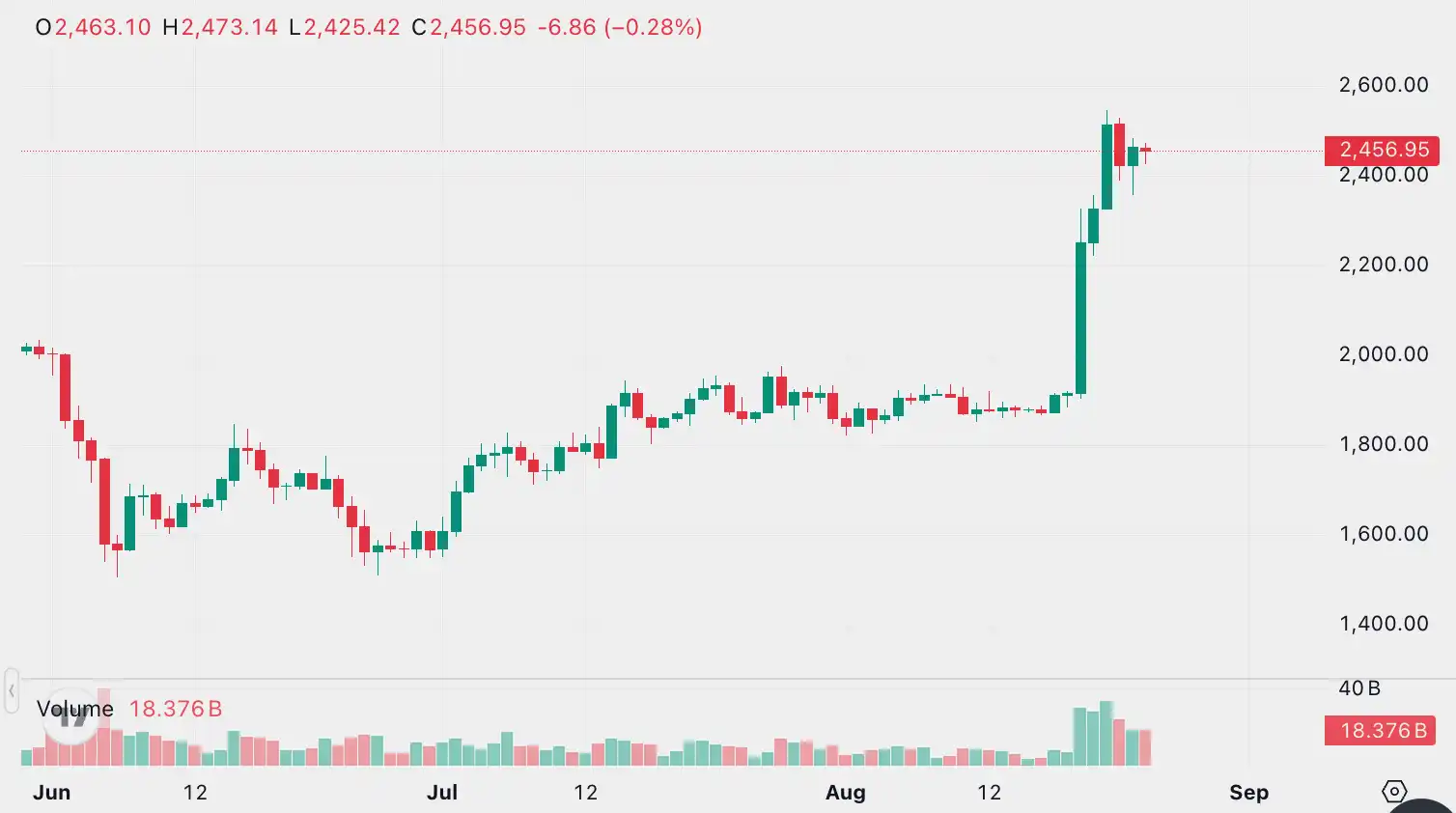
In terms of leverage ratio: $9.44 million in equity is supporting a $123.72 million position, resulting in an overall leverage of approximately 13.1x. This means if ETH drops from $2,463 to $2,229, a $234 decline, the $12.5 million profit made over these 3 days, along with the initial capital, would be wiped out.
Strategy Unchanged, Risks Persist

It is important to note that Machi Big Brother's profit this time was achieved through continuous 'position rolling.' 'Rolling a position' refers to opening a leveraged position and, instead of withdrawing unrealized profits, using those profits directly as additional margin to automatically support a larger position; if the price rises further, the position expands again, compounding in this manner.

Its mathematical characteristic is exponential gains when winning, but a total loss when losing. Because each increase in position size is built upon the unrealized profits of the previous one, a market reversal doesn't just erase the principal but simultaneously wipes out all the rolled-up profits. Turning $150k into $11.15 million requires getting it right several times in a row; turning $11.15 million back to $150k, theoretically, requires only one wrong move.

Last week's ETH rebound from the bottom provided the ideal environment for this structure: one-sided, continuous, and without pullbacks.
Although this operation resulted in $11 million in unrealized profits, one must not forget that as the 'on-chain liquidation champion,' Machi Big Brother has repeatedly seen massive profits rapidly turn into huge losses. In mid-September 2025, his account value peaked near $60 million (unrealized profit over $44–45 million). Subsequently, during the market crash on October 11th, multiple long positions including XPL and ETH were liquidated, turning a profit of approximately $15 million into a loss exceeding $11 million—profits evaporated swiftly.

His trading style is characterized by high leverage (often 25x–40x), extreme bullish bias, high win rate but extremely poor risk/reward ratio, and adding margin/averaging down instead of cutting losses during downturns. This leads to 'small wins, huge losses' and frequent liquidations.

In November 2025, Lookonchain monitored him being forcibly liquidated 71 times in a single month on Hyperliquid, ranking first across the network.

Currently, he still carries significant cumulative historical losses, and his fundamental issues with trading discipline remain unchanged. On-chain data is public and transparent, but volatility is intense.

The Two Weeks of Selling Apes to Add Margin

A highlight of this story is the halo effect Machi Big Brother himself carries, while another highlight is the narrative of a small capital base gambling for a massive position. But rewinding two weeks prior, he was selling off Bored Ape Yacht Club (BAYC) NFTs one by one:

August 5th: Sold BAYC #5670 for 9 ETH—the purchase cost over three years ago was 84.99 ETH, resulting in an 89.4% loss.

August 13th: Sold BAYC #5715 for 8.3 ETH, approximately $15,500; the original cost was 34.17 ETH, around $64,600, resulting in a 75.7% loss.

This was his routine for the first half of August.

The fire sale of BAYCs can be traced back even earlier. According to another Lookonchain statistic, he sold 34 BAYCs at a loss in June, obtaining about 326 ETH, but incurring an overall loss of approximately 399 ETH. The primary purpose was to add margin for his high-leverage ETH long positions on Hyperliquid, to avoid or delay liquidation. This led the community to joke that he was 'using monkeys for a lifeline.'

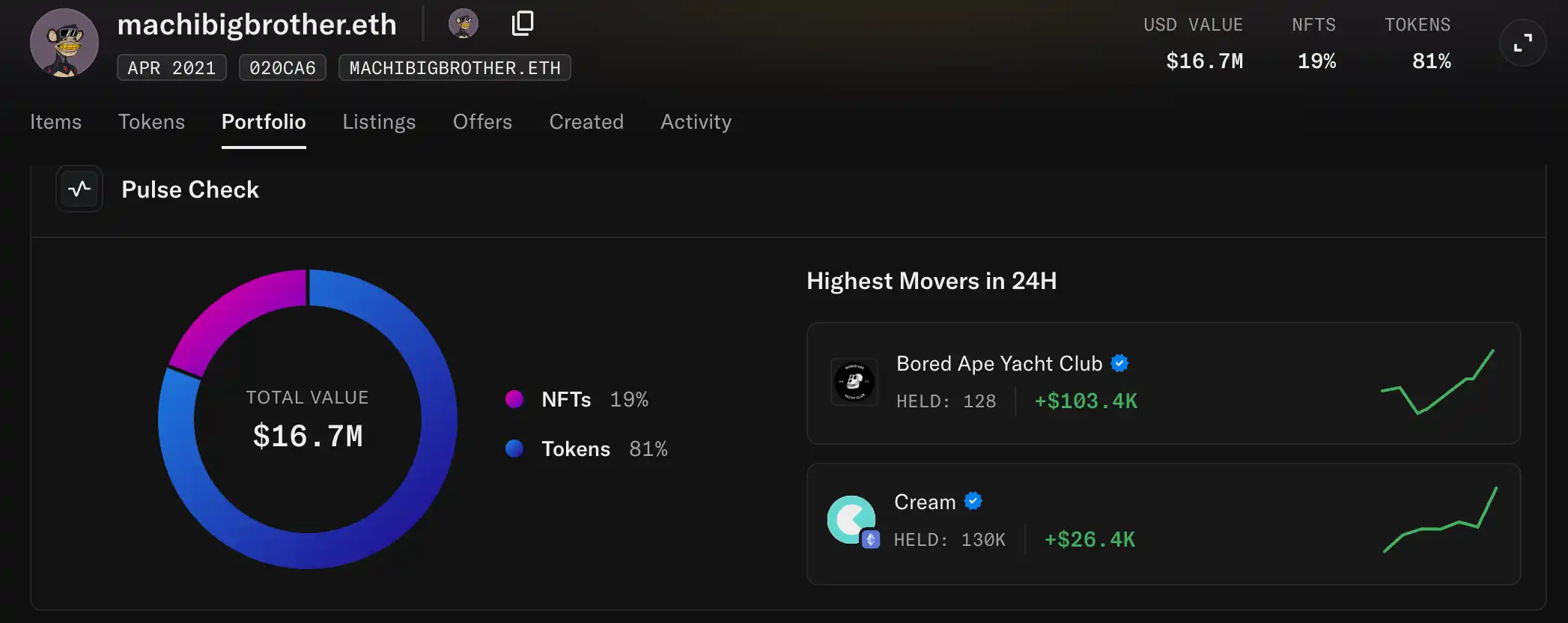
As of writing, according to OpenSea data, his NFT portfolio consists of 4,357 items, but the NFT portion's value has dwindled to only $3.17 million. This includes 128 BAYCs (~$2.5 million) and 102 MAYCs (~$288,000). In contrast, at his peak, he held a heavy position of over three hundred BAYCs.
Пов'язані питання

QWho is the main subject of the article, and what is his notable recent financial achievement?

AThe main subject is Machi Big Brother, a crypto whale. His notable recent achievement is turning a $150,000 principal into $12.72 million within three days through extreme leverage trading, an 84x return.

QWhat is the current situation of Machi Big Brother's portfolio on Hyperliquid as described in the article?

AAs of the snapshot, his account held about $10.07 million in total assets, but it was supporting a massive long position of $124 million. His overall leverage was approximately 13.1x. His main risk is the ETH position, which constitutes 59% of his total holdings and has a liquidation price around $2,229, about 10% below the current price.

QWhat is the trading strategy that Machi Big Brother used to achieve the recent $12.5 million profit, and what are its key risks?

AHe used a 'rolling' strategy. This means he didn't withdraw profits but used them as added margin to increase his position size, creating a compounding effect. The key risk is that while profits can grow exponentially during a sustained trend, the entire accumulated profit and principal can be wiped out in a single market reversal.

QWhy did Machi Big Brother sell a significant number of his Bored Ape Yacht Club (BAYC) NFTs in the months leading up to his recent trade?

AHe sold his BAYC NFTs at a loss to raise capital. The primary purpose was to add margin to his highly leveraged long positions on ETH on Hyperliquid, aiming to avoid or delay liquidation (forced selling) of those positions.

QAccording to the article, what is a characteristic pattern of Machi Big Brother's long-term trading history despite his recent success?

AHis long-term trading history is characterized by high leverage, consistent bias towards long positions, high frequency of winning trades but poor risk-to-reward ratio, and a pattern of adding more funds during losses instead of cutting losses. This has led to him being frequently liquidated and accumulating significant overall losses over time, earning him titles like 'on-chain liquidation champion'.

Пов'язані матеріали

How Does Wall Street View Warsh's Jackson Hole Debut? Hawkish 'Correction' of July Communication; Failure to Hike in September May Further Damage Fed Credibility

Wall Street widely interpreted Fed Chair Wash's first speech at the Jackson Hole symposium as a "hawkish correction" to the Fed's July FOMC communications. Wash firmly reiterated the Fed's unwavering commitment to the 2% inflation target, indicated that overall financial conditions are not restrictive, and stated that recent positive PCE and CPI data are not enough to show meaningful improvement in underlying inflation trends. He said if confidence is lacking that inflation is falling "clearly and fast enough," the Fed "has more work to do," with Reuters calling it his closest admission yet that another rate hike may be needed. This shifted market focus to the September meeting. JPMorgan's Priya Misra called it a "hawkish speech" that cleaned up July's communication "misstep." Aberdeen's Matthew Amis warned that if the Fed doesn't hike in September, its credibility could take another hit. Barclays and Société Générale now forecast 25-basis-point hikes in September and December, with SocGen adding a March hike expectation. However, analysts noted Wash provided principles but no explicit forward guidance. The "new Fed whisperer," Nick Timiraos, observed Wash gave a more hawkish diagnosis but no clear "reaction function." The CME's FedWatch Tool showed the probability of a September hike jumped from about 35% to around 50-60% after the speech. The bond market reaction was telling: short-term yields rose more than long-term yields, indicating traders were repricing near-term rate hikes. In essence, Wash rebuilt a hawkish policy logic: if the economy remains resilient and inflation doesn't fall fast enough, more tightening is possible. The consensus is that he successfully delivered a hawkish reset. While a September hike is now a serious possibility, the final decision will hinge on incoming data, creating a credibility test for the Fed if data doesn't improve and it holds rates steady.

marsbit12 хв тому

How Does Wall Street View Warsh's Jackson Hole Debut? Hawkish 'Correction' of July Communication; Failure to Hike in September May Further Damage Fed Credibility

marsbit12 хв тому

Warsh's Latest Speech: The Era We Are In

Federal Reserve Chairman Kevin W. Warsh delivered a speech titled "In Our Time" at the Jackson Hole Economic Policy Symposium. The remarks struck a cautiously hawkish tone, with Warsh emphasizing that inflation remains significantly above the Fed's 2% target and should be the primary focus of monetary policy. He expressed that recent, better-than-expected CPI and PCE data do not yet signal a meaningful improvement in the underlying inflation trend. Warsh outlined core principles for monetary policy, including the firm commitment to the 2% inflation target, the importance of both price stability and maximum employment, and the primary role of short-term interest rates as a policy tool. He also stressed the relevance of monetary aggregates and advocated for a Fed that communicates with greater purpose and restraint. A significant portion of the speech addressed the practice of "forward guidance." Warsh argued that while essential during crises, forward guidance should be limited in normal times. He warned that excessive pre-commitment to future policy paths can constrain the Fed's flexibility and create a "hall-of-mirrors" problem, where markets rely too heavily on Fed signals rather than independently assessing economic fundamentals. On the current economy, Warsh noted impressive resilience, strong business investment (partly driven by AI infrastructure), healthy consumer spending, and a stable labor market with low unemployment. However, he observed that broad financial conditions are not particularly restrictive. Despite economic strength, inflation metrics remain elevated, with a high proportion of PCE basket components still showing price increases above 3%. Warsh concluded by stating the Fed's standard: policymakers must be confident that underlying inflation is moving clearly and sufficiently quickly toward the 2% target. Otherwise, "we have more work to do." He framed his approach as a commitment to disciplined policy-making rather than to any specific near-term decision.

marsbit2 год тому

Warsh's Latest Speech: The Era We Are In

marsbit2 год тому

Access to Active Sessions Instead of Databases: How the Shadow Market in Russia Has Changed

The Russian cybercriminal underground is shifting from selling massive, stolen corporate databases to trading active, short-term access to user accounts, according to a 2026 report. The value of information intercepted directly from infected devices by malware has risen nearly 13% in a year. Attackers now sell packets containing active session tokens (bypassing passwords and two-factor authentication), live email credentials, VPN and cloud storage logins, and corporate network access. A subscription for a steady stream of fresh data costs $250-$300 per month, far exceeding the value of outdated archives. While Russian regulators have successfully penalized companies for data leaks from centralized storage—with no repeat violations recorded after imposing turnover fines—this framework fails against the new threat model. Malware now steals data *after* it leaves the corporate perimeter and is on a user's personal device, a legal grey area. In 2026, 60% of studied web attacks aimed to steal keys for infiltrating corporate infrastructure. The situation mirrors global trends, akin to the Genesis Market shutdown in 2023, and highlights a structural risk: the demand for "fresh" data incentivizes botnet operators to maintain long-term control of infected devices for recurring revenue. This creates a persistent vulnerability layer between personal devices and corporate networks, currently outside the reach of existing regulatory protections.

cryptonews.ru4 год тому

Access to Active Sessions Instead of Databases: How the Shadow Market in Russia Has Changed

cryptonews.ru4 год тому

Торгівля

Спот
活动图片