Micron Invests $24 Billion in Singapore Factory, But Your RAM Sticks Are Not in the Plan

marsbitОпубліковано о 2026-01-27Востаннє оновлено о 2026-01-27

Анотація

Micron announces a $24 billion investment to build an advanced NAND wafer fabrication plant in Singapore, with production starting in late 2028. This follows a previous $7 billion investment in a high-bandwidth memory (HBM) advanced packaging facility at the same site, bringing total new investments in Singapore to over $30 billion. The move comes as Micron shifts its focus toward AI-driven demand and away from consumer products, having recently discontinued its Crucial consumer brand, which sold retail memory modules and SSDs. The strategic pivot is driven by surging demand from AI and data centers. Micron’s HBM revenue reached $1.98 billion in Q3 FY2025, with full-year 2026 HBM supply already sold out. The company predicts the HBM market will grow to around $100 billion by 2028, surpassing the entire DRAM market of 2024. In contrast, consumer memory market is lower-margin and highly competitive. This supply shift has contributed to significant price increases in consumer memory products, with DDR4 and DDR5 spot prices rising over 150% and 300% respectively in 2025. Although Samsung and SK Hynix have extended DDR4 production in response to soaring prices, overall supply remains tight. As AI continues to drive memory demand, consumer memory costs are expected to stay elevated.

Author: David, Shenchao TechFlow

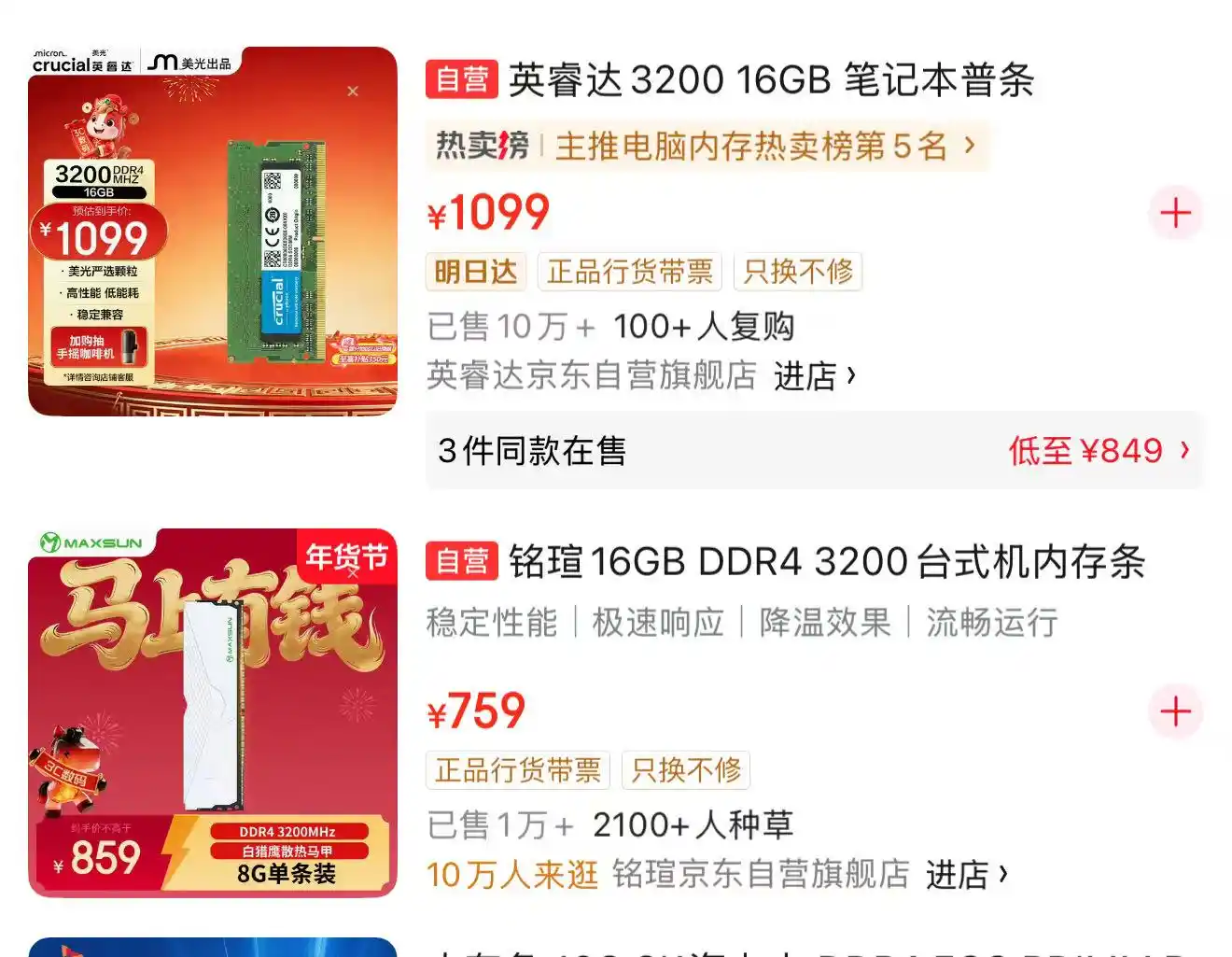
At this time last year, a 16GB DDR4 RAM stick cost just over 200 RMB. Now, the same model is priced at 600 RMB, with some models even approaching 700 RMB.

The direct reason for the price increase is a tightening of supply. The three major memory giants have collectively shifted their production capacity towards the AI market. And Micron is the latest to lay its cards on the table.

On January 27, Micron Technology announced a $24 billion (approximately S$31 billion) investment to build an advanced NAND (flash memory) wafer fabrication plant in Singapore. The investment will be phased over 10 years, with shipments starting in the second half of 2028. Singapore's Deputy Prime Minister Gan Kim Yong attended the groundbreaking ceremony.

This is Micron's second major investment in Singapore.

In January 2025, Micron had already begun construction on a $7 billion HBM (High Bandwidth Memory) advanced packaging facility within the same campus, scheduled for production in 2027. Combined, these two projects represent over $30 billion in new investments by Micron in Singapore.
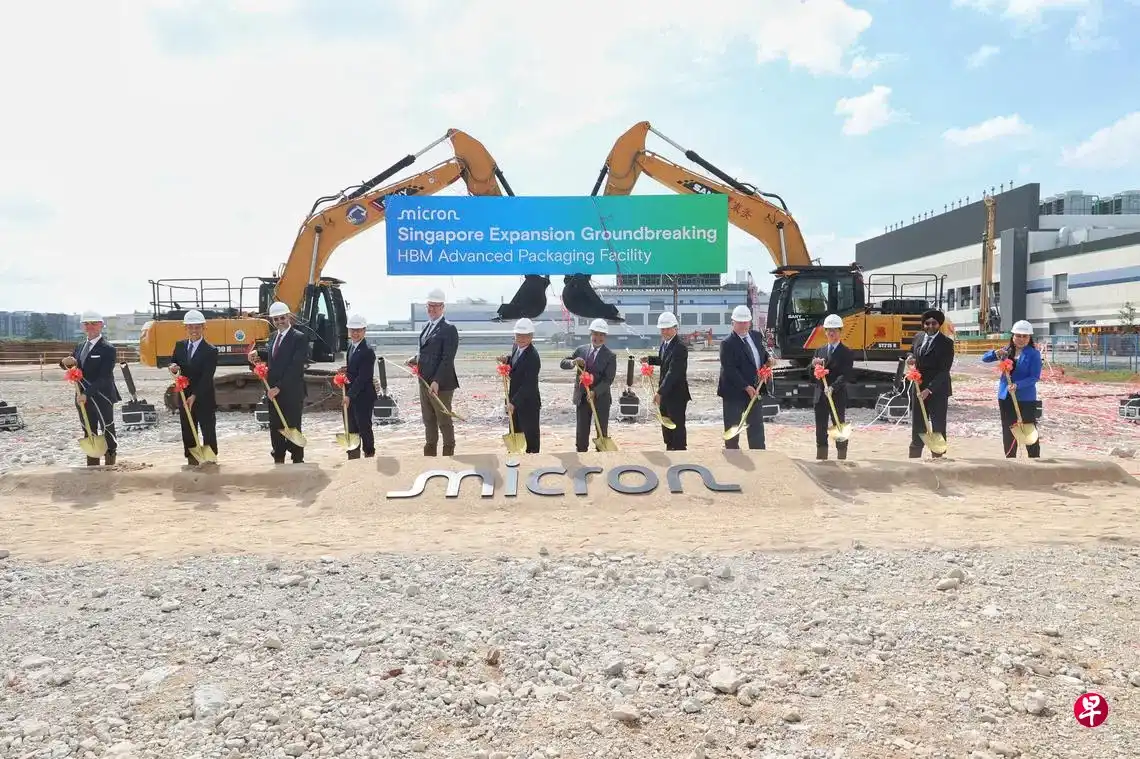
Image source: Lianhe Zaobao, photo by Tang Jiahong

Yet, this is the same company that just two months ago announced the shutdown of its 29-year-old Crucial consumer brand—the memory sticks and solid-state drives you can buy on JD.com and Taobao.

On one hand, spending billions to build factories; on the other, cutting the consumer business. Both point to the same clue: the demand for memory from AI remains high.

Capacity Reallocation After China Market Contraction

Micron's increased investment in Singapore has a clear geopolitical background.

In May 2023, China's Cyberspace Administration announced that Micron's products had not passed the cybersecurity review and required domestic critical information infrastructure operators to stop procurement. In 2018, the Chinese mainland market contributed 58% of Micron's revenue (approximately $17.36 billion); by fiscal year 2022, this had fallen to 10.8% (approximately $3.31 billion).

Production capacity needs a new outlet.

Currently, Micron already has three 3D NAND fabrication plants and several packaging and testing facilities in Singapore, employing about 9,000 people and producing 98% of Micron's flash memory chips.

Micron stated in its latest announcement that the HBM factory is expected to make a significant contribution to supply by 2027 and mentioned that as HBM becomes part of the Singapore manufacturing operations, "synergistic effects" in both NAND and DRAM (Dynamic Random-Access Memory, the common memory chips) production are anticipated.

But the priority of this "synergy" is clear: HBM capacity for 2026 is completely sold out, data center customer demand cannot be fully met, and the consumer brand is being shut down simultaneously.

Within the same campus, consumer-grade production lines are making way for AI production lines.

The Business Logic of Exiting the Consumer Market

On December 3, 2025, Micron announced via its official website a complete exit from the Crucial consumer business, including the sales of RAM sticks and SSD (Solid State Drive) products through global retailers, e-commerce platforms, and distributors.

Shipments will continue until the end of February 2026, at which point this brand, founded in 1996, will bid farewell to the retail market.

In the statement, Micron's Executive Vice President, Sadana, stated that the surge in memory and storage demand driven by AI in data centers prompted Micron to make the "difficult decision" to exit the Crucial consumer business in order to more effectively supply and support large strategic customers in high-growth areas.

Data supports this judgment.

Micron's fiscal year 2025 third-quarter HBM product income reached $1.98 billion, with an annualized revenue close to $8 billion. According to TrendForce data, the unit price of HBM memory required for AI servers is about 8 times that of ordinary servers.

Micron predicts the HBM market size will grow from approximately $35 billion in 2025 to about $100 billion in 2028, by which time it will exceed the size of the entire DRAM market in 2024.

In contrast, consumer-grade storage is a business with thin profits and fierce competition.

Micron's exit means the world's major consumer DRAM manufacturers are reduced from three—Samsung, SK Hynix, Micron—to two.

The AI Rally of Memory Stocks

The capital market has already priced in this shift.

According to statistics from *National Business Daily*, memory stocks occupied the top four spots on the U.S. stock gainers list for the full year 2025:

SanDisk rose 577%, becoming the S&P 500's top performer for the year; Western Digital rose 281%; Micron rose 236%; Seagate rose 216%.
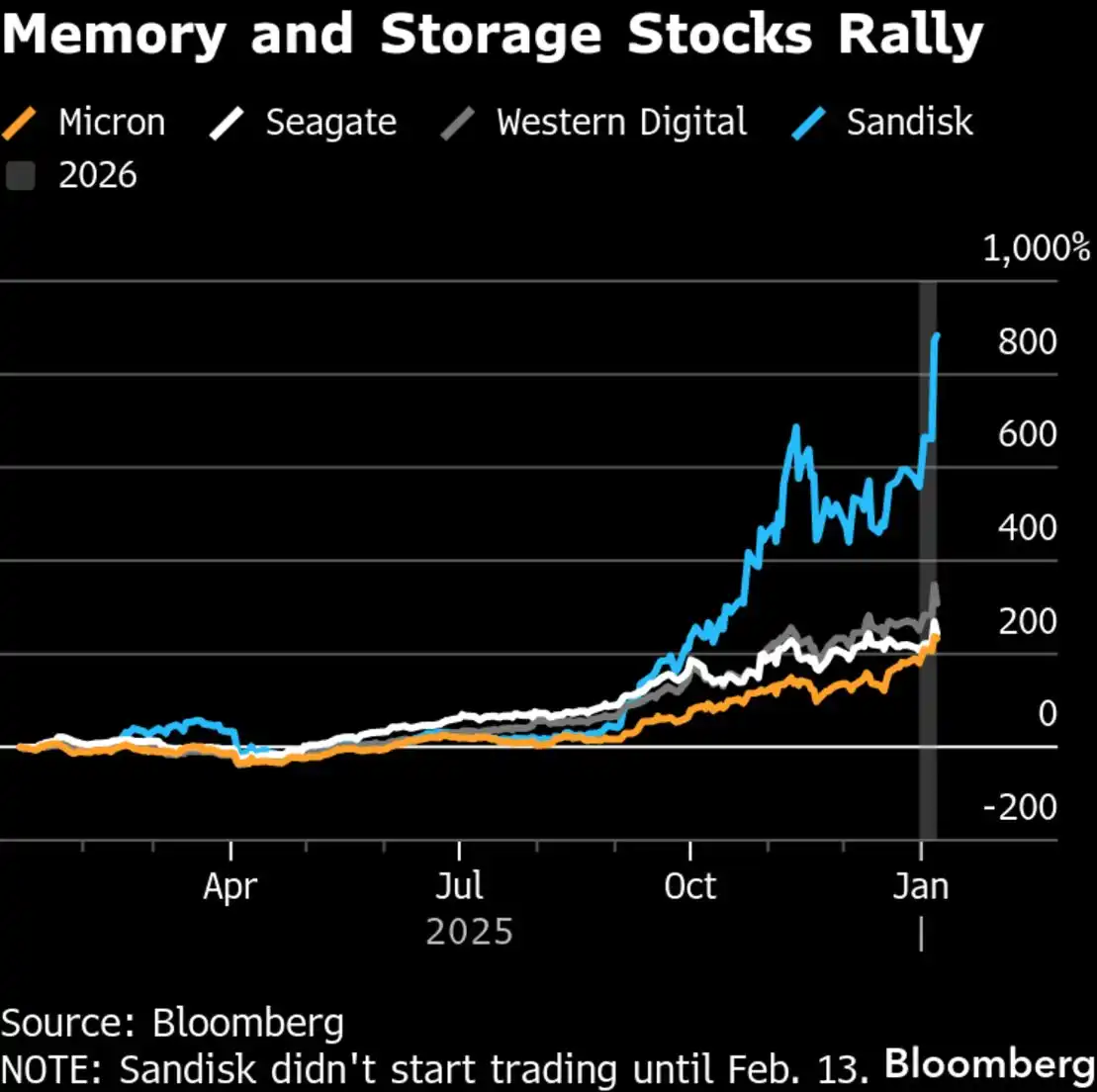
For comparison, Nvidia rose 39% in the same period, ranking 71st.

It was reported that tech giants like Google and Amazon presented Micron with "unlimited purchase demands" in October 2025. Micron CEO Mehrotra revealed on an earnings call that the company's entire HBM supply for 2026 is already sold out, and currently, it can only meet half to two-thirds of the demand from key customers.

Micron's latest financial report shows revenue of $13.6 billion for September-November 2025, a year-on-year increase of 57%, with DRAM revenue of $10.8 billion, up 69% year-on-year.

Consumer Side: Price Hikes May Continue

Samsung, SK Hynix, and Micron had all previously announced plans to gradually phase out DDR4 production from late 2025 to early 2026. Micron issued an end-of-life notice for DDR4/LPDDR4 in June.

Although Samsung and SK Hynix later extended their DDR4 production plans to the end of 2026 due to soaring DDR4 prices, the overall trend of tightening supply remains unchanged.

The price reaction has been intense. According to TrendForce data, since 2025, the spot price of DDR5 memory chips has risen over 300%, while DDR4 has risen over 150%. DDR4 has even seen a "price inversion," with the price of some specifications exceeding that of DDR5.
ADATA Chairman Chen Libai also publicly stated that the comprehensive shortage and price increase across the four major storage categories—DRAM, NAND, SSD, HDD—is a situation he is witnessing for the first time in over thirty years in the industry.

If you want to add memory to your old computer or build a new desktop, the cost remains high. Because AI needs computing power, and computing power needs memory. Your old computer is probably still behind AI demand in the queue.

Memory stocks have risen, and memory stick prices have risen too.

One is an investment opportunity; the other is paying the bill for that opportunity.

Пов'язані питання

QWhy did Micron announce the closure of its Crucial consumer brand?

AMicron closed its Crucial consumer brand to reallocate resources and supply to meet the surging demand for memory and storage from data centers and large strategic customers driven by AI, as the consumer market is less profitable and highly competitive.

QWhat is the total investment Micron is making in Singapore for new manufacturing facilities?

AMicron is investing a total of over $30 billion in Singapore, including $24 billion for a new NAND wafer fab and over $7 billion for an HBM advanced packaging plant.

QHow has the price of consumer memory modules changed recently according to the article?

AThe price of a 16GB DDR4 memory module has increased from over 200 yuan to about 600 yuan, with some models nearing 700 yuan, due to tightened supply and shifted production focus to AI.

QWhat percentage of Micron's revenue came from the Chinese market in 2022 compared to 2018?

AIn 2018, the Chinese market contributed 58% of Micron's revenue, but by the 2022 fiscal year, it had decreased to 10.8%.

QWhich storage-related stocks were the top performers in the U.S. stock market in 2025 according to the article?

AIn 2025, the top-performing U.S. storage stocks were SanDisk (up 577%), Western Digital (up 281%), Micron (up 236%), and Seagate (up 216%).

Пов'язані матеріали

TurboFlow Announces Strategic Partnership with Global Giant Susquehanna Crypto, Introducing Wall Street Institutional-Grade Liquidity and Dynamic Odds Market Structure Support

TurboFlow announces a strategic partnership with Susquehanna Crypto, a leading global proprietary digital asset trading firm. As part of this collaboration, Susquehanna Crypto will act as an on-chain liquidity provider and market maker for all TurboFlow products. This partnership brings institutional-grade liquidity, market-making support, and expertise in professional trading, market structure, price discovery, and risk management to the TurboFlow ecosystem. This marks a significant milestone for TurboFlow as it expands its product suite, which includes perpetual contracts and newly launched Event Contracts with durations as short as 30 seconds. Enhanced liquidity depth, efficient price discovery, and market stability are becoming increasingly critical for user experience. Notably, TurboFlow is transitioning its Event Contracts from a traditional fixed-odds model to a more dynamic, market-driven odds structure. Susquehanna Crypto will inject deep liquidity through TurboFlow's proprietary PFOF (Payment for Order Flow) architecture. This aims to ensure minimal slippage and millisecond-level execution for users, even during extreme market volatility, whether trading 1000x leveraged perpetuals or short-duration event contracts. Looking ahead, TurboFlow plans to onboard more top-tier institutional market makers to build a diversified liquidity network. The platform will continue expanding its product ecosystem across several verticals: Event Contracts (extending to assets like crude oil and gold), prediction markets and Telegram Mini Apps, and perpetual contracts. TurboFlow's mission is to democratize trading by making professional-grade infrastructure and a simplified, engaging experience accessible to all users.

链捕手19 хв тому

TurboFlow Announces Strategic Partnership with Global Giant Susquehanna Crypto, Introducing Wall Street Institutional-Grade Liquidity and Dynamic Odds Market Structure Support

链捕手19 хв тому

$30 Billion DeFi Capital Exodus: LayerZero Stumbles, Chainlink Feasts

Following the major DeFi security incident involving Kelp DAO, a significant migration of funds is underway from the cross-chain protocol LayerZero to Chainlink's CCIP (Cross-Chain Interoperability Protocol). Over $30 billion in Total Value Locked (TVL) from protocols like Kelp DAO, Solv Protocol, Re, and Tydro has moved to Chainlink in the past week, driven by security concerns. LayerZero is facing a severe trust crisis after the attack. Initially denying responsibility, LayerZero Labs has now issued a public apology, acknowledging management oversights. These include a vulnerable "1/1" single-node configuration for its Decentralized Verification Network (DVN) and past misuse of a multi-signature wallet by a team member. The protocol's weekly bridge volume has slumped to near-historic lows of around $470 million. In contrast, Chainlink is experiencing a surge in adoption and activity. Its independent active addresses recently hit multi-month highs, and whales have been accumulating LINK tokens. Beyond DeFi, Chainlink is securing partnerships with traditional finance giants like DTCC, European stock exchange operator SIX Group, and asset manager Amundi. While LayerZero has announced security upgrades—such as migrating to stronger multi-signature configurations and developing a second DVN client—and contributed to a rescue fund, the event underscores that security is becoming a decisive competitive factor as DeFi matures.

marsbit1 год тому

$30 Billion DeFi Capital Exodus: LayerZero Stumbles, Chainlink Feasts

marsbit1 год тому

The $13 Trillion Repo Market Is Quietly Being Rewritten by Blockchain

The $13 trillion repurchase agreement (repo) market, a crucial artery for global short-term funding, is experiencing a significant transformation through blockchain technology. After years of limited impact in finance, blockchain is finding substantial adoption in repo transactions. Major institutions like JPMorgan Chase, HSBC, and Broadridge are deploying tokenized repo platforms, with daily volumes already reaching tens of billions of dollars. Traditional repo markets operate with fixed hours, rely on intermediaries, and involve manual, time-consuming processes. Tokenized repos, by contrast, use blockchain to create digital tokens representing cash and securities collateral. This enables near-instantaneous settlement, 24/7 trading, automated execution, and enhanced auditability. The key drivers for adoption include maturing technology, more receptive regulators, and growing client recognition of tangible benefits like reduced operational friction and capital efficiency. Analyses, such as one from Broadridge, indicate that moving a portion of repo activity onto blockchain can significantly reduce a bank's required liquidity buffers, potentially freeing up billions in capital. The infrastructure is also seen as foundational for a future of round-the-clock trading for traditional assets. Challenges remain, including the existence of fragmented blockchain networks, the need for stress testing under extreme market conditions, and the loss of operational flexibility compared to manual processes. However, the industry consensus is that these are implementation hurdles. Tokenized repo has moved beyond pilot stages to become one of blockchain's most concrete and impactful applications in traditional finance, marking a pivotal shift in how a core market functions.

marsbit1 год тому

The $13 Trillion Repo Market Is Quietly Being Rewritten by Blockchain

marsbit1 год тому

Торгівля

Спот
Ф'ючерси
活动图片