Metrics Ventures: Why Are Gold, the Renminbi, and Bitcoin the Same Answer?

marsbitОпубліковано о 2026-01-28Востаннє оновлено о 2026-01-28

Анотація

Metrics Ventures analyzes the shifting global monetary and geopolitical order, arguing that gold, the Chinese yuan, and Bitcoin are all responses to the same underlying trend: a loss of faith in the existing international system and governance structures. The article begins by noting the surge in gold demand, particularly from central banks, which signals a deeper repricing of sovereign currency credit and global governance effectiveness rather than mere inflation hedging. This sentiment was a key theme at the Davos forum, where leaders discussed the breakdown of the "rules-based international order." As trust in multilateral institutions wanes, nations are rationally shifting towards strategic autonomy and risk management, preparing for uncertainty rather than operating within old assumptions. This erosion of trust is penetrating financial markets. Sovereign debt and currencies are no longer just economic tools but are now discounted for a state's governance capability and political constraints. The core of the issue is identified as structural within the dollar-centric system, which requires the U.S. to run persistent deficits to supply the world with "risk-free" dollar assets. This imbalance was sustainable as long as dollar assets were seen as uniquely safe, but the weaponization of financial tools and declining governance trust is forcing a repricing. The piece contrasts the responses of two major surplus economies: Japan and China. Japan absorbed adjustment costs thr...

Authored by: Metrics Ventures

Over the past year, gold's performance has been particularly striking. More importantly, the demand structure has undergone significant changes: the willingness of central banks and sovereign entities to allocate has noticeably increased. This can no longer be simply explained as inflation hedging or short-term safe-haven trading. A more reasonable understanding is that gold is responding to a deeper change—a repricing of sovereign monetary credit and the effectiveness of global governance.

This change was repeatedly discussed at this year's Davos Forum. Whether in formal agendas or private discussions, phrases like "imbalance in the world governance structure," "the old order is breaking," and "we are entering a phase from which there is no return" almost became the common context. On Tuesday, Canadian Prime Minister Mark Carney's speech at Davos clearly articulated this sense of unease pervading the venue. He bluntly stated that the so-called "rules-based international order" is disintegrating, and humanity is moving from a once useful, albeit fictional, narrative towards a harsher reality: great power competition is no longer constrained, economic integration is being weaponized, and rules are selectively applied in the face of power.

Carney did not simply blame a single country but pointed to a more widespread change in circumstances. When tariffs, financial infrastructure, supply chains, and even security commitments can be used as bargaining chips, the multilateral institutions—whether the WTO, the UN, or other rule-based frameworks—on which medium-sized powers and open economies rely for survival are losing their binding force. In such an environment, continuing to pretend that the rules are still functioning normally becomes a form of self-deception. He used Havel's metaphor of "living within a lie" to remind countries: the real risk is not that the order is changing, but that people are still acting according to the language and assumptions of the old order.

More notably, what Carney repeatedly emphasized was not ideological confrontation but a shift in governance choices. When rules no longer automatically provide security, nations turn to another rationality: enhancing strategic autonomy, diversifying dependencies, and building "pressure-resistant" capabilities. In his view, this is a typical risk management logic, not a betrayal of values. But it is precisely here that the foundation sustaining the old order begins to loosen—because once countries no longer believe the system can consistently provide public goods, they will instead buy "insurance" for themselves.

If we abstract the Davos discussions from specific countries, we find a deeper common direction: countries have not suddenly become more conservative but have begun to tacitly accept that a key assumption is failing—that the existing global governance system can long-term coordinate fiscal, monetary, and international responsibilities. When this premise is no longer widely believed, national behavior shifts from "division of labor within rules" to "preparing for uncertainty." And this shift will ultimately be reflected in the most fundamental areas: debt, fiscal policy, and currency.

It is here that the cracks in world governance begin to penetrate financial pricing. National debt is no longer just a macro-control tool but is re-examined as a discount of governance capacity and political constraints; sovereign currency is no longer just a medium of exchange but is required to simultaneously bear the functions of intertemporal commitment, international responsibility, and crisis buffer. Once the market begins to doubt whether these roles can still be fulfilled simultaneously, the impact on monetary credit is no longer an extreme scenario but a gradual yet irreversible process.

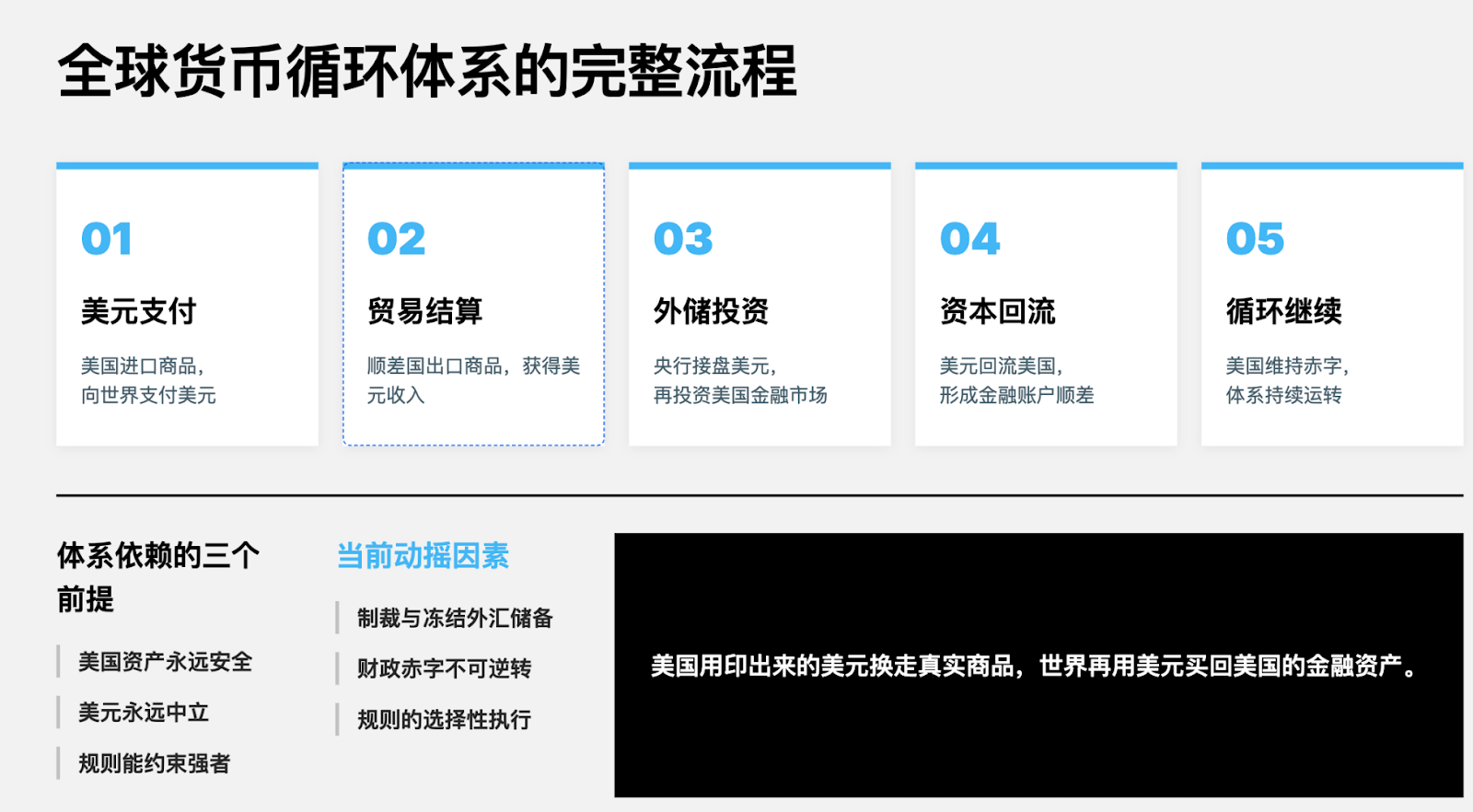
And all this does not stem from the fiscal mistakes of a particular country but is embedded within the current international monetary system. The dollar-centric system dictates that the world must have a long-term deficit center that absorbs external savings, and it also dictates that surpluses and deficits are not accidental but a role division solidified by the system. The US dollar is both a sovereign currency of the United States and the basis for global reserves, pricing, and safe assets. This means that global demand for "risk-free dollar assets" further intensifies when uncertainty rises. To provide these assets to the world, the US can only fulfill this role by continuously incurring external liabilities.

In an environment of financialization and free capital flows, this division of labor is constantly amplified. Surpluses are no longer primarily digested through adjustments in commodity prices or exchange rates but are transformed into long-term allocations to US Treasury bonds and dollar-denominated financial assets; deficits are no longer immediately constrained but are postponed and absorbed through the financial system and central bank intervention. As long as the world still believes that dollar assets possess irreplaceable safety in a crisis, this imbalance can persist long-term, even being seen as a source of systemic stability.

But when governance trust declines, rule constraints weaken, and financial tools are frequently weaponized, this structural imbalance begins to be repriced. Surpluses and deficits are no longer just macroeconomic phenomena but become risk exposures themselves. It is also against this backdrop that Japan and China, both surplus countries, have gradually moved towards different paths.
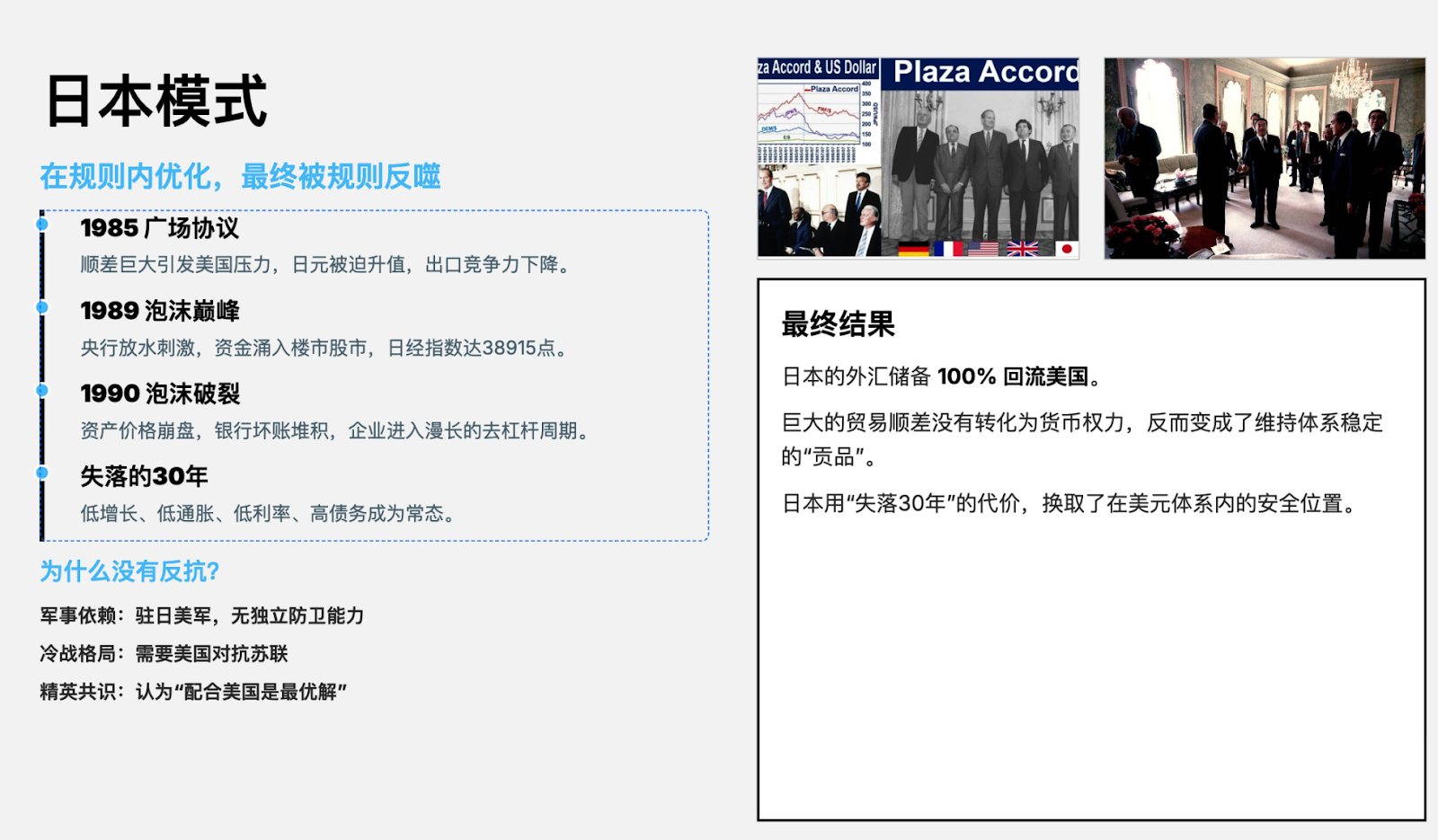
Japan has played the most typical and "cooperative" surplus country role in this system. Under external pressure and rule constraints, Japan chose to absorb adjustment costs through currency appreciation, financial liberalization, and long-term accommodative policies, thereby maintaining the stability of the overall order. This strategy reduced friction in the short term but transformed structural adjustments into domestic low growth, high debt, and deep central bank intervention. The surplus did not disappear but was internalized as the cost of long-term stagnation; Japan's monetary internationalization capacity was also significantly limited in this process.
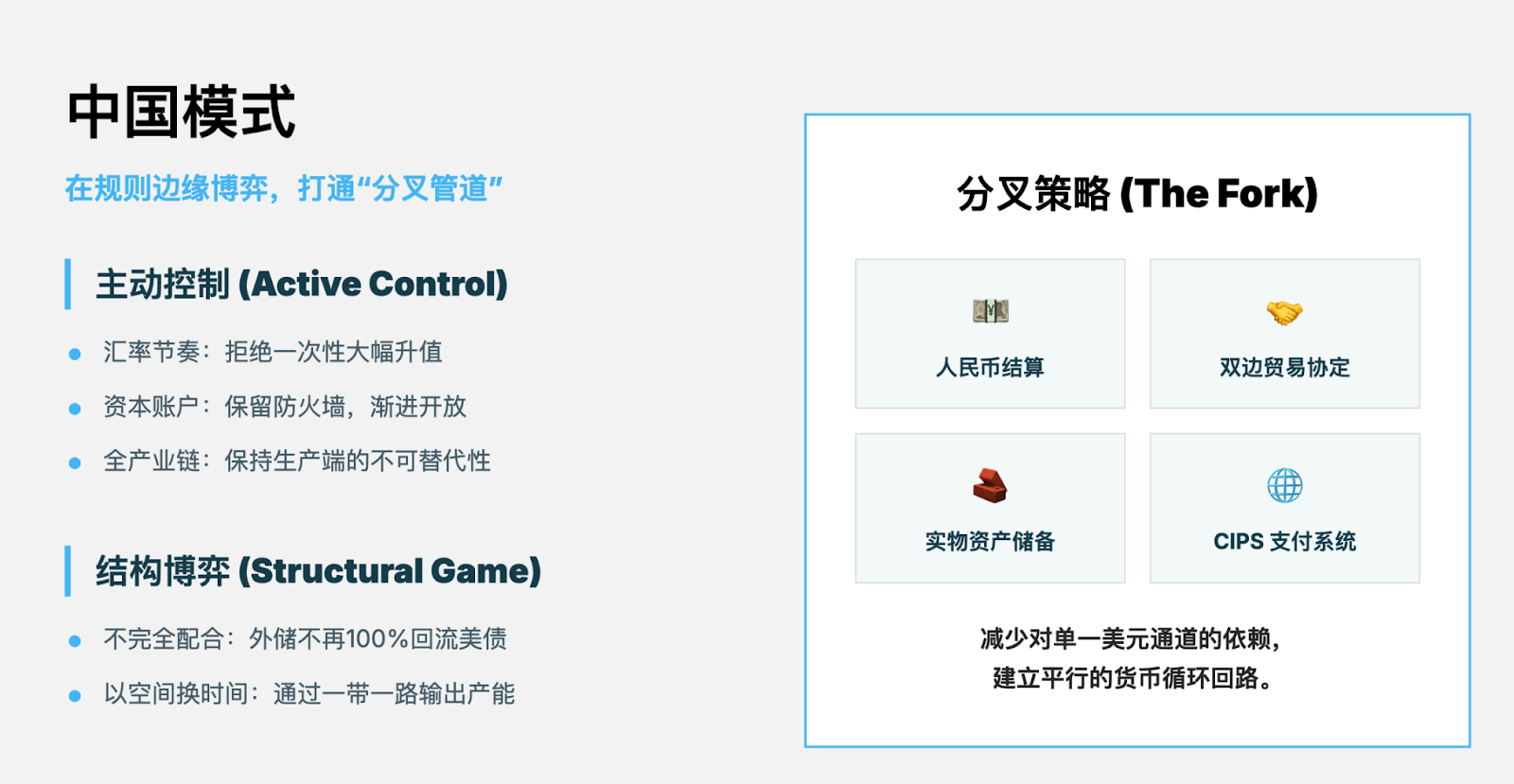
China entered this system later, and its stage of development and internal constraints were significantly different from Japan's. Faced with surplus expansion and external pressure, China did not fully choose to clear rapidly through price and financial channels but, within the framework of exchange rate management, capital account controls, and industrial upgrading, sought to preserve policy autonomy as much as possible. This choice has long placed China in controversy, accused of "distorting rules" or "free-riding," but from a governance perspective, it appears more like a strategic arrangement to buy time and space for internal transformation within the existing system, rather than simple institutional arbitrage.

More importantly, this path did not stop at "maintaining a surplus" but quietly changed the structure of renminbi demand. As China's position in global trade, manufacturing, and key supply chains has risen, the renminbi is no longer just a settlement tool but is increasingly seen by more economies as a practical option for reducing external dependence and diversifying currency risk. Against the backdrop of intensified geopolitics and the instrumentalization of financial sanctions, sole reliance on the dollar system itself begins to be seen as a risk exposure, giving demand for renminbi settlement, renminbi financing, and renminbi asset allocation a clear strategic motivation.

Once renminbi demand shifts from passive use to active allocation, its impact is no longer limited to the trade level but transmits to the financial level. More frequent and stable usage scenarios mean the market needs a deeper and more liquid renminbi asset pool to accommodate this demand. Increased liquidity, in turn, affects how assets are priced, gradually moving renminbi assets from "domestic policy pricing" towards "a logic closer to international marginal pricing." This process does not rely on complete capital liberalization but is更多的是 pulled by real demand, representing a gradual yet hard-to-reverse change.
It is also in this contrast that "the East rises while the West declines" has once again become a proposition that can be seriously discussed in recent years. It is no longer an emotional judgment about the rise and fall of a particular country but a reflection of the changing costs of systemic roles. As the self-healing capacity of the dollar system declines, the space for the deficit center to continue absorbing imbalances through debt and financial expansion is shrinking; meanwhile, the importance of surplus economies in industrial chains, security, and regional arrangements is rising. In this process, China, by not fully replicating Japan's adjustment path, has retained industrial, policy, and monetary space, giving it higher strategic elasticity in systemic restructuring.

But this change does not mean a new single hegemonic currency is forming. A more realistic picture is the monetary system moving towards a multi-center and coexisting structure. The centrality of the US dollar may be weakened but will not disappear quickly; the status of the renminbi in trade settlement, regional finance, and liquidity provision will gradually increase, yet not necessarily predicated on full free floatation, but more reliant on trade networks, industrial chain depth, and policy credibility. Monetary internationalization here is no longer an institutional label but an outcome that is used into existence.

In such systemic evolution, the logic of reserve assets also changes accordingly. Gold's return to a core position is not because it can provide yield, but because it does not rely on any country's tax base, political stability, or international commitments; it is a direct response to governance uncertainty. It provides countries with a de-sovereign, de-credit reserve option, particularly suited to function in an environment lacking consensus and with weakened rule constraints.

Bitcoin represents another tier of de-sovereign asset. Although its performance has lagged behind gold and some traditional assets over the past year and a half, its core logic has not been disproven. As a digital, scarce asset not attached to any single governance system, it更像 is more like a long-term option on future monetary forms. As monetary system restructuring becomes more explicit and liquidity is reallocated, its pricing logic is more likely to catch up in later stages rather than lead in the early phases.

If these clues are finally gathered together, one finds that what this as-yet-unnamed order migration is truly changing is not short-term power comparisons, but the preconditions for the validity of assets. When rules no longer automatically provide safety, when monetary credit itself becomes a risk that needs to be hedged, the core question of asset allocation is no longer betting on who wins, but how to remain valid in a world where uncertainty has become the norm.

Against this backdrop, gold is a defensive response, while more directional choices are embodied in the renminbi and Bitcoin. The renminbi represents the real liquidity embedded in the new order, a bet on monetary restructuring pulled by trade, industry, and real demand; Bitcoin represents the ultimate hedge against governance uncertainty, a long-term option detached from any single sovereign system. Choosing them is not a statement of stance, but a largely self-consistent outcome of asset allocation under the premise that the cracks in world governance have already become explicit.

History does not announce itself with dramatic events. It is often only at a moment when looking back that people realize the order has already, imperceptibly, migrated.


Пов'язані питання

QAccording to the article, why is gold experiencing a resurgence in demand from central banks and sovereign entities?

AThe demand is not just a simple inflation hedge or short-term safe-haven trade. It is a response to a deeper structural change: a repricing of sovereign currency credit and the perceived declining effectiveness of global governance. Gold provides a non-sovereign, non-credit-based reserve asset that acts as a direct hedge against governance uncertainty.

QWhat fundamental flaw in the current international monetary system does the article identify as the root cause of instability?

AThe article identifies the dollar-centric system as the root cause. This system structurally requires a permanent deficit center (the U.S.) to absorb global savings by issuing debt, while surplus countries accumulate dollar assets. This imbalance is institutionalized, and its stability relies on the unwavering global belief in the safety of dollar assets, a belief that is now eroding due to geopolitical weaponization of financial tools and declining trust in governance.

QHow does the strategic response of China to its trade surplus differ from that of Japan, as described in the article?

AJapan absorbed the costs of adjustment through currency appreciation, financial liberalization, and long-term easing policies to maintain the existing order, which led to domestic stagnation and high debt. China, however, used capital controls and managed exchange rates to retain policy autonomy, focusing on internal transformation and industrial upgrading. This path has given China greater strategic elasticity and is now shifting RMB demand from passive use to active strategic configuration by other nations.

QWhat role does the article assign to Bitcoin in the evolving monetary landscape?

ABitcoin is described as a long-term option on future monetary forms. It is a digital, scarce asset that is not dependent on any single governance system. It represents the ultimate hedge against governance uncertainty. Its pricing logic is expected to catch up later in the cycle of monetary system restructuring rather than lead in the early stages.

QWhat is the common answer that gold, the RMB, and Bitcoin provide, according to the article's conclusion?

AThey are all responses to a world where the 'rules-based international order' is fracturing and monetary credit itself has become a risk that needs to be hedged. Gold is the defensive response. The RMB represents a bet on a new monetary structure embedded in real trade and industrial demand. Bitcoin is the ultimate, long-term hedge against sovereign system uncertainty. Choosing them is a coherent asset allocation result in a world where uncertainty is the new constant.

Пов'язані матеріали

Торгівля

Спот
Ф'ючерси

Популярні статті

Що таке $S$

Розуміння SPERO: Комплексний огляд Вступ до SPERO Оскільки ландшафт інновацій продовжує еволюціонувати, виникнення технологій web3 та криптовалютних проектів відіграє ключову роль у формуванні цифрового майбутнього. Один з проектів, який привернув увагу в цій динамічній сфері, — це SPERO, позначений як SPERO,$$s$. Ця стаття має на меті зібрати та представити детальну інформацію про SPERO, щоб допомогти ентузіастам та інвесторам зрозуміти його основи, цілі та інновації в рамках web3 та крипто-сектору. Що таке SPERO,$$s$? SPERO,$$s$ — це унікальний проект у криптопросторі, який прагне використати принципи децентралізації та технології блокчейн для створення екосистеми, що сприяє залученню, корисності та фінансовій інклюзії. Проект розроблений для полегшення взаємодії між користувачами новими способами, надаючи їм інноваційні фінансові рішення та послуги. У своїй основі SPERO,$$s$ прагне надати можливості індивідам, забезпечуючи інструменти та платформи, які покращують користувацький досвід у криптовалютному просторі. Це включає в себе можливість більш гнучких методів транзакцій, сприяння ініціативам, що підтримуються спільнотою, та створення шляхів для фінансових можливостей через децентралізовані додатки (dApps). Основна концепція SPERO,$$s$ обертається навколо інклюзивності, прагнучи зменшити розриви в традиційній фінансовій системі, використовуючи переваги технології блокчейн. Хто є творцем SPERO,$$s$? Особистість творця SPERO,$$s$ залишається дещо невідомою, оскільки є обмежені публічно доступні ресурси, що надають детальну інформацію про його засновників. Ця відсутність прозорості може бути наслідком зобов'язання проекту до децентралізації — етики, яку багато проектів web3 поділяють, ставлячи колективні внески вище за індивідуальне визнання. Зосереджуючи обговорення навколо спільноти та її колективних цілей, SPERO,$$s$ втілює суть наділення без виділення конкретних осіб. Таким чином, розуміння етики та місії SPERO є більш важливим, ніж ідентифікація єдиного творця. Хто є інвесторами SPERO,$$s$? SPERO,$$s$ підтримується різноманітними інвесторами, починаючи від венчурних капіталістів до ангельських інвесторів, які прагнуть сприяти інноваціям у крипто-секторі. Зосередження цих інвесторів зазвичай узгоджується з місією SPERO — пріоритет надається проектам, які обіцяють технологічний прогрес у суспільстві, фінансову інклюзію та децентралізоване управління. Ці інвесторські фонди зазвичай зацікавлені в проектах, які не лише пропонують інноваційні продукти, але й позитивно впливають на спільноту блокчейн та її екосистеми. Підтримка з боку цих інвесторів підкріплює SPERO,$$s$ як значного конкурента в швидко змінюваній сфері крипто-проектів. Як працює SPERO,$$s$? SPERO,$$s$ використовує багатогранну структуру, яка відрізняє його від традиційних криптовалютних проектів. Ось деякі ключові особливості, які підкреслюють його унікальність та інноваційність: Децентралізоване управління: SPERO,$$s$ інтегрує моделі децентралізованого управління, надаючи користувачам можливість активно брати участь у процесах прийняття рішень щодо майбутнього проекту. Цей підхід сприяє відчуттю власності та відповідальності серед членів спільноти. Корисність токена: SPERO,$$s$ використовує свій власний криптовалютний токен, розроблений для виконання різних функцій в екосистемі. Ці токени дозволяють здійснювати транзакції, отримувати винагороди та полегшувати послуги, що пропонуються на платформі, підвищуючи загальну залученість та корисність. Шарова архітектура: Технічна архітектура SPERO,$$s$ підтримує модульність та масштабованість, що дозволяє безперешкодно інтегрувати додаткові функції та додатки в міру розвитку проекту. Ця адаптивність є надзвичайно важливою для збереження актуальності в постійно змінюваному крипто-ландшафті. Залучення спільноти: Проект підкреслює ініціативи, що підтримуються спільнотою, використовуючи механізми, які стимулюють співпрацю та зворотний зв'язок. Підтримуючи сильну спільноту, SPERO,$$s$ може краще задовольняти потреби користувачів та адаптуватися до ринкових тенденцій. Фокус на інклюзію: Пропонуючи низькі комісії за транзакції та зручні інтерфейси, SPERO,$$s$ прагне залучити різноманітну базу користувачів, включаючи осіб, які раніше не брали участі в крипто-просторі. Це зобов'язання до інклюзії узгоджується з його загальною місією наділення через доступність. Хронологія SPERO,$$s$ Розуміння історії проекту надає важливі уявлення про його розвиток та етапи. Нижче наведено пропоновану хронологію, що відображає значні події в еволюції SPERO,$$s$: Етап концептуалізації та ідеації: Початкові ідеї, що стали основою SPERO,$$s$, були сформовані, тісно пов'язані з принципами децентралізації та фокусом на спільноті в індустрії блокчейн. Запуск білого паперу проекту: Після концептуального етапу був випущений комплексний білий папір, що детально описує бачення, цілі та технологічну інфраструктуру SPERO,$$s$, щоб залучити інтерес та зворотний зв'язок від спільноти. Створення спільноти та ранні залучення: Активні зусилля були спрямовані на створення спільноти ранніх прихильників та потенційних інвесторів, що полегшило обговорення цілей проекту та отримання підтримки. Подія генерації токенів: SPERO,$$s$ провів подію генерації токенів (TGE) для розподілу своїх рідних токенів серед ранніх прихильників та встановлення початкової ліквідності в екосистемі. Запуск початкового dApp: Перший децентралізований додаток (dApp), пов'язаний з SPERO,$$s$, став доступним, дозволяючи користувачам взаємодіяти з основними функціями платформи. Постійний розвиток та партнерства: Безперервні оновлення та вдосконалення пропозицій проекту, включаючи стратегічні партнерства з іншими учасниками блокчейн-простору, сформували SPERO,$$s$ у конкурентоспроможного та еволюціонуючого гравця на крипто-ринку. Висновок SPERO,$$s$ є свідченням потенціалу web3 та криптовалют для революціонізації фінансових систем та наділення індивідів. Завдяки зобов'язанню до децентралізованого управління, залучення спільноти та інноваційно спроектованих функцій, він прокладає шлях до більш інклюзивного фінансового ландшафту. Як і з будь-якими інвестиціями в швидко змінюваному крипто-просторі, потенційним інвесторам та користувачам рекомендується ретельно досліджувати та обдумано взаємодіяти з поточними подіями в SPERO,$$s$. Проект демонструє інноваційний дух крипто-індустрії, запрошуючи до подальшого дослідження його численних можливостей. Хоча подорож SPERO,$$s$ ще триває, його основні принципи можуть справді вплинути на майбутнє того, як ми взаємодіємо з технологією, фінансами та один з одним у взаємопов'язаних цифрових екосистемах.

73 переглядів усьогоОпубліковано 2024.12.17Оновлено 2024.12.17

Що таке $S$

Що таке AGENT S

Агент S: Майбутнє автономної взаємодії в Web3 Вступ У постійно змінюваному ландшафті Web3 та криптовалюти інновації постійно переосмислюють, як люди взаємодіють з цифровими платформами. Один з таких новаторських проектів, Агент S, обіцяє революціонізувати взаємодію людини з комп'ютером через свою відкриту агентну структуру. Прокладаючи шлях для автономних взаємодій, Агент S прагне спростити складні завдання, пропонуючи трансформаційні застосування в штучному інтелекті (ШІ). Це детальне дослідження заглиблюється в складності проекту, його унікальні особливості та наслідки для сфери криптовалюти. Що таке Агент S? Агент S є революційною відкритою агентною структурою, спеціально розробленою для вирішення трьох основних викликів в автоматизації комп'ютерних завдань: Набуття специфічних знань у галузі: Структура інтелектуально навчається з різних зовнішніх джерел знань та внутрішнього досвіду. Цей подвійний підхід дозволяє їй створити багатий репозиторій специфічних знань у галузі, покращуючи її продуктивність у виконанні завдань. Планування на довгих горизонтах завдань: Агент S використовує планування з підкріпленням досвіду, стратегічний підхід, який полегшує ефективний розподіл та виконання складних завдань. Ця функція значно підвищує її здатність ефективно та результативно управляти кількома підзавданнями. Обробка динамічних, неоднорідних інтерфейсів: Проект представляє Інтерфейс Агент-Комп'ютер (ACI), інноваційне рішення, яке покращує взаємодію між агентами та користувачами. Використовуючи багатомодальні великі мовні моделі (MLLMs), Агент S може безперешкодно орієнтуватися та маніпулювати різноманітними графічними інтерфейсами користувача. Завдяки цим новаторським функціям Агент S надає надійну структуру, яка вирішує складнощі, пов'язані з автоматизацією людської взаємодії з машинами, прокладаючи шлях для численних застосувань у ШІ та за його межами. Хто є творцем Агент S? Хоча концепція Агент S є фундаментально новаторською, конкретна інформація про його творця залишається невідомою. Творець наразі невідомий, що підкреслює або початкову стадію проекту, або стратегічний вибір зберегти засновників у таємниці. Незважаючи на анонімність, акцент залишається на можливостях та потенціалі структури. Хто є інвесторами Агент S? Оскільки Агент S є відносно новим у криптографічній екосистемі, детальна інформація про його інвесторів та фінансових спонсорів не задокументована. Відсутність публічно доступних відомостей про інвестиційні фонди або організації, що підтримують проект, викликає питання щодо його фінансової структури та дорожньої карти розвитку. Розуміння підтримки є критично важливим для оцінки стійкості проекту та потенційного впливу на ринок. Як працює Агент S? В основі Агент S лежить передова технологія, яка дозволяє йому ефективно функціонувати в різних умовах. Його операційна модель побудована навколо кількох ключових функцій: Взаємодія з комп'ютером, подібна до людської: Структура пропонує розширене планування ШІ, прагнучи зробити взаємодії з комп'ютерами більш інтуїтивними. Імітуючи людську поведінку при виконанні завдань, вона обіцяє підвищити досвід користувачів. Наративна пам'ять: Використовується для використання високорівневого досвіду, Агент S використовує наративну пам'ять для відстеження історій завдань, тим самим покращуючи свої процеси прийняття рішень. Епізодична пам'ять: Ця функція надає користувачам покрокові інструкції, дозволяючи структурі пропонувати контекстуальну підтримку в міру виконання завдань. Підтримка OpenACI: Завдяки можливості працювати локально, Агент S дозволяє користувачам зберігати контроль над своїми взаємодіями та робочими процесами, узгоджуючи з децентралізованою етикою Web3. Легка інтеграція з зовнішніми API: Його універсальність і сумісність з різними платформами ШІ забезпечують те, що Агент S може безперешкодно вписатися в існуючі технологічні екосистеми, роблячи його привабливим вибором для розробників та організацій. Ці функціональні можливості колективно сприяють унікальному положенню Агент S у крипто-просторі, оскільки він автоматизує складні, багатоступеневі завдання з мінімальним втручанням людини. У міру розвитку проекту його потенційні застосування в Web3 можуть переосмислити, як відбуваються цифрові взаємодії. Хронологія Агент S Розробка та етапи Агент S можуть бути узагальнені в хронології, яка підкреслює його значні події: 27 вересня 2024 року: Концепція Агент S була представлена в комплексній науковій статті під назвою “Відкрита агентна структура, яка використовує комп'ютери як людина”, що демонструє основи проекту. 10 жовтня 2024 року: Наукова стаття була опублікована на arXiv, пропонуючи детальне дослідження структури та її оцінки продуктивності на основі бенчмарку OSWorld. 12 жовтня 2024 року: Було випущено відеопрезентацію, що надає візуальне уявлення про можливості та особливості Агент S, ще більше залучаючи потенційних користувачів та інвесторів. Ці маркери в хронології не лише ілюструють прогрес Агент S, але й вказують на його прихильність до прозорості та залучення громади. Ключові моменти про Агент S У міру розвитку структури Агент S кілька ключових характеристик виділяються, підкреслюючи її новаторський характер та потенціал: Інноваційна структура: Розроблена для забезпечення інтуїтивного використання комп'ютерів, подібного до людської взаємодії, Агент S пропонує новий підхід до автоматизації завдань. Автономна взаємодія: Здатність автономно взаємодіяти з комп'ютерами через GUI означає стрибок до більш інтелектуальних та ефективних обчислювальних рішень. Автоматизація складних завдань: Завдяки своїй надійній методології він може автоматизувати складні, багатоступеневі завдання, роблячи процеси швидшими та менш схильними до помилок. Безперервне вдосконалення: Механізми навчання дозволяють Агенту S покращуватися на основі минулого досвіду, постійно підвищуючи свою продуктивність та ефективність. Універсальність: Його адаптивність до різних операційних середовищ, таких як OSWorld та WindowsAgentArena, забезпечує його здатність служити широкому спектру застосувань. Оскільки Агент S займає своє місце в ландшафті Web3 та криптовалюти, його потенціал покращити можливості взаємодії та автоматизувати процеси означає значний прогрес у технологіях ШІ. Завдяки своїй інноваційній структурі Агент S є прикладом майбутнього цифрових взаємодій, обіцяючи більш безперешкодний та ефективний досвід для користувачів у різних галузях. Висновок Агент S представляє собою сміливий крок вперед у поєднанні ШІ та Web3, з можливістю переосмислити, як ми взаємодіємо з технологією. Хоча проект все ще на ранніх стадіях, можливості для його застосування є величезними та переконливими. Завдяки своїй комплексній структурі, що вирішує критичні виклики, Агент S прагне вивести автономні взаємодії на передній план цифрового досвіду. У міру того, як ми заглиблюємося в сфери криптовалюти та децентралізації, проекти, подібні до Агент S, безсумнівно, відіграватимуть ключову роль у формуванні майбутнього технологій та співпраці людини з комп'ютером.

540 переглядів усьогоОпубліковано 2025.01.14Оновлено 2025.01.14

Що таке AGENT S

Як купити S

Ласкаво просимо до HTX.com! Ми зробили покупку Sonic (S) простою та зручною. Дотримуйтесь нашої покрокової інструкції, щоб розпочати свою криптовалютну подорож.Крок 1: Створіть обліковий запис на HTXВикористовуйте свою електронну пошту або номер телефону, щоб зареєструвати обліковий запис на HTX безплатно. Пройдіть безпроблемну реєстрацію й отримайте доступ до всіх функцій.ЗареєструватисьКрок 2: Перейдіть до розділу Купити крипту і виберіть спосіб оплатиКредитна/дебетова картка: використовуйте вашу картку Visa або Mastercard, щоб миттєво купити Sonic (S).Баланс: використовуйте кошти з балансу вашого рахунку HTX для безперешкодної торгівлі.Треті особи: ми додали популярні способи оплати, такі як Google Pay та Apple Pay, щоб підвищити зручність.P2P: Торгуйте безпосередньо з іншими користувачами на HTX.Позабіржова торгівля (OTC): ми пропонуємо індивідуальні послуги та конкурентні обмінні курси для трейдерів.Крок 3: Зберігайте свої Sonic (S)Після придбання Sonic (S) збережіть його у своєму обліковому записі на HTX. Крім того, ви можете відправити його в інше місце за допомогою блокчейн-переказу або використовувати його для торгівлі іншими криптовалютами.Крок 4: Торгівля Sonic (S)Легко торгуйте Sonic (S) на спотовому ринку HTX. Просто увійдіть до свого облікового запису, виберіть торгову пару, укладайте угоди та спостерігайте за ними в режимі реального часу. Ми пропонуємо зручний досвід як для початківців, так і для досвідчених трейдерів.

1.3k переглядів усьогоОпубліковано 2025.01.15Оновлено 2025.03.21

Як купити S

Обговорення

Ласкаво просимо до спільноти HTX. Тут ви можете бути в курсі останніх подій розвитку платформи та отримати доступ до професійної ринкової інформації. Нижче представлені думки користувачів щодо ціни S (S).

活动图片













