Metrics Ventures Market Observation: Chaotic Consolidation Continues

marsbitОпубліковано о 2025-12-28Востаннє оновлено о 2025-12-28

Анотація

Metrics Ventures Market Observation: Continued Chaotic Consolidation As 2025 concludes, the crypto market has experienced a cold year, with crypto assets ranking at the bottom in USD-denominated annual returns, largely due to a Q4 downturn. The past month's market activity has been stagnant, characterized by a lack of vitality, shrinking volumes on both CEXs and the NYSE, and converging volatility. This period of narrow-range trading is nearing its end, with sudden "flash crashes" expected to be a recurring theme, making it a challenging environment for high-frequency traders. The report suggests this is a time for rest and systematic reflection rather than active trading. The recent market spotlight has shifted to precious metals, notably silver, rather than crypto. Silver futures volume on the Shanghai exchange alone has exceeded RMB 75 trillion monthly, with COMEX option open interest multiples of actual inventory, reminiscent of the 2020-2021 crypto frenzy. In contrast, Bitcoin's performance remains weak. The relative strength of gold versus Bitcoin has broken out of its long-term downward trend since the 2020 easing cycle, highlighting a significant capital rotation into metals. Despite the gloom, positive signals include MSTR maintaining its Nasdaq-100 index status, clearer guidance from the Fed Chair, and potential risks in the AI bubble that could benefit crypto in 2026. The current market is viewed as a continuation of the consolidation that began in late 2024, wi...

Author: Metrics Ventures

Metrics Ventures December Market Observation Guide

1/ As 2025 is almost settled, first and foremost, we wish all MVC friends a happy holidays! Looking back, 2025 has been a cold year for crypto investments, with crypto assets ranking at the bottom in terms of annual returns in the dollar market, which is mainly due to the Q4 collapse. At the year's end, we hope everyone can take advantage of the dull market to rest more and recharge for the coming year.

2/ The market over the past month actually hasn't been particularly noteworthy for analysis. The market is in a lifeless, chaotic state, with trading volumes continuously shrinking on both CEXs and the NYSE, volatility sharply converging, and the exchange of chips within the current narrow range approaching its end. What makes high-frequency traders even more uncomfortable is that this contraction shows no sign of a near-term turning point. So-called "painting the door" and "flash crashes" are expected to be the main themes in the near future. This period might be more suitable for resting and organizing thoughts, engaging in more systematic thinking about the market.

Overview and Commentary on Overall Market Conditions and Trends

Compared to the crypto market, the recent protagonist in the capital markets has been precious metals. The Q4行情 (market trend/action) anticipated within the circle did happen, but it was usurped by silver—the monthly trading volume of silver on the Shanghai Silver Exchange alone has now exceeded 7,500 billion RMB, and the open interest in options on COMEX is several times the actual market inventory. This frenzy is reminiscent of the crypto market in 2020-2021, and in contrast, Bitcoin's lethargic state is lamentable. Specifically, since October, the relative price strength of gold versus Bitcoin has also broken through the long-term downward trend channel since the 2020 easing, making this high-level capital rotation even more直观 (intuitive/visually clear).

Chart: Gold to Bitcoin Price Exchange Rate Pair
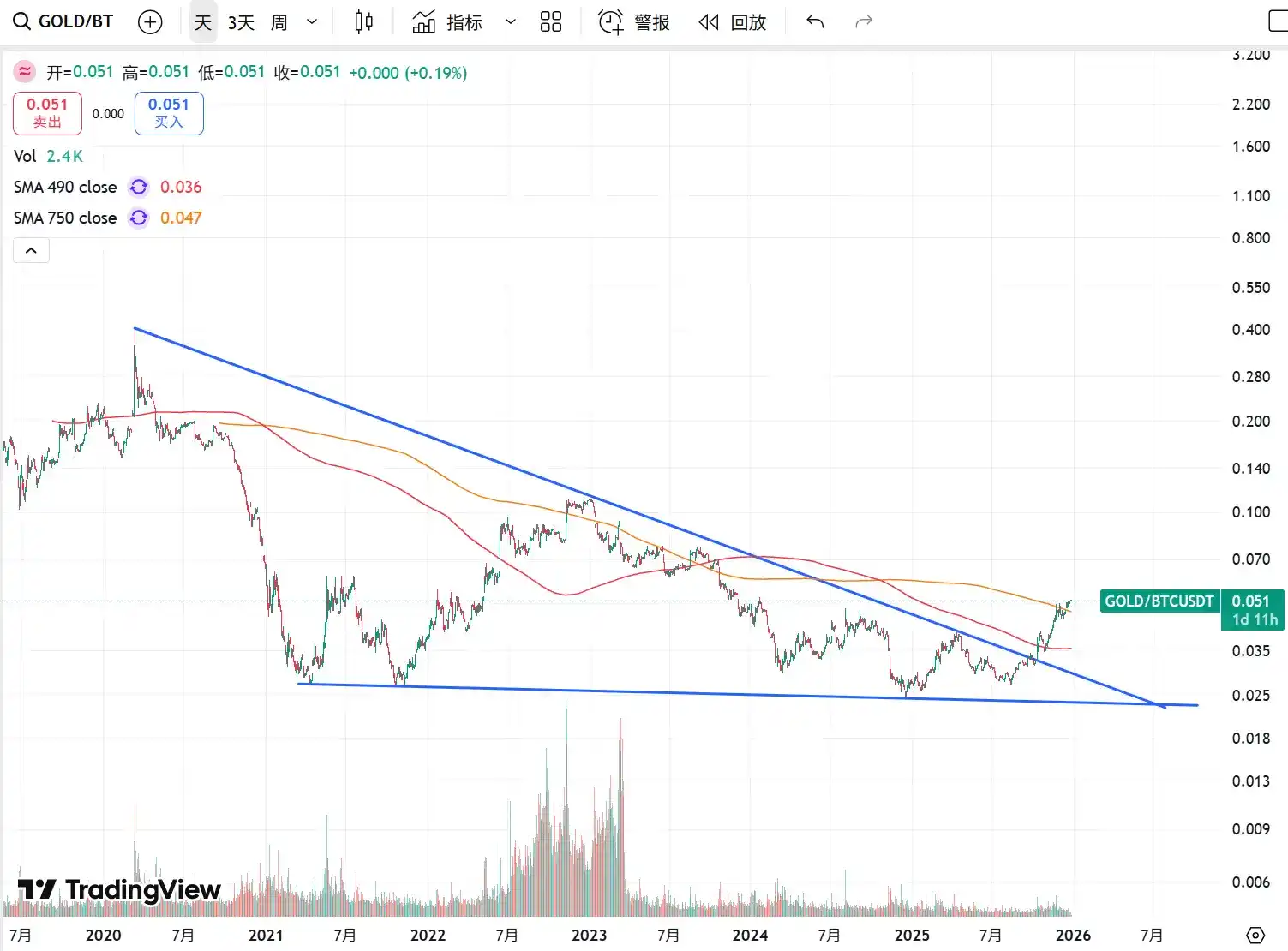
Of course, there are still some positive signals in the market. MSTR retaining its NASDAQ100 index status, the clearer direction indicated by the Fed Chair, and the potential crisis of the AI bubble all provide support for the 2026 market outlook. Standing at the end of 2025, we still believe this is a continuation of the year-long consolidation that began at the end of 2024. In the midst of price fluctuations with wide ranges, there will always be times of ebb and flow. Now is the time to conserve energy and build up strength.

This month's report is relatively brief, which also aligns more with our theme that it's a suitable time for rest. Once again, we wish everyone a happy holidays! See you in 2026!


Пов'язані питання

QWhat is the overall sentiment of Metrics Ventures towards the cryptocurrency market at the end of 2025?

AThe overall sentiment is negative and cautious, describing the market as 'cold,' 'lifeless,' and in a state of 'chaotic consolidation' with low volumes and high volatility compression. They advise investors to rest and prepare for the next year.

QAccording to the report, which asset class was the main performer in the capital markets over the past month, contrasting with crypto's performance?

APrecious metals, specifically silver, were the main performers. The report highlights that monthly trading volume for silver on the Shanghai Silver Exchange alone exceeded 7.5 trillion RMB, drawing a comparison to the frenzy of the 2020-2021 crypto market.

QWhat positive signals for the 2026 crypto market does Metrics Ventures mention?

AThe positive signals mentioned are: MSTR retaining its NASDAQ100 index status, greater clarity on the direction of the Federal Reserve Chair, and the potential crisis in the AI bubble, which could provide support for the market in 2026.

QHow does the report characterize the current trading activity and volatility in both crypto and traditional exchanges?

AThe report characterizes trading activity as萎缩 (shrinking) on both CEXs and the NYSE, with volatility加剧收敛 (intensifying compression). It states the market is in a narrow range and that sudden 'flash crashes' or 'painting the door' movements are expected to be the main theme.

QWhat does the chart labeled '黄金与比特币价格汇率对' (Gold-to-Bitcoin Price Exchange Rate Pair) illustrate according to the text?

AThe chart illustrates that the relative price strength of gold versus Bitcoin has broken through its long-term downward trend that began with the 2020 easing policies, making the rotation of capital into higher-priced assets more直观 (intuitive or visually clear).

Пов'язані матеріали

Fei-Fei Li's Team Clarifies the Concept of 'World Models', Sora Merely a Renderer

"World Models" has become a widely used yet confusing term in AI. To address this, a team led by Fei-Fei Li and World Labs proposed a functional taxonomy based on the Partially Observable Markov Decision Process framework. This taxonomy categorizes systems called "world models" into three distinct projections: Renderers, Simulators, and Planners. Renderers, like OpenAI's Sora and other video generation models, focus on producing photorealistic visual outputs for human perception. They prioritize visual fidelity over physical accuracy. Simulators, such as NVIDIA Omniverse, aim to compute precise future environmental states for computational tasks like engineering analysis or digital twins. Planners, like Vision-Language-Action models, take in observations and goals to output executable actions for robots or agents. The article clarifies that most current "world models," including Sora, are primarily Renderers. They generate convincing visuals but lack the core ability to simulate state transitions based on actions, a key requirement for a true world model in classic reinforcement learning definitions. This conceptual confusion has practical implications, leading to potential misalignment in technology selection, investment, and public understanding of AI capabilities. Clear categorization is crucial. It helps enterprises avoid costly mistakes (e.g., using a renderer for robot training), allows investors to accurately assess markets, and enables researchers to build comparable benchmarks. While future systems may integrate these functions, recognizing current boundaries is essential for honest assessment and progress.

marsbit55 хв тому

Fei-Fei Li's Team Clarifies the Concept of 'World Models', Sora Merely a Renderer

marsbit55 хв тому

Bloomberg Uncovered: How Do China's Wealthy Circumvent the Annual $50,000 Limit to Transfer Assets?

**Summary: How Wealthy Chinese Circumvent $50,000 Annual Foreign Exchange Limits** Despite China's strict capital controls, including an annual $50,000 per person foreign exchange quota, an estimated $150 billion in funds still leaves the country annually via various gray and underground channels. This report outlines the evolution of China's "capital wall" and the methods used to bypass it. **The Evolving Capital Controls:** * **Foundation (1994):** The system of "current account convertibility with strict capital account controls" was established. * **Quota Set (2007):** The $50,000 individual annual forex purchase limit was formalized. * **Crackdown Begins (2015-2017):** Following market volatility, enforcement tightened. Banks were required to scrutinize transactions, and channels like using UnionPay cards for Hong Kong insurance premiums or buying overseas property were blocked. * **Digital & Legal Upgrades (2024-2026):** Enhanced algorithms now flag suspicious patterns (e.g., "smurfing"). The Common Reporting Standard (CRS) provides Chinese tax authorities with data on citizens' offshore accounts. Unlicensed cross-border brokers have been targeted. **Five Primary Methods for Moving Capital:** 1. **Underground Banking / "Hawala" (Duiqiao):** The largest-scale method. No money crosses borders. Clients pay RMB to a domestic account; an overseas associate deposits equivalent foreign currency into the client's offshore account. Risks include high fees, account freezes, and legal penalties. 2. **"Smurfing" or "Ant Moving":** Using multiple individuals' $50,000 quotas to pool funds for one offshore recipient. Increasingly detected by anti-money laundering algorithms. 3. **Trade Invoice Manipulation:** Businesses over-invoice imports or under-invoice exports via offshore shell companies, creating a pretext to transfer excess funds abroad under the guise of trade. 4. **Channel Migration:** After a crackdown on internet brokers, funds flow toward more compliant but costly channels like major banks' cross-border wealth management services or Qualified Domestic Institutional Investor (QDII) quotas. 5. **Structural Arrangements:** High-net-worth individuals use complex, high-cost legal structures involving offshore trusts, insurance, and investment migration programs to transfer asset ownership. **Regulatory Response: Focusing on People, Not Just Money** The current strategy extends oversight from enterprises to **individual residents**. Tools like CRS allow retroactive visibility into offshore assets. Cryptocurrencies, once seen as a potential loophole, are now actively monitored and prosecuted as an illegal channel. The underlying driver remains: with significant wealth concentrated among millions of affluent households seeking diversification amid domestic economic shifts, the incentive to move assets offshore persists despite regulatory barriers.

marsbit1 год тому

Bloomberg Uncovered: How Do China's Wealthy Circumvent the Annual $50,000 Limit to Transfer Assets?

marsbit1 год тому

Торгівля

Спот
Ф'ючерси
活动图片




