Memory Card Prices Double in Four Months: How Long Will the Surge Last?

marsbitОпубліковано о 2026-04-16Востаннє оновлено о 2026-04-16

Анотація

NAND flash memory prices have entered a rapid upward cycle, with consumer-grade storage products like microSD cards seeing significant retail price increases. For example, a SanDisk Extreme 128GB microSD card rose from $17 in October 2025 to nearly $40 by February 2026—a 130% surge in under four months. This price surge is driven by structural shifts in the NAND market, primarily due to soaring demand from AI data centers. These large-scale buyers are securing the majority of NAND wafer supply through long-term contracts, leaving limited inventory for the consumer market. According to TrendForce, NAND contract prices rose 55–60% in Q1 2026, with enterprise SSD prices climbing 53–58%. Retail prices rose even more sharply due to constrained supply in the distribution channel. Unlike the 2016–2017 price cycle caused by production transitions, the current spike is demand-led. AI data centers are consuming NAND capacity at an unprecedented rate, with 2026 demand growth estimated at 20–22% against supply growth of only 15–17%. Manufacturers are prioritizing high-margin enterprise products over consumer-grade storage, further tightening retail availability. New production capacity from major suppliers like Samsung, Micron, and Kioxia is not expected until late 2027 or 2028. Until then, consumer storage prices are likely to remain high, with no significant price relief anticipated in the near term.

Since the beginning of this year, NAND flash prices have entered a new round of rapid increases, with retail prices of consumer storage products being the first to be affected. In October 2025, a SanDisk Extreme 128GB microSD card was sold for $17 on Amazon. By February of this year, the price of the same card had risen to nearly $40. In less than four months, the price increased by 130%.
First, it is important to clarify the difference between memory modules (RAM) and memory cards, as they are not the same type of product. Memory modules (RAM) are temporary storage inside computers, used for reading and writing data when programs are running; data is lost when power is cut off. Memory cards (such as microSD cards) are external expandable storage used for long-term preservation of files like photos and videos; data is not lost when power is cut off. The price increase discussed in this article refers to the latter—memory cards and the underlying NAND flash chips.

The continuous rise in memory card prices is driven by a systemic repricing of the entire NAND flash market. The starting point of this repricing is AI data centers competing for the same wafers.

Contract Prices Rose 50%, but Retail Prices Rose 130% by the Time They Reach You

First, let’s discuss what is happening.

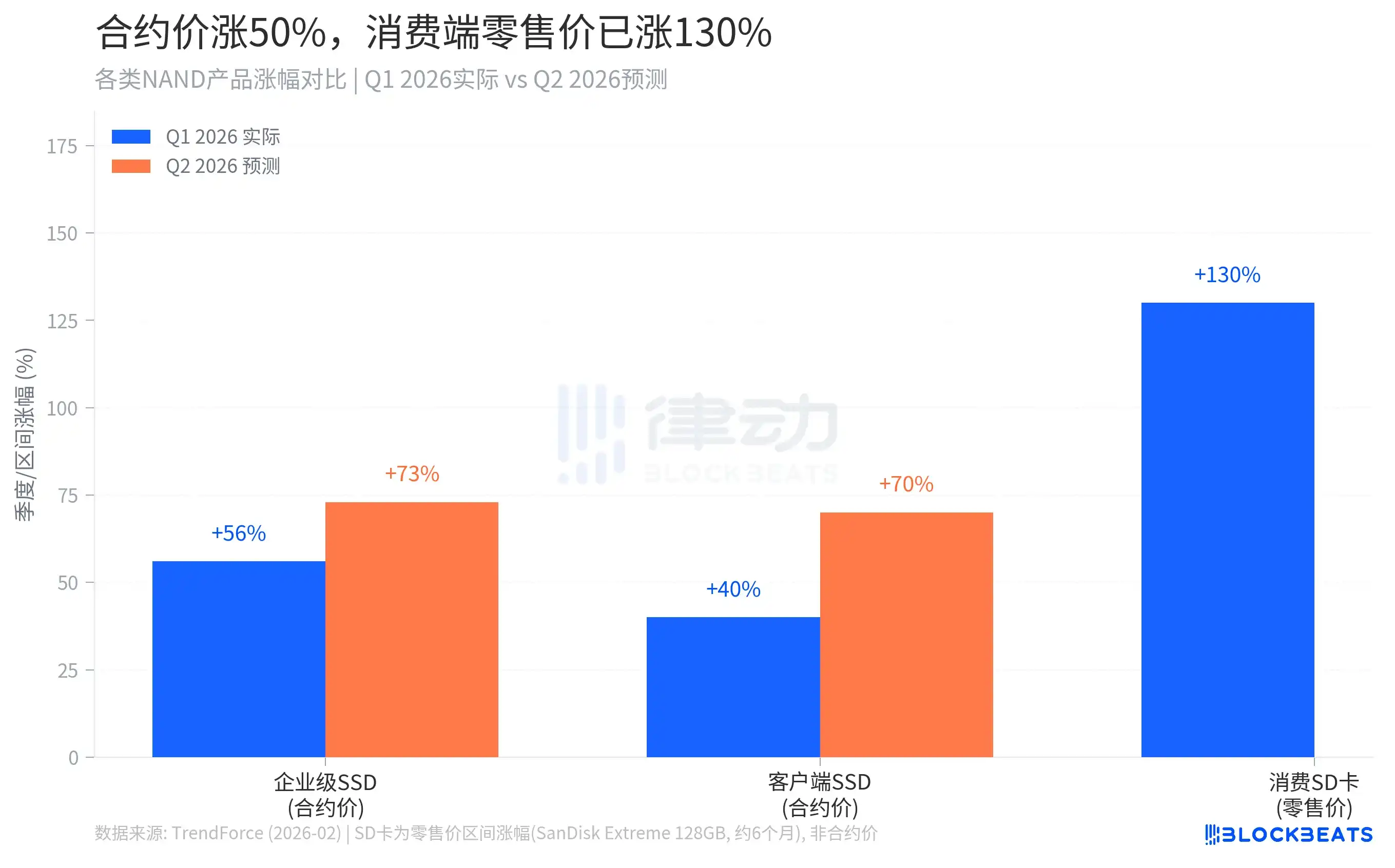
Global NAND flash contract prices began climbing rapidly at the end of last year. According to a February report by market research firm TrendForce, overall NAND contract prices in the first quarter of 2026 increased by approximately 55–60% compared to the fourth quarter of last year, with enterprise SSD prices rising by 53–58%, setting a new record for quarterly growth. TrendForce also predicted that overall NAND contract prices would rise by another 70–75% in the second quarter.

These numbers represent the bulk contract unit prices agreed upon between large customers and do not directly equate to the retail prices on e-commerce platforms. However, retail prices on the consumer side have risen even more sharply than contract prices. The rightmost bar in Figure 1, showing a 130% increase, represents the actual price shock felt by ordinary consumers.
Why are retail price increases far exceeding contract price increases? Because the consumer market is a "residual allocation market." When NAND manufacturers set delivery plans, they prioritize fulfilling orders for large customers with long-term framework agreements, including AI data center operators and hyperscale cloud service providers. Only after these orders are fulfilled do the remaining inventories enter the distribution channels of the consumer market. With supply compressed, the spot market has almost no buffer capacity against price increases, leading to steeper retail price hikes than contract price hikes.

Kingston has publicly confirmed that its procurement cost for NAND wafers has increased by 246% compared to a year ago. This is a cost shock at the raw material level, which is ultimately passed down to consumers through product prices.

How AI Is Pushing Up the Price of a Memory Card

There are two key points in this graph worth highlighting.

The first is around October 2025, when relatively low-priced memory cards were available on the market. That period marked the end of the previous cycle of oversupply. From 2023 to 2024, major storage manufacturers accumulated large inventories amid weakening demand, leading to continuously declining prices. Photographers, creators, and gamers took advantage of this window to stock up on memory cards at historically low prices.

The second key point is the fourth quarter of 2025. Samsung, Kioxia, Micron, and SK Hynix successively announced production cuts and price increases, completely reversing the situation in a short period. Samsung raised prices for enterprise customers by over 100%, while Kioxia explicitly stated that its entire 2026 production capacity had been pre-sold to large customers, effectively cutting off supply to the consumer market.
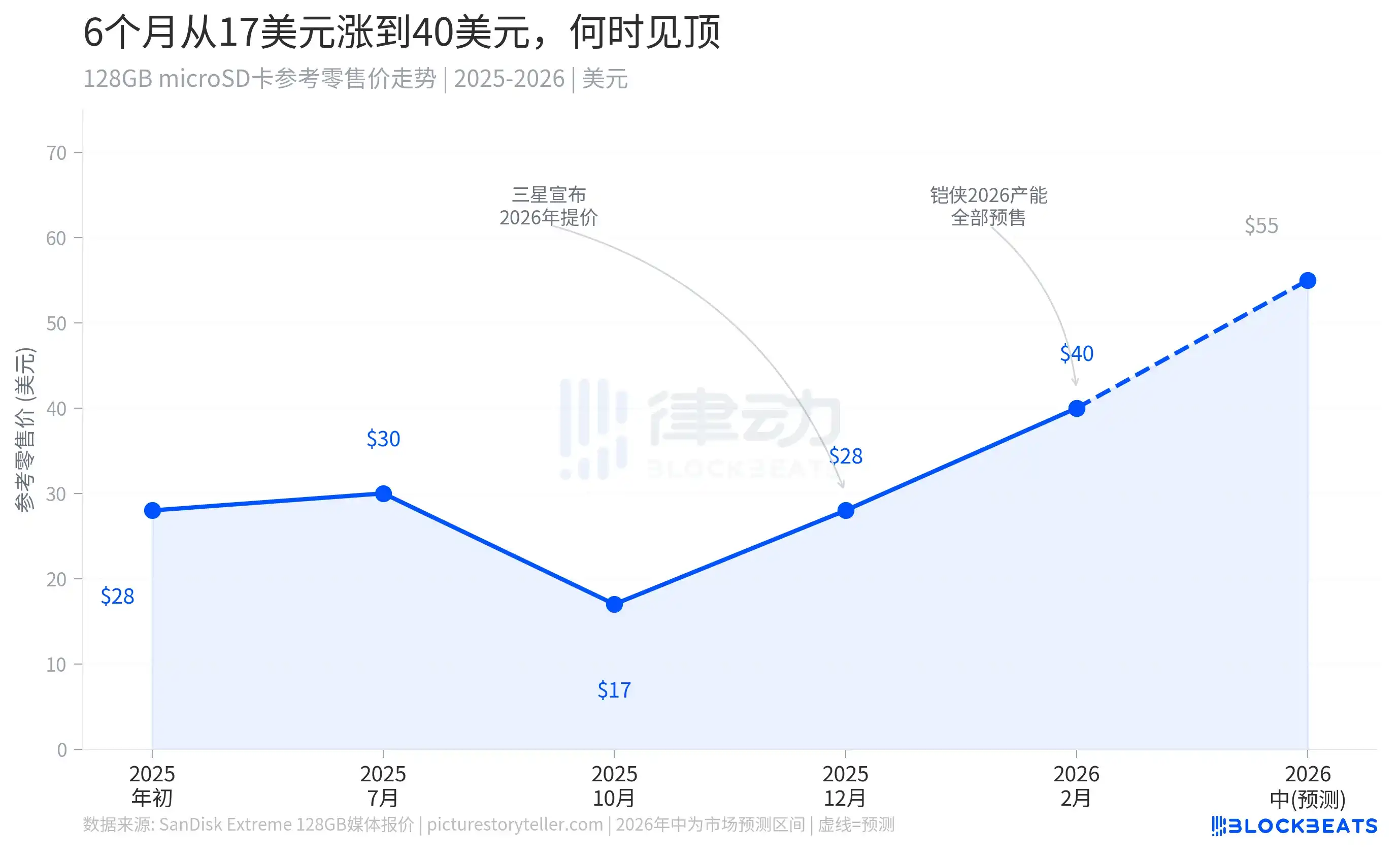
Since then, retail prices for memory cards have been climbing steadily and are expected to reach the $50–$60 range by mid-2026, with no window for a price correction throughout the year. This is not market speculation but a structural adjustment in the supply allocation mechanism. Before AI data centers became the top-priority buyers in the NAND market, consumer and enterprise products participated more or less equally in capacity allocation. Now, the consumer end is at the very bottom of the allocation chain.

This Time, It’s Completely Different from 2017

The NAND industry experiences a price cycle approximately every three to four years. The last significant price increase occurred in 2016–2017 and lasted nearly two years. That round was triggered by the technological transition from 2D NAND to 3D NAND. The new stacking process slowed effective output during the yield ramp-up phase, tightening supply and driving up costs. However, once 3D NAND production lines stabilized for various manufacturers, Samsung, SK Hynix, and Micron simultaneously expanded production significantly. Inventories quickly shifted from shortage to surplus, and prices plummeted in early 2018.

This time, the driving force is entirely different, and the path to recovery will also be截然不同.
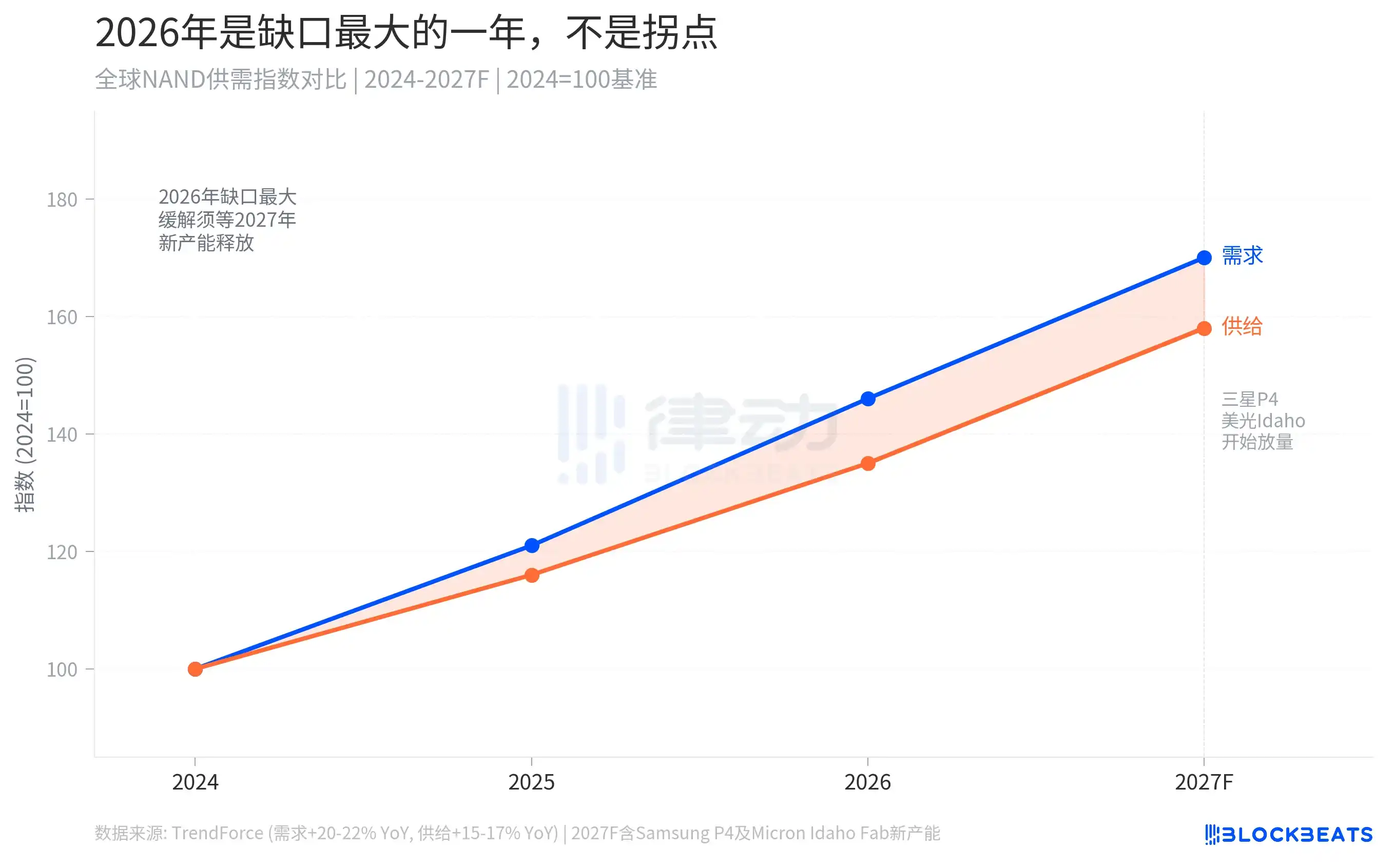
According to TrendForce data, global NAND demand growth is expected to reach 20–22% in 2026, while supply-side growth is only 15–17%. The absolute gap is not large, but in a market of this scale, a few percentage points of supply-demand disparity can trigger extremely sharp price reactions. More importantly, this gap is not caused by technical issues but by a structural shift in demand. AI data centers are consuming NAND capacity in a sustained, massive, and high-priority manner, and the scale of this demand has no ceiling.

New production capacity to alleviate supply constraints will not arrive until late 2027 to 2028. Samsung’s NAND production lines at its P4 facility in Pyeongtaek, Gyeonggi Province; Micron’s new wafer fab in Idaho, USA; and Kioxia’s expansion of its Iwate factory all point to this timeframe. 2026 is the year with the largest supply-demand gap, not the turning point for prices.

Manufacturers Aren’t Lacking Capacity; They’re Actively Selling It to the Highest Bidder

The following graph illustrates the essential mechanism behind this price surge. In the NAND industry’s revenue structure, the share of enterprise products (AI data center SSDs, general server storage) is rapidly expanding. According to comprehensive estimates by industry agencies, the share of enterprise products in overall NAND revenue has risen from about 45% in 2024 to about 62% in 2026, while the share of the consumer and client market has been compressed from 55% to about 38%.
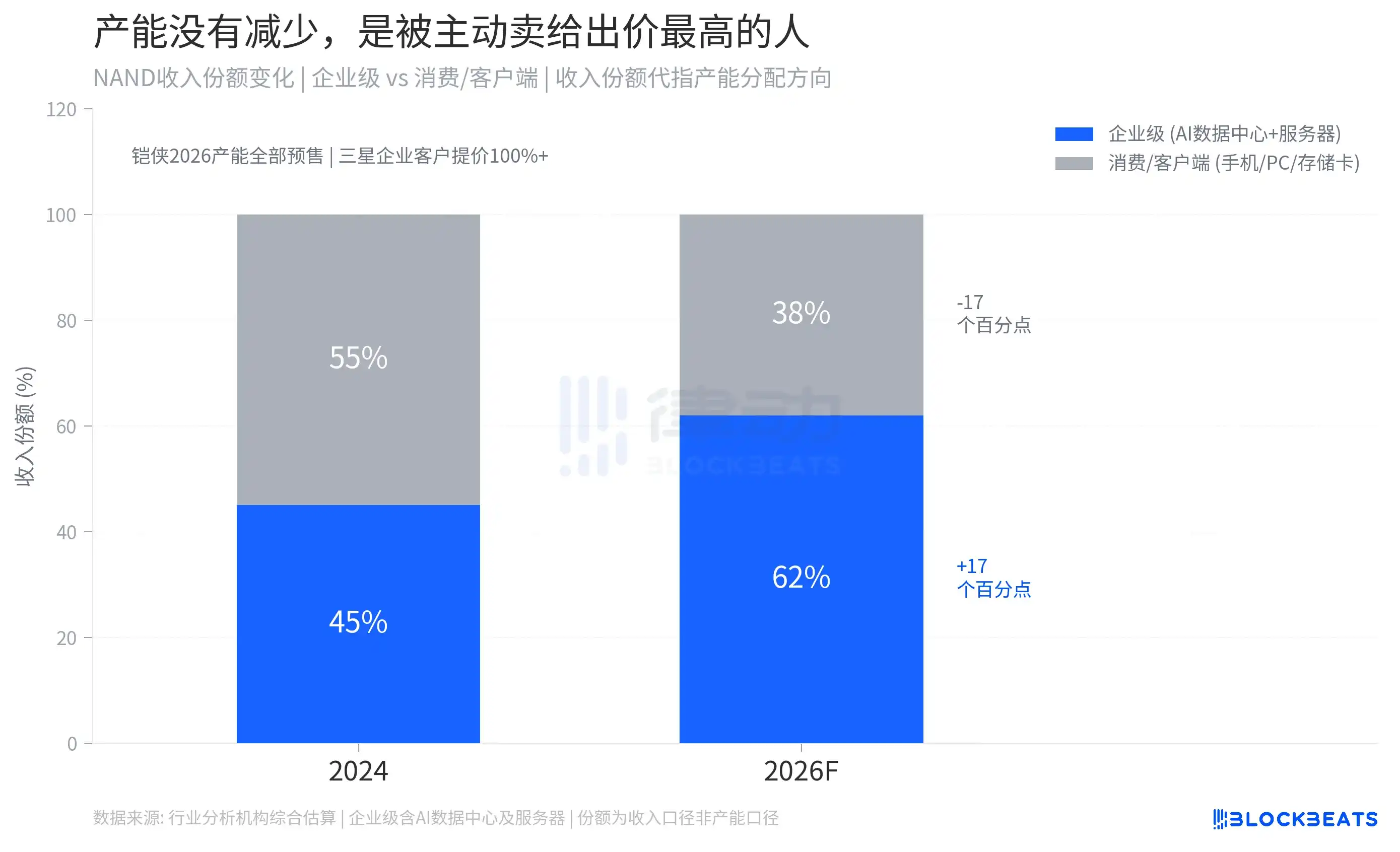
The logic driving this shift is straightforward: for the same wafer area, producing enterprise-grade high-density QLC SSDs yields 3–5 times the unit profit compared to producing consumer-grade memory cards. Capacity allocation by manufacturers like Kioxia and Samsung follows the principle of maximizing commercial利益, allocating the best wafers to the highest bidders.

This mechanism also has a hidden effect. As available inventory in the consumer market decreases, distributors and retailers accelerate their stocking pace to hedge against future price increases, further accelerating inventory drawdown on the consumer end and creating a self-reinforcing cycle of price hikes.

For consumers, memory card prices will remain high for a considerable period. This is not due to a lack of wafer capacity but because the allocation priority of the consumer market has been systematically lowered. Only when the construction pace of AI computing infrastructure slows down will excess wafer capacity return to the consumer product supply chain, but that won’t happen until after 2027.

The SD card in your camera and the world’s largest AI data center are using the same wafer. Now you know who wins.


Пов'язані питання

QWhat is the main reason for the sharp price increase in memory cards over the past four months?

AThe price surge is primarily driven by structural demand shifts, with AI data centers consuming NAND flash capacity at a high priority, leaving limited supply for the retail consumer market.

QHow does the retail price increase of memory cards compare to the NAND flash contract price rise?

AThe retail price increased by about 130%, which is significantly higher than the contract price rise of 55-60% in Q1 2026, due to the consumer market being a 'residual allocation market' with minimal buffer against supply constraints.

QWhy is the current NAND price cycle different from the one in 2016-2017?

AThe 2016-2017 cycle was caused by technical transitions (2D to 3D NAND) and resolved with improved yields and expanded production, while the current cycle is driven by structural AI demand, with no quick supply fix until 2027-2028.

QWhat role do AI data centers play in the NAND market supply chain?

AAI data centers are the highest-priority buyers, securing most of the NAND产能 through long-term contracts, which reduces the allocation for consumer products like memory cards and pushes retail prices higher.

QWhen is the NAND supply shortage expected to ease, and why?

AThe shortage is expected to ease around late 2027 to 2028, when new产能 expansions from major manufacturers like Samsung, Micron, and Kioxia become operational, increasing overall supply.

Пов'язані матеріали

Gensyn AI: Don't Let AI Repeat the Mistakes of the Internet

In recent months, the rapid growth of the AI industry has attracted significant talent from the crypto sector. A persistent question among researchers intersecting both fields is whether blockchain can become a foundational part of AI infrastructure. While many previous AI and Crypto projects focused on application layers (like AI Agents, on-chain reasoning, data markets, and compute rentals), few achieved viable commercial models. Gensyn differentiates itself by targeting the most critical and expensive layer of AI: model training. Gensyn aims to organize globally distributed GPU resources into an open AI training network. Developers can submit training tasks, nodes provide computational power, and the network verifies results while distributing incentives. The core issue addressed is not decentralization for its own sake, but the increasing centralization of compute power among tech giants. In the era of large models, access to GPUs (like the H100) has become a decisive bottleneck, dictating the pace of AI development. Major AI companies are heavily dependent on large cloud providers for compute resources. Gensyn's approach is significant for several reasons: 1) It operates at the core infrastructure layer (model training), the most resource-intensive and technically demanding part of the AI value chain. 2) It proposes a more open, collaborative model for compute, potentially increasing resource utilization by dynamically pooling idle GPUs, similar to early cloud computing logic. 3) Its technical moat lies in solving complex challenges like verifying training results, ensuring node honesty, and maintaining reliability in a distributed environment—making it more of a deep-tech infrastructure company. 4) It targets a validated, high-growth market with genuine demand, rather than pursuing blockchain integration without purpose. Ultimately, the boundaries between Crypto and AI are blurring. AI requires global resource coordination, incentive mechanisms, and collaborative systems—areas where crypto-native solutions excel. Gensyn represents a step toward making advanced training capabilities more accessible and collaborative, moving beyond a niche controlled by a few giants. If successful, it could evolve into a fundamental piece of AI infrastructure, where the most enduring value in the AI era is often created.

marsbit9 год тому

Gensyn AI: Don't Let AI Repeat the Mistakes of the Internet

marsbit9 год тому

Why is China's AI Developing So Fast? The Answer Lies Inside the Labs

A US researcher's visit to China's top AI labs reveals distinct cultural and organizational factors driving China's rapid AI development. While talent, data, and compute are similar to the West, Chinese labs excel through a pragmatic, execution-focused culture: less emphasis on individual stardom and conceptual debate, and more on teamwork, engineering optimization, and mastering the full tech stack. A key advantage is the integration of young students and researchers who approach model-building with fresh perspectives and low ego, prioritizing collective progress over personal credit. This contrasts with the US culture of self-promotion and "star scientist" narratives. Chinese labs also exhibit a strong "build, don't buy" mentality, preferring to develop core capabilities—like data pipelines and environments—in-house rather than relying on external services. The ecosystem feels more collaborative than tribal, with mutual respect among labs. While government support exists, its scale is unclear, and technical decisions appear driven by labs, not state mandates. Chinese companies across sectors, from platforms to consumer tech, are building their own foundational models to control their tech destiny, reflecting a broader cultural drive for technological sovereignty. Demand for AI is emerging, with spending patterns potentially mirroring cloud infrastructure more than traditional SaaS. Despite challenges like a less mature data industry and GPU shortages, Chinese labs are propelled by vast talent, rapid iteration, and deep integration with the open-source community. The competition is evolving beyond a pure model race into a contest of organizational execution, developer ecosystems, and industrial pragmatism.

marsbit10 год тому

Why is China's AI Developing So Fast? The Answer Lies Inside the Labs

marsbit10 год тому

3 Years, 5 Times: The Rebirth of a Century-Old Glass Factory

Corning, a 175-year-old glass company, is experiencing a dramatic revival as a key player in AI infrastructure, driven by surging demand for high-performance optical fiber in data centers. AI data centers require vastly more fiber than traditional ones—5 to 10 times as much per rack—to handle high-speed data transmission between GPUs. This structural demand shift, coupled with supply constraints from the lengthy expansion cycle for fiber preforms, has created a significant supply-demand gap. Nvidia has invested in Corning, along with Lumentum and Coherent, in a $4.5 billion total commitment to secure the optical supply chain for AI. Corning's competitive edge lies in its expertise in producing ultra-low-loss, high-density, and bend-resistant specialty fiber, which is critical for 800G+ and future 1.6T data rates. Its deep involvement in co-packaged optics (CPO) with partners like Nvidia further solidifies its position. While not the largest fiber manufacturer globally, Corning's revenue from enterprise/data center clients now exceeds 40% of its optical communications sales, and it has secured multi-year supply agreements with major hyperscalers including Meta and Nvidia. Financially, Corning's optical communications revenue has surged, doubling from $1.3 billion in 2023 to over $3 billion in 2025. Its stock price has risen nearly 6-fold since late 2023. Key future catalysts include the rollout of Nvidia's CPO products and the scale of undisclosed customer agreements. However, risks include high current valuations and potential disruption from next-generation technologies like hollow-core fiber. The company's long-term bet on light over electricity, maintained even through the telecom bubble crash, is now being validated by the AI boom.

marsbit11 год тому

3 Years, 5 Times: The Rebirth of a Century-Old Glass Factory

marsbit11 год тому

Торгівля

Спот
Ф'ючерси
活动图片