Meme Wrapped Contracts: Is alt.fun Real Innovation or a Pseudo-Need?

marsbitОпубліковано о 2026-05-18Востаннє оновлено о 2026-05-18

Анотація

A new platform called alt.fun on Hyperliquid has gained attention by merging meme coin creation with leveraged futures trading. Unlike typical meme platforms like Pump.fun, alt.fun requires creators to select an underlying asset (like HYPE or S&P 500) and a leverage level (2x, 3x, or 5x) to take a long or short position. The issued meme token is directly linked to a corresponding leveraged token (LT) on BounceTech, which represents that perpetual contract position. This means the token's price is driven by both the standard bonding curve (community buying/selling) and the performance of its leveraged underlying asset, allowing value to increase even without new purchases. The platform's "graduation" to a DEX pool requires a市值 of $9,000, achievable through market demand or underlying asset growth. While this mechanism can amplify gains in trending markets, it also introduces significant risks from asset volatility, leverage decay during rebalancing, and potential liquidation during sharp price moves. Despite early traction—with its top token ALT reaching an $8.8M market cap—alt.fun faces challenges. Its limited selection of 14 underlying assets constrains variety, leading to tokens with identical financial profiles. More fundamentally, critics argue it misunderstands the meme coin ethos: its tokens are primarily financial instruments tied to asset performance, lacking the community-driven narratives and cultural appeal essential for sustaining meme coin value. The article co...

Original | Odaily Planet Daily (@OdailyChina)

Author | Golem (@web3_golem)
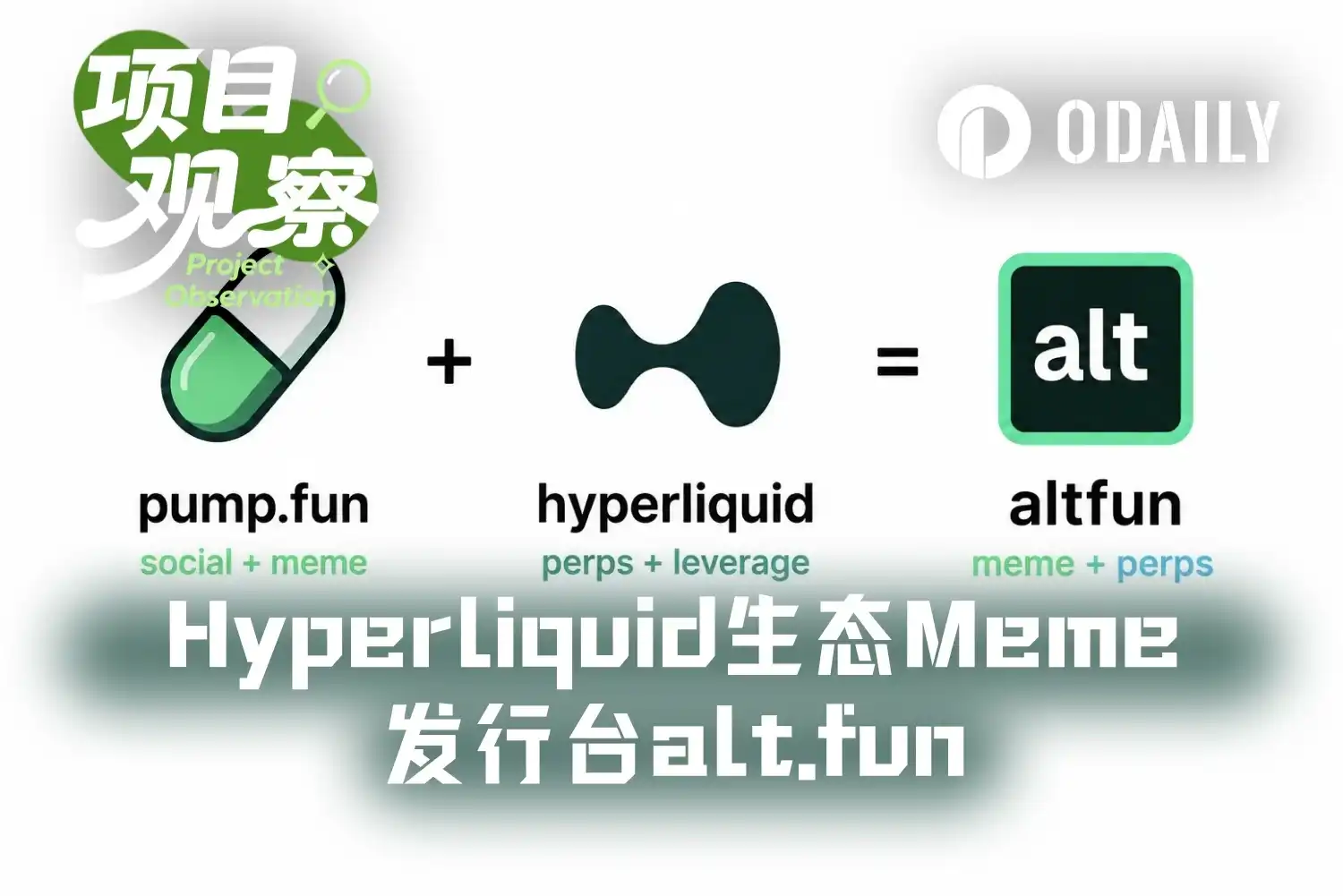
Last week, a new Meme issuance platform named alt.fun in the Hyperliquid ecosystem garnered significant attention from Meme players. Within just one week of launch, its leading token ALT reached a peak market cap of $8.8 million, with the current price having retraced, maintaining a market cap around $6.7 million.

The novelty of alt.fun can be understood as a combination of Pump.fun and Hyperliquid, where users can simultaneously experience the dual thrill of playing with Memes and opening contracts.

Introduction to the alt.fun Platform Mechanism

Specifically, each Meme token issued on alt.fun has a corresponding contract position matched on Hyperliquid at its core.

Similar to Pump.fun, any user can issue a Meme coin with one click on HyperEVM through the alt.fun platform. The token price is still influenced by a bonding curve. The total supply of the created Meme coin is 1 billion tokens, and when 75% of the tokens are sold, the token successfully "graduates" and is migrated to a HyperSwap V2 liquidity pool.

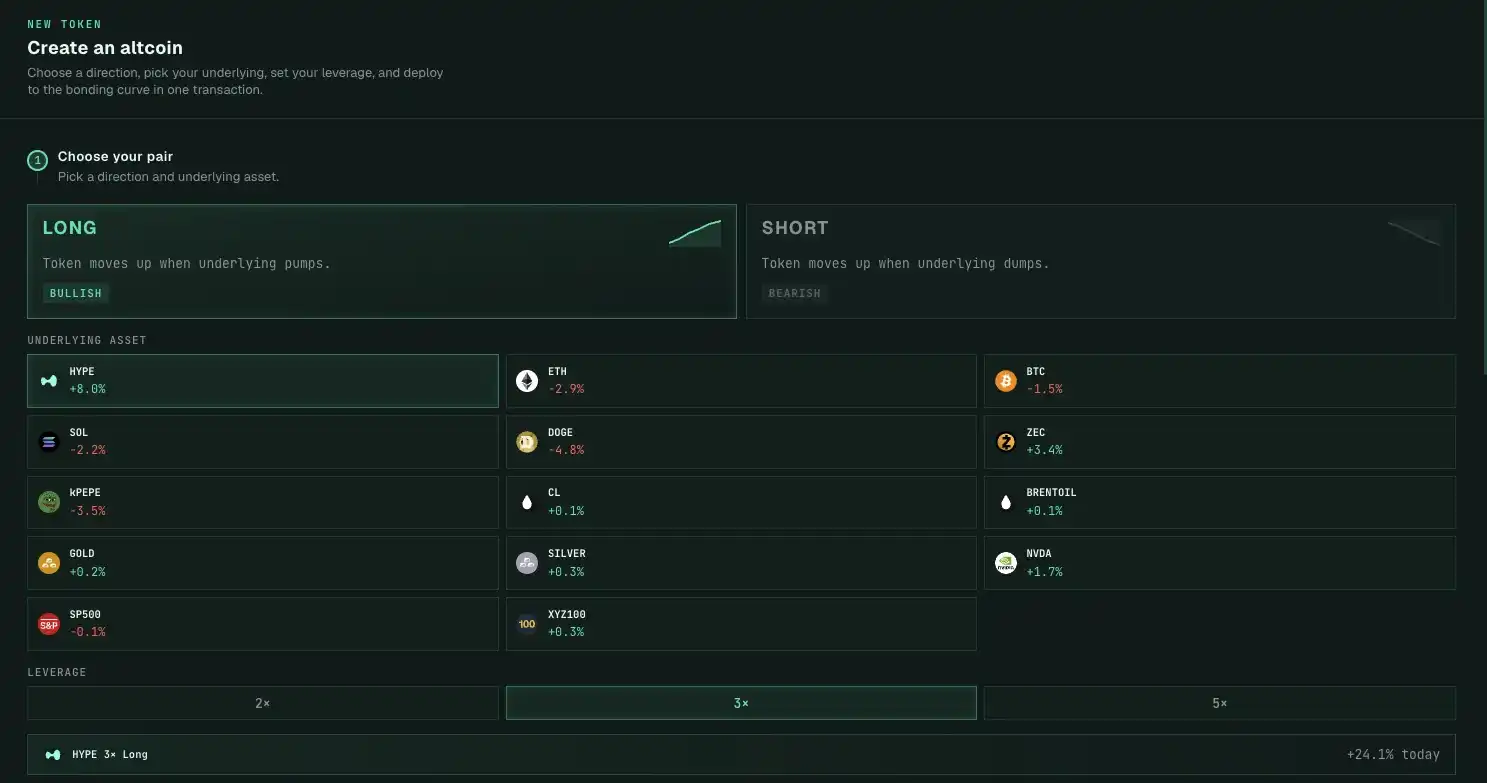
The difference from Pump.fun is that when creating a token on alt.fun, users also need to select an underlying asset and choose a limited leverage multiple (2x/3x/5x) to go short/long. At the same moment of token creation, the platform mints a corresponding amount of leveraged tokens (LT) on BounceTech(Odaily note: a permissionless leveraged token platform on Hyperliquid) and sends them to the user. This leveraged token corresponds to establishing a perpetual contract position on Hyperliquid. For example, if a user chooses to create a token based on a 3x long position on HYPE, what they receive is essentially a leveraged token that tracks the gains of a 3x long HYPE position.

As shown in the figure below, currently on alt.fun, users can choose from 14 types of underlying assets when creating a token. Similarly, when players buy Meme coins on this platform, the platform also mints corresponding leveraged tokens on BounceTech. If a player sells, this process is reversed—the leveraged token is redeemed, and the user receives the corresponding USDC.
This model of packaging and then selling leveraged tokens as underlying assets is similar to the securitization of specific risk exposures like futures and options in traditional finance, such as 3x inverse Nasdaq ETFs or 5x inverse crude oil products. In this process, the alt.fun platform acts like an asset management company, managing the long-term positions behind the leveraged tokens for users.

The price of such financial products primarily follows the net asset value. However, since the token price issued by the alt.fun platform is also simultaneously influenced by the bonding curve mechanism of Meme coins, the graduation mode and price drivers of tokens on this platform are not singular either.

Dual Graduation Modes and Price Drivers

This means that the price of tokens on the alt.fun platform is influenced by two factors: one is market sentiment driven by buying and selling, and the other is the performance of the underlying asset. So now you might understand what alt.fun's slogan "Your token pumps even when nobody's buying" means.

For instance, if a user creates a token based on a 3x long HYPE position with an initial investment of $20 (the platform's minimum buy-in size), and subsequently HYPE rises by 10%, then even if no one buys the token, the user's holding value increases by 30% to $26.

Based on this dual driver of price, the token graduation mode on the alt.fun platform is not limited to one method either. Specifically, its token graduation condition is reaching a market cap of $9,000, which essentially calculates the value of the leveraged token. Besides achieving graduation through buying tokens, if the token itself reaches a market cap of $9,000 due to the rise of its underlying asset, it can also graduate successfully. Therefore, whether a token reaches the graduation threshold is often a combined result of the two pricing mechanisms.

Of course, ideally, a rise in the underlying asset drives up the leveraged token, and combined with the emotional catalysis of the Meme market, the token might soar step by step. But once the underlying asset falls, the value of the leveraged token continuously shrinks, the market might panic-sell, and the token price could potentially crash instantly.

Thus, while alt.fun's mechanism can effectively leverage amplification effects, this only works in a one-sided market trend and requires users to accurately time the trend. If encountering volatile conditions in the underlying asset, users also have to bear leverage decay losses. This is because when the underlying asset price fluctuates, the platform needs to perform "rebalancing" to manage positions to avoid liquidation. This means that even if the underlying asset drops and then recovers, the leveraged token will suffer depreciation due to forced position reduction during the decline.

Moreover, in the case of wick or flash crash events, the platform might fail to react in time, potentially leading the leveraged token value to zero.

Meme or not Meme

Currently, the alt.fun platform has a total of 41 graduated tokens, with only two having a market cap exceeding one million: ALT (based on 5x long HYPE) and STONKS (based on 5x long S&P 500). The total number of users is around over 1,000. Although alt.fun is still in its early stages, we can also discern its current development bottlenecks from this.

First, the platform has too few underlying assets. Based on the current 14 types of underlying assets, there can be at most 84 different combinations of leveraged tokens. alt.fun has already seen leveraged tokens with the same leverage multiple shorting/longing the same underlying asset. For example, the current highest token ALT is based on 5x long HYPE, while another token with the ticker ATH is also based on 5x long HYPE. Apart from the token name and creation time, there is no difference between the two. If so, why wouldn't investors buy the lower market cap ATH?

Although alt.fun may support more underlying assets in the future, its core pain point is its inability to coalesce Meme coin community consensus.

The fundamental reason investors choose to buy leveraged tokens on the alt.fun platform instead of opening leverage directly on Hyperliquid themselves is essentially to gain greater price leverage. Moreover, because the platform manages position rebalancing in the backend for users, individual users can be "hands-off landlords," not having to worry about individual liquidation risks.

But this is also the problem. Investors buying an alt.fun token are essentially still basing their decision on future price expectations for its underlying asset, rather than on narratives, market games, or attention—these "meaningless things" are precisely what support the core value of a Meme. A Meme's ability to rise or gain market recognition is often not due to any practical value backing or financial design behind it; more importantly, it's the community propagation attribute.

As a Meme player, it's difficult for me to develop a love for a leveraged token similar to the affection for a particular Meme's community culture. If one truly has conviction in the underlying asset of a leveraged token, it might be better to issue one's own leveraged token rather than buy an existing one and bear unnecessary premiums.

Therefore, while the mechanism of the alt.fun platform appears novel, in my eyes, it's merely a mechanical innovation. If alt.fun pivots towards developing as a DeFi platform in the future, there might still be opportunities. But if it insists on forcefully entering the Meme issuance platform track, it is destined to be a flash in the pan.


Пов'язані питання

QWhat is the core innovation of the alt.fun platform as described in the article?

AThe core innovation is combining a Meme token launchpad (similar to Pump.fun) with leveraged perpetual contracts on Hyperliquid. Each Meme token created on alt.fun has an underlying leveraged token position on Hyperliquid, allowing token value to be influenced by both market buying/selling and the performance of the chosen leveraged asset.

QAccording to the article, what is one major drawback or criticism of the alt.fun model?

AA major drawback is its perceived inability to build genuine Meme community consensus. The token's value is fundamentally tied to the performance of a leveraged financial product rather than narrative, culture, or community hype, which are considered the true drivers of Meme value. It risks being a 'mechanical innovation' lacking the social dynamics essential for Meme success.

QHow can a token on alt.fun 'graduate' or be considered successful besides being bought by others?

AA token can graduate if its market capitalization (calculated as the value of the underlying leveraged tokens) reaches $9,000. This can happen not only through direct purchases but also if the value of the underlying leveraged position increases significantly due to favorable price movement of the base asset (e.g., HYPE or S&P 500).

QWhat role does the BounceTech platform play in the alt.fun ecosystem?

ABounceTech is the permissionless leveraged token platform on Hyperliquid. When a user creates or buys a Meme token on alt.fun, the platform mints a corresponding leveraged token (LT) on BounceTech and sends it to the user. This LT represents a perpetual contract position on Hyperliquid. Selling the Meme token reverses the process, redeeming the LT for USDC.

QWhat potential risks does an investor face when holding a token from alt.fun?

AInvestors face several risks: 1) Exposure to the high volatility and potential liquidation of the underlying leveraged position. 2) Leverage decay during volatile or sideways markets due to mandatory 'rebalancing' of the position, which can erode value. 3) The risk of the leveraged token's value going to zero during extreme market events like a flash crash. 4) The premium paid for the Meme token layer on top of the leveraged token's intrinsic value.

Пов'язані матеріали

Who Funds the Agents?

**Summary: Who Funds AI Agents?** OpenAI recently shut down a feature allowing AI agents to shop for users, highlighting the challenge of creating a secure and regulated environment for agent-driven transactions. While payment infrastructure exists, a crucial governance layer—defining spending limits, fraud detection, tax handling, and return policies—is largely missing. The potential is enormous: AI agents already processed $73M across 176M transactions last year, with McKinsey forecasting this could grow to $3-5T in global consumer commerce by 2030. The core competition isn't just about processing payments, which can be very cheap (especially with crypto-based settlement), but about controlling the rules that govern agent spending. Key players like Stripe and Coinbase are racing to dominate this governance layer. Stripe's acquisition of wallet provider Privy allows it to set spending policies, identity checks, and human-in-the-loop approvals directly at the wallet level. Similarly, Coinbase's stack, including its x402 protocol and AgentKit, embeds governance rules. This vertical integration across settlement, wallet, and governance layers is becoming the dominant strategy. Control over the governance layer is where significant future value lies. If agents handle trillions in transactions, even a small fee for managing compliance, fraud prevention, and policy enforcement could generate billions in annual revenue. The companies that successfully integrate across the payment stack will capture value from idle agent balances, transaction fees, and governance services, positioning themselves as the foundational banks of the AI agent economy.

marsbit22 хв тому

Who Funds the Agents?

marsbit22 хв тому

A Nation Blocks Chips, a Giant Buys a Nuclear Power Plant: Why It's Time to Seriously Consider DeAI

**Title: Great Powers Blockade Chips, Giants Buy Nuclear Plants: Why It's Time to Seriously Consider DeAI** In May 2026, the US closed loopholes for Chinese firms to acquire advanced NVIDIA chips via overseas subsidiaries. That same month, Kenya halted a $1B geothermal data center project involving Microsoft, fearing its immense energy consumption. Meanwhile, Huawei announced mass production of its Ascend AI chip. These disparate events underscore a new reality: the competition for computing power ("compute") has escalated beyond the tech industry, becoming a geopolitical and infrastructural battleground. A new era of oligopoly is forming, with control over the AI stack—from GPU chips (NVIDIA) and cloud platforms (AWS, Azure, Google Cloud) to foundational models (OpenAI, Anthropic)—concentrating in a few Western "AI Octopus" corporations. This centralization creates systemic risks: pricing power and platform lock-in for users, infrastructure fragility, and a widening "compute divide" that threatens to marginalize nations without independent AI capacity. An "AI Iron Curtain" is deepening through export controls. In response, some nations like Saudi Arabia and the UAE are investing heavily to buy compute power, aiming to transition from oil to AI economies. The EU seeks to triple its compute capacity by 2030 to reduce dependency. However, the spending gap is vast, with four US tech giants alone planning ~$750B in AI capex for 2026. The race is increasingly constrained by energy, with AI tasks consuming up to 1000x more power than web searches, pushing firms to even acquire nuclear plants. This landscape is fueling interest in Decentralized AI (DeAI). It proposes a third way: using open protocols to coordinate a global network of idle GPUs, independent developers, and data centers, creating an AI infrastructure without a single controlling entity. Leveraging blockchain and cryptographic verification, DeAI aims to break market concentration, disperse energy demands, reduce geopolitical dependencies, and enhance transparency. While still nascent in performance and stability, DeAI's core promise is not immediate superiority but providing a crucial alternative architecture to resist monopoly, censorship, and centralized power. As specialized AI hardware costs fall and open-source models flourish, the window to build this foundation is open. The very existence of such competition serves as a vital check against the inevitable abuse of concentrated power.

marsbit1 год тому

A Nation Blocks Chips, a Giant Buys a Nuclear Power Plant: Why It's Time to Seriously Consider DeAI

marsbit1 год тому

Торгівля

Спот
Ф'ючерси

Популярні статті

Що таке MEME 2.0

Memecoin 2.0: Поява $MEME 2.0 у світі криптовалюти Вступ У постійно змінному ландшафті криптовалюти з'явився новий претендент. Memecoin 2.0, що символізується як $MEME 2.0, підносить концепцію мем-криптовалют на захоплюючий новий рівень. Як побічний продукт оригінального Memecoin, цей проєкт привернув увагу крипто-спільноти, змістивши акцент з типової фінансової вигоди на захоплюючий і розважальний досвід. Працюючи на блокчейні Ethereum, Memecoin 2.0 сміливо переосмислює залучення спільноти у криптосфері. Що таке Memecoin 2.0, $MEME 2.0? У своїй основі, Memecoin 2.0 є криптовалютним проєктом, який надає пріоритет спільнотному духу і розвагам, пов'язаним з мем-культурою. На відміну від звичайних криптовалют, які зосереджені на практичних випадках використання та матеріальних вигодах, Memecoin 2.0 вирізняється тим, що обіймає легшу сторону цифрової валюти. Цей проєкт існує без обіцянок утиліти, структурованої дорожньої карти чи фінансових повернень, зосереджуючи увагу на створенні яскравої спільноти навколо мемів та спільних розваг. Зробивши це, він використовує зростаючу тенденцію мем-культури у онлайн-пробі, що робить його унікальним гравцем у світі цифрових активів. Творець Memecoin 2.0, $MEME 2.0 Не зважаючи на численні дослідження витоків Memecoin 2.0, чітка особистість його творця залишається невідомою. Ця анонімність не є рідкістю у крипто-спільноті, де багато проєктів очолюються особами або групами, які надають перевагу залишатися за лаштунками. Відсутність публічно доступної інформації про творця може розглядатися як стратегічний крок, що ставить в центр уваги залучення спільноти, а не індивідуальної популярності у цій сфері. Інвестори Memecoin 2.0, $MEME 2.0 Інформації щодо інвесторів або фінансової підтримки Memecoin 2.0 замало. Відсутність деталей може свідчити про те, що проєкт є самофінансованим або що його увага до спільноти, а не традиційних інвестиційних структур, привабила інший тип підтримки. Оскільки світ мем-криптовалют зазвичай передбачає більше участі низового рівня, а не інституційних інвестицій, цей підхід узгоджується з етосом проєктів, що управляються спільнотою. Як працює Memecoin 2.0, $MEME 2.0? Memecoin 2.0 повністю працює на блокчейні Ethereum, використовуючи його потужні функції безпеки та масштабованості. Використовуючи сильні сторони Ethereum, Memecoin 2.0 може запропонувати безпечне середовище для взаємодії користувачів, забезпечуючи при цьому, що транзакції є ефективними та економічними. Одна з унікальних характеристик Memecoin 2.0 полягає в його структурі, що керується спільнотою. Цінність та популярність токена $MEME 2.0 походять з активної участі його користувачів, а не з вродженої утиліти. Ця концепція підкреслює акцент проєкту на розважальному аспекті криптовалюти, натякаючи на те, що сміх та залучення спільноти є справжніми валютами, що ведуть до його успіху. Крім того, проєкт вписується в ширшу екосистему мем-криптовалют, де цінність кожної мем-криптовалюти коливається залежно від культури, тенденцій і участі спільноти, а не традиційних економічних принципів. Хронологія Memecoin 2.0, $MEME 2.0 Щоб краще зрозуміти еволюцію та віхи Memecoin 2.0, ось хронологія, що підкреслює значні події в його історії: 2024: Зародження Memecoin 2.0 вважається відгалуженням оригінального Memecoin, яке встановлює себе в процвітаючому контексті мем-криптовалют, працюючи на блокчейні Ethereum. 13 липня 2024: Memecoin 2.0 офіційно позиціонує себе як мем-криптовалюта, орієнтована на спільноту, в мережі Ethereum, підкреслюючи свій підхід, зосереджений на розвагах, який запрошує користувачів брати участь у його розвитку. Ключові моменти про Memecoin 2.0, $MEME 2.0 Кілька критичних характеристик визначають Memecoin 2.0: Спільнотно-центричний підхід: Основною метою Memecoin 2.0 є створення веселого, захоплюючого досвіду для спільноти, використовуючи колективне задоволення, що випливає з меметичної культури. Побудовано на Ethereum: Робота на блокчейні Ethereum надає проєкту важливу інфраструктуру, що забезпечує безпеку та масштабованість. Відсутність утиліти або дорожньої карти: У вражаючому відході від традиційних криптовалют, Memecoin 2.0 не обіцяє жодних утилітарних функцій або фінансових повернень, підтверджуючи свою прихильність до участі спільноти та соціального залучення. Акцент на меметичній культурі: Обіймаючи гумористичні та культурні аспекти мем-періоду, Memecoin 2.0 надає платформу для користувачів для залучення до крипти офлайн та онлайн. Додатковий контекст: Значення мем-криптовалют Мем-криптовалюти з'явилися як окрема класифікація криптовалюти, часто керуючись гумором та легким підходом до торгівлі. Ці валюти, як правило, не мають значної утиліти або розробницьких дорожніх карт, залучаючи користувачів обіцянкою розваг, взаємодії в спільноті та культурної значущості. В рамках ширшої екосистеми криптовалют, мем-криптовалюти відновлюють важливість залучення спільноти, протистоячи лише прибутковим підходам. Проєкти, такі як Memecoin 2.0, відкривають еру, в якій розваги можуть гармонізувати з фінансовими прагненнями, перетворюючи блокчейн на ігровий майданчик для творчості та соціальної взаємодії. Висновок Memecoin 2.0, або $MEME 2.0, втілює нову хвилю криптовалюти, яка надає пріоритет залученню спільноти над жорсткими фінансовими структурами. Зосереджуючись на гуморі та соціальній взаємодії, він використовує захоплення навколо мем-культури. Працюючи на блокчейні Ethereum, Memecoin 2.0 використовує можливості технології, залишаючись непохитним у своїй прихильності до розважальної цінності цифрової валюти. Коли простір навколо криптовалют продовжує еволюціонувати, Memecoin 2.0 служить доказом того, що майбутнє цифрових активів може значною мірою залежати від спільних досвідів, сміху та надійних зв'язків у спільноті. У непередбачуваному світі крипто, можливо, радість може бути такою ж цінною, як і традиційний фінансовий прибуток.

110 переглядів усьогоОпубліковано 2024.04.04Оновлено 2024.12.03

Що таке MEME 2.0

Як купити MEME

Ласкаво просимо до HTX.com! Ми зробили покупку Memeland (MEME) простою та зручною. Дотримуйтесь нашої покрокової інструкції, щоб розпочати свою криптовалютну подорож.Крок 1: Створіть обліковий запис на HTXВикористовуйте свою електронну пошту або номер телефону, щоб зареєструвати обліковий запис на HTX безплатно. Пройдіть безпроблемну реєстрацію й отримайте доступ до всіх функцій.ЗареєструватисьКрок 2: Перейдіть до розділу Купити крипту і виберіть спосіб оплатиКредитна/дебетова картка: використовуйте вашу картку Visa або Mastercard, щоб миттєво купити Memeland (MEME).Баланс: використовуйте кошти з балансу вашого рахунку HTX для безперешкодної торгівлі.Треті особи: ми додали популярні способи оплати, такі як Google Pay та Apple Pay, щоб підвищити зручність.P2P: Торгуйте безпосередньо з іншими користувачами на HTX.Позабіржова торгівля (OTC): ми пропонуємо індивідуальні послуги та конкурентні обмінні курси для трейдерів.Крок 3: Зберігайте свої Memeland (MEME)Після придбання Memeland (MEME) збережіть його у своєму обліковому записі на HTX. Крім того, ви можете відправити його в інше місце за допомогою блокчейн-переказу або використовувати його для торгівлі іншими криптовалютами.Крок 4: Торгівля Memeland (MEME)Легко торгуйте Memeland (MEME) на спотовому ринку HTX. Просто увійдіть до свого облікового запису, виберіть торгову пару, укладайте угоди та спостерігайте за ними в режимі реального часу. Ми пропонуємо зручний досвід як для початківців, так і для досвідчених трейдерів.

321 переглядів усьогоОпубліковано 2024.12.12Оновлено 2026.06.02

Як купити MEME

Обговорення

Ласкаво просимо до спільноти HTX. Тут ви можете бути в курсі останніх подій розвитку платформи та отримати доступ до професійної ринкової інформації. Нижче представлені думки користувачів щодо ціни MEME (MEME).

活动图片













