Meme Fading, Narrative Cooling: Falling Below $80, Has Solana's Cycle Dividend Ended?

marsbitОпубліковано о 2026-02-13Востаннє оновлено о 2026-02-13

Анотація

Solana (SOL) has experienced a significant downturn, with its token price dropping to a low of $67 in early February 2026, down over 71% from its October 2025 peak of $295. Currently trading around $80, SOL has been declining for five consecutive months. The NFT market on Solana, exemplified by Mad Lads, has also suffered, with floor prices collapsing from over $40,000 to around $1,760. The decline is largely attributed to the cooling of the Meme coin frenzy that previously drove Solana's growth. Platforms like Pump.fun saw weekly trading volumes plummet from over $3 billion to around $500 million. Meanwhile, competitors like BNB Chain gained traction with meme platforms such as Four.Meme, diverting attention and capital away from Solana. Broader narratives around high-throughput blockchains have also weakened. Ethereum's Fusaka and upcoming Glamsterdam upgrades have significantly improved its scalability and reduced fees, diminishing Solana's technical advantages. Additionally, Real-World Asset (RWA) tokenization, dominated by Ethereum with $149 billion in assets compared to Solana's $17 billion, has further marginalized Solana's ecosystem. Despite earlier support from corporate Digital Asset Treasuries (DATs) that purchased SOL, the ongoing bear market has overwhelmed this buy-side pressure. Companies like Forward Industries face massive unrealized losses on their SOL holdings. With declining user engagement beyond meme culture and intensified competition, Solana confron...

Author: Ma He, Foresight News

Even one of the most successful public chains, Solana, has encountered a winter moment.

On February 5th, during the market crash, Solana's token SOL once fell to $67, hitting a new low since December 2023. As of now, SOL is trading at $80, with a 24-hour decline of 3.57%. On a monthly chart, SOL has been declining for five consecutive months since its high in October 2025, with a maximum drop of over 71% during this period. The floor price of its most famous NFT, Mad Lads, once dropped to 22 SOL, approximately $1,760, while at its peak, this NFT was worth over $40,000.

Looking back during this bull market, SOL rose from a low of $8 to $295, performing quite impressively among public chains. Coupled with the explosion of the Meme sector, even U.S. President Donald Trump chose to launch his token first on the Solana network, creating countless wealth stories during this period.

However, as the market turns bearish, with token prices falling, TVL halved, on-chain transaction volume sharply decreasing, and the growth flywheel stalling, Solana also faces its own various problems.

Meme Craze Ends

This cycle, the Meme craze began on Solana. From late 2024 to early 2025, Solana sparked the "Meme Summer" with the Pump.fun platform, with the number of new tokens issued daily once exceeding ten thousand, and transaction volume peaking at over $6 billion. Meme coins like Dogwifhat and Bonk saw their market caps soar, pushing Solana's overall activity to its peak. This reached its zenith when Trump issued TRUMP, creating a historic high of $295. However, as various frauds emerged and the wealth effect diminished, starting from mid-2025, the Meme craze began to cool, with many projects having a graduation rate of less than 2%, and capital began to outflow.
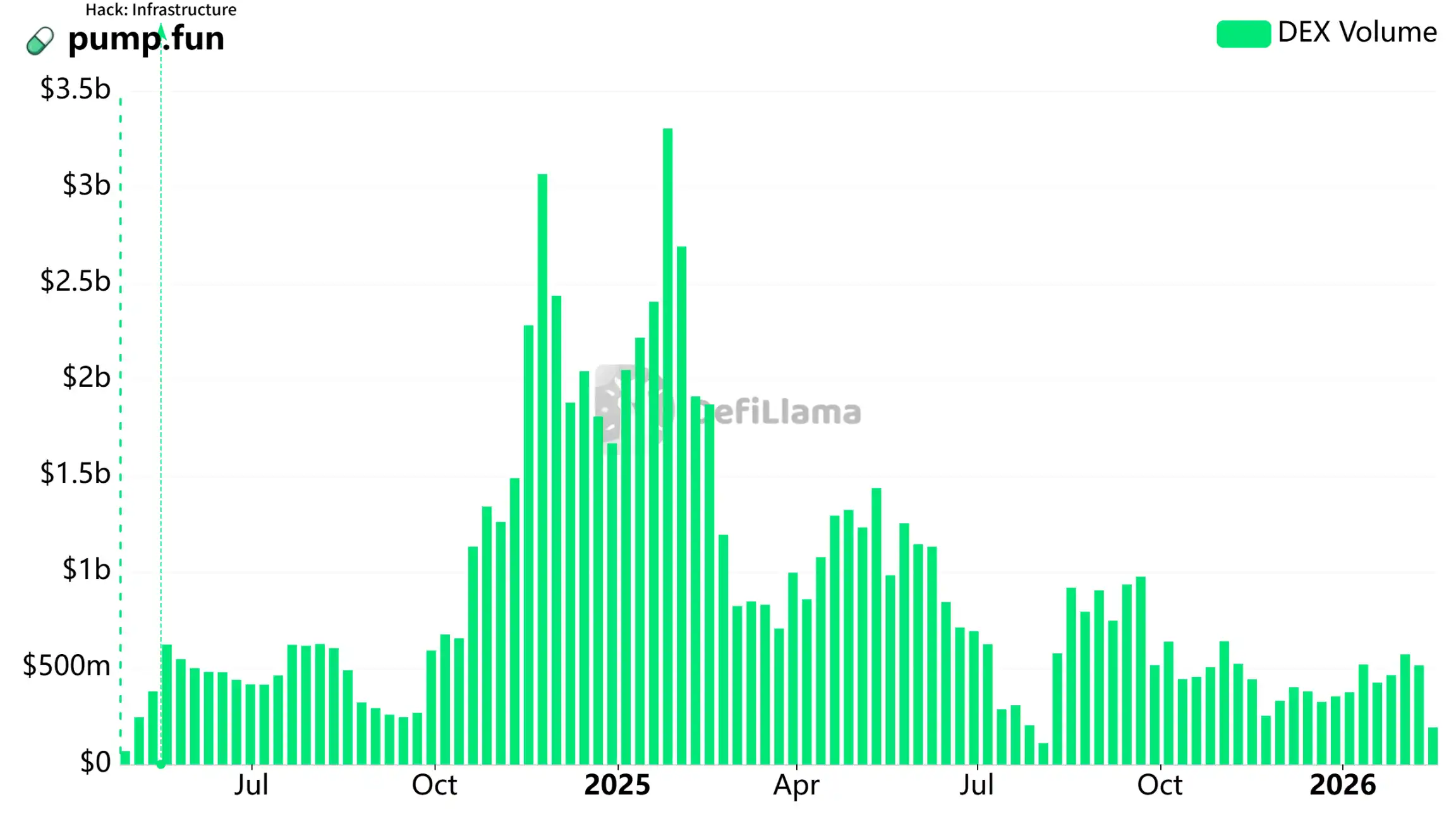
Defilama data shows that around the beginning of 2025, the trading volume of the Meme platform pump.fun reached a historical high. Weekly trading volume exceeded $3 billion twice, followed by a continuous decline. In early 2026, its trading volume hovered around $500 million, only one-sixth of its peak.

At the same time, some Meme traffic shifted to BNB Chain. BNB Chain rapidly rose through the Four.Meme platform. In the second half of 2025, Chinese-themed Memes like "Binance Life" and "I'm F*cking Coming" sparked FOMO sentiment. BNB Chain's Meme market cap grew from almost zero to hundreds of millions of dollars, with a 24-hour trading volume reaching $460 million. In comparison, although Solana's Meme market cap still amounts to billions of dollars, its growth has stagnated, with many projects falling over 95% from their peaks.

In October 2025, BNB Chain once replaced Solana on the trending Meme list, showing obvious capital rotation: when BNB Chain Memes surged, Solana's capital contracted; after BNB Chain receded, capital partially flowed back, but the momentum had weakened. Furthermore, under the influence of key figures like CZ/He Yi, BNB Chain saw short-term traction, while Solana's Pump.fun, despite its first-mover advantage, weakened due to narrative exhaustion and a lack of incremental funds.

The end of the Meme wave means that the demand for its public chain token has also decreased simultaneously.

Public Chain Narrative Cools

Additionally, the overall cooling of the public chain narrative has further weakened Solana's ecosystem expansion plans. Between 2025 and 2026, the crypto market retreated from early high leverage and excessive narrative expansion. Many weak narratives, such as celebrity tokens and the Meme craze, quickly faded, shifting focus to areas with more practicality and institutional support. Solana's narrative as a "high-speed public chain" once attracted developers, but as the market entered the "deep water of value," investors tended to prefer mainstream assets like Bitcoin and Ethereum for their "digital gold" or "settlement layer" positioning, leading to a continued overall bear market and intensified capital outflows from Solana.

This narrative fatigue reflects that public chain competition has shifted from pure TPS competition to ecosystem maturity and regulatory adaptability. Solana's previous TPS and ecosystem advantages have been diluted. Whether in terms of Memes or airdrop incentives, Solana's appeal to new users has weakened.

Meanwhile, the significant speed improvement of the Ethereum mainnet has also weakened Solana's core advantage. Through the Fusaka upgrade in 2025, Ethereum increased data blob capacity from 3 to 6-9 and introduced the PeerDAS mechanism, significantly reducing transaction fees and increasing throughput. Transaction volume and active addresses subsequently rebounded.
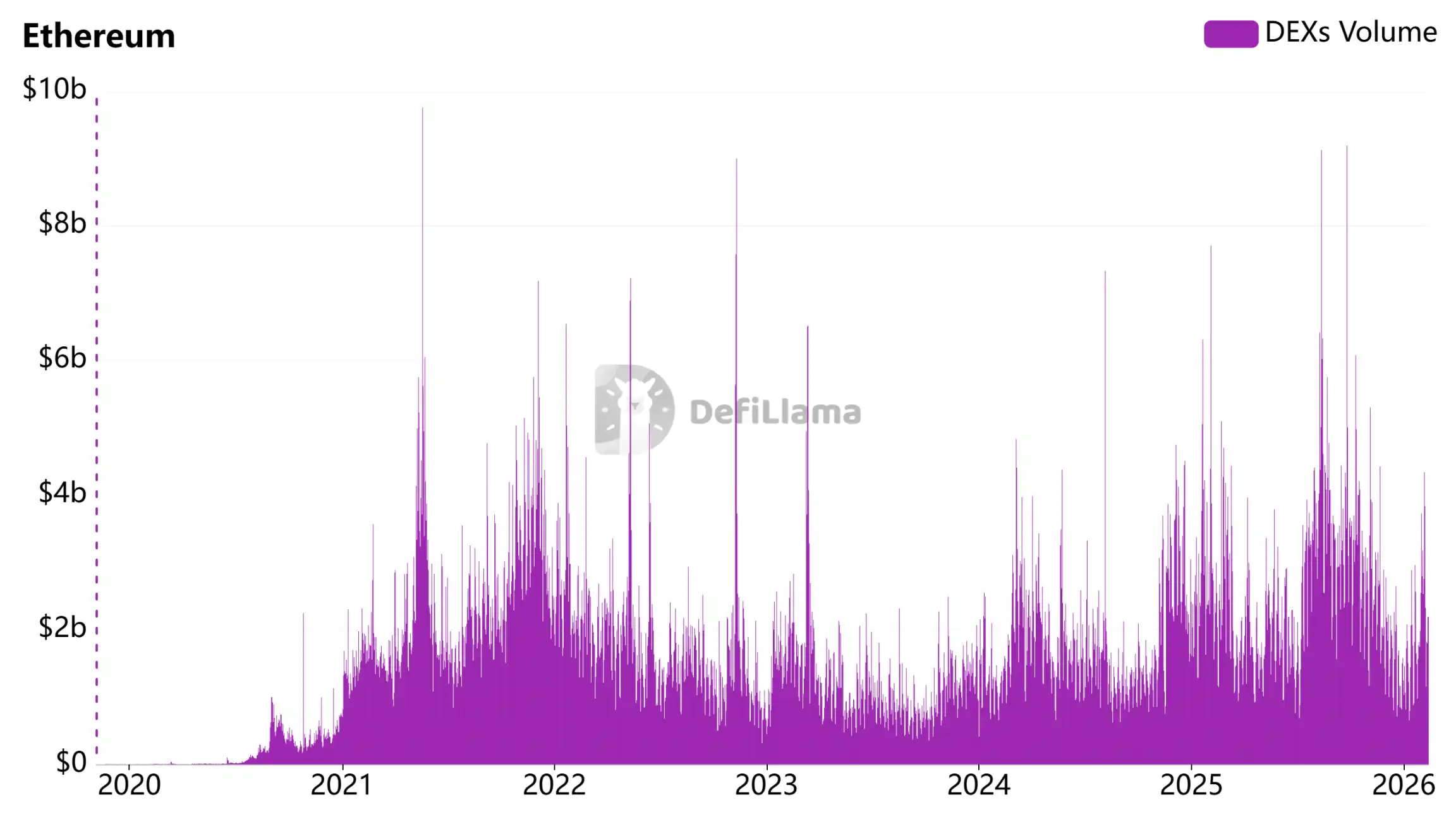
Data shows that DEX trading volume on Ethereum overall rose at the end of 2025. Entering 2026, the Glamsterdam upgrade will achieve near-perfect parallel processing, further accelerating block verification and reducing fees, bringing the mainnet closer to an "operating system" level. These improvements have brought Ethereum mainnet's TPS and cost close to Solana's levels, while retaining higher security and decentralization, reducing the necessity for users to switch to Solana.

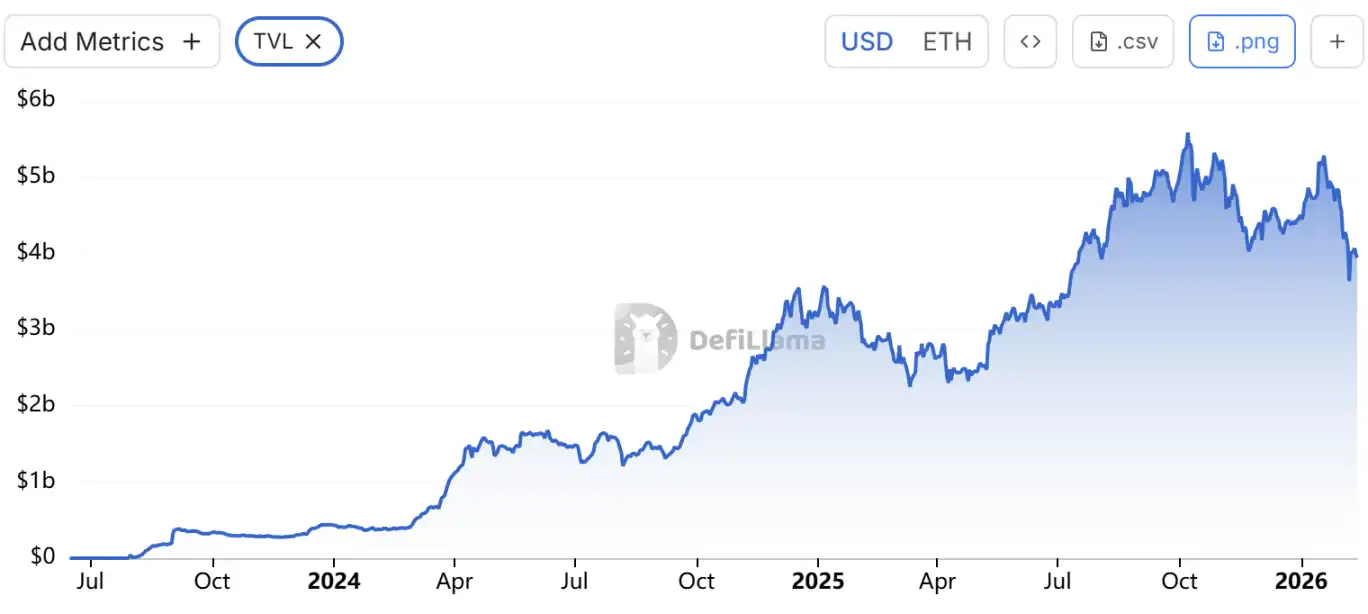
Another rising competitor, Base, is also growing rapidly, particularly attracting many users with AI tokens. According to DefiLlama data, its TVL is still maintained at a high level of $4 billion.
Under the tokenization热潮, RWA (Real World Assets) activities occur more on Ethereum, further marginalizing Solana's ecosystem. As of February 12, 2026, data from rwa.xyz shows that RWA assets on the Ethereum mainnet amount to $14.9 billion, while Solana has only $1.7 billion, still a significant gap. The tokenization trend of RWA emphasizes stability and compliance, and Ethereum's leading position makes it difficult for Solana to get a share.

Digital Asset Treasury Buyers Fail to Offset Overall Bearish Selling Pressure

From the perspective of Digital Asset Treasuries (DAT), in 2025, the DAT model was once popular. Many publicly traded companies like Forward Industries, Upexi, and Sharps Technology purchased large amounts of SOL as treasury assets through private financing or debt issuance.
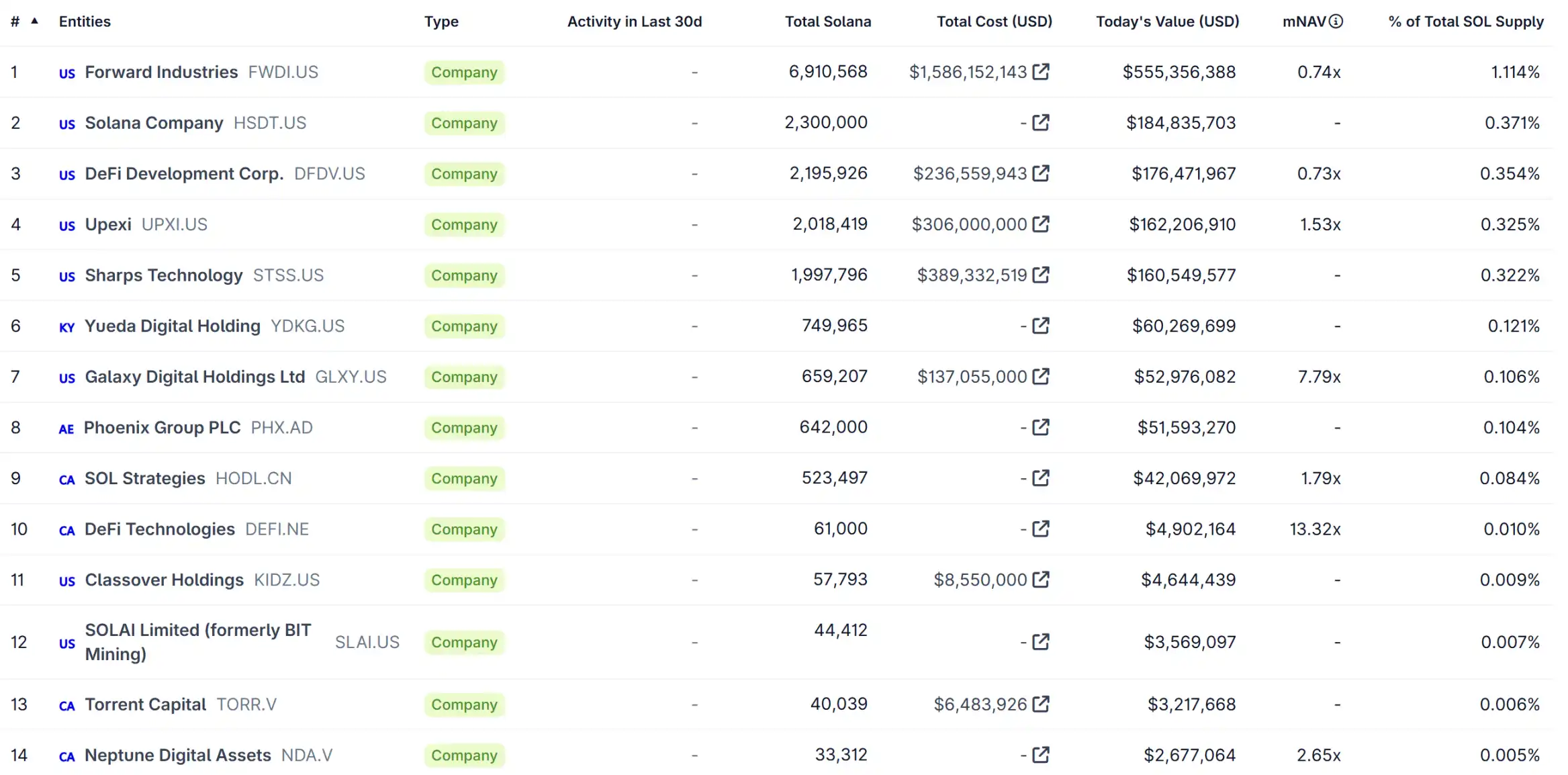
Entering 2026, as the price of SOL fell from its 2025 peak of around $200 to about $80, the market capitalization of these DAT companies shrank significantly. For example, Forward Industries spent $158 million to purchase SOL, now worth only $55.5 million, shaking the confidence of some investors.

Furthermore, the DAT purchasing热潮 has weakened, with fewer new companies joining. Although the early purchased locked SOL reduces circulating supply, it has failed to offset the overall bearish market pressure.

Bitcoin and Ethereum prices have also been severely hit in the bearish market of recent months. BTC fell from $126,000 to the current $67,000, and ETH dropped from $4,900 to the current $2,000.

In January 2026, Solana founder toly once asked on X in Chinese: What do you think is the biggest challenge for Solana now? The comments section received a variety of feedback and answers, including: no direct exchange, users have less perception of other product ecosystems besides Memes, etc.

Perhaps Solana will find its own solutions.

Трендові криптовалюти

Пов'язані питання

QWhat was the peak price of SOL during the recent bull market and what is its current price as mentioned in the article?

AThe peak price of SOL during the recent bull market was $295. Its current price is $80.

QAccording to the article, what was a major driver of Solana's activity that has now cooled down?

AThe major driver of Solana's activity that has now cooled down was the Meme coin frenzy, which was popularized by platforms like Pump.fun.

QWhich competing blockchain saw a rise in Meme activity, partially at the expense of Solana, according to the article?

ABNB Chain saw a rise in Meme activity, partially at the expense of Solana, through its platform Four.Meme.

QHow has Ethereum's recent upgrade, as described in the article, impacted its competitive position against Solana?

AEthereum's Fusaka upgrade increased data blob capacity and introduced PeerDAS, significantly reducing transaction fees and increasing throughput. The upcoming Glamsterdam upgrade will further improve parallel processing, making its TPS and cost competitive with Solana while offering higher security and decentralization.

QWhat is the significant difference in RWA (Real World Asset) tokenization value between Ethereum and Solana mentioned in the article?

AAs of February 12, 2026, the value of RWA assets on Ethereum was $149 billion, compared to only $17 billion on Solana, indicating a substantial gap.

Пов'язані матеріали

After Three Consecutive Quarters of Decline, Can the Crypto Market Find a Window for Stabilization in Q3?

The cryptocurrency market has just concluded its worst-performing quarter since 2022, with total capitalization dropping 12.6% to $2.1 trillion. All core metrics indicate capital is leaving the sector, not just rotating within it. Bitcoin fell 14.2% and Ethereum dropped 25.4% in Q2, breaking their previous correlation with US tech stocks. A key driver is the reversal in US spot Bitcoin ETF flows, which saw a net outflow of approximately $4.67 billion in Q2, including a record monthly outflow near $4.5 billion in June. While recent data suggests long-term holders are accumulating again, sustained ETF outflows mean continued selling pressure. Market focus is now singularly on the Federal Reserve. The upcoming July FOMC meeting is seen as the most critical event for Q3. A dovish signal could support Bitcoin reclaiming a $68,000-$84,000 range, while a hawkish stance might establish a new trading band around $50,000-$56,000. Additionally, regulatory uncertainty persists, with the progress of the crucial *CLARITY Act* stalling in the Senate, reducing its perceived 2026 passage probability to 40-45%. Despite the broad downturn, a few sectors showed growth. Prediction markets saw nominal volume surge 48.7% year-over-year to $113.8 billion, and tokenized collectibles transaction volume rose 143% quarterly to $1.4 billion. The Real-World Asset (RWA) tokenization sector also continued steady growth, now representing ~$28.1 billion in on-chain value. The market's foundation for an extreme crash appears limited, with Bitcoin price hovering near its 200-week moving average. However, the trading paradigm has shifted from narrative-driven speculation to decisions based on price action, policy developments, and interest rate expectations, making a broad sentiment-driven rally unlikely in the near term.

marsbit10 год тому

After Three Consecutive Quarters of Decline, Can the Crypto Market Find a Window for Stabilization in Q3?

marsbit10 год тому

BIT Trading Moment: BTC Still Suppressed by Weekly 200 EMA, Rejection May Restart Decline; Storage and Semiconductors that Surged Last Night Begin Falling in Evening Trading

**Crypto & Stock Market Wrap: Bitcoin Tests Resistance, Stocks Retreat After AI Surge** Bitcoin consolidates around $66,000, facing key resistance near $68,000—an area seen as a major psychological and technical hurdle where previous rallies have failed. Analysts note the cryptocurrency is caught between its 200-week moving average (~$63,333) and 200-week EMA (~$68,328). A clear break above $68k is needed to signal a stronger bullish trend, while a rejection could lead to a retest of $63k support. Market sentiment remains cautious, with low futures open interest pointing to a low-liquidity rebound rather than a full bull market. Bitcoin spot ETFs saw another $203 million inflow. US stock futures pointed lower after a strong Tuesday session led by a massive rebound in semiconductors and memory stocks. The rally was fueled by renewed optimism about AI-driven hardware demand, with Micron, SanDisk, and SK Hynix surging. However, those gains reversed in pre-market trading. Super Micro Computer (SMCI) soared over 20% after hours on strong guidance and a record backlog. Other standouts included Rocket Lab and nuclear energy plays Oklo and X-Energy. Rising oil prices (Brent above $91) and climbing Treasury yields (10-year near 4.64%), however, are reigniting inflation concerns and acting as a headwind for equities. In Asia, markets were mixed. South Korea's KOSPI pared early gains to close slightly higher as semiconductor stocks like SK Hynix gave back initial surges. Japan's Nikkei edged lower as the yen hit a fresh 38-year low against the dollar, raising fears of potential market intervention. Key events to watch include the Samsung Galaxy launch, AMD's AI event, and a slew of major tech earnings from Alphabet, Tesla, and IBM after the close on Wednesday, followed by the ECB meeting and Intel's earnings on Thursday.

marsbit10 год тому

BIT Trading Moment: BTC Still Suppressed by Weekly 200 EMA, Rejection May Restart Decline; Storage and Semiconductors that Surged Last Night Begin Falling in Evening Trading

marsbit10 год тому

Former CFTC Chairman, Circle President Tarbert: Preaching Long-Termism While Cashing Out $30 Million Himself

Former CFTC Chairman and Circle President Heath Tarbert has consistently advocated for a long-term vision in public, urging patience from investors as Circle’s stock price has fallen significantly from its peak. However, it has been revealed that since Circle’s IPO, Tarbert has continuously sold his CRCL shares through pre-arranged trading plans, cashing out approximately $30 million, without making any public market purchases. This contrast between his public messaging and personal actions has drawn criticism. Tarbert joined Circle in July 2023 as Chief Legal Officer, leveraging his regulatory experience to help guide the company through its IPO and expansion. Despite promoting stablecoins as long-term infrastructure, he established a 10b5-1 trading plan just before Circle went public, leading to substantial stock sales over the following year. In March 2026, he initiated another plan to sell more shares. His career trajectory highlights a pattern of moving between high-level regulatory roles and influential positions in the financial sector. After resigning as CFTC Chairman in early 2021, he joined Citadel Securities as Chief Legal Officer just 27 days later, during a period of intense regulatory scrutiny for the firm. He later joined Circle, aiding its efforts to navigate regulatory challenges for its public listing. While Tarbert's expertise in policy and compliance is valuable to companies like Circle, his actions—advocating long-term confidence while personally divesting—raise questions about the alignment between his public statements and his private financial decisions, leaving investors who followed his advice to bear the market risks.

marsbit11 год тому

Former CFTC Chairman, Circle President Tarbert: Preaching Long-Termism While Cashing Out $30 Million Himself

marsbit11 год тому

Gate Research Institute: The 'Wall Street-ization' Wave of Crypto Financial Products – Competition or Integration?

The article titled "Gate Research Institute: Are Crypto Financial Products Sparking a 'Wall Street' Wave—Competition or Convergence?" explores the evolving relationship between the crypto ecosystem and traditional finance (TradFi). The piece begins by reflecting on Bitcoin's original 2009 vision of decentralization, disintermediation, and moving away from banks. It then contrasts this with the 2024 landscape, where key crypto assets like Bitcoin are increasingly held through Wall Street products like ETFs issued by giants like BlackRock. The article questions whether this signifies that TradFi is systematically taking over the rights to issue, price, custody, and distribute crypto financial assets. The core argument is that this is not a zero-sum takeover but rather a bidirectional convergence where each side addresses the other's weaknesses. Crypto offers 24/7 global markets, programmable settlement, and open access but lacks compliant channels, institutional-grade custody, deep fiat liquidity, and mainstream distribution. TradFi possesses these but is constrained by legacy systems, limited operating hours, and slow settlement. Two primary convergence paths are highlighted: * **Path A (CEX to TradFi):** Exemplified by Gate, which has progressed from offering tokenized stocks and CFDs to providing direct, real stock trading (US, Hong Kong, South Korea) within its platform, using USDT. * **Path B (TradFi to Crypto):** Exemplified by Robinhood, which has integrated crypto trading, acquired exchanges like Bitstamp, and is moving traditional assets like stocks onto the blockchain via tokenization and its own Layer 2. Both paths are ultimately competing to become the next-generation, unified financial account—a "super account" where users can seamlessly trade cryptocurrencies, stocks, ETFs, RWA (Real World Assets), and tokenized treasury products in one interface. The growth of RWA and tokenized treasuries (e.g., BlackRock's BUIDL) is presented as the asset-layer fusion, providing stable, yield-bearing assets on-chain and acting as a bridge between the two worlds. In conclusion, the "Wall Street-ization" of crypto is framed as a mutual transformation. Decentralized ideals persist in the protocol layer, while at the application layer, a more efficient, global, and accessible unified capital market is emerging from this convergence. The future competition lies not between crypto exchanges and stockbrokers, but between platforms vying to offer the most comprehensive asset coverage, liquidity, and user experience within a single account.

marsbit11 год тому

Gate Research Institute: The 'Wall Street-ization' Wave of Crypto Financial Products – Competition or Integration?

marsbit11 год тому

Торгівля

Спот

Популярні статті

Що таке MEME 2.0

Memecoin 2.0: Поява $MEME 2.0 у світі криптовалюти Вступ У постійно змінному ландшафті криптовалюти з'явився новий претендент. Memecoin 2.0, що символізується як $MEME 2.0, підносить концепцію мем-криптовалют на захоплюючий новий рівень. Як побічний продукт оригінального Memecoin, цей проєкт привернув увагу крипто-спільноти, змістивши акцент з типової фінансової вигоди на захоплюючий і розважальний досвід. Працюючи на блокчейні Ethereum, Memecoin 2.0 сміливо переосмислює залучення спільноти у криптосфері. Що таке Memecoin 2.0, $MEME 2.0? У своїй основі, Memecoin 2.0 є криптовалютним проєктом, який надає пріоритет спільнотному духу і розвагам, пов'язаним з мем-культурою. На відміну від звичайних криптовалют, які зосереджені на практичних випадках використання та матеріальних вигодах, Memecoin 2.0 вирізняється тим, що обіймає легшу сторону цифрової валюти. Цей проєкт існує без обіцянок утиліти, структурованої дорожньої карти чи фінансових повернень, зосереджуючи увагу на створенні яскравої спільноти навколо мемів та спільних розваг. Зробивши це, він використовує зростаючу тенденцію мем-культури у онлайн-пробі, що робить його унікальним гравцем у світі цифрових активів. Творець Memecoin 2.0, $MEME 2.0 Не зважаючи на численні дослідження витоків Memecoin 2.0, чітка особистість його творця залишається невідомою. Ця анонімність не є рідкістю у крипто-спільноті, де багато проєктів очолюються особами або групами, які надають перевагу залишатися за лаштунками. Відсутність публічно доступної інформації про творця може розглядатися як стратегічний крок, що ставить в центр уваги залучення спільноти, а не індивідуальної популярності у цій сфері. Інвестори Memecoin 2.0, $MEME 2.0 Інформації щодо інвесторів або фінансової підтримки Memecoin 2.0 замало. Відсутність деталей може свідчити про те, що проєкт є самофінансованим або що його увага до спільноти, а не традиційних інвестиційних структур, привабила інший тип підтримки. Оскільки світ мем-криптовалют зазвичай передбачає більше участі низового рівня, а не інституційних інвестицій, цей підхід узгоджується з етосом проєктів, що управляються спільнотою. Як працює Memecoin 2.0, $MEME 2.0? Memecoin 2.0 повністю працює на блокчейні Ethereum, використовуючи його потужні функції безпеки та масштабованості. Використовуючи сильні сторони Ethereum, Memecoin 2.0 може запропонувати безпечне середовище для взаємодії користувачів, забезпечуючи при цьому, що транзакції є ефективними та економічними. Одна з унікальних характеристик Memecoin 2.0 полягає в його структурі, що керується спільнотою. Цінність та популярність токена $MEME 2.0 походять з активної участі його користувачів, а не з вродженої утиліти. Ця концепція підкреслює акцент проєкту на розважальному аспекті криптовалюти, натякаючи на те, що сміх та залучення спільноти є справжніми валютами, що ведуть до його успіху. Крім того, проєкт вписується в ширшу екосистему мем-криптовалют, де цінність кожної мем-криптовалюти коливається залежно від культури, тенденцій і участі спільноти, а не традиційних економічних принципів. Хронологія Memecoin 2.0, $MEME 2.0 Щоб краще зрозуміти еволюцію та віхи Memecoin 2.0, ось хронологія, що підкреслює значні події в його історії: 2024: Зародження Memecoin 2.0 вважається відгалуженням оригінального Memecoin, яке встановлює себе в процвітаючому контексті мем-криптовалют, працюючи на блокчейні Ethereum. 13 липня 2024: Memecoin 2.0 офіційно позиціонує себе як мем-криптовалюта, орієнтована на спільноту, в мережі Ethereum, підкреслюючи свій підхід, зосереджений на розвагах, який запрошує користувачів брати участь у його розвитку. Ключові моменти про Memecoin 2.0, $MEME 2.0 Кілька критичних характеристик визначають Memecoin 2.0: Спільнотно-центричний підхід: Основною метою Memecoin 2.0 є створення веселого, захоплюючого досвіду для спільноти, використовуючи колективне задоволення, що випливає з меметичної культури. Побудовано на Ethereum: Робота на блокчейні Ethereum надає проєкту важливу інфраструктуру, що забезпечує безпеку та масштабованість. Відсутність утиліти або дорожньої карти: У вражаючому відході від традиційних криптовалют, Memecoin 2.0 не обіцяє жодних утилітарних функцій або фінансових повернень, підтверджуючи свою прихильність до участі спільноти та соціального залучення. Акцент на меметичній культурі: Обіймаючи гумористичні та культурні аспекти мем-періоду, Memecoin 2.0 надає платформу для користувачів для залучення до крипти офлайн та онлайн. Додатковий контекст: Значення мем-криптовалют Мем-криптовалюти з'явилися як окрема класифікація криптовалюти, часто керуючись гумором та легким підходом до торгівлі. Ці валюти, як правило, не мають значної утиліти або розробницьких дорожніх карт, залучаючи користувачів обіцянкою розваг, взаємодії в спільноті та культурної значущості. В рамках ширшої екосистеми криптовалют, мем-криптовалюти відновлюють важливість залучення спільноти, протистоячи лише прибутковим підходам. Проєкти, такі як Memecoin 2.0, відкривають еру, в якій розваги можуть гармонізувати з фінансовими прагненнями, перетворюючи блокчейн на ігровий майданчик для творчості та соціальної взаємодії. Висновок Memecoin 2.0, або $MEME 2.0, втілює нову хвилю криптовалюти, яка надає пріоритет залученню спільноти над жорсткими фінансовими структурами. Зосереджуючись на гуморі та соціальній взаємодії, він використовує захоплення навколо мем-культури. Працюючи на блокчейні Ethereum, Memecoin 2.0 використовує можливості технології, залишаючись непохитним у своїй прихильності до розважальної цінності цифрової валюти. Коли простір навколо криптовалют продовжує еволюціонувати, Memecoin 2.0 служить доказом того, що майбутнє цифрових активів може значною мірою залежати від спільних досвідів, сміху та надійних зв'язків у спільноті. У непередбачуваному світі крипто, можливо, радість може бути такою ж цінною, як і традиційний фінансовий прибуток.

151 переглядів усьогоОпубліковано 2024.04.04Оновлено 2024.12.03

Що таке MEME 2.0

Як купити MEME

Ласкаво просимо до HTX.com! Ми зробили покупку Memeland (MEME) простою та зручною. Дотримуйтесь нашої покрокової інструкції, щоб розпочати свою криптовалютну подорож.Крок 1: Створіть обліковий запис на HTXВикористовуйте свою електронну пошту або номер телефону, щоб зареєструвати обліковий запис на HTX безплатно. Пройдіть безпроблемну реєстрацію й отримайте доступ до всіх функцій.ЗареєструватисьКрок 2: Перейдіть до розділу Купити крипту і виберіть спосіб оплатиКредитна/дебетова картка: використовуйте вашу картку Visa або Mastercard, щоб миттєво купити Memeland (MEME).Баланс: використовуйте кошти з балансу вашого рахунку HTX для безперешкодної торгівлі.Треті особи: ми додали популярні способи оплати, такі як Google Pay та Apple Pay, щоб підвищити зручність.P2P: Торгуйте безпосередньо з іншими користувачами на HTX.Позабіржова торгівля (OTC): ми пропонуємо індивідуальні послуги та конкурентні обмінні курси для трейдерів.Крок 3: Зберігайте свої Memeland (MEME)Після придбання Memeland (MEME) збережіть його у своєму обліковому записі на HTX. Крім того, ви можете відправити його в інше місце за допомогою блокчейн-переказу або використовувати його для торгівлі іншими криптовалютами.Крок 4: Торгівля Memeland (MEME)Легко торгуйте Memeland (MEME) на спотовому ринку HTX. Просто увійдіть до свого облікового запису, виберіть торгову пару, укладайте угоди та спостерігайте за ними в режимі реального часу. Ми пропонуємо зручний досвід як для початківців, так і для досвідчених трейдерів.

367 переглядів усьогоОпубліковано 2024.12.12Оновлено 2026.06.02

Як купити MEME

Обговорення

Ласкаво просимо до спільноти HTX. Тут ви можете бути в курсі останніх подій розвитку платформи та отримати доступ до професійної ринкової інформації. Нижче представлені думки користувачів щодо ціни MEME (MEME).

活动图片














