Mechanism Capital Founder: Excessive Worry About Bubbles Is Foolish

marsbitОпубліковано о 2026-02-11Востаннє оновлено о 2026-02-11

Анотація

Mechanism Capital founder Andrew Kang argues that excessive worry about market bubbles is misguided in the current technological landscape. He emphasizes that we are at a uniquely asymmetric moment in history, driven by exponential advancements in AI, robotics, energy, and other innovative fields. Short-term volatility and corrections are noise compared to the long-term transformative potential of these technologies. Kang predicts a near-future "singularity" with billions of AI agents, humanoid robots, space data centers, multi-planetary colonization, and revolutionary medical therapies. He states that the technological progress and economic growth compressed into the next 20 years will surpass the entirety of human history. Companies leveraging AI are already seeing order-of-magnitude improvements in productivity. Traditional valuation models are inadequate for pricing this unprecedented growth, which could reach "20-sigma" levels in historical statistical terms. The wealth creation will be extreme, and those without exposure will find it difficult to enter the market later. Kang advises adopting a long-term, exponential mindset and avoiding short-term trading, as the potential upside represents the largest asymmetric opportunity in history.

Original Author:Andrew Kang, Founder of Mechanism Capital

Compiled by: Ken, Chaincatcher

For those who have experienced at least one full market cycle, you develop an instinct to be wary of price increases that far exceed historical growth rates. Witnessing the dot-com bubble, the 2008 global financial crisis, and the rise and fall of cryptocurrencies sets off pattern recognition alarms in your brain. You are afraid to enter the market because prices are too high, and you want to sell your assets for fear of being at a peak.

But it is important to recognize that we are in one of the most profound and unique asymmetric moments in history. The only move right now is to extend your time horizon and completely abandon short-termism.

Excessive worry about bubbles is foolish. Trying to time the market is also foolish. Short-term fluctuations and corrections will always happen, but given how close we are to the "singularity," these fluctuations are completely just noise. Artificial intelligence, robotics, energy, and innovation are about to experience runaway explosive growth.

Within the next decade, we will have billions (or more) of AI agent workforces, humanoid robots, space data centers, multi-planetary colonization, and significantly improved medical therapies; we will fundamentally change the development pace and output of technological breakthroughs in all fields. The technological progress and economic growth we compress into the next twenty years will exceed the sum total of all human civilization history.

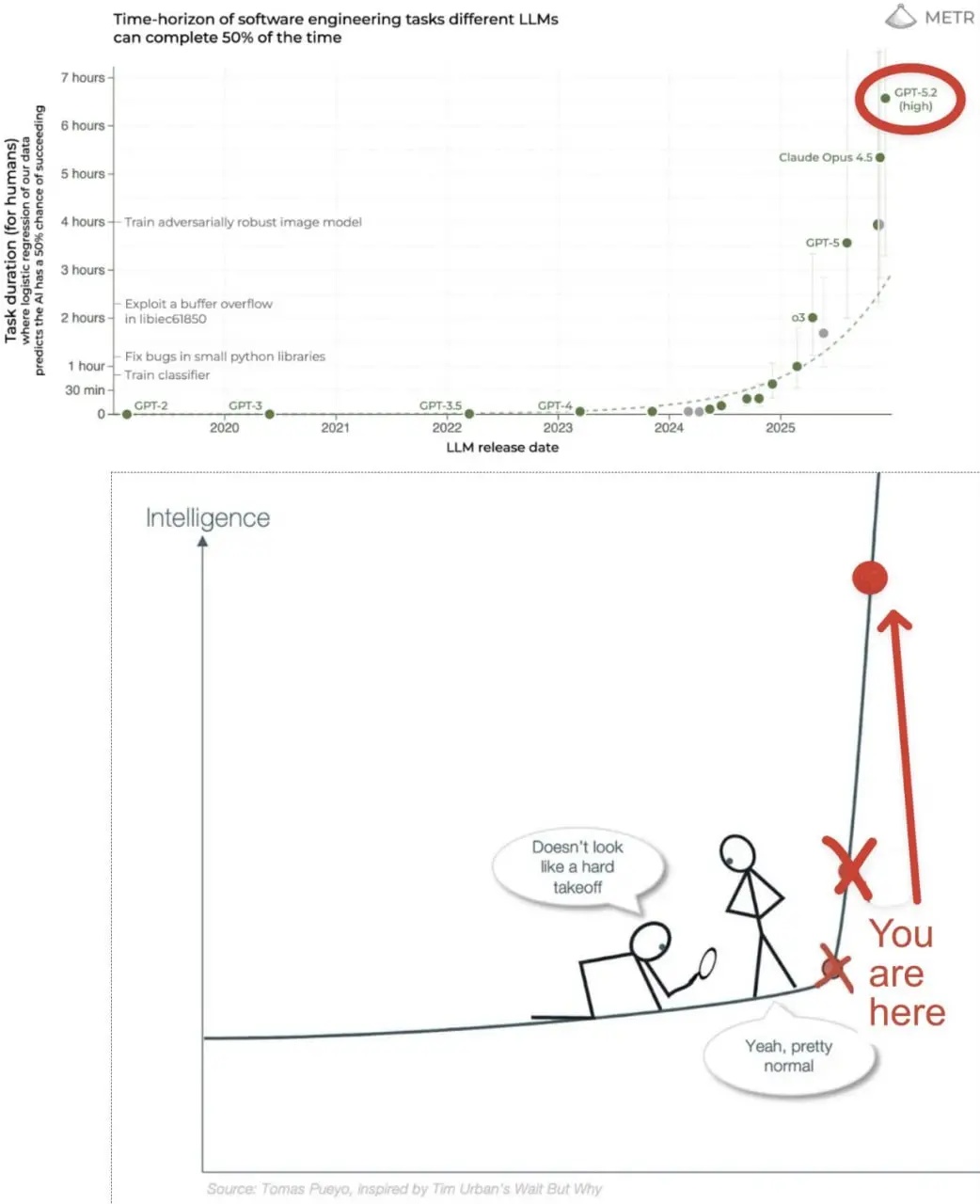
We are already in an extremely steep phase of the J-curve, but this is hard to perceive when we zoom in to the micro level of daily or weekly views. 100% of Anthropic's product code is now written by Claude. Product managers have a virtual team of software engineers, so efficient it's as if they can change time. The improvement in product iteration speed for companies that efficiently utilize AI is not single-digit, not double-digit, but triple-digit.

Moreover, the capabilities of these tools are still evolving at an even faster rate. Whether we officially achieve Artificial Superintelligence (ASI) in 2027 or 2029 doesn't really matter. It will happen. By the time it's officially announced, the assets you want to own will have already multiplied in price.

It is highly likely that the actual economic growth over the next 3-10 years will be on the order of 20 standard deviations (20-sigma) in any historical distribution model. This growth, once considered almost impossible, will be driven by unprecedented second and third-order changes. Traditional valuation models cannot price these transformations. The potential upside is so vast that traditional present value calculations struggle to capture them.

The speed of wealth appreciation will be staggering, much like how cryptocurrencies initially created numerous billionaires and millionaires in a short time, but the magnitude this time will be far more extreme. If you have no exposure, it will be difficult to pull the trigger and buy into such vertically rising asset prices; but unlike previous bubbles, the creation of real economic value will better keep pace with the vertical rise in asset prices. Over the past three years, those operating in the market with the cognition of an "exponential perspective" have reaped significant rewards. If you haven't adopted this perspective yet, it's not too late.

While it's important to always be mindful of downside risk, this is the largest upside risk in world history. Learn to bear risk over longer time horizons. Now is not the time for swing trading. For the vast majority of people, long-term investing typically outperforms short-term trading, but the gap in expected value between "trading" and "investing" will be wider than ever before. Ask yourself, what is the value of the call option embedded in the singularity?
Пов'язані питання

QAccording to Andrew Kang, why is it foolish to be overly concerned about market bubbles in the current economic climate?

AHe believes we are at a profoundly unique asymmetric moment in history, where the potential upside from technological advancements like AI, robotics, and energy innovation is so immense that short-term volatility and bubbles are merely noise. The focus should be on long-term growth rather than short-term fluctuations.

QWhat does Andrew Kang predict will be achieved in the next decade in terms of technological progress?

AHe predicts that in the next decade, we will have billions of AI agent workers, humanoid robots, space data centers, multi-planetary colonization, and significantly improved medical therapies. The technological progress and economic growth compressed into the next 20 years will exceed the sum of all human civilization history.

QHow does Andrew Kang describe the current stage of the J-curve in technological development?

AHe describes the current stage of the J-curve as extremely steep, though it is hard to perceive at a daily or weekly micro-level. Companies effectively using AI are seeing product iteration speed improvements not in single or double digits, but in triple digits.

QWhat does Andrew Kang suggest about the timing of achieving Artificial Superintelligence (ASI) and its impact on asset prices?

AHe suggests that whether ASI is achieved in 2027 or 2029 is not important because it is inevitable. By the time it is officially announced, the prices of assets one would want to own will have already increased manifold.

QAccording to the article, why might traditional valuation models fail in the current economic transformation?

ATraditional valuation models are unable to price the unprecedented second and third-order changes driven by technologies like AI. The potential upside is so vast that traditional present value calculations struggle to capture them, making historical distribution models irrelevant for predicting future growth.

Пов'язані матеріали

Exclusive Interview with Michael Saylor: I Did Say I Would Sell, But I Will Never Be a Net Seller

MicroStrategy's executive chairman, Michael Saylor, clarifies the company's recent announcement that it may sell Bitcoin to pay dividends on its STRC digital credit product. He emphasizes this does not make MicroStrategy a net seller of Bitcoin. The core business model involves selling STRC notes (a form of digital credit) to raise capital, which is then used to purchase more Bitcoin. Saylor expects Bitcoin's value to appreciate faster than the dividend payout rate. Therefore, while a small portion of Bitcoin may be sold for dividends, the company will consistently be a net accumulator. For example, in April, the company raised $3.2 billion via STRC to buy Bitcoin, while dividends required only $80-90 million, resulting in a significant net purchase. Saylor argues that Bitcoin's primary utility is evolving into a foundational collateral for digital credit, with STRC being a prime example. He notes that STRC now constitutes a majority of the U.S. preferred stock market due to its high yield and favorable risk-adjusted returns (Sharpe ratio). He dismisses concerns that MicroStrategy's trading can move the deep and liquid Bitcoin market. Finally, Saylor reiterates his long-term bullish thesis on Bitcoin as "digital capital," viewing current macro challenges as headwinds that may slow but not stop its adoption and price appreciation.

Odaily星球日报7 хв тому

Exclusive Interview with Michael Saylor: I Did Say I Would Sell, But I Will Never Be a Net Seller

Odaily星球日报7 хв тому

Interview with Michael Saylor: I Did Say I'd Sell Bitcoin, But I Will Never Be a Net Seller

**Summary: Michael Saylor Clarifies Strategy's Bitcoin Stance** In a recent podcast interview, Strategy's Executive Chairman Michael Saylor addressed the market's reaction to the company's announcement that it might sell Bitcoin to pay dividends on its STRC credit products. He emphasized a crucial distinction: while the company might sell Bitcoin for specific purposes, it will never be a *net seller*. Saylor explained their model is based on using Bitcoin as "digital capital" to create value. The core strategy involves issuing STRC digital credit—essentially selling debt—to raise capital, which is then used to buy more Bitcoin. He estimates Bitcoin appreciates at roughly 40% annually. A small portion of these capital gains (e.g., ~2.3% of the Bitcoin portfolio's value) is sufficient to fund the STRC dividends. Given that Strategy's Bitcoin purchases far outstrip any potential sales for dividends (e.g., buying $3.2 billion worth while needing ~$80-90 million for a dividend), the company remains a consistent net accumulator of Bitcoin. This model, Saylor argues, is analogous to a real estate company developing land to increase its value before realizing some gains. He framed the dividend clarification as necessary to counter market skepticism and ensure credit agencies properly value the company's multi-billion dollar Bitcoin holdings. Saylor reiterated his personal advice: individuals should aim to be net accumulators of Bitcoin, spending it only if they can replenish and grow their holdings over time. Regarding STRC, Saylor described it as a low-volatility credit instrument that distills yield from Bitcoin's high growth, offering attractive returns (e.g., ~11-12% yield) for risk-averse investors. He noted that Strategy's STRC issuance now constitutes about 60% of the U.S. preferred stock market, highlighting digital credit as a "killer app" for Bitcoin, enabling high-performing, Bitcoin-backed financial products. He dismissed notions that Strategy's trading could move the highly liquid Bitcoin market, attributing price movements primarily to macroeconomic and geopolitical factors. Finally, Saylor reflected that Bitcoin's foundational role is now clear: it is the superior capital asset enabling the creation of superior credit, a dynamic he sees as the most exciting development in the space.

marsbit14 хв тому

Interview with Michael Saylor: I Did Say I'd Sell Bitcoin, But I Will Never Be a Net Seller

marsbit14 хв тому

380,000 Apps Exposed, 2,000+ Apps Leaked Secrets: AI Programming Turns 'Intranet' into Public Internet

Israeli cybersecurity firm RedAccess uncovered a severe data exposure trend linked to "vibe coding" or AI-powered software development tools. Their research found approximately 38,000 publicly accessible web applications built with platforms like Lovable, Base44, Netlify, and Replit. Of these, an estimated 2,000 apps exposed sensitive corporate and personal data, including medical records, financial information, internal strategic documents, and customer chat logs. In some cases, access even granted administrative privileges. The core issue stems from default privacy settings that make applications public by default, combined with a lack of built-in security controls (like authentication) in the AI-generated code. This allows employees without security expertise—"citizen developers"—to easily create and deploy applications that bypass standard corporate security reviews. The exposed apps, often indexed by search engines, are trivially discoverable. While some platform providers (Replit, Lovable, Wix/Base44) argue that security configuration is the user's responsibility and question the validity of some findings, security researchers confirm the widespread reality of such exposures. This pattern, also noted in prior studies, highlights a critical security gap as AI democratizes app creation, potentially leading to massive, unintentional data leaks.

marsbit1 год тому

380,000 Apps Exposed, 2,000+ Apps Leaked Secrets: AI Programming Turns 'Intranet' into Public Internet

marsbit1 год тому

Attracting Global Capital, Asia's New 'Super Cycle' Is Unfolding

Investors are turning to Asia as the next frontier for global equity growth, with a new "super cycle" unfolding across the region. Driven by the AI revolution, Asian markets, particularly South Korea, have seen significant rallies. According to Morgan Stanley analysis, the underlying drivers of Asia's industrial cycle are shifting from traditional sectors like real estate and manufacturing to massive investments in AI infrastructure, energy security and transition, and supply chain resilience. Fixed asset investment in Asia is projected to grow from around $11 trillion in 2025 to $16 trillion by 2030, with a 7% annual growth rate from 2026-2030. The AI wave is a primary catalyst, driving immense capital expenditure for chips, servers, data centers, and power systems. Asia is central to this hardware supply chain. In China, AI investment is focused on building a full-system domestic capability, with the local AI chip market potentially reaching $86 billion by 2030. Beyond AI, China's export story is expanding from EVs and batteries to robotics. The country already captures about half of new global industrial robot demand and over 90% of humanoid robot shipments. This growth phase mirrors the early stages of China's EV export boom. Simultaneously, energy security investments, spurred by AI's massive power needs, are rising, with China benefiting from its leadership in solar, batteries, and EVs. Regional defense spending is also increasing structurally, supporting demand for advanced manufacturing. The main beneficiaries are China, South Korea, and Japan, positioned in core supply chain areas. However, risks remain, including potential overcapacity, profit margin pressures from competition, persistent technological restrictions, geopolitical friction, and workforce displacement due to AI-driven automation. Market volatility is also expected to increase as investor expectations diverge on the realization of these capital investment and export themes.

marsbit1 год тому

Attracting Global Capital, Asia's New 'Super Cycle' Is Unfolding

marsbit1 год тому

Торгівля

Спот
Ф'ючерси
活动图片